

 Apple Podcasts

 Spotify

 Youtube Music

 RSS Feed
 YouTube
 Pandora
 iHeartRadio
You Wont Believe His Story Until You Hear It. Master of Wine Tim Hanni
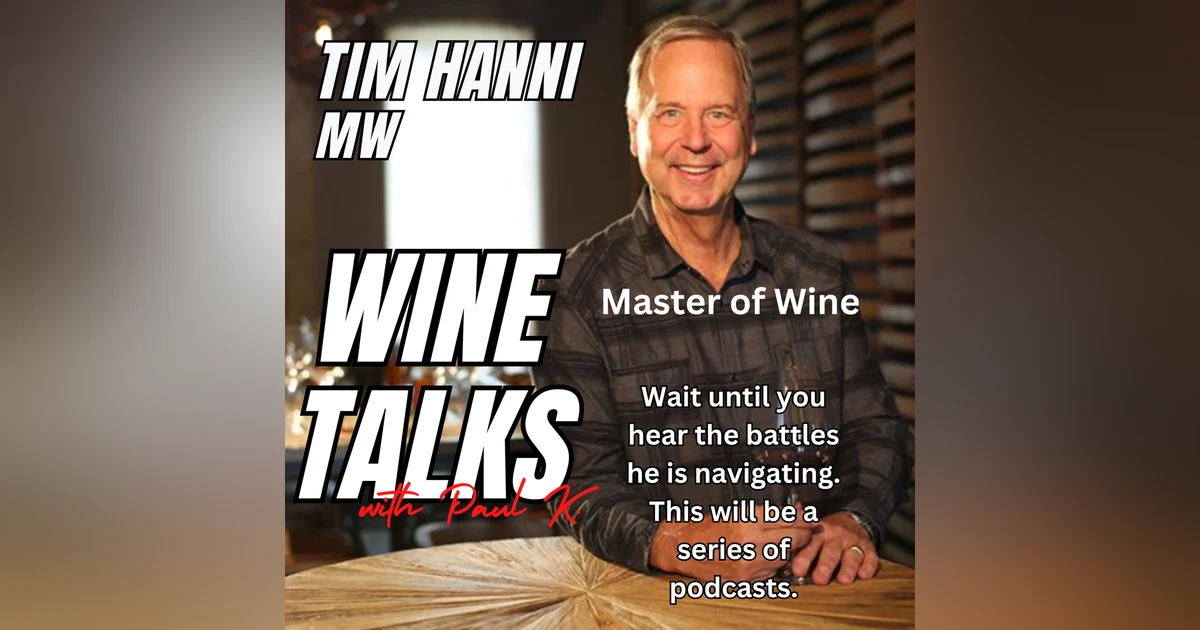

What I didn't expect when we first logged into Riverside.fm for the podcast...was his opening remarks. "I am a bit bi-polar, dyslexic, a recovering alcoholic, and diagnosed with ADHD." and my response was "Is that it?" Then that turned into what I...
What I didn't expect when we first logged into Riverside.fm for the podcast...was his opening remarks.
"I am a bit bi-polar, dyslexic, a recovering alcoholic, and diagnosed with ADHD." and my response was "Is that it?"
Then that turned into what I expect to be a series of episodes because forty-five minutes just ain't enough time.
In this engaging episode of "Wine Talks," I sit with Tim Hanni, a Master of Wine, to delve into the fascinating world of wine. Tim reveals historical insights, such as the original negative meaning of "terroir," and explains how wine education often overlooks the diverse perceptions and preferences of consumers. Tim shares his unconventional path to becoming a Master of Wine, highlighting his personal challenges with dyslexia and alcoholism. The conversation shifts to address the wine industry's failure to adapt to modern consumers, emphasizing the need for a deeper understanding of sensory individualism and adaptive marketing strategies. Tim critiques the industry's elitism and disconnect from wine’s rich history, pointing out that even acclaimed wines like those from Bordeaux were traditionally sweet. This episode is a thought-provoking critique of the wine world, stressing the importance of embracing diversity in wine perceptions and learning.
-
The term "terroir" originally had a negative connotation, referring to "soiled wine" which was of poor quality, much like soiled diapers.
-
Tim Hanni, the guest of the podcast, is a Master of Wine who became one of the first two Americans to earn this prestigious title, despite having dyslexia, ADHD, and being a recovering alcoholic.
-
Master Sommelier and Master of Wine programs differ substantially, with the latter focusing more on the business and science aspects of wine rather than purely service.
-
Historically, French champagne was incredibly sweet, sometimes even sweeter than Coca Cola, challenging modern perceptions of what "fine" wine should be.
Have at it folks...this really is some crazy stuff.
0:00 And consider that's where the wine industry is right now. You're too stupid to know what you like. You've got to learn this special language. You've got to learn this word terroir from experts who don't even know the etymology of the word and that it used to be not from the dirt. Terroir had nothing to do with the soil. It was soiled wine, like soiled diapers. It was the worst levels of Britanna Mices that the wine smelled and tasted like crap. Sit back and grab a glass. It's Wine Talks with Paul K. Hey, welcome to Wine Talks with Paul Kay. And we are in studio today in a little bit of a rainy day here in Southern California, about to have a conversation with Tim Hani, Master of Wine. Introductions in just a moment. Have a listen to my new podcast coming out in a week or two, which is called Song of America, which celebrates the life of George Mardiqui and the famed restaurateur from the 50s and 60s and his book called Song of America. Its stories of immigration to America, political, social or financial success in landing here. But now while we're here, here to have a conversation with Tim Hanai. Welcome to the show, Mr. Hannah. Thank you very much, Paul. Great to be here. Good to see you again. This is Master of Wine, wine educator. And we were just chatting a little bit off camera about with a, the variety of, of the personality traits that he has and how he got
1:30 here into this crazy industry. But you, you said you're bit bipolar, ADHD and a little bit like dyslexic and dyslexic. Yeah, yeah, that's all I was. I was the kid. No, no teacher ever wanted in their classroom all through my educational. But that's, you know, that's interesting because the Master of Wine is a tough road. I mean and you're the second, I think American to pass the test. And it takes like at least what, a minimum of five years to get that degree? Well, Joel Butler and I were the passive the same year, so he and I were the first. And so what was the minimum time frame you would say? For some it's a bit of a.
2:12 Longer conversation, but it actually fits into the thread. I was accepted into the program and first sat the Master of wine exam in 1989. Wow. And they had just in 1988 changed the areas of the examination about the wine trade and wine business that prior to 1988 had been you. You virtually had to work in the UK wine trade to pass the exam. Very specific. Things on bonds and oh really? Wow. Trade elements. In 1988, Michael Hillsmith from Australia became the first non UK resident to, to pass the exam. And so I read in the Wine Spectator they were opening this up to international candidates as we were, as we were got deemed. And so I, I had to send in a, a, a thesis, winemaking science or art? And I said yes. And they said great, come sit the exam. And, and I, and there was a blind tasting also. So in 1989 there were six Americans, one of which Patrick Fagan, who passed away a number of years ago from Chicago, had actually taken it in 1988. But
3:42 in, in 1999 or 89, Joel Butler and Mary Mulligan and Harriet Lembeck and a bunch, bunch of us went over and sat the exam and there was no structure there. I had never even really even seen an example of the test questions or the examination questions. The, the blind tasting segment is there's actually three blind tastings, 12 wines each sections and, and it's a much more of a deductive and technical process than today's descriptive, you know, fruits and vegetable and spices crap.
4:28 So, so I was one of the most epic failures in the history of the examination in 1989. Well, congratulations. Thank you. For years, David Stevens, who was the chairman of the Institute is who introduced me. Tim fared so poorly on the examination in 1989. I was trying to find, I had pen and paper in hand, trying to find a polite way to say, Mr. Hanai, please stay away for a long time. Wow. Let's stop there for a second because that's really interesting a that the format sort of changed. And this is for listeners who don't understand that the Master of Wine is probably the most coveted certification degree in wine study and it takes, you know, minimum of many years of study to do it. But what you're explaining is something that I semi experienced and that is, you know, what the uk, what, what they were looking for versus what you understood it to be, in other words. Well, the long and short of it, I can't write and I don't read. And add that to the mix. Yeah, we can backtrack just a bit. So I, I, I started reading and studying about wine in 1966. I was 14 years old.
5:44 Interesting. Yeah. And my dad was the executive director of the Dade County Medical Association. As a matter of fact, his, his Shender Rota search thing, he's right up here next to my Master of Wine. Wow. Might as well get this out sooner rather than later if you've not read in detail about me. I'm a Recovering alcoholic for 32 years. So you just, you're just piling it on, aren't you? Yeah, yeah, yeah. I, I may qualify as one of the weirdest people you ever, so. But somehow wine just captured my attention. I was a budding alcoholic. My dad's an alcoholic. He loved volney and an early adopter of, of gourmet cooking and, and stuff like that. That's interesting. And by the time I was 15, which is literally the date on his Shen Rota s thing up on the wall, I wanted to be, I wanted to be in the wine business. That was my, my first passion.
6:47 But the books I was reading and, and continue to read today in the bathroom is my coveted copy of Larus Gastronomique from 1938. I have a modern version of that book. Yeah, go on Amazon. Everybody watching this, get the 1931 Crown Edition. We are going to see the copy of this 1931 Crown Edition. I took the book out the other day. We had a caterer that is the 1931 bound version one. Well, this is, this was the first translation into English was 1961. So the 1961 is the crown edition, first translation. And so it's as close to the 1938 original as you can find.
7:44 Interesting. Yeah, I took a copy out the other day. We had a caterer come and I was looking for a recipe, I can't remember which sauce it was. And she goes, are you, are you looking at La Gastronique? I said, yes. And she's like, wow, wow, that's pretty bizarre. So go on. So you, well, actually this, Stop there for a second. This is very interesting because you said you were reading books in the 60s about wine, which, which I do frequently. The difference between today's writing and then because I love reading books written in that era and them going back from that point in time to, to describe The Wine Trade vs Books written today that just only go back, you know, in more recent history. What have you found as, as writers of the sixties, books different from today's writers.
8:33 So in, in with me thing, I'll, I'll suck you into my world of attention deficit and dyslexia and, and everything else. The wine industry. I, I, I, I just turned 73, so I get to say things like this because I'm almost dead. The wine industry has just lost its way. We are so full of ourselves. We are so disconnected from history. We are so disconnected from any reality. And it's just really A shame that things have gotten this way.
9:17 What's being taught in the educational programs. I worked really hard to, to try to influence, but no one really wants to hear it. So one of the things that, that, that in 1990, Jancis Robinson declared me the guru of wine and food pairing. And we'll get to, to my epiphany or nervous breakdown. But if you, if you look in Larouse Gastronomique and go into the section on wine and the reason that this, this was so attractive to me is it's, it's set up for people with adhd. You can bounce around in it. You don't have to read.
10:03 Oh, well, it'd be good for me too, because I've been accused of that. Yeah. So, you know, people are still embarrassed and carry the stigma of, you know, I've got learning disabilities, you know, pure and simply. But you've, you've, you've. I found ways to manage. And if you don't know, you've got, if you don't know who you are and, and how your brain operates. And, and this is my current, this is what I do now. This is my passion, is researching perceptual sciences, the genetics, neural channel conditioning, neural pathway conditioning, brain plasticity, and psychology of perception.
10:56 And we're all unique and different, but the wine, the wine industry, we give it a little lip service. Oh, everybody's palate's different, but we don't know how different. And it can be so vastly and profoundly different. Some people have 500 taste buds, other people have 12,000. Right. And the people who have 12,000 are sweet wine drinkers. They can't stand dry wine. Seriously, I could easily buy that because the whole argument right now without getting too far from the tangent, but, you know, whether the tongue is broken into its distinct segments of perception or whether your tire tongue has all types of perception all the way through is, you know, you know, standard argument when it comes to that thing. But go on. I want you to. Yeah, all right. So, so, so just on, on, on, on. One point where I become very controversial is since 1990, I've gone from the guru of wine and food pairing to leading a global mission to eliminate wine and food pairing and completely reorganize it. I'm kind of on that page, but I want you to continue that thought because that's fascinating. Well, why don't we continue it later? But I'm going to give one tease here in Larousse Gastronomique was the introduction of tables showing the serving of wines and if you actually go back to the original text
12:27 of Larousse Gastronomique, they defer all the way back centuries that when you bring out your. Your fanciest dishes, the, the. It used to be called the entreme, of course. And the funny thing, these were sweets. That's when the fanciest dishes are served. That's when you serve the fanciest wines, the Bordeaux Lafitte, the delicious Romanet, the Hermitage, the Cote Roti, or if the guests prefer the white wine of Bordeaux, the Sauterne, the Sans Pere, et cetera.
13:14 Sweet. Wow. So those were considered the white wines of Bordeaux at that point. Yeah. People of today aren't being taught that the French loved sweet wines. Yeah, We've got this stupid notion that Americans like sweet wines because they grew up on Coca Cola. Yet when this book was written, it was quite typical for French champagne, as preferred in France to be 100 to 140 grams per liter of sugar. Sweeter than Coca Cola. That's very sweet. And nobody knows us anymore. Well, let me ask this. You said this. And it's an important part to peel back because I completely agree that. We may agree that there's the disconnect in this industry. We may disagree on why or how it came about. But when you say disconnected from history, are you saying that the explanation, the study of the intrigue of the romance of wine has been muddled because of the disconnection of history? And, and this is my circular thing, I'm actually going to ask you a question or answer a question that you asked. And that's about the wine writers. Back then they were all salesmen. Interesting.
14:32 Freddy Wildman, Wildman and sons, Alexis Lachine, etc. Etc. And no is is the impact that that had such that let's. I'm a champion of sweet wine drinkers, but I also leverage this in my product development consulting and in everything I do. If you look in the. Even in 1961 when they put in the table showing the serving of wines with the soup and the wine enthusiast just did a wine and soup matching chart and it just all such BS with soup back in the. In France, Madeira, Marsala, Port Sherry or Zuko. Zuko. So Zuko was sweet Italian wines, the general category with fish and hors d'oeuvres, Bar Sack, Chablis, Chateau Carbonau, Chateau de Chem, Meursault. No, those are completely different.
15:43 Chateau Caberneau and Chateau Chem. They're not. You know, unless most graves were sweet. They were actually sweet then too, because. That'S what we lost. There's the term medium grave, which was. Was probably 90% of all the grave consumed was actually 3 to 5% residual sugar. The other thing we don't know is wines that we are absolutely. People bitch and moan about Mayomi having a little bit of sweetness with the sweet course. They're recommending Muscat de Frontignon, Rhine wines, Montrachet and Hermitage Blanc because those two wines were freaking sweet. The bottle of great Chardonnay Monrocher is not dry wine. You're kidding. And now we bitch and moan about Maomi having a couple percent of, you know, less than 2% of residual sugar. The greatest wine considered in history by many. And I was in the rare wine for business for a long time. If we were doing a. A blind tasting of 1947 Bordeaux, Chateau Cheval Blanc was so easy to recognize because it was over 30 grams per liter of sugar, 3% sugar.
17:10 And this is just for the listeners. The perception of sugar kicks in like when 5 grams a liter or something like that, or 8 grams a liter. 5 grams per. Per liter. 0.5%. Yeah, yeah, but that's highly, highly variable given what I was saying before, and this is a term I'll use a lot. Perceptual individualism is, is a concept I'm forwarding and actually created. And it's based on what you see, hear, taste, smell, and whatever might be similar in ways to what I taste, hear, smell and see, but it can also be vastly different.
17:55 And so people with certain hypersensitivities or tolerances might be able to distinguish that a bit of residual sugar at 0.6 or 0.7 others might not. Until over 1%. My wife and I have radically different perception. Oh, hers is much keener than mine, actually. Well, and that's very typical. And it's not better than yours. Right. It's hers and it's similar to people like hers. So then we take. We take grains of information and so over blow it and can misconstrue it and create pseudoscience around it would create this world of bs. And now we're wondering. Wine consumption's down a little bit in the US and not looking good. Wine consumption in China is down 65% in five years since my birth year 1952.
19:02 How many people know that wine consumption in France, Italy and Spain is down over 85%? So let's talk about that for a second. There's a whole bunch of influences for that, not the least of which today is this non alk loac Whatever that is. But is that part of this disconnection from history? In other words, we don't understand the value of this beverage anymore. And you said that the industry's myopic earlier in the conversation. That was that. Myopic in its ability to present terroir. Myopic and its ability to attract new customers. Where are. Do you see that as the problem? Because here's what I wrote. Real. I'm just going to quote myself in a recent post, which was.
19:48 It was. I forgot. The article was about Constellation Brands selling off their wine division. And they're pure business. Right. The profit's not there. Why do we keep this stuff around? But I wrote margins suck. There's a generational gap. Sales dip. There's too much crap came into the marketplace early on, souring the taste. Pun intended. But there's hope because wine has been around for thousands of years and will always be around. And I always think each generation will find that that historical moment. Consumption in France is down 85%. That's amazing. Binge. No wonder we're in trouble. Teen binge drinking is greater in France than it is in the United States. But that's obviously not because we're so. Wedded to the BS and we so lack any ability of critical thinking and of adaptation, which is kind of my new thing. We'll get on that somewhere later. But here's a question I have for you, Paul. What wine education program are you aware of that teaches you about consumers? I mean, deeply.
21:05 There. None. There really is none. So that's a great. If you go back to the beginning. Beginning of computing. How early did you get into computing? I was an early adapter. I had a CPM machine. Okay. So if you wanted to do something, what did you have to do on your keyboard to. To open a folder or to start a program? I don't remember. Function key. Or is there like the C colon for. You had. Yeah, yeah. We have dot. That was dos. That was even after cpm. Well, CPM had a similar prompt. Yeah. So. So there was an interface that. That was a forced technology. It required the user to adapt to the product. Right. And some people loved it because that's how their brains work. It gave them power.
21:59 Look at me, I'm expert. There were people who computed because they had to but hated it. And then there were those who said, no, I'm not going to do this. And consider that's where the wine industry right now is right now. You're too stupid to know what you like. You've got to learn this special language. You've got to learn this word terroir from experts who don't even know the etymology of the word and that it used to be. Not from the dirt. Terroir had nothing to do with the soil. It was soiled wine, like soiled diapers. It was the worst levels of Britanna mice that the wine smelled and tasted like crap. The worst thing you could say about a wine was this is a van to tear off. But wow, phenomenal. Never heard that. Nobody's heard this in what's. So anyways, I get kind of riled up by the way. Well, let's go, let's go. That language of wine thing. And you're taught, you're, you're. And I'm trying to bring you into this level where the consumer. We can understand each other because you're, you're actually at a way deeper level than a conversation I've ever had on this subject. But it's really fascinating. But let's just talk contemporarily. This is. Yeah. And maybe this is where you're seeing your, where the problem exists for you with people. We're just. Let me finish the training. Go
23:31 ahead. Yeah, go ahead. And so what happens is, is Steve Jobs came out and said we need to flip this. We need to make computing a consumer product. We need to study consumers and behaviors. And look what we did. We invented a mouse and you can move it around the screen and now there's a little picture of a folder. Click, click. I'm computing. Actually Xerox invented that, but that's okay. And as you recall, when the graphic user interface was invented, a lot of the gatekeepers who had learned all the dos were actually up in arms. No, we don't know.
24:19 Where will that get us? Well, look around. I mean, my refrigerator is a computer, my microwave is a computer. I've got a portable computer. I've talked in a laptop, my TV's a computer. It never would have happened until the computing industry completely changed the direction to the consumer. Yet the wine industry has nothing in any of its education and even all the really well intended PhD level consumer research people are actually using.
24:59 The starting point is so flawed and biased to begin with that we can't predict what's going to happen. We never have been able to predict what's happening and we can't do it now. It was thought for decades, as you know, we've got to educate the consumers, we've got to educate the staff, we've got to educate. There's so much wine education out there. It's almost like the certified wine educators are becoming greater number than the consumers. That's a great point. Yeah, I just, I had a sales call and I told the story once before but the new distributor reps came in, young boys and you know, now you have to have W set 1 or 2 or whatever number level just to get a job.
25:45 And so you're right. And it's not about whether they care about the education. They just want a job. Right. They just want to work. And. And I've got a. An on again off of WSET is adopting my principles of wine and food interaction and what's called sensory modulation. So they've been doing that for. For almost 15 years now and it's almost complete. So they're, they're moving away from wine and food pairing and they're starting to add the bits and pieces of the research I've done into perceptual individualism. But yet there they won't bring me in to actually help them really understand it. Which frankly, what would you tell them to do? I don't want to interrupt you, but I want to ask you a question. If you were to go into W the, you know, the court of SOM or the Master of Wine program and say, hey, I'm creating this new path of consumer knowledge, consumer education for people that are in the art trade trying to study wine. Because you're right, it's the lip service that's on the Internet today when it comes to wine is just drives me nuts because it's just a bunch of people have not been through the ringer and they're just talking about theories that they think they have, they don't even know and they haven't read the history. Theoretical. Yeah, it's all theoretical and it's not based on anything because I haven't read La Gasser Gastronomic or like I said, reading some of the books. My dad has in his collection hundreds of wine books
27:17 that were written by those guys back then. Looking backwards, I mean it's amazing what you find. But what would you tell them? What would you say to the courtesy? Hey, I'm starting a new division on consumerism. This is what it's going to be about. This is the program. I've been tooting this horn now for 30 years. And here's the response. Oh, Mr. Hannite, please, why don't you tell us what you think? Go ahead. Louder. And you know, this insane. Oh, it's storytelling. It's this and this. So to kind of corral this all together. I teach wine business.
28:03 I have a company, we create winery financial calculators. I'm on faculty at Washington State University, Linfield University. I work with Hong Kong Polytechnic, Caesar Ritz schools of hospitality in Switzerland and so on. So there's the business side of me. It sounds like it's just, you know, your day job. That's my day job. Well, yeah, or a part time jobless, let's call it. The other part of what I do is consulting for wineries with the insights that I bring forward.
28:44 So I do consumer research and, and I, I do help with new product development and so forth. And so how, how my crazy brain gets applied. 2007 I was doing work with Gallo, with Rich Boone who is their consumer insights guru. Wonderful guy. And I was brought in to, to a Trinchero Sutter Home kind of executive product ideation meeting. What's the next big thing? And I was brought in by a senior Behringer person that I worked with who then went to work with with Trinchero and said, oh, if you want wacky ideas, bring in Tim. And so in 2007 they said okay, what's the next big thing? And, and then they shared with me we're looking at single vineyard, Cabernet and this and that. And I said okay. I said no, it's Moscato. They go no, we were warned. You're funny. I said no, it's Moscato.
30:01 He said, moscato. We were the number one producer of Moscato Sutter Home. Moscato is 150,000 cases a year, you know, at a 399 or less Average selling price. I said I know, but it's Moscato. They said well, how did, how did you come up with this? And I said here's my data. And this, this was gleaned from over 26,000 survey results and in UK in the US and hands on work that I, I've been doing with consumers and whatever white Zinfandel was finally starting to tick down a little bit. But I knew where, why and it was because consumers migrating the cocktails. And just after how many decades of being browbeat, oh, you're unsophisticated, immature, you know, blah blah, blah, it's only a fad, it'll never last.
30:58 And I said that's finally trailing now. I said the consumers are still there and they love Moscato. And so they said no kidding. So I helped them to reformulate at a 10% production reduction so reformulate the Moscato worked with Derek Hostein, who was our winemaker back then. We increased the sweetness and didn't touch the acidity. Oh. Because you. Oh, you got to have more acidity for it, which is one of the BS things of the industry. We repackaged it. Moscato's Italian. It's got this heritage. It is easy to say. And it's white, not sort of pinkish, which was embarrassing for the white Zinfandel drinkers. So we repositioned it, everything down to how they were going to redo it. And in seven years, Gallo and Sutter Home combined were 10 million cases. Wow. At a 25% increase in average selling price.
32:13 And with Sutter home, a 10% reduction in cost. And their winemakers couldn't do that. They couldn't reformulate it because better was drier, better was more acidity, better was more. All the wrong things. And so by not understanding the market, we don't know how to market our product, we don't know how to market wine, we don't know how to market our products, we don't know how to educate because we're so busy with all this trivial BS and not. Not looking at the big picture in the global picture or a true unders. If you learn about the history of wine, you've got some cockamamie BS story about it that ends up, oh, the French always drank dry wines, and Americans drink dry wines because they like Coca Cola. And they don't know that typically a French champagne. There's a great article about French champagne found in the Baltic Sea, perfectly preserved from 19. From 1870. It was 140 grams per liter, which is 30% sweeter than coca Cola. And that was.
33:27 I mean, it wasn't that. Didn't Madame Clicot have a sweet. As much sweeter version for one market than the other? Well, Russia. This is hysterical. Was 300 grams per liter. Yeah. The alcohol, they Sweet. Lava lamp. There was one bubble in this syrup and it just come blue. So. But here's. Here's. Here you are. I want to stop for a second. You're a master of wine. You study this. You study the effects of. Of. Of soil, of weather, of. Of the winemaker's history. All the things that go into what would be considered the aristocracy of wine. Right? I mean, all that stuff is part of your curriculum. And so. But then you're talking about consumerism and look, I want to throw into this success of Moscato. Look at Stella Rosa. I think it's A million cases a year. Oh yeah, absolutely. Are those two different things? Completely. The study of Bordeaux and Napa Valley and Burgundy and the monks and the 12th century monks and how they farm. Is that, is that fly in the face of what you just described as sitting down with Trinchero and Sutter home and creating a brand and that the consumer wanted.
34:42 Had nothing to do with. So. So, so let me kind of, let me back up a little bit and. And again, this is going to be drawing you into my world. The difference between a Master Sommelier and a Master of Wine is a question very frequently asked. The Master Sommelier is the art and service of wine and extremely challenging and so forth. Most people don't even some people are actually aspiring and studying to become Masters of Wine. They don't even know what the institute is about. It is about the business and the science and the art of wine. Okay. But primarily about the business and the science. So they're asking questions about how would you effectively control botrytis in vineyards where you want it and where you don't.
35:38 What measures would you take? And you've got to know what kind of procedures viticulturally should be adopted to. To go one way or another. And the. The syllabus for the Master of Wine exam starts it with the vineyard and it's finance and it's business and viticulture. It's also phenology and production, but also logistics of production and technologies and so forth. Then it goes into pre fermentation handling and treatment of wines through fermentation into quality assurance and quality control and then goes into the business end of laws, regulations, distribution, global trade and ends with consumer, with the consumer marketing and sales and connection and hot topics and stuff like that. So that's what the Master of Wine program is. And most people don't know that.
36:47 I helped design the modern study course and educational programs. I was actually on the board of the Institute. The Institute's going the same route as this forced adoption of descriptive language. And a lot of the BS is now entering into the MW program because the people who are becoming MWs have grown up from the WSET the Court of Masters along Liaise. So the BS has become the dominant, almost the core, the dominant information that people are bringing in. Much to the my chagrin and the chagrin of many.
37:37 So does so that's. So the question then remains certainly the difference. I think the listeners maybe have heard that before slightly different the approach to this Master Psalms versus the Master of Wine and Master Psalm has a Lot to do with hospitality and more than just wine. But it seems to me that there are two parts. There's two parts of this industry. There is this romantic part of the business where we get to study the Burgundians and we can find out why. Well, I'm going to open a bottle of V tonight. Since you brought it up. I had taken it out last night, didn't drink it. And the, the differences between those pieces of ground and, and then the history of Bordeaux and then even Napa. Like for instance, let me just highlight it this way. When I spoke with Florence Cathiard, there's a 500 year difference between Chateau Smith Lafitte and Napa Valley. But when you're talking about formulating wines for the consumer, I think wine's always been consumer driven. I mean, I see that, but is that in direct opposition to this idea where we're dissecting in our mouth and in our conversation at dinner time about Chateau Bailly and those kinds of things? Are they different things? Completely. Are they just sort of a Venn diagram?
38:54 They intersect at some point and they're entirely different. I'm going to answer that question, then I'm going to go back to an earlier question. Okay. They can all coexist. I'm going to harp a lot for sexual individualism. Yeah, you know, there's molecules you can smell that I can't. There are reactions you'll have to sensory things that I won't have and vice versa. Right. So perceptual individualism is, is one of the foundations of what I'm getting ready to actually launch. So this is, we're, we're launching my new Life's End project on your show right now. Hey, how about that? Okay, so perceptual individual. The second thing is a complete revision of the whole wine and food mess. It, it drives people away from wine. It's based on a combination of BS and pseudoscience. All of it, all of it. Even red wine and red meat.
40:00 We'll say that if, for if, if we've got time later, it's not the protein and the fat, that frickin doesn't happen. It's a salt you put on the steak that creates the image that seems to. Salt suppresses bitterness. That's a primary role of salt. So we need to clean that mess up. The third thing we need to do is clean up information people need to know. French always love sweet wines. And the sweet wine drinkers are often adult, mature, sophisticated, well educated consumers. But if they love sweet wine they're not going to drink it when they go out. And we've got data to show this and it's probably easily as much as 40% of the total available global wine opportunity of sweet wines. And we mock and disenfranchise and what we're doing is stupid, actually. It's so ridiculous. And we have no ability to determine then how to speak to somebody who likes sweet wine or somebody who wants wine and food pairing or somebody who doesn't, somebody who loves red wine and chocolate and somebody who's part of the majority that thinks it's disgusting.
41:14 How do we do that? And that's the new piece that I'm adding to kind of the mix of what I'm doing right now. And that's adaptive strategies. Adaptive marketing means you market to different consumer segments differently. You market a phone differently to somebody who needs it for business and international and that needs connectivity and, and whatever. It's really different from how you market it to a millennial who wants to game on it, who wants to, you know, post funny videos and have it morph them into a cat or, or whatever. We have no, absolutely zero adaptive ability in the wine industry. So that when even the best intentioned wine expert can you recommend a wine that I'll like, People are more or less good at that, but they've not been taught how to say, okay, let's find your starting point. And for you it might be a Volnay and for somebody else, you know, how do we do that? We, we try to move them and cajole them and this is where it gets into the force technology of, of DOS computing. Does that make sense? Yes, I get it. So the, so here's a question. Is the assumption then, based on
42:47 what you're saying, that every consumer, because this is what I gather from people that are providing lip service on the Internet, is every, is it assumed that every consumer that's out there drinking White Claw and ready to drink cocktails and whatever, you know, whatever packaging they prefer, Tetra packs, cans, whatever. Is every consumer a potential wine drinker? In other words, can fermented grape juice and a variety of things be okay? I agree with that. However, that brings up a great question. How do we segment the wine market? And when you get a chance at some point and for go to myvinotype M Y V I N O T Y P e dot com. Now there's all sorts of companies that have lifted parts of this, but it's questions about coffee, but not the questions of people who have, have kind of Lifted my. My concept from. It's not the same thing. It's got questions about salt.
43:55 You're aware of those. Those people who. The food comes out and they grab the salt shaker before they've even tasted the food. Yes. If we were actually smart, we would congratulate them because we could say with scientific validity. You know, I just learned that's the number one sign of having the most taste buds. And you are so highly sensitive to bitterness, you can't taste the food until the salt suppresses that bitterness. And the role of salt and in flavor is just fascinating. And. Waiter, could we get some more salt? My friend ran out. Oh. We took the salt off the table because the chef knows better. Oh, well, screw you. I'm not eating here anymore, you arrogant, ignorant pieces of crap.
44:42 But that's an interesting thought, because if you think about how you know all this cuisine in the first restaurant in France and you know, and. And Medici coming from. From Italy, that probably salt in those days really was that put on the food, because who knows what they were eating and how old it was and whether it was freshly caught or whatever. And it needed salt to cut. Well, it was salt. Salt was one of, you know, Roman soldiers were paid insult. Yeah. Are you worth your salt? That's right. That's right. And. But again, this is what we're teaching is, as you said, not only theoretical, it's. It's metaphorical bs. Mm. That makes sense.
45:31 Having the heavy wine with the heavy meal. Yeah, I totally agree with you on all of that. Well, hang on. Wait. Take a. Take some Cabernet Sauvignon or Chateauneuf du Pop or Grange or Syrah, whatever. Gently pour some of the. The heavy red wine into the Moscato and it will clearly float. Wow. That's a specific gravity. As much of sugar is higher than of a dry wine. Right. And alcohol is lighter than sugar. And so heavy applied to wine is what's called a contranym. Just like we've talked about, terroir used to mean tastes like crap. Yeah. Right. So a contrary is when the usage of a word is the exact opposite of the definition of the word. We wonder why people are confused. So, all right, I've got to take you back to my nervous breakdown. Are you ready? So we're going back to. How did you get this way?
46:43 So when I was 17, I discovered if. If I asked for a two syllable French burgundy in a liquor store in the 60s in Miami, no one would card me. And so I could go into a store and Order and ask for a bottle of Volney, my dad's favorite Corton. My buddies and I went down to a 711 to try and unsuccessfully buy beer. I took our last five dollar bill and I went over to Sunset Package store, which is a wine icon. You know, even back then they had one of the best wine selections in Miami. And we're talking about 1969. I was 17, stand up as tall as I could. And I walk in the liquor store and a guy looks, looks up from his racing form. You can picture this, right? Can I help you? I said, yes, I'm looking for a nice bottle of Burgundy for dinner tonight. And he goes, yeah, what do you have in mind? I said, Corton. Oh, okay, those are over there. And I, I bought a bottle of jabolet bear share, 1964 Corton Grand Prix Burgundy. Gave him five bucks. He gave me a buck 50 back. Oh, come on. That's so funny. He said, come back again soon. I dropped out of college to go to work at Burn Steakhouse and, and working in the kitchen.
48:16 And my, my dad, I wish I had this today. He had a, he had brought home a copy of Burns early list when it was 17 pages. Wow. Back then. That's amazing. Back then, right? I've worked in every aspect of this business. I've nickeled and dined in retail for, for the lowest price on 3 liter bottles of California Chablis and Rhine wine. I was in the rare wine business. I'm a chef. I research all this kind of, dang it, I'm ready to do the Master of Wine examination. So we go over in 1989. It's over for me. From the beginning. I've got, you know, it's four days long and I've never seen, you know, really what the test, what the topics or questions look like. The blind tasting process is totally foreign to me. And I become one of the most epic failures in the history of the examination. I go back, I was working at Behringer at the time. And I said to my administrative assistant, Teresa, I need a writing course. I need to, I can, I think I can pass this, but I've got to, yeah, change my brain. And so she researched it and gave me some options. I signed up for a writing course and I went to San Francisco and went to the wrong writing
49:47 course for three days. So I go to the. Expect nothing else. Exactly. From an alcoholic, dyslexic, bipolar, whatever. So, so I, I'm at the registration table at like 8:00 in the morning and There's a sign, clear technical writing for electrical engineers in critical thinking and disruptive innovation. And I look at it and go, what the hell is this? And they says, well yeah, this is the course. I said, where's this one? And she said, you idiot, that was last week in San Jose. Oh no. And I stayed. Oh well, good. And it changed my life. So that ended up being the electrical engineering one. Yeah. And critical thinking is not blurting out an answer before you've really thought about it and, and listen to other people's ideas and opinions and whatever and then look at the data of those other people and oh wow, there's a lot of ways you could think this because what you're doing with your vineyards and your pruning and whatever in this situation or given this finance and economics kind
51:18 of area that you've choose in the play in or whatever. So critical thinking is the ability to not have endless pointless arguments, but actually to listen, look at data, collect new data if data is missing and rethink the problem. And we don't do that. The wine industry does not teach that. It's incapable of it. And that's why the pass rate of the master wine exam is still less than 8%. Wow. And this is people sometimes taking it four or five times and still never passing it. The other thing that they taught me is mind mapping. Mind mapping is an outlining process for people with dyslexia, add, bipolar disorder. That works.
52:10 And it's like, oh shit, I can organize my thoughts literally for the first time in my life. That's a phenomenal, you know, threshold across. Oh, it was, it was just mind blowing. I wonder why they don't prescribe something like that. Because it's not this, this myopia and narrow mindedness is not limited to the wine industry, of course, and certainly for a kid growing up and in second grade, they're starting to show you one plus one equals two. I was, I was gone because I'm not seeing them in that order and they're giving me the reading to do the book report. God, I would, I would fail classes and hide in the closet because I knew I was going to get punished because I'm so stupid and, and etc. Etc. Now we've come a long, long way. We have a son. So gaming is, is, is an area of great concern to a lot of parents. We had our younger son, Landon, he's, he's now 30, 29. He was, we took him to the, to have his brain scran scanned for ADD by The Amen clinic. A very careful prescription of his ADD medication. He's
53:41 one foot into autistic and basically Sheldon, from the big bang. Right. As soon as he got on the medication, he went from sitting on his hands every day, bringing home red cards three days a week for his bad behavior to absolute superstar. Wow. And gaming addicted. So the gaming industry knows how to neurologically trigger people. The wine industry is completely clueless about neuromarketing and any of that. We're just so locked into our bs and so Landon, we set parameters around his gaming, but when he was seven, he was leading teams with 40 year old grown ups into battle on, you know what? Slaughtering people. He's now a senior engineer at Qualcomm. And what is he doing? Headphones on. Leading teams to completely rewrite procedures in product troubleshooting and whatever. How amazing. And on online, the teams are 42 year old fat guys in their mother's basement. They're engineers in India, in Japan and across the US and again, people can't. And now this is going on with aio. It's evil. I don't even want to hear about it. Well, if you hate it, shouldn't you really learn about it? I think it's. Well that's
55:11 a, that's a good point. We're almost, we're actually out of time. But I do want to peel that back just a little bit more because you've exposed an interesting depth of lack of knowledge in the wine business. Not knowledge of wine, but knowledge of what to do in the industry, how to get to people what the consumerism is all about. There's a group called out on the Global, out of France. It's supposedly a think tank for wineries to get together and have these, I guess, brainstorming sessions about what's going on. But I've never heard the depth that you're talking about. No, nobody's doing, nobody's willing to do it. Yeah, and, and hell, I, I don't have anything to lose at this point. Plus I don't drink. And, and the, the industry really needs to wake up fast because the, the, the problem that we're seeing in our myopia here in the US it's way greater than that, way greater than anybody can imagine.
56:11 So, so here's, and this is, it's such a different level that you're talking about because when I have conversations and I'm going to have a few this week, you know that I had one yesterday was very interesting from an Israeli guy who's got Some software and everybody's trying to address it with metrics. They're trying to social metrics and cost of acquisition and they're all driving their, their decision making by some kind of metric. And, and I learned when I was selling wine that, that those metrics don't really tell you anything. I mean they don't really help you because they're, they're not actionable. You can't say, oh my, my conversion's down. Okay, well, so what, what do you do about your conversion? Well, you just test stuff that you think maybe is right. And what you're talking about is a layer of knowledge that may tell you what's right already. If you give it that, if you can dig that deep, but just managing your acquisition costs and your. And one ad versus another on Google Analytics, it's worthless. I mean all you do is not. Here's, here's. And here's the crazy part and here's what a lot of people don't get about my work.
57:21 It's not worthless. It's limited. And again, adaptive strategies in marketing, I mean if you look up adaptive marketing, adaptive communications, adaptive strategies, this is a big thing in a very high level in, in business and in marketing and in product development and in, and so forth. So people in the wine industry also want to protect. The information I taught is right. I'm right, you're wrong. Right. And this is one, one of my, my in, in my book why you like the wines you like. Have you ever read that or. No. I see it here in front of me though. Yeah, so. So there's there's this little meme of, of a letter 6 lying on the floor and there's some people standing looking at it so that it looks like a nine and somebody else looking at it, it looks like a six. And then I added to that the person looking at it this season six has a little cartoon bubble. What's wrong with me? Oh, that's interesting because we all agreed. This is a nine. You're wrong. Yeah, right. And we just don't get this. We are inflexible.
58:49 The, the work that I started to do in perceptual sciences and, and so, so after I went spent my three days with the electrical engineers, my mind was blown. You realize that though too as we. Become more expert in a given start to speak what's called a focal vocabulary and often we'll think we're agreeing on things that we aren't because we're interpreting the words differently. Well, that happens every different measurements. So you remember when the Hubble disaster. They got it out there for $1 billion and it didn't. And got the fuzzy pictures. Yeah. When they were grinding the mirror, one group was working in. In metric and the other in standard measurement. Oh, oops. So they ground it to the. The precise 0.00 inches, but it was supposed to be millimeters. Wow.
59:56 And. And they didn't know that. Yeah. And this was again, the wine industry just talking past each other and whatever. So I got out of that. Declared the wine and food pairing guru. I finalized my divorce that year. You were busy. Shortly after, decided that the singer in the rock Motown band I played in was really hot and decided to marry her. Okay. That was a disaster waiting to happen. And so I. The then the big decision was, I've got to quit drinking. Now, that brings up a few issues. When you're the first master of wine. First of two to become master of wine, you're the guru of wine and food pairing. I was now the director of international business development for what's now Treasury Wine Estates, Behringer Wine Estates, back then. And it was like, oh, now what am I going to do? And I decided, you know what? I am going to try to reconcile all this irreconcilable BS in the industry.
1:01:08 I am going to try to answer the question, why two masters of wine at the same moment, same glassware, same bottle. One thinks it's the best example in history of this wine, and another thinks it's commercially unacceptable. It's crap. And I've. I've been there when that's happened or when wine and food pairing devolves into, oh, do this because of that and do this because of that. I know it's not true. I know that's not the history. I know that's not the science. So for 30 years, since my epiphany nervous breakdown, that's what I've been doing. And the wine industry doesn't want to hear it. And every now and then, people.
1:01:53 I mean, I've got great chefs around the world who have literally changed their cooking. Jeremiah Tower changed how he finishes his dishes according to what I call flavor balancing. Oh, well, the French would never do that. Oh, except for the chef owner of Le Berjard, Le Lo's three Michelin star restaurant, who changed his cooking after spending a day with me. And then people posture. Well, as a taster, we've got masters of wine who do this in wine critics. Oh, I'm an unbiased taster. I don't have Any biases? Well, I'm sorry, then you're not human. Yeah, that's ridiculous.
1:02:38 And you don't recognize, you know, the basics of humanity. I'm going to stop this here since we're already past an hour and I'm going to say we're doing this again. I've got notes on my page. I got two pages of notes that most of it not even asked the question about. And then now you're into cuisine, which is one of my favorite subjects, particularly American cuisine. And, and the evolution of that and the 80s from. In America, in California. You're going to like this because I am. I am a historical classical trivialist and I was actually a chef in a. In. For. For. In a Chinese restaurant. Actually a group of Chinese restaurants. I can run a three walk professional.
1:03:22 Perhaps my favorite thing to cook at home is Chinese food. Yeah. Such an interesting conversation and so excited to continue it later. Oh, great, Paul. So I just gave the keynot presentation at the Missouri Wine Growers Conference in Carbondale, Illinois. Before we get out, did you have. Did you. Were you with Ester hold the guy that's trying to propagate American. They're not vitis vinifera, but they're wine grapes from, you know, pre prohibition. And he's in Kansas City. I forgot his last name, but he's got like American. Yeah, he's in, he's right outside of Kansas City airport. Oh, okay. No, I, I'm not sure. Okay. I'm in my own kind of bubble and, and, and I do work with people like that, but I can't recall that specifically. It's a crazy story. Anyway, we'll leave it at that and we'll reconvene. All right, my friend. Great to meet you, Paul. My pleasure.