

 Apple Podcasts

 Spotify

 Youtube Music

 RSS Feed
 YouTube
 Pandora
 iHeartRadio
Millennials, Myths, and Misconceptions: Henriot's Battle to Win Over the Next Generation. Meet Guillaume Deglise.
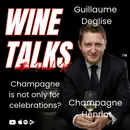
Champagne is missunderstood. It carries the weight of being a wine of celebration...but in reality, it can be and should be part of any wine drinkers quiver of wines.
Monsieur Deglise's manner is confident and demeur. Firmly confident in his approach to speaking with media guys like me, comes from an amazing history in the wine trade; including but not limited to the CEO of Vinexpo...a huge, international, wine event.
Guillaume Deglise doesn't just pour Champagne—he detonates the myth that it's a one-note party trick best reserved for New Year's Eve. If you're expecting polite small talk and tradition-for-tradition's-sake, this episode will uncork so much more: the anxieties, the ambitions, and the bold, unsweetened truths inside every bottle of Champagne Henriot. Why does Champagne still chase its own shadow, haunted by its reputation as fuel for aristocrats while quietly fighting to seduce a new, skeptical, and hyper-curious generation? In this conversation, the industry's façade is peeled away, revealing the pressure, the innovation, and the occasional existential crisis fizzing beneath the surface.
The conversation focused on the tug-of-war between heritage and relevance. Champagne Henriot, a house older than most revolutions, is now forced to seduce Millennials and Gen Z, who won't settle for glamour without substance. The talk goes deep: cellars aren't enough anymore; consumers want terroir in stereo sound, vintner's fingerprints on the glass, and hard data—not just stories—on the back label. Hospitality, once an afterthought, now edges toward the theatrical, and those crisp white cellars are having to make room for dusty boots and vineyard rocks under eager fingertips.
A key theme that emerged was the worldwide arms race for sparkling supremacy. Global warming is rewriting the map—now English fizz is expensive and, annoyingly, sometimes good. Producers who used to dismiss sustainability as a fad are sprinting for certifications, and Champagne houses are improvising like jazz musicians to keep their bottles relevant, rare, and not just a decorative status symbol in Tokyo or LA. Henriot isn't afraid to reveal how few hectares they own or how many markets try to outmatch Champagne's centuries-old spell.
The discussion explored the raw mechanics behind the romance. Forget marketing fluff—here's how blends are made, why disgorgement dates matter, and what happens when the bottle meets the glass (hint: it's not always a flute, and there might be a Syrah glass involved). While the big brands lock down shelf space and restaurant lists, smaller houses have to hustle differently, weaponizing authenticity, back-vintage power, and glassware debates to stake their claim.
If you thought you knew Champagne, prepare to have your palate—maybe even your ego—challenged. This episode doesn't just serve a drink; it demands you taste the history, feel the climate, and question the label.
What you'll learn in this episode:
🥂 Why historical Champagne houses like Henriot are re-engineering their narrative for new generations
🥂 The untold story of Champagne cellars—part tourist trap, part wartime fortress
🥂 How the "right" shape of a wine glass can make or break your bubble experience
🥂 Why sustainability certifications aren't just for marketing, and why organic isn't always practical
🥂 The real reason back labels are now packed with geeky winemaking info (and why sommeliers care)
🥂 How Champagne's global market is evolving—and what happens when Japan loves you but China's just flirting
Expect the effervescence. Challenge the cliché. This pour is deeper, sharper, and a hell of a lot more candid than any toast you've ever heard.
YouTube: https://youtu.be/c-5-YP-h7DA
-
Champagne Henriot: https://www.champagne-henriot.com
-
Veuve Clicquot: https://www.veuveclicquot.com
-
Riedel (glassware): https://www.riedel.com
-
Coravin: https://www.coravin.com
-
Jean-Charles Boisset (glassware/brands): https://www.boissetcollection.com
0:00 The interest of the consumer has changed, I believe. And as far as our industry of Champagne is concerned, they want to know more about it. We feel it very strongly. When it comes to presentation of, for instance, Champagne Henriot, we go very deep in how we do the winemaking, how we work in the vineyard. So we talk more about the dosage, the blend, the percentage of reserve wines. So we go very, very deep in the explanation, and I find this very reassuring. that champagne is really on the map as not just the, you know, the celebration drink that you have just for Christmas and New Year's Eve, but it's much more than that now. Sit back and grab a glass. It's Wine Talks with Paul Kaye.
0:51 Welcome to Wine Talks with Paul Kaye, and we are in studio today in beautiful Southern California, about to have a conversation with Guillaume Delisle. d'Église of Henriot Champagne. You know, you were welcome to the show. Thank you, Paul. Thanks for having me. I know, I'm glad to be your stop today on your way before you get back to France. So this has been about a week, a week's tour of— Yeah, it's a week tour that we do at this moment in October. It's very important for us to, you know, to be close to the market, to know our customers a little bit better. to plan the end of the year. And we had the chance to visit Arizona and LA this time. 2 important markets.
1:32 That's interesting to me because Arizona has been a— I don't know if any of it's changed much because I've only been out of it daily for 3 years, but I still have licensing. I still ship wine. But the daily stuff that required a lot of volume, Arizona was always It was always important, but it was always difficult. And I don't know if it's changed or not, but so you're dealing with the distributors down there? Yeah, we deal with the distributors down there. And it's a very exciting market. In fact, you see some wealth, some interest in wine, interest in good wines, very good wine lists, great on-trade accounts. So it was really exciting visiting every single one. I really enjoyed it. Yeah. Well, there are a lot of Californians leaving, uh, going to— That's what I heard. Yeah. That's what I heard. Yeah. That could be the reason they're taking— Probably. You know, their perplexity, propensities for wine. So when a Champagne house comes to America and Champagne being, you know, one of the great districts of the world for wine, but also less understood by most people and confused by a lot of people.
2:48 What are you showing them? Are you tasting them? Are you going to restaurants and putting it in the glass? What are we doing? Well, it's a bit of both. I think we need to explain who we are all the time, explain the history of the house. We have a very large history. We were founded in 1808 in Champagne. Henriot is one of the most historical houses. So it's always good to refer to this, to the past, but also to introduce what the present is for for Champagne Henriot. So, we were talking a lot about the last harvest, for instance. And obviously, we opened bottles, back vintages, and some great wines that we were sharing with the customers, with the distributors as well. So, I think it's always very useful to come to the ground and spend some time in the market. I deliberately did not let my son-in-law come to— usually, he engineers a show for me, has quite often, but I taught him about Champagne. And now it's costing me plenty to keep that much champagne around the house, but I'm happy to get the samples of the Henriot. Yeah. Yeah. It lightens the load. But the reason I say that is because he's a gen— he's a millennial.
4:00 Um, never thought about champagne. Uh, but then once we started tasting fine champagne, he realized, and my daughter as well, that there's something very special about this. How important When you're out there, is it this, the history, to tell the history, to explain what Henriot is? I think the history is key to give a little bit of background on the way we elaborate our Champagnes, but also to, again, make the link between the past and what's happening now in Champagne. Because we see a lot of changes in our region in terms of viticulture, winemaking, and also the fact that Champagne is not alone now in the sparkling wine market. There's so much competition from other countries, other even French regions. So that's why we also need to spend time on the floor, is to explain really what Champagne is about. And so that's why we're here. But the history, We're all in a situation in the industry in general, though. I had a woman here yesterday who in California makes this sparkling aperitif. It's just injected CO2 and she's actually doing quite well with it. It's, you know, it makes cocktails, all kinds of things. But in general, we know that sales are down and the generations— we're not sure exactly what the problems are, but we know it's a multiple front of attack on our industry.
5:33 Yeah. And Champagne being, you know, there's an amazing— look, there's, there's the Widow Clicquot book right there. She's in there. I saw it. She's a friend, Talar. Um, but there's— I think that the, the industry needs to go back to these conversations, to go back to these, to, to explaining, to understand the value of the history and bringing that forward to, to the consumer today. Well, I, I think that in, in many ways we see that the new generation, uh, and that's at least the case in France, they stay away from Champagne because it was a drink of their parents. They don't want to drink the same kind of stuff. But then they realize when they taste their first bottle of Champagne that, wow, this is a very high quality.
6:20 There's a great storytelling about it. And so, they feel a bit more confident. And I think Champagne is pretty unique for that. Yeah. It kind of goes back to this idea of almost everybody comes to the table when they finally have that glass of wine that regardless of whether they're wine drinkers or not, whether in your case it's sparkling, but they went, wait a minute, you know, I'd never noticed this before. And it has to come from what I call, and many people call, an honest glass of wine. a real wine that's made to express something, time and place, history.
7:02 And the reason I brought up the history thing, I just did a little blurb on the Wine and War book, the Kladstrup book. And it makes me understand that even though you don't taste the minerality because the Nazis came through Bordeaux in World War I and devastated Champagne. Correct. But doesn't that history play into that bottle? Doesn't that story get told somehow in its faintest way? Yeah. Well, history is part of the magic, I think, the magic and the mystery around the Champagne brands. I think people have heard about the Champagne brands before, and they just get interested in knowing a little bit more about it.
7:50 You mentioned wine and war. There are crazy stories about also during World War II, when the Germans arrived and they put walls into the cellars to hide the best bottles and so on. This is a very interesting story. And this is why we also host a lot more people in our cellars nowadays in Champagne. People are really wanting to come and visit, which is a great idea because there's so much to learn about Champagne. beyond just the name and the fact that they all have enjoyed a glass of Champagne in their life. But when you come in and see the region and try to understand a bit more deeper what it is about, it's a lot to learn about it.
8:36 In the book Wine of War, I don't know if you know this, but the Kladshots who wrote the book, they live in Paris. They've been there for 40, 50 years. I expect to see them. I expected to see them when we were supposed to come. But, but didn't— wasn't it the— didn't the Nazis jail the guy, the, the, um, I forgot the term they used for the guy who decided to give them really bad champagne and just send Hitler all the junk and special cuvées that weren't special. I think there was one guy was jailed for that. I think it was a champagne guy or was it a Burgundy guy? I don't know. Somebody got in big trouble. Yeah, maybe. Yeah. Well, you said something really important, and I think particularly on the French front, is the hospitality side of what wine is about. I mean, Napa was born on hospitality.
9:23 That's the California, which is sort of a different ambiance altogether. As you're saying, Champagne now has come around to welcoming visitors and— I think we're just at the beginning of it. We're learning a lot from you guys, honestly, because in the old world— Don't learn everything because they're not too good. Yeah, well, but it's true. In the old world, we never really figure out why hospitality was so important. And so we're late, we're very late. But I can say that in 10 years, 15 years, the Champagne region has changed tremendously now in terms of hospitality. And I'm not just talking about the Champagne houses welcoming their guests, but also in terms of hotels, restaurants.
10:06 Champagne has become a great destination. Notre Dame de Paris was closed because of the fire, and a lot of people went to discover the Cathedral of Reims instead. Wow. During the time. Wow. And that brought a lot of people. And all these people, you know, came to Champagne for the first time because of this. Yeah. And they came back with other ideas, not just the cathedral, but also the Champagne business. The whole, the idea of Champagne. Yeah. I don't know about Reims, but is it, what, an hour and a half drive or train ride? Yeah. And 45 minutes by train. Which is like, you know, a day trip from Paris. Absolutely. Yeah. You can go back and forth in the day and it's very easy. Well, you mentioned California's hospitality bent for hospitality, born on that. You know, and I have a— tomorrow I'm actually moderating a panel on 2 Armenian winemakers. We're gonna talk about sort of this cultural change and trying to get into the American market. But like Napa's having its trouble today too. And part of it is, the hospitality side. The hotels want to lower their rates to get more people to come, and then that's suffering in the tasting room. But tasting rooms are always open in Napa as part of the culture of wine. Yeah, this is really— I mean, you have a true industry of hospitality in Napa, which we don't really have in France yet. We still have to work.
11:35 When I was in Wine Paris last year, It, it, it, it was amazing to me. I had this amazing revelation, which is there's 6,000 vendors there. There's like, who knows how many SKUs there are. And it seemed to be the only product I could think of in my mind in the world where everybody that does exactly the same thing would come together and shake hands over, you know, but then go back and try to get on the restaurant list at the same store or same bulk wine market or whatever they're trying to do. It's such an interesting, uh, industry. But, um, Champagne has a unique position in the marketplace. It has. It has. I think, of course, the reputation of the brands plays a very important role. But you see that a lot of new things are going on.
12:21 You see the expansion of the grower Champagnes now in the market, which is, I'm not saying new, but it's fairly new. It's about 5 to 10 years only. So, we see a lot more interest in I mean, from the consumer and from the trade to get to know more the various styles of Champagne. But before, it was just Champagne is Champagne, and they didn't really want to know more about that. But now, it's the different side of the winemaking, the different regions, the different crus, the different categories, being Blanc de Blancs, Blanc de Noirs, whether it's 100% Meunier. We didn't have these questions before. You know? That's interesting. So we need to be much more precise when we talk about our wines. And this is what we do with Henriot nowadays. So the consumer that comes and visits, you know, when you're pouring the various styles that you just mentioned, are saying, yes, I get the difference. That makes sense to me. Because generally with sparklers, it's a little more difficult to cut through to the complexities and find this minerality. But at least for the regular consumer, to put them in front of them into different glasses and say, hey, this is, this is, this is what we do. But you mentioned something important. There's a lot of criticism of the industry because we're so slow. And I've always tried to figure out why that is. Like, maybe it's because we only get to do this once a year that we're slow or that we're stuck with our old models. I mean, I doubt you're going to put mango puree in any of your wines soon to make something, you
13:54 know, like, like this other junk that's on the market. But How do we manage the model that we are in, in this history, but with contemporary consumerism? Again, the interest of the consumer has changed, I believe. And as far as our industry of Champagne is concerned, they want to know more about it. We feel it very strongly. So now when it comes to presentation of for instance, Champagne-Orio, we go very deep in how we do the winemaking, how we work in the vineyard. So we talk more about the dosage, the blend, the percentage of reserve wines. How do we store the reserve wines? Mm-hmm. Why do we choose this cru and not the other cru?
14:46 So we go very, very deep in the explanation, and I find this very reassuring. that Champagne is really on the map as not just the celebration drink that you have just for Christmas and New Year's Eve, but it's much more than that now. I think that that's one of the great messages that's coming out of Champagne now, which is like, we're not just for New Year's Eve. Oh, yeah. Yeah. We need to drink Champagne not just once a year. But Clicquot is what, 27 million bottles or some ridiculous number? Yeah, about that time. Yeah. It's interesting to me, this is a picture of my father and I in 1975 in his wine shop. And he used to say back then, you know, the French, and particularly the Champagne houses, have a wonderful way of presenting the romance and the exclusivity of Champagne as a beverage to the public. And I think that's true. If I come to Henriot, which we will, what would I expect as a consumer for the hospitality? What does it look like? Well, first, to be honest with you, we're not that open to consumer when we're at a Champagne normal. I was going to say, Camille's a trade guy. But if you— I mean— What are you going to show me? Yeah. So most of the Champagne houses would invite people to go in the cellar and spend some time there in the— I mean, underneath the city of Reims or the city of Épernay.
16:12 What we prefer to do is to bring our guests to the vineyards and to explain really the differences of the terroir, where our vineyard is located. How do we work? You have like a bus? We have our small cars. Your own cars. Yeah. That's a question I have an answer to. I just wanna know how you do it. Yeah. So you take 'em to the vineyard? Yeah, we take them to the vineyard and So our head office is in Reims, the capital city of Champagne. But we also have a house close to the vineyard, closer to Épernay. And the experience takes place there, not at the head office where our cellars are located, but more closer to the vineyard.
17:03 And I think that makes a very big difference. Because people, what they have in mind when it comes to Champagne is mainly the cellars and the kilometers of cellars. The chalk wall. Yeah, chalk, extra. But I think it's also important to mention the terroir and to make them understand a bit better the differences between the Pinot of the Montagne de Reims and the Chardonnay from the Côte des Blancs. So this is what we like to do. And it's always nice to have a glass of champagne when you are in the vineyard, actually, which we always do. Bien sûr. Bien sûr. I mean, the reason I asked the question so specific about it was when people ask me, what am I going to do in Napa? What am I going to do when I go to Bordeaux? What am I going to do in the Right Bank, Left Bank?
17:51 And there's a lot of development in the hospitality side. So for instance, if I went to Cathiard and in Napa, which is Laurence Cattiares, Smith Haut Lafitte, you're going to get on an electric Range Rover and you're going to be taken through the vineyard and you're going to go up and down some rocky things and you're going to be shown the wildlife, if there's any, out. The same at Troplong Mondot. They've started doing that. And that's why I wondered, like, you're going to put somebody in the vehicle, that in itself is an experience, right? Yeah, of course. You go out, you're talking to the person in the car, You get to the vineyards, you step out, you pick up a rock or you grab a leaf or something. I think that's the experiential part of what we need to show people. Yeah, exactly. And it's personalized. It's important that we customize a little bit the experience.
18:47 So you said 1808? Yeah. Because that would be right after the Revolution, Renaissance? Well, uh, right before it, after. Yeah, it's, uh, yeah, 1797 or something like that. Was 1789. Yeah, that was the French Revolution. Um, and, and Clicquot was active then. Um, and how much contribution did her Manu Clicquot, that Vidal-Clicquot's business savvy bring to the region for everybody that was working then?
19:29 Well, it's not just that house. I think now if you see the— I mean, in the history of Champagne, everything started in the 18th century. We started at the beginning of the 19th century. So we're still among one of the most historical houses in Champagne. Now, the thing is, in the contemporary Champagne, yeah, there are some big groups, just like the one you mentioned. And we're more a smaller house. But how did it come about? Like, so you want to focus on Madame Clicquot, but I want to— how did Henriot come about during this post-revolution, which is, you know, pretty soon after, there's a lot of issues still lingering at that point.
20:17 And was it somebody that wanted to decide that we want to get into this business or we just love Champagne? What was the founding of the winery? I don't know if we can really talk about a business when it comes to the foundation of these houses. This was a very small activity of winemaking and obviously wine selling. But of course, in Champagne, there's been a lot of history about winemaking, but Champagne was more a red wine region at the very beginning. It was considered as the wine of the kings because we were the closest region to Paris. So, we were using the River Marne to actually bring the red wine to Versailles for the kings. And then, after we discovered the second fermentation in the bottle, a little bit by accident— By accident. A bit by accident. And this is how Champagne really started. All the houses became famous when they started exporting to a lot of different countries, mainly Europe, of course, at the time. Well, I know Russia, England. Yep. What's interesting to me about that period is that cuvées actually had started too, as well, right? The Russian cuvée was different than the English cuvée. Yeah, it's said to be. Yeah.
21:36 That would make interesting sense to me because I don't know if terroir was really part of the conversation back in the early 1800s? Maybe not. Maybe glass would— I mean, they discussed the idea that glass wasn't very reliable at that moment. And maybe by 1808 it was. So you're saying from the family standpoint, it was just part of their culture and that they didn't start to try to sell stuff out of the chutes? You know, the history of Henriot started with Apolline Henriot. It was a woman, a bit like Veuve Clicquot, in fact, who started her business at the beginning of the 19th century. century, and she was passionate about the vineyard. Everything started at the vineyard, and she had from her family 3 different vineyards in the north of the Montagne de Reims, Pinot Noir area— Verzy, Verzenay, Mailly— which are still very important to our blends. So, everything started from these 3 vintages— from these 3 crus, sorry.
22:40 And then later, the 4th generation of Henriot, that was Paul Henriot, got married with a beautiful woman from the Côte des Blancs. And she was beautiful because she had vineyards also, so she could bring vineyards to the business. One of those kind of marriages. Yeah. And so we got access to the Chardonnay through that marriage. This is when Henriot really got started and became an important player in Champagne. So, what I mean is that the evolution of Champagne as, I mean, the fact that it became a business, that took place in the 19th century.
23:23 Just fascinating. And I was just reading these questions here about, starts talking about the terroir, but do you make any still wines? We make a still wine to elaborate our rosé wine. Because we make the rosé through addition of red wine. So we need a red wine and we produce it ourselves from one of our vineyards in Aÿ, near Épernay. So we produce a red wine only to make the rosé. So we don't sell, to your point, we don't sell the red wine as a red wine. I've been desperate to find in America, A true Pinot Noir from the Champagne district that's bottled as a still wine. I just want to taste it.
24:10 And the ones that are here that I've found so far, they're either non-vintage or they're not pedigreed. So I've been desperate to find something like that. There are some very good ones. There are some. Yeah, they really— this is one of the effects of global warming is that we are able now to produce some very serious red Pinot Noir. Well, you mentioned other, other parts of the world and everybody, you know, it seems like every major wine district, even the smaller ones in the world, now have a sparkler and now also have a rosé, right? That's what they do. Yes. And now that the, with global warming, since you mentioned that they're, you know, this, the English, uh, are making sparkler where they only used to make German varietals in these, you know, islands that they have. And I thought, and they, they're rather good. They're not cheap, but they're rather good. Exactly. They're not cheap, but they have improved. And that's, again, one of the effects of global warming. They get more maturity. How else has it affected Henriot? Has it made it more difficult? Trellising, canopy? Were you changing things? No, I think it's not really the time for us to diversify our activity and to look at other regions to grow.
25:18 We're a Champagne house. We've always been a true Champenois house. And we believe we still have a lot of things to to make out of champagne. So, we're concentrating on our business. Like a French 75? Sorry? Like a French 75 cocktail? Well, yeah, maybe not. You know, I did some research on that. It was meant to reflect what it felt like to get hit by a French 75mm mortar. when you drink one of these cocktails. Yeah. You heard that story before? No, no. Yeah, I mean, apparently it was quite a thing. Okay. And so we're talking about, you know, World War I was— it's interesting to me, particularly in the book Wine and War, where they talk about that, that the invading armies had learned not to destroy the vineyards, and that lesson was learned in Champagne. And I understand there's some vineyards still that are contaminated by the phosphorus shells that you can't you still can't grow it. Yeah, yeah, that's true. Yeah. That's so interesting. So tell, tell me about the terroir then of what Henriot is trying to do. What, what is the philosophy Henriot to bring to the bottle? Well, I, I think first when it comes to the vineyard, we've, we've, we've come to a, a much more sustainable approach over the last few years. Uh, we went, we also got the, um, organic certification in Champagne last year. Uh, this was a very long
26:49 process. But you know what? In fact, these certifications, because there are a few certifications that are possible in Champagne. So we started first with HVE3, then VDC, which are very local certification, but very important. And I think these certifications are important because they go to a more sustainable way to run our vineyard. They are followed by a lot of other houses as well. But the organic certification is not easy in our region compared with Burgundy, Languedoc, even Bordeaux. And we have decided not to continue that certification, but to concentrate on the local, the other 2. That's interesting. Because following an organic trend is, I mean, can be an issue when you produce your Champagne because your yield can be really down.
28:03 And we have experienced very low yields over the last 3 years. So that's the interesting part of this trade. And America's always been viewed as this new world where you got an open palate to do what you want. And I've always respected the idea that in Europe, and particularly France, that there's a protection, an appellation protection of your cheeses, of your wine, of butter. But how important is that to you as an organization? Like, in Saint-Émilion, for instance, they change the rules. They keep changing them every year. Some people have dropped out because they've included hospitality as a requirement. But for you guys in Champagne, how important is that government, not intervention, but these guideposts to maintain? Well, every appellation in France has got its own rules, basically. So I think we have a very strong organization in Champagne, and this is what matters.
29:05 I think a lot of people are a bit jealous about the organization that we have, which works very well, and which is based on relationship between the houses of Champagne and the growers. I mean, we work together. The 2 categories work together to make Champagne successful. So, we make very important decisions on a common basis on the yield that we want for every from every crop, the pricing. Yeah, everything is really connected. Did the consumer notice the transformation in the bottle from conventional to organic?
29:54 Or the winemaker for that matter? Well, obviously going to organic, you get more precision, but it's, I mean, you wouldn't be able to say on a blind tasting, well, this is organic, this is conventional. It's impossible. Well, but, you know, it's interesting because here when the idea of biodynamic farming, organic first, you know, hit the streets and people are, in my opinion, suffering through some pretty bad wine because— but the pitch was, hey, it's organic. It's like, yeah, but wine was organic 100 years ago, even 50 years ago. Yeah. Right? So what's— yeah, yeah. Like, it doesn't mean it has to taste bad. And I feel like I'm doing myself a favor by drinking organic wine. It just seems to be the most natural part of our industry would be to be at least sustainable. Exactly. I think being at least sustainable, as you just said, is the most important.
30:57 Yeah. I mean, in Champagne globally, we've all reduced the use of pesticides a lot. So this has changed a lot the vision of people can have from the Champagne winemaking. And yes, the quality, I think, of Champagne has never been as good as now. I have a riddle rack, an old riddle rack in my home, but I put it on the wall and I give a little tilt and it's full. with all Champagne in it. Okay. Every day it seems like, you know, there's a new hole in there, new space. But one of the women, the woman I was telling you about that sat there yesterday making these sparkling aperitifs, and she's also a fine winemaker as well. She was telling a story about how she visited Champagne, and I was asking her how she decided that she wanted to be in this trade as a winemaker. And she explained this story, which you just touched on. I want to hear more about it, which is Growers turning into manufacturers. Now, was it primarily the industry, and up until what point were they just a family with a vineyard who contributed to the co-op or contributed to a winery their grapes? And now you're saying they seem to be making wines now. Well, you have a lot of different ways to consider making Champagne.
32:23 The growers can either sell their grapes to the Champagne houses, they can make their own Champagne, they can work with the cooperatives, they can do a bit of both. And as a Champagne house, it's a little bit the same. We have grapes coming from our own vineyard. Henriot owns 37 hectares of vineyards in the best location, but we also purchase grapes outside. And all globally, we have a sourcing of about 120 hectares to elaborate our Champagne. Wow. That's a pretty good size. Not that much, actually. It's quite a small house compared with the big boys and the one you mentioned before. How is that struggle?
33:10 Look, let's face it, in America anyway, you walk down the aisle of the market, you see all the same brands right at eye level. They've got the horsepower and they've got the marketing power to command those places. We just discussed Voukliko a little bit. I have to tell you a funny story though. In Napa, there's a restaurant, there's a hotel that used the same colors as this book and it's called Vouvre. It'll come to me, but it means something really bad in French. They didn't understand what they were saying. All right.
33:51 But they wanted to copy this ambiance. They made a huge mistake. I'll remember in a minute. But how do we go after that? Not market share. You don't make enough that you, I mean, whatever you make is, but making sure that people know that Henriot is here and it's competitive. Yeah. Yeah. It's not just about market share because Henriot is quite a small house anyway, but it's more about the quality of distribution, the visibility. Being listed in the right places on the right wine lists. Yeah, getting a little bit more traction on our wines. Of course, we want people to recognize the quality of Henriot, the unique style that we produce.
34:41 Today, we have a distribution that is pretty international. About 80% of sales are outside of France. Wow. With the first markets being Japan, US, UK, Italy. And so, yeah, it's a very long process because we don't have the same financial means as the big boys. Yeah. But it's a very long-term work that we're having at Orjó, and honestly, it works. What I'm very happy about is, and especially during this trip, is that each time that we open the bottle, that we do a tasting, people are really thrilled to get to know the brand. For some of them, they're very surprised because we sometimes open very old vintages, and they discover that Champagne can be aged a very long time, that it's not just the non-vintage that, again, you open once or twice a year, but that it's a real wine. Champagne is wine. It is a real wine. Does it surprise you that There's so much unawareness of, in the consumer side of things after 1808?
35:50 No, no, because I mean, first, we also meet in our business a lot of wine collectors who are very highly knowledgeable, and that's precisely the case in the US. There are so many people who know well wines and Champagne. So many of them have visited Champagne. So it's a bit of both. We sometimes meet very knowledgeable people, especially trade people, and also consumers who, yeah, for whom Henriot is not right in the center of the map, but it's an opportunity for them to get to know the brand better. So do you wrestle with brand?
36:35 You want someone to open a bottle of Henriot, do you want them to know if they've tasted enough to say, yes, this is Henriot, right? I mean, let's say a collector, this is, this is what it is. Versus, um, the consumer marketability of something so unique like the terroir-driven wines that you and I respect very much, but they're not usually mainstream in character. And, and so I've always wondered how we wrestle with maintaining that character of Henriot But still getting consumers, I don't know, I guess interested in understanding the brand? Well, this is our job. This is our job to— Yeah, someone's got to do it. Yeah, it's always very exciting and refreshing to go and see the customers and explain our style.
37:26 We are lucky enough to have a very unique style of wine, and it's great to share this with the people. Because we're such a small house that we are able to produce a very unique style. And I think it's great to share this with the consumer. What are the SOMs? They play a very important role for us. Yeah, of course. And especially when you're not a mainstream brand, which is our case, they get interested even more. You know, it's— I've said this before on the show, some of my listeners are bored with the story, but we were in Palermo not that long ago, and I had one of the greatest presentations of wine ever given to me by a sommelier. I think he was Serbian or Croatian, landed in Palermo.
38:20 And then when I was at the supermarket the other day, and somebody had set up a little kiosk, and they were pouring off an Italian Pinot Grigio or something. And it was the exact opposite. It was the guy talking about the elevation and the soil content to somebody that just walked into the supermarket who was trying to get some toothpaste, laundry soap. Yeah. And, and wanted to taste some wine. And I'm wondering how that affects, or how we talk about a Champagne for a somm to— I don't know, what do you ask questions about the, the guest? the hospitality side of this and just, this is the story about Henriot. I mean, is that what we hope happens? Well, yeah, it's true that we need to remain accessible. You know, the storytelling needs to be easy to understand. And it's not just about technical things that we share with the son, but it's also, you know, the story of the house, a few things to explain what Henriot is about. So I think we need always to adapt our speech to the people we have in front of us. Of course, when I meet somms, and especially here in the US, because they are so knowledgeable, it's a great conversation because we talk a lot about the winemaking, especially. When we meet consumers, it's different speech. It is something a bit easier. I just wonder how we harangue, it's a good word, the Soms that are of the ilk. And I don't
39:51 know if this guy was even a Som, but right after the Palermo experience, we were in Beverly Hills at a very famous steakhouse. I won't throw anybody under the bus. And it was the exact opposite. It was the Som who was talking, who wanted everybody to know how much he knew. Hmm. Now I could see you're having a conversation with a Som because they need to know these things. They need to know a lot more than what this consumer may ask about, right? so they can have— they can substantiate and corroborate their conversation. But to get them to speak at a level— and, and I, I guess I liken this to this idea. Obviously, you're in the trade, I'm in the business. We have dinner with guests or friends that don't understand wine, but the conversation always comes to wine, and it's a different conversation. Yeah. Right? It's a simpler conversation, and people really, really want to know But they don't want to be pushed back on it. They don't want to be pushed into understanding it. They just want to walk into understanding it. Well, you know what?
40:49 We've changed our labels recently, but we've also changed our back labels. And that was a very important message for us, to the somm mainly, but not just to the somm, also to consumers who are really into Champagne. We've put a lot of information on these back labels, on the percentage of reserve wine, the blend, the disgorgement date, the dosage. Everything is written. And you have no idea how happy all the somms were to get to know this information. Because when you're a sommelier, you can't know every single thing, every single detail on the wine that you sell. That's a good point. So we did it because we again, quite a small house, so it's easier for us to do that. Not the big houses could do it because it's not easy to manage, but it's a great way to connect with the somm and with the wine lovers. I think that's a really important thing. And it hits me just now, there's so many somms that I've dealt with that don't know all the wines in their cellar. They just got the job. They inherited this list. They don't know what's in there.
42:01 But if they bring out a bottle of Henriot now, Like an understanding what it might— if it says chalky soils or if it says a dosage of a certain amount, in your head, you know what that means. Yeah. And you can have that conversation with somebody that wants to know. Exactly. And not having to study necessarily. Yeah. And, you know, I mean, beyond Champagne, you know, people love drinking Champagne and they don't really realize all the work that is requested to elaborate a bottle of Champagne. I mean, the process is quite complicated, way more than making a white wine, a young white wine, for instance. Right. So, I think people want to know more about that now. And it's not just about the blend. I think the blend was the first step for people to get to understand how wine was made. Now people want more information. So this is what we're trying to bring. So I got to— I had a guy on the show, his name was David Kong. He owns a new glass company, Glacevin, like Coravin, Glacevin.
43:13 And by the way, Greg Lambrecht, the guy who invented the Coravin, has now invented a sparkling Coravin. Yep. Which we use a lot. Oh, you do? Okay. This is really interesting. So, and Max Riedel— I'm not— it sounds like I'm name-dropping. That's not why I'm doing this. You know, he will insist you don't drink champagne in a tulip glass. You drink it in a smaller sort of almost burgundy shape. Mhm. And when I got the sample glassware from Glacefontaine, it was that shape. And so now we have the tulip, the nice new shape, and then the mouillette à nette, shape. Is that who that was? The fashion that— Yeah, yeah, yeah.
43:53 Supposedly. So which one is it? Which produces the best experience? Because that's an important part of the experience. It's a very important part of the experience. And this has changed a lot also over the last few years. You see that people are getting more and more serious into wines, that they understood that Champagne should be consumed from a wine glass, not just the champagne flute. This is a little bit passé. Wine glass is very important, and even more for the Henriot style, we always use a rather big wine glass. Really? Yeah. Okay, so the ones that I've been getting are wine glass shape, but they're more petite.
44:37 No, we believe— Really? Yeah. I almost brought them in just to have them here. That's interesting. Sometimes I use glasses that could be Syrah glasses or, you know, Sangiovese glasses. Yeah, right. Those are really good. Yeah. Because I had these conversations with these people because Riedel and the hand-blown glass, and I think tactilely, tactilely, it's a very important part of our business to feel that glass. And what I found interesting is that both of these glasses, that I recently spoke with had beautifully thin stems and beautifully shaped bowls. And then you go to Jean-Charles Boisset's brand, and it's like this heavy, giant Baccarat glass. And I thought, well, they're both tactfully interesting. Yes.
45:29 Right? But completely different in, in their approach. And he also makes a champagne decanter. How does that work? Yeah, that's a question that I also have quite a lot. Should we decant Champagne or not? I don't believe so, to be honest, because the effervescence, the sparkle is so important in the experience that if you decant it, of course, you will lose bubbles. That's what I thought. Yeah. Personally, honestly, the only way that I decant a Champagne is when I have a rosé Champagne. because our rosé Champagnes are in a green bottle, so you don't see the color. Oh, yeah. Yeah.
46:13 So it's just for the show. I like to decant a bottle of rosé. Yeah. But then I pour it immediately in order not to lose bubbles. Something gentle, gently. I learned that lesson not from sparkling wine, but from one house I had. They had one of those You know, soda guns. Oh, okay. And if you didn't have the exact temperature— this leads to the next question— of the water going through the soda gun, the effervescence would be completely different from one degree to another. Okay. And so how, how do we manage that with the consumer to make sure that we're getting the right temperature so that those bubbles do produce and they are fine and they are light and dancing? I guess you can't, but Yeah, it's difficult. Like 42 degrees? What's the— well, that's Fahrenheit. Yeah, that's Fahrenheit.
47:04 So I need to calculate it a bit. That's an important part of serving sparkling wine. Temperature is very important in the service of wine. And I think Champagne should be cool enough and then can obviously get a little bit warmer in the glass, but we should pour it quite cold. Right. Isn't there a dosage issue? Or, you know, isn't— won't there be sediment in something if you don't— how do you dosage a canned wine? Doesn't make any sense to me. Well, in a can. Well, well, yeah. See, I confused you. Yeah, yeah. Well, the fermentation definitely didn't happen in the can, so it was— yeah, yeah.
47:47 But she called— well, Méthode Champenoise doesn't say In the definition, does it say bottle? Yeah. Well, why not? You know, this is a way to also get new consumers, probably new generations to have this in a can. But in Champagne, you can't do that. It's absolutely impossible. Against the AVI-8. I mean, against the appellation. The appellation doesn't allow it. And I don't know if that's necessarily the direction any winery should take. Just, you know, first of all, you can't, most people can't afford to switch gears and have a canning line versus a bag-in-the-box line or whatever it is to become more consumer consumer-friendly. And that's where I had this, this, you know, this theoretical discussion about the old model and sticking with it and producing the best you can from the best time you can and the best place you can. And, and living with those wines versus trying to contemporize yourself other than the cuvée. Yeah. Well, I, I, I think when it comes to Champagne, it's not just about tradition, although tradition plays a very important part, but it's also, also a question of technique.
48:50 You can't have double fermentation in another content than the bottle. That's why we need to stick to it. That's important. We're out of time. I know that's hard to believe. It's already been 50 minutes. All right. Time flies when you're having fun, right? Yes. But before we go, this is my favorite question book for visiting guests from France. And this is Dr. Murray, 1974. The book was written in French. This is an English version. He was an MD, licensed MD, but also a homeopath doctor. And he wrote a book about the maladies of the human body and the correct wine to fix the malady. Okay.
49:33 And the answer— and just so you understand that, if I— I'm gonna give you 3— a question with 3 answers, and everybody is pretty much 33% like this. Okay. And the reason is he expects an explanation. of why you chose that, just like a master of wine test. Okay. Like, you think this is Cabernet from Chile? Why? Okay, so this is— I'm going to give you a, um, a malady, and I'm going to give you 3 choices. And the malady is a fever. Okay. And the choices would be a young Beaujolais, a dry Champagne, or a Saint-Émilion. And why would you choose one of those 3 for your fever? And I'll have to look this up myself.
50:20 And obviously the dry champagne is the answer, right? And why did you say that? Well, because you— I think I drink champagne when I have fever and when I don't have fever and when I'm well and when I'm not well. Well, you're the only one that was insightful enough to know that I always throw a softball answer in there because I want you to get it right. That is the right answer. So, so the answer, the reason is, according to him, any abnormal increase in temperature, especially if it lasts, is a sign of poor health. Now that's brilliant. Oh. It should not be ignored and calls for medical advice since its causes could be many. In many cases, the phenomenon indicates symptoms of lassitude, that is a certain lack of energy.
51:10 So far he really hasn't stumped us on this, has he? Why champagne? Because these wines contain, among other things, 2 important elements for a feverish person: phosphorus, which is eminently stimulating, and sulfur in its sulfate of potassium form, whose detoxifying action on the body has been established. Hmm. How about that? You can tell that to your next guest over there at the Now, how much? What's the dosage for this fever, feverish problem? The dosage? Yeah, no, not the dosage, the dosage that one should consume. Oh, I don't know. A bottle a day. A bottle a day? Really? You should, this should be a poster at the house, right? Okay. Okay. That should be up on the wall, bottle a day, in case you have a fever.
51:57 Yeah. It's been a great pleasure having you here. Thank you, Paul. And I wish you good luck on your trip home. And what do you do next? Asian countries or Scandinavian countries? How did you know? Yeah, no, I go to Asia next week, actually. October, again, it's a very important time of the year because it comes after the harvest and before the end of the year. So we're preparing a lot of things. And so yeah, I fly to Seoul and then Tokyo next week. So since we have a couple of minutes, there's been a little shift in those marketplaces as well. The Chinese, which were chasing every premium brand, Grand Cru, everything they could, and they don't do that anymore. The Japanese have always been more established and a little further along in sort of culture. Um, what's hot right now?
52:44 Well, there's a big difference between Japan and China when it comes to Champagne. Uh, China is, is only at the very beginning. Uh, it's, it's, um, it's a small market. Um, Hong Kong is much more advanced, but mainland China is still quite small. Japan is the opposite. It's a love story with the Japanese for the last 20 years, 25 years. That's great. And it's already the 3rd largest market for all Champagne in general. Wow. 3rd export market. And for us, it's the first. So that's why it's important to spend time there. I mean, I always talk about this and it turns out I'm not an international businessman in this sense, but it's clear to me that the Chinese culture is well behind the curve of luxury brands in the sense of how they're appreciated and used and consumed compared to the Japanese, for instance.
53:39 Yeah. I've always tried to figure that one out. The cultures are both ancient cultures, but maybe it's the style of government. Maybe it's the style of society. that, that there seemed to be being towed into fine wine anyway. And, you know, you could do no wrong 10 years ago, right? Maybe 15 years ago. If you had Opus, I had phone calls here. Can you give me a pallet of Opus? Like, I can't even get like 6 bottles. So anyway, thank you again. Cheers. Thank you.