

 Apple Podcasts

 Spotify

 Youtube Music

 RSS Feed
 YouTube
 Pandora
 iHeartRadio
Fiasco to Fabulous: How Straw Bottles and Noble Rot Changed Italian Wine. Giorgio Fragiancomo.
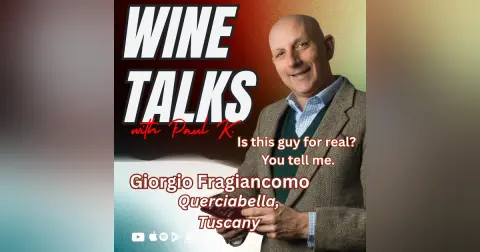
When an Italian man walks into the studio with an Australian accent who likes to ride skateboards around Milan, you know this is goign to be a hoot.
Giorgio Fragiancomo was jus that. A hoot. We were like two old friends catching up on the past 20 years.
I think you will finds him just as engaging.
I have to tell you, Giorgio Umberto Ferragiacomo of Querciabella was one of those rare guests who swirl together history, opinion, and wit in a glass that's almost overflowing. Sitting across from him in the studio, Southern California's dry heat announcing itself even more than usual, I realized this wasn't going to be an ordinary wine chat. Right from the get-go, Giorgio declared his love for single-vineyard Sangiovese and, with a twinkle in his eye, started unraveling stories about wine, language, and his own globetrotting accent. There's something about a guest who can poke fun at himself while digging deep into the roots and revolutions of Italian wine that makes you sit up a bit straighter in your chair.
Lunch with Giorgio could've been a podcast in itself. Between forkfuls of antipasti, he poured not just wine, but tales—like how Bataille got its name, and how much trademark law can swirl around a single bottle. The way he told the history of the Chianti fiasco bottle—you know, the squat ones wrapped in straw—made you feel like you could hear the old ox carts clattering down Tuscan lanes. It's the anecdotal details, like women weaving bulrushes for bottle insulation, that make this more than just a bottle on a shelf. With every sip and every story, Giorgio bridged centuries.
What I respect about Giorgio—and the reason I keep bringing people like him on the show—is that he doesn't just tell you about his wines. He stirs up the big debates. When I tossed in a little jab about Super Tuscans being a sneaky way to charge more for declassified grapes, he was ready. He explained the real revolution: how outdated Italian wine laws forced quality-minded vintners to color outside the lines, risking everything for better wine—even if it meant their pride and joy went to market labeled table wine. The best conversations, in my book, happen when someone like Giorgio is ready to challenge conventional wisdom with history, personality, and a dash of humor.
If you ask Giorgio, Querciabella's success comes from visionaries who saw beyond bureaucracy and narrow expectations. Giuseppe Castiglioni was one of those minds: a man who valued elegance over conformity and wasn't afraid to import a little Burgundian inspiration into Tuscany. That spirit continues today, he says, whether it's through seeking international experience in their winemaking team or leaning into the purest possible expressions of Sangiovese. The world is changing, Giorgio admits, and so is wine—but the pursuit of quality, relevance, and authenticity never goes out of style.
As we clinked glasses and traded stories about family, culture, and that universal recognition of "wow" when you taste something great, one idea lingered: wine is both history and future in a bottle. Giorgio believes—and I wholeheartedly agree—that you can taste vision and intention just as surely as acidity or tannin. That's why I host these conversations: to remind myself, and hopefully you, why wine matters, and why the right bottle (and guest) always leaves you a little more curious than before.
What will you learn in this episode?
-
The scandalous and surprising history behind the iconic Chianti fiasco bottle—and why it was more than just a candleholder.
-
How Italian wine law almost strangled quality, leading to a revolution that birthed the world-famous Super Tuscans.
-
Why a good accent story and a willingness to break tradition can make a vintner—and a wine—stand out.
-
The role of bold visionaries and international perspective in reshaping the future of Tuscan wine.
-
Why, in a world of convenience and cocktails, authenticity, passion, and quality storytelling are still wine's greatest strengths.
So pop a cork, pour a glass, and settle in—this is one Wine Talks you'll want to savor.
-
Querciabella: https://querciabella.com
-
Pio Cesare: https://www.piocesare.it
-
Château d'Yquem: https://yquem.fr
-
Jadot (Louis Jadot): https://www.louisjadot.com
YouTube: https://youtu.be/aToJeKqmNZ4
0:00 We want to produce world-class wines. We have now become absolute specialists in single vineyard and small batch and micro-vinified 100% Sangiovese. The Super Tuscans have given us our fame, but our future lies in pure 100% Sangiovese and showcasing just how good it is. Sit back and grab a glass. It's Wine Talks with Paul Kaye. Welcome to Wine Talks with Paul Kaye, and we are in studio today in beautiful Southern California. Though it might be around 95 degrees, it's still beautiful. We're gonna have a conversation with Giorgio Fra Giacomo. Fra Giacomo. See, I told you I was gonna say that right.
0:45 He's with Querciacella. Ma Paolo, che cazzo dici? Quercia Bella. Quercia Bella. The beautiful oak. Quercia Bella. Quercia Bella. That's— What does that stand for? Quercia is oak, Bella means beautiful. And it's the name of a magnificent hill in the Chianti Classico, about 30+ kilometers south of Florence and about 40+ kilometers north of Siena in the mountains of the Chianti. I think there's an oak tree here in Southern California named after that. After Quercia Bella? Yeah. Well, they should be. We can't cut it down. It's against the law. Exactly. So if it's dedicated to our wines, it's a national monument. So, you know, you said something during the lunch, and I did— to tell the listeners, we had a wonderful lunch to taste the wines. And this is why I love getting content for these conversations, because you talked about judging a wine. It was the white wine you poured, the, um, Bataille. Yes, I was trying to figure I'm trying to think of the French word that you copied. Which is a rude word, everybody. It was originally named after— well, it was inspired by Bâtard-Montrachet. And as you know, Bâtard is both a place name between Chassagne and Puligny in France, in Burgundy, but it also means love child. I'm so glad you brought that up actually, because I am doing on Saturday, I am moderating a panel of two winemakers from
2:17 Armenia that it's in front of the attorneys. It's 100 attorneys are coming to this event, and so I have to tie it to some law issues because they get credit for coming to the you know the continuing education credit for coming to the event. So I have to tie in some law, obviously trademark law and. branding is an important part of that conversation. But this is a great part because the international version of that problem doesn't really exist here. Like, we have California champagne and nobody really cares, you know. Until you export it to Europe. Well, then let me say that the Comité Interprofessionnel du Vin de Champagne would certainly have something to say about that. Of course they would. I have many an anecdote about their war chest. We'll talk about that. But the point of that is you were to ask, if you were asked what's in this wine, which you asked us, I would've never guessed Pinot Bianco and Chardonnay, but I would've never guessed your accent in the same vein that you have to guess a wine.
3:22 Yes. Because I was thinking England and Australia, but what? Why? I apologize. In fact, normally when I do a wine event, I literally have to explain the accent at the beginning. Just get the white elephant out of the room. When I start about Chianti Classico and Etruscans and the history of the Chianti and the Super Tuscans with this accent, with this outrageous Australian accent. People, I get to the end of the evening and I say, does anyone have any questions? And sadly, the first question is usually about my accent. Yeah. Well— So I get it out of— so for your viewers, let me just explain.
4:04 I'm Italian. My name is Giorgio Umberto Ferragiacomo. I'm from Trieste, which is to the very northeast of Italy. I'm an expat brat, as you would call it in America. And I spent 20 years amongst the savages in Sydney Harbor. And that's, as they would say down under, my accent got buggered up. Okay. And then I spent many years in the UK. I lived here in America for a year. I lived in the south of France for 4 years. And somehow my accent is It's confusing. It's confusing. Vous parlez aussi le français? Oui, bien sûr. Incroyable. Oui. C'est pas incroyable. Je suis européen. Ouais, je suppose. Mais, you know, le chauffeur de taxi aussi, beaucoup, beaucoup de langues. I'm not a taxi driver. They all speak 5 languages. We all do. Well, I speak 3, 3 and a bit. I did do several years of Spanish, but it's quite normal. So let me— you said a whole bunch already that I want to ask questions about, but we're going to get to it. Let's stick to the subject of Quelche Bella and not my accent. We'll get to skateboarding later.
5:16 You're from Friuli, basically? I'm from Trieste, which although it's a separate region to Friuli, it's Venezia Giulia. Friuli Venezia Giulia is a created merger of 2 regions that actually can't stand each other to the northeast. Trieste was the capital of Venezia Giulia. But after the Second World War, Trieste lost all its territory and it got lumped in with Friuli. The real capital of Friuli, the Friulans would argue, would be Udine, but it's actually Trieste. So you end up in Tuscany, but you've been all over the world doing this. And how did you end up with— and this is a short part of this conversation because I want to get to the substance of what you're putting on the plates across the world, but the big difference between those wines and that region? You're up against the Dolomites. You've got a whole different cuisine.
6:10 And now we're in Tuscany, one of the major regions of the world in Chianti Classico, et cetera. How does it— well, I would argue that Friuli is one of the major regions of Italy for the white wines. Once upon a time, before wine really took off, let's say 25 years ago, 26 years ago, if you went to a fine dining restaurant in Milan, you would have whites from Friuli, reds from Tuscany and Piemonte, and maybe a local wine from the Oltrepopavese, the region just south of Milan. And it was like that everywhere. You went to Florence, you had Tuscan wines, maybe a little bit of Barolo and Barbaresco, and possibly the whites of Friuli. They were the 3 main areas, Friuli for the whites. And Piemonte.
6:59 Piemonte and Tuscany for the reds. And then a total revolution happened, and Quercibella fits into this revolution. We are very much at the forefront in the Super Tuscan movement, which is probably arguably the movement that gave the impetus to Italian winemaking. It really gave a kick in the pants to Italian winemaking. As I said over lunch, back in the '60s and '70s, you could buy milk. You would pay more for a pint of milk than you would for a fiasco of Chianti, which is exactly what the Chianti was back in those days. Wonderful candlestick holder. Let's define that since you brought it up. Fiasco. for the listeners, is the traditional squatty bottle of wine with the, with the, uh, thatched exterior. Was there a reason for that? You know? Absolutely.
7:52 Uh, well, uh, perhaps the, uh, the listeners will recall when they were struggling students and they were dining in an Italian trattoria, there would be a candle in the middle of the table. It would be normally a checkered tablecloth. There'd be wax dripping off the candle. It'd be red, white, and green wax. And inevitably the candle would be placed in a bottle with a straw-covered thatching, as you called it. And that was a fiasco. And there was a reason for that. Once upon a time, there was a railway that went from Florence to Greve, which is where Quercia Bella is based, Greve in Chianti. And so the producers of Chianti would bring their bottles down by cart driven by oxen. So just imagine 4 to 6 oxen driving this cart, and the cart would've been almost as high as the ceiling. It would've been 4 meters. 4 or 5 feet.
8:44 Yeah, that's about 15 feet. Yeah. And it would've been, it was like on a, it was 2 slanted wooden barriers and all the bottles were placed against that. And the straw covering was so that when they banged against the wood or banged against each other, they wouldn't break. The women of the area would use, you have them, bulrushes. It's the leaves from the bulrush plant and they would thatch or how do you say it in English? When you basket weave, weave, weave. Yes, you weave. Weave these leaves from the bulrush plant or straw or a combination thereof to make these.
9:28 And it was just basically bubble wrap of the time. Oh, that's very clever. And it was something that the Romans made with amphora when they were transporting wine in terracotta amphora, which are those big, beautiful earthware vessels that the Romans used to use. In the ships, they would wrap straw and thatching around it so that they wouldn't smash together during rough passages. Last, about 2 months ago, I put on Instagram and Facebook this article that I found in my dad's archives. And it was about the Armenians and they had these leather boats. And they would put a donkey on the boat and they would bring all the wine down to wherever there's down the Euphrates to go sell it. And then they would fold up the— and the wood boat had a— the boat had a wood structure.
10:20 And then they would sell the wood when they got to the destination. They'd fold up the leather boat, put it on the back of the donkey, and they'd go back up the thing. And the article, you know, somebody else chimed in and said, well, not only were they one of the first wine merchants, because they say it's 6,000 years old, but they're also one of the first exporters. That was a really great— and your story about the fiasco is the same kind of thing. They found ways to get wine out of the indigenous countries to do something. Absolutely. The Chianti Classico has— well, we have the oldest appellation in the world from 1713, but they've been making Chianti in the— they've been making wine in the area for thousands of years. We had the Etruscans and the Romans, and the Chianti is the Goldilocks place. There is a school of thought that thinks the word Chianti comes from the Etruscan Clante, which means water. The Chianti is actually a range of hills, low mountains. We were driving up and I was really impressed by the mountains you have here in Los Angeles. I love it. So I wasn't expecting the altitude, but we have these, they go up to 3,000 feet. We're actually, Quercibella is on the side of— Quercibella is actually the name of a mountain, which is on the side of a much bigger mountain called Mount St. Michele. And we've been making wine in the area for 3,000 years, or the people, And it, most of Tuscany was too arid. And further north you've got
11:53 the Apennines. It's too high and too cold. It goes up to 9,000 feet, 3,000 meters. And so the Chianti Hills, because of the water, because of the altitude, were just the perfect place to make wine. And that's actually why Quercia Bella ended up on where we did. I mean, the idea was to produce beautifully elegant wines. The founder of Quercia Bella, Giuseppe Castiglioni, was an absolute lover, especially Burgundy wine, which as opposed to Bordeaux, which he also drank obviously and collected, he preferred the Burgundy because of that beautiful finesse, the fresh acidity, the raciness that is conferred by altitude. And where we are on Mount Quercibella, on Mount San Michele above Greve in Chianti, it's the perfect Goldilocks place to make the fine wines that we always envision. Nice.
12:51 Silky, It's interesting though, because we're talking about the fiasco and Chianti back in those days, I think there were 13 or 20 grapes or something you could put in, including white wine, white grapes. And not that that's a— They were compulsory. I don't think that's— that's what made it horrible. Well, I don't know that that's necessarily a problem. Australians do it. They put Sémillon in Shiraz and all kinds of crazy stuff. But the question is really, Advancing to now the Super Tuscan world, Ornellaia and Sassicaia and the rest. If the neighborhood was always capable of doing that, and I can tell you in America, the idea of Super Tuscans when they first started with this enormous price was just a way to take declassified grapes and call it and charge more money for it. But I'm just going to play devil's advocate there.
13:43 You're provoking me. I know, but that's not really what I'm— the point of the conversation was, is like, if it was always capable of that type of wine. Was it during the years of the fiasco? Weren't there some fine wines from one of the 5 Chianti districts that was really special? You touch a nerve there. And I hope your listeners like a bit of history. Of course. It actually, back in the late '80s, a Chianti Classico won the gold medal at the Paris Wine Show. And it was a Chianti. It was made by Baron Riccardelli. Riccardo. And he was asked, how did he do it? And he said, well, I make 2 types of Chianti. I make one for aging and it's mainly Sangiovese. But because the Sangiovese is quite harsh in youth, it needs time to age in big barrels.
14:38 And then I make a Chianti for drinking immediately. And to do that, I soften the harsh Sangiovese with— I give it color with colorino, canaiolo, that was for the re-fermentation. But I add white grapes to it. At the time, he was thinking of Malvasia, which subsequently became Malvasia and Trebbiano. And flash forward to 1932, and after the success of this initial prototype Chianti that had won the gold medal, a lot of other areas around the Chianti, which was originally 3 villages, it was Radda, Gaiole, Castellina, and a little bit of Greve, I think, was admitted, all now in Chianti. And a lot of other places around, whether it was Siena or Florence or Arezzo, were making wines in the style of Chianti.
15:37 And the Chianti, a few big families formed the Consorzio in 1924 with the idea of defending the intellectual property of the Chianti. They came up with the Gallinero symbol. They called it the Consorzio per la Difesa del Chianti. But in 1932, under Mussolini, Mussolini was looking for export products to showcase Italian excellence. And one of the products he chose was Chianti. Yeah. And he rigged the commission to decide that Chianti wasn't so much a place, which it is, it's a range of mountains with 3 major, 4 major villages in it at the time. And he rigged it that Chianti was a process. And so the result of that was everyone in Tuscany, with the exception of maybe Carrara, where they grow marble instead of grapes, was able to make Chianti wine.
16:42 And it was called Chianti Colli Pisani, Colli Fiorentini, Colli being hills. Sensei. The Florentine hills, et cetera. There's 7, I believe, Chianti subzones. And the only concession to the original 4 villages as Radda, Castellina, Gaiole, and Greve, was to be allowed to be called Chianti Classico. And as a result, we've had hundreds of years of legal— 100 years of legal battles with the other Chiantis to try to defend this intellectual property. Now, getting right back to your question, wasn't anyone able to do something about it, produce better quality wines? Unfortunately, the laws were really rigged towards the large bottlers, the large industrial concerns.
17:31 And just for an instance, Riserva is simply a 2-year-old wine. If you're a large bottler and you make 10 million bottles and you only sell 8, what are you going to do with those other 2? Call it Riserva. It was a commercial decision. Everything was taken on large-scale commercial decisions, not quality decisions. The grapes that we were using after phylloxera and after the Second World War. We're using the wrong clones of Sangiovese. We were forced by the disciplinary— by the DOCG to actually, it was compulsory to use white grapes. If you didn't use white grapes, you couldn't call it Chianti Classico. It's a legally binding recipe. That is what the Super Tuscans, the original Super Tuscans that you referred to were. They were, as I mentioned, milk was more expensive than Chianti. At the same time, the Italian government changed the laws on how agricultural workers were paid. It was just unaffordable. You couldn't run a business making Chianti Classico at a small family level. So the quality-minded producers stopped following the rules. They stopped putting the white grapes in. They changed. They put grapes that they felt were better. Many put Cabernet Sauvignon in with the Sangiovese. Some made 100% Sangiovese, but they weren't allowed to call it Chianti Classico anymore. And the wines had to be sold as vino da tavola, table wine. Yeah. 2 buck chuck. talking at
19:05 the bottom of the shelf in the supermarket here. We're talking about jug wine, stuff that you drink when you're depressed, stuff down in the park in a brown paper bag, or you put it when you're making bad risotto. That's where some of the finest wines, and I'm talking Sassicaia, although it wasn't a Chianti Classico producer, was inspiration. But Tignanello was a Chianti Classico. Vigorello was a Chianti Classico. All these these great— Pergoletorte was a Chianti Classico. They all declassified. And in fact, we are forming a history. And Quattrabella was one of the very first to fit into that category. They're called Super Tuscans because no one could figure out what they were. They were superior in terms of quality. They were superior in terms of price. They were from Tuscany. They weren't Chianti Classicos, they weren't Brunelles. And people are going, what are these superior quality Tuscan wines? Tuscany wine? That doesn't sound very cool. Super Tuscan.
20:03 Tuscan does, and the name stuck, but there is no legal definition. So we are trying to— we've created an association for those original producers of Chianti Classico that declassified, risked everything on quality-based wines that then became a huge success in the US, which was the most receptive market. And it's thanks to those producers, which include Quattrabella, as we are in the first 10, that you— The rest of the wine industry saw that that was the way forward. It wasn't about making quantity, it was about making quality. So the vision— I mean, that took some vision on somebody's part to decide not only that we're going to make wines that buck the system, the DOCG system, the DOC system anyway, and put grapes in this wine that aren't part of our district, all the rest. Like, if you can imagine doing that in Burgundy, we're going to talk about that in a second.
21:03 Who felt that this terroir in this part of Italy can produce something other than what had been mandated up until that point? Visionaries? I think so. I mean, if you look at some of them, Cepparello by Isola Eulena, I think it was the Manettis with Pergo le Torte, and the Manettis certainly with Flaccinello delle Pieve, Giuseppe Castiglioni of Querciabella. These were visionaries. These were people that understood fine wine and they knew that this soil was perfectly capable of producing. It'd been making, I mean, it had the first appellation in the world.
21:46 It had just been ruined by bureaucracy. Yeah. But everyone knew that with the right clones, with the right rootstocks, with the right training systems. And in fact, thanks to the success of the Super Tuscan movement, the Consorzio del Chianti Classico set up a project called Chianti 2000 in the late '90s. I can't remember, '93, '95. Anyway, sometime in the '90s. And they picked about over 130 clones from the best producers. And they, with the help of various universities, they put the clones on different rootstocks at different densities on the 3 major soil types, the limestone, the slate, the galestro, the limestone, the Albarese, and the sandstones, either the Macigno del Chianti and the Pietra Forte, the types of sandstones that we have and their derivatives.
22:42 And they tried them at different training levels, different types of Guyot or Cordon Royal, different types of training systems. And they came out with about under 10 clones of Sangiovese. I can't remember if it's 9 or— but it's around about 10 clones. And one, I think, of Cannaiolo as the ideal things to grow. And they showed how to grow them. And in fact, we at Quercia Bella have several of those clones in our vineyard. You can find this. Plus some of our own originals. But that was thanks to the Super Tuscan movement. The Chianti Classico realized that to survive and to be relevant in the modern world, it had to follow the example of the Super Tuscans and get away from this hidebound, you must put white grapes in, you must put this, you must have this percentage, et cetera, et cetera. Can you imagine doing that in Burgundy? You've got drawn and quartered. I'm sure they, with climate change coming, the Bordelais have put in Trigone National and tested some other grapes. And I don't know if I've ever heard of Burgundians trying to do this. They would be, you know, it would be choc de but.
23:56 I mean, we've had to adapt. I was telling you over lunch, Merlot's not possibly the grape variety. We tried Quercia Pellegrino, which is 100% Merlot. I think in 25, 26 years, we've released it something like 11 times, no more than 12, certainly, because it doesn't always come up right. So we've had to modify, and sometimes we don't release it. I dread to think what would happen if the current weather patterns that we've been experiencing in Europe would mean something like that for the Pinot Pinot Noir. I'm a Burgundy lover and I hope Pinot Noir, or certainly they have clones or rootstocks that can resist the conditions that we've had. Well, Monsieur Barnier at the Lou Jadot is, I think they have 9 hectares of 10 different trellisings, 10 different canopies. They're testing all kinds of things to combat or to deal with this. But that's not why we're here, because you— though you did say something during lunch that I didn't challenge you on, but I wanted to understand better. You said we've adopted Burgundian character. We've used Burgundy a couple times. I'm gonna just frame this for a second. In California in the '70s, when my father was in his shop, and when I started with him in the '80s, that was a quite frequent term
25:29 to say, oh, this is so Burgundian. And we went to the Willamette Valley, Oregon Pinot Noir Festival, but only the second year they did in 1989. And they're all saying this, but they don't say it anymore. Okay. So I think once upon a time, you really— it's so outdated and it's sexist. You talked about masculine and feminine style of wine. You wouldn't want to do that these days. But I think you divided the wine world into 2. Burgundy meant lighter. I would say Burgundy meant cool climate. All the characteristics we associate with cool climate, less intense color, less extraction, more acidity. Yeah. A certain finesse, a certain gentleness. And we associated Bordeaux Cabernet Sauvignon and the 5 Bordeaux grapes, Cabernet Franc, Merlot, Malbec, Petit Verdot. We associated that with more muscular wines, more broader wines, more powerful wines. And certainly during the Robert Parker revolution, if you like.
26:41 Whereas Burgundy always maintained that cool climate. Again, as I said, what you associate with cool climate, less intensity, more finesse, more elegance. And all those words and adjectives all have to do with acidity. And where are you going to get acidity? acidity in cooler climates, higher altitude. So when I talk about Burgundy, remember I mentioned over lunch that Giuseppe Castiglioni, who founded Quercia Bella in 1974, first and foremost was a collector, and his favorite wines were Burgundies. Mm-hmm. And he wanted— so most of the Super Tuscans and Giacomo Tarchis, who worked with us at Quercia Bella, who's the master, the winemaker behind Sassicaia and Tignanello and Solai, because he was Antinori's chief winemaker before becoming Italy's foremost flying winemaker consultant to many, many wineries.
27:33 Giacomo Tarchis had worked with Émile Peynaud. He'd spent time in America in the Napa Valley. And so he was a Cabernet Sauvignon specialist, very much so. And he had more of a Bordelaise viewpoint. Mm-hmm. And remember, Sassicaia is a pure Bordeaux blend, and that was the first wine kicked off the Super Tuscan revolution. We, in fact, didn't want to make wines in that style. That's why we ended up on Mount Querciavella, because we wanted to make wines with all those cool climate characteristics that I mentioned, that we can call them Burgundian if you like, call them cool climate if you like, call them more finesse, call them more feminine, more graceful.
28:20 Structure. It's a weight thing. It's how the weight's distributed in the wine, I think. That's the motivation behind That is definitely. And so I think once upon a time, we're always looking for simple black and white dichotomies and solutions. And black is Bordeaux and white is Burgundy. And it's just an easy way to split the world into 2 camps. It's a classic rhetorical tool. Actually, you mentioned just now, but the winemaking Manfred Ing, who's South African. Manfred Ing. He's been in South Africa, Napa, Hawke's Bay, Central Otago in New Zealand, Barolo, Barbaresco. Yep. I mean, he's been all over. And I always wonder, you know, you're— if you, if you give a gentleman like that a vineyard who's in all the world, made styles all over the world, here the owner wants Burgundian-style structure in his Tuscan wines, and you give that same vineyard to somebody that's been farming it for 30 years, 30 harvests, let's say, you're gonna get 2 different wines. It depends if the 30— Manfred's got well over 22 to 25 harvests. He's made wines. 'Cause he does, he does, he used to do one harvest in Europe, one harvest in the Southern Hemisphere. Well, that doubles his production. But he's made, you know, let's use Cat B, Marlborough Sauvignon Blanc to Barolo to Cabernet. He's in Central Otago.
29:53 Okay, Central Otago. But at the point I'm making Marlborough, How much value— not value— how important do you think it is that a winemaker have that worldwide experience to bring to the table? Giuseppe Castiglioni was a world traveler with houses in America, in France, in Italy. He was an international businessman with an international mindset. He was from Milan, which is probably the most open-minded city in Italy. I lived there and I can vouch for that. I didn't care what the Florentines say. Well, you skateboard around Milan. I do. It's flat. It's flat. But Sebastiano, his son, was likewise. He married an American, extremely well-traveled man, very cultured, as is the current owner, Mita Castiglioni. Again, she and her son who's been educated in various countries, Andrea, who currently runs the winery. There's always been an international outlook. I have an international background. Manfred has an international background. It was a very good fit for the winery. We are not constrained to local dialect, local small-mindedness. I lived in Barolo for 3 years and people would talk about the hillside. What will the people on the hill think if I do this? I know. What will La Collina say? So
31:23 very, very small-mindedness. And that is something that I've always loved about Quercia Bella. is that it has always had an international outlook. It's always been very sensitive about our international markets, international tastes. We want to produce world-class wines. Sebastiano chose, and his father chose Cabernet Sauvignon as opposed to pure Sangiovese back in those days. Mm-hmm. With an international palate in mind. We have now become absolute specialists in single vineyard and small batch and micro-vinifying. 100% Sangiovese. The Super Tuscans have given us our fame, but our future lies in pure 100% Sangiovese and showcasing just how good it is. And that is what the UGAs, the Unità Geografica, the geographically mentioned, so the Gran Selezione Chianti Classico with the village name on it, is showcasing just how much we have— We've almost come full circle. circle and gone beyond. It's like the hero's journey. We started out with the Super Tuscans. The Super Tuscans gave us great, especially the Bâtard made us, our white wine made us internationally famous. Our Camartina's always been a top-scoring red Super Tuscan and highly sought after by collectors. And that has taken us on our journey. Our journey started with fine wine.
32:53 We're back with fine wine, but we're really looking at the Sangiovese as our future. I want to draw that parallel with— we were in Barolo not that long ago on our way to Monaco for the Grand Prix. Okay. And I was— I had not been there before. I've been to Milan before, but not there. I've been to Lake Como, Lake Garda. I want to get to Friuli, but— and I I thought, wow, this is extraordinarily old world, extraordinarily old school. We went and saw an old family friend of my father's from way back in the '80s, the Cesare family. Went and saw Monsieur Cesare. Pio Cesare. We're talking about Pio Cesare. Pio Cesare. Very good friends of mine. Yeah.
33:40 And now Federica, who's taken over the winery after her father's death. But I know, yes. He came here. And I presented him with a newsletter my father wrote, original copy of it that we wrote in 1983, I think, or '81. It was Barbaresco d'Alba, Barbera d'Alba, I think. And he goes, you know, that was the first wine that Pino Cesare ever brought to America. My dad had featured it in his club at the time. Oh, wow. And so he was very touched by this document, which is an 8.5 by 11, 8.5 by 5.5, but Regardless, I was intrigued by its rusticness. I mean, the whole where we stayed, you know, his cellars itself, very, very old school. They're part of the Roman walls. They're over 2,000 years. They're right in the middle of Alba. Quercibella, though, today's tasting structurally hit me as contemporary wines with contemporary structure. The question comes down to Is this something that we need to address in the industry to move the needle for newer generations to drink, to taste and drink wine? Something of this palate, this structure? I mean, wine is a very old beverage, and our civilization as we know it is based on wine, bread, and cheese, on agriculture, on when we stopped being hunters and gatherers.
35:02 It has a very, very ancient history. You mentioned Pier Cesare's cellars in Alba. The cellars that have been making wine in that area for 2,000 years. Quercibella, all around us, we have castles and villas. We have friends who've been making wine for 1,000 years, 600 years, 27 generations, 800 years, what have you. Quercibella's only got 52 years, but we were born right at the cusp of a revolution. The one that I told you about. That's true. The Super Tuscan Revolution. We were born to produce relevant world-class wines. We don't care about your 1,000 years of history or your 2,000 years of history. We want to a statement. We want to make wines of a particular gravitas, wines of a particular style, wines that are internationally relevant, wines that are collectible, that can age.
35:54 Every single wine that you tasted, perhaps apart from the Mongrana, that beautiful, wonderful, fresh, unoaked red that we started lunch with the antipasti, they're all made to age. But you'd be surprised how well that unoaked Sangiovese Cabernet Merlot can do. Yeah, you should introduce that. It's lovely when it's young, but we were tasting the '23, so it's already 3 years old. But I think in terms of relevance, relevance has got to do with quality, quality of the story, authenticity, and the thought behind something. These days we see spirits and I mean, Marketing is a very important part of the wine industry, but many stories, you look at the spirits, they just get fabricated as the spirits very often are. But wine tends to have something that is both rooted in very, very ancient tradition, but offers something completely modern.
36:58 You can make rustic style wines using amphora or using rustic techniques, takes, or you can make wines that are more adaptable to a modern palate, or you can just ignore both of those and just work on what you do best. Quality. Quality. I think that's— And producing simply the best expression of a grape that that site and that particular vintage offers, and making sure that you paint with those grapes, a beautiful, beautiful canvas every single year. And for us, every single year is different. The painting, the results from that year can be quite different. You recognize the hand, you recognize the signature, but you're true to your vintage, you're true to your soil, you're true to your land. And yet you are working in a style that is, call it modern, we call it quality. And ultimately wine is about drinkability.
38:05 That's very articulate what you just explained in what, how I feel about the industry coming from and having people that sat in that seat that are selling cans and buying in the box and they're bottling stuff with fine wines, which is not, because I know where they bought it, you know, I— my career took me from the industry that we could actually find interesting things at a price you could afford, like Pio Cesare Barbera d'Alba. Delicious. And bring it into the country and let people experience it. To now, before I sold the company, I was forced to taste and possibly buy the best versions of 20,000-liter, you know, vinyl bladders coming into America with something in it. And that was no longer what the original attempt at my father's club was. And so we got out for a lot of reasons, but that was one of them. Like, I wasn't seeing those interesting wines anymore to share with people.
39:05 And you, you said something important, the thought behind it. You know, there's, there's ready-to-drink cocktails now. There's— I'm gonna have somebody on the show next week that makes citrus-based wines, which is all fine And dandy, because I think the industry needs all those things. Like, in that shelf right there, there was probably all kinds of stuff that you and I would never drink, but it brings people to the table. And I think your idea, the thought behind it, you've got to stay the course on presenting what is brought to you by nature to express in a bottle. And I don't think that will ever change in this plight of humanity. That's, Paul, that's That's why I'm here and that's why you are here. Our job in the industry is to communicate this passion to people, to make sure that it's relevant. A ready-to-drink drink is disposable. What we make is not disposable. It's culture. Mm-hmm. It's something that you enjoy around a table. It's something that has a way of bringing people together. Whether you know what's in the bottle or not, you recognize quality. I'm not a butcher, but if I have a steak and someone puts a steak in front of me and I'm eating it and it's grisly, I know there's something— I'm not eating a particularly good cut or something. But sometimes I know nothing about it, but I'm eating a fine steak and I go, wow, this is amazing.
40:33 You don't have to be educated to understand when you're drinking something good. What you need is to have something good available. And then you can just tell. You can just tell, oh my God, this is so much better. I mean, we all start, we're all at, you call it college, we call it university. We're all drinking, God knows, back in Australia it was rum and Coke. And then we grew up a little bit and we started drinking wine. Our friends, instead of having raging parties, we'd have dinner parties with our girlfriends and partners and friends. And wine was always present. It's like the background music to a video clip.
41:16 It is something that's always been present in people's lives. Great family occasions, Christmas, what do you call it? Thanksgiving, New Year's. We have that too. Marriages, celebrations. You've got champagne, you've got wine in one way, shape, or form has always formed part of our culture. And it's very important that we communicate to the new generations just how relevant it is. Even if you are currently an 18 to 23-year-old and you are out partying all the time. I guarantee you that at one point you'll start slowing down. And when you start taking life one minute at a time and enjoying things, wine certainly becomes relevant. And after wine, you get into fine spirits and it's just part of evolution. I think that wine will always be relevant, but I think people will always drink drink less and they will drink better. And that's where Querciabella, that's what we're banking on. That people, yeah, they're going to drink less, but when they do drink, they want something very, very good.
42:24 And we are there to provide it. There's no question that when we bring in some Querciabella, let's say, right? And I pour that, like the other night I had guests over, my son-in-laws who are in their late 30s. Are they that old already? For instance, I open dessert wine and ports quite frequently at the house when we have guests, and no one ever does that, right? Stickies, as they call them in Australia. They just— well, there's some great Australian ports, by the way. I mean— And muscat liqueur, Maxcat. Oh my gosh. That's another chapter. I could rave. So, but the point is that they, people that come to our home expect good wine. That's what I did all my life. But then when we pour something that they're not— they don't taste every day, they— I went through a whole bottle of Sauternes the other day. Oh, yummy. And, you know, they just like were beside themselves on what this stuff is, you know. And they tell it to them.
43:17 And what's interesting to me of those kinds of occasions is if you had a conversation with somebody about Sauternes and Southern Bordeaux and the Botrytis and the fog and all this stuff, they would think they would be bored bored to death. No. But when they open that and you put it in their glass, then the conversation starts and they're like, wow, this is pretty amazing. I beg to differ. And you're really striking a chord there because the first wine I fell in love with, the wine that got me into the wine industry was a Barsac or a Sauternes. Yeah. I can't remember. It was the first wine I absolutely fell in love with. It was a Château, either a Sudiraut or a Guiraud. Oh, that's what I had the other night. Sudiraut. Okay. Well, that's the first wine I ever, that's a wine that just, that was my aha moment.
44:03 Now, you were talking about boring about the fog and the mist. I don't know if you know the legend about Château Yquem and one of the ancestors of the Lusselouzes apparently was out in Versailles or something, obviously an aristocratic family, they were counts, and he gambled away his livelihood and he was banking everything on the next vintage of the wine that he produced at Château Yquem. So he'd gone to Versailles or something like that, He'd come back and told his winemaker, don't touch the— the estate manager, don't touch the grapes till I get back. He was stuck in Versailles gambling, et cetera.
44:45 Came back, and when he drove through that long, wonderfully long tree-lined avenue from the road to the Château d'Yquem, he looked around and saw that all the grapes were rotten. And he went, oh my God. Oh my God. How am I going to pay my And when he saw the estate manager, he was going to, I don't know, do something nasty to him. But they didn't have anything to do. So they actually crushed the grapes. And what actually came out ended up being the best wine that they'd ever produced. The Botrytis-affected grapes produced just one drop of nectar. That nectar, when it finally fermented, produced the most sublime wine that we know as Château d'Yquem and Sauternes. And it was all thanks to the fog and the the mold, that particular noble rot, pourriture noble, the noble rot. And I think that's fascinating. One of the great wine stories. And that's how Sauternes was born.
45:48 I had Mr. Pasquini on the show. I don't think he told that story. He told the story about the matron, the matron d', matridame of Château d'Yquem. I forgot the story. Anyway, not why we're here. So Have you find Tuscan wine, Super Tuscans, almost everybody in this industry, though it's not universal because I've seen some pretty successful stuff going on, people making inroads into this short-term consumption issue because not a huge number, but it can affect people, 4, 7, 8%. And I've read different periodicals. But boy, that can really affect the bottom line with some people if you don't have that expected revenue. Have you sensed any of this at the— Now, what do you mean? Correct. Have you noticed a volume issue from your sales volume throughout the world? Oh, absolutely. I mean, that's, it's undeniable. Volumes are dropping, but we're bucking the trend. I mean, we tasted 3 single commune wines at the Gran Selezione UGAs that that we are just about to release here in California. And we make a few thousand bottles. Yeah. Not 1,000 cases, 1,000 bottles of each. As I mentioned, wine consumption is going to drop. It's dropping around the world. There are way too many producers.
47:15 There's incredible amount of consolidation in the industry. There's not enough room for all the producers. And we are aiming at quality market. Our production is not huge. We will certainly grow. We've grown land, but we're always aiming at a quality offering. We believe that as the Super Tuscans set off the revolution with quality wines, they set off a whole revolution that affected the whole country. We are true to the spirit that we were founded in. And quality is what's going to get us through. You tasted those 3 UGAs and they are the pinnacle of Sangiovese in the Chianti Classico. They're amazingly high scoring.
48:07 They're amazingly small volume, fine and rare at its finest, and the maximum representation of Sangiovese. We believe in that sort of direction in making less but better. And that's how we started and that's how we're going to continue. Well, I think since we're out of time, I think that those wines that we tasted today, all of them, even the entry-level version, are the kinds of wines that people will sit for the first time and go, oh, wow, I think I get it. Wow. That's all we want. They don't need to know about wine. They don't need to understand what it is. I mean, we would, with wine professionals, professionals, but, you know, the word on everyone's lips was, wow. Yeah. Just, and this is different than I've ever tasted before. Exactly. That's all we want. Well, we wish you luck in that endeavor, but we're going to support that endeavor in our own home and my own group of collectors that I sell wines to.
49:01 I think there's a couple of things in there that they would like to have on their shelf, and they're daily drinkers of interesting appellations and interesting I think that is the way forward, philosophy and quality. Thank you so much for having me, Paul. My pleasure. And talking about such wonderful things. Yes. Gorgeous pairings today. In fact, I stopped the chef and said, I want to bring a group of 6 in. And, you know, do you— can I make a reservation? He goes, no, we don't have reservations, but we're going to— text me and we'll get I have to say that was absolutely magnificent. They did an absolutely wonderful job. The food was fantastic. We're going to come see you.
49:50 Last time we went to Brunello, we were in Cortona. The next time in Italy, we're going to head that direction and come check it out. Okay. Well, look forward to having you at Quercia Bella. Cheers. And thank you again. Thank you.