

 Apple Podcasts

 Spotify

 Youtube Music

 RSS Feed
 YouTube
 Pandora
 iHeartRadio
The Dark Side of Food Network: Are We Really Learning About Real Food?
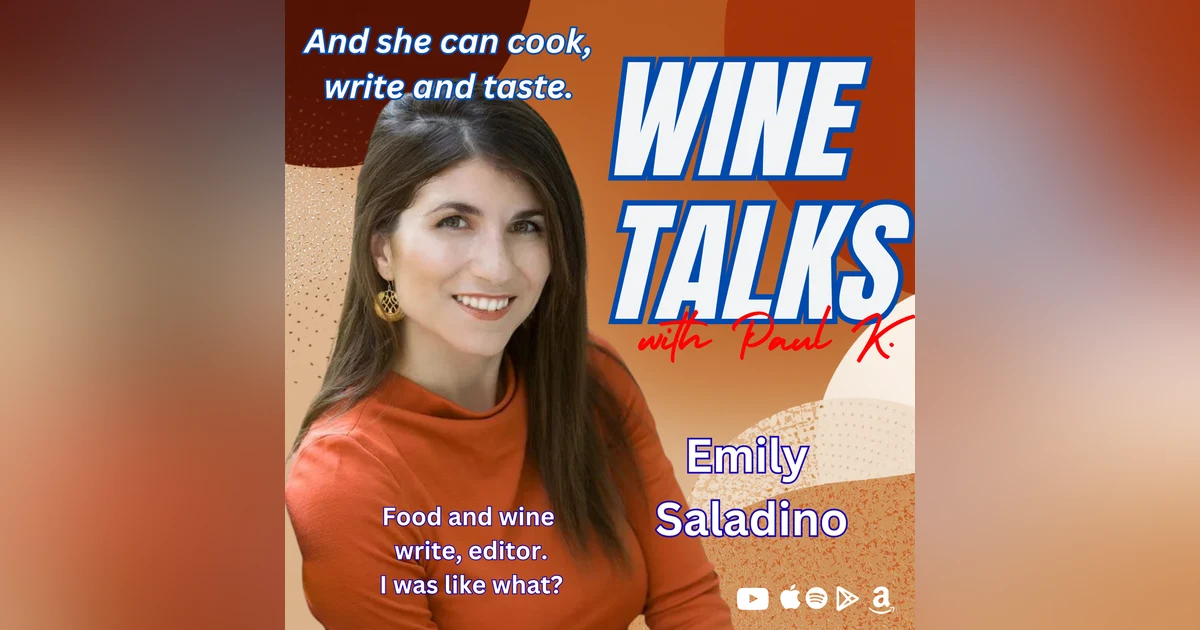

If I was to say I was 'taken"by this young woman, it would be an understatement. Besides her immense accomplishments in the world of cooking, wine and writing, her humility will set her apart. I think if all the world of hospitality took on her world view, the world would be in a better place.
If you think Emily Saladino is just another name among wine writers, wait until you join her at the table—because the conversation quickly shifts from ordinary pours to the kind of deep, delicious stories you want to savor and swirl for hours. Emily Saladino doesn’t just write about food and wine; she dismantles the myths, exposes the secret handshakes of the wine world, and invites you to explore flavors the average drinker might never encounter. This episode of Wine Talks promises to make you see your next glass—and your next plate—in an entirely new light, blending practical knowledge with high-spirited tales from the frontlines of food media, international tastings, and vibrant family reunions where new bottles meet skeptical drinkers.
From the first sip, you’ll be hooked by Emily Saladino’s approach to making wine accessible, even as she navigates the high-stakes, jargon-filled world of tastings and reviews. Ever wondered why orange wine is suddenly everywhere, or why some people seem to speak an entirely different language around wine labels and tasting notes? Emily Saladino breaks it all down, sharing candid moments—like explaining to her own family in New Jersey that “orange” wine isn’t made from citrus. She reveals how different corners of the country, and the globe, have differing encounters with flavor, tradition, and the very concept of wine itself.
As the story unfolds, Paul K joins Emily Saladino in questioning why American wine consumers still face so many hurdles when trying to find “real” wine—the kind that isn’t mass-produced, stripped of its origin, or drowned in celebrity hype. Their conversation exposes the complex machinery behind wine distribution and answers pressing questions: Why do some regions have to market themselves with words like “natural” or “biodynamic” to catch your attention? Are these just buzzwords, or genuine guideposts to better, more honest wine? Together, they recount adventures among ancient vineyards in Georgia and Armenia, tasting the difference that truly local food and attentive farming make.
Prepare to get hungry, as well as thirsty, when Emily Saladino and Paul K turn toward the kitchen and table. The episode dives into food’s forgotten rules—like only eating strawberries in season—and explores how America’s obsession with convenience has dulled our collective palate. Yet, the revival is underway, powered by younger generations seeking out genuine ingredients and regional specialties, and fueled by experiences that prove the difference between bland trucked-in tomatoes and those dug fresh that morning is bigger than you’d ever guess.
What’s in it for you? Beyond the lively banter and bold ideas, you’ll walk away with a glass full of actionable insight and newfound confidence. This isn’t just a story about wine—it’s an invitation to taste, question, and celebrate more:
-
🍷 The secret behind the wine world’s three-tier system—and how it shapes every bottle you buy
-
🍷 Why “orange wine” turns heads (and sparks confusion) in both hipster bars and family BBQs
-
🍷 How industrial agriculture shaped modern taste—and how local, sustainable food could rescue it
-
🍷 Why fancy terms like “natural” and “biodynamic” matter (or sometimes don’t)
-
🍷 The single conversation that can open wine’s closed doors for new drinkers
-
🍷 How memory, flavor, and the story in your glass can connect generations and cultures
With Emily Saladino at the mic, you’re not just learning the ins and outs of wine and food—you’re discovering the beauty of not having all the answers, but being passionate enough to keep tasting, keep learning, and savoring every unexpected detail along the way.
YouTube: https://youtu.be/bCs7a7dfPVQ
-
Wine Enthusiast: https://www.winemag.com
-
VinePair: https://vinepair.com
-
Food Network: https://www.foodnetwork.com
-
Pie 'n Burger: https://www.pienburger.com
-
iHeartRadio: https://www.iheart.com
-
Spotify: https://www.spotify.com
-
Pandora: https://www.pandora.com
-
Blue Hill at Stone Barns: https://www.bluehillfarm.com
-
EmilySaladino.com: https://www.emilysaladino.com
0:00 What gets me excited about working in wine and food, but particularly in wine, because I think it does have this bit of an impenetrable reputation, I get really excited about the fact that there's so many audiences to be reaching. Like, there's so many people to get into wine. Sit back and grab a glass. It's Wine Talks with Paul Kaye. Hey, welcome to Wine Talks with Paul Kaye, and we are in studio today in beautiful but hot Southern California. About to have a conversation with Emily Saladino way out in New York. Introductions in just a moment. Wine Talks, of course, available on iHeartRadio, Spotify, Pandora, wherever you hang out for podcasting. And do me a favor, let's subscribe to one of those services and let's listen to the podcast. I want to tell you guys, there's something very interesting that I just released. I was in Armenia for 3 podcasts, actually. They gave me a studio downtown. Had an incredible conversation with the first wine bar owner in Armenia. Then with Vahye Kushgarian, who I think is probably one of the most brilliant winemakers, of course, in Armenia, but probably the world actually, at least most versed. And then I had a conversation with James Tufankian, who is the distant relative of my wife, a hotelier in Armenia, and had a very insightful philosophical, philosophical, easy for you to say, conversation. So listen to those, subscribe, and please you have nothing nice to say, don't say it at all. But if you have something good, go ahead and rate the show for me. Anyway, Emily, welcome to the show.
1:32 Hey, how are you? I'm doing great today. Thanks. You know, we had a, we had a huge party over the weekend for my 4-year-old daughter, granddaughter, who, 4-year-old daughter, that'd be trouble. 4-year-old granddaughter who was just cleared of cancer after suffering through chemotherapy. And so we had 200 people at our home. Wow. Oh, I'm so happy to hear it. Thank you. And since you're in the culinary side of things as well, we'll talk about that. We had one of the local burger joints called Pie 'n Burger, very famous place in Pasadena, come and cater and everybody freaked because their burgers are the best. Oh, that sounds like a really lovely weekend. I'm so glad. Yes, we were very fortunate for that. You are the culinary editor of the Food Network TV show or the TV network.
2:22 You're a writer-at-large for The Wine Enthusiast, one of the great periodicals in our industry. But that's, but you've been around the block a few times when it comes to, I don't mean that any other way except about writing and wine and food. So tell me about a little bit about some of the things you've done with the wine world. Sure, sure. So I came into wine sort of through food. I worked, I went to culinary school and worked in restaurants for quite a while. And then I was approached by this website called VinePair about coming on to do editorial for them. And I had written a lot about food and beverage, and wine was always on the periphery, but I really came into it through food. I feel really lucky to have worked in restaurants and gotten to taste some bottles that quite honestly weren't as affordable to me personally, but you might get to taste at a restaurant or in a wine shop, anything like that. So I came into VinePair in 2017. So I'm relatively new to wine. And through there, I studied it. I went into some of the, you know, there's WSET programs. There's all sorts of ways to learn about wine. As I said, I feel like I learned a lot also from restaurants. And so from VinePair, I started working with Wine Enthusiast after I joined them in 2019. I worked in the office for 3 months and then we, it was March 2020. So I was only in the office for a short amount of time. But I worked there for about 2 and a half years. years as the managing editor.
3:54 And now I work freelance for them. I contribute articles, but I also review wines from Georgia and Greece. So not Armenia, regrettably, but right near it, next door in Georgia. That's right. Yeah. I've not been to Armenia. Yeah. I've been dying to go. It's such an interesting time for their wine industry. Both those, both Greece and— and I had an influencer on, a Greek influencer. She was really interesting. to do. But I'm gonna go back just a second. You said something very interesting where you got a chance to taste wines of great repute and not have to, you know, invest in them like most do. We're going to talk about investing in wine and Burgundy as well on the show because I've read many of your articles. I think it's at emilysaladino.com.
4:36 Emily, E-M-I-L-Y-S-A-L-A-D-I-N-O.com. There's some great articles there for the listeners to log on and check, take a look. But one of the things you said about Investing in wine and the value of tasting wines of that quality. I went to a lunch the other day. I was invited to a lunch and it was a long way from home and I thought, oh, I got to drive out there and taste wine. And the host of the lunch had told me, he goes, you know, I do this because I get for $8,000, which I'm assuming is what he put up for this lunch and the wines he bought, I get to taste $80,000 worth of wine. You know, that's a pretty good deal, right? The guy's got it figured out. No, I think that's fair. Because he gets to, they try to one-up each other. There's like 7, 9 guys in this group and they have lunch and then they bring wine. So we had a vertical of Penfolds Grange, you know, from like 1986 to 2007 or something. It was like incredible, right? It was just incredible. So anyway, interesting way to learn about wine.
5:38 to jump in on those tastings for the value of it and not having to do that. But let's talk about Georgia. You wrote an article about orange wine, and we're going to get into some pet peeves of mine when it comes to this industry, what's going on out there. But, you know, Georgia was, as part of the Soviet bloc, you know, told to make the still wines. Armenians were told to make the brandy. The Russians were making sparkling wine, and the Moldavians were making low-end, you know, whatever. So, but tell me, tell me about the reception of Georgian wines in America right now. And, you know, orange being one of the great things they've always made for a long time. What have you seen as far as consumerism?
6:20 It's so fascinating because I think, you know, here in New York where I live, um, I imagine parts of LA are quite similar. It's almost— you expect to have an orange, at least one, like maybe 4. Um, and so in that way, I think that's skin contact wine has become really, really mainstream in certain corners of the US. But if you exit some of these cities, it's not uncommon for people to be like, is it made with oranges? I mean, I recently attended a family reunion and I was in northern New Jersey where my mother lives, and I had relatives from all over, and I brought some skin contact wines. And I mean, half of my relatives had never heard of such a thing. I should probably say upfront that I don't come from a wine drinking family or a family in media. You know, I'm a bit of an anomaly. So. But no, I think that it's interesting to see the diversity among the reception, within rather I should say, the reception of Orange and Georgia. There's times when I tell people I review wines from Georgia for Wine Enthusiast and they say, the state? No way.
7:24 This is a bit of a Captain Obvious point, but we live in a really big country. There's such diversity within the market. And so I think there's folks who are for whom Georgian and orange wine are so exciting, if not even approaching played out, right? Like they feel like they know it already. And then there's folks who've never heard of such a thing. So I just, I think there's so much possibility. My biggest kind of what gets me excited about working in wine and food, but particularly in wine, because I think it does have this bit of an impenetrable reputation. I get really excited about the fact that there's so many audiences to be reaching. Like there's so many people to to get into wine. You know, we, we in the wine industry often wring our hands and clutch our pearls over losing audience and market share. But I would argue there's so many more people that we could be reaching. So that to me is exciting.
8:16 Like, I like that there's places where orange wine is, you know, as I said, almost passé because people feel like, oh, it's been 2 years now. I'm done. I'm ready to move on to something else. Right. Or, and then there's other, there's places where people have never heard of it and don't, you know, don't know where Georgia, the country Georgia is on a map. I think that's accurate for just about any segment of our industry. You know, it's one of the questions I wanted to talk to you about, but wine, orange wine is not new. It's been around for billions of years. The Georgians have been making it forever. They've been making it under, you know, in amphorae that are buried in the ground. And, and so, and what is it? It really is, it's for the listeners, it's just white grapes processed and fermented like red grapes. And so as the opposite of rosé is the opposite, is red grapes fermented like white grapes. So This isn't a new thing. You know, wine vintners for thousands of years have been playing around different things to do. And so it becomes a fad. And then it, for me, it's, it felt like it became a reason to make substandard wine. In other words, well, it's natural, quote unquote, we'll define natural in a second, but it's natural and it's skin contact. And then it tastes like, you know, like horse dung. And then you have to like muscle it down because you think you're doing something healthy. It doesn't have to be that way, does it?
9:34 Right, right. There's so many exceptional orange wines, and then there's so many borderline undrinkable orange wines because, as you said, because, you know, smart, smart producers saw that there's a market for it and people are buying it. It reminds me of, you know, in certain ways of rosé about 10, 15 years ago in the US where producers just saw that people were spending money on it. So it was like, sure, I can, I can bottle you something pink. And I think that happens, right? And the risk there is that it can turn someone off of the entire category, right? You can have one of those orange wines that taste like you're just consuming pennies, like you're just like drinking liquefied copper. And that's a bummer, right? Like that can easily turn you off. But the hope is that, and my, you know, the reason, one of the things that I'm particularly enthusiastic about skin contact is that I do think about orange. Sorry, I use those terms interchangeably. That's totally fine. Yeah, one of the things that does get me excited about orange in particular is I just think there's such opportunity to have conversations there, to talk about the diversity within it, to talk about the fact that you can have these really ancient ones with this long, long, long history, and then you can have these kind of brand new kids on the block who are trying it on for size, and it's going to taste different. But you can have these really rich, tannic wines, or you can have something really light and easy drinking, and they're both orange.
10:58 I think that's kind of a cool— I don't know, that's a cool aspect of this segment. Well, it's kind of interesting because we— I had dinner last night, and I think— I'm sure, as, as at your, at your family reunion recently, um, you know, the conversation always seems to come back to wine. And I try not to be like the guy in the room who everybody's asking the questions to, but they want to know. People really want to understand what it is, and they have questions, and they, they're intimidated, blah, and all the things that go in our industry that probably aren't gonna change soon. But all the things you just mentioned about orange wine, I mean, really can be said about Burgundy. It can be said about Bordeaux, Cab, Napa Cabs. You can have those same conversations. And the, and the industry's reeling from consumerism issues right now. There's a radical change in, in post-COVID consumption, radical changes in post-COVID online purchasing. And so it's, we're all trying to figure out, you know, ground our feet as to figure out what's going on. And I, and I think what you're doing is, is incredible because you're trying to educate at one segment, which is great, the segment that has some questions that people want to understand.
12:04 And the more questions people ask, you know, the better off we are as an industry to move away from Josh, Apothec Red, and all that stuff we see on the shelf, right? past the supermarket wines and get people engaged in these interesting things? You have a solution for that? Because if I want to write it down, right? I was going to say million-dollar idea right here. I mean, my solution, and unfortunately it's not one that I personally can implement, I think it's the, the problem is the, the 3-tier system. I think that just makes it so difficult to get your hands on things that aren't mass-produced and distributed. So that to me is, that's if you've got the ability to dismantle that, I think we're Really, you know what, kudos, we've done it. But otherwise— That would be super. Yeah, right?
12:55 Otherwise, I think it comes down to folks like you who have expertise, you know, to people who are just kind of open to saying like, let's have a conversation. As you said, like everyone has questions. And I do think there's a lot of, I don't know, hunger for that knowledge, but people are really scared of mispronouncing names. I wanna be really upfront about the fact that like I mispronounce things all the time. Most people mispronounce my last name and I'm not upset about it. Like, it's okay. No, it's, I just think the more we can kind of like take the edge off of these conversations, the better. I have to say, you pronounced my last name flawlessly. I was really impressed. Most folks— I'm from Santa California. Thank you. No, I was delighted. But no, I do. I think that the more we can kind of like take the edge off of these conversations so that you don't feel like you have to know, the folks who are truly into wine are so happy to not know things. Like, that's what makes wine so exciting is that I feel like it's a lifelong process. I'll be studying it Forever. I think that's kind of the thing to remember, to remind ourselves, but also to remind folks who are maybe new to it.
14:00 Like, what is this about wine? And I ask this question, there's no answer to it, that it's thousands of years old. We were fortunate when we were in Armenia to go visit the Adadi Cave, which is a 6,000-year-old winery. I mean, absolutely breathtaking in just the scope of what this thing represents. But you don't get that feeling with bourbon, scotch, beer, you know, Maui Blanc pineapple wine. There's something about grape in the soil that draws you to learn and understand more, and it goes on and on. And I think people would get that bug. And this is my solution. And just for the listeners, the 3-tier system means, as they say, a supplier, which could be an importer or a manufacturer of wine, there's a distributor that is required to be able to sell the wine to the retailer or the restaurant, and then they sell it to you as a consumer. And that's a required methodology of post-Prohibition life. You know, I always contend Prohibition was not repealed, it was just broken up into 50 different, you know, versions of it. And so she's— so Emily's right on in that, uh, and having had that conversation with the RNDC Vice President of Wine last week, you know, they get more, they're getting more powerful because it's getting more difficult to do business. So the little guys are kind of fading away and it becomes a numbers game at this point. And so we don't get to share things like Georgian wines. I mean, I don't even know if the Georgian wine distributor in LA is still around. His
15:31 name was Stetson Robbins. Do you know him? Oh, I don't know him. I, yeah, I will say Georgia in particular has done, has really made a lot of efforts and invested, quite honestly, in the last year or 2 to try to, you know, they're targeting the US. And so that is great news for me personally, someone who loves Georgian culture and wine. But it's also great news, you know, for drinkers. That's the thing though, is it does require investment and it requires capital to get these wines not just over to the US, but throughout the US. And that's, I think that's That's the thing, right? You're reliant on there being like a guy, right? That's a tough situation for any business.
16:14 So, right. And so I think, I don't know, that's the part that kind of, again, if we could just quickly figure out how to dismantle that 3-tier system, that would be super. You and I are good together. We'll figure this out. Right, right. We'll circle back after this podcast. We'll sort it out. Yeah, no worries. You know, there's something interesting about Georgian wines. You know, also you review Greek wines for The Wine Enthusiast, and we've had a lot of those lately come through here. And again, the focus has been natural, biodynamic, organic, and some orange. And I'm thinking to myself, why does a country— Armenia's trying to break into the worldwide market now— why does a country have to have some kind of niche like that when their wines are very good? They're all, you know, there's some really good wines that have lots of history and we know that it takes, it could take 100 years for a vineyard to, for somebody to understand a vineyard's capability and the grapes coming out of it.
17:12 But we're focusing on all these anomaly wines like organic and biodynamic and orange. And I'm wondering why that has to happen. Why does it, why do we have to play that game with the consumer to get them to try these things? Do you have any thoughts on that? It's a great question. I wonder if some of it has to do with just how vast wine is. I think about that sometimes. The word wine encompasses a lot of products. And so I wonder if sometimes that helps consumers feel like, okay, that's one for me. I know that I'm someone who, you know, I like to buy my tomatoes from the farmer's market, not from the grocery store. So I'm going to buy a natural wine or a biodynamic wine. I mean, you kind of alluded to this earlier. The tricky thing there is that there is no internationally agreed upon definition for natural wine. And so It's kind of like, you know, when I go to like a kind of a certain type of grocery store that'll just be like farm fresh eggs and like, what does that mean? Like, there's no designation for farm fresh eggs, right? And it's the same thing with natural wine is you're, you're, it, it can be a really like powerful ethos by which you farm and vinify. It also can be a marketing tool. Both, we can hold both in our hands, you know, both things can be true. And so that's what's tricky is I think that That helps regions, particularly ones that are, that, you know, someplace like Greece and Armenia, these are ancient wine-producing regions, but they are relatively new in the modern US market. I
18:46 say that there's caveats to everything in wine. There obviously have been Greek and Armenian wines in the US, but much, much, much fewer than a lot of producers are trying to distribute in the US now. And so I think that might be it. just a way to kind of differentiate yourself in such a crowded market. Like, it's a way to reach consumers, particularly if you're targeting Gen Z, millennial, younger consumers who tend to buy, I believe, I mean, my gosh, I should fact check this, but I believe that's the larger market for organics and food in the US. So it's a way to kind of reach, to reach a target market, whether or not it works, whether or not it always makes sense. You know, I am, I'm the first person to say like, I'm happy to buy locally grown beets if my local farmer once sprayed pesticide, I still am happy to support them, but that means that they might not qualify as organic, right? I think that there should be flexibility within all of these things. But wine, as I said, it's just so big. It's such a vast category, and people are so eager to find ways to divide it, to kind of categorize and understand it, and sometimes to our own peril. I think there's a— it always stimulates a thought for me, and I say this and I get crazy answers, and I'm not going to ask you the answer, but it would be like if profitability was not part of the equation. You know, ready-to-drink cocktails are hot, so they're flooding tons of investment in the ready-to-drink cocktails, canned wines as well. And so if we weren't driven by profitability and we're trying to do the best we could with what we
20:18 are given by the earth, then, you know, maybe maybe the industry would be different. But do you— I have this philosophy, and maybe because of the age of the industry, that eventually, regardless of your generation, whether you're a millennial, Gen X, baby boomer like me, whatever, that eventually you come around through— you wade through the fads. I mean, we had wine coolers at my dad's wine shop, you know. Right. And you come to the point where you realize that a properly made, or what I call an honest glass of wine, has all you need for the expression and the feeling you want to get when you have a glass of wine. Why you drink wine in the first place isn't— you can drink vodka if you want to catch a buzz, but you drink wine for a different reason. And I think every generation lands there eventually. That's why it's been here for 6,000 years or 10 or whatever the number is. But you said something important. You said something about tomatoes. And so we're going to move into the food side of things because I think it's really important.
21:14 You know, the argument is you are what you eat eats, right? And there's clearly flavor benefits to properly grown vegetables and, and fruits that are farmed fresh. Why do we have the other stuff? Why isn't it all organic? Why isn't it all biodynamic? Why, why did we stray away from, that's what we always did. Oh, what a great question. I wish, kind of like how I wish we could just real quick dismantle the 3-tiered food system. We're dismantling a lot today, I guess. I love it. I know, revolution. I love it. I think industrial agriculture had its reasons for its origin story, right? In the last century, it was a way to get food to all corners of this very big, country for not that much money. And so farms became increasingly corporatized. I'm going to get someone from Big Tomato in my inbox, and I welcome the conversation, ma'am or sir. But no, I do.
22:20 I think that there's a reason why agriculture became industrialized in the last century. I think we're past it now though. I think that it would be really great if we kind of, as you know, vast community of consumers could wrap our minds around, you know, maybe I don't get strawberries in New York in January. Maybe I have to wait for them for the springtime. But unfortunately, we've now created a consumer expectation that you can have strawberries all year round. And yeah, sometimes they might be flown in from far, far, far away and taste sort of like the packaging they come in. And sometimes they might be fresh from the farm and taste so sweet and rich. But there's an expectation that you can always get them. And so that I think is I think that's, that's where, that's the trouble, right? Like that's the sticky part is we, we've created the expectation that you can always have every food and that, that does lower the quality. It just, you know, it's, do you want quality or quantity? I think if, if every listener could go to Armenia or Georgia, I'm sure, and taste an apricot and then find out what an apricot really is supposed to taste like, like my mother's on her big giant tree we had growing up because the stuff you buy in the market has just been, you know, pre-picked or doctored up to last the trip. Don't you ever wonder why the tomato at the bottom of the truck driving down to the 5 freeway here or wherever, Highway 95, and it's not smushed? How come that is that? How can that possibly be? There's like all this weight on top of it. But, you know, Dan
23:51 Barber said in his book, The Third Plate, that organic foods and biodynamic foods you know, the yields are so low that you probably can't feed the world that way. But I've had counterarguments to that comment. So do you think that if everything went organic and/or biodynamic, that there'd be enough wheat and food to do that? I think that for me personally, I would prefer we focus on local over certified organic or biodynamic. Biodynamic, I actually put in a slightly different category because it is a bit more holistic. in my opinion. It is. And so I think that if we just focus, so if we cut out, like you're saying, that huge truck that's taking tomatoes from California over to me in New York, right? Like if we cut, maybe they could, I mean, they could go a couple of miles. I have not yet drawn the radius, so we could sort that out as well. But no, I think that for me, local is possible.
24:54 And like there's all sorts of ways to do it. You can look at hydroponics. Like there's all sorts of ways that we could revolutionize our food system. For me, it's not organic so much as it's just local and sustainable, which are 2 words that, as I said, I've not drawn a map to say the radius of what local is. Sustainable is kind of one of those itchy words that people throw around a lot, kind of like natural wine, but something that can be farmed over and over again without the need for really putting a lot of chemicals into your soil to make it work. That's how I would define sustainable. A farming system that allows for cover crops as well as the cash crop. That's a different— that's a big undertaking. That's a lot harder than just we need to certify organic, right? And certifying organic's hard, but I'm talking about something that would be such a structural overhaul.
25:47 I think that's hard. Systemic change is hard. It is hard. It's what to me would fix it, but I don't have a timeline. I don't have a project manager or Assigned to this task. It's hard, but it's also the desire of a lot, at least farmers in the wine business. Because as one winery owner put it to me out of Tuscany, hey, my kids are playing in that vineyard. So I think in general, what bothers me or what kind of confuses me that we spent all the, we were always organic. We always were even biodynamic in some senses of it. Then we create all this stuff that doctored everything up, and now we're going back to it and, and saying how great we are 'cause we're going back to the way it was in the first place. And we'll, when we talk about Burgundy, we'll talk about that in a second. We'll talk about the same, same concept.
26:38 But at your alma mater, when Dan Berger spoke, not Dan Berger, the author of The Third Plate spoke, he said that a land economist had come to the Blue Hill Farm, And had sat just for lunch, spread some butter on some bread and tasted the butter and asked him if the butter was hand-churned. He said, yes, chef, of course. And then he tasted again and he said, the milk, the cows that made the milk that made this butter, did they graze, you know, in the fertile part of the farm? He said, absolutely.
27:20 And Alain left. And the next day, chef was in the kitchen and looks over and there's an intern using a Cuisinart to make butter. And he goes over, he says, hey, what are you doing? And he goes, oh, I found a faster way to make the butter. He says, how long you been doing that? He goes, a couple of weeks. So Alain Ducasse was able to taste that the butter hadn't been hand churned. He said, a couple days later, I was in at the farm, And I see the cows were missing. And he asked the farmhand where the cows were. He says, I sent 'em to the south because we needed to fertilize the land. And he goes, how long you been doing that? He says, a couple of months. So Alain de Kast was able to taste that the milk from the cows were not from fertile, you know, the food that the cows were eating was, weren't as fertile as it could have been. And I thought, you know, that is so fascinating, right?
28:07 I mean, you can detect And anybody who has one of those tomatoes off one of those trucks will tell you that it tastes like nothing, right? So why don't we want— don't we want our food to taste better? No, we want it to be— Right, right. No, I mean, gosh, my kingdom for Aladdin Ducasse's palate. That's so impressive. Yeah, right. I know. It's pretty amazing. But no, I think you're right. I think that whether or not I can taste the difference, between hand-churned or Cuisinart-churned butter. You know, that aside, I do think that there's— you're making a really powerful point, which is you do taste the difference. You know, I think you can taste the difference in wine. I think you can taste the difference in food. I loved what you said about Armenian apricots. I thought that when I was last in Georgia, I had like boiled salted potatoes with some dill. And I was like, this is the best thing I've ever tasted in my life. No, totally. Because the potatoes had been dug that morning, right? So like, they were so flavorful. And so, I think that there is something to be said. You do taste the difference between things that are farmed in a slightly more immediate way, for lack of better terms, right? Like, if I like to say sustainable and local, like, just things that have a more immediate connection from the earth to your plate, I do think you can taste it.
29:25 Is that the buzz around the Food Network? I mean, what— Food Network would probably be a place to, you know, we want more viewers and we're going to put shows on that people are interested in watching. But Like sort of the bowels of the people that work there? Is this an objective to not only create food that tastes great, but as, as natural and as expressive as possible? I mean, I don't want to speak for the organization. I will say most of my colleagues, we are lucky enough to be about 2 blocks from one of the biggest farmers markets in New York. And I will say most of my colleagues, myself included, like go on our lunch break to do our grocery shopping. Like it is. Yeah. And I mean, that is, that's a privilege, right? Like that's such an asset. to being in certain destinations and certain geographic areas. But that's kind of what I— that's sort of the revolution that I would love to see realized in our lifetimes is for that to be doable for everyone. And if that means we don't eat strawberries in January, that means we don't eat strawberries in January. I think, Felicia, what Emily's saying is that, you know, the seasonality is— there's a reason why nature does that. There's a reason why we only typically have strawberries at a certain part of the year and tomatoes at a certain part of the year. And that's when they taste best, even though they're being tricked into thinking that the season's on right now. Right? Right. But you wrote this article about butter and I thought that was fascinating, but you brought up the AOP designations in France, Appellation d'Origine Protégée, which protects food,
30:57 wine, cheese, butter, what, lentils, all kinds of foodstuffs in France. And as the New World, we look to the Old World, what I do anyway, and I'm jealous of this, you know, that they've protected their, the regional characters of their food and their wine. But the French will come to America and say, this is the New World, and guess what? We get to do whatever we want. So if we want to grow Cabernet somewhere, we can just grow it. And if we want to grow Pinot somewhere, we can just grow it. But are you nostalgic for this AOP system and that it has protections of the character of our regions? I think for me, I don't know if I'm nostalgic for that in particular.
31:40 I am, I envy sometimes folks anywhere in any corner of the globe who put an emphasis on growing things where they're meant to be grown, on producing things in a very natural kind of— the hyphenate farm-to-table, I think, has been used to the point where it doesn't mean anything anymore. And a colleague of mine once said, he's like, I mean, it's always a farm. It just might not be a farm you like. And I was like, I think that's a very strong edit. That's a good one. But no, so, you know, I think that— so I'm envious of any place, any community, any, you know, anyone who puts a strong, who puts a lot of emphasis on where things are grown and why and how.
32:26 So I think for me, that's what's so interesting about a system like what they have in France and Spain. And, you know, they have it in Martinique for rum. Like there's all sorts of ways to kind of make sure you're making things in a traditional way. The tricky thing there is like who, who's the governing body, who decides what's important and what's not. Like, and I think that's where I'm like, I don't quite envy the system. I like the mindset, right? Like, I worry the system can be exclusionary, whereas the mindset I think is available to all of us. There's a book, The 10 Restaurants That Changed America. Oh yeah. Dr. Friedman. And he talked, and it's fascinating stories. None of the restaurants you'd expect, like McDonald's isn't mentioned. Restaurants like Le Pavillon, which started in New York after the 1939 or '36 World's Fair and, you know, became probably the institution that started the food cuisine of America, the change of cuisine in America. But he also cites Howard Johnson's.
33:37 You're so young, that you may not even know. Howard Johnson's was, you know, a coast-to-coast hotel chain, motor lodge, but it also had restaurants. So you were guaranteed the same character hamburger in Los Angeles as you were in Illinois or New York. And it's also the reason why maybe American food designations sort of got blurred. Right. And maybe because we built highways and we could go And we could be comfortable. Well, here's another way to put it. I went to Pennsylvania once with a software engineer back in an earlier career, and he wanted to go to Denny's. I'm like, we're in like Amish country.
34:19 Why do you want to go to Denny's? You want to have a patty melt? We could have had some cool local cuisine, you know? But do you see that coming back? Do you see in your travels with the Food Network, do you see regional cuisine is sort of making its way back into the American households? First of all, I love that you were traveling with someone who's like, I just need a Grand Slam breakfast. It's the only thing that will sate me. I just absolutely love that. But no, you know, I do think that there is— I'm very enthusiastic about the generation that's coming up right now, the Gen Z consumers. I think they're just very savvy. I think there's a real movement toward exactly what you're saying to being like, okay, if I'm in Amish country, where should I go that's only in Amish country? And I think that for me, that gets me really excited. You know, the children are our future. No, that gets me really excited to see— Oh, we're in trouble.
35:19 Yeah, I know. That gets me very excited to see, you know, to see consumers becoming so savvy, to see people being so open. As I said, I do think, you know, what you're touching on with Howard Johnson's And what we were saying, or what I was saying earlier about industrialized agriculture, they came from— I don't think it's a mystery that it was really hard to get safe-to-consume meat. I get why we standardized things in the last century. I just am like, well, we're past that now, right? We can move into a new era. And if it's one where Gen Z is leading me to dine in the most local establishment possible, sign me up. I'm there. I think that's a really I think that's an exciting aspect of the direction that food is going. You think? Because, you know, I think I was talking to Jonathan Waxman. He was, I forgot the number he quoted, like 90% of people drink, you know, eat fast food when they go out. And so that obviously is very non-regional and nor exquisite. But coupled with this idea we were talking about, you have an article about Burgundy on your on your website and Jason Palmeyer, who tried to buy a property in Burgundy, got nixed because it's very difficult to do. But he says that all oenophiles end up in Burgundy. My philosophy is, is because the complexity is easier to feel than in a Cabernet or at Bordeaux.
36:48 It's crazy good in the sense of You know, massaging the wines and the palate feel of a properly made Burgundy. But I'm wondering if that— Jason's comment about every oenophile ends up in Burgundy trying to figure out what's going on there, that if food doesn't have that same sort of path where when we start educating palates on more complex food or even simple food like potatoes from Georgia that are properly grown, that we start educating the palate about what, what could be. Oh, I love that. I think that's super interesting. You know, I, when I went to, I went to culinary school in New York and it was a French culinary, it's the French Culinary Institute, which since has merged with ICE, I-C-E, and which is the Institute of Culinary Education. And when I was there, a lot of my classmates were international students and it was super fascinating to learn the ways that they had been kind of folks from other corners of the world had had been brought up to approach kind of what you're talking about, ingredients, not even food, not even preparation, but the individual ingredients. And so I do think there is something to that, right? If we focus on what things taste like when they're grown in a certain way, and then how you can prepare them so that they taste very differently, I think there's— that's really exciting too. That's a really, really great, smart, sustainable direction to take our attentions. And that's something that also I think we— I do see it happening. I do see people becoming more interested in ingredients. Sometimes in an almost
38:21 ridiculous way. Like, you know, people zeroing in on something that I'm like, okay, I mean, if that's the size flake salt you need, then that's the size flake salt you need. But, but no, I do. I think that there is a, that sort of, that sort of faddishness. I'll take that overcorrection, right? Like, I think that might be a pendulum swing. And then maybe we'll come to the center where we are just kind of treating ingredients as the, like, interesting multifaceted things that they are. And then going from there, as opposed to being like, I need everything to taste the exactly like this one dish my mom made, go, right? Like, I think it's a more, I don't know, it's a more sustainable, it's also just more interesting way to nourish ourselves, to sustain ourselves. We all gotta eat. So I just think that's a really cool way to approach it. You know, something so fascinating just triggered a thought. Have you seen the show Drops of God? It's on Apple. I haven't yet seen it. I've heard such great things that I never read the book. I'm dying to, I'm dying My wife and I binged on it like 2 days. We watched 8 episodes in 2 days. And they're like an hour, you know, so we were— You prioritized it, you know, you made it a priority. But they sort of reinforced something that we've always known, particularly with food and with wine, that the sense of smell is such a memorable sense as well as taste, but smell evokes amazing historical sense.
39:45 And Having done this for 35 years, you know, I can smell something that's 15 years ago that I tasted it and I'll remember. And we were in Paris the trip before last and we went to a, you know, a tourist bistro and I ordered the quiche. Yes, real men eat quiche. So, and they put it on the front of me and I freaked out because I went back about 50 years when my mom made the same one. Wow. And I just sat there and my wife's like, what's wrong with you? I said, I cannot believe this historical sort of ancient nose that I'm picking up and the memory it evokes. And wine is like that if it's complex enough. And so last night we were at a dinner party and the guy was pouring nice wines, you know, Joseph Phelps Cabernet, Stag's Leap Cabernet. And I, you know, I drank them and I enjoyed them, but they weren't thought-provoking.
40:37 Mm-hmm. Is the popularity of the Food Network and the shows that it puts on and the, you know, the hands-on thing, is that, you think it's because there's this awareness now of good food on the horizon? Oh, that's so interesting. That's such an interesting question. I do. I mean, I see just within, you know, the last 20 years, the way that food culture in the US has evolved is night and day. It is wild, you know? And so I do think that, you know, kind of what we were saying about younger generations, Right. Like, I do think there's just a, there's a higher degree of awareness of food and cooking. And, you know, there was a time I know that like, within the very recent history, you know, before the new millennium, there was a time when working in restaurants and being a cook was not nearly as highly regarded as it is now.
41:29 And to anyone who's listening who wants to work in restaurants, please know that I love restaurants. I think the world, working in restaurants changed my life. It's really hard work. It's extremely difficult. Very hard. You're standing, it's hot, the hours are long, it is punishing. And so like, that's to me, you know, of course we should give these folks a lot of respect. But, you know, just seeing the ways that cooking has kind of evolved, and you don't— it doesn't even need to be professional, seeing the direction that attention has gone toward home cooks, I think is really important. That's exciting to me. I see that like within my lifetime, I just see this revolution in terms of the ways that people think about and approach food. It used to be that if I wanted to talk about food or ingredients or a restaurant or a recipe, I had like a set group of friends I could talk about that with. And now I think almost anyone, like almost anyone will talk to me. You know, there's, there's just a little bit more of a, of an understanding of food as culture than I think there used to be. I read, what is it called? Salt, Heat. Oh, Salt, Fat, Acid, Heat. I love that book. Yeah. Yeah. It changed so much of how I look because we cook a lot at the house. And I love, my mom was a great cook and so I just sort of just sat, I used to sit on the counter, watch my mom cook and discuss whatever we were discussing. And so it just sort of rubbed off. But boy, you know, those simple techniques, one I'll tell the listeners, hyper-salting water as you're boiling vegetables, it protects the color and gives it a nice, you know, bright character, but not salty. You know, you don't
43:01 taste the salt, it just happens to punch things up. But what a great book to help people understand the nuances of simple changes that make the food just better. Right. I think it's important. Absolutely. And, you know, breaking food down into elements like that is— it's funny that I remember in— I can't remember if it's in the intro to her book or in the Netflix special that she had where it's like there's one episode for each, for salt, for fat, for acid, for heat. And I can't remember where she said it, but she— Sami Nosrat, the woman who wrote the book, talks about how she almost couldn't believe that no one had done this before. And I think that's very funny, right? But like breaking food down into those elements, into thinking about it in those 4 elements, it's such a smart way to approach food. It's such a helpful way for home cooks. If you're starting out cooking and you're like, what about this feels— why don't I love what this tastes like? I mean, the answer is often a squeeze of lemon, a little bit of olive oil or butter or some salt, right? Salt. Like it's often as easy as that. And to kind of empower people in that way is to me really like, I don't know, that's one of the things that I thought For me, made that book and that special so, so cool. It is chemistry. I mean, my mom used to say it's chemistry. Right, exactly. It's chemistry. So, you know, you're right. You know, it's funny when we cook and we have guests or friends, that's part of the discussion besides the wine, which is always part of the discussion. It's always like, oh, what did you do here? What did you do? And there's this, there's an Asian man on
44:33 Instagram or TikTok, I can't remember, who's a fascinating, quick recipes. He puts what the ingredients are, he shows you what to do with them. And I made this chicken dish for my wife's friends. They were doing a charity event at the house and they needed dinner. So I made this thing, it was so good. And they thought I was a genius. And all I did is literally, all I did was follow my phone. I hid my phone so they couldn't see it, you know? Totally. It's in there. No, I think that's, you know, that's something else that I think, you know, I know it's really annoying to be so positive all the time, but I do think that's something else that gets me really excited about this current era is there are all of these techniques and perspectives and points of view that are available to us just in the magic antisocial box of our phone. Like, that is a really, really, like, interesting thing. And there's a lot of pros and cons, but it does open Yeah. If you be disciplined, I can only watch TikTok for half an hour at a time. No, I'm kidding. You used the word enophile in an article, and it's an interesting word because it's sort of intimidating. In fact, I tried out for You Bet Your Life, which was an old Groucho Marx show, and you're supposed to introduce yourself and say who you are. And I said, I'm an enophile, thinking that would stimulate interest. I didn't get on the show. So, but oenophile being somebody who studies wine, of course. And then I started thinking, you don't have to be an oenophile
46:06 to enjoy a good glass of wine, right? For sure. And I also find that when somebody does have a good glass of wine, what you and I, you know, as wine people sort of get a chance to taste, they always say, wow, this is really good. It's getting away from the store market. And I think to myself, okay, they don't, they don't, can't describe the complexity. They don't need to be able to describe the complexity. They don't need to describe the weight of the balance or any of those things that go on. They can just realize that there's something special about this wine. Absolutely. And I think food's the same way.
46:46 Absolutely. No, I do think that there is, you know, You kind of can't miss quality, you know? You can, you can like some things more than others, but when something is really well made, whether it's a wine or a dish or well produced, whether it's a, you know, a grape or another ingredient, you taste it. Yeah, right. You know, I don't— I might not yet have the vocabulary for certain things. There's all sorts of, you know, I'm not an expert in shellfish. And so like, there's all sorts of shellfish that I'm always like, okay, so I gotta taste the difference between these clams. Like, I'm gonna have a hard time. Yeah, that's right. They can tell you. Yeah. Yeah, yeah. And you're like, okay, so this one grows exactly where? It likes what kind of sand? You know, I think that, you know, I think that there's all sorts of ways to, like, you can kind of get into food and beverage in a lot of ways and you don't have to know all of the answers. You know, I taste certain wines from certain regions and I might know that people are going to say leather, cocoa, or whatever as like tasting notes, but that doesn't mean I'm not tasting the same wine as you, you know what I mean? Like, that doesn't mean that— and also doesn't mean that I might not be flummoxed by the wine and be like, I don't taste cocoa or leather, because sometimes you don't. And so you can get it your own way. I think that there's, you know, there's absolutely the best ways to get into wine is to just drink it and like, problem solved. No, the best way to get into wine is to get, you know, to get exposed to as much as possible. Just do it. Yeah. Yeah. So like, there's no, you know, there's, there's no, there's no shame in whichever way you do it, whether you go and you buy like like a $10 bottle, you go to a restaurant and you taste
48:17 a glass. Like, there's just so many ways that you can. And like, that to me is the best way to get ourselves to that Alain Ducasse palate where we're like, was it harvested in late October or was it harvested in mid-October? You know what I mean? I want to get there. But I think that to me, that's the best way. It's just tasting. You know, I didn't finish the hearts. I don't know. I asked the question. I never followed up. The Cups of gold, God thing. What it comes down to, and I won't tell the end of it, I won't tell you the whole story because it's very fun and very dramatic and the whole thing. But the reason what you just said, which is not everybody can describe this, nobody can describe that, nobody's going to taste 100,000 wines like I've been privileged to do. So you, that experience, you know, goes a long way to do those descriptions, but it's not really the point. The point is understanding what is a good glass of wine. And it comes down, a lot of it comes down to the story. You know, a lot of it comes down to how it got in this glass. And Michel Rolland, who's, you know, one of the great enologists of the world, you know, his comment generally is it takes 100 years for somebody to understand a vineyard because all the variables that go into making, forget the making part of the wine, just the growing of the grapes, you know, the temperature changes and the types of weather and the climate and the terroir and all those things that go into a grape, you know, all the macerations, even 100 years, 'cause you only get one time, you only get one chance a year. That's the part That's so funny. That's just interesting to me. But the Hearts, the Drops of God
49:48 story ends up being about the story and it's kind of fascinating that way. And this is what I'm about. The show's about is the stories behind people like you. The stories behind winemakers that are trying to make a difference is what people should understand. At this lunch I went to the other day, he poured 2, and I'm not saying this because I I think, because I've never really do this blind tasting. And I see you were a judge for the Wine Spirits Competition. But I suppose after literally 100,000 wines in 35 years, every Tuesday of tasting wine, something, something stuck. I feel confident something stuck. So it's a bunch of guys and they're all, like I said, they're trying to outdo each other every month.
50:37 with who's going to spend the most money and to do the vertical. And this guy brought 2 whites and they're all talking about their thing. It's from California, it's a Chardonnay. There's obviously the one was older than the other, the color and all that. And I was a little, I didn't want to be arrogant. I didn't want to be obnoxious and I didn't want to be the guy at the table because I've done all this. So I just sat there and I don't know who they are, but I said one thing. I said, this is Marsanne and Roussanne blend and it's from La Rome. That's all I said. And they continued to talk and nobody agreed with me. And then And the host says, it's Marsanne Roussanne from the Rhône. Now, I'm not saying that because I've never really done blind tasting like that formally, but what happened was, and I think this is for the listener, was I just started turning in my head what it wasn't. It clearly wasn't California Chardonnay. It clearly wasn't over-oaked. It clearly wasn't South American. It clearly wasn't Spain. How do I know that? Because I've tasted so many of them that I the character there. I just landed in the Rome because that's what sent me there with deduction.
51:39 Right. And it came from just experiencing and trying things. Right. Like you said, how are you going to have— how do you know that a clam, you know, from whether it's from the East Coast or the West Coast until you've tasted them and you say, oh yeah, I get it now. Right. Anyway. Right. Right. Also, I got to get in on your friend group. This group of people. Yeah. Well, no, I'm probably not reinvited. Yeah. This guy ruined our blind tasting. I don't know if I want to spring for like $5,000, $6,000 worth of wine that night, but it's, it was super fun. I've got a really good $21 bottle right here. Yeah. Yes. Hey, I earned a living for 35 years selling wines for $15 that were, you know, there's a lot of good ones out there. There's so much value. There is. There is. There's probably many wines. You know, we're almost on an hour, Emily.
52:32 It's been really fascinating. We have so much more to talk about. And I hope we can do it again. When, if you're out here, for sure, if you come to Los Angeles, I have a beautiful studio. You're seeing part of it. This is, by the way, this is my father in 1975. And that's me in 1975 in front of my dad's wine shop. Get out. Oh my gosh. What a lovely mural. That's super cool. This lady— Or it's not a mural, I guess. Is it a photograph that you— No, it's a painting. It's a painting a woman did. With a local artist who's really talented, obviously. And she just took a picture and she just like, you know, was doing this and made it work. How cool. But fascinating conversation and I wish you luck and I hope if we're out in New York, my daughter is no longer in Manhattan. She's in Potsdam. Oh, nice. Not too far. As north New York as you can get. Not too far. Yeah.
53:24 The last question, that's what I didn't actually want to ask this. What is it? What's your daily routine then with it? Are you at the office every day with the Food Network, or are we writing things every day? What are we doing? I go into the office 3 days a week. The other 2, I work from home. I think that perhaps much in the way that I remember I heard you say on a previous episode that, like, it sounds really glamorous that you work in wine, but, like, it's 1 day a week that you're tasting. It's not every day you're surrounded by bottles and glasses. Hey, you were listening. Right. Much in the same way, I think that it sounds really glamorous, but a lot of times it's just me hunched over a laptop. Or in my kitchen, like, you know, do I'm working on recipes, like, you know, sweating. So I, it's, it's a little bit of both. I do some work in, um, in kitchens doing recipe development and I do some work on, on laptops writing. And then about once a month I go into Wine Enthusiast to taste there.
54:16 I'm going to call you separately and ask, consult with you because I've been dying to build a demonstration kitchen in this building here. Oh, how cool. And, uh, have access to all kinds of cool stuff. And so when that occurs, we'll get your input. I would be honored. Thank you. Thank you for today. This was a lot of fun and we'll do it again. And best of luck the rest of the week. Absolutely. And if you do, look us up when you're out in town in Los Angeles the next time out. Will do. Thank you so much for having me. Cheers.