

 Apple Podcasts

 Spotify

 Youtube Music

 RSS Feed
 YouTube
 Pandora
 iHeartRadio
Why Bordeaux Châteaux Are Embracing Experiential Wine Tourism; with Jean-Louis Carbonnier
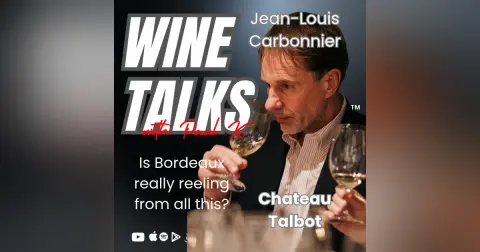

Jean-Louis Carbonnier may be the only man who can argue that Champagne is just what the doctor ordered—for both your heart and your spirits. From the heart of Reims to the vibrancy of New York City, his story uncorks more than just great wine; it uncorks the challenges, transformations, and opportunities that come with introducing French wine to the American palate. The episode kicks off with personal tales of language, family, and the culture shock that comes from swapping the vineyards of Champagne for the skyline of Manhattan, drawing listeners into an authentic, cross-continental adventure.
The discussion quickly bubbles over into the world of wine law, where Jean-Louis found himself defending the identity of Champagne against American sparkling wine producers. The conversation focused on the high-stakes battle over geographic names, trademark struggles, and why a simple bottle of bubbly can trigger international legal disputes. Through stories involving everything from perfume bottles shaped like corks to the legacy of "grandfathered" American brands, listeners receive an insider's view of how region and reputation are meticulously guarded in the wine world.
The conversation then decants layers of the wine business that most consumers never see: the evolution of Bordeaux hospitality and the modern PR strategies required to shine in an overcrowded market. One concept discussed was Bordeaux's shift from insularity to welcoming visitors, injecting warmth and experience into what was once seen as an inaccessible, even "arrogant" region. The discussion explored the rise of high-end tasting experiences, the importance of personal connections, and the relentless drive to make storied estates relevant for a new generation.
A key theme that emerged was the power—and challenge—of storytelling. In a world where nearly every producer can claim "quality," narrative becomes the main differentiator, especially amongst Bordeaux's so-called "second labels." Several points were raised, including the responsibility of restaurateurs and sommeliers to elevate wine service and how, in a world of $20 glasses and crowded shelves, loyalty is won (or lost) in a single sip.
Throughout, the episode threads together issues of changing consumer habits, the pitfalls and potential of influencer marketing, and the future of wine for younger generations. From nostalgic memories of wine as a daily ritual to bold insights on how the industry must adapt, you will come away with an intimate understanding of the challenges and charms that define French wine's present and future.
What you will learn:
🍷 How Champagne's identity has been defended—sometimes in court—against misuse by American producers
🍷 Why Bordeaux estates are shifting from closed doors to high-end, immersive visitor experiences
🍷 The complex relationship between producers, négociants, distributors, and the PR world in today's wine business
🍷 How storytelling and heritage help Bordeaux second labels compete in a market full of lookalike brands
🍷 The impact of influencer marketing and social media, and why results are rarely what they seem
🍷 Why the first glass of wine often determines if a new generation will become lifelong enthusiasts—or miss out on the magic altogether
PR is hard to pin down. And with the wine trade, even harder. What is PR? and how does it benefit a Champagne house or a Bordeaux Chateau?
Meeting up with Jean-Louis Carbonnier at the studio, cleared up some of these questions, but then again, created more questions. Jean-Louis knows his stuff...
YouTube: https://youtu.be/FvzdN6UGFqw
Sites mentioned in the podcast:
-
Château Talbot: https://www.chateau-talbot.com
-
Château Palmer: https://www.chateau-palmer.com
-
Yves Saint Laurent: https://www.ysl.com
-
Veuve Clicquot: https://www.veuveclicquot.com
-
Kendall-Jackson: https://www.kj.com
-
Gallo (E. & J. Gallo Winery): https://www.gallo.com
-
Grgich Hills Estate: https://www.grgich.com
-
Château & Estates (historical, under Diageo, not an active consumer-facing website)
-
Union des Grands Crus de Bordeaux: https://www.ugcb.net
-
Cité du Vin (museum in Bordeaux): https://www.laciteduvin.com
-
Southern Glazer's Wine & Spirits: https://www.southernglazers.com
0:00 Because at the end of the day, when you look at people in their 20s, many of them have never had wine. You know, it's not on their radar. They may have had, you know, cocktails or vodka or whatever, or beer, but wine is not necessarily in their life. Sit back and grab a glass. It's Wine Talks with Paul Kaye. Hey, welcome to Wine Talks with Paul Kaye. And we are in studio today, and actually a beautiful day in Southern California. Gonna have a conversation with Jean Louis Carbonnier, and he is the US Ambassador for Château Talbot and Monsieur Bignon, who's been on the show, as we talked about. But more importantly, you were born in Reims. I love saying that, Reims, because no one knows what that means, but in Champagne. And here you are in New York. When did you do— when did you decide to come to New York and make that your home? Well, I moved to New York in 1988. You know, my wife is a New Yorker. Oh, she is? So, you know, we decided New York was a better place, at least that was her view, than Paris. Than Champagne? Or Champagne, for that matter. Yeah. How's her French? Her French is good.
1:11 Yeah. Did you— No, she, I mean, she was a good French speaker. She lived— her parents lived in France, I think, I don't know, in the '60s or so. So, you know, late '60s. So she had the opportunity to go to school in Paris. So she was exposed to the French language as a young, as a child. And I think it makes a big difference. Big difference. Because then you know that you have only— I've been studying it for 10 years and I can have a conversation. It's so hard to hear, like to comprehend the responses. particularly when Clarice speaks, as she speaks so fast.
1:56 But my father spoke French. There he is there. And I decided to learn so we could have a conversation in his final years of his life. And it was very successful. We had a great time together, and he really appreciated it. But where he grew up in Cairo, it was his third language. It was just, you went to school, you spoke English, French, and Arabic. I mean, that's what you did. Yeah. So, Um, it was, for me, it was very emotional to do. Mm-hmm. But, you know, I can ask all the right questions and do what I want, but don't respond to me because I will not understand anyway. So this is interesting to me because, um, you're a PR— you have a PR agency, which you started, uh, in 2000. And was that premised on the idea that wine, the industry needed PR? or how did you come up with this idea that you needed to do PR for the wine trade? Well, it did not happen quite like this, because what happened is that after I moved to New York, so in the late '80s, of course, I had to find a job. And being from Champagne, friends in Champagne had told me, you know, the Champagne appellation has representatives in the US to promote Champagne, to defend the appellation Champagne, and all these good things. So, I had some contact, and when I was looking for a
3:26 job, I went to see the guy who was running this organization, and he was in the process of hiring someone, and he said, well, how would you like the job? How about that? The first time you show up. Yeah, exactly. Because he thought, here is somebody who's from Champagne, who knows Champagne, who speaks— who is French. There you go. And as you know, not to be down on it, but the PR business, you learn a lot of things as you do it. You know, you, I mean, and I had, you know, I had studied political sciences and international relations, so I was able to write fairly well. Yes. So they hired me and I worked representing Champagne for until 2000.
4:12 So, at some point, the person I was working with retired. I took over the account, the Champagne account, and did that work, which was quite fascinating because, you know, for somebody from Champagne to have the opportunity to see the world of Champagne from inside was wonderful. And it was also a job where I was representing all of Champagne, you know, the houses, you know, the well-known houses, the less known ones, the growers, the co-ops. Let me stop you for a second. How, how, how does that work? I mean, organizations that obviously they're on the— they want to be on the same page.
4:54 Uh, you got to present a unified front to the world about Champagne and what it is and protect that image because it's pretty much what it is. It's about the brand value. So how How has that changed since you started doing it? Well— I mean, the concept of it, not the mechanic. Well, first of all, in the US market, there was this problem that has not been fully resolved, that American sparkling producers would use the name Champagne, and some continue to this day. But eventually, part of the work we did was also to help the fight, you know, to secure the name Champagne in a stronger way. And ultimately, it happened after my tenure there, but then an agreement was found with the US producers that newcomers would not use the name Champagne. And those who would be— that had been using it were essentially grandfathered and were able to continue using the name Champagne. But as you know, in the US, there is no simple way to protect geographic names. I mean, it's a very big topic.
6:11 No. And the EU and the US don't see eye to eye on that. I can assure you. Okay. This is very interesting to me because I grew up in the wine shop and certainly there was André Champagne and all these names. And I'm interested to hear that there's a grandfathering feature, which I didn't, know of, but, um, to be associated with the lowest-end stuff that we make, because certainly Schrammsberg and other brands aren't going to use the name. They'll respect it. Yeah. But is, is, can you even enforce it? I think, I mean, trademark law and, and copyright law in America is the most expensive law there is. Is there recognition internationally that you know of that you can even bother to do something with it? Oh, yes. Well, for example, in the EU, it's a very clear situation because the, I mean, The concept of AOC, now PDO, is part of EU law. Yes, I know. And in France, I mean, historically, if let's say you went— you were faced with a product, French product or whatever, on the shelves in a store labeled Champagne, you could get the fraud department involved. Really? Oh, yes. It was very quick in terms of— acting. But in the US, of course, it's just the opposite.
7:29 Yes. So there had been numerous battles. I mean, I think at some point with Corbell and so on. I mean, it was— but as you said, it requires huge amounts of money. And the US industry, whether it's the wine industry, the dairy industry, the meat industry, are incredibly well-organized and well-funded. I mean, they're major lobbies. So when you are a French appellation, or if you don't have a lot of weight. But eventually, you know, at least some agreement was found. I mean, there was some little bit of an exchange in some ways on some other issues between France and the US. But anyways, some kind of arrangement was found. But the US market is also very different because the name Champagne is used outside of the wine and spirits world, and it's completely unregulated. Yeah. And in fact, in my— in those days, I remember very well, well, there was a fight with Yves Saint Laurent because Yves Saint Laurent, the perfume company, had— I mean, and that was so insane because they had had the great clever idea to create a perfume called Champagne. And the bottle had the shape of the upper part of a champagne cork. And so that was a major— Wow. That's like, they call that, and I've been through a lot of this law selling wine, uh, a colorative— a color irritant. Now my English is failing.
9:00 Um, but it's— there's a word used in the law that makes it, you know, if it's closed, you got to be careful. And I was just moderating a wine panel for a bar association last weekend, and I brought up a couple of lawsuits since they want to hear about the legal stuff. Mm-hmm. About Kendall-Jackson suing Gallo over this little tiny leaf, you know, on their label. And it turned into this extraordinarily expensive— of course, they both could afford it, but ridiculous lawsuit that Jackson ended up losing. But I just thought it was interesting. In fact, you see that there's a Veuve Clicquot book here too, D'Amazio's book. Just— this is just anecdotally— there's a spa in Napa called Rendez-Veuve. Mm-hmm. Rendez-Veuve, I see. Does that make any sense? Does that mean like meet the widow? Well, it's a pun on the word rendez-vous. I understand that. Rendez-Veuve has no meaning. It's just that they want to either imply something. I know. It's close. You know what I mean? And they use the same color palette as the C. Maybe it's a place for widows to network. Who knows? I don't know. It didn't make any sense to me. There was a thing in cognac, I'm Armenian by heritage. And every Armenian speaks about cognac in Armenia, which has its heritage and has its background. And I keep telling my friends, you can't call it cognac. It's not cognac. And then I studied that apparently at some time in the '40s, the Armenians won an international contest. And part of that contest was you could use the word
10:32 cognac for a certain amount of time. Uh-huh. It was like 10 years you could call it cognac and then the contest was over. And then that stuck around and now everybody calls it cognac. And I try to correct them. but they don't, they don't listen to me. So how do, as a PR agency in this industry, which we desperately need, and we were just talking about the château, the one on the end of the— Talbot, Sénéjac. Yeah, we were talking about that and that they've gone to some hospitality and they have some rooms and things. As a PR agent, from your point of view, have you seen the experiential side of wine becoming more important in promoting Château Talbot and Château, what's the, What's their interesting name they have for their Napa Valley winery? They don't have a Napa Valley winery. No, not Tabo. I'm sorry, Tesseron. Tesseron Pimeray. Pimeray, right. So have you seen a growth in the experiential side of wine in Bordeaux or Champagne?
11:30 Yeah, in Bordeaux, very much so. I mean, I think Bordeaux now versus Bordeaux, let's say 20 years ago or even 15 years ago, is extremely different. I mean, most I would say most châteaux will accept visitors. I mean, you may have to make an appointment, but at Château Talbot, we have visitors. We have plenty of visitors. Really? We simply ask people to make an appointment, and we have a person dedicated to the visitors, et cetera. So there is— this is an example of many other châteaux, have developed very high-end experiences. I also worked with Château Palmer before working with Talbot, and they have now developed a whole experience for top visitors. I mean, it's very expensive, but they've created that experience. So all this to say that it has become something that is much more common I mean, and it's— I would say the whole mindset has changed in the sense that in the past, visitors were not especially welcome. And people, you know, and very often Bordeaux was described as an arrogant place, but it has changed a lot. I mean, I think it's— people have evolved also. They have seen what's happening in other places such as Napa and the importance of hospitality. And I think Bordeaux has done this. And as you
13:02 know, they created this— museum of wine, the Cité du Vin. And that has also contributed, you know, to attracting more visitors and more tourism and try to make, you know, Bordeaux, let's say, friendlier and, you know, more desirable in terms of its image. I think that, I mean, I personally think that's critical to the industry all over, you know, Napa, Actually, post-COVID, I'm not gonna say it's been more restrictive, but it's— you do have to make appointments now. They prefer you make appointments. You never did that before. You just walked in. Of course, it's gotten very expensive. $100 a tasting, $75 a tasting.
13:44 So it's got less. They're actually down in tourism right now because I think because of that. When maybe it was 20 years ago, even in the '70s, and my dad and I would go, you know, you just walked in and it was free. So, but I think it's critical to the industry that they become hospitable. Yeah, of course. Absolutely. But you think we're too slow and too old? Not personally. I'm talking about the industry seems to be slow, at least if you listen to the pundits on LinkedIn and the rest of the social media, that we have to change, we have to rethink what we're doing. Has it been slow for that in your opinion? Or do you think that this is the natural course? Well, it's very hard to say. I mean, clearly, there are factors that explain the drop in consumption, but it's not just the consumption of wine. It's really across the board.
14:40 True. So there are several things going on. I think there is a trend, which is a basic anti-alcohol movement that has been around for quite some time, but over the years has become more visible, I would say. Then you have the health trend. I think that comes from California. But people are— Go ahead, blame it on us. But you can see this, I mean, people much more concerned, people of all ages about being young, looking young, That's a very interesting thing. People, they don't want to die. They want to be young forever. I mean, some of the techies are really promoting this view of the world.
15:27 That's a good point. I've not heard that stated that way. We know that there's a lot of pressure on the industry of not only alcohol and wine, but distilled spirits as well. But there's still ton being sold. Yeah. You know, there's a lot going on. And, and so I try to, I always wrestle with this. Here we have this classic château, like Château Talbot is a fourth growth. Yep. Mm-hmm. Classified growth Bordeaux. I see it at the shops. I have some in my cellar at home. I don't see a lot of activity around it. I don't hear people talking about Château Talbot. I will say my friend built his first cellar, his first home that he built a cellar in. And one of the gifts he got from his in-laws was a case of 2005 Talbot, which I thought had to come from a wine shop. So one sommelier had to say, or wine shop owner, we recommend this.
16:22 Is that what you're doing on this tour? You're reaching your hand out and showing people the wines and going to dinners? Yeah, exactly. In fact, my work that I used to do has evolved in the sense that, as I mentioned, I worked with Shadow Palmer and And basically, at some point in our relationship, they asked me to become their representative for the Americas, a big title. But that implied— I mean, and I just jumped on the opportunity because that implied a lot of fieldwork. And I think especially for Brotto, there's a major lack of it, you know? Mm-hmm. For various reasons. And so I really embraced this. And after I ended my relationship with Palmer, then I continued on with Teller. elbow.
17:12 But, you know, I find it— one of my observations, and it's when I, when I am in different markets, is to say, you know, I wish there were more people from Bordeaux doing what I do. Because what we do, we meet with buyers typically, um, we sit down, we taste with them. And that sounds very basic because other wineries from other regions have been doing this consistently for a very long time. Yeah. But Bordeaux, hasn't, because, you know, the châteaux sell their wines to the négociants. So typically, you know, the formula is that, well, the négociants sell our wines. It's their job to sell the wines.
17:54 And the châteaux are not really involved in that part. No. So some châteaux have had brand ambassadors. Some châteaux, like the châteaux, the classified châteaux like Talbot, are part of group— of groups like Union des Grands Crus that organize, and, and you, I mean, annual tours to America, to Asia, and so on. But having said that, there isn't enough of that street work where you go, you meet people. It's like being a missionary. It's like you have to meet people, you have to sit with them, they have to taste. Because if you're selling in some markets, you meet— I have met people who are buyers, so And Bordeaux is almost foreign to them. Yeah. They know the name, they may know the classification, but they rarely taste the wines. So there is a disconnect that makes it less present in the buyer's mind. So this is why we do this work, because ultimately Bordeaux needs to recreate, in my view, more of a connection with, with the buyers and, and the consumers. But it's very slow.
19:09 I mean, it's a slow, one glass at a time concept. But, you know, I don't, I don't, you know, the, the négociant model, um, has been around for hundreds of years for the Bordelais and for the Burgundians. And it's really not that much different than the American model in that there's a supplier, let's just say, and then the distributor is the négociant, so to speak. But, The difference now, which seems to be that when I started doing this, you could bring on a négociant/distributor and they would go sell the wines. They would go out to sell the wines. That doesn't occur anymore, at least in Los Angeles. To find a distributor to carry your brand is enough of a feat, let alone incent that distributor to go out and try and sell the brand. They want you to come with that. They want you to come to them with, we have 100 placements already, these restaurants and these wine shops.
20:08 Will you, will you basically deliver it for us? Because they're not going to think— it's what you're saying is accurate in that the houses that have a representative that represent the house, the supplier side, the Grgich Hills, for instance, they have representatives on the street that go out and augment and support the distributor. And yeah, I don't know if it's because it's— not everybody does that because it's expensive. Yeah, it is, right? It is. But it's, um, I mean, I would say for Talbot, we have had, you know, very measurable results. You know, that's been very encouraging in terms of the growing the number of placements. Um, one of the goals also of the property, you know, you mentioned the, you know, the, the, the story of this friend or of yours, you know, was given, gifted the case of Château Talbot. Yeah. Right. Well, Château Talbot, um, until the '90s, I believe, had a, had a exclusive relationship with Château and Estates, which is not the typical Bordeaux model.
21:13 But the Cordier family had their exclusive relationship with, uh, Château and Estates, which meant at the time that their, their distribution, their distribution covered the entire United States. They were part of the stables, if you will, and they had— their presence was very strong. I mean, you remember Château and Estates. I mean, they were the Bordeaux house, period. If you could get a job as a representative for Château and Estates, you were doing well. Yeah, exactly. But then, you know, Château and Estates and Seagram, all of that went by the wayside. So, basically, Talbot found himself back into the normal model, working with multiple négociants, and so on.
21:58 So then, when you look at this, I mean, it affected the distribution a lot. But also, as to your point, the challenge is that, okay, we work with multiple négociants, but each négociant works with multiple châteaux. So, you know, I can speak to a négociant and they say, oh yes, we sell some Talbot, but But from their perspective, whether they sell Talbot or another, they have to sell it all. Yes. All that they buy, they sell. So we find— I think the châteaux find themselves in a competitive environment within their négociants. So if they want to raise their visibility and develop placements, it's their responsibility You know, and their investment to come into the market and work with the négociants to, you know, to put a focus on their own brand, because that is not the role of the, of the négociants typically. You know, when I was in Paris, Wine Paris, which is gonna be my, an annual trip. So we were talking about Paris earlier, we're gonna go in February. It hit me, even though I did this for so long, and I, and every Tuesday I sat in the tasting room and watched vendors come and go, Château and estates included.
23:17 It didn't really hit me till I stood there at the 7 buildings with 7,000 vendors that everybody in the place is selling the same thing. And what you're saying is so accurate because every one of those people could get a sale that the other one misses because they showed up. Yeah. Right? They went to the restaurant or they went and had a dinner with a bunch of people. So I just, it just boggles my mind. And everybody's sitting next to each other having a good time. It's great. It's a great industry. But I don't think I can think of any other industry when you go to a trade show trade show that everybody has the same exact product. For Bordeaux, it is. But Bordeaux is the only example of this. I mean, now there are a few other bottles that, you know, that outside of Bordeaux that also sell to négociants. But let's say this is not the main, you know, this is not the core business, but the négociants and at Wine Paris, it is absolutely striking, you know, to to see them side by side and selling essentially the same.
24:21 Salon de dégustation is incredible. All the wines. I mean, I was telling my friends, one of my collector friends, you won't believe this one room. You can walk in and taste anything you want of all the greatest châteaux. And one thing that is off subject a little bit, but because I want to ask you about the story here, but what I have noticed, particularly talking to folks like you and many other Bordelais, representatives is that getting away from this idea of a second label and just calling it a new brand. And so there's the Petit Ducoup de Boucaillou and those places like that. The wines are extraordinarily high value. Mm-hmm. And they're, they go right after the Napa Valley stuff because you're paying a lot of money for Napa Valley juice. And here come these, these entry-level Bordeauxs at $35, $45, $55 a bottle. And they're really good.
25:14 And I think this is a concerted effort by the Bordelais to do this. But because of all that, how important then is the story? You know, the Talbot story or the story of the other— how important is it that you tell that story to differentiate yourself from the rest of them? Well, I mean, the story is very important. I mean, because it's also— it contributes to the credibility of your wine. I mean, but number one, the quality of the wine is the priority. I mean, I think what we see in the wine market more and more is also that what people sell has to be of quality.
25:57 The point you make about the other wine or the second labels, like Connétable Talbot— Right. These are wines that that are successful. And I would say they offer value. And even a wine like Talbot and many other Bordeauxs, if you look at what you get for the price, compared to what you would get, let's say, in Napa and other parts of California, I would say you get more value. And also what I would add is that at the price point of the second wine, like Cognac, because some of the second wines are very expensive, but— Connaissable is not that expensive, but what you have are wines that are at reasonable prices, but yet they have personality.
26:46 What I find with many wines of California, and I'm not an expert, and I'm not picking on that in particular, but you can buy wines, let's say, at $40, $50, and to me, they taste pretty much the same. You're right. Whereas you take the second wines of each château, They're different, number one, because it's estate fruit. So each château has its own terroir, we could say, but also its own style, its own team. So the wine is going to have a different personality, even within the same appellation. Oh, fascinating. In this case, let's say a model whereby you have a company, a brand that buys from multiple vineyards. This is what everybody does in California. So I think it creates less differentiation and less less character, less individuality for each of the wine. I think that's a great explanation. And what I also say with Bordeaux, and even take Sénéjac, which is quite inexpensive, the wines really deliver. I mean, I think it's— some people think Bordeaux is, it's a little boring, but what they don't realize is that if you spend $20, you're going to have a good bottle of wine. It's not a $200 bottle of wine, but it's going to be— there's this this reliable aspect to it that, let's say, you don't find in Burgundy. You know, try— if you spend $50 on a bottle of Burgundy, you don't know what you get. Yeah, it's— And mostly, it's not going to be so
28:18 exciting for your $50. I think if you spend $50 on a bottle of Bordeaux, you get something that is really enjoyable, that is well-made, that is not— you know, it's not going to be acidic because the vintage was like that or whatever. The level of quality is more— is higher and also more homogeneous. You know. I think that's a great explanation. There is very little differentiation in my mind, and I'm not, uh, I mean, certainly Napa's appellations have their unique characteristics, but you're right, they're buying the grapes on the open market and making blends and conforming to what currently is a Napa style. Just the other night I went to a banquet, and usually at these kinds of banquets they call me and say, what do you think? Show me the list. And this was driven by price.
29:10 It was a Sonoma County wine. Sonoma County, it wasn't Sonoma. I couldn't drink it. Nothing wrong with it, but I couldn't drink it because it was so nondescript. It had nothing to offer me. And I think you're right. I think this idea that you have a Bordeaux house, you have a château, and it's trying to represent itself and its region, Saint-Julien or wherever you're at. And maybe that is the differentiator between these labels coming in, these newer brands? And I think this is really an important distinction that we're calling it a brand rather than a deuxième étiquette kind of thing, right? Because— You know, this is an interesting word because I think at Château Talbot, we don't really use the word brand very much because brand sounds, you know, it sounds industrial in some ways. Well, that's true. You know, it's not, I mean, we talk about Cognac Talbot as either the second label or the second wine. When I was working at of Palma with alter ego, we would say the other wine. Oh yeah, right. You know, we, or, and when I— That's good. And when I make presentations, I say, well, you know, at Talbot, we make 2 reds. Right. Because we do make 2 reds, you know, in the sense that— I think that's better. For Cogné Table, it's, it's this, the way we select the, the, the batches of, of, of wine that we're going to blend is different from the approach with Château Talbot. We don't want the same thing. We don't vinify in the same way, et cetera. So you, we are making, you know, What's important to maybe sometimes
30:41 remind people is that when the second wine started, which is by and large in the late '70s, early '80s, it's an approach that progressively took over from the way things used to be done, whereby everything was possibly the Grand Vin. And then at blending time, stuff was eliminated that did not— that would really bring the quality down. So that eventually, you know, châteaux started to use that to make their second wine. So at the beginning it was, okay, well, the second wine is what you're not using for the Grand Vin. Right. But nowadays it's, I would say, for most châteaux, the approach is partly the selection of parcels.
31:32 So we have parcels that go into Connecticut every year, you know, parcels that go into Talbot every year. We use, typically we use the younger vines. So vines that are under 35 years old, we use them for Cognétable, and we use old vines for Château Talbot. We use, for Cognétable, we ferment in stainless steel and, and we age in barrels, but we don't use new oak, et cetera. So the idea is to make a wine that's, you know, maybe more supple, more approachable. Mm-hmm. Et cetera. Whereas with Château Talbot, the goal is to have a wine with more structure, more depth, and so on, and great aging potential.
32:15 But also, this is the best that we can make on this estate with the best parcels, et cetera. I think that direction that Bordeaux took whenever they took this was an important direction. I did a tasting of maybe a dozen second labels, but that's why I call them brands, even though you're right, this is an institutional name, but it is a separate wine. Right. That's not the Grand Vin, and it's made specifically for that bottle, for that label. And I think that's a really important distinction. And I did a whole tasting because my nephew got married on, on, um, remember what wine it was, Clarice, that we used for my nephew's wedding? Was it the second label of Giscours?
33:00 I can't remember. Anyway, it was a huge hit. And people were like, where did this wine come from? Like, you never get this at a wedding. And it was very competitive to bring it, even though there's a corkage compared to what they had on the list for the same price. You would've gotten sugared-up Napa stuff, you know, or sugared-up something else. But let me add, moving into this PR side of things, is there more activity On the Bordelais side, and Talbot, obviously, Palmer, obviously. Did Palmer stay with the PR agency? Did you guys separate, but did they continue with somebody else? No. They're not doing any PR. So is that a movement you think is important? As you were talking about— Let me say, my view at the time when I started with Palmer is that You know, at the end of the day, most châteaux don't have that much money.
33:56 That's the problem. And to be effective with PR, you need a lot of money. So that's one thing I wanted to say. But another thing is that, you know, let's say if I look back at my days with Champagne, I could say, well, we had a number of journalists we worked with, and these were people who knew wine. Well, that doesn't exist by and large. So all of this has moved onto, you know, into I mean, podcasts and influencers and this sort of stuff. And, you know, podcasts, you know, like yours, that's interesting because this is wine-focused. You know, you know wine, we can talk about that. But, you know, when you work with influencers today, they're going to do something with your wine for their audience, and tomorrow it'll be olive oil or whatever it may be. You know, it's pay-to-play.
34:46 It's like advertising by and large. That's what happened. So at the time, I thought, I mean, and I continue to think, is that given the difficulty to obtain results through press relations, partly because of the lack of press and the lack of money to advertise, possibly to work with influencers and such things, I think it was very— it was a good choice, let's say, a good decision to go into the market. Because, you know, I would say for a number of years now, people who are important, and more important than ever, are the buyers in restaurants, you know, the wine directors, sommeliers, because they're in contact with the clientele. Mm-hmm. And if you want to reach the clientele and you don't have, you know, the funds to do consumer campaigns, well, that's very piecemeal, granted, But it creates a dynamic whereby, you know, sommeliers, if a sommelier likes your Talbot 2000 or, you know, 2022 or whichever it is, well, they're going to work with it and also, you know, speak to their friends about it, recommend it to their customers, and so on.
36:02 So it is piecemeal, but at least you can have a sense that you're touching people who can you know, who can relay your information, your messages. I think you're right on with the whole influencer social networking. When I was selling wine and we had, you know, the oldest wine club in America, I mean, we were prolific digital marketers. I mean, that's what we did. We were a marketing agency. We happened to have a great product. And so you had to understand all of that influencer marketing, affiliate marketing, email marketing, all that we did, and we did it daily. Um, and I— my contention of it was, when I was done, was it's going to implode on itself. You can't afford to buy a customer through social because it's so crowded and dense that by the time somebody buys something from you, that acquisition cost is so high that you're never going to see it again. And so that goes into things like podcast marketing, um, influencer marketing. You're right, they have all these products and and there's no benchmark. Somebody might ask you for $100,000 to review your wines. Another person might do it for $5,000. I don't, you don't know if there's any value there. It's impossible to know that. So here's an interesting question that I had, and maybe, maybe it answers itself, but I'm not gonna throw anybody under the bus, but there's some very large PR firms. They take on some of, they've taken on some Bordeaux clients, for instance.
37:28 Yeah. And then I get a phone call from, from just entry-level associate who maybe just graduated from college, who took PR classes, is calling me to put their client on the show. Mm-hmm. And then that person is getting flown to France. They know nothing. They're children. Not criticizing them, but they're children in the industry anyway. And they're being treated to this amazing château. They have no concept of what that value might be. to, you know, an educated or mature adult, so to speak. Somebody who's been on the road a long time. And I didn't— then it hit me. Maybe that's what the strategy is. Maybe we do want young people like that experiencing what an honest glass of wine is in Bordeaux to go tell their friends and say, you can't believe. So maybe it's a new view. Maybe it's a new perspective to have young PR people. trying to do this. But again, you have to have a lot of money. Yeah. But at the same time, what I see with my nephews and other people is that the consumption has changed. I mean, and in France, it's particularly striking because I think people used to drink wine every day, very inexpensive wine, but it was like the beverage. And I think now people who are going to buy quality wine, they're buying it more occasionally, maybe once a week, and they buy more expensive wine. But they— I mean, my nephew
38:59 said, I don't really care to drink my dad's Muscadet that he has every day. If I want wine, I want a good bottle of wine, and that may be just once a week. But the approach is different. It's not— the perception of it, even the enjoyment of it is different. In some ways, it makes wine more special, But of course, the consumption is less frequent. Yeah, that's interesting concept. So there's an adaptation that has to take place, but it's not as if we are not without wine drinkers, is what I mean to say. No, we're there. The interest continues, but things are evolving. And for some of the younger consumers, cost is definitely an issue. I mean, I live in New York, You go into a restaurant or a bar, you want a glass of wine, it's $15 to $20. Typically, you are going to have 2 glasses, so it's $40 plus tax and tip, it's $50.
39:57 You haven't had dinner, you just had a glass of wine with your friend. No, that's true. So that's definitely an obstacle to enjoying wine, to discovering wine. You just remind me of a story. And we were in New York. My, uh, my daughter and her husband lived in Potsdam. You ever heard of Potsdam? Not the German one where they signed the armistice, but Potsdam like North County. Mhm. And we went to a restaurant, and I— it would be the nicer restaurant in this little town. And I said— I asked the waitress, I go, what's the corkage here? Because the wines were $8 a glass, and it just said red, white, rosé. I go, you know, maybe I'll walk across the street to the liquor store and get a bottle of wine and bring it back and find out what the corkage is?
40:41 She goes, I don't know. No one's ever asked me. So she came back, she goes, $10. That was a good deal. So I went across the street and I looked at the list and it was the regular supermarket stuff, right? This is just a little liquor store, but all probably Southern Wines and Spirits or one of the equivalent in New York. And I chose a Paso wine that I knew the winemaker and I knew its style. And I brought it back and it was less drinkable than probably what they were serving just because it was their supermarket version. I've had very good versions of wine from this guy, but this was their supermarket version. And I thought, okay, if that's the case, no wonder we're not drinking as much, at least the young people, because it's not very good. Uh-huh. And so that leads into this whole conversation about packaging and ready-to-drink cocktails and people that are, that we oversupplied the market with all this stuff, with completely nondescript.
41:40 And I think that's where Bordeaux has taken hold. We just talked about it a little bit briefly, but you're creating descriptive wines. Mm-hmm. Wines that feel something, that you should feel something. And I think, do you think every generation comes to that sort of Wow, I've never tasted this before like this. Maybe some later than others, I don't know. Yeah. I mean, I think what's interesting, what I've always found interesting, is that I have met in the course of my life, my professional life, people who were serious collectors or people who really drunk wine, and they had started drinking wine in their 30s sometimes. It was not something that they had grown up with. Their parents did not did not know what wine was, et cetera. But it's something that was, I would say, it's something that was part of what you would enjoy if you were in certain, in a good place in life professionally. Let's just put it in the loose way like that. But it was part of these sort of attributes. You'd go to nice restaurants, you'd drink nice wine. I'm not sure it's as true today, this sense I think, um, I think it is. It's just later.
42:58 And this is my reason. I'm looking at it, and I'm going to ask you your point of view in a second on the PR side of this. But when I sat here in this tasting room from 1988 to 2023, every Tuesday for 35 years, tasting what's basically going on in the marketplace, right? It was like a temperature gauge. Yeah. If Australia was hot, I would see a lot of Australian. If it wasn't, you know, and one of the reasons that, well, one of the reasons I sold the company in 2023 was A, things were difficult. B, I'd done it for a long time, getting tired. And C, I was not finding these interesting wines at the price point that I used to find them. Mm-hmm. What I was finding at that price point was, and we were selling wines for $15 to $25, was this junk coming from Europe, from Valencia, Spain, whites being bottled under all these brand names that were just irrelevant to anything and being pawned off as wine.
43:58 And I kind of had this half thought that that spoiled a lot of palates into what wine really is by pawning this off as this is a great wine and it's not. And then people go, yeah, it's not worth it. It's not that good. And then you we're fighting now to bring to the table what would be a proper glass of wine. But let me ask you this viewpoint. Do you remember the TV show Bewitched? I'm afraid not. It's a— well, it's an American show, but it was about a PR agency. Like, this guy was a PR guy, and what they would do is they would call the client into the office and he'd have an easel up and they'd go through the pitch and they'd have the logos and the drawings, and then they say, yes, I'll sign on, and they go on. And that was the old days of PR, right? Yeah, it's true. and we're going to take that message to the street. Well, today it's, it's, it's today, it's now. Like, you and I can start a brand today in 5 minutes.
44:56 We can be on social and we can start preaching what, what's going on. So from, from the time you started in PR for wine, have you seen a shift in the way the wineries think about who you are? As a brand, you mean? As a company, Carbonnier and You know, I'm not sure. I think it's more the challenges are different. I mean, certainly, you know, you have new— I think there is a sense that, you know, the message has to be different in the sense that wine has to be seen as part of, you know, a healthy lifestyle, for example. You know, it's, for example, and I think if you look at the campaign, you come October, that Karen MacNeil initiated, it's very interesting, is to try and tell people, because what we're up against is that we're up against people who, when they talk about wine, the anti-wine people, anti-alcohol, they look at it as alcohol. Whereas on the other side, if you will, people who are more into wine, they describe it as something of enjoyment. It's not about the alcohol. Of course, there's alcohol in it, But the point is that it's like enjoying a nice steak versus having a piece of meat. That's right. It doesn't mean anything. Good point. And wine, this is a message that maybe hasn't been communicated enough. So people are more disconnected from wine as opposed to
46:29 thinking, okay, I'm having a nice meal, I'm going to have a nice glass of wine. It's going to make the enjoyment of the situation of the moment greater. Maybe that's your PR message. Well, I think it's— but I think clearly in the wine world, this is a real— really a current question is how to formulate the message. But at the same time, it's that, okay, how can we make this message more appealing? How can we reach, in particular, younger consumers so that they Yeah, you know, it's not easy. And also, it also means that when the consumer, that young newcomer, tastes wine, it has to be good. You know, as you were describing, if they spend $20, you have to have a glass of wine that has been freshly poured, not a bottle that has been open for 2 days. And you want the person to say, you know, I'm happy I spent, you know, $20. I'm happy I ordered a glass of wine. It's really good.
47:34 It reminds me of a story I haven't told in a while, and that is we were up in Monterey at the Concours d'Elegance, you know, the famous car show. There's billions of dollars worth of cars. We're sitting at the bar at a restaurant. I ordered a martini. Now, people ask me what my favorite wine is. I tell 'em gin. Mm-hmm. So, and so, but I noticed that some brilliant somm or brilliant bartender had taken big black felt pen and wrote on the label the date they opened the wine. And I know the house— it's a house brand. I've heard of it. I used to sell some of it. It was actually a decent house brand. Well, the one Pinot Noir was dated 2 weeks prior. So that bottle had literally been sitting there for 2 weeks. And the waitress came up right next to me, the server. She said, a glass of Pinot. The bartender didn't even look at the label, turned around, started to pour the glass. And I looked at him, I said, that's coming back. He goes, what do you mean, sir? Did you see the date?
48:31 And he rolls, he goes, oh, you know, oh crap, sorry, you're right. Thank you, sir. And he put them on, opened a fresh bottle. I mean, if we're not paying attention to something as unique— because the server, the client may have never said anything. They may have just assumed that's what this was, right? Yeah. I mean, this, what you describe, unfortunately, is not so uncommon. I think there's a certain level, you know, of, I would almost say cynicism, And if the consumer doesn't say, hey, look, this glass is not fresh. I want something else, they're going to be stuck with that glass. And I find that if you go out with a few friends for dinner, let's say you have a bottle of wine, the wine is corked, everybody's embarrassed. That's right. You know wine, you say, well, you know, it's corked. You start calling, and your friends, you can see everybody is like shivering because you're creating a fuss. Yeah. And nobody wants a fuss.
49:36 So, you know, so you have the onus because this is not a good wine, and either you go, you sort of pinch your nose and— No, you're right. You know, it's— people are intimidated to do it. I think the restaurateur needs to be also a promoter of wine. You know, I mean, they have many things to do, but I think if they're going to have wine on their wine list, it has to be made in a way that it's going to catch the attention of the consumer, maybe by describing the wines on the wine list, maybe by making sure that every glass that's served is, is, is fresh. And most important, so some restaurants do that, but not, not everywhere, you know? No, I think that's, I think that's a really good, uh, summation of that because I guess what wine has in its final analysis, if it's properly made, honest wine, this soulful connection to the soil, to where it came from and when it came from, that people can feel that if it's presented properly. But if you have a wine that's 2 weeks old in the bottle, or you're putting the cheapest thing you can find on the Southern Wines and Spirits book on the thing, you're not gonna get that.
50:46 cerebral experience delivered. Yeah. And it is the onus of the somms and the restaurateurs to do that. Yeah. I mean, unfortunately, I think many restaurants don't have sommeliers. No, they don't. Of course, it's expensive. Not anymore. You can't afford them. They can't afford them. Or when they have sommeliers, the sommelier is also a manager and this and that. And the poor person is just, you know, can't really devote— They can't do it. Themselves to wine. Even in Vegas, all those, famed restaurants that had— I mean, it used to be a 6-digit— this I'm talking about 20 years ago, maybe even more. You would get 6 digits to be the head somm at a restaurant group, and those jobs are gone. You know, they can't afford that anymore. Even the wine angel that used to harness— she's— he or she is gone as well. Yes. You know, we're out of time, but I want to— you, you brought up the health part of wine, and it triggered this thought here. And since you're French, you'll— I can read this book to you because this is a French-made book, a French-written book. It's called Wine Is the Best Medicine. It's Dr. E.A.
51:51 Murray, and he is an MD. He was an MD in France, but also a homeopath. So he, he liked— I'm going to read this so you don't have to worry about your glasses. Let's see, I've misplaced these glasses. So he has a list of human maladies here, diseases, and the proper wine to at least alleviate the symptoms, if not cure your problem. So I'm gonna give you a wine. Mm-hmm. I'm gonna give you a malady, and I'm gonna give you 3 wine choices, and you can choose which one you think it is. Now, just to make you feel better, no one ever gets it right, really. It's the same percentage. Since I give you 3 choices, 33% of the people get it right. But this is kind of like the Master of Wine test. Not only do you have to decide what this wine is, but why did you choose that answer? So you got to substantiate your answer. So we're going to run with, um, coronary trouble. And you could have a Grave, a dry champagne, or a Saint-Émilion to cure your— or to mitigate your coronary troubles. Which one would it be?
53:05 This is, you know, I don't want you to take too much time. No, no, no, of course not. Of course not. You know, I'll say champagne. Hey, you're right. So you got the 33% right. So why do you think it's champagne? Well, you know, coronary problems are fairly serious. Yes, they are. But champagne can take, you know, can improve your mood, even if it doesn't cure your troubles, you know, and It's refreshing. You can have it anytime. It's a wine of pleasure. So I think when you are ill, it's important to have places you can go to that give you pleasure, that make you feel, that improve your morale.
53:47 That would be a good answer, but he wants to be more technical than that. But I think you're right. I think certainly that you're from there, so that should certainly support that. But it says here, Wine could play a preventative role and also be useful in the medical treatment of cardiac disease, which is getting more and more common today, which is true. Why? Because this type of wine is rich in potassium bitartrate. Bitartrate. Maybe that's why it's refreshing. Potassium bitartrate. Maybe. The salt has a favorable action on muscle tone and on the ability of the muscles to contract. Therefore, these wines could help strengthen the cardiac systole. So, what's the dosage? How much should we drink? I mean, if you have coronary problems? Yes. A glass a day. Oh, you're selling yourself short. That's not being an ambassador.
54:48 It says 2 glasses for every meal. So, that's close to a bottle, isn't it? You could do that. When was this book published? 1970. But you know, it's interesting because the— This is the English one. There's a French version. That books like this were, you know, the perspective on wine was so different. It says, funny, copyright 1964 by Éditions du Jour. That's the publisher. That's funny. Well, I found this in my dad's archives. My dad has hundreds of wine books and he would pick and choose stuff he needed for them. And I have this fun— I can only do this with the French folks because there's no Italian wine listed on this thing. But, you know, what's interesting when you said there's no Italian wines, when you look at the supply of wine that comes to this market compared to what came to the market, you know, let's say in the '70s, you have so much more wine. The market, you could say, you know, has become just oversupplied. You know, so there's a problem of consumption, but there's also an issue in the sense that the supply has grown very fast at the end of the day. Even in Bordeaux, you know, the production has increased. In Champagne, the production has increased. Just about everywhere. So, when you walk into a supermarket, supermarché, in Bordeaux, or let's say in Paris, you know, a well-stocked one, you're seeing hundreds of SKUs, thousands of SKUs. And
56:22 my question always is to a regular consumer, how do you decide? And I don't know if they use shelf talkers in France. I can't remember. But in America, every single wine on the shelf at Ralph's supermarket has a shelf talker, either the price or some kind of rating. Well, how would you know? Even you and I as educated buyers and have done this for most of our career can look at the shelf talker and go, I don't even know what this is. I've never tasted it. So how am I supposed to know if it's any good? Yeah. It's impossible. It's impossible. It's impossible. So it's amazing you taste something lousy. Yeah. But I think that people decide, first of all, according to how much they want to spend, because that reduces your options. And I think if you, in a French supermarket, let's say if you spend €20 and above, you're almost certain to have something decent.
57:18 You know, that's an interesting thought. I've never seen a market— we got to wrap this up— but I've never seen a market where it's categorized by price. And why not? Because you— maybe because they want you to walk up and down the whole aisle. But why don't they make— this is $5 to $25, and this is Pinot Noir, Cabernet Merlot, Bordeaux, Chianti, whatever. And then this is $25 to $50, and maybe that's taking them out of the thing is now the local Ralph's or the local Pavilions in Hermosa Beach where we hang out has built a cellar. Inside the cellar are these premium vintages, but you can't get in. It's locked. Yeah, that's true. What? It's locked. Yeah, I know what you mean. So who's— you're intimidated to send back a corked wine. Who's going to say, hey, can you open the locker for me? I mean, no one's going to do that.
58:06 Yeah. We're at a different difficult place in the industry, but I think what endures is the things you're representing, the story, an honest glass of wine that represents a place and a time. And I think that endures everything. Well, I hope that's true. And I think, but, you know, again, it takes work. I mean, people, you know, the industry needs to connect and interact as much as possible with consumers and younger consumers. In the past, I used to do a lot of seminars for MBA students, you know, sometimes at law school wine clubs and so on.
58:49 That's a good thing to do. A great thing. I mean, you can— of course, you cannot say, okay, all the students are going to buy my wine, but at least they know what it tastes like. They are, you know, my wine and wine in general, you know, because at the end of the day, when you look at people in their 20s, many of them have never had wine. You know, it's not on their radar. They may have had, you know, cocktails or vodka or whatever, or beer, but wine is not necessarily— Not my kids. In their life. Of course. I, I— final thought is I taught my son-in-law champagne, and now it's costing me plenty. Anyway, such an honor having you here, Jean-Louis. Thank you very much. Such a good time. It was a lot of fun conversation. I hope the rest of the day is successful here in Los Angeles. Yeah, I'm doing Tonight, have a grand tasting. No, no. Being in the market, I'm very thankful to Duclos for having me because I cannot do it alone. This is another paradox in some ways with Bordeaux châteaux, that I could come on my own and see customers, but I cannot sell them. I would have to say, well, if you want my wine, check with so-and-so, or go to such-and-such store. That's a whole new— that's a whole layer of of a path that shuts down the number of sales you're gonna make. Because if you make them work for the sale, right? If you make them go find it, you've lost half your people at least. Yes, of course.
1:00:13 Of course. And also working with négociants, you know, they're our partners in the way we sell our wine. So it's kind of, okay, if we can sell more Talbot, it's great. If it contributes to their bottom line, great. You know, and if they want to continue buying more Talbot, Great. Even greater. You know, that's the way it works. I'll tell my friend we had this conversation, then he'll— I think he still has a couple bottles of the 2005 left, and it's— I've had it many times. Very good. Yeah, that's great vintage. It's one of the wines we have at tomorrow's dinner. Oh, wow. 2000, we have 2005, '15, '18. Beautiful. And the white. I mean, we do produce white as well. Cheers. Yeah.
1:00:54 Caius Blanc. Yeah. Thank you very much. My pleasure.