

 Apple Podcasts

 Spotify

 Youtube Music

 RSS Feed
 YouTube
 Pandora
 iHeartRadio
With His Insight And Enthusiasm, South African Wines Are On An Upward Trajectory. Meet Henrich Venter.
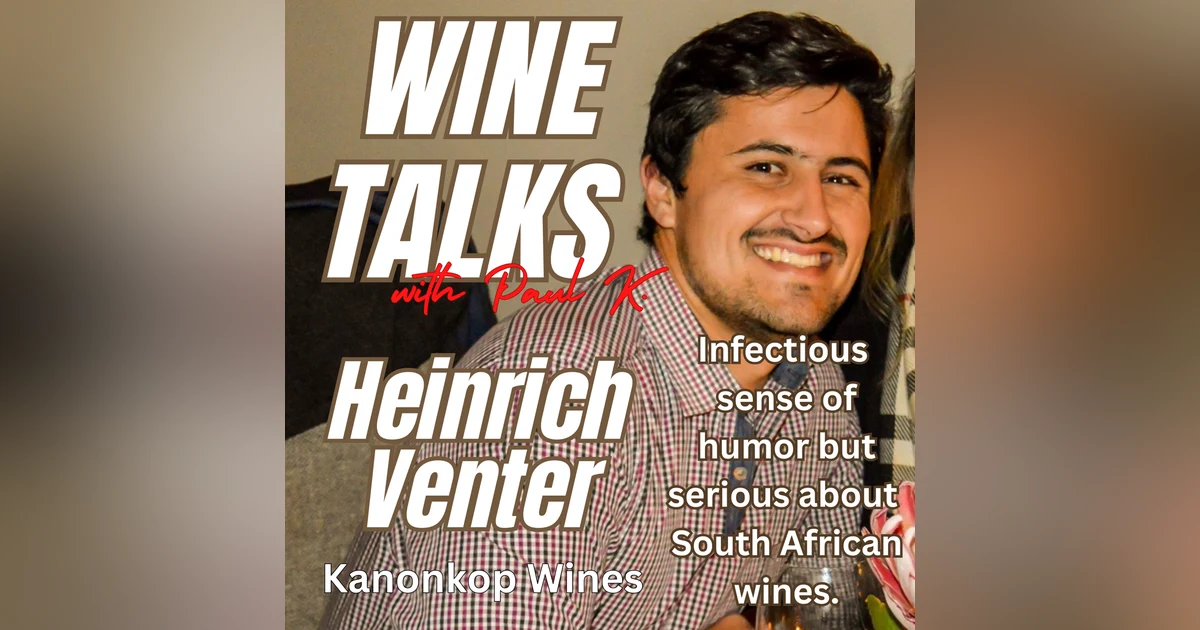

The wine trade is about passion. From vineyard management to marketing, without the passion, one could never overcome the headwinds. Multiply the headwinds by 10 when trying to open new markets for smaller wineries and lessor known districts. Heinrich...
The wine trade is about passion. From vineyard management to marketing, without the passion, one could never overcome the headwinds. Multiply the headwinds by 10 when trying to open new markets for smaller wineries and lessor known districts. Heinrich Venter tells us all about those headwinds...couple with the passion to get it done.
Embracing Tradition and Innovation: Paul K and Heinreich delve into the challenges faced by young winemakers who strive to uphold their predecessors' legacy while introducing their own innovations without compromising the wine's quality.
Market Insights: From shelf space dynamics in retail to the powerful narrative behind winemaking, learn how South African wines are capturing the market’s attention. Discover why engaging storytelling is essential to draw consumers to these remarkable wines.
From Entry-Level to Prestige: Heinrich shares fascinating comparisons between the wine and whiskey industries, highlighting how entry-level products serve as gateways to appreciating more premium offerings.
South African Wine Excellence: Gain insights into the history, reputation, and unique challenges faced by the South African wine industry. Understand why South African wines are world-class and the complexities involved in bringing them to the US market.
Travel and Tradition: Paul and Heinreich reminisce about memorable travels, such as their plans to visit Canonko, and share Paul’s adventurous story of planning a surprise trip to South Africa instead of Paris.
The Essence of Wine: Dive deep into discussions about the timeless passion and ageless quality of wine, its irreplaceable role in enriching conversations and culinary experiences, and the importance of terroir and sustainability at Canonko.
Challenges in the Wine Industry: Navigate through the conversation on the shifting consumer preferences, trends in packaging, and the balance between brand integrity and market demands.
0:00 Carson Leno Fallon. Now it's wine talks with Paul K. Hey, welcome to wine talks with Paul K. And we are in the studio today about to have a conversation with Heinrich Venter from South Africa. Wine talks course available on iHeartRadio, Pandora, Spotify. Wherever you hang out for podcasting, I need you to have a listen to a couple of shows. One, I want you to go back and find the episode with my father, Paul Callum Carrion Sr. I had a chance to sit down with him before he passed a couple of years ago to understand a, how he came up with this idea for just direct to consumer wine in America. And two, his sort of a career as an immigrant from Cairo, entrepreneur by trade, pharmacist. But the love of wine brought him to a wine shop, and this created the direct to consumer market in America, which is an amazing conversation as well.
0:55 Since we're in South Africa today, I want you to hear Mae Elian Lancasong of Glenallie Winery in Cape Town. She was alive and watched the Nazis shoot up her parents chateau in Pichon Longueville in Bordeaux. And I didn't even ask any questions. She just started talking and had this amazing conversation about the history of wine and her history and why she ended up in South Africa, but not why we're here. Welcome to the show, Heinrich. Thank you, Paul. Appreciate it. You guys are on some kind of whirlwind american tour. What's going on? Yeah, we're visiting with our importer, Cape classics. We're visiting the west coast and doing a little bit of a road trip with some of the boys from South Africa, trying to get south african wines into a couple more glasses. Well, you know, I came out to the lobby and there's like a not barrage, but I met with five or six guys. You guys just having a grand old. Time, all looking like they're on a. Wine holiday, but a long haul to get here. 30 odd hours. Yeah. Yeah, that's hard to do. It is. The. The time adjustment. Adjustment is a bit so. So why. What's the point? Why you go through this headache? Oh, why not? Why not come? Okay. No, no, man. It's. I think the. The US market for south african wine has always been very exciting and, you know, for, for wine in
2:25 general, global. The global wine market, there's so much influence here and we've. I don't know if people realize how long south african wine has actually been in the US. Well, by the way, your winery is. Can I. Can a cope. Cannon cop. Cannon cop. Sorry. Cannon Hill. Cannon cop. Yeah. Cannon Hills. Yes. Us, of course, is one of the most important wine markets in the world, of course, and has been cutting edge in many technologies and or just appellations and importation. It was kind of interesting. Cause you guys were talking about earlier that how New York, the east coast has generally more, way more imports wines than the south, southern California does. Yeah. I think also because you have so much local wine being produced. Yeah, for sure. On this side, it's a problem. Right now we're long.
3:20 I mean, they're talking about pulling out 150,000 acres of vines in California. Is there a problem with production in South Africa? I think pulling might. It's not only California, it's really in every major wine producing country in the world. I think there are, you know, there are news articles coming out where people are, some are panicking, you know, others with the head on their shoulders or just saying, you know, the ship will, ship will get through the waters. But I think that's true. Yeah. I mean, why not? I think there will. Wine's not something that, you know, will be produced for 6000 years and then all of a sudden, you know, tomorrow. You stick the word. Right.
4:09 I've been saying that forever. But I think the public needs to know, the listeners. It's an agricultural product, so you can't throttle back production like you can't a widget if you're overstocked or inventory's piled up. I mean, you kick it and you crush it. And if things change in the market, you have to do something. But also the interesting example about the widget things that are fads, that's true. Come and go. And if you put yourself in the same pool as a, you know, a fad and some fads become more, let's say medium to long term and then kind of fizzle some just flesh in the pan overnight. Did you guys have the pet rock in South Africa where the guy was selling rocks in a little box and people were giving him his gifts?
5:01 I just opened a fridge down at a cafe and it was craft water. Yes. I didn't know that existed. Oh, I thought water was water. There are water psalms. Yeah, well that can get a water scene. Yeah, that one I haven't figured out, frankly. But let's talk about that for a second. The fad part of this. Cause that's an important part of my pet peeve or one of my pet peeves in this industry. You've got packaging fads, you've got style fads, you've got alcohol content fads. You have flavor profile fads. How do you weather that? I think a lot of, if you look at not only wine industry, but if you look at industries, the ones that, or the products or the brands or the companies that make it, or rather have longevity are the ones that, that show focus. And they know exactly what, where the company needs to be in 25 years from now, you know, so focus. And if you're in it for a quick buck or it becomes more of survival. Yeah. Rather than, you know, I know what I'm building towards. Right. That's a good point. That's a really good point. Because wine. Wine should be that.
6:25 Exactly. Why? Why would you make a product that should actually be able to mature in a bottle for 25 years, but you're in it for the cash? Well, yeah, of course. But short term goals. The reason I brought it up is where you're sitting now. I've had many, many entrepreneurs sit, and they've been mostly packaging entrepreneurs. And you just made me think of something. I've never had anybody sit here and say, yeah, I'm crafting this wine because I've seen this void in the marketplace. And I think we need a wine that is expressive of something. Let's just say, you know, of Napa Valley, as colloquial as that might sound. But they sit and they say, I think we needed a wine that comes in a self serve bottle, or I think we needed a wine that comes in a can. I think we needed a wine. And clearly the motivation for those kinds of products is I want to build it up, get as many placements as I can, sell it to a wholesaler, distributor and move on with my life. And that bothers me in wine. It doesn't bother me as a business. We all want to make money and be the person that made that product happen. But when it comes to wine, then. It'S not about the wine.
7:37 Right. It's not what you actually then put into that vessel. Yes, that's the problem. It becomes about the vessel. And they always say, this is fine wine or gourmet wine or next tier wine in a different package. And I opened them and it's like they're not, they're fooling somebody. So are those kinds of trends in South Africa? Do we have, are we. It's a younger industry in general, right? More than 360 years? Well, in the long, long term. But let's say, you know, well, that's a good question. Is it new world or old world? Are we talking about wines that have been around forever and the technology I. Think it's a knowledge base. I think it's an old, new world, if that makes sense. Okay. You know, some.
8:24 Well, the first vineyards in Australia came from South Africa. Oh, really? Yeah. I didn't know that. So, you know, we've. The south african industry is, I would say South Africa as brand South Africa. Maybe it's not the 300 odd year industry, but Napoleon drank south african wine. Really? I've never read that in a book. Vin de constance, the sweet wine, very famous sweet wine was Napoleon's table wine. Oh, wow. That's interesting. Yeah. So when you come to America, what do you hear? You're doing this, obviously, to make people aware. And this is, you know, this is a tough road to hoe in general, just because it's a hand sell almost. But what would you sit in front of a group of people? Like, don't you have an event tonight or something you're doing? Yeah, yeah, we've got a event with our local distributor. Okay, so you're gonna go to this event, you're gonna meet some people. What do they tell you? What's the number one comment they make? Well, I think it's not really comment, but I think if I could make another observation is that people are. People are asking questions. It's a thirst for knowledge about south african wine. So, you know, you get people who really, they want to delve deeper into what makes south african wine tick. What is it? That's the fiber, you know, and I think that's a very important mindset to have, really, is when you want to start
9:57 exploring something that's maybe new to you in a lot of ways, you want to start asking more questions rather than have too much perception. That's true of what South Africa is or what it isn't. So what do you tell them? I'm going to come. Let's say I come tonight. What am I going to, what am I going to hear? What am I going to do? Well, I think you're going to taste some brilliant wines. That's a given. I think, as a. As a south african industry, the one big thing that I think we're all really on board with is that South Africa, that the wines coming out of South Africa really is of a world class.
10:46 We, you know, we. We win international trophies that. That I think people know about. And in wine circles, people might say, oh, okay, great. But these are. It's just showing that the wines are on exactly the same stage as, you know, what you would think a good wine, in your mind, would be. I mean, I totally agree with that. And I stood where you guys were sitting earlier today for a total of 35 years every Tuesday and tasted from nine to two in the afternoon every day. If I wasn't, it was all by accident, really. But if I wasn't on vacation or sick that I was doing that, and it matched, it amassed to a lot of wine, but not that much South African. And I could. I count on one hand how many South Africans I featured in the club and. But I see some countries that ebbs and flows, like Australia. Sometimes it's everywhere, and then ten years later, it's only yellowtail. And then ten years after that is everywhere. And there's been a very volatile cycle, but South Africa has been a very steady cycle that from a volume standpoint, an awareness standpoint, or we're still getting our foundations built. Well, I think it's also a matter of access, right?
12:15 We're quite far away. The whole world went through a couple of years now where the whole logistical system of the world has been impacted in a big way. It's a freaking wreck. It's terrible. And if that's not enough, if you don't have a virus shaking up the world, you've got a couple of wars going on. That was good for me, though. I sold a ton of wine there coming. But. So if you. If you had a good strategy, then I think you could have sold a lot of wines. We saw, you know, it was so bizarre during COVID because my, my sweet spot, we're going to talk about your wines here, was $15 to $20. I have all my wines for $15. I had a higher end clubs, but they weren't nearly as. The membership wasn't nearly as high as in my main club, which was $15.99, I think, bottle.
13:05 And during COVID though, they were buying anything I put in front of them. So Austin Hope, which is a well known passive robles plan, which is $60 a bottle. So I sold 100 cases of it. During COVID I sold five bottles the month after Kamus camus one liter bottles, which was a restaurant only sale. Originally, I was selling for 140 a bottle, and I couldn't keep my 18 bottles a week in stock until they ran out of one liters. And then again, when Covid was over, I didn't sell any. I still have eight cases here, none because the concept changed. And so I wonder how that applies to the general scope of wine. You're the sales export manager, sales manager for the brand.
13:55 We come to America and you hear these comments are they saying, where do I find this stuff? No one's ever told me about it. I go to the wine shop, they don't know what I'm talking about. Is that what you hear? I think sometimes you might run into difficulty when it comes to shelf space. For sure, for sure. Any retailer, and you can't blame them. Any retailer, they have a certain amount of real estate and they want to make the real estate sweat. So. Well, you know, it needs to, it needs to work. And so they're gonna sell the wines that, that move off the shelf the quickest. Right. And I think it's just for us as South Africans, it's the matter of engaging and answering those questions that are being asked and being able to tell the stories, tell people about, you know, the, the winemaking philosophies, the terror that we have, you know, the, the climate. It's. I think we've got some of the most amazing terroir and sites in, in the western tip of the southern tip of Africa. The idea of coming has already been sold to me and I. Yeah, talk about may alian here soon, but just. Watch out for that 30 hours flight time. Yeah, that's a brutal. It's not me, I'll do it. It's my wife I gotta convince. And she hasn't listened to the show, so I can say that.
15:28 Excuse me, do you have in South Africa, the segmentation of the marketplace where you have this consumer style wine, which is in America, is a slightly sweeter version of everything. So you go down the supermarket. If you go to a supermarket while you're here in Southern California, you'll see that whether you're in Ralph's vons or Safeway or Kroger, it's the same stuff. And it almost through the whole shelf of Cabernet. Is the style the same? It's the consumer style. Do you have a consumer style in South Africa? I think in certain product segments, yes, there is. For example, you know, if you start looking at, at sweet bagging box or you want to generalize with pearl a rose or, you know, things that. Are there some things like that, yeah, for sure. And I think those products definitely have a place in the market. Yeah, there. Those products generally draw people into the wine market. Yeah. And if it weren't for those, you know, it's, it's like with big whiskey brands, they've got you, you have the whiskey that, that gets appreciated, you know? Exactly. It's a good point. But, but they need to have that, that one that is more affordable, that can just be grabbed, you know, without, you know, worrying about breaking the bank.
17:01 But that is how you make people start to love the product and become a. If you ask them, what do you drink? You know, I'm a wine guy. That's what you want, right? Well, yeah, I guess you're right, because we were talking about this earlier with your other group when we were on Amazon for a long time, and I had thought, what a wonderful marketplace to go sell wine on, because it's billions of eyes, and we only sold the most well known brand in America, or one of them, which is called Stella Rosa, which is a sparkling moscato. It's sweet. It's like 8% alcohol. Nothing. It's a huge brand.
17:46 It's right here, Southern California. And so I thought, wow, that's interesting, because those people are just looking to buy something. They know they don't want to go down the market to go to target or something to buy a Moscato. So they just get online. They were paying me $2 more a bottle than they could buy it for locally. But it was just the convenience of it. Those people were not looking for something interesting to taste. No, they're not shopping at this point. So if you look at wine shelves in general, and this is something that I think is not only. It's not a problem in South Africa, only, it's perhaps much broader than that. But people get so intimidated when they stand in front of a shelf.
18:34 Normally, you grab the first thing that you know or that you've seen or that you've tasted with a mate, you know, and you. And you go to the tall, you know, what it tastes like. So I'm comfortable with it. Right. You know, and I think that's coming back to your earlier point. That's where a lot of people exploit the shell, the packaging, you know, and we have a lot of labels out there, but how many wine brands do we actually have? That's true. I think somebody did do that. 85% of the wines you see at the market are sold from four companies. Constellation, treasury. Exactly. That kind of thing.
19:14 Exactly. So, I mean, how do we combat that? I think you made a really good point. I think throughout the history of wine, contemporary wine in a contemporary world, there's been that entry level thing that we like to do. And in my dad's case was white Zinfandel. That's 1974 Bob Trinchero. Now it's 19 crimes and Cali Red and Martha Stewart Chardonnay, those kinds of wines. And I think what's interesting to me is that eventually, the palate, they get tired of that. Yeah. And the question really is how to convert that initial. I almost want to say endorsed, you know, product, how to convert that into somebody going to a wine rack and saying, oh, you know what? I want to try something new today. I want to explore a bit. I had this at a. It was my first experience of wine, because personality out there, you know, I read they endorsed it, or they own it, or they say, I must drink it. And that's a great way to get people. This is a life story. Happened to you, or he's talking. He's talking about this, the concept of this. Well, I mean, I started. I'm gonna say this on a podcast. I started my wine drinking journey with sweet rose, and from there, went on to 1.5 liter bottles. Yes. Oh, well,
20:48 yeah. Bang. For the pot there, it was more about volume. But. But then from there, when you get exposure to actually, you know, somebody telling you, listen, stop worrying about the price and the packaging and the other intrinsics, other stuff that. Just the fluff, really. How about starting to explore wine, even if it's at that entry level price point. Try something different. Try something and, you know, see whether you can hone your. Your preference rather than sticking to one thing, getting bored and moving on. Yeah, that's what happened. Yeah. That's an interesting problem.
21:29 Yeah, you said it. You're. Since you're in the marketing side. If I get bored with Cali red, which easy to do, I'm bored with some of the biggest brands in Napa. And so now I got to find something else. Well, somebody has to kind of tell me what it should be. The next step. And I used to have a wine buyer here, and when I had a wine shop, well, I thought had the best palate and best buyer in Southern California, because you could tell him what you usually drink, and he could take you to the next step in his head, and he would take you to the part of our store that had that wine, that next level of complexity, the next level of dryness to make the wine interesting. But that then works backwards to what you guys do. In other words, if I need to have a store owner or department manager show me my south african red because it's the next step, then that wine has to be the next step, which has to come from the vineyard for you guys. And you have to know what that next step is.
22:25 I mean, how do you. How do you keep your ear to the ground? I. Well, I think I. Getting back to what I said earlier for. For a wine estate like Canonkop, it has always been about the focus. If you fall around every five years and you change your style and you try and adapt to what the market is doing, you're never going to have any consistency. So now you're going to find that somebody is going to buy a wine, they're going to like it the one year, and now all of a sudden, next year, your style is completely different to what they liked. So where. Where are you actually keeping your consumers? Where are you building your brand equity? Yeah, so that's a really interesting point because I had a Bordeaux maker here, Lagrange, fourth growth, and he works for their own by Suntory, you know, the big japanese company, but he's given complete autonomy to what he makes. He's not required to listen to the marketplace. He's required to make the best that he can make from what he's given the best meaning.
23:38 I think most indicative of what that part of Bordeaux offers. Absolutely. What a refreshing attitude. Absolutely. And I suppose that consistency is what the consumer is going to finally land on. Yeah. Sounds very typical of the japanese style. Really. Yeah. Right. You know how many japanese companies have been in business for. Yeah, that's true. Right. But, you know, getting back to. To that mindset and that philosophy, I think we are in a. In a time, a very interesting time where the whole. If the wine industry was a bag, the bags being shaken. Yeah. Right.
24:22 And maybe some. Some things are going to fall out, you know, and it's. It's gonna. There are going to be opportunity, I think opportunities in the. In the industry as a whole. But through consistency, you are going to avoid being, you know, one of those that are being shaken too hard. I agree with that because there's a lot of market forces against what you're doing. The term that's been going around the Internet, that bothers me the most, LinkedIn and all those services, is innovation. And I'm trying to think, what does innovation mean in the wine world? It's the same product it was 6000 years ago. And we've refined the character, but it's always been about. There's two opposing arguments here, that it's always been about what the soil delivers to me and my representation of what that terroir was at the time, it was meaning that wine should be a sense of time and place. But then there's this other concept that the consumers have always driven. The need for wine. You go back to Vuv clicquot and she made a russian version, and she made an english version.
25:36 So we had to listen to the consumer sometime to sell stuff, of course. And then there's this philosophy that I read in a Burgundy book, an old Burgundy book, when they were appellating parts of Burgundy in the thirties, it was 32 or 38 or something, and one of the winemaker said, well, we don't. We shouldn't. It should be part of our appellation that you cannot advertise. Because if I build a better product, there'll be the path to my door. It's like, of course, he was completely like, no, we're not doing that. Oh, no. Absolutely no. Absolutely no. Yeah. So how do you. It's a balancing act for you guys, because here you are on a tour of America, trying to get people to taste, but you're not gonna succumb to the market forces of consumerism.
26:20 No, no. I think if. If you start doing that, as I said, you are. You're really. You. You're kind of screaming for attention a bit. Yeah. You know, we're like, hey, I can also. You know, I can also do the whole innovation act or I can also do this, or. Whereas if you just show, listen, this is what we're doing, and we're doing it damn well, then, you know, there's. A lot of pride in the south african wines that I've sent so far. Oh, well, I'm glad to hear that. It's not only me. Well, they're great. I mean, they're really good. And because I spent so much time tasting that, I wish there was a solution to turn a lot of people onto the south african brand quickly, and there just isn't.
27:14 You're doing it now. That's. That's the way I think that we need to do it. You can't. You can't expect a lot of South Africans to get here. It is. Obviously, it's hard to get here. Being here is absolutely fantastic. I think the american public and the south african public, in a lot of ways are very similar. Very similar. Very, very similar. And we can. We can really relate with each other on a. On a very personal level. I think we've got a lot of the same interests. We've got a lot of the same tastes when it comes to not only wine, but food, sport, outdoors, you know, different facets of life that.
28:05 That we both have in our respective countries. And that is so dear to our hearts. The thing for us is how do we share what we love with the american public, you know? And we can honestly say we love being here. Yeah, right. Because we feel so at home. It's an interesting thought. I didn't put it that way, but there is a certain camaraderie that seems natural between Americans and South Africans. I just asked your compadres here if they knew Peter Koff. Koff. He's a south african importer of wine here. He's semi retired now, but he's also a master of wine, one of the few south african master of wines. He did it a long time ago. He was a very good friend of mine, bought a lot of wine from early on. But I was calling him to find out how to get to Cape Town because I wanted to go see May alliance. I just chatted, but that same camaraderie turned around and he goes, by the way, since I have you on the phone, I'm having a very difficult time selling wine on the Internet right now.
29:05 I said I'd be happy to take a look at it. And it's a very comfortable relationship, way more comfortable than what I would have with a Frenchman or an Italian, because it seems the outlook of life is similar. Very. Yeah. Isn't that interesting? Yeah, it's brilliant. And I think for us as South Africans, that particular facet of american life, because we can relate with it, we speak so easily about our wines and what is so special about the terroir, because those things are also what you guys give a lot of value to.
29:52 So it's easy to understand when we actually start having that conversation. What are your biggest markets for your brand? Look, I think South Africa. South Africa, we're quite a well known brand in South Africa and internationally, we've done very well in the traditionally strong south african markets. The US is one of our top markets as well. Yeah. And generally, the european market has been very, very strong for South Africa because a lot of european tourists visit South Africa very often because it's on the same time zone. Well, may alliance, she's from Bordeaux. She started a winery at 70 years old, which is fascinating to me.
30:44 I hate to tell people how old I am, but that'd be five years from now, me saying, I want to start a winery, which I would never do. I would never do it because I've seen too many failures, too many people getting on the wrong reason or the amount of capital it takes just to even think about selling anything. And the time it takes to do that. How did. How did your winery get started? Well, we're. We're fourth generation. Say it again. Canon cop. Canon cop. And spell it for the listeners k. A n o n k o p. Okay. So we're. We're a fourth generation wine estate. Well, that's probably pretty old. Yeah. They're some very, very old wine estates in South Africa. Some. Some even 8th, 9th generation. Wow. Yeah. And so, so we're. We've been well established. Last year, we. We did our 50th harvest.
31:40 And the two, the two brothers that currently run the estate, they. They really have been at the forefront, I think, of quality red wines in South Africa for a long time, and specifically cabernet and pinotage. So we're. Again, I'm going to come back to that focus of the two main varietals being Cabernet and pinotage. We do have a little bit of other port over it, the merlot, cap Frank and petty on the farm as well. But Cabernet and pinotage are our main focus points. So generational. It's interesting point.
32:31 European generations are normal, even with restaurants in France particularly. They get handed down, they get managed again. The next generation, America, is not like that. My wife, cousin has a restaurant 30 years. That's like an anomaly. And he has no heirs, so that's never going to. There's no generations there, is it just generations in the wine and food business in South Africa a normal thing, or. Is it sort of a. Yeah, absolutely. I think a lot of times when obviously, your agricultural land will. When it changes hands, it is from generation to generation.
33:14 Sometimes economic conditions makes that hard. And also, it's something special. It's something you kind of want to hold onto every time you see a generation. Kind of. Or, you know, the family, the old family, you know, leave a piece of land, there is this kind of, you know, oh, man, that's brutal. You know, it's no. This picture behind you. My father in 1975, and I. Oh, brilliant. I had no business. I had no idea. You were a handsome mess. Yeah, thank you. No, the idea then. I had no business. I had no idea I was gonna do this. I was just working for him at the time. And in 88, he came to me, says, I'm gonna sell to a south african company, actually, the south african wine of the month, which is still around, I think. Yes. So they had made him an offer and he said, why don't you come check it out and see? Okay. That's not the point. That was business. Right? So businesses are a little different here.
34:20 Generationally, you have land and you have a stewardship of that land that probably has a little more poignancy to handing it to the next generation. When I was done with this march of last year, my wife and I were like, we would never wish our business currently at the time, on our kids. We wouldn't want them to have the headwinds that we were about to get into, because it was very difficult here on the Internet, etcetera. So it was a foregone conclusion we were going to have one of the kids. I had one child that probably wouldn't be very good at it, and her husband as well. But we saw nothing but headwinds. There was nothing of ethereal value to hand somebody. It was just business. And here you are with land Vines philosophy. Right? There's a philosophy behind all that that makes it attractive. So I would, you know, and coming back to your earlier point about starting a winery at a certain age, at 70, um, I thank you. No, I would. I would ask, what is your why? What is your why? What's your reason? Yes.
35:29 So do. You wouldn't do that? Sorry. Why? I wouldn't do that. No. Or why would you do that? Why would you. What, what is, what is the. Is it, is it because you are missing something? Is it because you, you want to start something exciting? Is it about, you know, you want to have a place where you can sit and watch your grapes grow? Yeah. Is it, what is the why? And in terms of handing from one generation, taking over from the next one, is your why? True? Is it genuine? Yeah, it's a really good question. I think that if I think a younger man or couple or woman going into Napa Valley and having their first love of the vine and seeing the lifestyle, that is a different motivation than somebody who's 70, who's been in it for all her life and for her, clearly, and I think she says this in the podcast, it is, she fell in love with south Africa and she saw what, you know, that what I say, damage. It'd be american colloquialism, what damage she could do, but what love she could bring to the land to produce something special again. Yeah. Having come from Bordeaux, you know, have. You been to Glenelg? No. And I, this is one of my. I was trying to convince my wife last to do it this quarter, but that's not happening.
36:58 But we need to go. Yeah. And we're gonna be in the east coast, we're gonna be in Paris in May. And I was trying to figure out a way without her knowing. Again, she doesn't listen to the show, so she'll never hear me say this, like, how can I just trick her into saying, okay, we're gonna jump on a plane and go home, but we actually go to South Africa. She realizes once she sees the chicken, you know? Yeah, right. Well, what are you doing? Why are we going to Stellenbosch? Well, only because this connection with Maya Leon, and I don't think I told you, I was telling your friends. We went to Vin Expo in 1993, and we went across the street. We were staying across the street at Pechete Belgravia to have dinner with her, Monsieur Henri Vandervoort and my wife and I and my dad and my mom. And we walk across street, and here's this elegant woman in her sixties with a. With a white eyelet dress. And we had this amazing dinner with her. And I didn't know it was her. I didn't know. I was just. What did I know?
37:58 Yeah. And I didn't realize it until I had her grandson sitting here for the podcast. He runs a winery in Spain. And I said, wait a minute, your grandmother is May Aleana? You're right. I said, was she. Was she in Bordeaux in the night? Yeah. I said, oh, my God. I go, I had dinner with her. But there's the amount of passion to be 70 years old and start from scratch. Wine keeps you young. Yeah, but it's an amazing thing. You just said that, too. At the end of the conversation, which was like an hour and 20 minutes, we were talking about the special, how special wine is. And she goes, look what it did for us.
38:46 We're friends 30 years later. And I went, wow, what other beverage can do that? Well, I think, you know, that that is exactly the point. Yeah. Is the fact that we can. We. I mean, me and you, we can sit here and talk about wine probably for hours. Right. And, you know, we don't have any, but, yeah, I actually do, too. I do it for a reason, because they go downhill very fast. Corks start flying. Yeah. Right. So I. And that is exactly the. The beauty about wine and what I would love for more people to be able to experience is the fact that you can sit, and not only when you have a bottle of wine, obviously, there are the occasions we have a bottle of wine, and it's about the wine. Right. But the wine is probably, for me, the most enticing accompaniment to conversation and food and sharing moments. It's like, why is that? You don't have. There's no answer to this question.
40:02 Yeah. I've asked it of everybody rhetorically. Yeah. And is it because it's so soulful, because it's deep in the soil. But why do grapes represent the soil better than peaches and apricots? Like, we don't know the answer to that question. We don't sit around the table after, you know, guava nectar, you know, or strawberry wine. Maybe that's the next bad. But you don't. Yeah, you don't do it with a glass of whiskey. I mean, whiskey aficionados will sit around and talk about the character of whiskey, but not like wine. And I'm not talking about, like, this smells like cedar and blueberries and BlackBerry. I'm talking about that. I'm just talking about the expression brings to the table. I think, obviously, you know, wine is one of the oldest beverages. You know, if we just look at it as a beverage, one of the oldest, you know, in the.
41:01 In the book that's been made for thousands of years. But I think it's also one of the only, if not the only one that is really produced by Mother Nature instead of by man. Mm hmm. That's a good point. And that is why terroir is such a huge part of wine. And, you know, coming back again, when you start talking about the packaging and all the things that. That I can do when what, you know, me, the guy who decides what cork to use or what label to use or what bottle, really, I didn't. I'm not making that product. Yeah, right.
41:54 Me and the winemaker, we need to do as little as possible. Yeah, right. That's. You're right. Nature is much more powerful than we are. Just get out of the way. Exactly. Just do what you need to do in the seller. Right. Is there any, at Cannonkop, is there any conversation of alternate packaging? I think, and I had this conversation earlier, the sustainability, I think, is, of all the industries, of all the world, that sustainability is probably the most appropriate in the wine trade. I think it's more accessible that way. But what movements are you guys remaining focused, which I think is a very important thing. And in lieu of that variety, stylistically, packaging, any movement coming from you guys? For us, I think if we talk sustainability, for example, there are many different types of sustainability. Some people see it as you need to go organic. Some people focus on financial sustainability.
43:06 It's probably a very important one. How do you define sustainability and what will be sustainable for us over the next 50 to 100 years? And for Canon Corp, we need to sustain the. The wine philosophy at Kanonko. Well, that's a really interesting thought, and. A lot of times in different industries, and it happens in business, I think every day when it starts becoming again about the people rather than the philosophy behind the product that you are making, then you have the opinions coming in, and this is what I want to do, and this is my way of thinking. And at the end of the day, you don't buy into the bigger picture. Right. Essentially thought.
44:07 And for Canon Cop, or at Canon Cop, rather, everybody buys into the philosophy, and that's very important for us. I think you have the advantage because it's generational change. In other words, that philosophy trickles down naturally. Plus, you stay focused. And so the thing that doesn't waver is the wine. And people come and go as long as they get the same. That's the stewardess. That's the concept of stewardship to the land and the value of the grape and not the marketplace. Yeah. So, for example, Canonko has only ever had three winemakers. Wow.
44:51 Yeah. In a 50 year span. That's amazing. So the. The winemakers have really. And they're all still alive. And the. The wine quality. And today's winemaker, Aubrey Bierslauer, he would tell you that a lot of the terroir and the. The grapes that he's getting into the cellar. The groundwork was laid by our first winemaker, Jan Boland Kutzir, who prepared the vineyards in the correct way. And, you know, after him was Bayer Streeter, who was. Today he's known as the prince of Pinotage. And then Arbery came, and the philosophy stayed exactly the same from day one until where we are now. I've always. I've always asked that question of wine makers when they've been handed off by. Let's just talk about Frederick Bernier. He's a Louis Jadot right now. And he was handed it to by. I can't remember the name, but he was the guru of Burgundy forever. And I always wondered for a young winemaker to come in and be handed that responsibility to carry on this tradition without screwing it up. You know, I mean, you can screw it up. Exactly. Exactly. They say, you know, it's. It's. It's very, very easy to make bad wine from good grapes,
46:25 and it is very hard to make good wine from bad grapes. So the. The, you know, the. The terror is. Is so, so important. But Aubrey, our current winemaker, joined Canonkop when he was 28. Wow. Yeah. So isn't that sort of the irony of the wine business? Because here you are, the sales manager. You're here in America, you travel a long way to talk to people one at a time, almost. And then there's the farmer and the steward of the land who doesn't really care about what you're doing. He said that it pays his, you know, salary, but at some point, it's, like, not my problem anymore. You have to go sell what I produced. And it seems to be too, at some point, opposing, you know, philosophies or approaches to the industry because they really like, you know, there's a guy that I had on the show, and he gone to Burgundy and done something amazing. American who went to Burgundy, was able to buy land, and he produced wine, and he got out of it eventually.
47:27 It proved to be very hard. The love of the farming part was great, but the part of getting it on the street and selling it was really, really difficult. Yeah, we're already out of time almost, but go ahead. No, well, I think. And, you know, you talk about the wine production side and the wine selling side. Right. Again, the Canonko philosophy and the Canonko brand is much bigger than Heinrich. Right. And at the end of the day, all I can do is I can be a vessel to talk about what has been going on for way longer. Before, I wasn't even a thought.
48:19 So that's. That, for me is just the. The nice part is humbling, isn't that? It is absolutely right. And how many people and how many real, you know, visionaries have. Have been part of this and kind of gotten the product and the wine estate to where it is today. All I'm doing is I'm taking the baton, or part of the baton, and really just, you know, bringing it to the US. Where can I get cannon cope in Southern California? Do you know retail? Is there retail stores? Are you going to see one tonight? I think we're going to vendome tonight, right? Yeah, we're going to vendome. Yeah. Yeah. Yeah. Which city? You know, I'm. I'm not exactly.
49:07 There's one down the street, but I don't think this is the one you're going to. Yeah, no, I'm. Look, I think the canonical brand, you'll. You'll find if you, you know, look for it. Go and. Go and search for it. We. We are, I think, uh, in. In a couple of retailers. I'm not exactly, uh. Yeah, exactly. Sure. Madeline. Madeleine. Yeah, yeah, yeah. Fascinating chat and love to hear your philosophy. This is great. Thank you. I hope we can do it again sometime. Next time you come to SoCal, Will. Well, first you must come and visit. Well, that I'm going to drink your water. Two conversations or three by the. I'm at four by the end of the week. Yeah, I think I can. I can convey the romance to my wife to make the trek, visit and see it, how beautiful it is and meeting you guys and your comrades and knowing Peter well, that it must be a bucket list wine thing. And now because she's older, I really want to sit with her and hear. More and I think it's really amazing what she's made with Glenn. Ellie in Stellenbosch. It really is a beautiful cellar and the wine range is fantastic and it just shows if you want to do something,
50:38 if you've got a batch, if you've got a why. That's why. I like. That was a great word. Call it that. Yeah. Then. Then I think that it's. You guys always talk about a land of opportunity in the US and I think opportunity is one thing we're not short of in South Africa. Well, you got my why stimulated because we're going to come down and. And check it out. It's a pleasure to meet you. Same. Thanks, Paul. And hear about what's going on in canon Cope and appreciate it in general in Washington. I wish you good luck and safe travels. The rest of this. Thank you very much. Keep that charm up and appreciate it. Get these people tasting some. Some great South Africans. Awesome.
51:20 Cheers. Thanks, man. Cheers. Thank you for listening to wine talks with, with Paul Callum Carrion. Don't forget to subscribe because there's more great interviews on their way. Folks, have a great time out there in the wine world. Cheers.