

 Apple Podcasts

 Spotify

 Youtube Music

 RSS Feed
 YouTube
 Pandora
 iHeartRadio
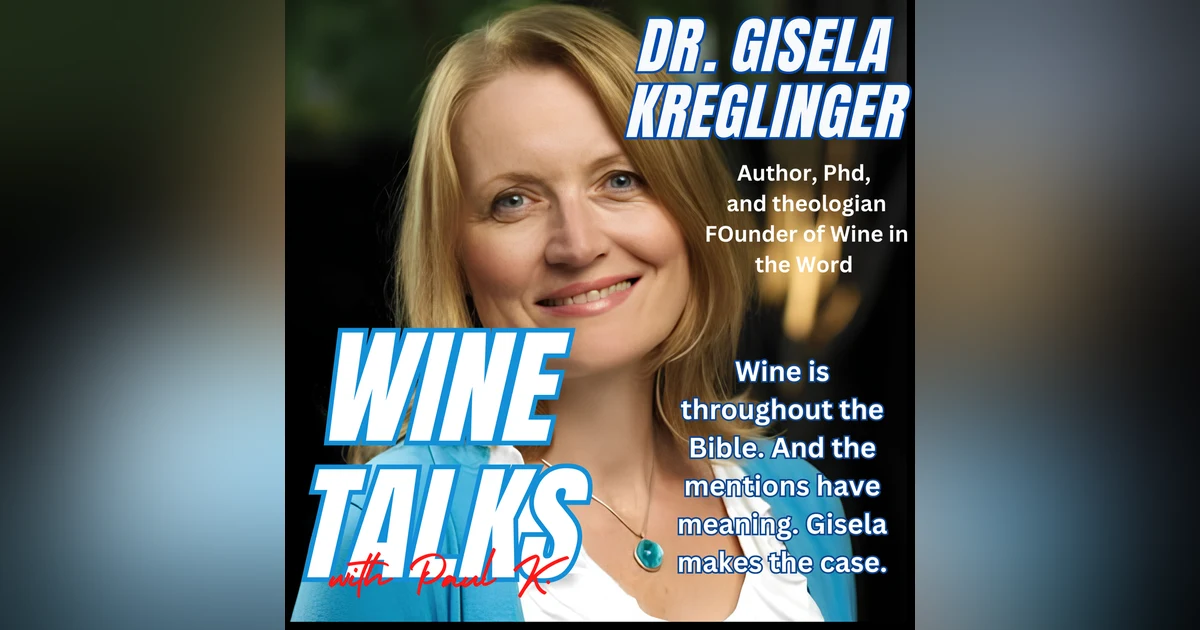
Wine As It Is Stated In The Bible. She Clears Up The Discussion. Meet Dr. Gisela Kreglilnger

I had to take the call. When a PR firm reached out to Wine Talks to ask if Gisela Kreplinger would be an appropriate guest...I jumped all over the opportunity. We all have questions about wine as it is discussed in the Bible. Is it hypocratic? DId...
I had to take the call. When a PR firm reached out to Wine Talks to ask if Gisela Kreplinger would be an appropriate guest...I jumped all over the opportunity. We all have questions about wine as it is discussed in the Bible. Is it hypocratic? DId Noah become drunk? How is wine to be viewed in today's culture? You will be impressed and inspired by the answers from Dr. Gisela Kreplinger.
Gisela Kreglinger might just convince you that wine is much more than a mere beverage; it's a divine conversation starter. Imagine taking a sip and feeling not just the intricate flavors but also a brush of the sacred, a whisper from God, as she puts it. In this episode of Wine Talks, Gisela unravels the profound tapestry of wine's role in theology and spirituality. You'll explore how this ancient drink transcends being a symbol to become a tangible blessing, richly woven into the fabric of biblical narratives—from Noah's resilient grape planting to Jesus' miracle at Cana. Gisela takes us on a fascinating journey through history, explaining how wine's spiritual dimension has been celebrated across civilizations yet diminished in modern consumerism. You'll discover the wisdom imbued in the Lord’s Supper and how wine functions as a social connector, a medium of storytelling and confession around the table. This episode challenges us to revive an organic kinship with wine, grounded in its ability to evoke memory and emotion—what Gisela calls "holy tipsiness." Join us for this enlightening dialogue, and you're bound to come away seeing that each glass of wine offers a deeper, divine connection waiting to be savored and cherished.
🍷 Lesson 1: Wine as God's Gift
Wine isn't just a tasty beverage; it’s God’s way of giving humanity a comfy hug. As Gisela Kreglinger says, wine is the divine way of planting a smooch on our cheek! It's deeply connected to our memories and emotions, capable of transporting us back to the time when mullets were cool and MTV played music videos.
🍷 Lesson 2: The Role of Wine in Spirituality and History
Who knew Noah started the first vineyard after surviving the flood? According to Gisela, this was a significant act of faith – waiting five years for grapes isn’t just patience, it’s divine patience. The evolution of wine in the church, from monks planting vineyards to it being used in rituals, shows its intense historical and spiritual significance.
🍷 Lesson 3: Wine as a Catalyst for Conversation
Our host, Paul K, muses on how wine weaves its way into profound discussions. It’s a magical social lubricant turning silent dinners into vibrant conversations about life, the universe, and why anyone still drinks White Claw. Wine’s complexities and stories transform mundane chats into soul-stirring dialogues, making even the quietest family member the life of the party.
In a nutshell, this episode is a toast to wine’s role in history, spirituality, and our taste buds – it’s like a TED Talk, but with better refreshments. Cheers! 🥂
0:00 Wine is God's way of kissing humanity. It is a very intimate encounter with something very beautiful that deeply impacts our body. A beautiful smell or a very complex, varied smell can evoke emotions and memories that we have stored up since childhood so they can move us. Wine and smell can move us in profound ways if we allow it to do it. Sit back and grab a glass. It's Wine Talks with Paul K. Hey, welcome to Wine Talks with Paul K. And we are in studio today in beautiful Southern California. A little wet outside, but beautiful just the same. About to have a conversation with Geisha La K. How about that?
0:43 Wonderful. Hey, listen, do me a favor. Do a nice review for Wine Talks. When you get a chance, subscribe to the show. If you don't have anything nice to say, please don't say it at all. But that's how us podcasters keep our egos in check. But now while we're here, I am inspired, excited, even, like using that word, excited. It doesn't mean that much these days, but inspired really, to have this conversation with Gisla about wine and the church and Christianity. Welcome to the show, Paul. It is so wonderful to be with you. I'm delighted. Well, this is just gonna be fun because I have a lot of questions and I have a lot of interest, and I think I told you off camera because I do want to produce a show about wine in the role of the Armenian church, which is as a study with a PhD in theology and two master's degrees in Christianity or theology. You're probably going to know a lot about this, actually. Have you heard of a guy named Claude Mutafian by chance? I have not. He's a Parisian. He's a professor of physics at the University of Paris, or was, and. And physics and mathematics. But he's an expert on Armenian theology from the 13th century, and he was on the show. I haven't released it yet because I'm waiting. It's not about wine. And I'm trying to figure out how I do that with the Wine Talks. But, wow, this is going to be a fascinating subject, but really kind of important. You know, most people, when they think about wine in the Bible, all they know is about Jesus turned the, you know, water to wine at the Jewish wedding. And I did a
2:15 calculation. Check me if I'm wrong on this. And I told our local pastor when he was preaching on the subject, I took whatever the vessel was that day, forgot the name of it that was that stored the wine, and I took today's modern consumption of a Wedding wine, which used to be, if I was consulting for a wedding, I would do four people to a bottle. Let's just say that's the formula from back then. I calculated there were 3,500 people at the wedding that he switched the wine to. Which wouldn't they invite the whole village? Well, you have to remember that wine lasted up to seven. Weddings at the time lasted up to seven days. They were celebrating for a long time and they probably drank a little bit more wine than we do today for such special occasions as weddings. You know, I don't think they would have enjoyed that much on a day to day basis. They probably didn't have that much. But for weddings, they were very, very important celebrations. They would have had a lot of wine. And to make sure that they celebrated in accordance with the occasion, well, that. Would have been, I guess if I calculated backwards, that would be about 900 bottles. So that would, that might jive. Right. We might be in good shape with that calculation anyway. Yeah, I just thought it was fun to make that calculation. But this is an interesting subject and I'm interested to know with your two master's degrees and your PhD in theology, that you landed on this. Because I looked at some of your
3:47 videos and read some of your work and I'm like, wow, this, this is rather granular study of wine and theology. Well, my general field of research and teaching has been in Christian spirituality. Given what we know about the Bible, given what we know about theology, how are we then to live is sort of a question that I've always sort of pursued. And my first book actually is on George McDonald. This is sort of my PhD called Storied Revelations. Very interdisciplinary work. Because I feel like as theologians we need to reconnect the dots. So much of our theology and so much of our contemporary life is sort of disjointed because of how life works. And I feel like we need to reconnect the dots. And so when it came to writing my second book, which you need to do when you are in a tenure track teaching position. Right. You know, I realized that no one had really written on this. Obviously there are books that, you know, why wine isn't alcoholic in the Bible and, but nothing serious, nothing academically serious had been written on the biblical, theological and spiritual understanding of wine and what that actually means for us, for the church, what that means for vintners. Are they, you know, is this a spiritual vocation? And so I, you know, and as I was sort of talking to publishers, they were so interested in the Subject matter that I realized, you know, being a
5:19 theologian and having grown up on a wine, on a winery and being comfortable in the wine world, I felt like I could really make a contribution. And so that's how I sort of pursued this. And the Spirituality of Wine is really quite a groundbreaking work because it sort of looks at wine in the Bible, wine in the history of the church, a theology of feasting, a theology of the senses, understanding the role of wine in the Lord's Supper, and then asking questions about what does that mean for us, for the church, what does that mean for agriculture? What does it mean to use technology in winemaking? What are we doing with alcohol abuse?
6:00 You know, and does swine have anything to say about soul care? We cannot possibly cover all this in one. So I'm inviting you to a second episode at least. There's too many questions to be answered. And I and I discussed when we, we started that I'm Armenian and we were in Armenia. And let's just start with that. You know, Noah landed his ark on Mount Ara, which is the Armenian at the time, and he planted grapes. And of course, if you just, if you focus on the Bible and just that portion of wine, he became drunk and naked. So that kind of is kind of for agnostics anyway. It kind of just defeats the whole idea. Like, oh, well, you know, the guy got drunk and he was naked. So that's not a very good thing. How do we go from there?
6:46 Okay. The very important thing is that after Noah gets off the ark, God makes a covenant with Noah to promise to bless him and all the living creatures. And then the first thing that Noah Dassi plants a vineyard, you know, and in that world, you know, vineyards and wine was a highly esteemed cultural good. So I actually argue in both cup overflowing and then the video series Wine in the Word that I created together with Randy Frazee, that it was a powerful act of faith. You know, think about it. Surviving a flood and starting anew. Why did he not plant a fast growing crop like a grain?
7:31 No, he didn't. He planted a vineyard that takes four to five years to have a significant harvest. And I believe is that it was an act of faith that God, that Noah trusted in God's future, that God had a future for him and his descendants. And therefore he planted a vineyard because they were going to be a civilization. For that you need wine to celebrate had Noah got drunk. I mean, I grew up in the wine world. If you have never planted a vineyard and you plant a vineyard, you wait for years. You finally have your first vintage. No one will blame you for getting intoxicated and having a little bit too much fun. And the text actually doesn't give no hard time for it. It gives, you know, what is really judged is the action of the son, the grandson, of coming in. And rather than covering up the shame, they intensified the shame by spreading the news that got harshly judged.
8:26 And I think that's really important. And so as the theme of wine continues to develop in Scripture, it is very clear wine is seen as a very precious gift from God, a blessing from God, and, you know, as the tradition, and, you know, the people of God mature. When you come to proverbs, you have a very nuanced understanding with a lot of wisdom woven into. Yes, wine is a gift from God, but we need to enjoy it wisely, and we certainly must not abuse it. You know, this is a. This is what's so fascinating. And again, a word that my friends give me, criticize me for using all the time. But one of the questions I asked many vintners, and I want to ask you a couple of questions that are not related necessarily to the subject. One is, do you usually speak on this subject to wine people or do you usually in a theology environment? In both. I mean, we. When we. We just had the launch party for Wine in the World and the video series, and we went to Napa where we filmed it, and at the launch party, there were a lot of vitners and people, people who work in the wine and food industry. And I was just in Chattanooga for three days in various organizations, Christian's organization held events that they invited people from the food industry to. To encourage them, because working in the food industry is really, really hard. And what they do is very important, at least from the biblical perspective. Hospitality,
9:58 yeah. Is tough. And you're. Maybe this. Maybe this next question is what answers that. Because the question I always ask the vintners is, can you define why the grape planted in the vineyard that's been fermented into wine is entirely different than any other beverage that we consume? Yeah. And the connection that allows us to sit back, it stimulates conversation. All the benefits that we have as humans, but nothing else in this world represents where it's grown and why it's grown than wine. You can't describe the connection, the human soul to the proper glass. Not the cheap stuff at the store. But the good stuff, I think. And this is very important. When Jesus performed his first miracle, he transformed water into choice wine into beautiful wine. Wine with expression. And wine is used to speak about the kingdom of God, about God's work with his people. And I think there can be so much beauty in wine and complexity and nuance. If you craft a wine well, and if you have the capacity to really savor and enjoy it, that is so expressive, and that's so beautiful.
11:22 The other thing is that, you know, you can really keep wine for a long time. So what other food can you keep as long as wine? And it speaks about eternity. What God does lasts. And so if you choose a food which is perishable, you know, you would have chosen. They didn't have distilled spirits back then. And that's also not very flavorful. Wine is. It is very flavorful, and it can last for a long time if it's well crafted and it has an intoxicating effect. I talk about holy tipsiness. There is a level. Holy tipsiness, Holy tipsiness. There's a level of intoxication that wine can bring that is actually really beautiful. I've seen it growing up in a tasting room. It's not about getting drunk. It's not about getting out of control or shutting down because you've had so much alcohol. But it's that level of wine intake that helps you to relax, that warms the body. And suddenly you open up, you let go of your pretenses and, you know, holding up the masks that we all hold up because we need to appear a certain way to our culture. And you, you, you, you come to a more vulnerable and honest place. And confessions come more easily. Confessions of joy and delight in confessions of failure and grief and loss. And therefore, it functions as a social lubricant and glue. It connects us more deeply to one another.
12:55 And God gave wine because he wanted to woo back humanity to himself. In Germany, we have a saying that wine is God's way of kissing humanity. It is a very intimate encounter with something very beautiful that deeply impacts our body. And, you know, the neurosciences have done a lot of research in how we process smell, and they've shown that the part of the brain that processes smell, or the regions of the brain where the smell goes through, process emotions and memory. So a beautiful smell or a very complex, varied smell can evoke emotions and memories that we have stored up since childhood. So they can move us. Wine and smell can move us in profound ways if we allow it to do it. You know, this is interesting because I hold this position as well. And one is the scientists can tell us how that happens, right? They can dig as deep as they want, but they can't tell us why that happens. It's interesting that the. Our tongues like memory. For instance, I have a story that I tell about a quiche I had in Paris a couple years ago that I hadn't had for 50 years. So my mother made the same quiche, and when.
14:12 When the plate was put in front of me, my face changed, and my wife's like, what's. What's going on? I said, I haven't smelled this for 50 years. And I went right back to my childhood sitting at the dinner table. Yeah, and that. But. So we can explain why that happened molecularly or biologically, but we can't explain why. Why it happened. And that has to come from God. It has to come from a deeper source that we can't explain as to why wine does this for us. Why is a human soul connected to the earth through a glass of wine and not through a beer, not through a shot of Jack Daniels and not through tequila. Yeah, well. But the neurosciences, they do give us some insight in how our brain processes smell and how they then connect us to our emotions and the memories that we've stored up. For example, they have shown that, you know, the way we can identify the flavor profile in a wine is because we have memories of flavors stored up in our brain. Right. So when we smell something like cherry or a little bit of oak or a little bit of grass or something floral, you know, those flavor memories are connected to even deeper and more comprehensive memories that we've stored up in our bodies, and they are evoked. So God made us this way.
15:29 And that is why, for. For example, when we have wine in the Lord's supper and we smell the wine, it can really, if we allow it to, and if we have trained ourselves and to sense salvation, as I say it, it can really stir us in these very profound ways rather than just thinking through ideas, it's this more embodied way of engaging, of experiencing and remembering what God has done. So it's a very understandable thing that wine is singled out. And I think ancient civilizations had a good understanding of how wine operated and why wine was so precious.
16:09 And. Yeah, and the other thing about, you know, vines and vineyards, they can grow and flourish in areas and elevations. They're very, very little other edible things can grow. So you don't need to have this rich, fertile soil on a flat surface. You can go to very steep and rocky hills like in Germany when you go to the Mosel, and you can plant vineyards there, and they can root themselves and Produce fruit that can be turned into something very, very delicious. And yet it seems such a barren place.
16:54 By the way, I spent six weeks in Germany on study of German media, from opera to film to music. This is 1979, so a little while ago, but. And I loved it very. All of it. Maybe that's why my dad had German wine for my wedding in 1986. So after Noah's episode, flying the grapes. And I never even thought about this idea that, you know, we as wine people, we know it takes four to five years for that first crop to come and to make. Make anything. And I didn't think about that space between him landing and planting and waiting. When does wine show up next in the Bible? I think I'm going to jump right to our patriarchs.
17:37 You know, when Isaac blesses his son Jacob, part of that blessing, he says, may God give you of the dew of heaven, of the fatness of the earth, and plenty of grain and wine. And then when Jacob in turn blesses his son Judah, again, vines and an abundance of wine features prominently. And I think that's really, really important and foundational that in the Hebrew scriptures, wine is understood. In the patriarchs, seed is a blessing from God, not a symbol of a blessing, but an actual tangible blessing. And I think this is what's so hard for us to understand because we want so quickly to move on to the metaphorical meaning of it all. But it's like, no, God made this world beautiful. And all that the earth brings forth, the fruit of the earth is a gift from God. And, you know, Psalm 104, the beautiful creation, Psalm praises creation. And all that it brings forth is because God makes it to come forth.
18:43 And then in Psalm 104, it singles out wine and says, God gave wine to gladden the hearts of humanity. It is not just for our survival, like bread, you know, to give us sustenance. Wine is to bring us gladness. It is to help us in our celebrations. And, you know, celebrations are an important way that believers in scripture have always practice their faith. They celebrated God's goodness. You know, that when they celebrated the first fruits, they had a celebration for that or, you know, the Passover meal. They celebrated a whole evening and reenacted the story of the Exodus. And then they used food to help them remember and ingest and to smell that God had saved them.
19:35 And by the time of Jesus, the Passover meal included four cups of wine. You're going to be very careful with this message because if it gets out too much in our industry, you might find a whole change in the way people sell wine and approach the marketplace because it's such a difficult industry. And you're painting such an amazing story about the history of what we do. You know, it's interesting to me how the role in the church. How in the role of church? Because church is the human expression of their understanding of God. Right. So how does. Why does. And how do different sects. Sects use it? One of my son in laws is an Anglican priest in New York, and it's a very important part of church to have particular wines. Not just any wine, but particular wines. My other son in law just graduated from Fuller Theology with his master's and he's now starting his career. How did that evolve? How did that change from one church to the other? And how did that role happen?
20:42 Right. I mean, it's a long history. And again, I talk about that both in my first book, the Spirituality of Wine, and then also in Cup Overflowing it really, when we look at the Western church, we have to look at monasticism and St. Benedict and the Rule of St. Benedict. And in that rule, he says that he gives permission for every monk and nun to have one hermanna of wine a day. That's probably approximately a third of a liter because he was ministering in Italy and everyone drank wine. And he probably would have appreciated or emphasized, you know, no wine. But the Bible talks about wine. He lived in Italy. So I said, okay, one of wine a day. And then if it's really hot or if you have really, really strenuous labor, you can drink a little bit more. So and then when the Benedictines started all of these monastery all over Europe, of course they planted vineyards. Then the reform movement of the Benedictines, the Cistercians did the same. And so when you go to Burgundy, for example, most of the gras there were first planted by monks and nuns. And so that that continued. And in the US when the pilgrims came over on the east coast, they also wanted to plant vineyards. But the vitis vinifera that they had wouldn't take because it was too humid, the climate wasn't suitable, and so they couldn't plant vineyards. And then really it was rum and whiskey, hard
22:14 liquor that became the primary drink of the people. This country came of age during the Industrial Revolution that they were able to mass produce distilleries. George Washington, for example, after retiring from being the president, retreated onto his estate, Mount Vernon, and started a massive distillery. It was a very lucrative business. And he probably didn't think what that could do for his people in terms of distilleries just exploded and distilled spirits became readily available to the population for the first time in human history. Think about that. So Americans relationship with wine, with alcohol is really shaped by this very, what I call a very unfortunate happening of historical circumstances.
23:06 They couldn't plant vineyards, but they could make distilled spirits. And a lot of the challenges with alcohol abuse over the years and centuries really has to do with hard liquor. And so when that got out of control once more and so many, there was so much destruction because of the abuse of hard liquor. The temperance movement started and then Thomas Welch applied pasteurization to grape juice and kept it from fermenting. And so it was the Baptists and the Methodists that started using grape juice in the Lord's Supper because of all the alcohol abuse.
23:49 While the Catholics and the Anglicans and the Lutherans continued to use wine, the Baptists, the Methodists and the Presbyterians stopped using it. But before that all denominations used wine in the Lord's Supper. And this idea that you shouldn't be drinking any alcohol is, you know, that really emerged in the 19th century. And so now people are taking a step back and saying wait, wait, listen, listen. This is a very particular history. We have to come to terms with that. And in the Bible it's the most talked about food. In the Bible it's affirmed as a gift from God. And we as a society can learn how to develop wisdom around enjoying wine so that it can really bring us the benefits that God meant to bring rather than be destructive. You know, interesting points. Prohibition in America was really a political movement and yes there was some abuse. But I think it's kind of interesting because now grapes in the east coast are very popular and some amazing like Long island and different parts of New York are becoming Virginia's got know growing. And I know that Thomas Jefferson tried desperately to. To do it and finally now it's working. And it kind of, kind of interesting that there are that God put it virtually everywhere in the world and that, that that Riesling and. And Neo grow great and pres. And present to people the expression of Germany. And
25:22 throughout the world. Each, each region has its own sort of way of expressing itself because of that. And I think what's really important is I think people really get to know a place well when they figure out what grape varieties grow best in your region. I feel like that's when a place is coming of age. And you know, I was just in Sonoma in talking to Some vintners there, I mean, you know, the geology is so varied there in the climate, and people are still figuring out, well, what grape varieties grow really well in those patches. And as that happens more and more and you have that discernment, you can craft really, really beautiful wines. But for the monks, that took hundreds and hundreds of years. You know, the Benedictines and Cistercians started planting them in the, you know, started in 7th, 8th, 9th century. It really took off in the 11th, 12th, 13th century. So they've had a long time to really, you know, like with the Pinot Noir and Chardonnay in Burgundy or the Riesling in Germany, it took a long time for them to figure out what grew really well. And now, you know, that is such an expression of that place, though, you know, with the climate changing, that all changes once more. It's changing too. But you know, that's. I've always said this in conversation with people, particularly about Burgundy. How did the 12th century monks know that, you know, Chassel, Montauchet or Courtin, Charlemagne, all those places are so different and such
26:55 small, fragmented piece of land. And somebody goes, well, they had nothing but time. So they just. And you're saying it took a long time. But I don't want to address that necessarily. Here's something interesting because the port, my son in law in New York, they use a particular port for most of the ceremonies and they have to bless the port. And then the priests, if they go through the service and there's leftover port, they can't leave until they finish all the port. And I'm thinking that's more of a. He goes, sometimes we over buy, you know, and we have to sit there and it takes a little while to get through it all. But I thought that's an interesting process for the church to take on that once you bless this, you got to finish it because that's what it's for. Yeah, there's so many questions. I'm not sure where to start. But what's the next step then in the Bible for wine? Now you mentioned the Last Supper and he said, take this wine that represents my blood. Yeah. Well, if you, if you look at really the development of the Hebrew scriptures, you know, wine, when people, when the Israelites come into the promised land, you know, to have, you know, vineyards there and wine was just an important part of God blesses them.
28:09 And, you know, the people are sent into exile because they do not live in ways to become a blessing to others and to take care of the most vulnerable in their society. But then the prophets also talk about a time of redemption where God would redeem his people once more. And one way that they talk about is that there would be feasting, that wine would be flowing in great abundance down the mountains, and that there would be celebration, rejoicing, wine, you know, the enjoyment of wine and food, and even a wedding feast. That's how the prophets, the latter prophets, talked about how God would send a messiah, an anointed one, to save his people once more. So when Jesus performs his first miracle of turning water into wine at a wedding feast, what he's really doing is saying, I am the Messiah. I am the anointed one that God has sent, and the kingdom of God is at hand. And the way we know that is that there's a great celebration, a wedding feast. God, our bridegroom in Christ, in the church as the bride, are now being reunited. And I think that's really, really important, that Jesus, that first miracle, really responds to the prophecies of the Old Testament and fulfills them by coming and joining a party and then providing this abundance of wine. And then, you know, when. When Jesus celebrates the Passover meal with his disciples, which at the time
29:42 included the drinking of four cups of wine, he elevates wine to new heights when he says, you know, drink this. Drink this cup of wine. This is my blood shed for you. So wine now speaks to Christ's blood and Christ's sacrificial death and his resurrection. So I think that here it is elevated to new heights. And all that makes wine even. Even more important for the biblical story and for Christians. And I think wine has such deep symbolic meaning. You know, think about Christ's sacrifice and the process of him being crushed on the cross.
30:27 And through his death and resurrection, new life happens. And think about the winemaking process and the grapes being crushed and gathered up and transformed from sticky grape juice into something very beautiful and lasting. So there's so many parallels. So that whole winemaking process, which the people at the time would have been very, very familiar with, everyone was involved in making wine at the time, but today we're not. So it doesn't mean too much, very much, but to them, it certainly did. Are there misinterpretations by atheists, agnostics, about those stories and wine and how it plays a role in humanity? I'm not quite sure I'm understanding your question.
31:08 Well, would somebody. Would somebody who's an agnostic or an atheist say, well, that doesn't represent those things. It's alcohol. And you're just using it to get drunk. Are there people that sort of try to diffuse your position on what? Well, there are certainly Christians, you know, talking about this particular history in the US that say, well, the wine in the Bible didn't have any alcohol because God wouldn't use alcohol. You know, that's because they're traumatized by alcohol abuse. I hear that sometimes still. But in general, I think people realize that no wine probably not only probably did have alcohol, because otherwise, how could people get drunk? And why would God then speak out against drunkenness and say, you shouldn't get drunk? You know, so that's more the concern in asking non believers saying, oh, you're just using an excuse. Well, people who understand wine, who really understand wine, it makes a lot of sense to them. I mean, what other food could you use to talk about the Creator and Redeemer, not just of this world, but the universe? I mean, what can speak to how God is present and acts in the world? What beauty?
32:23 I mean, obviously creation in general is so beautiful. But that wine is singled out is for good reason, because at its best, if people really take care to craft something beautiful, it speaks so beautifully about the gift of life and how to enjoy it together and how it moves us. You know, there's tomes, right. Of. Of quotes from famed philosophers and all walks of life and the. The role of wine. You know, Hemingway was prolific the way he wrote about wine, but I wanted this. And since you. You obviously have a keen understanding of the wine industry itself and obviously now biblically, and some of the conversation I have. Much of the conversation I have today is about consumerism and.
33:13 Versus a real glass of wine that's representative of this area. Right. So let's just take Burgundy, for instance. Let's just even take Chessel, Montrachet, just for fun. That consumerism of wine, the general consumerism of wine, it's. We need profit. We have to make as much as we can. We have to put as much into the logistical system to ship it to people. We got to make sure we get it in the system. And so the. So a lot of the industry is driven just purely by consumerism. Whereas, and I have this romantic view of wine, which is it represents where it's grown, when it was grown, and you know, what it. What speaks to you that way. And now we're throwing in this whole new level. And it's. I think it's a real level, the biblical application of wine and what it does to our soul. Yeah. So when you speak to vintners do you inspire them? I mean, I'm asking for the after effect. Do they come to you say, wow, now I've got a whole new interest in my business. And I don't really, you know, profitability is not so concerning anymore because I really want to be part of this movement of. Of wine. In the Bible, I think it's. It adds a dimension that's been lacking. You know, the spiritual and cultural dimension of wine has always been celebrated. Throughout wines existing, except for the last 60, 70 years, and especially in a place like North America, where wine is now accepted in this sort of wine guild, the wild experts have emerged, and the way they talk
34:43 about wine is very narrow. We can learn a lot about, you know, when they describe the flavor profile, the alcohol, where it comes from, you know, the soil type and all of those things, they are helpful, and yet they are also very rationalistic. It's also all about, you know, dissecting the flavor profile. But when you really think about what wine does to your own body, into your conversation in the people that you're with, it really functions as a social lubricant in glue. And I also think it can deeply nourish our souls as we savor this gift together and realize it's a gift from someone. It's not a random thing, but God created the world in such a way that there are yeast bacteria swirling around and help us to transform grape juice into wine. And then you develop this relationship with God on this level of beauty and savoring and understanding something about his goodness. But also, you know, the way wine works and the way savoring and smelling works, how it so works upon our pleasure center, upon our memories, storehouse of emotions that really can evoke sort of the creative spirit in us. And that's how
36:15 it has shaped conversations and imagination, creativity and civilizations throughout human history. And I think wine cannot speak for itself. And because the wine world or the wine experts have so bombarded us with all of this rationalized talk about wine. And there are some wine writers, like Andrew Jefford, one of the most beautiful wine writers alive today, who is saying, stop it. Who wants to have all of those tasting notes. Most people can't even afford those wines. And we need to stop this craziness, and we need to talk about wine in different ways. More of, okay, where do they come from? You know, for example, I feel like French wines very much reflect not only the soil in the particular climate, but they reflect the culture. French wines, you know, France is the country of Christian mysticism and The French wines have more mystique to them. There is something about them that's very different from German wines. You know, Germany is the country of the Enlightenment. We've had the Enlightenment. We are very rational people. We are very direct people, and so are our wines. German wines are usually very direct and clear. You know, even a Riesling that can be very, very beautiful and floral and herbaceous and fruity, it's still. There's a clarity to me that you're right. A Chardonnay from Burgundy doesn't have. You
37:46 can't dissect things as much. It's true. There's much more this sort of mystique about it, and I think that's, you know, and that's what I want to say about. Terroir is, first of all, a human construction. It's because of human beings planting vines in a certain area and then crafting wine in a certain way that we have terroir. Some people say, oh, no, it's just about the place in the grape, you know, the vine in the weather. And I'm like, no, a big part of terroir is the culture. Oh, I think I preach this all the time, and I've gotten 100% agreement on that from winemakers. And that is. Let's just take Nazi Germany for a second when they invaded Bort Bordeaux. If you don't think that the stories handed down from the chateau's owners about what they had to do during that process is not reflected in the wine somehow. I don't mean like a piece of tannin or flavor character, but the lessons learned through all.
38:46 Through all history of a winemaker or winemaking family shows up in the bottle. It has to. Right? It's not about the terroir is not just the soil. But somebody just told me the other day this very well read. I think he's master of wine. That the word terroir actually is an opposite meaning in Old French. It's a. It's a just. It's actually the troubles of land and the troubles and the. The trash of what happened. I have to research that further to find out. But, you know, it's interesting the way you said this, and I learned this from a young winemaker in Armenia. She said, what other product can you take halfway around the world, put on the table and say, this is who we are. Yeah. And there is none. And I think that's very godly because it's the only thing you can take. You can't take a semiconductor that way. You can't take a bottle of water, you can't take anything that's expressive of where it's from than as a bottle of wine and plop it on the table and say, this is who we are and when we were. And in fact leads me to this other definition I came up with, which I get 100% agreement on, that is there are no bad vintages.
39:55 Whether you're at the Mosel or the Rhine or Napa. If the wine is grown there and made honestly and prepared the way without trying to influence it by the winemaker and it reflects that moment in that place, then it can't be a bad vintage. It's a different vintage. It might taste different than the previous vintage. You may not like it as much, but it's an honest wine representing what, what it is. Maybe this is what you just said, the impasse in the direction of the consumerism of wine right now because it's in a, it's in a tailspin. Right? Nobody and, and a lot of people are talking about the guys that are doing the point systems. They're not as prevalent, not relevant today than they used to be.
40:40 No, it's not like Parker when he started this whole thing. And, and the consumers are being barraged with social networking and different beverages like White Claw and those different things. And maybe your approach, maybe your conversation is the most relevant conversation to this. Well, I think it's one aspect. I think the spiritual dimension of wine, which ties very closely into the cultural dimension, needs to be recovered. You're right. We have sucked it into this consumerist mentality. Were these expert, you know, the masters of wine in the sommeliers, they have been socialized into talking about wine in a certain way. And it's very top down, it's very rational, it's not accessible to the ordinary person, and it negates that. Each person will experience a wine differently because of the flavor memories that I have stored up personally because of my life experience, and then the other comprehensive memories that I have because of my unique life. And so the same person that I share the wine with, that's not talked about at all because most people don't really engage with the neurosciences and they don't engage with understanding the real cultural meaning. But Andrew Jefford, I like him a lot. He has, he has really called attention to it and he's one of the wine writers who really tries to understand the cultural dimension and embeds it a lot more into
42:11 stories now. He's also the son of a Anglican priest. He's Not a, he's not a believer. However, he has a spirituality about him, despite him saying he's an atheist. Yeah, Transfers his spirituality into the philosophy of wine. And I think we've. You can only do this consumerist stuff for so long and you're turning people off because it's not accessible to the ordinary person. Most people can't afford expensive wines. And now we have this sort of, I call it the medical temperance movement saying, you know, no amount of alcohol is safe. Well, when you look at the studies, they don't differentiate most of the time between hard liquor, beer and wine. Very few people, very, very few studies focus on wine. And if they do, they don't differentiate between mass produced wine where a lot of herbicides and pesticides are used and a lot of additives given into the wine from organic or biodynamic wines. So I think all of those things are just such sweeping statements and I think we need to take a step back and again come back to the regional. You know, I'm a huge fan of the slow food movement and farm to the table movement. Go local. If you live close to a wine region, try to be local and eat locally grown foods that are a lot more flavorsome. And the same is true for wine. Of course, the US wine world
43:42 is so young that to get well crafted wine is still very expensive. You know, you said something interesting because that's another conversation we have organic, biodynamic. Well, the monks of the 12th century, Burgundians, they were organic. In fact, they were organic for a long time. You know, it wasn't really till modern times, let's say the 40s, when they started doing that. So, you know, I, it never ceases to amaze me when people walk in, they did walk in here and say, well, organic and this. And then they would use that as an excuse as to why the wine had funky character. I'm like, you know, that's not right because, or wine was always organic. But that's not why we're here. It's an interesting concept. You just came up with the conversation around a glass of wine. Like tonight, I mean, I'm going to go home and I'm craving right now at Burgundy because of our conversation. But who knows, that might change by the time I get home. And that's what I'm going to open and we'll have a conversation. My son in law, the one that just graduated from Fuller, will have, he'll have a glass and we'll have a conversation.
44:42 And the conversation is not going to be this got 95 points or this is, you know, the, the winemaker decided not to put a cap on it because he wants to be sustainable or she wants to be sustainable or we're using this, we're not going to talk about that stuff. And I'm thinking that's the narrative is changing, it needs to change. And I think it needs to change in your direction because the other concept that's being thrown around ad nauseam on the web and in social is innovation in our industry and what are we going to do? And should we put it in cans and tetra packs and all those different things? I'm like, no, we don't need to do that because it's never going to change. It's at least 12,000 years old that we know. We just need to change the narrative. What we're talking about, why we're talking about it. I think that's so right. I think we need to change the narrative and we need to see wine.
45:35 Whether you are a believer or not, it's a gift to humanity and it's meant for everyone. And everyone has the capacity to learn to enjoy wine. We need to come to our senses. You know, I mean the most of the food here in the US is either overly salty or spiced overly too much sugar. So our taste buds need to heal and become desensitized towards the bounty not only in wine, but look at fruit and vegetable. If you grow your own fruit or I'm just making a little pot roast and I added some of my own rosemary and some thyme. And these herbs are just gorgeous and when you rub them and smell them, there is such bounty of, of, of smell and taste. And I think we need to in general, we come to our senses again and stop using, you know, eating all of that processed food and go back to what naturally grows in your region and then you know, with simple ingredients allow those subtle flavors to satisfy you. You know, it's really interesting because my, my son in law that wanted the priest in New York, they live in a very, very rural town called Potsdam and he's the head of the Trinity Church there. And my daughter is a, I'm not going to say it because I'll get in trouble with my friends, but she's, she was, she worked at a Michelin star restaurant.
47:00 She was one of the head bakers there. She was the head baker there. Closed because of COVID But they have no choice really in this rural part of, of New York to go to the farm and buy vegetables, to go to the farm and get their pork and their beef to go to the orchard and pick their apples. Their eggs have a laid on date, you know, that's how fresh they are. And it's a whole different mentality and that's a tough one for Americans. Despite the fact America went through a food renaissance in the 80s and the farm to table idea came supposedly from. From France, it's still mired in horrible food and.
47:45 Yeah. Butchered fields and contaminated wheat and all of that. Yeah. How do we, how do we. Maybe more of your videos, maybe more of this conversation. Yeah. Is gonna. Is what we need to do. But food in the Bible with wine, how does, how is that represented by. By the writers. How does the gospels talk about. Yeah, I think and Thomas Jefferson also understood this. Agriculture is our most precious and most important vocation from God. And we have given agriculture over to corporate organizations that mass produce, you know, corn and soy and grain. They dump a lot of fertilizers and pesticides on our soil. Our soil is dead, it's dying. And it's not a kind of aquaculture that's sustainable. We need to go back to regenerative aquaculture that helps heal the soil. That way you get more nutrients back into our food. That way we can help people become healthier. And I think that farm to the table movement needs to continue. And you know, we as consumers have power. We can choose how we live. For example, my husband and I. My husband has had cancer twice and so we don't go out to eat a lot. I go to the farmer's market on Saturday. That's my pilgrimage. Every week I go on a pilgrimage. And the pilgrimage, that's a great term for that. It's a great farmer's. I'm going to the promised land. That's where I go. And I go to
49:19 my organic farmer. I buy what's in season and I have this pot roast in the oven. We have some guests come tonight and all the ingredients, the root vegetables, everything is locally grown. The pot roast is from a regenerative farmer in Alabama. My husband and I work full time, but I spend just over an hour throwing everything together into the pot. And I think we need to do repentance. And repentance literally means we need to change the way we think. Metanoeo means coming after your thought life. We need to stop living in a way that destroys our earth, that destroys our health. And we need to say food is important. The table is important in supporting our local farmers who work so hard to grow really healthy and Nutritious food. That's if we could have a revival of understanding that agriculture is one of our highest vocations. You know, we think that the lawyers and the doctors and, you know, all these people with the big salaries are the heroes. They're not. Our farmers are our heroes because they heal the soil and they and their food heal our bodies.
50:42 Is that the premise behind the seven year wait? You know, I think the Bible talks about, you know, the seventh year of a crop or of a farm. It rests. Yeah, yeah. Let it rest for all of creation, but also let the soil recover and plant something, you know, not plant something for a year. Absolutely. But in general. Sorry to interrupt you. I wonder why no one. Like there's a book called the Third Plate. Dan Barger, anyway, the chef from Blue Hill Farms in New York, you know, he does. He lays out the same argument you're talking about, but never brings up the biblical part of this. And it really is the root of all of it, is it not? Absolutely. The vision that we get for living a Christian life is agrarian. In the culture that Jesus lived in and ministered was agrarian. And to hand over our food system to corporate organizations whose primary goal is profit is not a good idea. And we can see that in how sick Americans are. Do you know that There are over 50 million people who have an autoimmune disease, not to talk about cancer, cardiovascular disease, diabetes too? We need to change something. And Christians have always been called to be prophetic and show the world how to live and how to blossom on this good earth that God has given us. And I feel like we as Christians should take a lead
52:14 role. Christians should become farmers. Christians should become middlers. Christians should start learning about nutrition and feeding the families and their communities well and serve where our society is very broken. I think that is an incredible way to leave this conversation, only to know that we're going to do it again because we're already at almost an hour and you have guests coming, so we got to make sure the pot roast is properly cooked. But what a fascinating conversation and enlightening conversation. It gives me so much inspiration for what I do. And now I have a whole new path of conversation to have because of. Of your study. And it's never going to end, I don't think. No. And I think this is what I am really hoping is to find conversation partners who are willing to take that into our society. We need to have a nationwide conversation about wine and about food and how to heal together, both in terms of our relationship with alcohol. But Also in relation to our foods, because both errors have been broken, and it's time to reclaim them as gifts from God and understand how they are to nourish us so that we can not only survive, but flourish.
53:33 Inspiring. Fascinating. And bravo for taking this on and making it, putting in terms that everyone will be able to understand and reflect on, despite the whatever level of Bible knowledge they have. Yeah, everybody knows, you know, the inspiration behind the Armenians part of this. And I, like I said, I'm working on a TV show, but, you know, if Noah landed in Ararat and he planted the vineyard, I mean, it very well could be that Adeni, the grape is, you know, the oldest grape in the world. But I guess that DNA could tell us this. But, you know, there's this whole romantic fascination that, you know, the Armenian grape is the beginning of this industry.
54:17 But whatever, I hope we can do it again. Yeah, I would love to. I think it's a conversation that needs to grow. And with all of that I've written, but especially Wine in the Word, people need no understanding of previous understanding of the Bible or of wine. You can just come and learn, and you don't need to be intimidated, and you can learn on your own terms, and it's a wonderful world to enter. The book, the one book was called Spirituality of Wine. That's my first book, the Spirituality of Wine. Then I wrote an autobiographical book called the Soul of Wine. And then Cup Overflowing was really for the church in North America, where I talk about the particular history with alcohol. I interview a lot of people who struggle with alcohol abuse or how to integrate it, and then showing a way forward. And then we just created this video series with a study guide called Wine in the Word to make it more accessible and to help people really think through a biblical understanding of wine, but also how to develop the wisdom to integrate it into your life so that you can flourish and so that your children and grandchildren will understand what it means to embrace this essence, a gift, and how to develop a healthy relationship with it. We will pass the word on. And count me in for any help you need from my side of things as far as media. And I did this for 35 years,
55:49 and you answered a lot of questions for me after all this time and gave me some new thoughts to bring to the table to stimulate conversation with people. So thank you again and good luck tonight with your tot roast. I hope it turns out all right. Cheers. Cheers.