

 Apple Podcasts

 Spotify

 Youtube Music

 RSS Feed
 YouTube
 Pandora
 iHeartRadio
They saw the story. They tell the story. Meet Don and Petie Kladstrup
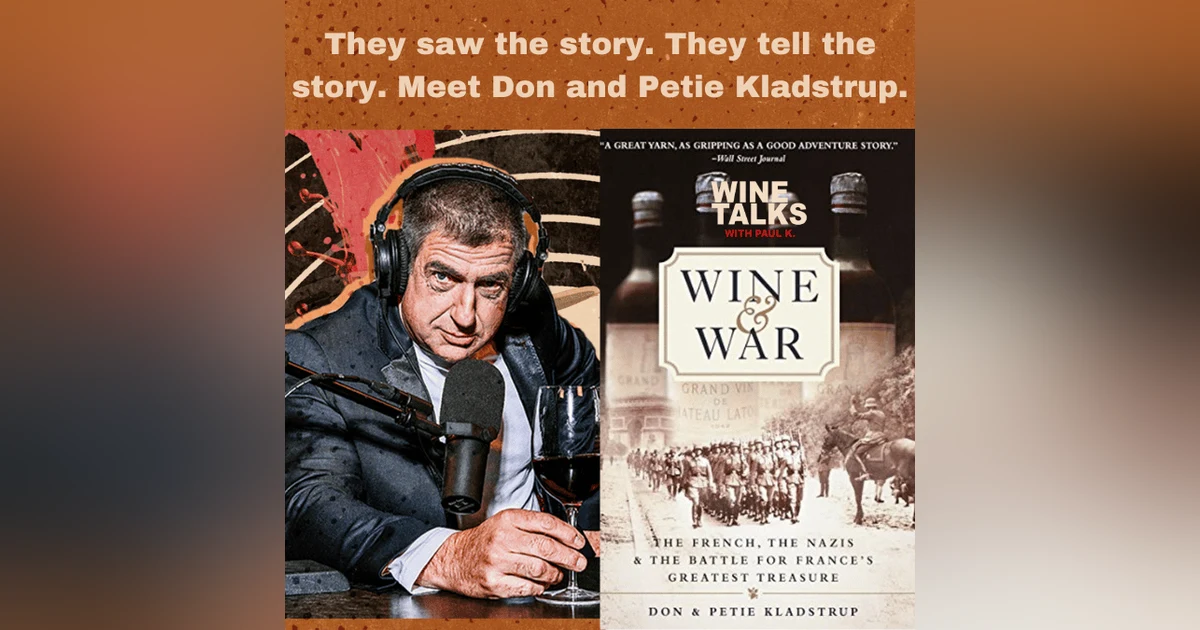

Wine and war is a subject close to my heart. I had been studying it when I stumbled across the book of the same name. What a story about the Nazis and the French sparring during the Nazi occupation during World War II. The detail that Don and Petie...
Wine and war is a subject close to my heart. I had been studying it when I stumbled across the book of the same name. What a story about the Nazis and the French sparring during the Nazi occupation during World War II. The detail that Don and Petie were able to convey as to the punches and counter-punches over the wine trade is inspiring and telling. This is a must-know story and a must-know part of wine history. Have a listen.
0:00 It's here. It's now it's wine talks with Paul K. Hey, welcome to wine talks with Paul Kay. And we are in studio today in beautiful southern California about to have a conversation with Dom and Petty. Is it Petty or Petey? Petey. Petey Clad Strub, authors, co authors of the book wine and war. And this incredible conversation. Introductions in just a second. Wine talks, of course. Available I heart radio, Pandora, Spotify, wherever you hang out for your podcasting. And now, sporting the Napa and Sonoma and Bordeaux series of wines. Hey, have a listen.
0:41 Actually, after this podcast, I'm going to record a rant. I'm going to rant about what's going on in the marketplace of wine. We're going to talk specifically about wink, and that'll be coming out shortly. So have a listen to that. I think you'll find it fabulous. But let's have the introductions of Don and Petey Cladstrup. Welcome to the show. Thank you. Thanks. Pleasure to be here. You know, as we, as I told you off camera, you know, I, I've been reading your book, wine and war, and it hit me that we've got to tell these stories to a younger audience, from a contemporary audience to a wine audience that doesn't know these stories. And here I am looking for you all over the Internet. Nothing. Can't find a thing. But thank goodness your daughter Regan is available through all the typical channels. I guess it's a generational thing. Yeah, it could be. And so you're currently in Philadelphia right now, right? We are, yep. Visiting Regan and, well, doing a few other things. And I read that you live in Paris.
1:44 That's right. We've lived there for, golly, more than four decades now. Yeah. We arrived in France because of my job. I was a news correspondent, television correspondent for CB's and ABC News back in the day. Wow. You know, after a number of years in the network news racket, we decided to change our lives, do something, reinvent ourselves. That's fabulous. Write books, maybe. And turns out that's what we did. Fabulous books. And we're going to talk about wine of war right now. We're going to talk about champagne and the other ones you've written. But let me just ask, when was this that you picked up and left?
2:25 Picked up and left the network? No, we moved to Paris in 1978. Wow. This is fabulous. I'm sure you're familiar with the. George Tabor's name. George Tabor, the author of the Judgment of Paris? Sure. Yeah. And he was in Paris in 1976 as a correspondent for Time magazine. Right. And so here's this group of Americans that have gone to Paris, stayed in Paris, and done amazing things and reported great stories along the same lines. But you just fell in love with the town and the city, and you just said, city of lights, and this is what we're gonna do.
3:06 Yeah. Well, I think we just got very comfortable there. Our children grew up there, and after a while, it started to feel like home. Yeah. And it was a stimulating area, a place that was entirely new to us. The food, the wine, certainly we'd never tasted things like we were tasting back then. And suddenly it was really a revelation. I suppose. Steven Spiria's place, Cobb de Madeleine, was still around. He probably visited there lots of times. Yeah. We were very lucky and fortunate to get to know most of those people, and occasionally we still see some of them. It's a great network of. It's almost a family of the folks that work there. And producer Patricia Gastaut was going to be on the show. I haven't heard from her lately, but what an amazing time for wine in the world, let alone the Americans winning the judgment of Paris. But it was a different time then, wasn't it? It really was.
4:10 And we missed those times. I bet those times were very personal. Stephen Spurrier, he was a good friend. David cobbled Patricia, who you just mentioned, Gallagher, James Lawther. Yeah, yeah. But, you know, it introduced us to the world of wine in a way that I think would be very difficult today. Again, the personal touch. Have you tried this bottle? You know, we just opened it. Would you like a taste? And, you know, sure enough, a whole new experience that's a little bit about kind of how we got turned on to the whole. The whole picture.
4:54 I wonder, you know, my dad's wine shop in the seventies was very much like that. In fact, Patricia's sister was a regular in the store and had told my father, my sister's coming to America to go select wines for this idea that she has with Steven Spurrier. And it's like this. You almost feel like family, because Patricia will tell you that her sister has fond memories of my dad's relationship. And it was a different time. People wanted to talk about wine. You'd come into a store. Wine was new for Americans, so it needed a conversation, it needed a taste, it needed those things. And now we've got social media and we've got influencers in there, you know, dramatic video of swirling the glass. But until you and I get to sit and have a glass and stimulate that conversation. It's different.
5:42 Absolutely it is. And if perhaps you saw Eric Asimov's column today in the New York Times, you'll know that it definitely was another time, and that to reach the younger market now is a very, very difficult thing. You know, I'm going to have to read that. I didn't know it came out. He was slated to be back on the show, and I had just sent him an email. But I. About the rant I'm going to do after we're done with this. Well, let's talk about wine and war, because I had done a quick sizzle reel on an episode that I wanted to produce about the four wineries absconded by the Azerbaijan's during the armenian war. And I know two of the families. Well, in the cultural upheaval that this created, the people that affected the wine itself, of course, the cultural contribution of the wines from Artsakh to the armenian community is gone. It's disrupted, it's finished. And then I started, I thought, I'm going to Google this term wine and war, just to see what it's about. And up comes your book. So tell me about the. Here you are in Paris. What was the idea behind the book? Why did it stimulate your intellect?
6:47 Well, I think it hit us something like, it hit you that we weren't really interested in talking about sniffing and sipping, but we were more interested in talking about and learning about how it all came about, about the culture and certainly about the people who made wine. And there was one other factor that entered in. We had a house in Normandy, not far from the landing beaches. Wow. So the world War two was very close to us all the time. The idea that we were living right on its, what should I say? In its, in its shadow, made us think about world war two a great deal. And then the real key thing were some of the experiences Don had when interviewing people for network news. Those people led us to start really pursuing the topic, particularly some time spent with Gaston Youette in Nauvoovre in the Loire valley.
7:49 All began there. And it began with a guessing game. Well, he had invited us down to visit him, and we arrived at his home in Vouveray, and he brought us into the office, told us to sit down. We chatted for a few minutes. Then all of a sudden, he got out of his chair and disappeared from the room. And Petey and I looked at each other and he said, what's going on here? A few minutes later, he returned with three glasses and an unlabeled bottle of wine that looked very old. But then he poured, and out of the bottle came this golden liquid that, well, whose bouquet just filled the room with the scent of apricots and honey and peaches. And we thought, oh, my gosh, what are we going to be drinking here? And Hewitt said, go ahead, taste it.
8:45 Tell me what you think. Tell me when you think it was made. And so I went down. 1970. No shaking the head, smile on his face. I went back the 1960s, the 1950s. Each time I guessed the smile on his face would grow bigger. He would shake his head and indicate, try again. So finally I said, all right, 1953. Uh uh. Biggest grin of all. I said, I give up. When was it made? And he said, 1947. Wow. Wow. Greatest wine. It was a sweet wine, but he said, it's the greatest wine I have ever made. And I looked at it and I said, you know, have you ever tasted a wine better than this? And all of a sudden, the smile on his face disappeared and he grew very, I don't know, almost sad. And he finally said, only once. It was when I was a prisoner of war in Germany. I had a little bit of wine, just a thimbleful. It was nothing special, but it was the only wine I tasted during five years of captivity, and I would never forget it.
10:05 That's phenomenal. I think that was the moment when Petey and I looked, you know, decided, you know, how many other stories are there out there like this? And as we discovered, there were a lot of them, and that's how wine and war began. Well, night Chen Blanc. Right? A vouvre which can make fabulous dessert wines and fabulous still wines and fabulous sparkling wines. And here he gets to share with you, which is at that point, what, 30 years old, 35 years old. About what? This is 2000. When would this happen? Yes, in 2000. I would just. Yeah, about then. Wow. So this is like 43 year old wine, or 53.
10:45 But it certainly didn't taste it. It was out of this world, really. It was so fresh, it tasted so young that you might have thought this was made yesterday. You know, that this is the part of wine that stimulates the intellect, and that is, how does that happen? And what is this connection to the human soul that makes you sit on this camera and bestow the virtues of this wine that was already 53 years old? And it can't be defined, but it happens. No, you're right. It can't be defined. One of the things Hewitt said to us at that point was, you know, this was the taste of home. This is what kept me going. That is the best definition of wine should be a sense of time and place that I've ever heard. I mean, really? And here he is in prison and is keeping him alive, and he's so talked about how he became a prison of war at that time.
11:49 Yeah, yeah. He was a captain in the french army at the time and was leading a troop after the initial invasion of France in the early 19, in what, mid 1940s, mid 1940. They were being chased by a Germane, I guess, division towards the coast, towards the English Channel. And it became apparent that they were not going to survive or they weren't going to make it. So they stopped not too far from the coast. I think it was close to Dieppe, and they were on kind of a rise in the land, and they had with them, of course, a french flag.
12:39 So Hewittley said, take the flag down. And he cut the flag into small pieces and gave one piece to each of the members of his troop, and he said, so no matter what happens, we have this with us. And the Germans arrived shortly thereafter, and he was marched with, I think, finally a group of close to, what, 500 officers that they had already stopped and arrested and march back to Silesia in, well, what would now be Poland and where he was in camp then for. In a prison of war camp for five years. This was during the big evacuation, you know, the British. Dunkirk.
13:22 Dunkirk. Dunkirk. Trying to get into a boat, get off to England. There weren't enough boats. And Hewitt realized this at the very beginning. And when the final boat left, even though somebody called back to him and said, you know, well, return, we'll get you out of there, he says, it never happened. We were completely abandoned. Wow. Also considered Hitler's greatest mistake during the war by not pursuing the British into the ocean. But how did you find Hewitt? And what was the name of his winery? It was a family winery. And then I. How did you find him to be the first? Sort of.
14:02 It was. It is indeed, or it was indeed a family winery. The place that they bought first that his father bought at the end of World War one. His father was gassed in World War one, and his health was very bad, so he was advised to move to the country. And he bought this small wine property. Olieu wasn't the first. Yeah. Called Oleu. Yeah. Place. And from that, Hewitt expanded it through the years. I believe his father bought the rhino in, what, 1919? And then they've added to it, became a much larger operation. Yeah. Speaking of 1919, when it was founded, we have a bottle of wine from that estate. Whoa. Date. We haven't tasted it yet. We're waiting for it to evolve. Yeah, yeah, we'll make sure. Wait for it to come around, maybe. Yeah, exactly. Exactly. Waiting for us to come around. That's very funny. So the Germans come in in 1940, right? And they come in and they basically split France in half, so to speak. I don't know if geographically it's actually in half, but. And create the Vichy government, which is sort of the French trying to manage themselves, but not really. And the German occupied side. And I wrote it, I put in, we put a map in my little sizzle reel about this war and wine thing where, you know, looks
15:34 like they went right down the middle of Bordeaux, maybe left bank, right bank kind of thing. And left, of course, the great chateau for themselves and maybe the lesser ones. The way the France was split, all of the best wine of the time was in the german occupied zone. This almost seems deliberate, doesnt it was. Oh, it was very deliberate, yeah. And, you know, the thing about the invasion is that it happened so fast that there was no blueprint for any organized occupation. Well, thats interesting, you know, I mean, what, on May 9, 1940, Hitler, Hitler speaks to his generals and everybody else and says, gentlemen, you are about to witness the most famous victory in history. A day later, german troops pour across the border into France, and less than a month later, theyre marching down the Champs Elysees fast. Even the Germans supposedly were surprised, but. The result was utter chaos. I mean, you had cellars pillaged of their wines, chateaus taken over, places like Chateau Mouton Rothschild, having soldiers inside the chateau, taking potshots at various pictures that were hanging on the wall, and youve got the poor cook running around trying to take them down
17:05 before they were all destroyed. So, so many things were happening at once that, as we say, utter chaos. You know, through your book so far, it seems like there were two, two sets of rules for the Germans. There was a compassionate set of players, and there was the, the gorings of the world that this, you know, pillage and plunder as much as they could. And you, you open the book with this fabulous paragraph, which is when one of the lieutenants or generals opens Hitler's cave. And, of course, everybody knows Hitler really didn't drink much. And here are, what, 100,000 bottles of some of the best things ever made. Absolutely. And it was Bernhard de Nolencourt who became head and really developed to the point, Laurent Perrier Champagne.
17:54 He was the man who really opened up Hitler's car at the top of the Bertescaden at Eagles Nest and was able to recoup quite a bit of wine. But he also had seen these very many of these very wines taken out of champagne as what he was a teenager working. He was working at one champagne house when the Germans came rolling into the village and began. It was. Began emptying the bottles from salon. Yeah, yeah. And it's amazing because he said, when I went up to Eagle's nest and I opened the door, I saw the very bottles that had been absconded. I mean, there were hundreds of thousands of bottles there of the very best wines that France ever made. But he specifically pointed out, he said, you know, I saw those three bottles. Yeah. Talk about full circle, really. So what is it? What is it about wine? And maybe there's no definition, but what is it about wine that I just witnessed in the current times in 2022, the stealing of wineries and the equipment and the labeling and the fermentation vats and the shiners and whatever there was that had happened again in World War Two or happened prior and probably happened prior to that.
19:23 I think even during the French Revolution, some of the regiments came and tried to raid Madame Clicots place. What is it? Is this just. Well, let me ask you another question. How did Goring know that the 18, whatever, 67 or 97, was this incredible vintage from Bordeaux? How do we know all this already? Well, you know, first of all, nobody ever heard Goering say the word enough anything. And he would have, I suppose, had somebody tell him what the best wines were. In any case, when we were working on wine and war, we talked to an American who was at that time the only american to be making champagne in champagne, and he had been a soldier in Patton's army, and he said, what is undoubtedly the truth about every single winery that's been pillaged during any war? And he. With what he said was soldiers drink. Wow. Well, that's. That pretty nets. That pretty much nets it out, now, doesn't it? So it's just. Well, there was, there, you do tell the story in the book about, you know, wine being part of almost the, you know, what would have been the Red Cross care package for. For french soldiers. It was part of sort of the diet, was it not? It was sort of a
20:54 daily routine. I mean, not just World War two, but World War one. You know, the soldiers were there and they were expecting their. What, their little plant? Their pinard. Their pinard, yeah. Every day, kind of a rough red wine. But, you know, it was essential. It was something to look forward to. I wonder if that would have settled the argument, if the Nazis could have helped us with that, like, much better Burgundy or Bordeaux. But we will get into that. So you know those arguments. But I didn't know, and until reading your book, that Burgundy was part of this. I kind of remember champagne being part of it, but Bordeaux obviously being a port city. What did they do in Bordeaux? They came in, they grabbed the chateau, established a port.
21:40 Well, the port, of course, was already there, but they took over, and they definitely went after the major chateaus for all the bottles they could get, but they wanted all of it to send back to Germany. One of the things that, when we were writing the book, in fact, we were, what, halfway through when we realized the importance of the men who were sent to be in charge of it, what the people that the French called the Weinfuhrers, who were in charge of buying wine for the Reich, who were in charge of making sure that the shipments kept going back to Germany, and who, in fact, were already in the wine trade themselves, which was one of the great mistakes that the nazi leadership made, was choosing men from the wine industry in Germany to run the wine industry in France, because they were already. Friends and who were totally sympathetic to the french winemakers because they knew that the war would not go on forever, that the day would come when they would have to do business again. And as a result, they went out of their way to actually protect the winemakers at the same time slake the thirst of Hitler and his cronies. It was a very dicey game that they had to play. And dangerous.
23:13 Yeah, absolutely. But as Don said, these were men, primarily men in the same business as the men in France. They had known each other for generations. They trained in each other's businesses. They spoke each other's language. They intermarried. They were godfathers and godmothers to each other's children. It was both. I guess, on paper, it probably seemed like a good idea. We need a wine expert to run this. Well, that begs a lot of questions. Right. Not to interrupt you, but I want to set the stage for the listeners. We have. Germans occupy France. They occupy certain parts of it. Certain parts are free under the Vichy government, but they hire or command a certain amount of people. That was at one per major region. Is that the way it worked? The vine Fuhrer was one in Alsace, one in Bordeaux, one in Burgundy kind of thing. That's right. And one in champagne. One in Champagne. We talked about the chaos that erupted at the very beginning. The german leadership realized that we have to put a stop to this.
24:25 You know, we have to impose order somehow because, you know, this is. The wine is the golden goose. I mean, at the time, you know, today, anyway, it represents one 6th of France's economy. It was even bigger then. And they realized that if we don't bring things to order real quickly, we're going to lose it all. And that's the reason that they reached into their own wine trade, to bring out people who understood wine and could put their hands on the best wines France had to offer and get them back to Germany. Preston, it seems like here's this guy. He's person, man or woman, effectively brokering the indigenous value of a bottle of wine from this potential region where champagne, Burgundy, Bordeaux, or all such.
25:21 Let me stop you there. Not Alsace, because Alsace was at that time, German. Oh, German. Yeah. Okay, so, but the others, the dual. Personality part of the world, you know? Right. So they have to sort of walk this line between, like, as you're saying, being the friend, old friend of the winemakers and the families of those winemakers, but represent the Reich to the superiors to get them the things they wanted. I wonder why the Reich didn't just say, we're just taking it. Why didn't they just say, we're going to take it, we don't need this liaison. Well, I think in a certain way they did, because they set the price they paid, but they wanted to keep the business running, and they knew they couldn't do it themselves. They didn't have the manpower, they didn't have the expertise to bring in to run, for instance, the great chateaus of Bordeaux, to take care of the vineyards, etcetera. Because obviously the german manpower was going into the army and going into armaments, into furnishing the necessary things for the war effort. So they needed to keep it going because they had learned in the first world war that destroying it meant destroying a lot of income for Germany itself.
26:43 And so to just take it would have made it both counter to what they were, the image they were trying to present as being correct and ruining the industry. But of course, they set the price and they set the exchange rate. So while they were very proud of the fact that they bought the wine, it was for a derisory amount. Was there a difference between the way the vine fure handled Bordeaux versus Champagne versus Burgundy in the way the Nazis actually handled those regions? As far as absconding with chateau, or like, they turned Chateaubriand into the Luftwaffe rest home? Did they work differently? You know, they were all. They were all essentially sympathetic to the wine situation and to the plight that their winemaking friends were facing. But I would say the one wine fearer who was different was the fellow who conducted affairs in Champagne. Klebusch. Yeah, Klebisch was a lot more, what should I say, army, more military in his approach to the situation.
28:09 Also, he had the greatest demands put upon him. The third Reich leadership was asking for what clad a million and a half bottles a month. A month. And this caused great disruption in Champagne. Champagne makers went on strike for the first time in history there, and it took practically an act of God for the strike to be settled. But the situation in Champaign was different from other regions, because Otto Klebisch was not only the guy in charge, he was a connoisseur. He knew what good champagne was and maybe more importantly, what bad champagne was. And some of the champagne makers adulterated their wines, did various things that are probably unmentionable on a podcast. But some of this got back to Klebusch and he hauled the culprits in and at one point sent one of them, a guy named Tayttinger, to prison. And he was not the only one he hauled in. He put several of the winemakers in prison, was until later in the war, when they came down really hard on champagne and sent the man who is nominally the head of the champagne industry, a man named Robert Jean de Vaugue, and he
29:43 was also head of moet when they arrested him and his assistant, a man by the name of Formonthe, and sent them off to concentration camps, Robert Jean de Vauguet became so ill and developed gangrene in the little finger on his left hand. He realized that unless something was done, he would die. So he found a piece of glass and sharpened it and sharpened it until he could cut off his own finger, which was how he survived. But when he came home, he was nothing but a skeleton. But Klebusch realized that he was, that Dvoga was head of the resistance in that part of the country and as a result, was determined to, if he couldn't have him executed, have him work to death. I wish I had known this about Tanger before, because I had Clovis Taytanjay on the show recently and I could have brought up the fact that his.
30:54 Relative, his great uncle, right? Yeah. Actually, Klebisch went after Taytanger and, you know, said, you know, how dare you foist, you know, dirty ditch water on us Germans, and replied, well, it's not like you Germans know anything about good champagne? And, you know, that was when Tasinger suddenly found himself behind bars. Oops. Yeah, he had Maurice Durant. Was he one of the subjects behind bars? That. Almost. He was. The Germans came to his place and tried to arrest him.
31:39 And, yeah, he was the middle, well, middle of the night. It was early morning when they knocked on the door. And he, he was pretty much aware that he was a target because he'd been very active in world war one and had spent time in America. They knew that his sympathies were definitely not with the Germans. So when they came after him, he was prepared. He'd already had a suitcase packed. And as they knocked on the door, his wife went to the window because their house was on the rue d'enfer, the rue street of hell. And that's right, the winery was down below. They lived up above. She opened up the windows, buying time, and said, what is it? What do you want? Et cetera? Now, because it was winter, it was cold, and there wasn't much for heating. Their son Robert had come in to sleep in their bedroom.
32:37 And when he heard this, he began to crawl. He crawled out into the next room where his sisters were all sleeping, and said, mama is at the window telling the Gestapo that Papa's gone to Paris on business. So when the Gestapo came in, they questioned the kids. And then they got to Robert, who was by this time, back in bed, a little boy. And they believed this sleepy little boy who said, mama's, I don't know where Papa is. Mama said, he's gone to Paris on business. Wow. Meanwhile, Papa was down in the cellars going through a little door and escaping. Now from the route d'enfer, the root of hell, to the rue de Paradis, the street of paradise.
33:24 Yeah. And he went into hiding for the rest of the war. What an amazing. You know, how did you. I understand, and I want to hear the answer is how you found these stories and peeled it back. But it's hard to do it justice as you, and I'm visualizing, as you're telling the story, you know, this child crawling into his bed and saying these things and. But the Gestapo is banging on the door, who was feared greatly. You know, I think it's somewhere in your book you talk about. Yeah, don't you know, we're the good guys. Wait till the yellow bands come. And this is going to be a problem when the Gestapo. What suspense and what drama. Can you do it justice? And how did you find these stories? How'd you peel them back by chance, really. I mean, we were familiar with the wine scene in France. We took our vacations most of the time in various vineyards or wine regions, and we got to know some of the winemakers.
34:27 And, you know, we sort of became acquainted with the people who went way back, whose families had a history. And so, you know, we began knocking on doors. And hewitt was an incredible help. He, from his contacts, he was head of what, the Inao at that time in France. And he pointed this to other people, some of the men he'd been in prison with. But nonetheless, along the way, there were lots of people who said to us, nobody will talk to you. Collaboration is still a sensitive point in France. And we did have plenty of people discourage us. Yeah. One person, Chateau Bechval in Saint Julien. After agreeing to meet with us, after thanking us and saying, I appreciate you're taking an interest in our story, he called up and said, I'm not going to talk to you. What's going on? And we tried to persuade him to change his mind. He finally said, look, let the living live in peace. Let the dead live in peace. Rest in peace.
35:46 Rest in peace. Yeah, that, too. I always blow that line. I think we understood what you're saying. But by and large, even with some discouragement, we found that most people were first of all surprised and then very touched that we were interested in hearing about their stories and how they struggled to survive, because it was a real struggle. That's incredible. Absolutely incredible, because you're talking 21 years ago now that you started the conversation. Many of those stories are now, have been buried with the folks. I mean, we were talking about May long song. She's, she's 96 years old or something, and she, you know, she's able, but she's probably not going to tell these stories again.
36:30 And how sad that, that there was. I'm sure they weren't trying to protect anybody at that point or protect the Germans to protect the relationships. They were just protecting the story. Just let it go. And how sad that is because it's such an important story to tell. You know what? I think we. I think we were there at the right time. As you said, nearly everyone we talked to has since gone to till the vineyards in the sky, I guess. Yeah. But the rest of the time we think that it helped. Being Americans, they didn't have to try and figure out where our family stood during the war, whether we were from a family of collaborators or a family of de Gaulle sympathizers, but instead they knew what our attitudes would be.
37:24 And they had all reached a point in their lives where they had done what they wanted to do, what they had hoped to do, and were perhaps ready to look back at it. Whereas before, they were really, really busy putting lives together after the war, many of them wanted to forget about it and just move ahead. Understandably so. For us, it was just the right time and we were lucky enough to meet some of the right people. Yeah. May de Lanka sang could not have been more receptive. We went to her chateau. She came trooping into the room and described in vivid detail how the Germans burned furniture there to keep warm in the winter, how the smell of oil from what, their jackboots and everything just permeated everything.
38:19 Unreal. Yeah. Yeah. And how they absconded, how the Germans took all the horses, which meant that plowing the fields meant that they had to use cows. I mean, May says, oh, those poor cows. And they had to give milk, too. Wow. But it was just one story after another. She was a teenager. You mentioned Maurice Drouen. His family was actually well prepared when the Germans came. Robert Drouen tells us, or told us how he and his sisters went down into the cave and with their parents, they erected a false wall behind which they hid their most precious wines, which. Was Roman a conti.
39:06 They were distributing Roman a conti. And then they began picking up spiders and putting them on the walls so that they could spin cobwebs and make the walls look actually older than they actually were. So it's just one story after another. One person leading us to somebody else who had a fascinating tale to tell. That's like Hollywood, right? We're fake walls with fake spider. Well, they're real spider webs, but they were intentionally put. It's kind of the question I just wrote down here was, did they disrupt history, or did they create history by the invasion and then absconding with whines and disrupting the thing? I guess that answer isn't necessarily evident, but the difference between Bordeaux and Burgundy in general is family history. It's a very tight knit group of people. In Burgundy, you don't even think you're going to buy a chateau there and invade the hundreds of years of history. But in Bordeaux, there's chateau for sale. I know there's a couple of russian owned ones that are not doing so well right now, but this is not a political show. All right, so we're not going to get into that. Do you.
40:24 Do you sense that some of these stories are soon lost, even though we've lost some of the players, you know, they've handed them down to family members. I know that if I needed to speak to. To me long song, I can talk to the great, the grandson. He'll remember the stories. But do you think today, 23 years later, after you wrote the book, that maybe some of those stories are gone forever without this book? Well, you know, it's the only book of its kind nobody had written about. Unbelievable. That we were writing about, and nobody has written about it since. And it would be impossible to go and, you know, duplicate what we have written. So in that sense, I think some of the stories have been lost, but they're still out there.
41:12 And the book itself don't mean to toot our horn. The book has been sort of an evergreen. It's been an international bestseller. It's done really well in the United States. And do you know what our best foreign market is? Here we go. Our best foreign market is Germany. Really? Yeah. I think those generations, they want to know the history, too, right? The publisher, they've had us back there on three book tours, and the second best market, or internationally, is Brazil, where the boys are, right? Oh, yeah.
41:53 Right. At least the descendants of. Right. Argentina, maybe. Exactly. Wow. So there's a like. And I was trying to find it before we got on the air here, the vintage that Goering was trying to find in tour d'Argent. Ah, yeah. 18, 1860, 918, 69, and 67. And I have. I was. The reason I wanted to look it up in the book was to go research the vintage, to find out what was so great about why he knew about it. But more interestingly, that's a whole different part of the world. I want to touch on it a little bit, and then I want to get to champagne. But when they came to Paris, he makes a beeline for tour d'argent for the listeners. Tour d'Argent, probably the most famous restaurant in the world, and if not, at least the most famous seller in the world.
42:45 And I have to tell you an anecdotal story. When in 1993, my father and I and my mom and my wife went to Vinexpo in Bordeaux, and we stopped in Paris, and I had just sold my grandparents house for them in Hollywood. And my dad says, your commission. We're going to go to tour d'Argent. And so we go there, and I have a jacket. You know, they got to buy a jacket for a couple of francs, and my dad orders the 45 Lafitte. Wow. Yeah. I think at the time, it was $3,500 a bottle. Okay, so it's a little steep, but yeah, that's pretty good commission, right? Yes. And he brings it out. The ullage is pretty dramatic. It's caked with dust. And my dad tells. And my dad spoke French at the time. He tells the psalm, he says, I'll tell you what I'll do. You open it. If it's good, we pay for it. If it's not, you pay for it. The guy goes, no, we're not doing that. So he puts it back and I think we got a 62 Costa estranel or something. And it was fabulous. Of course, it was only dollar 600, but I, obviously, the German Reich and the generals and Goering particularly knew of tour d'argent, knew of the vintages they wanted and how amazing. They built a wall to protect, what, 20,000 bottles or something. Yeah. And it had to be done really quickly. Claude Tarai, the late owner of the restaurant, had to fly back from Lyon, you know, and, you know, got to Paris
44:18 just in time, went into the restaurant and, you know, went downstairs, began, you know, slapping the mortar and bricks together as quickly as they could. It took, what, just 6 hours? It was the time they had to do it. I mean, they'd already know. They knew for sure what wines they were going to put back there, but. And maybe had done some of that, but they had very little time to do it. And I. And more importantly, they had. They got it done in time because it was, what, just the following day. Like the next day, the Germans arrived and they said, yeah, we've come for your wines, especially the famous 1860 whatever, I think.
44:59 Yeah, we'll look it up. And the Mater D says, you know, I'm sorry, sir, but, you know, all of those have been drunk. There are no more. Oh, but that's impossible. We've heard such wonderful things about the 1860 nines. Please, you must, you know, we're going to go down and check ourselves. And so they did. Unbelievable. They went through everything. Unbelievable. There was, I think they said in the book, there's 100,000 wines at the time. What a collection in 1940. I mean, that's unbelievable. They made off with the, what, 80,000? With the 80,000 and left the 20,000 hit the 20,000 that were hidden. Yeah. Which was, you know, all right, a good cushion to rebuild with, you know, when the war stopped.
45:42 But it was a close call. I suppose they were just tired of Riesling. I don't know that they were maybe just going after all the best word. Oh, well, there's another book, you probably know of it, tl Amasio's the hotel place vendome, which sort of takes your story from them arriving in Paris, but now they've invaded the hotel, and Goering was a regular and hanging out in the, you know, bar, Hemingway and all these fabulous, fabulous stories that I find fascinating. But I want to move to champagne a little bit because another fascinating in a book you've written. What year did the book Champagne come out? I think it was about 2005. About five years. Yeah. Was this because of your studies for wine and war? That, boy, this region is really special, and I want to peel that back a little further. Is that the impetus for the book? Yeah, pretty much. Because all the time we were in Champaign working on wine and war, we'd talk to people about, oh, how terrible the war must have been. And almost universally they said to us, yeah, it was awful, but it was not nearly as bad as World War one. So we became really fascinated by the stories of what had happened. Then, of course, we weren't able to do the same kind of first person interviews, but we
47:16 were able to see a lot of the, what should I say, the relics of the war. The remains of how the cellars were constructed were, for instance, in Krug, a chapel built for the protestant soldiers. We were able to go through the cellars and see how the soldiers had marched from the train station, essentially underground, straight out to the front, because Pomeran was right on the front line of World War one. Yeah. A big difference between the takeovers of. Well, between World War one and World War two is that in World War two, the Germans were, you know, determined to preserve the goose that lays the golden egg. You know, they didn't want to destroy the wine situation there. In World War one, everything practically was destroyed. They put their hand on as much stuff as they could and then just leveled the place. So many battles were fought there and so much armament went into the ground, the gas shells, the mustard gas and other chemical gas, that many of the vineyards were so severely poisoned that there are still some that some that they can't plant in today because of the poisoning. And many towns and little villages in Champaign disappeared during the war. It was a very, very battle scarred area throughout. You know, when I was
48:49 working with ABC News, I went out with the bomb squad. There is a bomb squad that still exists there, and it periodically gets phone calls from some person who says, I just found this big shell in my garden, or from a farmer who says, my plow struck something in the field. And the size of these things are like 6ft tall and some of them any, they're still leaking these chemicals and when the squad collects enough of them together, they take them out to a remote area, forest or something and blow it all up. But in that way, the war is still very. That's amazing. That's amazing. This is World War one shells, primarily world War one.
49:39 And, you know, practically. Well, what would you say, Clyde? At least once a year, maybe more, you will find that someone has died, had been killed by one of these shells. So the. The death toll of World War one is still growing today. That's amazing. It seems that poor champagne is just through the ages, through the French Revolution, now world War one, then World War two just got abused. Well, in the book you're talking about, the champagne book, we say that it's the area that's had more bloodshed than probably any other small area in the world because these date to prehistoric battles. We start with Attila the Hun, who fought one of the greatest battles of all, one of the bloodiest battles in Champaign. Wow. And you've got the Hundred Years war, the 30 years war, the wars of spanish succession, et cetera, et cetera. You know, all of them were fought in, or at least partly in champagne. And. And before that you had wild tribes from the east invading.
50:48 I mean, the whole place has suffered from an overdose of invasions. Looks like I've got my next book ready to read. I didn't know we went back that far. There's a book vuv clicquot, Madame Clicquot from t la masgio. Asio also. And this is one of the subjects I want to touch on. You talk about Marie Louise and buying the winery, the chateau. Laurent Perrier. Yeah, Laurent Perrier. I knew I had it written here. This is a fascinating concept and it's going to shift gears a little bit from war crimes and into sort of entrepreneurship. A hot topic today in the wine industry is women in wine. You know, everyone are frequently we're asked, how come there, you know, all these widows in champagne? Well, as you can imagine, with a lot of wars, there's a lot of widows.
51:45 And in this case, Marie Louise de Nonencourt's husband was very badly wounded in world War one and she was concerned about her children and how they would survive. And so with some help from her family, which happened to be named Lanstone, she bought this rundown champagne house, was in such a terrible shape. It was what number? 99 out of the hundred champagne houses at the time. Wow. And she knew that nothing could happen during the war, that she wasn't going to be able to do anything with it. So she also was one of those who walled up the champagne they had and put her statue of the Virgin Mary into the wall to protect the wine. I remember that in the story.
52:39 Yeah. But so I was just thinking, when he said that Madame Clicquot, I think, wasn't one of her relatives or ex husband or brother or something injured, wasn't able to work, there's kind of reflect on this. That's right. Yeah. I believe it was her brother who was unable, if I remember correctly. But the thing that's not puzzling, it's just interesting to me that it's such a hot issue to have women in wine now, but in champagne seems to be a district where that was not that unusual, at least. And I think in your book, you talk about how her relatives were saying, what are you talking about? You're a woman. You can't do this. And, of course, creates this, you know, wonderful chateau and brings it back parallel in the 17 hundreds, late 17 hundreds, early 18 hundreds. Madame Clicquot's doing the same thing. Not so unusual, but it's also a district of innovation. You know, where I was telling my staff, one of the things that Madame Clicot came up with is still being used today with the way they. I think it was how they riddled or how they basketed the wines.
53:45 Fabulous innovation. Maybe that comes from all the strife and all this needs to recover. I don't know. Yeah. Innovation, promotion. What about this situation? I don't mean to put you on the spot, but placing the finger lakes that they needed. Oh, yeah, you were talking about women who took over. Louise Pomerie was one of them who took over Pommery and ran it and was so successful that. And in fact, as many of the champagne houses were so successful, everyone tried to imitate them, and a group of Americans were among them who thought, wow, you know, we can make wine in the finger lakes.
54:28 We just need to find a bit of promotion here. And so they traveled through France and ran across a widow, a cook, whose name happened to be Pomery, and they brought her back to America, established the widow Pomery, went to Congress and asked to have a post office named. And they named the post office reams, New York. Wow. I didn't know this story. They made champagne Pommery in reams. And the address still exists. Yeah. On some gps, you can still find Reims, New York. You call that american innovation, or do.
55:08 We, I don't know. Who do we blame? There's actually still, when I stocked my dad's shelves in the seventies and eighties, a lot of the sparkling wines from California were called champagne back then, but there's still one that calls themselves California champagne, and I think that's wrong. But. Well, didn't Putin just announce a few months ago that you, nothing coming into Russia, with Russia being a huge market for champagne back in the day, but announced that nothing coming into Russia could be called champagne? Only sparkling wine made in Russia could be named champagne. Have you read that? Hey, how do you do that?
55:51 You just make it up, I wonder. Make it up as you go for himself. Yeah, this has been fabulous. We're already at almost an hour, and so I want to do it again. But these are the two books I know about under your authorship. What other books have you written, and are they related to wine or other subjects? Well, about a year ago, we wrote a third book, again on champagne, but called Champagne Charlie, the frenchman who taught Americans to love champagne. Actually, we went further backward in time to the civil war. It's the story of a dashing young frenchman who decided to seek his fortune in the United States. The market in Europe was just, just full of champagne, and there was no place to sell it. So he thought, okay, I'm going off to America. Everybody thought he was nuts. The place is full of wild Indians. People said it's crude, it's unsophisticated, and you'll go bankrupt. But Charles Heidsich, the fellow who became known as Champagne Charlie, went anyway, and he was enormously successful. Everybody loved his champagne, and things were going perfectly until he suddenly realized that his sales agent in New York was
57:21 cheating him. And as a result, Heizik decided ive got to go south and try to collect money that ive lost or else im going to go out of business. Unfortunately, little thing called the US civil war had erupted, and he had to do a zigzag course to avoid battle lines and everything to get to south, get to his friends and try to collect his money. But, well, long story short, nobody had any money. Heids hired two ships to ship, I think, cotton that he collected back to France for textiles. The ships got sunk by Union gunboats. So Heizig decided, I got to get out of here. Unfortunately, he was passing through New Orleans. He was arrested by the commanding general there, a fellow named Beast Butler, and thrown into prison and nearly executed.
58:23 This is probably the gist of our, of our book. Wow. Yeah. He was saved only, yeah, he was saved only at the last minute by, you know, the Lincoln administration, who didn't want to create another incident that would further inflame things. Now, part of the folio partners group, Michael Mondavi's family, is, I think, the owner of the brand, right? I don't believe so. I think that's one of the other Heidi brands. Yeah, maybe it's Piper Heidi. Yeah, yeah, yeah. I think. I think Emi owns Charles Heidsink. I have an idea for your next book. It's called the Champagne Paul, the man who taught his son in law to drink champagne and drove into the poorhouse. So that's.
59:18 It can be very interesting, you know, all these stories, and we're gonna have to do this again because there's more to tell. It did hit me as you're talking, and we're talking about champagne, for instance, with all the disruption over the years and the wars, and certainly the book wine and war and wine is about the story, and it's what changes what it feels like when you drink. And we talked about that in the beginning of the show, and I look at Napa and Argentina, Chile, all the new world locations, Australia, and, man, not only the time part, which is always sort of part of the conversation, that, you know, we just don't have the time into this industry that the old world does. But forget that. What about these events that have shaped the way people think? And in this case, one case, the way the soil works because it's full of phosphorus and they can't grow anything. But for the most part, the evidence, the events, the people's families that were disrupted, the stories that were told to the kids, that were told to the kids, shape the story. And we don't have that here. We really don't. It's coming, and, you know, it's 200 years in the industry or whatever. You know, I think post prohibition, you know, it's kind of restarted. But these are fascinating stories to tell. I'm so thrilled to have the chance to have you on the show and talk about it. Well, thank you. Yeah, for us, it's a. A great pleasure. Really is. Yeah, no, thank you for having
1:00:49 us. Well, we're coming to Paris, and I have this idea. I was going to contact TLR Maggio, the author of the hotel place fondome, and I think there should be a tour of the hotel because Coco Chanel had her hidden rooms, and there were these pathways that Goering took. And, you know, the bartender. Can you imagine what the bartender at bar Hemingway or place vendome heard while Hemingway. Is that incredible? I mean, the stories you must have heard and the drinks he made for who? I mean, it's unreal what was going on there. And you've. Maybe that is the next book, but when are you headed back to Paris? We're going back, what, in about ten days, I guess. It is. Yeah.
1:01:39 We're actually supposed to go to Armenia in June and go to a baptism. I wanted to also sort of start peeling back the story about the war in Azerbaijan and what it did to the wineries. And I wanted to go back to Paris on the way home. Our friends want to go to Greece, but I'd rather come see you, have a drink. Go walk through Cal Madeleine, 1945 Lafitte. Yes. Yeah, we will. But the bulk of Don's wine is going on auction in April. Oh, where? Sotheby's or Christie's? Art curial. Art curial.
1:02:21 Art curial. Okay. French. Yeah. In. In France. Or. In France. Yeah. Correct. And it's a lot of stuff we've. That Don built up while we were doing wine and war. So there's some. Yeah, some pretty old bottles there. Wow. Some going back to, you know, the. The 19th century. You know, that's a. That's a. I hope you're documenting this whole path of these wines. Of course, the provenance of wine is the most important, particularly older vintages. That is Seltzer book, just listing the wine in the provenance and how you got it and what you know about it before you bought it. That's amazing.
1:03:04 Yeah, well, it's. Putting them on auction, it's like partying with dear friends. Yeah, that's true, too. I remember as a news correspondent walking through Afghanistan and for more than 24 hours, pitch darkness. And the only thing that kept me going was picturing my Cobdenh and remembering where I placed every bottle. Oh, yeah. Over there were the Sauternes. Down here, some old burgundy. Here was some 1929. Oh, yeah. Laberthe brevisac chateau. Chateau that no longer exists. So you're living the who at story right there. I mean, you're just. You're repeating exactly what he went through. Right?
1:03:49 I mean, yeah, this was. Yeah. So don's doing better with it than I am. I'm. In some ways, I'm feeling worse about it because I know how special it was for him to build up this collection. And I think I fought against this for a long time, but. Okay. But. Hey, Paul, can we ask. Can I ask you a question? Sure. We started talking about these precious wines that the Germans had stored up in Eagle's nest, and Bernard de Nonencourt discovered. Okay, it's up high on a mountain, right? Oh, yes. How do you suppose they got 100,000 bottles down from a place like that? There were no roads. The elevator was broken. Hitler's elevator was broken because Eagle's nest had, like. It's a single lane road that. That you can, you know, you have to pass only, like, at the very beginning or the very end, I think. And then. Now you're saying the elevator was broken, too?
1:04:55 I mean, the current eagle's nest. Yeah, but it was blocked, you know. How do we get the. I thought you're gonna ask me a question I knew the answer to. Yeah. Okay. Okay. I don't. Not to put you on the spot. Hospital stretchers, they called ambulances out, parked them at the base of the mountainous. The french soldiers who got there first, they were in competition with the Americans, went up with hospital stretchers and came down transporting all those bottles. The medics. The medics, yeah. That's an amazing story. The other thing, actually, when I read that part of the book, I thought, wait a minute. I thought the Americans got there first or the Russians. That's what the Americans want you to believe. They didn't like the french guy in charge said, you know, God loves the French. The French were ordered to take their flag down and hoist the american one in its place. That's fabulous. We were just a stone's throw from Eagle's nest. I think we were in Strasbourg. What's the cute austrian town that looks like Christmas? Salisbury. Yes, Salisbury. And we were going to take a trip to eagles dance, but it was closed, so we couldn't do it. I would have. I would, but I would have rather known the story before I went. So now if I do go, I'll know the story. All right. Right. It's such a fabulous time, and thank you so much for taking the time, and I wish you safe travels.
1:06:24 Bon voyage, and Abianto till the next time. And see you in Paris, maybe a l'or messi. Okay. Thank you for listening to wine talks with Paul Callum. Carynae, forget to subscribe because there's more great interviews on their way. And of course, all these podcasts are sponsored by the original wine of the month club. 48 years in business. Don't forget to visit our website, wineofthemonthclip.com. folks, have a great time out there in the wine world. Cheers.