

 Apple Podcasts

 Spotify

 Youtube Music

 RSS Feed
 YouTube
 Pandora
 iHeartRadio
Disrupting Wine: From Artificial Intelligence to Award-Winning Orange Wines in Armenia. Luiza Avetisyan
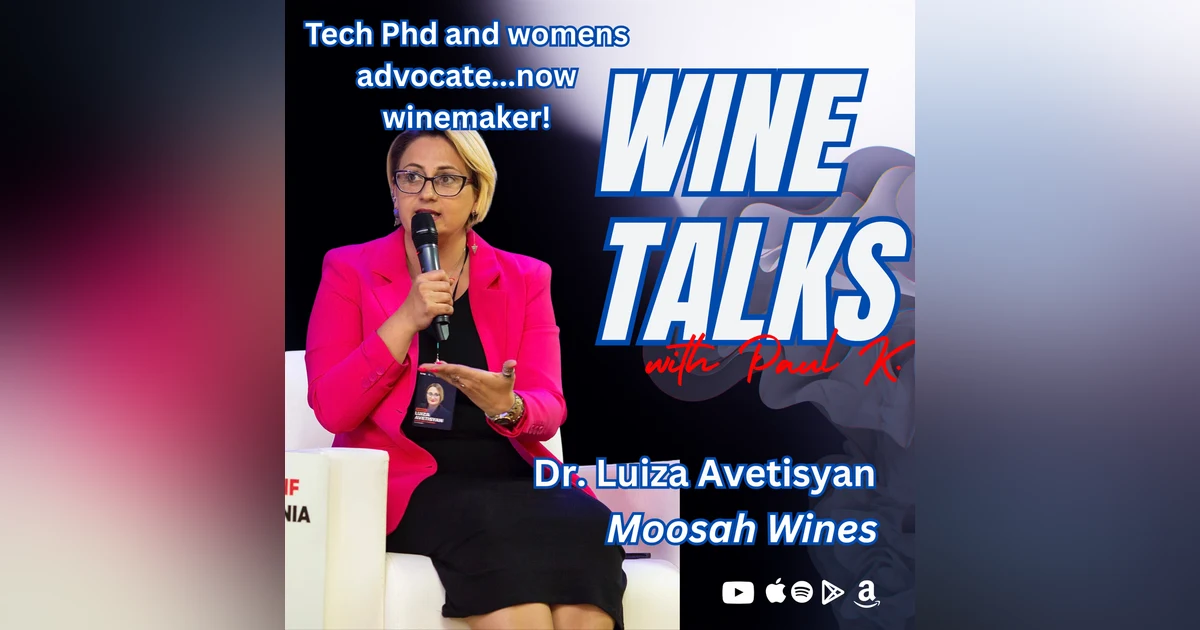

0:00 I always say that Musa wines, like winemaking, is my way to stay connected with Earth. And I really mean it. With digital and tech and everything, you are producing value, but when it comes to winemaking, you're producing heritage. Sit back and grab a glass. It's Wine Talks with Paul K. Hey, welcome to Wine Talks with Paul Kane. We are in studio today in beautiful Southern California, about to have a conversation with Luisa Avetisian way out in Yerevan. Listen, a new show just came out called Song of America. It's about immigration to America.
0:40 Some crazy good stories about people that have come here, relatives, grandparents, and established themselves in America with various disciplines, social, political, financial success. It's really crazy good. But not while we're here. We're here to talk to Louisa. Welcome to the show. Hi, Paul. Hi. Thank you for having me. Now, Louisa is the host of Beyond Podcast, which is by demand back on the air, so you got to check that out. She's also the owner and founder of Musa Wines out in Armenia. So we've got a nice conversation about some of the other things that are going on in the world of wine as well as winery ownerships. But you're a PhD out of Yerevan, right? Yes. Engineering? Yes.
1:22 Do you like to be called doctor when people talk to you? No, I usually I'm not called the doctor. No. But the search for academia. We're going to talk about this a little bit while we get along. But you know, certainly Armenia is a rather patriarchic society, as France and many other countries in that part of the world. How. How did that sit with a woman becoming a PhD and did. Was it a. Were there henwoods headwinds to that process? No, I'd say that it's not something that it's not a male dominant space. My mother holds a PhD in engineering and I started my career as a. As a software engineer because my bachelor's is also in math and in engineering.
2:10 So getting a PhD. I actually did it a couple of years after I left my master's. I graduated from master's program and I was working for HSBC Bank. And my PhD thesis was around financial engineering. And I actually used real data to build the models. And I won't go much into, you know, the very details, but no, I wouldn't say that this is something that only men or mainly men do. You know, it's interesting you say that because before I got into the wine Trade, which was 1988, although I had worked at my dad's store for a long time, I owned a software company and I mean Obviously from the 80s, so much has changed, but it's radically different.
3:01 Just in the last few years, have you delved into some of these changes, some of the AI work and how it affects the workflow and how it works, how coding works these days? Yes, yes, sure. So my company, the staff am, which is the premier career marketplace in Armenia, software engineering company. And then the second product is Hirebee, which is fully AI powered hiring and HRMS solution. So actually this, we witness it every day from building autonomous agents to actually going like using no code tools, et cetera. These are things that are happening now and affecting Armenian engineering workforce and software engineering workforce. And in general product, digital, digital product building process a lot. So this is something that I deal with every day within the scope of stuff Am I call it the best time to be in the industry.
4:06 Actually that's interesting thought and I'm obviously fascinated by it. Having sold, having worked in the industry, it was database driven type product at the time, but it did actually have network capabilities. And this is 1988 where we would call across the country and download data from a remote data source. But you know, this is ridiculous. So yesterday I was working on a workflow because I do this by myself and we were going to talk about podcasting here in a second, but you know, I do everything. I had a staff here at one time when I sold wine. So I had a software engineer, I had a IT guy, I had a digital designer, I had all the people to support the podcast and I don't anymore. So anyway, long story short, I took an airtable product that I had laboriously put together with another staff member and I just put it in one of the code writers vibe, code writers. And it duplicated it in so much and it's so much better than what I had created. And it took, I don't know, maybe it took an hour total and I'm in the middle of testing it.
5:13 It's just, it's phenomenal for this process and I think you're right. I think it's a really interesting time for the world to embrace it. Do you find people are not using it enough? I mean, other words, they're not looking at their own lifestyle and their own business and their own workflow and saying, you know, I should probably attach AI to this. Yes, I think many of them do. And when I'm asked what is going to happen to labor market in Armenia, in the world, et cetera, I said that AI is definitely going to create a lot more jobs than we have now. Of course we're going to lose some of them. That's obvious, that's already happening. But what I like to say is that we're going to start to speak to our fridge and for that we're going to need more engineers, more product people, more jobs to actually start to speak and to interact with many of the gadgets that surround us differently. And then, you know, I'm waiting for a robot to be ready to be used in my yard, so, you know, it can take care of everything.
6:28 So these are really very exciting times. And you told about, you shared about Vibe coding when it was new. I also had some ideas which, you know, I was postponing all the time and I sat there and I created the stuff and I tested and you know, it was then ready to go and to be build with a normal life cycle. But for product people with product mindset, founders with product mindset, it's quite easy today to actually build something, validate it and then go to the market with more confidentiality and more product input, like user input. It's crazy that it's, I mean it literally changes every day. Even the product that we're sitting on now, Riverside fm, it seems like every day they have a new release, AI driven. You know, answer this question for me because the diasporan Armenians will tout the idea that there's this hotbed of intellectual tech in Armenia and I tend to agree with it. There's a lot of engineering that comes from it and part of the conversation is, well, that's where, when it was part of the ussr, that's where the USSR pointed to Armenia for their tech intelligence. Is it? So is Armenia a hotbed of Armenia of engineering, AI engineering and even, you know, military and or business
8:00 engineering? Yes, quite. Yes, I would quite agree with you. And we saw a number of multinationals and also US based startups and scale ups open their offices in Armenia for the past 10, 15, even 20 years. And now with all the developments that we are seeing here with Nvidia's investment and big projects and other things that are happening in Armenia, the entire region's attention and even Europe's attention. And why not? Also that world attention is on Armenia.
8:40 This is gaining a real momentum and I'm sure that this is just the beginning. So this becomes a new era of development for Armenia. Armenia, this means a lot for our engineering talent. This means a lot for our mind as builders and creators. So this is very exciting, definitely for Armenia. I think you're right and I agree with you completely that much. To the naysayers of the industry and how a lot of politicians even will talk about how AI is going to take jobs. I don't agree with that at all. It's just like when computers hit, you know, when many microcomputers hit people's desks in the early 80s that they were going to take away jobs. And it just creates so much more information to have to process and to react to that. We're going to need the people to react to it because it doesn't do it all. It never will. As long as it progresses, it will create more information to process and to move along with. And I wish I had some of this data when I was selling stuff back in the days, but I guess it's always relative. So whatever, you know, grow up with. Let's, let's get. We got off subject a little bit because we're going to talk about wine here. You know, the, the Concour Mundial de Br was in town in Yavan and I had every intention of coming. We happened to be on a two week Ireland Scotland tour just days before and just wrapping up and my wife's like, I don't know if I can spend a week in Armenia. I was asked to judge and I wanted to come and, and shoot more episodes of the
10:14 show called the Back Label that we did out there. But you were there and I want to get a feeling for the energy, the international exposure that this created for Yvonne and the Armenian wine trade. Was it exciting what was going on? It was very, very exciting, Paul. And we knew about CMB to take place in Armenia around 18 months ago. So it was the beginning of 2015 when the C founders were in Armenia who were celebrating with the wine community and there they announced that the CMB 2026 will be held in Armenia. And this is huge in the terms that almost 8,000 bottles of wine were sent to Armenia and around 320 expert judges, sommelier buyers came from different parts of the world to Armenia. And of course majority of them, you know, didn't know about Armenia much or haven't heard that, you know, we had this heritage, you know, we are by fact the first country to produce wine. The are any one cave is an artifact of this and also the fact that so many international wine experts tried
11:45 Armenian wine. They were hosted by different wineries in different regions. The Vayoc region, Aragatsotal region, Almavid et cetera. So this was, you know, very monumental for Armenia for sure. And I will just briefly introduce the scope. So what happens when big competition like CMB happens in Armenia. So there are four or five days of wine tasting which took place in Garen Demmerchand port complex. And it was, you know, equipped in a way to be branded, very nice interior. And judges were there like trying the wines and doing the blind wine tastings for hours. Then for the second half of the day they would go to different wineries and like Karas and Armenian wine and these big wineries, they hosted dinners there and it was really very beautiful. On 20th of May, we had a big opening ceremony at Garni Temple and it was, I don't know if you have had a chance to see some pictures, some videos, but it was huge. And it was very, it made us really proud of our heritage. It was based on our history and the storyline was built around winemaking and us being a winemaking region. And
13:17 at Garni, I could feel that, you know, all the people who came, who flew to Armenia from Asia, from Europe, from, from Americas, et cetera, this was huge for them as well. And this was unexpected. Something that, you know, they might not expect a small country to, to, you know, to produce something that beautiful. And when I spoke to Mr. Havel, he was like, I don't know what the next country is going to do to really keep up with this high benchmark that you guys created today. Wow. And we also, as a winery Musa one also got to meet with sommeliers and buyers who were interested with Armenian wine. And they were again, when they were tasting, not just as a blind tasters, but you know, approaching the producers, speaking with them, tasting the wine, they were really nicely surprised as well. So to sum up, CMB was something that Armenian winemaking industry really deserved. And this was the best arena where we could showcase what we have to offer to the world. And in terms of quality, we really have much to offer. The spectacle that I saw was amazing. I was jealous and FOMO because I actually had to cancel my reservation at the Alexander Hotel that I had already booked months
14:48 ago, but it just wasn't in the cards. Well, this is an important thing. The idea that the CMB exists is an interesting point of discovery for the wine trade because up until, and they've been around for a long time, but really what led the wine charge for, for the public was scoring Robert Parker spectator enthusiast all those people and you know, points, you know, you think about the point system, it really is like a 20 point system. It's not a hundred, it's out of 100. But really you don't Talk about wines that are less than 80. And so really you only talk wines that have 80 points plus. And here the CMB has created a methodology where it's gold medals, which is old school and it, it's a sticker you can put on a bottle so that you, when you go to the marketplace, people can recognize the gold label.
15:40 And to put it in perspective for the listeners, in the early days of this business, the Wine of the Month Club, we do lots and lots of wine fairs. And the largest fair in America at the time was the LA county wine judging during the LA County Fair. And that was up to 3,000 bottles. So when you think about that, organizing a group of tasters from all over the world to taste up to 8,000 bottles of wine in one place over the course of what, two or three days is incredible. Four or five days, yeah. From 19 to 23rd. And the logistics was all on the Armenian trade to do this. Mostly, yes. Vine and Wine foundation of army is part of the Ministry of Economy where the key organizers of the entire cmb, of course they had the company who was supporting them. But the main hosts, if I can say so, of the CMB were the vine and Wine foundation of Armenia, which is Zahra.
16:45 Yes, Zahra Muradian. And the work done was really sub. It's really quite fascinating. And in my personal opinion, I think that the pace of the, you know, post freedom for Armenian wine is incredible. This, and I can vouch for this in 2006 or so. And I've brought this up before on the show, you know, we were there and we were stopping at wineries and they really were unpalatable wines. I mean, you really couldn't drink them. And of course in the Armenian pride scenario, I had to tell them how good they were because I was the American wine guy and just really for the wine industry, in a short amount of time they've become world class in many of them and their quality and their production value. They're still learning about the soil, about the weather, about what's going to happen with the grapes, what CNN can do without any can do, et cetera. But the acceleration is pretty amazing. It's quite impressive. But let me, let's go backwards a little bit. You own Musa Musa wines?
17:49 Yes. And how long has that been? Four years already. Four years. Wow. Four years. Yes. Our first. That's a baby. Yes. Yes. We are, we are a small family owned boutique winery and we really started the winery because of mainly the love towards Armenian winemaking and Armenian wine. My husband is A winemaker by first academic profession. Profession in general. And I am, as I said at the beginning, from tech. And I'm a huge wine. Armenian wine enthusiast. So four years ago, we had our first industrial level, like the first vintage. Then we bottled our wines in 2023. So just three years ago. So the first Musa wine was bottled three years ago. And then last year, we won the IWSC International Wine and Spirit Competition.
18:55 Best amber wine, best orange wine. It's called orange wine in the world. So we first. Yes, we first won the gold and we sent our red and amber wine. And I just want to show quickly, so the viewers what how amber wine looks like. So this is filtered. Do you filter yours? It's filtered, but it's not like it's mildly filtered. Yes. Okay, so it has some residual bit of sediment, which is normal. Yes. You know, I think orange wine is an interesting process. What. What confused me when they started coming to America from Georgia and then they were making them here was certainly it makes sense to manufacture white wine using the red wine process. Why not? They make red wine, you know, they make white wine out of red grapes. But it was an excuse in some cases for the wine to be rustic, hard to drink, acidic, tannic.
19:58 And it doesn't need to be that way, right? No, I mean, no. In fact, there's less tannin in a white skin, you know, white grape skin, white skin grape than there is in the red one. So. And I. It just took a long time for the industry to come around to the fact that, you know, you can make really nice orange amber wines if you produce it. Right. I mean, manufacturing. In other words, it's not an excuse for a wine to taste like kombucha just because you think it's organic or that it's, you know, orange. Yes, but this is a tough industry. I mean, why would you do this? Were you trying to express Armenia? You're wine enthusiasts. If you listen to my show with Mariam Sagatalian, you know, she'll say in that video that there's more wine than consumers. Why would you do this? Was this an expression of culture?
20:46 Yes, it was an expression of culture. Also. It was the deep belief in Armenian winemaking in general. So I always say that we are just getting started. The winemaking industry in Armenia, we're really just getting started and being a team at the beginning of something. This is really fascinating. And I always say that the current winemakers who really aim for high quality, they are going to be remembered. But it's not about the Vanity or things like that. I truly believe that we need to show how beautiful Armenian wine and how beautiful Armenian terroir is to the world. Because like you told about orange wine being, you know, a bit different from white, et cetera, but our ancestors made the white wine like we do, like we make the orange wine today. So long story short, right from day one, when we created Moussa wines, we knew that it was going to be an award winning wine, it was going to be on international arena. Now we sell in the us, we sell in Europe, and we have many tourists in Armenia who when they visit Armenia, they order Musa wines. So we never compete with
22:20 local producers, with other producers. And I fully agree with Mariam, because Armenians don't drink that much wine, as all winemakers would wish. We still drink vodka, we still drink beer, et cetera. But this is, you know, this is a culture shift that needs to happen and people need to invest money, resources, energy to make this happen. Well, that is kind of the irony of the industry, right? I mean, it's people like you that have passion for it. That and I always, I usually start my little lectures when I do these things around town. I'm going to start with the idea that if you tried to pick the top five expressions of a culture, you know, you have to say a language. If there's a separate language, you'd have to say the, the land, if there's a separate country, the food, the music and wine, those are going to be expressive of it. And wine, even more important. And I got this quote from Juliana at Katas years ago, two things that came out of my podcast. One of them was, what other product can you take halfway around the world, put on the desk and say, this is who we were and when we were because of vintage. And the other thing, this is a question for you, since you've only been doing this for four years.
23:33 Michel Roland, who just passed away, the fandinologist who was working with Katas in the beginning, told Juliana, you can grow grapes here in the Arad Valley. Valley. But we're going to need a hundred years to figure it out. And you know, he's right, because how many, with all the variables that go into what's in that bottle of wine, you know, it could take that long. And so is this a legacy for you? Are you going to leave this for the kids, et cetera, et cetera? Yes, yes, exactly. So I always say that Musa wines, like winemaking, is my way to stay connected with Earth. And I really mean it with digital and tech. And everything, you are producing value, but when it comes to winemaking, you're producing heritage. So with Musa wines, yes, this is something that myself and my husband and would really love to see our kids, our grandkids, to, you know, continue the work.
24:34 And when creating the brand, the name, the story, the narrative, et cetera, we had this vision of seeing Musa alive and thriving 100 years from 2022 when we were doing all this. You know, I wanted to back up just a second to lead to another point, but one of the great photographs that I got got sent to me and probably an expression of what wine is about in the first place, but I had a wonderful African Bordeaux importer on the show years ago. Not even, not even a year ago, actually, a few months ago. Wonderful lady. And she. Her specialty is Bordeaux in, I think, Ethiopia or that part of the world. And they. They texted me a picture of her and Mariam sitting on the bus going to one of the events.
25:19 And I go, what other industry in the world would. Would that. Could that even happen? You know, an African woman who imports Bordeaux sitting on a bus with this pioneering, you know, wine bar woman, you know, in Yerevan, I mean, it just seemed. It just seems so poignant. Yeah. And wine connects, Paul. Wine really, for me, it connects people. Doesn't matter what nationality you are from. It really. It really connects. It's a celebration. Wine is a celebration for sure. Tell me then, what surprised you? When you. You're coming from tech, you're coming from an organized industry, a very practical industry, you know, A equals B type industry, and that's not the way the wine works. What has surprised you and what has intrigued you since you started doing this project? That was the first aha moment for me when we were, you know, we were starting, we went to see some of the big and medium wine producers, and when they were asking, what would your capacity be?
26:27 I was always saying, well, 2 million tones, 3 million tons instead of 2 tones and 3 tones. So in tech, you used to this millions. And this was. And they were looking at me like, sorry, sorry. No, it's just three tones, five tones. So we're producing rounds. And they were like, who is this lady coming just from out of nowhere with this? And the second thing was that in tech, when you need something to be released earlier, you add resources, you add engineers, you add product managers or ui, ux, et cetera. So you can make the release faster by adding resources. In winemaking, the wine doesn't care if you have 5 winemakers or 50 winemakers or 500 winemakers staying there next to that wine.
27:26 It needs time. And the same applies to the grape and it has its own rules. And also people in the wine industry, they're not as stressed out and binded with all these deadlines and everything. And it was so hard for me to set up the initial process with my husband when we would speak with cork importers, with printing houses, with the company that we bought the bottles and had them shipped to Armenia, et cetera. So they had their own pace, which was much slower than mining tech. And they would get sometimes, you know, hard time working with me. And when we were done and the bottles were, we had bottled the wine and went to see Mariam at Invino and she was like, oh, I'm sure you had a hard time with the printing, with et cetera, et cetera.
28:21 And I said, no, madam. I think they, because I was projecting the pace that we have in tech on winemaking. And it was the first lessons learned. But now I think I have more patience and I learned to actually wait and to obey. And I think I'm more humble now. Well, that's the right word, the humility of it all. Because despite the supply chain of corks, bottles, labels, glue, everything that goes into a bottle of wine, not let alone the actual, you know, putting it on the line and bottling it is the fact that you're beholden to what the earth gives you. And your job, you know, as I've determined all this after all these years, is, is to do the, is to create something that best expresses that moment. If you do that right, there's no such thing as a bad vintage because you've expressed that time and place. Exactly. We can screw it up, you know, we can screw it up easily. Right?
29:33 We'd be given something and then it doesn't come out the way it's supposed to. But it's a very humble, it's a very humble, humiliating humility producing industry. But it's a very, you know, this is the part that I'm not sure if you're aware of the French group called Adeni Global. It's, it's, it's out of Shataneuf D Pap. It's some very high level women that created this group and they chose Adani, the name because of the origins of, of Adani One Cave. But their, their job and, and you should look them up is, is to help wineries understand the business side of this. Because ultimately, and it's kind of the irony in my opinion of wine is you Got to sell some, right? You got to figure out how to sell. You can't continue to lose money and just pour money into winemaking because unless you have a lot of money to start with, which is an old axiom of the wine trade, but you know, you want to sell some and all of a sudden the realities of business come into play.
30:36 Margins. And the margins aren't good in wine and you've got to get distribution and you got to go see Mariam and put it on a shelf and then you got to do event. And so was that a surprise to you? Was that part of it or did you know? I think that part. I was more comfortable with that part because I have been in the business for eight years before actually producing Musa wines. And I'm glad that the decisions that we made along the way in terms of the production period and production approach, it helped us to to invest the capital wisely and it allowed us to actually leave some money for marketing as well. And when it comes to business side, it's very important to know if a winery is working with mass market, then this is another approach.
31:39 Whereas if this is something like we want to see our wines like boutique style, award winning, only in specialized stores, in good restaurants, et cetera, and we're okay to wait for years to make it happen, then this is another approach. So we have chosen the second approach at this moment, for the coming two, three years, we don't plan on expanding the production drastically. So we also love to participate at different festivals in Armenia and it helped us a lot. You mentioned events, so Yerevan Wine Days is one of the best places to be for a winery in Armenia. It's happening this weekend and from 5th to 7th of June. And these are spaces created for wineries to interact with their consumer. When we produce wine, we ship it to specialized store, to supermarket. We never see the person drinking the wine, how they react to it. With tech products, you can test and you can track and you can analyze basically everything, where they click, where they stayed longer, which UX worked better, et cetera, et cetera. With wine you don't have this luxury. So you do when you go to festivals, you stand there for two days or three days, you give the wine to the
33:13 person and they start to share their emotions. So this helped us a lot, Paul. And we understood who our consumer was. So we understood it very quickly. We knew that for orange wine, this is someone who is quite versatile, someone who likes to experiment, someone who is okay to give up the general white wine vibe. They really want to go for something new for our red. There is another segment. So it's very much like doing any business. You really need to understand who your consumer is, who your user is, who your customer is, and then be where they are. Yeah, so that was our approach. Margins are quite low if compared to tech.
34:03 I think this is something that is obvious, not even cool. Even when I was selling, you know, 40 or 50,000 bottles a month, the margins were still low. So it doesn't really change. But that's an interesting point. How old is the Adeni Festival? Has it been around long time? 10 years. This year they celebrate their 10th anniversary. So they are doing this. This is not. This is Yerevan Wine Days. I'm not sure how old are any wine festivals are, but the company organizing both. So this is the same company, Eventura. So it's an interesting thought. Let me see if I can articulate it efficiently. And that is different parts of the world, including Armenia at this point go through their life cycle of the wine industry and they get to the saturated part like America has been for many years. And I don't think obviously Armenia is there yet, but the Japanese, for instance, are well ahead of the Chinese in their understanding of wine and what, you know, the value of a good glass wine. And the Chinese are learning it. So everybody, every country's got a sort of different, you know, meter and.
35:11 But I think all in all that the industry is going back to experiential parts of the wine trade. And if you look at this picture here, that's my dad, that's me in 1975 and we're standing in front of what was the original Wine of the Month club display in my father's wine shop in the 70s. And the reason I brought that up is because back then you did that, you had dinners, people got dressed up, they had speakers and they did all the things you did to create the experience around wine. It's not unlike. Well, let's take Armenia for a second. If I come to Yerevan and I sit in a cafe and I have a glass of Moussa and I'm having a conversation with, with Louisa, I'm going to remember that every time I opened the bottle of, of wine and, and my club was, was based on that because we started the relationship with a handshake at a festival.
36:06 That was the primary method of, of growing the company from 1984 to 2007. And in fact, in 2007 I did over a hundred festivals in one year. Year. Wow. So that's two a weekend. I had a sales staff, etc. All that to say those people were my lowest, most loyal customers, because I shook their hand and we talked about wine, and every time they got the shipment from me, they were thinking, oh, I remember Paul, I remember Larry. Whoever was selling the wine at that time. And I really think wine needs that today. Because the Internet is, you know, Internet and metric marketing has completely destroyed that experience is. And people are just shopping for price and they're not necessarily looking for Musa. You know, here's a classic example. When I was on Amazon, I had. I took all this energy to put all of my wines, all two, 300 skews, into the Amazon platform.
37:06 And the only thing that ever sold was Stella Rosa. Wow. Which is that sweet Moscato from the north of Spain, the north of Italy, which is brought in here by San Antonio Winery. But the point is, people on the Internet are not shopping for different experiences. They're just shopping for what they know. And particularly on Amazon. And here you are out there at the booth, shaking hands, pouring your wines, having the conversation. And I think that's absolutely critical. Stories. Yeah, telling the stories. Because during the wine festivals, so people. People come. Not all of them, but majority of them come after stories. They want to know why you started the winery in the first place. Especially when the wine producer, the owner, the founder, himself or herself are there and they speak and they interact with the visitors. We have so many stories that people who tried our wine during Dilijan Wine Fest during Yerevan wine days, they became our loyal customers. I mean, we have some customers who order 20 bottles, 30 bottles per month.
38:16 That's even more than a specialized store does. And we have people who travel to Armenia during Yerevan wine days, tried Nusa and then they kept ordering it. And we shipped it to different countries on the post via postal service. We don't even sell it in that country, but we send them two, three, four bottles. And when they arrive and they come to Armenia again, they come to see us and they buy wine. So you build a relationship and it takes time to build these relationships. Because unlike your case, we don't have 100 festivals and we have really a couple of them. And we make sure to be at every single possible festival in Armenia so the consumers get to know us and get to Armenia.
39:07 Maybe I can give you a little inside information here, because when I did those hundred festivals, maybe not even half of them were food or wine related. But we did the. We did the boat show, we did the gun shows, we did the home improvement shows. And so People be walking down, looking at windows at a home improvement show. And then there's a wine booth. That was kind of fun, right? I mean, it's like, wow, what are you doing here? So those were very successful for us. You know, we won't get into metric, the metrics of it all, but they were very, very lucrative for at least a few years. You know, in the middle of the 80s, the, you know, the wine trade here. It's funny, when I, when I started this podcast five years ago, there was a, there was a serious inequity in, in gender when it came to wine making and executive wines. But at some point, almost all of my guests here were female. And my intern here, a young Lisa, was thinking about getting in the wine trade and now she's graduating from Cornell's wine school this year and she's. We. She had an internship in, in Bordeaux, France is Chateau B.
40:31 And is there an inequity in, in the wine? I mean, the. Most of the people I know in Armenia are females. Maram being the, you know, leading the wave and Zara and the only, the only male Armenians I've had on the show that deal with the Armenian trade is Zara's husband. So, so is that, is that a, is, is that an issue? And if it is, are you, are we addressing it or is it just the natural, you know, evolution of the trade? You mean issue that there are two too many women in, in wine industry? No, I would never say that. That would be, that'd be a death nail of the show. No, I mean is there a concerted effort to get women involved with the trade? No, I think it comes naturally. I mean, no one, I mean there are so many challenges and problems in wine industry that why we don't have to like many women here is the last on the list. So in that perspective, I think women in general in every single industry in Armenia are getting more, are starting being more active, getting more share in if we can say so. And that comes naturally. And that applies naturally to wine industry as well.
41:53 And I think that we had some trailblazer women who really showcase that it doesn't really matter if you are a man or woman, you can succeed in wine industry. So still majority of chief winemakers are men. I won't say everyone, but the majority of winemakers are men. But then commercial heads or business development or overall CEOs, we see more women there. So I would say that only on technology side we still have a male dominant industry, but that's not because it's hard for women to get there. I mean, whoever decides to, you know, be aspire this. This path, then they should definitely succeed. That's interesting thought. I like the way you articulated that because, you know, one of the other issues here in America, of course, is, is diversity in the wine trade and in the African American community. It's just becoming a popular and important part of the industry. I can say that the association of African American Vintners has grown from 5 to 250 in a matter of a few years. But I don't believe that there was any exclusionary, you know, that it was excluded, but it was just not part of the path. And so now it has become part of the path. And there's some. I tasted 75
43:26 African American wines not too long ago, Napa, and they're all great. You know, they were all really good. So do you think then that path in Armenia, for a woman in the trade and I've had the trade here obviously is much more complicated and much more sophisticated in the layers of bureaucracy and, you know, working for a big distributor and how much time and energy it takes to do that. But is there a grassroots method to become a winemaker in Armenia? Like, I don't know if there's an Armenian word for cellar rat or not, but somebody that hangs around the winery, who cleans the tanks in the beginning, who sweeps the floors, who make sure everything's clean and they grow in the ranks of the winery without going to sleep.
44:10 Winemaking school or is there a preponderance of going to winemaking school in order to get into the trade? I think both apply, but because we have EVN academy, that's easier for someone who is not like who hasn't done a bachelor's degree in winemaking or food industry in general to go and get this training. But of course, I'm sure that, that there are cases where someone grew from being just a help around and manual worker to becoming actual professional in wine. But if I look into the current community, I think majority of them are winemakers by their academic practice.
45:04 So they add, yes, it's. It always interests me when I talk to French winemakers, Italian, many of them, you know, started in the cellar and that's just the way they learned and it's that kind of industry and other ones you went to academic school. But I think, you know, when it comes down to it, it's being in the cellar, picking the grapes, knowing when to pick the grapes, all the things that go into a proper bottle of wine that, that prevails yes, but I love to. We will see it, actually. It's just. We're just getting started. Well, we're almost out of time here, but I do want to touch on this because of the current political situation all over the world, really. But I think it was just announced here. We just read recently that Russia is putting the screws to Armenia about certain things. And I think. Didn't it restrict wine trade as one of their embargoes?
45:57 I think it had something to do with the eu. Has that happened? And if it does, Russia is a huge marketplace for. I mean, why? What's going to happen? Yeah, I don't have much information there, so I'm not an expert on the end. And we don't export to Russia, so our markets are the US and the Europe. But yes, there is a big market for certain Armenian wines in Russia. And of course, if that happens, this is going to affect them and that affects not only winemaking, but other producers as well. That can be fruit and flowers, et cetera. But then we might be able to use this to find new markets. It's going to be difficult, for sure.
46:48 And many winemakers and wineries have been exporting to Russia for more than a decade. And Russians really enjoy Armenian wine and they are used to it. So that's not actually my area of expertise. But that's not going to make sense for neither of the sites, neither for the Russian consumers nor for Armenian producers. I mean, the Russians have been huge consumers of all things alcohol. I mean, the primary marketplace for brandy. Brandy as well. Armenian Ararat brandy as well. Another market for. For that. Do you have aspirations to come to America with. With your wines?
47:34 We actually. Our orange wine can be delivered throughout all. Like, all throughout all the 50 states. And it can be bought online on wines of Armenia and with other wines. Yes, we are, you know, we're open our red and our barrel select aged wine sold in the US as well. It's quite a good market for Armenian wines, and it's an untapped market. I would say we need to do more work as a wine community and also work closer and somehow have some different approach when it comes to the trade in the us this is a huge market and a good market. I've had that conversation with Zara and many Armenian producers and bureaucrats.
48:27 The extent that, yes, you know, as a tradesman and doing this for so long, I can't tell you how many tastings I went to that were sponsored by a region of the world, not only a California region like Paso Robles or Napa, but Wines of Croatia, Wines of Italy, there's groups like that. And important, again, when I won't name any names and throw anybody under the bus, but there have been attempts here in Los Angeles to do this and they've, they've fallen by the wayside. And I just had this conversation re recently and the reason that they fell apart is because they were, they were attracting consumers to the show, which is, is completely, I mean, not ridiculous. It just makes no sense because the people that need to buy the wines from these people are the restaurateurs and the wine shops and the grocery stores. So that if a consumer does taste a wine they like, they know where to go to get it. But if you're just tasting wine with a consumer and then they say, where can I get it? And you say, well, you know, you go to Stepan's website, that's going to be it hit. That's not enough. And so I've been trying to teach here that we need to produce a show. And there's a, there's one gentleman actually in LA who puts on amazing tastings and they're trade only.
49:51 You can't go as a consumer. And they're packed with buyers. And the buyers come and say, oh, where can I get this? Oh, here's the distributor's name and here's the price sheet and here's how you order it. And so that they can put on the wine list or they can put it in, in their wine shop, or they can put it on the shelf at the market. Market. So that's, that part is really important to understand the, the, the chain of command when it comes to people trying to find their wines. And look, let's face it, you know, wine sales are off all over the world. And in fact, there was an Armenian restaurant here that was telling me that his bottle sales are off 40%. Well, that's, that's a lot. You know, that's really hard to recover from if you don't. Yes. Put effort into it. So. Well, I hope one day we get a chance to sit and taste some Musa wines together. Other.
50:36 Definitely. Yeah. I'd be happy to host you and you know, and you're going to love our orange wine for sure. Are you an orange wine person or not really? You know, I tasted 100,000 wines in my career, and so I was required to, to understand and appreciate all of it. So, yes. Just. Do you like it? Yeah, I do. I, I do like it. As long as it's not like I said, using the fact that it's an orange wine as an excuse to taste like, you know, kombucha. Like I said, it doesn't need. I fully agree with you and share your opinion. Yeah. So some of them do like kombucha. And I plan on coming to Yerevan maybe in the next 12 months. I want to shoot more of the shows, the back label and. And highlights of more wineries and more people that do this trade. And that show is sort of like Anthony Bourdain's Parts Unknown, where we're not really talking about swirling and sniffing wine. We're talking about the struggles like we just did. We're talking about the people like we just did to get an understanding of what drives this passion. And it's clear to me, you and your husband have this passion to express Armenia, which is really cool. Yeah. Yeah, exactly.
51:56 Great. Such an honor to have you. Yeah. I'll be happy to meet in person. Paul, thank you very much for giving me the stage. I can talk about Musa and winemaking in Armenian wine for hours. Thank you for giving this chance. And we will. Cheers. Cheers.