

 Apple Podcasts

 Spotify

 Youtube Music

 RSS Feed
 YouTube
 Pandora
 iHeartRadio
So You Want To Create An Ready To Drink Cocktail. Have A Listen To Rob and Leslie Levy.
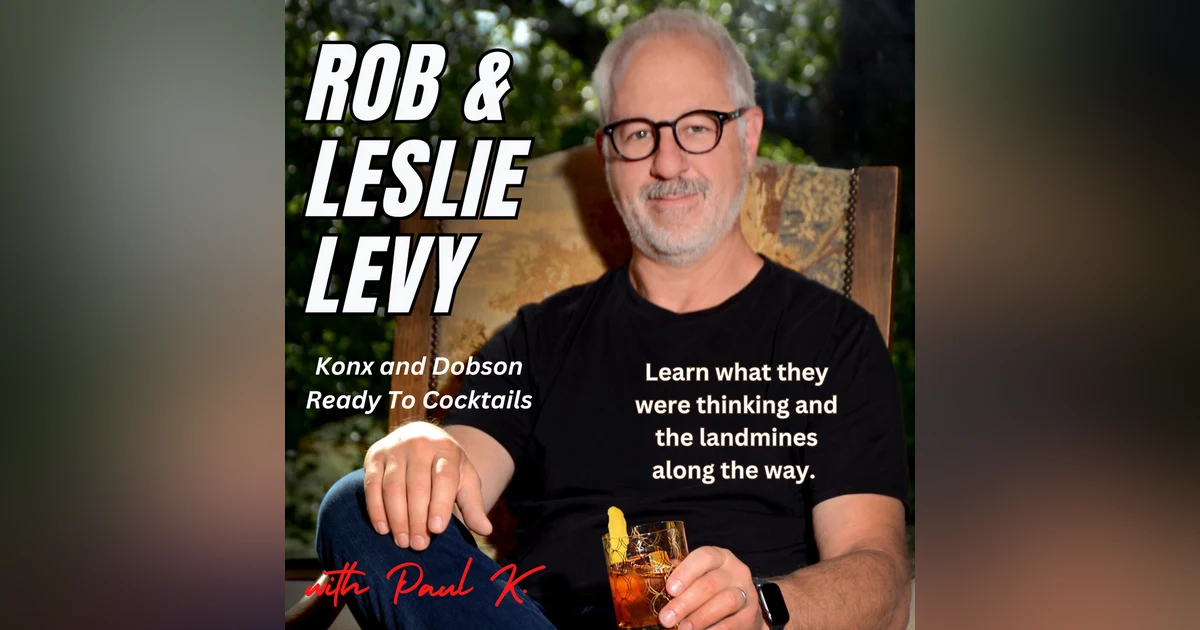

I have known the Levys for years. I've known them as restauranteurs and gracious people. They fell in to the restaurant business and it was sink of swim; swim they did, creating an iconic establishment in heart of Southern California. From the restaurant came what one would consider the first of its kind in the San Gabriel Valley...a craft cocktail lounge. No one had heard of such falderall out of downtown Los Angeles, a craft cocktail bar...the idea.
Well, it turns out to be a brilliant idea and the bar 1886 became a destination in itself for lovers of hand made, exotic cocktails.
Enter the RTD market. I mean, they enter the RTD market. At the time of the success of 1886, the Levys brainstormed a premium, in the bottle, cocktail. Focusing on the classics and nothing but the best ingredients, Knox and Dobson was born.
Rob and Leslie Levy never intended to become restaurateurs, much less champions of craft cocktails in a bottle—but as you’ll discover, some of the best ideas come when you’re busy doing something else. In this episode of Wine Talks, you’ll find out how a couple just trying to buy a Pasadena apartment building accidentally inherited an iconic restaurant, survived the baptism-by-fire of the food business, and spun that hard-earned wisdom into revolutionizing the ready-to-drink (RTD) cocktail world with Knox & Dobson. You’ll hear tales of kitchen crises, the quirky genius of naming a brand after a childhood Chicago street corner, and what it really means to translate the heart of a five-minute, hand-crafted drink into a shelf-stable bottle that still surprises—and delights—even the most jaded bartender. Paul and the Levys dig into the gritty, exhilarating reality behind building something new: wrangling with distillers for barrels, battling the sneaky complexities of upscaling classic recipes, and learning the hard way that shelf space is gold and distributors want more than just a good story. Along the way, you’ll pick up rare insight into why most canned cocktails are disappointments, the secret advantages of a deep purple apothecary bottle, and the surprisingly emotional connection people make when you pour—literally and figuratively—your passion into a public tasting. Whether you’re dreaming of your own food and beverage business, fascinated by the science and soul of the perfect martini, or just want to know whether you could actually run a bar without losing your hair, this is the episode that will pull back the velvet curtain on both the chaos and the romance of bringing real cocktails to a thirsty world.
✅ Ever wonder how a legendary restaurant sparks a craft cocktail revolution?
✅ Rob & Leslie Levy share their wild journey from owning Pasadena’s iconic Raymond restaurant to launching their own high-end ready-to-drink cocktail brand—on the latest episode of Wine Talks with Paul Kalemkiarian.
✅ Hear how a real estate deal gone sideways led to 18 years in hospitality, and later, to breaking new ground in the premium RTD (Ready-To-Drink) cocktail market with Knox & Dobson.
✅ Takeaway: Want to know how to turn setbacks and industry surprises into flavorful success? Tune in for lessons on innovation, grit, and the secret to a perfect bottled Manhattan. You’ll never look at your next cocktail the same way! 🍸✨
Listen now to Wine Talks!
#ReadyToDrinkCocktails
#CraftCocktails
#DrinkEntrepreneurs
#KnoxAndDobson
#RestaurantStories
#BottledCocktails
#BarInnovation
#WineTalksPodcast
0:00 The bar has been set very low. So people's expectations for a you tell them a bottle of cocktail or can cocktail, whatever, they expect it to not be great. And so when they're surprised when they try it and they're surprised that it's good, that's what we hope will bring them back to bite again. Sit back and grab a glass. It's Wine Talks with Paul K. Hey, welcome to Wine Talks with Paul K. And we are in studio in beautiful Southern California today about to have a conversation with Robin Leslie Levy. Yes, got that right. Why do I doubt myself? As soon as I start introductions in just a moment. I just got back from our editor the episode for Song of America, which is the Agogenian family, starting with an Armenian Los Angeles racing history family. Incredible conversation. Look for that to come out soon. But not why we're here. Here to have a conversation with Rob and Leslie. Welcome to the show. Thank you very much. Thank you.
1:02 It's good to see you guys in a professional environment. We always have dinner or whatever. That's fun. You guys are founders of the Ready to Drink Cocktail. And for the listeners, RTD's, which is quite a acronym these days, Knox and Dobson. We're going to get on that subject in a minute. In fact, I see you've got like, how many more do you have now? We have six now and soon we'll have seven. Wow. Yeah. When we first started, two or three. Yeah. Yeah. We originally launched with four, but yeah, it's beginning to grow and we're seeing what, what takes and what doesn't and people like. And we're going to go back a little further. Not like when you met and all that kind of stupid stuff.
1:46 Because we're. Going to talk about restaurateur because you guys were the proprietors of the very famous restaurant, an iconic restaurant in less in this Pasadena called the Raymond. We were. And I think where this idea burgeoned from. But talk about the restaurant business. How long were you doing that? 18 years. Yeah. That's long enough to pull your hair. Out, I would say. 18 long years. Yeah. Yeah, you all have your hair. So that's good. A little bit. Not, not much more in the first place, you know, we, we never, never intended to own a restaurant. We were buying and selling real estate and the. We knew the owner of the Raymond. We were fixing up a building across the street and having lunch there and asked her if she would sell an apartment building she owned behind the restaurant. And initially she said no. And we just, you know, we kept Going in, she finally said, you know what? I'm ready to retire here. If you'll buy the restaurant, I'll sell you the building. Oh, wow. And so we had a good friend who was a chef, and this was her dream. I mean, this was like buying Chez Panisse in Pasadena, which was great. And so she agreed that she would take the restaurant. We had no interest in the restaurant at all.
3:04 And we went into escrow, and two weeks before closing, her investors pulled out and we owned a restaurant. Wow. I can tell you for sure that is not the way you want to learn the restaurant business. It's a crash course, that's for sure. Did you go right into the kitchen or what did you do? I mean, like. No, we. I mean, our initial thought was we got to sell this thing before we go bankrupt or crazy. And we had to hire a chef. Had to hire a chef because she was the chef. And that's the. That is a fun experience. It was. Yep, yep. Chefs, as you may know, can be temperamental. Yes. The kitchen was 50 years old. The building was falling down. That part we knew how to do, but the rest of it we didn't. And fortunately, we had enough good friends from around town that were in the business that kind of kept us from going off the rails. And we. One thing led to another, and 18 years later, we were so. But it was fun. Was. You said the Chez Panisse. And for the. For the listeners, Jezebel's is a famed restaurant in the Berkeley area owned by Alice Waters, who probably single handedly changed the direction of food in America. But that's what you felt like this place was at the time. The reputation of Raymond Craftsman Cottage. Yeah, right. It was really cool, 1800s, but no one steps into the restaurant business like, you know, not knowing anything. Right. And honestly, you know, if it weren't the Raymond, we would. I don't think we
4:35 would have stood a chance. I think we, you know, we. We lucked out in that it already had a history. Yeah, right. And the former owner, the founder of the Raymond, she came up with Julia Child. Really. So they were. They were compatriots. They were local. Julia Child was from Pasadena and. Or lived in Pasadena. And so there was. There was a lot of history. A very formal French restaurant when we took it over. White tablecloths, very formal. And what we found is that when you're going to a formal restaurant, you go about once a year for your birthday or your anniversary. So we wanted to make it more casual so that people would come Every day.
5:16 So it kind of became kind of like the cheers of Pasadena. Yeah. I mean, were you guys there every day in the beginning? We were here a lot, Leslie. More than me. You know, I had my business and. But the, the goal was to make it. Instead of wearing a suit, you're wearing jeans and it was okay to come in shorts and hang out. And you know, that, that was. The goal was to make it more of a neighborhood hangout where you would. Drop by more often. Yeah. Can you even, you know, can you even run a restaurant without being there? I mean, is that, is a restaurant a non proprietor type? Unless it's corporate America, like where, you know, you know, Black Angus or something or, you know, Olive Garden. But if you're running a restaurant like that, that's specific. And then we'll get into this, this idea now. But is that even possible to do without being there every day? Practically? I was there every day, but just. Not, you know, you weren't waiting tables.
6:12 I wasn't waiting tables. But you know, we, we wined and dined people there. We had our friends there. We were always entertaining there. It was like having people come over to your. It's like having a party every day. Would you, would you trade that? I mean, like, you're looking at the wine shop picture right there. My dad, my dad acquired that wine shop because it was sort of an opposite thing. He's. I won't buy your pharmacy unless you sell me the wine shop with it. Sort of the opposite. But thank goodness that's what happened. My career came from this insistence. And so here you are now, you know, in the marketplace with, with Knox and Dobson rtd. Would you trade now the experience as a restaurant tour for anything to get here? I don't think so. I mean, I think it really helped us, like partnership with the community. We've done a lot of events. We've had events, political events, fundraisers, all kinds of things at the restaurant, which we never would have been able to do if we weren't involved in the restaurant. We've met amazing people. I mean, it's been a real eye opening experience. You know, operating a restaurant, not so much fun. But the people and the social aspect of it was phenomenal. But it's put you on this treadmill right here.
7:29 You wouldn't possibly be ready to drink cocktails without the restaurant. Not at all. In fact, as you may recall, in 2010, and this is what launched us in this direction. We knew early on that we had to build a bar. We had a bar but it wasn't really a bar. It was more of a service bar. And they were doing virtually no business in the bar, really. $1,500 a month. Would that formula even remotely work today without the margins in a liquor? Not a chance. And so we knew we had to build a bar. We didn't know how. We didn't know what it should look like or feel like. And Leslie, by chance, through a friend, met some people who had built all the crazy successful craft cocktail bars downtown.
8:23 And she came back and, you know, said, we've got the idea. And so I went with them on this little bar crawl, and together we just said, well, this is it. And just by chance, by luck, it happened to be at the very beginning of the craft cocktail craze, and. And even more lucky, we were the only ones to do it outside of downtown LA. So we were the first in the St. Gabriel Valley, and it made us famous. You know, it wasn't a big space, so actually, probably. That probably lent to some of the success, like, well, it's very small. You can't just walk in and expect to get buffalo wings here. You're gonna have to time this and make it work. And it created this whole vibe in the community. And we had regulars who were there. You all the time, and just. But it was a really wonderful experience. And at that time, bottled cocktails really didn't exist. Yeah, right. It's not that long ago. No. This whole phenomenon just kind of happened in the last 10 years. And so we were at the very beginning. We just couldn't get it right soon enough. And then Covid hit. Covid hit our bottles. What was it called? 18.
9:45 1886. 1886. The year I. I knew about it, but I had. I'd only been there a couple of times, but it was. How old was that bar when you sold the restaurant? We built it in 2010. Really? It's that young? Yeah, I'm gonna say it's that young. Yeah. And, you know, before that, it was. It truly was just a service bar. It was just. There was nothing there. It was part of the dining room. And so it kind of took on a life of its own and became its own special little gem. And, I mean, there were people that would come to the bar that didn't realize we had a restaurant. Now, see, this is really interesting because I think in most formulas of most restaurants that I've experienced through all my career doing this, doing the liquor and wine thing is that if the bar, if you have to go through the Restaurant to get to the bar. They're not generally that successful. People don't want to have to like interrupt dinner, walk through a path and get to a bar.
10:45 And I've seen it fail many times in many different places. But here you kind of had to do that. Right. To get. We had a separate entrance for the bar. Oh, you did. Okay. But most people came right through the front door. And you know, most of our seating was on the patio anyway. Yeah. So the main dining room was actually pretty small. Yeah. So what would craft cocktail mean when you. When you were out bar crawling in la. And I remember that, I remember when this all started. But what would you consider what was considered a craft cocktail? Fresh ingredients. Yeah, fresh ingredients. Everything was made in front of you right there. You know, you spent five minutes watching the guy make the fancy. So whether it was a six to one gin martini or whether it was a, you know, a muddled, you know, mango margarita, you. You watched it. You watched that take time and money and energy to do it. Did it, did. And, and part of what led us down this path was we had days at the restaurant on a busy weekend when people were waiting 20, 20, 30 minutes for a drink because every drink was so labor intensive. Right. We started batching our cocktails and so we could get our most popular cocktails into the hands of customers quickly.
12:07 And that's where this all kind of came from. So now let's jump to Knox. Knox and Dobs. It's. Yeah, there are. There were surprise. Some big houses that started this idea of a ready to drink cocktail. I mean, I think there were other types of canned and bottled beverages. Club canned cocktail. Yeah. Right. That was it that you could buy. My dad even had them at the store at some point in time, but cans. Yeah, most of them had a lot of sugar in them and other ingredients. And we just wanted to do it exactly the way you would have a cocktail at a bar. Right. And that's what took us so long to figure this out, is because we spent all this time with flavorists and food scientists and all these different secret, fancy methods of trying to make it taste like a cocktail, when in the end we wanted to make a real cocktail, just a cocktail. And so it took some time. That's an interesting proposition because my niece, who's coming today, you might meet her on your way out, is. Had started a brand of salad dressing I think we might have spoken about a little bit and that she had the same experience. You know, here's my salad dressing. And then now we've got to figure out a way to put it in a package.
13:28 And the immediate response is, let's get a food scientist on board and start manipulating the things that we have in our quivers to make these concoctions. When the reality is, you know, we just want gin and vermouth in there. Right? That's right, Yes. I mean, the trick is when you're making a thousand gallons, the recipe is different than when you're making one. So. Okay, that, so is that, that a scale issue? Like if I took, I, I make my martinis sometimes eight to one, six to one, something like that. My dad prefers, you know, six to one. He's an English guy. You know, he grew up in an English environment. So if I was to make 20 gallons of it, I wouldn't do 6 to 1.
14:09 At that point, there's a balancing act. Yeah, the, the flavors either become too, too intense or too diminished. Yeah. You have to balance it out and adjust your, your recipe to make up. For that martini is a tricky one because everybody likes their martini just slightly different. So we're, we're, we're having fun with, with pleasing people that love a gin martini. Ours is not a bike martini. So, so right there we have our crowd of gin connoisseurs. Well, omg, go to Paris and try to order a dry martini and you just get the range of what you taste from one bar to the other is just unbelievable. It's like, no, I just want a little martini.
14:57 When you walked in and I was telling you about Connor, I had both my son in laws out when he first gave me some samples. And I tasted your gin martini against mine, which I consider myself an expert in this field thanks to my father, Manhattan's as well. I've done a lot of experimenting with Manhattan's and man, they were so close. I mean, I will say that the fresh one made, I made right then was maybe 3%, you know, more interesting. You mean ours was. Right, Ours was just for the show? Yes, yes. So that process then you're saying that you recanted from that process, you stepped away from the food scientists and you went a different direction? Is that what happened? We did, we, you know, we kind of came full circle and said if we're going to make a really, a real mark, a real cocktail and make it taste like what we serve in the bar, we have to serve what we serve in the bar.
15:50 Right. And so. Which is aged spirits. Yeah. We ended up going to distillers and convincing them to sell us whiskey in the barrel that we then aged two to four years, I had to convince Angostura Bitters to sell to us because who are we? Yeah, right. In bulk. Because you can't buy those little tiny bottles. And I can see Leslie going there, that doesn't work. Yeah. So there's so many parts to the puzzle that required extra work to make this all come together. Okay, so back it up a step. So here you guys are having success with 1886 and there's people coming in. Maybe somebody said, hey, you ought to bottle these things, or maybe you didn't, maybe you did on your own. But there's a. That's a huge leap from what you're doing today.
16:44 Packaging design, TB approval. Beside, we just talked about formulation. I mean, there's a lot of moving parts. When you decide as two restaurateurs to take something to the market and get it on a shelf, that's a whole different part of the business that possibly we were aware of. Yes, we're more aware of it now and we've discussed this before, but so what was the thought process in how this was would feel to the consumer? Like you guys were sat at dinner table boring each other to death with details about this product. That was a joke. And I've been through these same conversations, by the way, many times.
17:26 But you're discussing what this thing should feel like, and it's not High Noon. I mean, that stuff looks like crap and it doesn't taste much better. So how did you come around? This idea of a name like Knox and Dobson was very English sounding. The octagonal, or not octagonal, but the bottle shape, the color, everything takes a decision. It's kind of like building a house. You got to know where every plug's gonna go and every light switch. That's true. Well, I will say that one thing we learned from the restaurant business is people eat with their eyes first. And so we wanted to make a product that looked like quality. And so that's where we came up with the hex shaped bottle. By chance, our partner is a artist by trade, graphic artist, and he helped us design the label and the bottle. And you know, there's some science in the color of the bottle. It's a deep purple, which protects what's in the bottle. So, you know, the old apothecary bottles from back in the day protected what was inside. And so there's that. And so we started there and you know, we knew, we knew we had a good cocktail. We knew how to make a good cocktail.
18:41 Now translating that to the market and making people see that this looks really good. So maybe I should try it. It's not, you know, High Noon. It's not, you know, a can on the shelf in the sea of cans on the shelf. Isn't that interesting, though. You would think that corporate America, these giant organizations that have these boardrooms full of people would have a similar thought process at some points, in other words. Or they're just like, well, we got to get the thing out as cheap as we can get it, and we're going to use the worst materials that we can find, and we're just going to get on the shelf and take our market share to, you know, rely on our market share to get these things out there. That is generally the thought process is they, they use their clout and inexpensive ingredients. Yeah, they, they, they.
19:33 The bar has been set very low. So people's expectations for a. You tell them a bottle, cocktail or canned cocktail, whatever, they expect it to not be great. And so when they're surprised when they try it and they're surprised that it's good, that's what we hope will bring them back to bite again. It's kind of interesting. Jog. They thought, which doesn't happen very often, that in the wine trade, the stuff on the shelf that we walk in and we see the apothecary reds. Apothecary reds, and we see the Josh's and we see all the same stuff at all the markets. It's annoying, but it's a very important part of the industry to get people that otherwise wouldn't drink wine to start trying wine. They're sweeter, they taste. You know, they're not very complex. And it sounds like maybe that's the segmentation that's happening maybe in your trade that. Yeah, the High Noons and all the other canned beverages that are coming out aren't really necessary. Competition for a craft cocktail in a bottle, is that segmented yet?
20:39 Not as much as we would hope. Yeah, it's. People are kind of grabbing whatever's easiest. Yeah. If you look at the majority of cocktails on the shelf, they're very low abv. So less alcohol, more profit margin. They usually make up for it with flavorings and sugar and all of that, but you can drink a few of them. It's like drinking a beer. It's very, very low alcohol. These are serious cocktails. They're exactly what you get in the bar. Yeah. So it's, it's, you know, you're not going to down three or four of these. It's it's almost the first thing I look at. Just maybe because I'm in the industry, when somebody brings something to the table that's one of these, I immediately go to the alcohol by volume. I look at that, right. And I realize I can tell it by looking at it. What kind of canned cocktail this is, Is it real or fake? If it's. If it's a low alcohol cocktail, then it that they've made the decision to make a cocktail that tastes like a cocktail. Yeah. Right. But it's not a real cocktail, you know, so it's. So you got to the point where you've got this bottle, I got the design, which is great. The name. Where'd the name come from? Corner I grew up on in Chicago.
21:56 Come on. Knox and Dobson. That's great. We had a group of kids that hung out literally every day on this corner. There was a park right there. That is so clever. Yeah, well, you know, we went round and round with names. I mean, we were writing down names that nobody could agree on. And one day I just threw this out and we just kept coming back to it. Yeah, it just sounds like an old. Pub and yeah, it's beautiful. It's very English sounding. Yeah. And the packaging too. Very old school. Yeah, I've been through that 25 times, naming wine brands and I get the same reaction. And I'd come up with something wacky because that's all that wasn't taken. Because Oak everything and bridge everything and Valley, this was all taken.
22:43 There are actually books on the history of street names and we looked through them and we were really hoping that these would have some value. Civil War general or something. Turned out to be so much banker and a builder, it was nothing ex. Con, which would be Chicago. It wouldn't be best. So I want to stop right there. Timeline. Now, you decided all this and you still haven't taken it to market yet, but you think you've got a formula. Had anything surprised you up until that point, like, why do we get into this? Or can't wait to get this thing going because this is so much fun. Well, we had gone so far down the road with this. It was sort of a decision of, are we going to do this or are we not? And we had just put so much time and effort into. Into it. We just, it was a natural. We just, we had to do it. And so. But literally every, every turn has been an education. I mean, every, like you said, the ttb. Oh, you need an approval for that. Oh, you need an approval for the label or the formulation or the. Yeah, we're working on a margarita. Working on that right now. So we need very close. What's the problem? There's no problem. It's just time consuming. We're importing 100% blue agave tequila. Oh, tequila. Yeah.
24:09 And yeah, that's apparently a headache giant. If you want it to be actual tequila. Right? Yeah. So you can buy truckloads of what they call mixto, which is, you know, not really tequila. We wanted to do the real thing just like the rest of these. But it's taken us two years to get through the. Very close. I've heard that. But when you taste. Where were we? At the Gardens. One of the. One of the disconsol gardens. And they had a. Halfway through they had this little hut and you could get a shot of tequila and it was Cuervo and it was undrinkable. I mean, we've gotten so used to having. I mean, that's the right thing to do is get the right stuff. Because I don't think anybody accepts those brands anymore as far as legitimate tastes.
24:51 We're actually really excited. We're going to be importing a. A family owned. Are you elevating it as well? We are. They've never been available in the United States and so we're bringing them in for the first time and we're gonna, you know, co brand with them and. Wow, that's great. Excited about it. Okay, so you jumped in two feet. You're. This is going. We got this cool bottle. We got this thing and you get it in the bottle. Did you say, oh, crap, what do you do now? Or you had relationships in the liquor business because of the bar. You had some kind of guidepost that was. We had a lot of people that wanted to see us be successful in this. So we have a lot of support behind us, just people that want us to do well in this. So we're feeling appreciating where we are. I mean, we're like a little company and we're already now in Bristol Farms. But you are cutting new teeth here. I mean, you're cutting new teeth for yourself and you're cutting your teeth for a market segment that really hadn't been tapped that way. At least a premium cocktail. And so all those things in our industry take a little bit of extra persistence and perseverance. It has been a challenge, no doubt, because the bar has been set low and people do expect less convincing retailers that there's a market for premium has been. That's an Interesting
26:23 point. Same with wine. It's like, can we sell that $150 bottle of wine on our shelves when everybody's looking for the $20 bottle of wine? So it's the same thing here. It's been a, you know, when they try it, they love it. But now then they have to make that extra decision of can we sell it? You know, so I'm going to lay the landscape for the listeners a little bit. You have a product like this, whether it's wine or ready to drink cocktail or white claw or whatever you're trying to sell. In the beverage world, the competition is extremely high. The shelf space is limited and the budgets are down. And, and not only that, like if you ever been to Arthur J in the restaurant in Manhattan Beach Steakhouse? No. No. Part of that Simsies group. Anyway, they have an incredible list which you don't see wine lists like this anymore. Yeah. Why?
27:10 Because. Well, because if you have 75, and I guess there were 75 vendors for this one list, there's actually like a hundred. Well, that's a hundred different checks you've got to write a hundred different salespeople. Number of salespeople, let's say 20. But you've got to have just exponentially grows the amount of work it takes to put something on the shelf. Yeah. And I'm going to assume that when you walk into a retailer or a restaurant or whatever you're trying to sell and say, look, I've got this product and you're going to. Every objection in the world, at least the least of which now is the quality of the product. This is really good. But I don't want a new vendor. At some of the hotels we're at, the bartenders actually want to taste it. And some of them have actually liked ours better than what they actually make. So that's kind of fun when that happens. That's really great. Yeah. And that has been a good market for us. You think about, you check into a Hotel, it's 10 o'clock at night, you'd like a cocktail.
28:09 Either the bar is closed or room service comes 30 minutes later with a watered down mess. Or they can bring a bottle, has two cocktails and a bucket of ice and it's actually good. Yeah. Right. And so we're getting some traction there and people are starting to. It's a great service actually. Yeah. Yeah. Because I never want to open the bottle of wine that's there. It's too much and it's probably not that good. Yeah. Or there's you know, a half bottle of tequila and what am I going to do with the rest of it? And you're staying one night and they're expensive. They're expensive. Okay, so you've got it in the bottle and you're. You started brainstorming who might carry this. And for the listeners, you know, you. There's two pieces of this business, and it wasn't always like this. You could rely on a distributor to sell the brand that create the brand. And that happened in the old days a lot. You know, you'd hand it off to somebody as hungry and aggressive and they would go build this brand for you. And then the problem in most cases is there's no allegiance in our industry. So once they built the brand, if you thought you wanted to go to a bigger house, you would just pull it from the people that made it for you. Well, that doesn't happen anymore.
29:16 You have to build your own brand, as with my niece and her salad dressing, that no one's going to just shop it for you. So was that a surprise? That part of it? It was. We went into this thinking that if you gave a distributor a great product, that they would see the value in that and simply take it and run with it, right? Negative, negative. So literally every sale that we've made in this company has been us and it. And I guess short of you having to put it, in fact, I have very close friends and just got their daughter a nice internship in Bordeaux, France.
30:04 She's an enology student, but she got interested in wine because they built this little vineyard in their house in the valley and they created the wine. They had a co op come pick it and make the wine. Well, the other day he pulled up here to pick something up. He's an architect by trade, and there's six cases of wine in his trunk. I go, what are you doing? He goes, making a delivery. And so I guess your option would have been go shop it yourself. You have the licensing, go pour these things, and then when they order 10 cases, you got to put it in your truck and drive it over there. Right. So really now your supplier is. Your distributor is doing that part logistical part for you. Your job is to make it go to the point of purchase locations and pour it and then they'll make sure it gets to the location. Yeah. Build and collect it and all that. The one thing I will say is being with a large distributor, it does open doors. Yes. So when I'm having a conversation with whatever Marriott corporate or, you know, a retail chain or you Know, whatever. And I tell them the name of our distributor, they'll say, okay, you know, you're legitimate and come talk to us. Good point. When we were first starting out, we were with just a boutique, you know, distributor that new brands start with. And there were many occasions when we had a conversation with a hotel or somebody,
31:37 and they say, well, when you get with one of the majors, then call us, because we don't deal with these guys, you know, so It's a catch 22. It's a. You know, what I made is that like there's. Well, there's much less small distributors than there used to be anyway. But, you know, we don't want to deal with all these people. Right. You know, the accounting department is, like, not into this. And we already know the structure of the large houses. We know who to pay. We know when they're due. We know all those issues already. We don't have to worry about it, because I don't think listeners probably don't know, but there's very serious restrictions on credit in our industry. You can't just ask for 60 days credit. If you're a retailer or a restaurant, you're entitled to 42 days, and then you're on a COD basis. And some of the big distributors are. They will not budge from that. Other ones are a little more flexible. We learned that along the way. Well, we also learned that when you're with one of these little boutique distributors, collections are on you. That's right. You got to go collect. And that's hard. Yeah. When you're with an rn, DC, or a Southern, or, you know, a breakthrough, one of the big guys, you don't pay, they don't deliver. So how is that relationship then with you guys? You do. You display the landscape out. So if you have this brand and it goes into the Southern book, which it has, which is very thick these days, and there's pages and pages of different types of competitive beverages. Do you have to educate the sales team? Yes.
33:04 Oh, 100%. No question about it. Well, often, because their landscape changes. You know, they. You know, our company, Southern, had a big layoff, so all the people we were dealing with were no longer there. Yeah, there you go. So now we gotta educate a whole new group. And then if you're talking to the hotel group, that's a whole different team. The chain division is different team. So there's. It's always a. You're always. And you know, you want to be friends with these guys because they're doing. They're. They're doing work, you know, they're. You want them to be inspired to pull it out of their bag and talk about you. I can't tell you how many Gazotchkas and espresso machines. And I even my wife was going through her jewelry thing the other day and there was this bar of silver that somebody had given me. There was a Tanqueray thing. And so because they're incented by these organizations, as you probably know by now, like if you sell 10 cases of this Mondavi Cabernet, I'm going to send you to Italy. And that takes their priority out of the field. So it makes a smaller company like yours a little. A little more difficult to get the attention of the brokers. If you can be a friend. I mean, and I'm saying that because one of the first lessons I ever learned at Xerox by one of the old school sales rep was become the buyer's friend. In your case, become the seller's friend because it's very hard for the friend to tell you no. And however long it takes, however relationships you have to do whatever you
34:35 have to do to become them and be friend, I mean, earn their trust, right? That they trust you and vice versa and that they go to bat for you. So now you are in this field, when we've talked on the phone a few times, you're on our way to San Diego, you're on your way to wherever. And you make that little stanchion at the Whole Foods or wherever you're at and you're pouring off a quarter of an ounce, right? Is it the maximum you can pour. Of an alcohol in a retail. Does anybody keep going to the line more times until they get you like an axe? It's happened. So how is the response then on the point of sale? At the point of sale, like you're standing again for the listeners. I don't think anybody else could do this part of the work. In other words, you could job this out to somebody else.
35:20 Right. But where's that enthusiasm and that commitment, that passion it takes that you have to do this? Well, as we get bigger, we'll be forced to go down the road. But we have hosted the demos ourselves from the beginning. And that whole sips to lips, if people try it, they buy it. So there's no question. And we have tried to work with other people to train them to do what we do and stuff, but they're not as engaged. No, they're not. You know, we're as passionate as you can get. And so anytime we have a live, wet demo where people actually can try it, we always sell out. We always sell out. It's.
36:06 It's just an. It's a very easy sale because. Kind of an interesting thought, because you wouldn't think necessarily with liquor. It is about the story. I mean, if you two are standing there and you're telling this story, and the passion's coming from your eyes, that sells. I remember at Whole Foods, we were in Columbus Circle in New York, and the guy was supposed to be cutting apples and putting peanut butter on him, and he had no idea what he was doing. He was sent there, being paid to stand there, asked me if I had a knife if he could cut the apples. And I thought, this is the worst demonstration of service I've ever seen. But I'm thinking to myself now, you know, wine is about the story. That's what has to sell today, because you'll get lost in the myriad of choices. And here you guys are telling the story. Point of sale. I think that's a great position for you.
37:01 You know, it makes instant fans. You know, if people like the product, they like us. They like the story. Like you said, they continue to buy. Yeah. And they tell their friends, and so. Do you give them. Like, here's. Like, you're in a store, so they obviously. That store or that is selling the product. Right, right. So they know they can come back to that store to get more. Right, right. And of course, that has to happen in order for the store to continue wanting to have the product there, because. Exactly. It's taking up shelf space. Right. And how are you finding these locations to. To go pour at? Well, we've been to. I mean, they're all. We've been all over California. Who sets them up? You guys are making fun of them. We do. Well, for example, like, with Bristol Farms, they're. They're a great client of ours.
37:48 They have six locations in California that are licensed for wet demos. So we can do dry demos where. Spray it in a cup or, you know, talk. Just tell the story. It's not as effective, but, you know, we've done those. But we've gone all over California to do the. The wet demos. And they have a. A system, a very organized one, actually, where, you know, vendors can go on and just schedule it on their calendar, and then we just show up. Yeah, that's great. That's. You know, they. So I have a legal question, a technical question. I went to Whole Foods here, and they were pouring Corona non Alkali, but I had to stand in line and said, People 21 are over.
38:38 I didn't understand it. I don't quite know why that is, but probably because it's in the liquor department. Yeah. I don't know. It's actually the olives. Yeah. So tell me what we brought today. You brought the. I've tasted the gin martini, I've tasted the Manhattan. I tasted the bourbon based old fashioned. Yeah, the Old Fashioned. We have a rum daiquiri that's. That's brand new. That's the newest one. And that's a kill that tastes the mule. The Moscow mule. Moscow Mule. And then we have the improved whiskey cocktail, which. That's the one that won best in class in double gold at the San Francisco World Spirits Competition. They've all won awards. They've all won gold or double gold. And that one is special. It's kind of a fancy old fashioned. It was one of the first cocktails ever published in a book. 1862, really. In fact, when we submitted the name to the TTB for our approval, they kicked it back and said, no, you need to call it something that is a real cocktail. And we had to send them the historic pages from the books to show them that this is actually the original cocktail. And so it's rye whiskey, marasca maraschino liqueur and angostura bitters. And it's a. It's a great. I think I tasted that one too. That was one of the first. You might have. Yeah, you really did. So when you submit to these contests, which are probably relatively new when it comes to, you know, wine tasting and judging has been around for a long time, but probably alcohol judging are not as, you know, popular, but
40:11 I'm sure it happens. Are you seeing more and more brands as you submit? Oh, yeah. Oh yeah, yeah. There are a lot of brands, a. Lot of people submit, but the, you know, the, the circle that the winners are actually really good. I mean, we've. Their competition is fierce and you know, naturally there's a million tequilas and bourbons and, you know, all kinds of different things. And that as. As tough as our market is, the. I would not be wanting to launch a tequila brand or a, you know. Well, I don't get it. It's. I've never understood that. A million of them. How many? But very popular. And there's a lot of good ones. A lot of. A lot of really good ones. But. But it was a really interesting experience this past year when we won the big award. Yeah. We were invited to be at the top Shelf tasting and did a whole big dog and pony show and. And it was not only great to talk to other winners and other people in the industry and learn from them, and we just had just a really spectacular experience. And San Francisco is the most respected competition in the industry. Are you enjoying this side of the fence, then? We're having fun. Yeah. Yeah, it's been. It's been a lot of fun. You're still together?
41:31 Yeah, so far, so good. She hasn't kicked me out yet, but we've. We've met some really great people and had some really great experiences, you know. You know, it's interesting this side of the fence because I. I work with Sandra every day for 25 years, and we even had a rolling window between our. Our offices, a couple of different buildings, and I swore I'd never do that again, but. So it's not up in a door between like an idiot this time, but we're. We're enjoying. Even though I don't sell wine anymore, this podcast and other things I do in the industry have opened more doors for us when we travel and people we meet. Have you seen a change in the relationships outwardly from now that you're out in the street pouring stuff off, meeting the reps in their own place and teaching them about your product? Have you seen a different set of relationships? It's a different kind of relationship. I mean, when we had the restaurant, it was more, you know, we've met a lot of winemakers and a lot of, you know, distillers and things like that, but now we're.
42:44 It's a different part of the industry, and we're meeting a lot of just different, interesting people, as well as, you know, the people on the retail and whether it's a hotel or a restaurant or a, you know, a stadium or, you know, whatever it is, it's. It's been a very different dynamic, but a really interesting one. I know that you were kegging these things. You still doing that? We are. In fact, we're going to be launching the Alameda Fairgrounds in the next couple weeks. To me, it just seems like a. I've had kegged wine and it's terrible. I mean, generally, they put crap in the keg, or go ahead, just put in the keg. You know, who's going to care if they're getting a spigot full of wine? But in this case, wow, what an opportunity for a venue to have a real cocktail that doesn't require crafting on the fly. As you experience at the restaurant no labor. No labor, no waste, no prep, no training. Literally anybody can pour. And the life in the keg is probably endless. Pretty much, yeah. Is there shelf life to these right now? Even the fruit based ones? So long? We've tested them up to three years now and they're as good as it really made them. They're really good. Well, that's kind of interesting because we were in Paris. We went back last week, two weeks ago, but the first time we went to this restaurant, Le Tupli, which is part of the LVMH group. And we were having a great time there. And the menu came and there was a while there, and I didn't know they did in Paris, but there was
44:17 a while there where restaurants in New York were serving like 25 year old Jim Beam and they had a 35 year old Gordon's gin martini. Wow. I don't know where you find this stuff. And I had to do it because that was my dad's favorite gin and he drank martinis and so I ordered this thing and it was, it was interesting. There were little black specks in it. I think that was very good. Bugs. I don't know what gin throws off cocktails and diamonds. Avoid black specs. But I thought, how interesting. This is like vintage gin. I never heard of that before. But the fact that you can have that without refrigeration, it could sit there for shelf. Yeah. Unlike, you know, wine ages in the bottle. But this does not. Liquor does not.
45:05 Liquor does not. And so, I mean, even after we open it, once you put the top back on, it stays for the longest time. The citrus ones, I would refrigerate after they're open, but otherwise, no. And just this whole idea of cocktails on tap for venues, as we learned in the, in the restaurant industry, just makes so much sense. And, you know, it's hard to find labor. It's hard to find. You know, it's a different pitch when you're going out. It is, it's a different pitch, but it's an easy one. We actually did a side by side. My partner Pete was our bar manager from the Raymond and he's a real bartender. He knows what he's doing. I am not. And so we did a side by side and he made a simple old fashioned, just, you know, start to finish a couple shots of bourbon, some bitters, some sugar. In the time he made one, I made 14. So that's money. And when you're at a Dodger, what. A great study, right? Yeah. And it's just I'm sure you have too. I've gone to Dodger Stadium, waited in line for 25 minutes, missed an inning, and to get a $30 bad drink. Yeah, that's amazing. And so this can pump them out in seconds. And how do we get to these venues? Like, how would you go to Dodder Stadium? Well, those are tricky. You know, you're talking about AEG and the, you know,
46:35 the big sponsorships and so it's. Smaller venues are easier. Yeah. The national ones require some finesse. You think like the Whiskey a Gogos and this. All those places like on Sunset would. Oh, yeah. Eat this up. Yeah. Because, you know, they're cranking out cocktails like crazy. And so for your growth then. And we're out of time already, you can add skus. Continue to make cocktails that people we. Don'T want to, you know, have. You don't have like endless list of cocktails. You know, that kind of, when you, when you said that and that shelf kind of reminds me of that. There was that chocolate wine that came out, the Danish based chocolate wine that was really hot like 15 years ago.
47:19 They ended up with like 30 flavors, you know, mint and cream, de mint and this and the raspberry and strawberry. And I thought, wow, I'm overwhelmed just looking at the shelf, you know, and I was not into chocolate wine, but I wanted, I was studying something at the time. So I think you're right. You know, you got to keep your balance and your mix to the popular things. But this is such uncharted territory. What do you think is next? Well, I think, you know, as we go, customers will tell us what is good and what isn't. You know, it may be a great cocktail, it just may not be popular. Yeah. And so, you know, we're, we know a margarita is going to kill it and the daiquiri is going to be a smash. And our Old Fashioned is a winner every time. But as we go, we'll probably maintain the six to eight cocktails on our list of cocktails, but we'll remove one, one or two that maybe isn't as popular as others.
48:17 I actually would like to do one non alcoholic cocktail just because there's, there's a demand for that. And, and like with our group of friends, when you have 12 people and somebody's driving somebody home and doesn't want. To drink, you see my face go. Blank like, I know, I know, I know it's true. But I mean, what about. I, I just want, if somebody doesn't feel like drinking, I Want everybody to have the same experience and just feel like they're part of the group. I just put brown water in a bottle. It's like decaf coffee. It's like weird fancy food show a couple years ago when they moved into Vegas from San Francisco, and the preeminent theme for beverages was non alcoholic everything. So there's non alcoholic Prosecco and white wine, red wine, and then there's. I don't know how many non alcoholic distilled spirit type products there were, but there were a lot. And for me, they made zero sense that they were undrinkable. But they were trying. They were using Indian spices and trying. I don't see what the point of that is. But, you know, you see at Whole Foods, you know, a $7.50 of non alcoholic bourbon, you know, they're 35, 40 bucks. It's. It's there.
49:27 But, you know, then you also get back to this whole thing of making something that tastes like a cocktail. Yeah. Instead of making a cocktail. So I, you know, that could be a philosophical. This could be the first argument. Yeah. Well, you know what? Honestly, it took us years to crack the code on citrus. And so now we have the Moscow Mule and the daiquiri and the margaritas coming out. Now that we have figured that out, I think that will lead us to a. When you guys came up with this, and then we'll wrap it up. But when you guys came up with this, you're sitting at the bar, who knows what you're doing, but you're at the restaurant, you're talking to your bartender, and the idea comes that you're already making prefabbing cocktails, so to speak, for that. Nice work.
50:14 Was there a point there where you, like, you couldn't wait to get started? Like, I was just like, wow, this is so much fun. This is going to be really fun. And wow, I got to get out of here. Kind of thing with this. Yeah. I think we reached a point where we actually had it ready to bottle and in the bottle. And we were so excited about what it was and the quality that it was and what it represented as a. A turn in the industry that we couldn't wait to see it on the shelf. Wow. It was a. It was an interesting experience going to some of these retailers and having them say, we love it. We have no space, or we, you know, that was, that was the education that was challenging and frustrating that, you know, building a brand like this when literally we've never had anybody say we don't like it. Yeah.
51:15 But now will you buy it? My only regret is that we weren't out during COVID because people wanted to treat themselves, make themselves feel a little bit better, you know, trapped at home. And this would have helped. Well, I don't, I, I would agree with that. But then there's, you know, as you know, my daughter's living with us because they got displaced by the fires. That house didn't burn, but they can't live there now. And that generation, you know, they are into convenience and they are into experience and they are pretty critical of cocktails. I mean, they're sushi bars and they spend $300 for dinner. And I don't think you missed that curve. It's just me to tell more people about it to get them to understand. But doordash and, you know, postma and all that stuff is part of their lifestyle. Yeah, yeah.
52:04 And that whole convenience thing is part of their lifestyle. Dried meat. But I think that this is a huge part of that. Well, and that's why, you know, back to the demos and things like that, if they try it, they will buy it. And there's never a barrier with price or anything like that. We're probably the most expensive one on the shelf. You know, we're, you know, this is two to three cocktails in a bottle, and it's anywhere from 14 to $16, depending on where you buy it. It could be 13. And so this is how many ounces? That's eight ounces, 200 milliliters. So 206 and a half ounces, something like that. So, yeah, that's just sort of two cocktails maybe. Yeah, well, it depends. Maybe at the Raymond, they're a little cocktail. But you know, where can you go and get a real high quality cocktail for seven bucks? Oh, you can't. That's impossible.
52:57 Yeah. So when people try. Amazing. Really, you think about it that way, right? I can't do it. Great value. Yeah. And even at the hotels where they're charging 25 or 30 bucks for a bottle, they're saying, well, you can go down to the lobby bar and pay 20 bucks for one martini or we'll bring you two. And yeah, you know, so it's. Well, this is, you know, it's about time we had a chance to tell the story and I hope we can do it again. Thank you. Your next level of, of not to say success, you're already successful, but I mean, the next level of sort of the complications that arise and the changes in our market, in our industry, it's such A. I think you've learned the passion of this industry is critical, but once you see it and you realize what it does for people and how it makes them feel and the things you're providing or. There's nothing like it.
53:48 You know, I related to golf. It's like, I'm a terrible golfer, but in every 18 holes, I'll hit that one ESPN highlight shot. Yeah, right. And then. And then you're excited again. It'll bring it back. Every time we get a yes, we're like, this is great. You know, this is fun. So interesting to hear the story from the ground up. And thanks for coming, and thank you for having us. We'll do it again. Thank you. The Raymond. No, I'm kidding. Cheers. Cheers.