

 Apple Podcasts

 Spotify

 Youtube Music

 RSS Feed
 YouTube
 Pandora
 iHeartRadio
Not Your Grandfather's Bordeaux: Inside Cos d'Estournel's Disruption. Meet Adriane Laclef
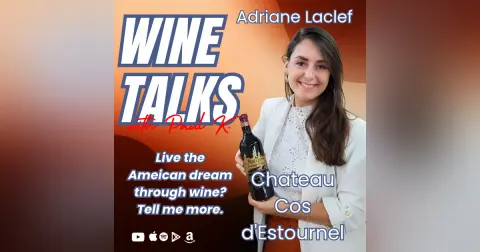

Cos d'Estournel has a place in my heart. When my father put together a trip to the 1993 Vin Expo in Bordeaux, he wanted to take my mother, myself and my wife to Tour d'Argent. We had never been to such a place until that evening and we were breath taken from the food to the service and the bottle of 1969 Cos d'Estournel (listen to the show for the rest of the story.)
When I heard that Adriane was in town to meet and greet restauranteurs and collectors, I had to get her on the show. And she was a charming as could be and I was smiling the rest of the day.
You might expect a second-growth Bordeaux ambassador to waft in with an air of mystery and a heavy dose of tradition, but today's guest delivers Cos d'Estournel's story with wit, warmth, and a refreshing honesty that upends every stereotype about French wine. From her first jet-lagged moments in California to tales of uncovering Bordeaux's best-kept histories, this episode invites listeners into the heart of a legendary chateau—but not from the heights of a gilded balcony. Instead, you'll be at the table, glass in hand, hearing how heritage and hospitality walk hand in hand through the vines of Saint-Estèphe.
The conversation focused on how the guest's own journey—from Lyon to Singapore, through lockdowns and across continents—shaped her philosophy on wine, business, and the meaning of the so-called American dream. One concept discussed was accessibility: the idea that storytelling remains wine's most potent tool, and that stripping away pretense actually preserves what's timeless about tradition. A key theme that emerged was transformation, both personal and institutional, as storied estates like Cos d'Estournel evolve their approach to welcome younger generations and global palates.
The discussion explored how the mythos of Bordeaux, often overshadowed by complexity and exclusivity, is being reshaped by ambassadors who understand how daunting those famous labels can seem at first. Several points were raised, including whether fun and high pedigree can co-exist in wine—what does it mean to "make wine fun," and how does one balance approachability with a heritage measured in centuries? With vivid accounts of tastings, trade events, and the changing face of French hospitality, you'll learn why it really is all about the experience—and how even classified growths can find new life in new lands.
By the end, you'll see not just a world-renowned estate but the passionate, relatable person bringing its story to your table—someone whose mission is to ensure you leave with more than great wine on your palate, but a lasting connection to the story in your glass.
Here's what you'll learn about Cos d'Estournel and the ambassador:
-
The fascinating history of Cos d'Estournel's founding, and how its legacy travels from Bordeaux to the world.
-
Why the current owner, Michel Rebillet, is a game-changer for both hospitality and vision within the chateau.
-
How Cos d'Estournel has transformed Bordeaux hospitality, from closed doors to bespoke, immersive vineyard experiences.
-
The ambassador's unique path from France to Asia to the U.S.—and how global perspectives shape her approach.
-
Tactics for making legendary wine estates accessible to new, younger wine lovers without losing their soul.
-
The essential role of storytelling, simplicity, and genuine passion in connecting people to the magic behind a bottle.
YouTube: https://youtu.be/WuTLSab5aaY
-
Cos d'Estournel: https://www.estournel.com
-
Joseph Mellot (Domaine Joseph Mellot): https://www.josephmellot.com
-
Tours d'Argent (restaurant in Paris): https://tourdargent.com
-
K&L Wine Merchants: https://www.klwines.com
-
La Réserve (hospitality group associated with Michel Reybier): https://www.lareserve-paris.com
0:00 You tell about the stories, you tell about, you know, the history, the little, you know, anecdotes and all that about, you know, about your estates. But make it simple and don't really get like attitudes. Be simple. Make it simple for people. Sit back and grab a glass. It's Wine Talks with Paul Kaye. Hey, welcome to Wine Talks with Paul Kaye. And it's a beautiful day in Southern California today. It's like 80 degrees in November. Figure that one out. Gonna have a conversation with Adrienne Leclef from the Costes Tournel Group. And I'm gonna read something from chapter— welcome to the show. Thank you, Paul. And you just landed here from LAX and you're on a show. That's incredible. That's what I call the American dream.
0:49 At least the Los Angeles one. I want to talk about that for a second. Okay. Adrian, Adrian. Yeah, that's right. Adrian Laclef is the US business development manager and ambassador for Costes d'Estournel and its parent group Domaine Rebillet, based in the New York City metropolitan area. She travels the country leading tastings, dinners, and trade presentations, bringing one of Bordeaux's most storied second-growth estates to life for American audiences. You know, I'm going to stop there. Get this. And it's just ChatGPT. But you know what? Costes d'Estournel, which is a second-growth Bordeaux house, is one of the most dearest wines from Bordeaux to me and my family.
1:31 And I'll tell you why. My dad's there in 1975. We took that picture. But so I did something in 1993 for my parents. They were on— they were in Europe at the time, and I did a business transaction for them. And they said, come me this. with my wife, we flew out to France and we went to Paris and we went to Tours d'Argent. Wow. And my dad says, I'm gonna treat you as commission for the sale you did. That's a nice treat to be there. Yeah. Right. And this is 1993, right? We went to Vinexpo and then we went to Tours d'Argent. First time in France in 1990, uh, '93. I was there in '76. '76. It was a whole different town. Yeah. Trust me, it has changed. Yeah. And it's, and it keeps changing too.
2:11 So, we— my dad ordered— Clarice may have heard this story— he ordered the 1945 Lafitte. Imagine how rare that is. It was 3,500 francs at the time, and they brought it up in the basket, and the ullage was really large. And my dad said— he spoke French— he said, look, this is pretty big. You open it, If it's good, I'll pay for it. If it's bad, you pay for it. And Assam said, no, I'm not doing that. So we bought a '62 Estournel. Excellent. To celebrate this event in our family. And that's why whenever I hear Costes d'Estournel and you were coming to town, we had to have a conversation. Oh, wow. That's wonderful. I mean, like, is it like your first memory about like Bordeaux? Like, yes. First emotions. You know, when we talk about emotions about Bordeaux, with Cos d'Estournel. I'm happy to hear that story. So we were, you know, my dad had that wine shop there in the '70s and '80s, and he sold Bordeaux, but it was, you know, different world then in 1975, '77. So he, this was my first sort of experience with not only Bordeaux, but a classified growth Bordeaux.
3:27 And so since I have it in this house, and I only open it when it's really a special story to tell again. Anyway, welcome to the show, and I'm so glad you're here. Thank you, Paul. This— when Domaine Rébié, they own the property now? Yes, actually, you have Michel Rébié who owns the property of Côtes du Tournel since 2000. So it's been like over like 26 years now. Time flies. And before, he was absolutely not involved in the wine industry, and he decided to, you know, to plant seeds. That's what we can say, you know, in French, in Bordeaux. because he's originally from Lyon. So— He's from Lyon? He's a Burgundian? Yes. Not Burgundian. No, no.
4:11 Like south of Burgundy, in Lyon, in the city of Lyon. So he's from there. And he always was, you know, like, very involved into wine, for sure. And he decided, like, to completely, like, switch his business and to come and to arrive in Bordeaux. And actually, that's a— I have now a funny story for you. Yes, I'd love to hear that. So absolutely not involved in wine. But when he decided to come to Bordeaux, that was only for Cos. Yes, absolutely. I believe that he also had like some emotions, you know, at a very specific moment, as you had.
4:52 Definitely. When are you coming? You know, in Cos d'Estournel, we are waiting for you. Wine Parish is coming up and we're going to be there for that. And I thought, What I thought I'd do is give you guys a chance to settle down after the show, if you're going to be there. I will not. I will not be there. But I'm sure we'll meet. The property will be there? Back, you know, you say? The property will be there? Yes, we will. Absolutely, we will. Look, you know, when I travel, my friends want to go all over the world and go to Thailand or whatever. And I don't. I'd rather live a culture. And I have to be honest with you. In 1993, I hated Paris. Hated it. I was so frustrated. And now I would live there.
5:34 Well, maybe not today, but— I mean, like, Paris is an absolutely, like, gorgeous city. I think it's, it's absolutely, like, fantastic. You have the, you know, the culture, the history, the gastronomy, for sure, the wines. And I think it deserves not only, like, a weekend to travel there, but at least, like, you know, you could spend, like, weeks and weeks. And I'm sure that each time that you go back, you know, to Paris, Paris, you always, like, discover something. And I think this is absolutely, like, stunning. And we can also, like, say the same thing for Bordeaux. I always say, you know, like, Bordeaux, it's actually, you know, the little Paris. It's gorgeous there. Yeah, I like that. That's just— It's beautiful. But I found out recently that I was wrong.
6:20 Like, Bordeaux is not the little Paris. Actually, Paris is a big Bordeaux because you had the Haussmann Yeah. He was like from Bordeaux and he used to like build like all the buildings that makes like Bordeaux as beautiful as it is like today. And he did this in Paris and built like the city that, you know, today. You just learned this? Oh, it's been like a few months and I was like, oh, I found out something like super interesting. That's wrong all the time. Thank you, ChatGPT. No, but yeah, I was wondering about this too. So why did you land up in New York? Before I was in Asia, I was based in Singapore. Then you had all the crisis. For the same group? Not the same group. I was working and involved in the wine industry as well, but for a different wine company, a wine distributor in Singapore. And then you had the COVID which arose in this beautiful, like, Earth planet. And it has changed a lot of perspectives at this time. So I had to go back to France. Then I settled on for a few months there.
7:28 And then I arrived to the United States because of different reasons. But that's a serious lockdown though. You had to like, didn't you have to sign yourself out of the house before you came and go for a walk and come back? I didn't leave the COVID you know, the COVID lockdown there. But trust me, the one in Singapore was a different story. Really? Wow. Interesting. And so you came, you left Singapore, which is a whole different marketplace. We'll talk about that in a little bit. And then you signed on with Castel Chenel or Domaine Rébillier? No, I had another wine experience just before. I had the chance to work for a beautiful domain as well, the Joseph Mélot domain estate in Sancerre. So not the Bordeaux wine region, but in Loire Valley, actually, in Sancerre, and which is actually producing his wine, of course, in Sancerre, but in all the appellations which are part of the central vineyards. So I had the chance to work for the family. for Catherine Corbomelo and for the wonderful team as well, and to represent them in the United States. So I had the chance, you know, to, to arrive via this, you know, job opportunity. And then after, I moved forward to the Côtes d'Estournel and to the Domaine Rébillet group. Was that something— classified growth, second growth, you know, Bordeaux, the famed region— was that an objective of yours when you were in Sancerre?
8:55 Or Singapore that you thought, well, I'd like to be in Bordeaux, or this— the opportunity arose and you thought, I'd like to give this a whirl? And was it always gonna be in New York, or did you work in France first? No, actually, I haven't worked in France except, you know, for the harvest that I've done in the past at a château. I try to avoid France. I try to avoid France. You know, that's a fun fact. It's, you know, when I came back, you know, from Singapore, my family was very happy, you know, to welcome me back. And I told them, don't be too happy. I'm going to stay for a few months, for a few weeks, but I'm gonna leave. Wow. And I was sure back at that time that I was about like to go back to Asia. I was planning to go to Hong Kong, probably like to Saigon as well, like to different like cities and to, you know, different opportunities and maybe like back to Singapore. I like really, I love Asia very much.
9:50 And I told my parents, you know, It's maybe not become the case in Asia, but I will probably travel, I don't know, in Africa, in Europe, in wherever, but everywhere without the case to go to the United States and to Canada. Yeah. I told them that, which is funny. Like a few years later, I've been like, I arrived in the United States like 5 years, almost 5 years ago. And you're like, oh, Like 5, 6 years ago, I was sure that I will maybe never had like an experience in the United States or in Canada. And wow, here we are. So that is still surprising. And I— We're glad you came here instead of Canada. I'm sorry? We're glad you came here instead of Canada. Thank you.
10:36 I had my first experience in Canada like years and years ago. So that's probably one of the reasons that I was okay. I had it and maybe I want to discover, you know, different cultures and different markets. You know, this is interesting. I want to see if I, If I can explain myself, I had a lot of— every Tuesday for 35 years, I sat in the tasting room on the other side of this wall and tasted wine, and I, and I would entertain any and all vendors that wanted to come— suppliers, distributors, brokers, proprietors, didn't matter. And I've had a lot of French women call on me and do different things. And you said the American dream when you first sat down. Yeah. And my French teacher, who was with Alliance Française, had the same opinion. She goes, I came here for the American dream. Was that really something in the back of your mind, that there's something in America that you can't obtain in France? So that's a good question here. And I have, like, 2 points, like, to highlight here to you. I don't think I came with the American dream because, like, my heart was in Asia. It was, like, in a different— And I think that I am now living the American dream. But I think it's a good thing that I've never had like this kind of objective to live the American dream like you, you know, you like we had studied at school, for example, or even, you know, exchange with our friends back in the time. So I think it's like a different perception now, if I may say this way. Sure.
12:07 And now For the American dream, it's, um, I think it's a concept. And you, it's like, you know, every word, every term is like you decide to put the definitions on it. My American dream is, I think, probably different from like anyone else. But that's true that we can like have like different job opportunities of life in the United States. Mm-hmm. That's definitely a bit different than in France. In France, we like to have, you know, like all the diplomas, the master degrees, and it's quite challenging, which I think it's a bit different. It's kind of interesting. I mean, and the other point that dovetails off of that, what I said was all the French women from— I had this wonderful woman, Claire Baroy, back in Champagne. She grew up there and she vintaged Champagne, but she spent a lot of time— but she lived in this really crappy town in Southern California. I never understood this.
13:07 Like, you came from Champagne and you're gonna live in this stupid town? Anyway, but they've all been very strong women that have come here to do this job and sell in America. And I've always was impressed with that, that the French women that called on me were very, very strong. And my French teacher, who was— her name was Catherine Lefebvre, and she's back in She's back in the Pyrenees, huh? What's down— what's the cities down there? Passy-Biré, it's way down there, with an Airbnb. But she was adamant during our conversations that the American dream was a lie until she saved money and bought a house. And she lived in East Los Angeles. We were very close. We still talk. But then it came real that There was possession. We could own a house and we could have friends over and we could cook for them. We could do all these things without any pretense to it.
14:05 And then she decided to move back to France and started Airbnb. But I always thought that was very interesting. That's very interesting. I mean, like her perception on like the American dream and, you know, like you don't leave the American dream until like you make money and then after, you know, you buy a house and all that. That's basically what happened. I could maybe kind of agree with her because like you have, like I have friends towards me, they have like the American dream that, uh, you know, since like years and years and they're happy to, to work here. I'm not saying I'm not, you know, I'm very happy about it. Uh, but they, I mean, like it's challenging for everyone. And recently, uh, you had in France like a TV show who are like, you know, comparing like, uh, the average salary in France versus in America. And they were saying, oh, how, like, uh, why is that difference? And, uh, America is a great country and, you know, they don't have any issues. You, you can kind of like feel it this way, the way how they put, you know, the facts, uh, in front of, you know, of the screen of the camera. And I didn't really agree about it because they, they, they didn't they didn't take into account like many different factors. Exchange rate, like that's the first thing. But then after you have, you know, all the healthcare, uh, the income, the taxes, like all these kind of things, which is like different. Also retirement and all that. And I mean, like even in America also with the
15:36 inflation, with the cost, uh, cost of living, uh, purchasing power, uh, power of purchase, sorry. Yes. Back and forth. That means 2 different things. Yeah. I mean, like, you can have, like, definitely, like, challenges and families who are, like, suffering not only in France, but also in the United States. So American dream, I'm sure that people, you know, they can live it, but maybe not everyone when they're arriving here. I think that's what the point is, right? That depending on the way— this is not a political show, so we're going to try to stay away from that. But depending on the way things are going, Or really can there not go? The idea is you can obtain what you want to obtain here. There aren't many shackles. That might change. But at this point, my father came from Cairo.
16:31 He spoke 5 languages. French was his second or third language because that's what he spoke in Cairo. And he, with nothing, I mean, the typical one of those stories. And I still think those stories are really, really important stories to what happens here. I'm going to do a voiceover. I'm going to do a recording of a story of my— on the other side of this wall is a recording studio. I'm going to record a story of my grandfather that was written in 1952 when he came to America in the '20s and started a carpet store. And I read the story recently. I hadn't read it for 30 years. And I go, you know, we need to hear this story. People need to hear this story. Because it's what it is. It's what America really is. And I'm just impressed with everybody that comes here with that dream to do something. There are a lot of Americans that don't have the dream. Who knows why, but they're lost in their own souls and they don't have the dream. They don't have the ambition that you can come to here and do something interesting. Anyway, we're gonna talk about Costa del Sol now. Yeah, I'm listening. I mean, that was a very interesting conversation. I could sit here for hours. You You can keep me for the day. Yes, thank you. We, after the story about Kos, and there's a whole, the whole industry's in a different scenario today than it was when I was doing this 3 years ago. I sold the company because, not that I saw this happening, but it was happening in my own books.
17:56 Sales were off, people were moving around. There's a lot of competition. There's a neo-prohibition movement, non-alch, completely non-alch, which is disgusting. Ready-to-drink cocktails, all that. Does that, How does that affect a brand like Côte d'Estournel, which has got this mythology in its age and its history? You mean like all the trends, if I may say, towards like cocktails and beers and all that? I mean, definitely it affects not only Côte d'Estournel, but I mean, like all the wine industry. Like you have like studies like showing like this is like, unfortunately also they're decreasing. So it's been challenging, but we try to find also our ways. To like, you know, find solutions and to make it a bit more trendy and to use like all this like prestigious also, you know, like statue that, that we have the chance to have. But also, you know, to, to, to keep the history and how can we make it like something trendy also for the new generation. And that's definitely like questions that we ask ourselves every single day. How can we improve also in the future? What can we do to also, you know, like if I may say, like, fight against, you know, like this trendy with the cocktails and beer and also like the spirits industries. But it's not just not different ever. I think the trends are different.
19:29 The trends in that picture were Matusse, Lancers, Boone's Farm Strawberry Hill, Cold Duck, you know, which is a sparkling wine that was sweet. To me, the history and the mythology around Coste et Chanel, Lafitte, all the classified growths, the 1855, even the 1955 of the Right Bank, is the story. I mean, it is the trend. And I wrote an article years ago, and I didn't agree with the guy at all. It was years ago. He said that we need to come to the consumer But wine, because of its nature, because it is a reflection of a time and a place, that the consumers have to meet the winery. And this guy's like, we shouldn't do that. We should bring the wine to the consumer, meaning put sugar in it, put acid in it, flavor it, and give them what they want. I don't agree with that. I don't either.
20:27 I'm not trying to make a buck out of it either anymore. So I don't know. But I think I think after 6,000 years plus, the brand, the style of what wine does to a human soul isn't ever gonna change. And that's what you have to bring to the table. Yes, definitely. I mean, like, especially as you just mentioned, you know, we have like a beautiful history and background at Cos d'Estournel, and I think it's absolutely like fascinating. And this is definitely something that we need to bring into the, you know, the table each time that we do like wine dinners, events, like tasting. This is definitely something that we highlight and that we are proud of. I mean, with all the background, it's like years and years of history, of travels through, you know, with the founder, Louis Gaspard d'Estournel, with all his travels in, you know, in India and like different, you know, like part of this globe, which is absolutely like fantastic. And I mean, like, we have to think about that. That was in the early 1800s. That's a different context. I wonder what their headwinds were like. I wonder what their conversation— you have these conversations with your group about, trying to be trendy, try to bring it to the table of the younger generations, teach Gen X something about life or Gen Z or whatever it is. I wonder what those questions, what those conversations were like in the 1800s about how we're gonna bring cost to, you know, to the table of the communities and think it's so interesting. So are you doing lots of dinners, tastings? Talked about this, you went to Misa there in Dallas, right? Yes.
21:58 and K&L. Is that the way we're doing it now? Is these sort of hands-on? Indeed. I mean, like, we're trying to bring the stories into, you know, like, into the tables, into the rooms, into the restaurants. And we try to do our best also to visit, like, all the people involved in the wine industry, all the trade, but also the consumers through, like, wine tasting, market visits as well, like, across the United States on my side. But that's also the case for my colleagues who are, like, also, like, overseeing like Europe market, Asia market. We have like 2 people in Europe, 2 people also in Asia, and I am based here in the United States. So the— this is kind of a mission here, Paul, that we have, you know, is like traveling across our territory, I mean, the United States, and to be able like to tell the story of Côtes du Tournel, of the Domaine Rébier, and, and I mean, like to make them taste and to let the wine speak for itself as well. That's a valid, important point.
23:02 Let it speak for itself. Because eventually, I believe every generation, even though I think one of the stated objectives of the generation now is, I don't want to be like my parents, which I don't really want my kids to be like me anyway, because that would be a mistake. But I do agree. I keep it for myself. She may listen to it about it. Yes. Okay. Though I did teach my son a lot about champagne, and now my whole collection is depleted. But somebody said the other day, we need to make it fun. And I thought, what the hell does that mean? What do you mean, make it fun? What does that mean? You mix it with 7-Up? Not really. I hope not. No, I know.
23:48 But that's like, why don't they get it? You're supposed to play a game with it. There are a couple of wine games out there right now. I watched a TV show the other night. I won't name shows or throw anybody under the bus. It was a couple of celebrities tasting wine and I, I couldn't watch it. You know, I couldn't watch it. I don't know what making it fun is supposed to mean unless it means the opposite of don't be pretentious about it. I think that's more of that fact. I mean, like, I, I do agree with you like 100% with what you just say. You don't really like make fun of like such estates like Cos d'Estournel, like being like, you know, part of the history with all the background. Uh, I think this is not right. But what you can do is, like, to make it, like, less pretentious. I mean, you know, like, when you are seated in a, in, in a table with, like, friends, with family, and you bring your bottle of Bordeaux, it can be, like, quite intimidating too.
24:44 Mm-hmm. Vintages, region, prestige, classification. Well, I get it, but this is our role to make it simple. It's not so easy. Yeah, simple is a good word. But I think it's like probably, you know, the results of what we need to do, you know, and to bring like Côtes d'Estournel and other wines, you know, in that direction to make it like very different. And you tell about the stories, you tell about, you know, the history, the little, you know, anecdotes and all that about, you know, about your estates. But make it simple and don't really get like attitudes that I'm sure like in like different, you know, experiences that I'm sure you have had like in the past, as we all had. It's like, be simple, make it simple for people. I think this is like something that the young generation is having like issues with. you don't understand about wine. They don't know about grape varietal. They don't know about winemaking processes. Right. So when you do a wine dinner and you are like recruiting like new drinkers, if you talk about like vinification too deep into aging, about like percentages of old barrels and, you know, all that, it's interesting for sommeliers, for head
26:16 sommeliers, for all the trade, but for consumers, Not that much. It can be very interesting, trust me, especially in the United States. I've met like absolutely like wonderful like, uh, wine geek persons and collectors, and they have like their— trust me, their little questions. And I think, yes, you will be that person, you know, to guide them and to answer them. But for the other people, which is not, you know, like a majority of the crowd that you have in front of you, they are just here to have an experience. to taste your wines and to have a memory of what they are currently having here. And I think this is what is so important when you do these kind of things. You could lose them so fast. Yeah. Having the wrong conversation. That's true. About soil and pH and, you know, taproots and all the rest of it. I've told the story before on the show, and I was just, I'll reflect on it again. There was a, somm in Palermo, we went to dinner and I gave him a separate tip because he was, first of all, he respected everything I did when I chose the wines. He knew when to back off. Because one of the things, of course, being in the industry, you know, we go to sit down and we can immediately tell if a somm knows what they're doing, if they know what they're doing, if they really respect my opinion, if they respect what I, as the consumer, not as a wine person, wants or how I treat wine. That's like the
27:47 sommelier's most important job is to understand this person before— you don't get much time to do it. But anyway, the point is, this guy, I think he was Serbian, he respected the wine so much, the way he had passion just to present it, that you just felt special regardless of Everybody at the table felt it. I did, and I'm an experienced wine person. My friends are not, but they still felt, wow, they go, well, this guy's really treating this the proper way. And I think that has a lot that goes a long way with it. You know, we have dinner all the time at our home. We have guests all the time. Even my son-in-law, my daughter lives with us right now because of the fires. And we open a bottle of wine almost every night and conversation always comes back to it. And it's not about the pH and the— No. It's always about the story. It's all about the story.
28:38 Is there any other product that you can think of in your mind that reflects or encourages such conversation and such discussion? If I have a product in mind? Is there any other product that you can think of? Would you do that about a book? Well, maybe about a book. Flashlight? Maybe about a book. That was a bad example. No, actually, that's a— I mean, like, you can have, I'm sure, like, you know, in the luxury with all the tech still, like, some, you know, history and some anecdotes with, like, creators and designers. And I'm sure you can find, like, maybe something similar, but not as much as what I think we can find into wine. You know, that's interesting. I just thought of that. We go to Paris with my friends, they always want to go to all the stores, you know, Dior and all that. And actually, there's some great history to hear about Christian Dior and all the designers, Coco Chanel, like, you know, sleeping with the German spies and, you know, in the war. You know, those are interesting stories, though. That actually brings to life— Yeah. The history of— that would happen with cost.
29:47 But we have reality today that we need to try and sell stuff, and we need to tell the story in a magnanimous way. How has that changed since you've been with them? Or have you— you, you were immersed in this industry here in America with the same conditions that we have today. So what have— Like, what has changed? Have you seen more reluctance? Have you seen an increase in tastings and handshakes? Um, what are you going to do in the future? What are we going to do to weather this storm? I mean, what I have seen, like, from the very beginning, I will try to answer the best, you know, to your question, Paul.
30:31 The things that I've noticed that have changed, I mean, like, this is also the interest of the people when I'm doing, you know, like, all the wine dinners and tasting and when I'm meeting, like, just directly with them in, like, a very simple format. And they're getting definitely interested. I see, like, a bit more of the younger, like, generation as well. They're interested. They are interested. But again, we need to make that simple. And they are here. I'm going to repeat, but for, for the moment, to live an experience and to bring back home like a memory. And when I do these kind of things, you know, like you, you really talk with your hearts. And you were talking a bit before about, you know, like how do you talk about your patients? You live it. You don't talk about your patient. You really live it. Yeah. And I think this is what's like people are looking for as well, you know, and that's where you get interest from the people to, okay, I've had a good experience with Côtes d'Estournel with that event, and I would like to learn more, you know. So I think we are, of course, ambassadors of Côtes d'Estournel.
31:43 But I do believe this is a bit more than Côtes d'Estournel. This is about Saint-Estèphe appellation. This is about like Bordeaux wine regions, Left Bank. Bordeaux wine region. And then after France, we are ambassador of like different things. So it's, you know, it's trying to bring people to Bordeaux through like different actions and through different events too. We had my brother-in-law and my sister-in-law traveled to Bordeaux a few weeks ago. And they asked if I could help them out. And so they ended up at Truong Long Mon Do. Oh, Truong Long Mon Do. And they also were at Chateau Bailly.
32:28 And I can guarantee you, well, I don't have to guarantee you, it's already been told to me, that those 2 experiences alone— now you can't send everybody to France and go to Bordeaux and live there, but those 2, my sister-in-law, my brother, and my nephew actually, will be devotees of those châteaux for the rest of their lives. Right. Right? Because they saw it and they felt it, and they felt the passion that you're talking about that it takes. You obviously have the passion for what you're doing to share with the rest of the world this feeling that we don't— we can't even describe it ourselves necessarily, but we know that there's some— and I brought this up the other day. Let's see if this makes any sense. We went to a church meeting and the pastor wants to develop some property.
33:15 And he told the whole pitch to the older couples in the church that he wants to do this project. And my comment afterwards was, one, it only takes somebody with the passion you have, to the pastor, to do the job. Mm-hmm. Because there's too many headwinds. And so if you don't have sincere, earnest passion to tell the story, you can't do it. You can't. It's impossible. His job is to do the same thing that wine does. Wine is a connection for the human soul. I don't know what it is. It's not happening. I mean, it's happening in the soil, but it's happening, right?
33:56 Yeah. It makes you feel something. I agree with you. I mean, like the best experience, of course, that you can have with a winery and with the team, with all that, that's there, that's at the estate. I mean, we're trying to do our best, you know, to make you travel. Definitely. How is, how is, sorry to interrupt you, how is— No, go ahead. Hospitality at Costa Estornel? Is it changed? Costa Estornel? Have you been there? No. No. Well, we've driven by. Well, we're waiting for you, so you will see. Well, maybe you'll see us in February. Definitely, I'd be happy, you know, definitely like to try and reach out to you. But I mean, just generally, what's going on? It is very something. I mean, like I always, you know, when I meet with people, I always tell them, you know, Like, when you go at Cos d'Estournel, you're really having, like, such a very specific experience. First of all, I like to start, you know, the journey in Bordeaux.
34:46 Yeah. You leave Bordeaux, Saint-Estèphe, Cos d'Estournel is about, like, an hour plus from Bordeaux. You have all this beautiful wine route through all the different appellations of Margaux, Saint-Julien, you know them, Pauillac. And then you finally arrive in Cos d'Estournel. You have Lafite Rothschild on your left, and then you have Cos in front of you. I mean, like you have to visit them, you know? So next time again— But you, you couldn't before. Now we do. You can. We definitely do. And this is important. And we have like a specific, like a dedicated, like, team to host clients to visit Cos d'Estournel. And you have like different options too, depending also on the time that you want to spend at the château. And you come and you, you can have a visit, you know, of the vineyard. You can visit, you know, the cellar, the private cellar, also of the château, which is like downstairs with all this beautiful statue of elephants. I don't know if you have seen like any pictures of this one, Paul, but I will definitely show you, you know, after. No, I haven't, but I will do that. It is absolutely like wonderful. The hospitality, you have the best team ever who are definitely like passionate about Cos d'Estournel.
36:02 You can feel it and you feel it. I mean, like you see the terroir, you see the vines, you have a better understanding of what you are having here. For sure. And if you want really like to push a bit like your experience in Saint-Estèphe and you don't want to go back to Bordeaux, you also even have like the option to stay at the château. You have the private residency at Clos des Tournelles itself, of Michel Rebillet, the owner, which is called La Chartreuse. And it's a beautiful villa. La Chartreuse, like the grape? La Chartreuse, actually, like the name of, you know, the— The flower, the color. Exactly. So this is called La Chartreuse and And you can be there, but you have another also option is, like, to stay at the private, uh, residency, not of Michel Rebillet, but actually of the founder, Louis-Gaspard d'Estournel. He was not used to live at Côtes d'Estournel, but 2 minutes away from Côtes d'Estournel, at Château de Pomies, which has been turned into a beautiful, like, 14-bedroom hotel in the middle of the vineyard. Wow.
37:07 So, you know, you can even, like, stay there. So you, you know, you have the full experience with the restaurants, with the wines, with the visits, and you can That's important, hospitality. You know, it's funny you should say that. I just, I just remembered I was on the internet this morning looking for flights to France. How about that? Oh wow, does it mean that next trip is like the one to Mercosur? Well, I think that is the way you made it sound. I got to come. Well, we're going to be there for Wine Paris, and I told my wife, let's just run down to Bordeaux and spend a few nights and catch up with some friends. 'Cause it's just so storied, you know? It's just so storied. But the point is, in 1993 when we were there, you didn't walk down, you didn't make appointments, you didn't do anything when it came to hospitality. And I think that's critically important. Napa has always been that way because it's America. I was thinking about this the other day. It was founded that way, right? Yeah. But it's very completely like total, like different experience. Totally. I had the chance like to go in Napa like many times and I really wanted like to live this. And I have some experience. I mean, like, we need to learn from, like, different wine regions, from different estates to see what's going on, you know.
38:19 And, uh, in Napa, for that example, like, most of the estates that I have visited, they have, like, all the options. You can book online, you can— it's more easy, let's say that. And, uh, well, I think it's maybe, uh, from— be careful with what I'm going to say, but from my, you know, experience at those specific, like, estates, you don't really get, like, the chance to visit the cellar, to visit like the vineyards. You are in a dedicated like room. And if you do not ask or if they don't know that you are working the business, they don't really show you. At Côtes du Saône, you don't even have like, you know, the— I mean, it's not even a question. We are going to show you the, you know, the vineyard. We are going to show you the cellar. And you need to leave this place with a better understanding of what we're doing.
39:09 So I think it's like 2 very like different ways, very interesting different ways how to, you know, approach people in general. They're struggling big time there because the hotels aren't reducing their rates because they prefer to live with a high rate and less staff. And then so the tasting room traffic is off 30%. I mean, there's not that many businesses that can survive with 30% reduction. So there's a lot going on up there. But you're right, the way they treat hospitality is completely different. And it's kind of interesting you said that because Florence Cathiard was here yesterday? Was it yesterday? And they have Cattleya Vineyards. When you go there, you get put into this electric Range Rover and they drive you all over the property. That is true. And they show you the lake and they show you the vineyards. And this is probably reminiscent of the Bordeaux experience that they do that because it's— and I am jealous of the French. And this is what's fascinating. And maybe we'll wrap up with this, but I've always been jealous of the Old World anyway. Like, for instance, my cousin owns a restaurant in Pasadena. He's been there for 35 years. That's really rare in America. but not in France.
40:16 Like Troisgros and Fernand Point, all these restaurants are legacies that are grown organically with the country. And you protect your butter, you protect your cheese. But then on the other side of that, you know, America is a new world. You can grow whatever you want and produce whatever you want and handle it however you want. You're not bound by Appalachian restrictions. I just find that maybe the grass is always greener. Oh, we always think that, but maybe not at the end, you know, maybe not. You know, it's always, I think, again, like, you know, a different, like, view of perspective. I think we need, like, to focus on what we're doing and to always, like, question maybe ourselves to know, like, in which direction we want to go and how can we improve, how can we be better. That's the key. And if I may add something here, Paul, because you were talking about hospitality and We have the chance also to have an owner which is like a visionary owner, Michel Rebillet. And he's also been involved in, of course, the wine industry, but also the hospitality. So he has like a beautiful, like great business that he have like founded years ago with all La Réserve Palace and different like villas and properties.
41:34 So when you go at Cazes Tonnens, here's a connection coming. Yeah. Like hospitality is important to us. Customer first. So you're really having like a very specific moment when you are like visiting us. That's a very contemporary and necessary, I think, way of looking at it. We need to. Yeah, we need to. Well, I think we're out of time according to your caretaker here. I have my bus waiting for me. It's such an honor to have you, and thank you for stopping here on your travels today from LAX and on, onto the next I mean, I'm very, you know, like thankful and grateful to be in Los Angeles and living the Californian dream with you today. So, you know, thank you so much for your time and, and keep opening like bottles of Côtes du Tournai with your friends and family and don't wait for occasions. I'm going to open it. So definitely. And I hope that I will be sharing a bottle of it very soon with you in Los Angeles, in New York, anywhere else, or maybe in Bordeaux. Next time you come. But how often do you come here? Several times a year. Okay. We have a place. By the time you come back next, our new location in Hermosa Beach, my wife and I built, building a house. We'll do a real California— Could do that. Beach environment thing. Let's do that. Okay. I'm flexible. I adapt myself and I love that. Cheers. Cheers to you, Paul. Thank you.