

 Apple Podcasts

 Spotify

 Youtube Music

 RSS Feed
 YouTube
 Pandora
 iHeartRadio
How Did an Olympic Skier Become a Leading Force in Bordeaux's Wine Scene? Florence Cathiard
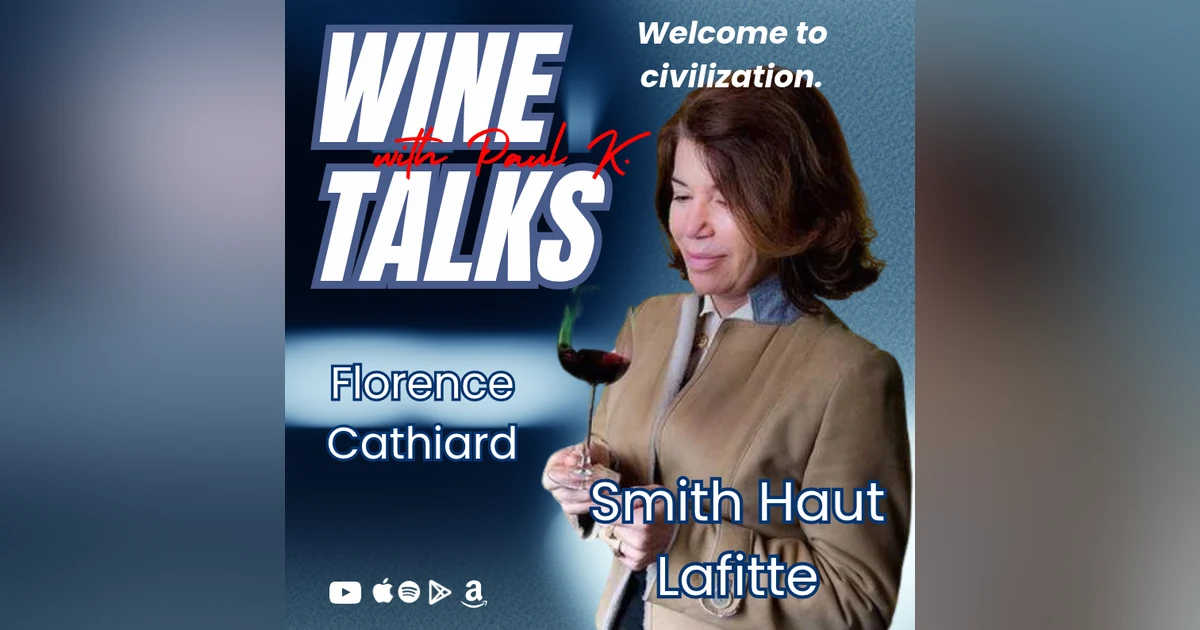

Florence is the type that you wish you could spend all day with her. What flows from her being is wine wisdom, poetry and business all wrapped into one.
She stopped into the studio to sit on here way through a whirlwind of tastings, lunches and dinners. Why? Because, as she put it, that is what you have to do.
When you are as deeply committed and passionate about what you do, you do. And that is why I can sit with her for hours...because of what she has done.
What happens when an Olympic ski champion swaps her goggles for grapevines? Meet Florence Cathiard—a woman who didn't just change careers, she rewrote her own story, sliding from the snowy slopes of France into the heart of Bordeaux's centuries-old winemaking landscape. If you think vineyard life is a leisurely stroll through rolling hills with a glass in hand, this episode will make you think again. Florence's journey bursts with grit, humor, and the kind of passion that makes you want to pack your bags and chase your wildest dreams.
The conversation focused on what it truly feels like to resuscitate a 600-year-old château and why, for Florence, working the land is less about business and more about belonging. One concept discussed was the difference between vineyards where rules reign supreme—like Bordeaux, where even the grapes you use have to come from your own soil—and California's Napa, where a winemaker might buy grapes like they were picking out apples at the market. You'll come away understanding why these differences matter so much, and just how much heart goes into every bottle at 14:04.
A key theme that emerged was the enormous effort behind organic and biodynamic farming. Florence shares the real sacrifices—lower yields, higher costs, and hands-on dedication—that go into cultivating not just grapes, but a living, breathing ecosystem. The discussion explored how inviting guests onto the property isn't just about showing off—it's about forging human connections and turning every tasting into a story worth retelling. You'll see why Florence loves watching young people discover Bordeaux and how sharing a sense of place changes lives at 12:00.
Several points were raised, including the quirky challenges wineries face today: from influencers who collect likes instead of bottles, to diet drugs changing drinking habits, and Gen Z's never-ending search for what's cool and meaningful. By the end, you may find yourself looking at your own glass differently—knowing that behind each swirl stands a family, a legacy, and a whole lot of love.
What will you learn in this episode?
🍷 How Florence Cathiard's path from skier to vintner inspires reinvention
🍷 Why Bordeaux and Napa's cultural differences shape every sip you take 14:04
🍷 What it really takes—emotionally and practically—to run an organic, biodynamic estate 17:39
🍷 How a great vineyard experience is crafted, one conversation and memory at a time 12:00
🍷 What today's challenges mean for the future of wine and why resilience (and a dash of humor) are essential.
YouTube: https://youtu.be/alM1GwZ8dMw
The discussion explored several companies and vineyards. Based on the conversation, here are the websites for those mentioned:
-
Château Smith Haut Lafitte
https://www.smith-haut-lafitte.com/ -
Caudalie (Les Sources de Caudalie hotel and spa)
https://www.sources-caudalie.com/ -
Cathiard Vineyard (Napa Valley)
https://www.cathiardvineyard.com/ -
Décathlon
https://www.decathlon.com/ - Go Sport
https://www.go-sport.com/ -
Flora Springs
https://www.florasprings.com/ -
Jean-Claude Boisset
https://www.boissetcollection.com/
https://www.jcboisset.com/ -
Sotheby's (Auction House)
https://www.sothebys.com/ -
Christie's (Auction House)
https://www.christies.com/ -
Cornell University
https://www.cornell.edu/
0:00 Being a viner is not a job, it's a passion, and you have to share this. And people are here to communicate, to understand, and I think— and we live in some island of beauty, and that's very important because when I am in the traffic jam of Los Angeles, I look at the palm trees, but they are far away, you know? Sit back and grab a glass. It's Wine Talks with Paul Kaye. Hey, welcome to Wine Talks with Paul Kaye. And it's a beautiful day here in Bonavia, California, having a conversation with Florence Cathiard. Let me read something that was kind of interesting. She says she traded Olympic-level ski slopes for the Grand Cru of Bordeaux and somehow made it look effortless. Do you believe that?
0:47 Florence Cathiard is the owner and president of Château Smith Haut Lafitte, one of Pays d'Oc Léon's most celebrated estates. a former French ski champion, president of the French Wine Tourism Board, and the driving force behind the second vineyard chapter of Smith-Olaphite and Cathillard Vineyards in Napa Valley. But this, I wanna ask you this question here. The French Wine Tourism Board, are you still president? I stopped president because we were invited with the Minister of Health, and she was a teetotaler and not, not a fan not sensitive to what we can put in terms of civilization, of social links.
1:33 She put us in with the heavy drinks, with the big spirits. And so after 3 years, they want to renew my mandate, but I say, well, goodbye. It's hard work, no? I will be more useful just telling young people. 2 weeks ago, I had the Harvard Wine Club. Really? That's Miss Olafitte. And these girls were brilliant, totally. They were girls, you know? I don't know why, but— Wait a minute, Harvard Wine Club, the wine group, is it— was it a Harvard enology school or is it just a group of— No, no, no, it's a group. Like, I spoke to 165 young people from all the other schools. That was last year because they all come to Bordeaux by, you know, you have Polytechnique from France, you have Princeton, you have Chinese. They are very good, the Chinese. Oh, yeah. They learn fast and a lot. Maybe spies, I don't know. But they come to confront themselves, which group is knowing the wine from France better. And that's encouraging, that young— Yes, yes. We need that, right? We need that, of course, because they have finished with binge drinking, they have finished with tequila, or I don't know, anything which is strong and bad for your health. And they come slowly but surely to more sophisticated You know, this is— and that's why I brought it up, the tourism board, because talking to Rémy a
3:05 little bit about the need now for experiential wine. Yes. For people to come and meet Florence and to walk the properties and to taste the wines and then go home and say, wow. Yeah. You know, I'll remember this the rest of my life. Of course. Of course. And because I told you my nephew and my niece are at Cadoulet right now. Now, that's— And I got a picture from her this morning at Château Margaux. Good. And I thought, I would've never expected that when she was a young child, ever. Good. And now she's talking about Château Margaux. Exactly. And staying at Smith Haut Lafitte, Cadoulet. I mean, seriously? Exactly. That's great. So isn't that a slow process for us to claw back to? I think so, because— and I think the tech world is helping us in a paradoxical way, because you cannot put a funnel in a glass of crystal and put a Petrus or Romanée-Conti inside. It does not work. So they have to come to taste real great wines with real people. And yeah. When you were skiing, and we talked about this once before, you were on the French Was it downhill?
4:24 Unfortunately, I was obliged to make downhill, and I am a slalom or giant slalom racer. But at the time, you had no choice. You raced the 3 disciplines. You know, Micaela Schiffer, she's only slalom. And that's why— and I came to whine because, you know, Jean-Claude Killy, the guy who won 3 Olympic medals? Yes, I remember him. He had this prescience of French paradox. He said to our coach— we were 2 girls like us— and he said, it's stupid to make these girls going downhill because we spent all night before making up track and, you know, and being totally afraid without sleep. And he said, give them a small glass of red Bordeaux Cabernet Sauvignon because it's the most digestible varietal. And the coach did this. What? And we slept like stones. I don't remember that story. You didn't tell me before. Maybe, maybe because that was it. And on the following— And you were what, 20, 21? Not even. I was 18.
5:25 Wow. And following day, of course, we were afraid, but at least we had slept. Yeah. So when we got married very young with my husband, because we were the only students in this team, we decide to, instead of having a bourgeois wedding list, we say, offer just good wine of red Bordeaux, Left Bank. We did not know anything. Wow. But— You just— But— That's really funny. But then I remember both of us were drinking a Léoville-Lascaze '61, And we finished the bottle totally tipsy without knowing anything. But I say, oh, we cannot have more of this stone art, you know? Well, you see, but, but well, it was something. That's amazing. Yeah. But then you left skiing and you started, uh, I think it was a market. No, was it a supermarket? Yes, because Daniel Favre unfortunately died very young from brain cancer. Oh, wow. And he had to drop the Olympics and And when the skier came, all the bankers went away from the small grocery shops.
6:32 Was he the oldest son? He was the only son. The only son. So is that a French cultural that the son would take over, or he just did it as he needed to do it? Well, it was totally family operated. And the funny story is that after we worked like crazy both together because I joined him after the Olympics, but nobody twisted their leg, so I was replacing girls, too. That's funny. And then we got married. We worked, like, 7 days a week, 12 hours per day, and we managed to open big supermarkets and also a chain of sport shops, which was— we even had 4 big sport shops here in Los Angeles. In Los Angeles? Yes, at Century City, Pasadena. You're kidding. No, no, no. Were they ski— were they ski-focused on skiing, or what sport? No, focused on all the sports. All the sports. Yes. Maybe I went there. It was going well, but we had a little trouble. It was not Zen Generation at the time, but, you know, the young, they were all dreaming of being— because they were sports guys and girls, beautiful.
7:52 They were all dreaming to have a big actor scene in Hollywood. Yeah, yeah, yeah. Oh yeah, of course. Yes. So sometimes it was difficult to— That's what I want to do, to keep them. I want to take, you know, I want to be in Hollywood, but I'm a little too far along in my— And, and then, as we did not inherit our château after 20 years of hard work, we sold. You sold the— you sold the chain. So how many stores were there when you sold it? Um, Gros Porte, we had 56. Wow, that's a Big one. We were like this with Décathlon, you know? Wow. But Décathlon, when we sold it, it was the same size, same margins. But then we sold also the supermarket and— Are they still around today? Yes, but they changed the— no, the Go Sport. No, it went like this. And then it did not stand because Décathlon, we sold to Casino, a big French group. group of supermarkets. They did their supermarket. Our supermarkets are still their best now, but not Go Sport.
8:59 They just look going with what we call a milk cow, you know, in France. Yes. And then surely but slowly it was failing. And they came back, I think, 8 years ago to ask my husband and me whether we would retake this. We say no, we are winners. We are winners. They came back and said, would you— you know, I had that conversation about my company, which I sold 2 years ago, 3 years ago. And somebody asked me the other day, not the owners, but, you know, what would you do? And I would say, no, absolutely not. Why would I want to do that again? Of course not. Because we are passionate about our 2 vineyards and we sold everything to get them without any social But when you sold, were you thinking you wanted to be in the wine business at that point, after Léoville-Castillon?
9:54 More or less, because we did not want to have a big group. We had only 20% of the total shares. You know, the bankers had still some part of it, some shares. And we had to sell everything, the lavish house in Saint-Tropez, the sailing boat, because we had very small vacation. But we had money. Yeah, right. And we sold everything. That's pretty good. Nobody will weep because now we have beautiful estates and we love it. But it wasn't when you bought it. Oh no, it was not. It was great terroir, poorly managed, I must admit, both in Bordeaux and in the States.
10:35 But a historical château. Oh yes, yes, because it was one piece. big terroirs surrounded by Mother Nature, all of them. 85 hectares of forest around our 85 hectares of wine in Bordeaux, and 300 acres of wild, wild west in Rapha Ford, which surround our 25 hectares. or 60 acres of vine plots, you see? Yes. But in the Napa that we're talking about. In Napa. Yeah. Well, so that's kind of an interesting comparison because it seems similar in the way you will approach the idea of wine. Yes. And the Smith Haut Lafitte was what, from the 1700s, 1800s originally? No, it was from the 1400s. The 1400s? 600 years, my château. 616 years.
11:40 60 years exactly. Wow. And look, you spoke about the Sources de Caudalie, which is not even 20 years old. But I must say, my daughter and son-in-law, they made a beautiful palace of the vines. I was talking to Rémy about storytelling. Yeah. You know, and we were just talking about experience and coming to Bordeaux Experiencing the hotel, experiencing the property, tasting, coming home, telling your friend. But how important today is that story? This story of the 1400s, you know, and the history of the château, whether it was functioning all the time is irrelevant. It's just part of the culture of the château. Of course, because our château in Bordeaux does not look like any other. Because you have towers, the lower part of the big tower, for instance, is 14th century, definitely. Wow, yeah. But the upper part, the English, in 19th century, they added 4 meters high, which makes it a little unbalanced, but we kept it. And then all the owners, and we are in a long tradition of quite famous owners, including the mayor of Bordeaux, the president of Chamber of Commerce, in 1886, who signed the classification of Médoc. You know, we are just in this line, and each add something.
13:10 So it's all the centuries in this château, and we put a lot of vegetal around it because that's our DNA. We think Mother Nature is spoiled at Ponsac. place where she cannot heal by itself, we have to do something. Because I think the difference between the wines at your old supermarket— the wines at the supermarket here, which are all— Pool wines. Similar in character because they're meant to be for the consumer. But isn't all this history and your approach and your lifestyle prior to the château.
13:53 Isn't that part of the terroir of what's in that bottle when you present it to the public, that it shows up there that you have a philosophy? Of course. That was very important because we wanted wine with a sense of place, wine with a terroir. We, you know, in the States, we are allowed to buy grapes. We never did I've done this because in France you are not allowed, and I think it's better to give to the public what's the best, what— Okay, that's it. Let's stop there for a second. In Bordeaux, now you're in southern Bordeaux, what used to be Graves, now Pays d'Oc Lannion, for the listeners to understand where the property is, right across the street from Château Haut-Bailly. Yes, the nearest of the city. A cute little town right there. Yes. But you cannot buy grapes— No, of course it's forbidden. From another château.
14:52 No, it's forbidden because we are classified growths. Oh, that's right. And no one has the right to do this, you know. And I am happy we are one piece because the other châteaux, the classified, they can buy other places and say they join us in classified. We did this for 10 hectares, which were connected to ours. That's all. Okay. And so in Napa, there's no rules like that at all? No, no. I used to buy grapes to make wine there. Yes. And so do you? No, we don't. We don't buy grapes. You brought your philosophy from the Graal? Yes, of course, because we think that we want wines coming from a living soil, you know? And the vineyard is so important that we gave the name Cathiard Vineyard. It's the same number of letters. It's a rhythm, you know? And so, if you have a great vineyard, you have no excuse for not making a great wine. But in Napa— That's so interesting.
15:54 Everybody is excellent in the cellar and in the vat room. But in the vineyard, the young agricultural engineer that we have sent there, which was trained 4 years at Missol Lafitte. It's herself. She lives on the premises, like me when I go there, and she opened the water, she, you know, for irrigation. Yeah. Because even if we have 2 natural lakes, we have a drop by drop. And even if we have 1/5 of the vineyard, which is, how do you call this, dry culture, she wants to, She does not delegate to anybody. Wow.
16:37 Because it's very important what you do in the vineyard. That just— but that was a very important comment, 'cause I never thought of this after all these years. And I was just doing a tally. You know, I did this for 35 years. Oh, yeah. Like me, 35 years in the vineyards. Yeah. I have all my newsletters that I wrote every month. Yes. for 35 years. And I'm asking AI, and we talked about that a little bit. Yes. I'm asking it to review all of them and what, what I bought and why I bought it and all that. Yeah.
17:17 But it's, it's a very important comment that you said, which is if you're buying grapes, if— because in California, do whatever you want. I mean, most of the wine in California is not bottled by the grower. Most of it, like 90% of it. Yeah. Well, what are you getting? Yes. You're just getting— The universal taste. How interesting. I never thought of that after all these years. For us, it's very important because we grow it. It was much easier for us to be certified organic in Napa than in Bordeaux, because in Bordeaux, to have great white wines like we have got, you need some rain. And sometimes rain in Bordeaux comes at a time of harvest or at a time of flowering, which is not so good. But We manage now, and it's very hard. You can count the classified growths of the Left Bank on the fingers of one hand, which are certified, you know. Whereas in Napa, after 3 years and a half, it was okay. Why? Because we have not mildew. We have powder mildew, which is a soft illness. Yeah. But in Bordeaux, we know what it is to look after the vineyard.
18:26 And if I was not living on the premises, with my head winemaker living at the other end and the cellar master living in the middle of the vineyard, we could not have such a thing. So, Cathiard's organic now? Totally. In the cellar and in the vats. And wasn't it the Martini estate? Wasn't it the Martini? Cathiard? Cathiard? No, it was— of course, it was Louis, Louis Martini. Martini, yeah. His heart. We built the house where I live now in the '41, I think. And, but he never made wine there. Oh, he didn't? He lived there, he built the house, lived there, and died there. So a very long time. I have a photo of him. He was a beautiful guy, very seductive.
19:19 Really? Yes, in my garden. And the other part was made by what the 2 guys we call founding brothers, James and William Rennie, and they came in 1880, and it took them 5 years to build the beautiful old stone winery in Rutherford, where we have the cave. And we built a new winery because we had to build a new winery for the vats. So when you got there, the grapes were not organic? No. Who was using those grapes? Do you know? Yes, the name was Flora Springs. Oh, Florispring. Yes. I think Jean-Charles Boisset just bought that thing. No, he bought a name. Oh, he did? That's very different. JCB is buying everything. He's buying everything. A lot. Yes, yes. But, uh, which is a good thing because he, yes, he bets on the future. He's very smart about that. So he's very smart. Yes. And his wife, I, I adore Gina Gallo. Yeah, but I've been at Jean's. We know them very well.
20:19 Yes, they came to visit and they, they loved the place. Yes. I was on his podcast and he was on mine, and I visited all the places. I haven't talked to him lately, but— and I love his father's— Oh, yes. But the father, who is very strict, because now that my daughter and son-in-law have a beautiful luxury hotel hamlet in— next to the father in Burgundy, they— Clos Vougeot? Yes. It's 2 minutes from Clos de Vougeot. It's an 11th-century Cistercian cloister. That my daughter and Jérôme, it took them 2 years to totally refit it. And it's beautiful. It's gorgeous. They put the spa in the old arcs of stones, you know. The famous Burgundian. Yes. Yes. Wow. Well, I'll have to visit that place too now knowing that. Yes. But begin with Messole-la-Vite and Les Sources de Caudalie. That's the best. Incredible. Yeah. The reason I brought that up was, It was organic before.
21:25 It had to have been, right? In the 1400s, Martini, whoever grew grapes back in Mr. Martini's time, you know, they were organic. Château Smith Haut Lafitte was organic at some point, and somebody decided to start to use pesticides, et cetera. Yes. That was the year '70. They were awful for Bordeaux because they put a lot. Did they? Of— you have many wines have this metallic taste I don't like. No, not all of them, but a lot. But I think it's fascinating that humans who were doing something and then they destroyed it, and then we bring it back and everybody's clapping. But it was always like that.
22:07 And what's interesting to me, particularly here— It's big circles. Yeah, it's a big cycle. And wine is liquid geography and liquid history as well. So it tells you plenty of things. What's interesting to me is that in the early days of organic and biodynamic wines that would come here to my office to taste on Tuesday, every Tuesday I tasted one. Good. The reason this, this, um, the, the reason this studio exists is because people like you would come to taste wine with me. Yeah. And then, and tell me a story, and then the story would leave. I go, why are we letting this story leave? Why don't we record the story? And that's why you're here today. Great. But those wines, those initial organic and biodynamic wines that would come in here, at least the domestic ones, were not good. They were not palatable. No, because you need a lot of money and low yields. So you have a double problem. Still low yields though, I understood. Oh yes, you are. You go down by maybe 30% and you go up with the cost by 30% too.
23:20 Wow. So it's a lot. But, and you cannot put this in the price because otherwise you are too expensive. But my husband and I, we never took any dividends. And my father wanted to call me when I was born, Nature. So it does not come from me, you know? And then with my husband, we love to ski in Tignes, to cure snow outside after we drop the team, you know? Wow. And we think it's so important to be biodynamic. We are the only one in Bordeaux to have our own plants in the 85 hectares of forest around the vineyard. And we grow them. Some are naturally here, like nettles for fortifying the vines, like fern against bad insects, you know, and like horsetail against mildew, but we grow camomilla, we grow— I try to translate— En anglais? Achillée millefeuille. I don't know. Je sais pas. Oh, yes. And six-over, like bourdaine. I don't know how to translate. So I always— the reason I brought that point up, I had a guy in here, I mean, the one, he was talking about how he's biodynamic and he showed me pictures of the vineyards with the weeds and the plants and all the crossing. Yes, I have the same on my little booklet. And so, I know, and I didn't understand that. How did you balance that? How did you go from a
24:51 conventional winery vineyard to biodynamic and maintain the character of Smith-Olofite? It's just— Because we lower the yield. Otherwise you have no density. And because we put very high the cost, that's why for small vineyards it's very difficult, except like you are small and you have the, the, the, The couple I introduced to King Charles III when he came to visit us, and he chose only us in the whole Bordeaux. Wow. Because we were biodynamic and certified. And this young couple is good because they are only 2 of them, their vineyard is small, and they work 20 hours per day. I exaggerate a little, but not so much. And they manage to be like this because they don't count their salaries, you know, But, and for us, we never took any dividends with my husband. Our daughters are making much more beautiful bottom line than we do. And so— I think that's a good thing, I guess, right? That's why— We hope that for our kids. Yes, of course. I am just sorry I did not make 3 instead of 2 girls, because maybe one would have been less brilliant and be a very good viner, you know? Oh, there you go. I had 3 girls. Hey.
26:16 There's a question that you just reminded me of, and that was what they're doing at the château now with this Côte d'Ali, and you've got this nice hotel. It seems like tourism and enotourism, I'm convinced of this, for the industry is critical. Just think about my niece and my nephew who would've never visited a château in Bordeaux to save their lives. if it wasn't for us exposing them to civilization, as you would say, right? Yes. How's that going in Bordeaux, and particularly in the Pays de Collioure? Are they coming? It's going pretty well because they are opening their vineyard. We began 35 years ago to be open 7 days a week, every day of the year. So that was also a big financial sacrifice, but we were living there. In the beginning, it was just my husband And after, we had a team.
27:16 But the fact that I was stolen my big estate by my competitor, my friend also, but they stole my head of boutique twice, you know? Oh, no. So now I have a good one because she was young, she was prepared, she has taken this. But it was pretty difficult. That means that there is a huge interest in becoming open to tourists. And I must say, we are favorites because we have been trained with these 35 years. We have a lot of experience to offer. It's an appointment basis? You have to make an appointment? By appointment all the time. But you can go to have a walk in the forest.
28:02 And we made a very— it's the forest of the 5 senses to see what we do with the plants, but also to see works of art and to listen to the noise, to the perfumes, to the sight, because we— it's very— it's a land art trip, you know? You get— you probably have complete novice wine drinkers, people that— Yes. Don't understand anything, or— Yes. But— and then you probably have very educated You're right. So it's different. Yeah. Because we try to see what we are looking for, and that's not always easy. No. Because my daughter will not help me.
28:48 It's not her job. She has her own experience, mainly with food and the matching of food and drink, you know? But we have our tricks to do it. to recognize the— and different way of having a social link with these people. You know, it's interesting, 'cause when I go to a restaurant— Yeah. And they give you the wine list, I pay attention— Yeah. To the sommelier or whoever's— Of course. To see how they learn what I know. Yeah. I'm not an egotistical person. I don't worry about it. But I'm interested as a hospitality side of things, how they go about understanding who the client is and then tailoring their comments back. Yes. My daughter, she has multiplied by 3 the training that she usually— why? Because the Z generation, I suppose you have the same here. Yeah. You know, the young people, they want so much to make discoveries of non-celebrated gems, you know? Yes. That when I go there and I see a new one, he offers a little, very small vineyard from Beaujolais. Okay, okay, but we are living in the middle of a great Bordeaux. Please offer me a great Bordeaux, you know?
30:20 And, but She has some success because she has a very solid, how do you call this, a seed of very strong people. I think I would have loved the idea if my eldest, my eldest is the one that could have done the wine business. We are all retail, all DTC, everything we did, right? Right. the industry is in such a bad place. Yeah. And my wife and I saw the writing on the wall in March of 2023. That was not going to be a good year. Yeah. And it'd been a long time. And we decided, you know, it was enough. And I would have loved to just hand it off to her. But I didn't want— I didn't wish that upon her because it would have been headwinds immediately. It would have been difficult Like right out of the shoots. Yeah.
31:15 And how does— has, has Smith-Olafita— I know Bordeaux has, in its grandeur, it has problems right now when it comes to the marketplace. Uh, this morning I got an email from an old acquaintance, a domestic winemaker. He goes, I have 6,000 bottles of Pinot Noir that I need to get rid of, like today. Even Burgundy? Yes. Why? That's new, because Burgundy usually— California Pinot Noir. Ah, okay. Because Burgundy, In the real Burgundy, is more advised than we are in Bordeaux because they go by exclusivity and everybody has a margin all along the sales. Yes, right. In Bordeaux now, it's rather awful because I have the reverse problem of my equal in classified growth.
32:05 Why? Because they have big family and now they have stopped giving dividends to the ones who are not operating the château. Oh, no. So you have a lot of suing each other. Wow. And a lot of big châteaux for sale. That's not good. Which is very sad. Yeah. And what happens, they are selling their stocks at low prices because the Bordeaux wine merchant, they are used to borrow money. And at the time, it was very cheap. Now it's very high price. So they try to— I didn't even think about the backroom stuff. Yeah, yeah. Stuff going on the backside because— And in California, it's the same. It's another problem, but the Americans are reacting much faster.
32:49 I was surprised when I saw, not with us because we have only 60 acres, but on the big estates, like Triangle going to Mayacamas and mainly 80% Rutherford. So, but the others, they are taking away lots and lots of acres, even hectares of vines. They're pulling 'em out. Yes, yes. And that's not bad because they are saying that in 2 years, might be a depletion. So the one who will not be dead will be stronger. Maybe. Maybe. It's possible. Yeah. Well, the other problem with— well, a couple of things you said. One is 60 acres. I just remembered I had 60 acres of potential vineyard land in Paso Robles. And my wife and I thought we would plant and retire there. And then we also realized that we kill everything. thing. We're horrible farmers between us, and we sold it because we were never going to do it. And if we did it, the year that, that my neighbor planted, which was 2004, the year that he had grapes, so 4 or 5 years after he planted, yeah, he didn't even pick it because there were so many grapes on the marketplace that they didn't even pick it.
34:05 It just hung there and died. Yes. So, I, I was under the impression, at least I heard people in the valley, in Napa Valley, that the hotels have not lowered their prices. No, that's a problem. Right? But I think everything is 3 times the price higher than in France. Everything. Oh, is that compared to France? Yeah. Because a room at the Yountville Estate, you know, which is where we usually stay, is $1,000. Exactly. That's a lot of money. In France, you have the same for $300. Yeah, exactly. Well, I'm going to come back. That's why the people come to the Palace of the Vine of my daughter, because, um, the equivalent in Napa is 3 times the price. Yeah. And we— I need to go soon, and I go to work, I come to do— speak with people like you and have and learn, and it's almost too expensive to do. Yeah. So, yeah. When you, when you took on Château Smith-Oliphant and you, you weren't a wine person really, you know what you like. No. Daniel was not either. No. But was there a vintage after you took over where you went, wow, you know, this is really good. Yeah. This is something that I think we are really gonna love. My husband used to say that he, he drank the highest-priced bottle ever in the world.
35:34 Why? Because the white, and they are the 10 hectares of white like we have now, were always good. But the red, 73 hectares of red, you know, they were— we found them no good. Why? Because in fact, the guy had not been paid for a big time by the previous owner. The vigneron? Yes, the guy. The manager? The manager. The technologist. And also, So, the master cellar. So, what they did, they took the good bottles. They let only the very poor ones. And when you say, we have a problem, the red are not enough good, the guy say, well, from my private cellar, he gave us a 1961 red. And my husband drank this, I drank this too. It was a big moment, and he said, well, I sign to buy Vosges. Wow, that was the most expensive bottle. After one bottle of red, because in '61, Mother Nature made the job the English owners did not make. We had a natural frost, and so the yields were low, and the terroir gave its best. So, it was absolutely excellent. I don't remember '61. And now, I buy at Sotheby's or Christie's for $500 when I met— I don't see any one of them recently. So you find a 1961 Smith& Lafitte that comes up
37:08 at auction? Yes, I bought 10 of them maybe, but according to the 35 years we stayed in Viessette. Wow. Yeah. Now, what a great story. Do you have some now? Yeah, but if you come, maybe you can ask me to open one of the very few left. I'd like to taste the most expensive bottle. Yes, but it's very good. Yeah. So today's challenges, climate change. Yes. Ozempic and Wegovy. Which? Hollywood has shrunk. And these new drugs that make you lose maybe 20 kilos in 6 months. Yes, 20 kilos. That would be what, 40 pounds? Yeah, 44 pounds. Yeah, that's hard. because these people, they used to be collectors, especially the Angelinos, you know? They used to be collectors. Yeah. So, they put— it's a double bad effect. They put all their collection for sale at Christie's or Sotheby's. So, you have a big mass of great wines, and they come to us because we invite them at Nyssot Lafite or at Cathiard Vineyard in Beaufort, and because we want social links. Yes, but they don't drink, they don't eat, and it's difficult when you have one in a dinner. Everybody waits for them, you know, because when can the girls take away the plates or the glasses? Right. So, no,
38:39 we did not see many. But, and I hope, because after 6 months, usually, they have lost their muscles, they are a little gray-faced, and, you know, they will come back to have their 5 senses open, I hope. I think so. Well, I think— I just think it ebbs and flows. Yeah, because for the climate, of course, El Niño, of course, big waves of drought, but we are prepared. We know, especially when you are biodynamic, you know how to deal with this because we live on the premises and we can let the phenolic maturity, we can wait for the chlorophyll chlorophyll of our green leaves to be like umbrella, you know? And we— But none of that, that part of the business has been around since the founding of the winery. We've been through all— even Madame Clicquot went through a cold frost for 15 years. Yes. I don't think that is— in fact— We can manage. Yeah. And it adds something very important to the history of wine.
39:49 Michel Roland told a friend of mine who owns a winery in Armenia, yes, you can grow grapes here, but you won't know what to do with it for 100 years because of all the different emaciations of climate and drought and wet and whatever. That's how you learn what your vineyard is going to do. Yes. Right? So that's not the problem. The society problem, which is the Ozempic weight loss people, the teetotalers, as you use the word, that are coming out, neo-prohibition, generations that don't want to do what their parents did. That will all pass also. It has to. I mean, because it's just whether you can survive it is the question. I think so, because our young people were never really young. They had first to find their life partner, then their flat, then their small vino cave, and then they come to, as you said, towards civilization.
40:42 No, you said it. I didn't say it. Yes, okay, but we think the same. And above a glass of wine, above your generations, above your wealth, above your nationality, you can have really social link because being a viner is not a job, it's a passion, and you have to share this. That's right. And people are here to communicate, to understand, and I think— and we lived in some island of beauty, And that's very important because when I am in the traffic jam of Los Angeles, I look at the palm trees, but they are far away, you know? Ooh, that's a really good point. Well, no, but that's important. I think that's so important. And I've never thought of it this way, but you were put there in this beauty to manifest it so that other people could enjoy it too. Of course. Because you— It's important to share. When you get there, you can breathe.
41:41 Yeah, exactly. And you can't breathe here. It's difficult. For me, it's difficult. I met interesting people all the time, but I think it's a world city, you know? It never stops. I think it's like the song Hotel California. You know, when you get in, you never know. You can't go out. That's funny. But that's important. That's an important piece of this puzzle because not everybody— and this happens in Napa all the time— a doctor, a government contractor, a guy that builds freeways for the government, makes their wealth and thinks they want the lifestyle of the winery and the château.
42:30 Yeah. And then they go to Napa and then they realize it's really And without people like you, the passion it takes to do this, you'd never survive this. And many people don't. No, they cannot. No. Because all those who want a nice house with, like, a collar, a little vineyard around, you know, that's very difficult because you— some are managing. I met some people who have a wife or a son who is passionate. And okay, it will take them 10 years, but he will manage maybe. Maybe. You know my friend Jean-Noël, no? Of course, Jean-Noël Fourmeaux. I have lunch with him in a few days. Good boy with a chip. He's great. He's great. He's very good chip, as he calls it. Yeah, very good chip. He's the best client. I love him because he's half French, half American.
43:25 And his Canadian wife is gorgeous. It's a great story, dude. And I bought from him in 1990. '92 or something. A lot of Zinfandel. Yes. Uh, from Château Poutel. Yes. And now, I— when I saw him last time, I had not known the rest of the story with his illness and his cancer and selling everything. Come back and I— it, it creates— I call him the Phoenix, you know. Yeah, he's a wonderful guy. You say hi to him for me next time you see him. Yeah. You know, we're, we're actually out of time here, but I had another thought and I just forgot what it was. We were talking about, oh, we were talking about the young generation and then we'll wrap this up. My daughter's 36. And so her husband is, my son-in-law is 36. And they had the Southern California fires. They didn't lose their house, but they can't live in it right now.
44:20 So they've been at our home. In LA? Yes, in Altadena. They— you probably saw them on the news in France, but, um, yes, their whole neighborhood's gone. But there were like 4 houses, and their house survived, and they haven't been able to live in it. They live with us. Well, what has that done to my wine collection? I have much less wine bottles than I did 18 months ago. Of course. And the reason I say that is, I— he— my son-in-law has learned about champagne, for instance. And he's become quite good at understanding and tasting and knowing Champagne. And that gives me hope for that generation. I agree, because my son-in-law, who is the Caudalie, who married the Queen of Cream, my daughter, Mathilde, you know, he began— he's half American, and he began with Champagne, then he came to Sauternes, then he came to white, and after 10 years, he's fully in red now, you know? Wow, that's great.
45:18 It makes you feel good. You did something. All the things you've done in the life of people that you've supported, but you got your son-in-law interested in agriculture. Yeah, because you have to go from the bubbles and sugar, and then you go to more serious things. Because what my favorite saying, maybe it's better in French than in English, but I say that in culture, you know, in agriculture, there is culture, the world. In artisan, you know artisan? There is art. And we are craftsmen with our cooperage integrated and everything. And then in aesthetics, there is ethics also. So I think that's very important. That's interesting. Yeah. So the French words do better with that relationship? Yeah.
46:06 Yeah. Because there's also this movement of non-alcoholic wines. I don't know about you, but I have never tasted a non-alcoholic wine that you can drink. And we tried a lot. And after, anyway, after 15 days, it's vinegar. Sorry, but— So there's the question. There's a lot of pressure on the wine business. Bordeaux particularly, but as you know, in Napa. In fact, I was gonna tell you a story quickly. I got a phone call. I get a lot of these now because of all my relationships over the years. Of course, you know everybody. We have 6,000 bottles. I got this morning, but I had a very famous I had this Tuscan woman call me 2 years ago. She says, I have 12,000 bottles of Tuscan rosé in Chicago, and I don't know what to do with it. Okay, this is gonna hurt you a little bit. Rosé? But rosé is not wine. It's a soft drink. Yes.
47:04 I am not hurt. I'm sorry. My husband would like rosé along his swimming pool, but— Well, here's the story. It was already 2 years old. And so, long story short, I sold it. I got it sold for her. Wow. $1. You managed? $1 a bottle. $1? Oh, I thought one call. No, $1. Oh, that's too sad. Isn't that terrible? That's nothing. But what are you going to do? I mean, I said— No, but— I said, if you don't take the dollar, in 6 months when the 2025 comes out or 2024, it's gonna be worth 50 cents. Yes. We make— we made 7,000 bottles of rosé each year.
47:49 First, it was to please my husband. Now, we have buyers. You know, 7,000 bottles, it's nothing. And it's under our cost price, okay? But it's nice because we don't add things to make it more nervous because we have our Cabernet Sauvignon. Okay, that's almost an hour. And so I want to ask you a fun— this is a fun question. Yeah. Okay, that's 50 minutes. This is a book by a French doctor. Have you heard of him? Dr. Murray? 1974, this book. I don't know him. Okay, so it's Wine Is the Best Medicine.
48:29 I think so. Okay, and so on the back— well, the whole book, but it's all these human ailments Yes. Diseases, and the wine that's best to drink when you have this problem. So I'm going to give you an ailment. I'm gonna give you 3 choices. And you have to tell me which one of the choices is best for that ailment. Get it? Okay. Okay. And so now this is fun because only 33% of the people get it right. In other words, you have a 33% chance. So no pressure on this. So if we were to have, um, hmm, a nervous depression, nervous anxiety, would we want a young Beaujolais, a Côte de Beaune, or a Madoc red to cure our nervous depression? Not a mediocre, because you have to, um, to make a— oh, I can tell you a story about this. Yes, please. I had, I had, I found a joke, and it was a very bad one. Now I have stopped telling this, but I will tell it for you.
49:47 Okay. Uh, when, when you, when you, um, if was women. It's not what I am going to say. And you think, um, a wife, a lady which is very open, and she, she's half-naked, and she says hello to you, then you are Saint-Émilion. When she is in bikini, it's a story of Flèche Banque. Yeah, okay. She's in a bikini, uh, you are in Pomerol. She is in a suit by Chanel, you are in Médoc, north of Médoc. And if she's with a long dress and she's very clever in her head, you are in the classified growth from the Graves, you know?
50:38 Wow. And so, I should choose the Beaujolais because if you are depressed, you cannot make your brain— That is really funny. No, don't tell this. maybe, because I will have a lot of enemies. They will kill me. Even if my, my vineyard is made only by women. My legacy, my niece is head of hospitality. Well, that's okay. My head winemaker is a charming young lady, and I am the president. Yeah, you just told them how elegant they are. What's wrong with that? Yeah, but Saint-Émilion cannot be happy with a topless lady. I just posted on LinkedIn a picture of me as a monk. Wow.
51:25 And AI, of course. And I was just talking about Burgundy, and I said, if I was a monk in the 14th century, this is what I would do. And the first thing that they did was remove Gamay from the list of grapes available. Anyway, I think— Anyway, it was not Beaujolais. Maybe— It was Gamay. They took Gamay out. Gamay. From I never drink Cabernet. From Burgundy. I know. See? I drink Pinot or I drink Chardonnay, but— I drink Jean-Claude Boisset Clos Vougeot. It's very expensive. So, you know, the answer was the Médoc. No, my answer was Bourgogne. I know, but the answer in the book is— Médoc. But I'll tell you why. Because they want a depressed guy to make the intellectual effort of going to pick Médoc. I disagree with the doctor.
52:17 So, because if you want instant gratification, you have to go to Beaujolais, just Merlot, something open and nice. No, I think the doctor was basically talking about, you know, the chemical breakdown of the wine. Okay, because then he joined Jean-Claude Killy with his paradoxical, uh, yeah, uh, way of telling, uh, that, uh, the best digest varietal is Cabernet. Cabernet from Médoc, of course, or from us, from the Graves. But that's good for your health. I really think so. But is it good when you are depressed? When you are depressed, you need a kick to be joyful. Maybe this'll answer the question, 'cause he recommends 2 glasses for every meal.
53:04 So that's a bottle a day almost. Wow. Wow. That's not— So maybe that is good. That's not moderate drinking, no. No, it's such an honor to see you again and have you here. Thank you so much. Thank you so much. You came from Napa. You're gonna go home from, from here? Are you gonna go on to somewhere else? I, I got back to Napa for 3 days and then back to Bordeaux. That's my 2 houses. I have no other. I'm in the middle of my 2 beautiful vineyards. And please invite, uh, your listeners to come and visit either Smith Haut Lafitte the nearest beautiful place next to Bordeaux, or Cathiard Vineyards in Rutherford, the nearest place next to St. Helena, which is the bone of Napa. Oh, the bone of Napa. I think so. I like that. I think so.
53:58 I've never used that term. And you have to, of course, it's by appointment. We will make sure they get that. And I was talking to Rémy about making some, um, you know, bringing my collectors together for a day. That's great. Great. We, we love this. That's— I did it for, uh, I helped my— I had an intern here. Yes. Wrap up with this. And she sat and she would write all the talking points for all my female winemakers and, and proprietors that came into the show. She would be here today if— oh yes. Back in the day, she ended up becoming, um, a Cornell enology student. Wow. And then Véronique took her on one summer for, as an intern at Château Haut-Bailly. Oh, yes. So, and I think this is very interesting and very important to get back to the roots of what— Of course. Good wine is.
54:48 And so she held the Haut-Bailly dinner the same way that we'll do it for Smith Haut Lafitte. We'll bring in people that understand. Great. That want to hear the story. Great. And learn about the brand. Great. So we'll do that. And I hope they eat early like you do in the States, because I went once in Madrid. I will never go back. The dinner begins at 11:00 PM. Oh, I can't do that. So after— How do we do that? I don't know. I don't know. You feel terrible after that. It's awful. And at 1:00 AM, they just began with heavy drinks, you know, cognac and— I love it. Merci. Merci beaucoup. There we are.