

 Apple Podcasts

 Spotify

 Youtube Music

 RSS Feed
 YouTube
 Pandora
 iHeartRadio
So You Want To Buy A Winery In CA.? Speak (or listen) To Carol Collison First.
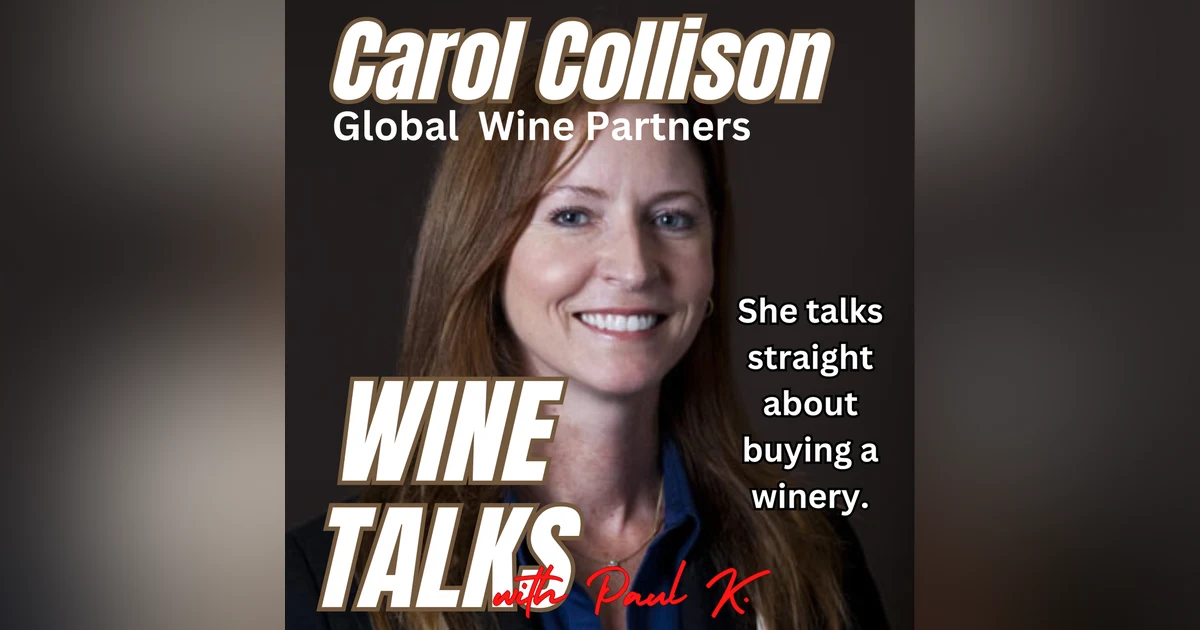

When the Original Wine of the Month Club was ready for a new chapter, they turned to Carol Collison to make sense of the landscape of selling a wine club. In this episode, we peel it back on a number of fronts: Challenges in the Wine Business: - This...
When the Original Wine of the Month Club was ready for a new chapter, they turned to Carol Collison to make sense of the landscape of selling a wine club. In this episode, we peel it back on a number of fronts:
Challenges in the Wine Business:
- This episode dives deep into the financial and operational challenges faced by those in the wine business. Paul K recounts a friend’s struggles with a large, aged inventory and shares a cautionary tale about the risks of high pricing and poor market support in the wine industry.
Impact of Industry Downturn:
- Carol Collison discusses how the current downturn in the wine industry is affecting larger producers more significantly than smaller deals, causing ripple effects throughout the industry.
Real Estate and Winery Transactions:
- Carol provides insights into the niche market of buying and selling wineries. She discusses her role in wine real estate brokerage and shares stories about challenging transactions, such as the sale of Moraga winery.
Direct-to-Consumer Sales and Marketing:
- Both Paul and Carol examine the complexities of selling wine directly to consumers, addressing the oversaturation of the market, the importance of marketing, and challenges like the decline in direct-to-consumer sales.
Valuation and Profitability:
- They talk about the financial metrics like EBITDA, profitability, and growth potential that are crucial in winery transactions, highlighting the importance of finding motivated buyers and understanding the financial landscape.
Brief Biography of Carol Collison:
Carol Collison is a seasoned professional in the wine industry with a background in investment banking. She transitioned from finance to real estate brokerage, specializing in the sale and acquisition of wineries through Global Wine Partners. Over her career, she has developed a keen insight into the complexities and nuances of the wine business, making her a respected figure in this niche market.
Very fun story:
Carol shares the story of trying to sell Moraga, a small boutique winery. Despite its premium wines, the property's real value lay in its luxury residence rather than its productivity as a winery. After struggling to find a buyer and ultimately losing the listing to a luxury real estate firm, Rupert Murdoch eventually purchased the property. This highlights the unique challenges of valuing and selling boutique wineries.
Tune in to "Wine Talks with Paul K" for a fascinating dive into the intricacies of the wine industry, where every bottle tells a story far richer than just its taste.
0:00 Carson Leno Fallon. Now it's wine talks with Paul K. Hey, welcome to wine talks with Paul Kay. And we are in studio today about to have a conversation with Carrot Carlitzin up in northern California. Introductions in just a moment. Wine talks, of course, available on iHeartRadio, Pandora, Spotify, wherever you hang out for podcasting. Hey, listen. Have a listen. Hey, listen. Have a listen. That was redundant. Rodolfo Tanger of the famed family tanger. He is the author of and the creator of French Bloom, this enormously successful non alcoholic sparkling wine from France. Incredible conversation because he also makes a very boutique champagne under his family name, Freijn, as well. Frederick J. Ryan was in the house, so to speak, virtually. He is the preeminent authority of wine in the White House. It's a fabulous conversation going back to George Washington and all the way up to current time about who poured what when and sort of the philosophy behind wine in the White House. Have a listen to that. But not while we're here. Here, talk to an old friend. I don't mean olden age. I mean old is, and we've been known each other for a few years now. Carol Carlson, welcome to the show. Hi. Thanks. I also happen to be old, but, well, I'm an old, old friend. So to make sure that we don't pigeonhole ourselves on this thing, Carol is a partner of global wine partners. And the reason
1:32 I want to on the show is because we're going to talk about buying a winery, the concept of buying a winery, the issues with buying a winery, the stories behind buying a winery. Everybody wants to be in this industry. But tell me a little bit about how you got there, because you were not just in the wine trade, you were a investment banker by trade. No. Yeah, no. Global wine partners. Well, we were an investment bank. Now I, you know, I just, I say m and a as a fancy way of saying we sell wine companies. We are not an investment bank anymore. You know, I'm licensed as a real estate broker, so that's kind of how we operate. We found that clients really don't care as long as you can get the job done. And it was kind of a hassle to be an investment bank.
2:18 So it was, the trade off wasn't clear. So. Well, we found each other accidentally, so to speak. And for the listeners, I want them to know that you orchestrated and moved the needle along when we sold the original wine of the month club, which I think we both learned a lot during that process. But I was looking, this show is about not only stories of wine. And as you know, there's no swirling or sniffing on this show. We don't talk about terroir, I mean, in the sense of soil and exchange of micronutrients at the tapper level, we don't talk about that stuff. We talk about the interesting parts of the wine business. And I was going to bring on a vineyard saleswoman. She was a real estate agent.
3:01 And I go, what am I doing? I have one right here. We're old friends. She knows what I'm talking about here. And because the concept behind buying a winery is so romantic, how did you decide to get from investment banking into wine winery brokerage? Basically? No, I don't own anything and have no intention to. That says a lot. Yeah, no, I mean, honestly, our firm was formed by Vic Moto and Mike Fisher. They were partners in MKF, which was an accounting firm. And I had been in commercial banking before this job, you know, selling wineries in the wine space. So I was familiar with them, familiar with the industry, and I came on board. We're very much a finance company, but because of their background in accounting, my background in banking, you know, we've both seen at the 30,000 level throughout our careers how difficult it is to be successful. And as defined by making money, you know, you can be successful and have a wonderful period of time owning a winery, but it may or may not be a financial success. So it was interesting to me when I joined the firm to see that, knowing what we know about how hard it is, none of us really invest in the wine industry personally or probably
4:33 told our stock brokers not to keep us out of it, because it is not. Really shouldn't, shouldn't even. Well, that's a different story. But anyway, so, no, the partners and I are all really mostly finance people. And. Yeah, so that's kind of. That's what we do. And so I've avoided going into the wine business. But, you know, there are many very successful people, and a friend of mine gave me an opportunity to put money in one years ago, and I deeply regret not having done that because it became very successful. So I don't know anything at the end of the day. Well, let's catch the listeners up. We were talking about not only owning a winery and the overhead and the requirements to try and make money and brand build, but all aspects of the wine business, particularly now, are very difficult. And we're going to talk about vintage wine estates. We're going to talk about the people that come to you looking for a winery but let's just start with that. People that come to you that say, I want to own a winery, and this looks so much fun. I was in Napa Valley, we went to a tasting room, and I was so enamored that how can I get involved? Are they most of them rookies or are you brokering one winery to another? Well, we mostly do sell side, so we mostly represent cellars, which is wineries. But your audience is going to be some folks, folks in the industry, obviously, but also consumers who may be thinking about it. And we do
6:03 occasionally have people reach out to us, but we keep a pretty low profile. So we don't, we have a lot of consumers talking to us. But what I will say is that one of the reasons I don't take by side engagements personally, some of my firm might, is because it does take a while to figure out what you want. Like even if you've had a week, you've had a weekend in Napa, you're about to retire, or Napa or Paso or Walla Walla, wherever you've had a fun time, you think, maybe this is where I want to do in my post career retirement second job.
6:45 Many people do that, but it takes a very long time to figure out exactly what you want. And that's why I don't take by side, because you'll say, oh, I'm really interested in Napa. And then you spend a while introducing them to the opportunities in Napa and they go, wait a minute, that's a lot of money. Or it's not too much money. They may eventually find out that it's a commitment. It's a commitment to work hard. The wine doesn't sell itself, as you know. Yes, I did calculate that we sold around 17 million bottles. And I thought, wow, you know, that's pretty big number on the surface. And what it took to do that, though. And this is, you know, you're talking about his second career, wanting to get in the wine business. I want to be an actor.
7:36 So you started a podcast? I started pod. I go to acting school. I go to voiceover school. But the podcast, not about me, it's about you. So, but on the sell side, obviously, you sell probably many wineries and vineyards, amongst other winers and vineyards. In other words, something's for sale, you list it or you're the representing organization and somebody hears about it or they come to you. So those people, is that a different type of sale then to somebody that already knows what they're doing? They already have the land. They already fermented something before, and now they're looking to expand. Is that the typical sale? Yeah, that's mostly who we sell to. And it's most of the market for existing wineries. The folks who will buy winery are other wineries. And so that's really who we interact with and that's who we sell to. It's interesting. I was listening to your podcast on Moraga. Yeah, yeah, yeah. That was super interesting. And I can tell you a story about the sale of Moraga. Yeah. If you have a minute.
8:39 All right. So we actually were engaged to sell Moraga when it was owned by the original owner, the founding owner. I was not involved in it. A couple of other partners were involved, were hired to sell Moraga. Right. And, you know, listeners can go to that interview, and it was really interesting. And you may not know that there is a very, very high level, high quality, small production boutique winery in the Bel Air hills, you know, and so we were engaged, we were hired to sell that winery. And. But here's the thing. It's too small and too specific. Too much of the property value was in a luxury residence for it to pencil out for a commercial operator. It just doesn't make any sense. And so we ran the traps on our network and really weren't successful. And we're thinking about JV ing with a luxury residential real estate broker when they decided to just fire us and hire them, which is fair enough.
9:45 I have been fired before. That makes sense, though, doesn't it? No, totally. So this is my point is that Morago was not the sort of thing that we are engineered to sell. We're engineered to sell wineries that have a kind of commercial viability, because we'll sell them to another, either small or big winery. But the punchline on Moraga was after we spent all this time and all this effort, tried to sell it, they hired a luxury firm which advertised the availability publicly. See, we always do. Confidential, right? If we could put a sign up or run an ad in the Wall Street Journal, yay, that would be great. But we really can't do that. And we can talk about why later. But as soon as they got rid of us, they hired those luxuries folks. These guys put an ad in the Wall Street Journal and Rupert Murdoch bought it. I mean, it was that fast.
10:36 Wow, that is really interesting. Yeah. That publicity was required to do it because it isn't very big. I think it's only like eight acres planted and a total of 17 available or something. But wow, that's so funny. It's just, he probably was the first to the table, too, right? Yeah, yeah. I mean, you know, he reads the paper every. I mean, it was literally that fast. Literally that. Here's an interesting story about it, and you don't hear about it in the podcast, but, you know, the red wines, $140 or so retail, and the whites, I think it's like 90. You know, that's. Those are lofty prices for even a Napa wine. You know, people know they can buy silver oak Napa for that price, or they can buy a camus one liter for that price, or, you know, so you kind of know what you're getting. So we were talking about tough sells, and we're talking about selling a winery and the things that go with trying to make a dollar in this business. I'm guessing it's not profitable right now, at least on the quantities that they have and what they're making. Yeah, probably not, insofar as the dirt, the investment in the land is going to be well past anything that would make any sense. But, of course, if you're Rupert Murdoch, who cares? Yeah, who cares? Right.
11:56 Did you visit? Can I have a little. I have not been there. I mean, as I said, I wasn't involved in the transaction or the effort to sell because it does feel like. A regular Napa style winery. It's in the hills or so. It'll be a foothill winery, something maybe in stag's leap or something, but it's a little road that goes up into a winery, and there's a tasting room and there's a lab and there's tractors and there's, you know, perfectly manicured vineyard rows. There's roosters and chickens walking around. He says a lot of production gets done there, Hollywood production, because they don't want to go to Napa to shoot it. So they just. Yeah, it kind of works that way, but, you know, kind of leads to the next section that do people, when you, when you get involved with selling a winery, are people amazed at when you explain, let's just say, the lack of profitability or the lack of.
12:50 Of market share and the way you have to market this. And we've talked about this many times privately, but how difficult it is to build a brand. Are those part of the conversation or. No? Well, the way that things typically work is somebody will be referred to us. I can't recall how you found us, but either through an accountant or somebody. I don't know. We work on the Google search. Yeah, right. Or Google, where I don't know how good our SEO is, but yes, some folks will find us that way, but mostly referrals. And then after I've done this for 16 years, so I have developed my sales pitch from, yeah, great. This is a great brand. Let's go to. Okay, this is a great brand. However, here are the odds, and the odds are I did the research many, many moons ago in wines and vines, which is a trade. Wow, that's an oldie. Yeah, it's an oldie. Yeah, I did. And this was old research, but it's held up over the many, many years that there's just a lot less activity than people think there is in terms of successful sales. It's a lot in a lot of little. All those ducks on the water, there's a lot of paddling going on underneath our little feedies. But in terms of when you get to the end, when there's a transaction that can be announced, that's a lot less common than people realize. And in fact, when I did the research, I discovered that, well, it's on average, 20 transactions a year, and that's along the whole coast, California,
14:23 Oregon and Washington. It's not a lot as much as people think. And then it's about 100 brands that will just go away. So the way, so it's five to one. The way most people on five to one way most people will get out of the wine business is at some point they're like, I'm tired. Kids aren't interested. Let's just wind this thing down. And it works because people have these tremendous investments in inventory. So if they can just basically stop making wine, quietly sell through at normal prices, they can get all their investment out of the inventory and be satisfied. Chalk it up to a great experience and get some of their investment back, if not all or more, excuse my. Cough, on what's going on. That's all right. Well, we know already.
15:07 In fact, they just got this huge list. I can't remember the brand. I wouldn't mention it anyway, but, uh, somebody just bought a winery. It's Napa, it's appalated. And I got a call from a random person that actually from my sign maker here in Monrovia, the guy that makes my signs when I was busy, when I was in business. And he's like, yeah, my buddy just bought this winery and would you mind selling off what he has? They said, well, send me the list. It was huge. I think it was, I don't know, 3000 cases or so, distributed among probably ten varietals and probably ten vintages. So 100 cases here, 50 cases there. And I. He didn't want to hear the reality. I said, you're going to have to sell this for pennies on the dollar.
15:50 No one's going to take this inventory. Much of it's getting too old, and it's in small lots. Nobody really cares about ten cases of your 2012 merlot. It's not that important. And he was flabbergasted at this idea that there's no value here. But particularly in today's marketplace, the industry is going through a lot of changes. Has that changed your perspective on transaction volume? Because the industry is, and I'll share with you a conversation I had this morning, but the industry is in this learning mode or transition mode. Well, we are in it. We have been in it before, and it is a cyclical business and so is tech. I mean, there are plenty of cyclical businesses.
16:36 So we've been here before, but yeah, we're in a bit of a down cycle. It's funny, they're all different. This one is affecting the largest, the highest scale producers. And so it's different. I'm lucky. I tend to work on smaller deals. And to be perfectly honest, this is one of these downturns that, at least so far, hasn't really affected the folks working at the lower end of the scale in terms of their prospects, their experience, what's going on, you know, so. But no, it's a complicated time. And it's funny, I was just saying the other day, hearing this description of this guy who's bought this winery, and there's all this obsolete inventory, you know, I hadn't seen that in so long, I thought people figured out not to do that, you know.
17:25 You know, your best. There's an expression of finance. Your first loss is your best loss. Yeah. Right. And so what tends to happen is people in these circumstances where you find, you know, a lot of old inventory, they just could not, they did not have the intestinal fortitude to say, all right, we've made this vintage. We're not going to sell all this vintage in a normal commercial cycle. We'll make the balance go away, even if we have to take the loss. So there's that psychological barrier that people have, which is completely normal, but it gets you, especially in the wine business, it gets you into a ton of trouble. I can't tell you how many stories I have, but one in particular of somebody that came to me. Wonderful spanish couple. She was an anchor for one of the foreign language tv things. She was this pretty woman, she was out on the street selling wine, and they wanted to bring in some albarino. Not the most at that time. At least ten years ago wasn't the most popular grape in the world. It's a little more popular today, but not to this extent. They asked, you know, how to, how to do it. I said, well, let me get you an importer. You bring in, you know, bring in a couple of pallets and go sell it, and then we'll see how it goes.
18:32 And they're like, okay, they came back in six months, and they had gone off, bonded a warehouse, brought in a full container, which for the listeners is 1200 cases or 20 pallets or so. And they wanted, let's just say they wanted $160 a case wholesaler, you know, puts on the street for $20 or so. I said, no, I go, it's too expensive for what it is. And you're gonna have a hard time selling Alberino here to show. Then they came back in six months. They go, now it's 120. I don't think they ever sold through the container. Oh. And they just didn't want to listen to the logic because it's so romantic and so fun and, and we had positive encouragement from the people that tasted it.
19:17 But when it comes to opening the wallet up and having to go sell it, when it's not being supported by any other means except your own hand sell, it's a tough business. And you said it's affecting the larger organizations. And let's say these, we know a bunch, right? But when sales are off 20% and you've manufactured wine to fulfill would have been 20% more than what you actually sell. You're sitting on quite a bit. I mean, it doesn't seem like a big number, but the margins are so narrow that you just chunked up all your profit for almost the rest of the 80% by not having a sale for the 20%. Yeah, I mean, hopefully the math is, at the higher levels, a little bit better. Hopefully the margins are, yeah, 20% doesn't take all the margin away. But, but no, I mean, that's the thing.
20:10 If you're doing small volumes, it's a lot easier to make it go away, if you need to make it go away than if you're. I think you mentioned vintage wine estates, and you were, I don't recall where they sort of peaked in terms of volume, but, you know, ten. I think that the word at the end of last year was it was off 9%, but, you know, the shipments and yeah, no, 9% of a million cases is a lot of wine. That's a lot of wine. So we'll talk about that since it's a public company. Yeah. And this for the listeners. I mean, I was trying to play with it the other day. I couldn't find their market cap, but apparently it was somewhere around 210 or $220 million when they came out.
20:55 Only, what, three years ago, four years ago publicly, for the stock at $13 a share. And there's quite a few public wine companies around, and they were doing 250 million. So it seems rather stable in what might be just considered an unstable industry, not on a regular basis, but today the stock was at $0.26 yesterday. Well, that is an absolute shellacking. And the response is to sell off all their direct to consumer stuff, which is what they're building as part of their platform to go forward, was the direct to consumer. We'll talk a second about that. But they're selling off all the stuff they bought along the way. Yeah, no, I don't have visibility into it, and I'm too busy to pay that much attention.
21:47 I got nothing but time, Carol. Well, sometimes, trust me, I have nothing but time. But right now, thank God I'm busy, because I'm self employed. But, yeah, you know, shortly after they went public, there was an announcement that had something had gone wrong in their accounting and that the adjustments that were required to correct the accounting, I mean, it was kind of a perfect storm of problems at the exact wrong time. So they, and I know Pat, I sold him clopagos back a while ago. Did you really do that? Yeah. Well, me and Vic Motto, my business partner at the time and said, no, I'm a bit, I've known him for years, and I know his dedication to direct to consumer. So I'm sure if that is what they're doing, kind of offloading the DTC, that's rough. But the problem is, if they have to sell the DTC model is there's a lot less of a market for it than the wholesale stuff. So that may be, if that's what they're doing, that's why they're doing it. Well, since you were involved with the sale of why the month club, and we've saw, we consider very fortunate to have found the buyer that wants to take advantage of smaller companies like ours was. I keep reading on the web and I'm reading all these pundits, and maybe you have seen some of this. If people are talking
23:18 about the industry, not only is the DTC side down and direct to consumer, for the consumers, for the listeners, is something that you buy online, direct, shipped to your house, whether it's from a winery or a third party tasting room or club. Yeah, right. Yeah, that sales are off. There's too many choices. There's, you know, there's a club came out last in December called Cheapo. Vino. No, Vino. Cheapo. Sorry, I had backwards. Why would you join Vino Chippo? But the point is that, and I was thinking about this a lot over this last couple of months when I started doing this with my father, it was truly the opportunity to find these odd lots, much like Trader Joe's foundation, of how they started the business, where they're finding. And they would tell you, in the fearless flyer, we bought the last 2000 bottles. And so you get it while you can. And wine of the month club was really that same outlet for wineries that had made good wines under their brands ready to sell. The consumer, you know, had to get the stuff off the floor because the next vintage is coming in and we would take advantage of that. Well, those, those don't exist as much, as nearly as much as anymore because people have learned better logistics and better manufacturing. And so now what you're getting for those prices are really bulk wines from middle of Europe at kind of thing. And the values doesn't seem to be there anymore. I'm not categorically saying
24:49 that. I'm just saying. Right. And you throw into that the mix of marketing and the ability to send a message immediately. You know, in a second I can get a message to all people on Instagram, Facebook, to say, hey, I've got this special deal going on. It's congested, everything. So when you sell a winery, then, like, how do you approach this part of this? How do you approach this idea that brand building is tough? You know, marketing on the web is even harder. What is it come up even? Well, you know, you and I had this conversation at one point in time because I think, you know, I sell, as did you, for all your career. So we were both salespeople. But the sale, I said, I think, I said, I don't, I can't sell snow to the Eskimos. I can sell the Eskimos warm shoes.
25:41 And I've recently been told I'm not supposed to use that phrase. So I apologize. Inuit or native Alaskan. But anyway, I'm 61. So come on, give us old people a little grace to adjust. You can say it. At any rate, I tell the story in a very straightforward way because I'm selling to knowledgeable buyers so I don't have to put a lot of spin on the ball. If a knowledgeable buyer is going to be buying what I'm selling, it's because, for example, they have excess capacity and they want another brand to kind of fill the capacity or they want a different varietal.
26:28 They're doing well in Cabernet and they curious about Pinot. Let's buy a pinot brand. So it's really more top level stuff. I don't get. That's kind of what sells it is these broad categories and growth, growth helps. Profitability is excellent, but not necessary because I actually, we're selling the top line because our buyers will bring their own cost structures. So yeah, so somewhere educated, a buyer. And somebody that I was talking to, somebody in Europe who sells the villa, the villa experience the lifestyle of being in Italy in a villa.
27:10 And it's probably a different conversation. How do you parse out or how do you deal with the idea that a Dow selling for a billion dollars or Schaefer for $250 million from foreign entities, so to speak, did that fuel the fire for people to sell or people that come into it to think that they're going to flip their winery in 20 years for numbers like that? Yeah, no, I do think it gets everybody's attention. And if you have a very successful winery and you point to those transactions and say, I want what they got. But it is very much, it's a moment in time for that when deals of that nature come together and it's not part of the normal everyday, so you can find the right buyer. One of the things I always say is that in my line of work, what you need is a motivated buyer. A motivated seller will not get you anywhere. You have to find the motivated buyer. So. Wow, how counterintuitive.
28:13 Yes. Always the motivated seller, the real estate guys always have I got a motivated seller, you know, like, okay, great, so I'll jump in. But a motivated buyer? Yeah, the headwinds the conversation. What? Well, it's because, you know, it's difficult to do as you know. I mean, even though, you know, you had a friendly relationship with the bit business owner that you were in discussions with and eventually did a deal with, you know, there's a lot of hiccups. There's, you know, questions that come up. There's, you know, issues that have to be overcome in the due diligence process. And, you know, it's easy for a buyer to get buyer's remorse and walk away. That's the easy decision, the hard decision is to go past all these, all this difficulty and all these hurdles and the negotiations are complex and sometimes contentious.
29:06 The buyer has to get past all that. So your seller wants to get out. So they're going to roll with it a lot. Yeah. There you go. That's it. So are we pitching EBItda for the listeners? Are we pitching a factor of the profitability? Are we pitching the brand placements? I mean, obviously the Dow sale just for the consumers, the Paso robles based winery, who's a great story from immigration to America. The two brothers fled Beirut, shrapnel in their shoulder kind of story, and sell for a billion dollars. And I think everybody in the industry knows that the metrics that didn't conform to the typical selling metrics and that, you know, one of them would be a factor times your profitability. Earnings before income tax is that you talk about those things when you're selling or they're just ancillary to the piece of property, the vineyards, the brand. Well, I mean, this gets back to the, you know, I don't believe I can talk anybody into a multimillion dollar investment.
30:15 I think they talk themselves into it. So, you know, it's got to be what, what they need. And that might be, I think typically what's going to drive it is growth, for sure, gets everybody's attention. And I think that's part of the Dow story. I wasn't involved, don't know anything about it. But I think it was very, I wish I were you and I would not be talking right now. I'd be sipping a cocktail with a little umbrella in it on a beach. That's a dow on the little umbrella. Right. Instead, I'm still humping wineries. Now. I love the work. So growth can be a factor. So yeah, you tell that story. But profitability, again, it's a nice to have, not a need to have, because the buyers typically like treasury that bought Dow. It's going to wipe out all the basic overhead expenses that Dow was related to, its bottom line, its net income. True. And then it always depends what confuses everything and is vineyards. If there are vineyards in a transaction, I mean, what is valued by multiples of revenue or EBITDA or gross profit or whatever is the brand inventory and operating assets or the brand inventory. Winery or the vineyards are valued separately. So that's what can kind of muddy the waters a little bit. You know, you see this, you know, if something has a lot of vineyard, and I believe Dow had quite a bit
31:49 that could sort of muddy the waters. And people just look at the simple math. Oh, they got this for that? Well, no, you have to take the value that the vineyards out of the discussion before you really look at what they sold it for. So. So you said earlier that we're in it. We were in it. And I've had this conversation a little bit. One of the things that bothers me a lot, they see on the, on the, on the web with some pundits, and at some point, particularly our complicated historical industry, it's as complicated and it's got romance and it's historical that people coming into the fray of this industry that don't know all the history, that don't understand it, but learn something new or see something in the industry, and they say, oh, you know, it's ready for change. It's ready for innovation. It's ready for this, ready for that.
32:34 It's like you don't even know. You don't even know what that means. And I was. I've been trying to figure out what innovation means in our industry right now. Is there such a thing? Do you have any idea what they're talking about? Does it make sense? Do you mean disruption? Are you trying to say disruption? Oh, disruption, too. That's a good favorite. You know, it's this thing that everybody sounds very fancy and high flying and techie. Folks like to use it. I don't know where it came from, but disrupting. Nobody's going to disrupt a multi. I mean, you know more than anybody else how long the history of the wine industry is. And so sort of, it's. The disruptability of this industry is probably limited. Yeah, but, yes, of course.
33:17 I mean, new innovations. And I was talking to. Hey, everybody, can I plug my podcast? Yes, please. Do I have a podcast? It's called small fortune. It's about the business of wine. And I was speaking with Alex Sokol Blosser. Do you know the Sokol blosser brand of Oregon? Yeah, yeah, of course. So he was talking, everybody in the industry is talking about this little moment we're in. And he said that it reminded him not of the 08910 that was driven by the financial crisis, but by some, possibly some real changes going on in consumption. And he said that his recollection, the family's experience, was at a point in the nineties, there was this sort of sliding, sliding consumption, and then it got reversed by, at the time, the french paradox story. Right. Oh, it turns out it's healthy for you. And so we're kind of a bit. It may be the case that we're in a bit of a slide for a variety of reasons, in terms in demand, and that, of course, is going to shake out. It's a shrinking pie. It's probably shrinking pie for a minute, and then it's somehow or other we're going to. And maybe, to your point, maybe instead of waiting for a miracle, like the french paradox, you can't control. Or COVID.
34:37 Or COVID, which, I mean, if, you know, some people were hurt, but many did great. At any rate, maybe we'll find some way to disrupt that trend and maybe some innovator will come in. But for the most part, you know, it's a multi thousand year industry, so, yeah, we'll be all right. I don't get it. Yeah, I mean, it's going to ebb and flow on its own and, yes, zero eight and zero nine was a bad year for the wine of the month club. The worst year I'd had up until that point. We kind of broke even, and that was purely financial. The people weren't buying, they just didn't have the means. Now, it's a much more complicated problem, and not the least of which is, you know, Internet marketing and all the things, all the messaging that people are waiting. I tell people when I consult with them, you have to understand, you're not competing against other wine companies. When you're socially marketing on the Internet, either Google or Facebook, Instagram, etcetera, you're up against Kim Kardashian and the rest of the influences of the world. They're taking their eyes away from what you want to tell them.
35:43 But I think this is such a slow moving industry. You only get one chance a year to make the product. It's got a life cycle to it. It doesn't last forever, as explained by the dumping of all these wines that I saw the other day. So it's tied to a lot of other factors that we can't control. And to say you're going to disrupt it, or that it needs innovation. I mean, what does innovation mean? That we have an augmented reality label where some prisoner tells a story? I mean, that's not innovation, that's just packaging. That's. Yeah, and that's. That part also sort of gets under my skin a little bit. But, you know, packaging is not, in itself, diversification of the product. Right. The product is still what it was 10,000 years ago. Tastes a little better, hopefully. Actually, I just read somewhere that the roman wines in their amphora actually are probably pretty good. Yeah, I saw that. So they did some kind of test and came away going, you know what?
36:42 These guys knew what they were doing. But that's the part that's interesting to me. I guess I just had a really interesting conversation with a woman. She's going to be on the show and she's coming up with a new product. She's raising a lot of money to develop this new product. And I looked at it and I go, you know, it's interesting, but, man, to throw all your chips in a basket like that and think that we're going to come up with a new method. I'm not a new method. A new fermented grape juice that's going to change the way the world looks at wine. I just, I just don't see how that, how that works. God bless everybody who takes a big swing, right? That's kind of what my, my podcast is. You need to know that. Yeah, entrepreneurship, you know, and I worked with business owners my whole career, and I have great respect for those, you know, taking these big swings and, you know, sometimes, sometimes it works like the. Is it was it, Underwood was the brand up in Oregon that really kind of took, said, oh, we're going to put wine in cans, and everybody's like, what?
37:49 And off it went. And of course, that settled out for a variety of reasons. But so, you know, there's, there's still innovation to be had. I, you know, you joined my podcast, wine talks listeners. If you want to hear what he had to say on my podcast, go, go look for it. One of the things that I came away from that conversation with is that it may be the case, at least on the selling side. Right to your point, you know, you're consulting with people on social media. It's a very complex and frankly, degenerating medium as we speak. You know, in terms of the crowding and the. Anyway, it's just a lot of noise. I came away wondering if it's time to go back to basics. Right. You talked about your dad and you building the business through person to person contacts at various shows throughout the country.
38:40 And maybe it's time to go back to more person to person stuff, then maybe set the social media side a bit, or at least do both. I think that's entirely accurate. And I've had a lot of head nodding on that when I bring it up. And that is, I don't think that the value of the glass of wine ever will change as it sits on your dinner table. It's always going to have that ethereal value, what you drink is up to you. But the idea that you're drinking it when you drink it, is the experience that you're hoping for. And I often, during the day, not dream of, but look forward to something in particular. I might be looking, granted, we do this every day, so I'm in the business. So people probably don't have this experience all the time, but they certainly have the experience of saying, I can't wait to get home, I have a glass of wine. Yeah. Now I go home. I can't wait to have a burgundy or a burdo or whatever, but that's. A little bit more la di da. At the same time, you know, you still feel like, I can't wait for that to happen. And there's not too many beverages like that. And I think that experiential part of wine is what you're, what you're talking about going back to those. It's funny you said that, because the woman I was talking to this morning, not only is she releasing a brand, it's coming with this destination in Italy. Oh. So it's part of the money she raises not only to launch the brand, but it's to launch a facility to go visit and to hang out and be part of
40:12 it. And I think that has a chance because until you, till you have a reason to drink something or see something or you feel something from going to Napa and having a tasting room experience and going home. Why do you think wine clubs from the wine, the winery side of things are so popular and so, so much an important part of the revenue stream of a winery, because I went to the winery and I was with my girlfriend, boyfriend, whatever. Right. And I had this glass of wine and we shared it. And now I joined the club. And every time I get that box, it reminds me of that moment. Yep, that's it. Yeah. That's tasting rooms and your sales.
40:54 Most of the, do most wineries have tasting rooms? Most, but not all. Yeah. Most wineries will have a retail presence, but, but not all. But, yeah, no, that's a thing. And interesting. I read in the trade, some trade publication that there's Lawrence wine estates, they bought Heights and Stony Hill and et cetera, et cetera. Yeah, yeah, yeah, yeah. Kajing recently now. Yeah. Over the last couple of years now as a fellow, he's a big, successful ag, industry investor, and he got involved and has acquired a number of things. But they recently announced they're going to have some very high level club like they have in the big cities in San Francisco, New York, they're the private clubs of some sort, and that they're going to create that private club experience for their people who they're going to let in, and then they're going to pour all these fantastic wines and, you know, so that's an innovation. I mean, that's an interesting concept that hasn't been tried before. So, you know, I hope that it works for them. And then, you know, maybe there'll be one or two more. You can't have too many fancy private clubs in a, you know, a two horse town like Napa. I mean, look, I love Napa, but come on, it's, it's. It's really a small. John Charles.
42:15 Yeah. Yeah. He's another reliable innovator and acquirer in the industry. He's great. I did have a conversation with a guy who started a club, but it's more than just the club. He has relationships throughout the world. And so you get a chance to make your wine and you pick the location. I forgot how much it was. I didn't think it was that exorbitant, considering that you are literally, you know, hands on part of the winemaking process of your preferred location in the world. Could be Italy or France, Bordeaux, Burgundy, whatever. And I thought, okay, that's kind of a cool experience. Logistical nightmare, but an interesting aspect of it. Well, the banker in me is like, yeah, great idea. How are you going to make money? I mean, God bless them. I, again, taking big swings. Keep, keep doing it. Sometimes they connect with some wood and off you go. So let me get colloquial. So is it true if you want to make a billion dollars in the wine business, I mean, a million dollars in the wine business. Start with a billion.
43:21 Well, no, it ain't that bad, but you may shave. You might shave a zero off if you. That was a Kevin O'Leary comment, which everybody knows, of course, that we. That we. Well, I mean, that's the, that's why my podcast is called small fortune because it's this old joke, you know, what does it take to make a small fortune in the wine business with a large fortune? So that's a common. Right now you're working on a project? Yeah, I've got a couple. Yeah, I'm working on a few things. Yep. So exciting. Yeah. No, I'm glad. I mean, all but one of them are at the lower level in terms of the prospective buyers. So it's the one that I have to talk to the big boys about because of the scale of the project, you know, that one's a bit of a question mark just because there's just so much froth, but it's an excellent asset, so I'm sure we'll find a home for it. And the fires, recovery from the fires in Napa, have you seen activity from that or growth or.
44:19 Daddle, at least at the vineyard level? The vineyards did fine. There have been wineries that have had to be replaced. The day to day of the business has not been affected by it, except for nobody in Napa Valley had a 2020 cabernet. So it was a huge challenge from that standpoint. I think that going forward, the challenge is going to be insurance. And that's a national, across all industries and individuals. Problems in California? Yeah, well, everywhere. I mean, there's. Nobody is safe from fires and floods anymore.
45:00 But, yeah, I think the insurance has to be figured out. They're talking about 2023, and I sort of say it's tongue in cheek, because maybe it's just pr, but they're saying 2023 in Napa is going to be one of the most incredible vintages worldwide for wine, period. The quality and the level and the sophistication, the complexity of the wines from 2023 are going to rival the best vintages of Bordeaux or Burgundy or whatever. Well, it wouldn't be great. I have not heard that. I, you know, I operate at the numbers level, not the tasting level. We got to break you out. We got to get to. One of these days, I swear, I'll learn how to. How to taste. I mean, I enjoy it. Of course. I'm not a complete dummy, but. But, no, no, I hadn't heard that, and I'm glad to hear it. I remember going to the Napa Valley barrel auction.
45:53 It's the one Napa Valley auction event I go to because it's locals and owners. It's a little bit better from a business perspective, which is why I'm going. And I remember, not last year, must have been the year before walking in, kind of. I think it was 22. And I'm like, why are there 21 cabs here in this barrel tasting? I don't get it. I forgot, you know, they didn't have a vintage, you know, in 2020. So if we can have a 2023 for which there's incredible demand and people can take a little price, yay. I mean, that'd be great. I guess I should have bought those two pallets of 2020 Cabernet from the. Oh, I don't know if it was coming your way. It was probably smoke tainted. I don't know. Who knows what's going on out there? Well, we're almost. We're actually out of time, which is unbelievable. Okay, well, good.
46:41 Edit. Edit out that, my dumb eskimo comment. I can do that if you want. I don't care. It's up to you. Fascinating conversation. We have more to talk about when we read. We do this again, and we got flip side of some of these deals and want to peel them back a little more, a little more granular without mentioning names, just so people understand, you know, the emaciations of doing this, because, you know, it's interesting industry. It's not just marketing stuff like my niece is starting, and she wanted to start a salad dressing company. She's 19. She's produced. She's produced it. She's gone through the whole rigmarole of food science and the packaging, which is interesting just to highlight something. The packaging that they got sent to the co packer when they were putting the salad dressing finally in these pouches, they're single served pouches. It was determined later that the wrong food grade lining had been used, and so the acids in the salad dressing had eaten away, so they had to repackage them. And I thought for a moment, you know, it's interesting because right now they don't have a food grade lining for wine cans that can last more than nine, six to nine months. And it's. I.
48:00 So now we're getting to. And I was talking about the moving parts of the wine business. That's a moving part, too. You know, we're not just talking about selling wine like you want to put in a can. Uh, you better make sure you have the freight food grade lining, because that it's gonna be worthless in so many months. And the same food grade lining that lines a Coke cannot. Wine. Wine can. Yeah, no, I saw it different. Yeah, I know that they're trying to figure that out. Yeah. Too many pieces. So it's not just like I'm going to be in the wine business. I'm a brand and I'm. I have friend of my house. We're going to look at the Vista over Napa Valley floor and look at John Charles property. Yeah, no, it's. It's a lot of work and it's a lot of decisions, and it's. But it's fun. It is fun.
48:47 That's the part that, that brings you back is it's fun. It's like that really clean golf shot. I'm going to come back because I think I can do it again. Such a pleasure to see you. Next vintage. Yeah. Great to see you. Say hi to Sandra. I will do that. And thank you for being on the show. And we'll send you all the credentials when it's ready. But fabulous conversation. Thanks for having me. Thank you for listening to wine talks with Paul Callum, Cary. And don't forget to subscribe because there's more great interviews on their way. Folks, have a great time out there in the wine world. Cheers.