

 Apple Podcasts

 Spotify

 Youtube Music

 RSS Feed
 YouTube
 Pandora
 iHeartRadio
Redefining Wine Tourism: Intimate Journeys Beyond Typical Wine Country Tours

Enotoursim has been a staple in the tourism trade. One of my favorite podcast was with XXX Duput, the woman who delivered the wines from Napa to Steven Spurrier in Paris for the Judgement In Paris. She was the leading Enotourist company in America.
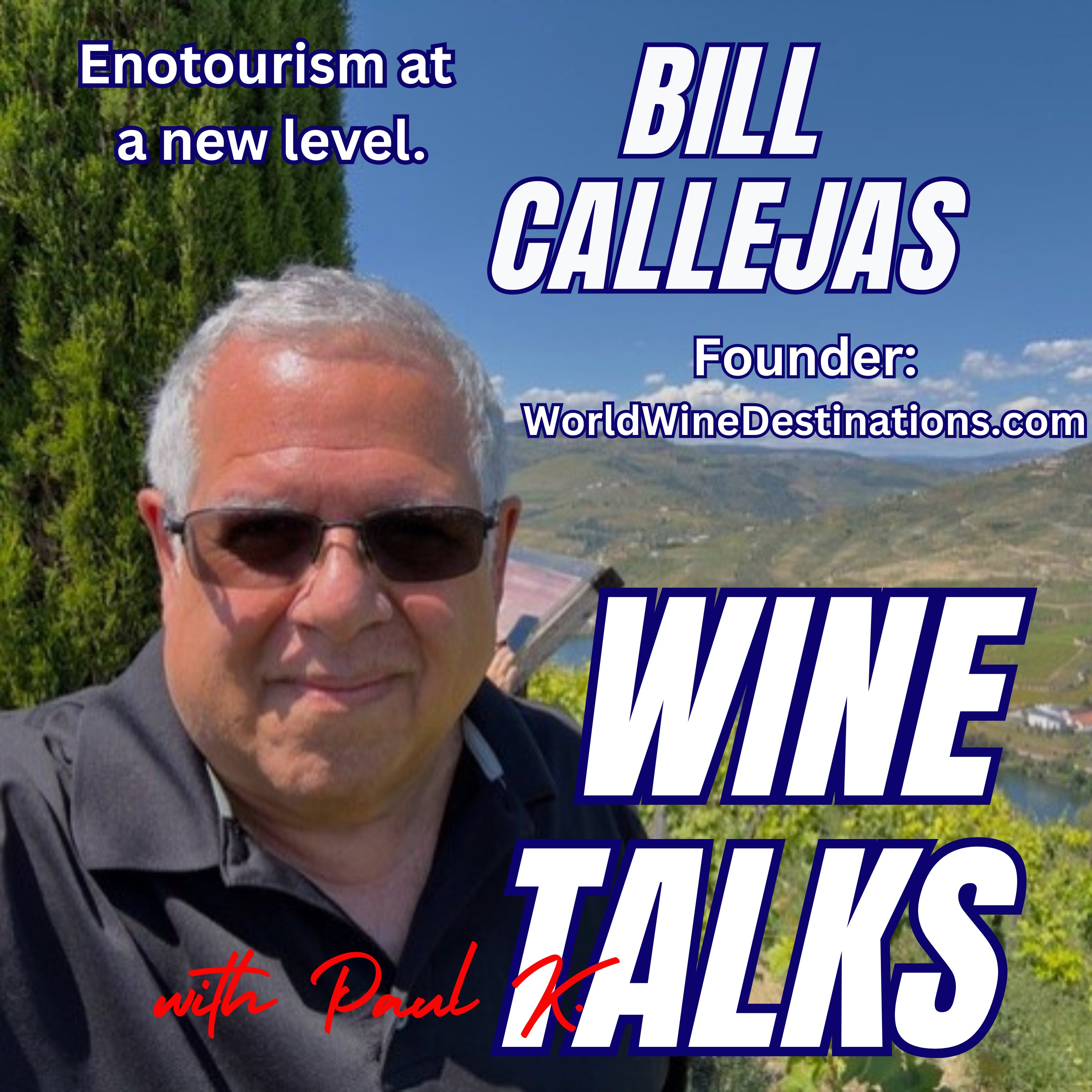
As time would have it, Enotourism had seen its days, slumping a bit for the past decade...until now. Though wine sales are off and the wine industry is scurrying to define the cause of this slump, enotourism could save the day. Meet Bill Callejas, he is grassroots and has created an enotourism company from sheer passion.
Bill Callejas didn’t just stumble into wine tourism—he reverse-engineered it from the ground up, blending the precision of his production background with a storyteller’s flair and an explorer’s curiosity. You’ll be hard pressed to find a more nuanced perspective on wine travel, or a more convincing case for ditching those cookie-cutter tours. In this episode, you’ll discover the real difference between “just another wine trip” and a thoughtfully crafted, immersive journey that brings you shoulder-to-shoulder with winemakers, artisans, and even the family matriarch preparing your meal. Bill reveals how he and his partners built World Wine Destinations around the idea that travel and wine are each a world unto themselves—each deserving of respect, intention, and creative design. Listeners will learn how each trip is structured like a multi-day live show, full of distinct characters, rising action, and the slow burn of discovery that comes from tasting with local experts in quiet, off-the-map villages. Expect revelations on why genuine wine travel can’t—and shouldn’t—be “dumbed down,” why asking winemakers about their intention often leads to the best stories, and how wine acts as a cultural glue, binding food, land, history, and people in an experience you can literally taste. Whether it’s the ancient amphorae of Greece, the wild terroir of Argentina, or the unexpected intimacy of Paso Robles, you’ll come away with an appreciation for how travel, when done right, changes not just what’s in your glass, but who you are as a drinker and a global citizen. Buckle up—one glass at a time, you’ll learn how the story of wine is best lived, not just told.
✅ Think you know wine travel? Think again.
✅ Discover how storytelling and immersive experiences are redefining wine tourism.
✅ On this episode of Wine Talks, host Paul Kalemkiarian sits down with Bill Callejas of World Wine Destinations to reveal why their unique approach skips the cookie-cutter tours and takes you straight into the heart—and the culture—of the world’s top wine regions.
✅ If you thought wine was just about tasting, you haven’t heard the stories that bring each glass to life. Hit play and get ready to plan your next adventure (and maybe reimagine what a wine trip can be)!
-
World Wine Destinations
-
Corner Wines (Plano, Texas)
-
Website: https://www.cornerwines.com
-
#winepodcast #winetourism #winetravel #wineculture #worldwinedestinations #BillCallejas #PaulKalemkiarian #winestories #winemakers #winetasting #culturalexperiences #wineregions #wineeducation #foodandwine #winehistory #immersivetravel #wineindustry #PasoRobles #winetrips #oenotourism
0:01 Wine is a social and cultural bonding agent, if you will. It is able to bring people together around stories and around meals and around tasting. But there's also historic aspects to the role that wine has played. Sit back and grab a glass. It's Wine Talks with Paul K. Hey, welcome to Wine Talks with Paul K. And we are in studio today in beautiful Southern California, about to have a conversation with Bill colleges of world wine destinations. Yes, I am the guy that tastes 17 million bottles of wine. I didn't taste 17 million. I sold 17 million bottles of wine, but I did taste a hundred thousand bottles along the way. And I heard a hundred thousand stories. And that's what Wine talks is about.
0:47 It's telling the stories of the wine trade. So welcome to the show. Thank you very much. Really happy to be here. This is going to be a lot of fun because I was kind of explaining on a previous take of this show that my dad had started this idea, and I found one of his business cards. He got that far in the idea anyway, which was to produce trips to the famed wine fairs of the world. At the time, we're talking about 1975, 76, 77. And, you know, tourism was probably not nearly as popular as it is today, but that's not what you always did. And we'll get into that in a second. What. What landed you here in Eno? Tourism. That became such an interesting idea. It really stems from personal interest in wine and.
1:35 And not as anything serious, but just understanding and learning about wine and meeting my partners who had a wine shop in Plano, Texas. We'd come down from New York. I was looking for a new bottle shop, and Jim and Linda McDivitt had this store called Corner Wines. And Jim had a very, very, very, very effective way of teaching and expanding your taste. And that's really what drew me into the shop to understand more and more about wine. And he just mentioned that they were trying to get a travel program off the ground that would be sort of a community built around the win customer base. And as we talked about that and they told me about a little bit, I said, you know, that's something we could probably do ourselves if you wanted to do it. I come out of the production world, and I've been moving people and dealing with logistics and hotels and restaurants and all kinds of destinations, air travel and such, for years. I can move that. And, you know, the wine. What if we put that together and started a wine travel company? And that's how world wine destinations got off the ground. We discussed that Briefly in our pre call and that is every company that entered the wine trade and we were in the direct to consumer wine business, which is a very important part of the trade now. But every company that
3:08 started, that would start with this sort of comprehensive idea of what they're going to do to the wine trade, they're going to completely revamp the whole world. They're going to make everybody think differently about wine. And so they're going to have a subscription model, which we were of course, they were going to have travel, they were going to have accessories, they're going to have rare wine finds. All the things that you, that you sort of try to build into a wine company. And every one of them landed back at just a subscription model because they found it too expensive and too hard to do. Was that was logistically were you expecting what you found when you started this conversation with your wine shop? There were no real surprises other than both of us understood that there was the wine business and there was the travel business. And they really were two separate professions and they had to be dealt as such.
4:05 And anybody, and I know you have that's led a wine trip before, it is a nail biting, harrowing experience because nothing can go wrong and everything potentially can't. And you're traveling internationally and we're out in some pretty rural areas as wine growing, as grape growing tends to be. And there was a real good respect between us that Jim and Linda understood the wine and I understood the logistics and the building of experiences because part of my background was also in production and as a creative director, a writer director. And a lot of the last 15, 20 years of my career was built around live experiences created for audiences that were brand storytelling.
4:59 And these are huge events and auto shows and those sorts of things where you have to emotionally connect an audience with a product or a service, a story, and what is actually happening within the production that stimulates them and engages them and helps them care. And that's really seemed to be the secret. Could we build wine experiences using travel as the way to connect people? And could we pull it off? And we started back in 2010, early 2011, and we've been going ever since.
5:42 We're now going into the last trips to 2025. How many trips a year are you doing now? It depends. Sometimes it's two, sometimes it's four. There's no set, there's no set, there's no set target, if you will. We usually present our customer base and the people that we market to with five or six options and we start to see who's interested in this and who's interested in that. And initially we thought, boy, we'll be really lucky if we can get people to do this once, maybe twice. There really wasn't a lot of wine travel at the time, and certainly not the kind we were doing.
6:29 And so we now are at a. At a place in 25, 20, 25, where we're entertaining about a 92, 93% repeat rate. We have customers that have done 10 and 12 trips with us over the years. And over the last several years, we've had customers do two trips a year, which is a pretty big commitment on their part. So something about these trips is they're finding really enjoyable. They're telling their friends, they're bringing their friends, and they're expanding that base. You know, it's interesting you. You use a term, not what we are doing. And I'm wondering. And you and I discussed briefly Joanne Dupuis, who was doing shows in the 70s, and I won't bore you with that detail again, but I wonder what that. What is different that you think is different about when you say what, not. What we are doing right off the bat?
7:25 I think both Jim and I agreed that we were not real big fans of tours. And so we wanted to create a travel experience that was built around wine and food. That was not the typical tour. It would be something we would want to go on and not be hustled and moved about on some relentless schedule that stepped on your enjoyment of being able to spend time and getting to know winemakers and getting to know the culture and other things. But the part that resonated with me, and it's how we structure trips now, is out of my experience in production. And if you think about episodic television, you are doing a shoot. And this shoot has multiple days, and it has multiple setups.
8:15 And you're trying to accomplish this, and you're trying to string it all together to a script, to a concept, to an episode, to bring it to some enjoyable outcome. And the way we look at it is each day is like a shoot. Each day has setups. Each day has characters. Our talent is both our customer base and the winemakers or the restaurateurs or the hoteliers, and they all fit into a day. And we structure where we go and how long it takes to get there, and what is the wine experience? What is the eating experience? And we structure all that on a daily basis, and then we need to raise it the second day, and we need to give them Some breathing room the third day, and we have to bring it up again. So we have to orchestrate an individual day's storytelling with anywhere from seven to 12 days of storytelling, so that the whole experience feels like an emotionally based experience, that it feels like a story, and it presents them with a wide array of things.
9:26 And it's very hard for somebody to find something that they don't like within any given day. So that's really what makes us different. Because, you know, it's interesting, I suppose. Had you been on a wine tour by yourself or had your. Your partners been on a wine tour? Jim and Linda had, and they had originally had a travel agent that was putting together a couple of trips for them. Some of those were on a cruise and they would do it and. But you were sort of bound by the boat, and you were bound by where the boat was going and what relationships the cruise company had with what wineries. And we were very much about wanting to bring people into the regions, but to find the undiscovered producer, the small volume, low production, high quality producer that may or may not have had very much distribution in the States, in particular in Texas, you know, more specifically. And so being able to free ourselves from that kind of confine, you know, really led to the creation of an immersive experience that moved us deeper and deeper, not only into the wine regions, but deeper and deeper into the conversations and moments with the winemakers and the marketers and the staffs and the culture, the wine culture and that in any of these
10:57 countries. So we really take people in to places that they normally would never go. You know, it's kind of interesting thought because you said travel agent. My mind went to an old movie called if It's Tuesday, It Must Be Belgium. Now that is effectively sort of a satirical view and almost depressing view of humanity when it comes to being put on a tour. The title says it, which, if it's Tuesday, must be Belgium. In other words, we don't know what we're doing, but if it's Tuesday, we must be in Belgium. Because that's what the, the, the script says. And it's, it's, it's not funny. I watched it again. I go, this is really, really bad. But it was very funny in the 60s. It was a very important film at the time. And I started thinking when you said, we use the travel agent to go on a tour, and that certainly would be exactly the wrong thing to do because the travel agent's objective is completely different than what sounds like your objective is which is to tell the story of wine. You know, it's interesting because I've been pitching on the show forever, and. And it's. It's part of the complexion of wine right now to tell the story. And so here you are doing a story like life. It is. It does have that, I think, being in the live event experience, you know, where you've got an audience of 3,000, 5,000, 10,000, you're working out of a. Sometimes a sports truck, multi camera,
12:29 sometimes, you know, the front of house operations, calling live cues and presenting a lot of moving parts, a lot of video roles, and of course, executive speakers who always like to wing it because it's really confused. She's got her right. So you're really having to engage people. And one of the things that I noticed at front of house, which is, you know, really in the back behind the audience calling the show and accused, is as soon as the lights would go out, when the speaker would come up, you would see all the little phones and all the laptops light up as the audience would immediately just disconnect from what was going on there. And we really focused ourselves on how to change that and what could we do? And that was to somehow involve them in the stories.
13:22 So in content that we developed, we involved a lot of the people in the company and a lot of their outposts and a lot of their regions and all that in the story. And they were now seeing themselves as part of what the presentation was. And it just wasn't talking heads and rolling the financials. We applied that same thinking. Here is our winemakers, and I call them ours, they're obviously not, but we have relationships that we've developed over time with many winemakers who understand our brand and they understand our people. They call one another and they say, definitely meet with the world. Wine destinations, folks, because they're different. It's not drive by wine tasting. They're not here to pound wine. They're here to ask questions, hear what you've got to say, listen to your stories, and not a huge thing on the technical side.
14:22 They want to get a feeling for what it is that you're doing. So when we have these families that have been in business, you know, on farms, and we have one place we go in South Africa, that they're operating in a winery that was built in 1798 and still making wine in that handmade way, it is just an experience that puts our guests into their world, into the winemaker's world. And that's the only promise we really make everything else sort of spills out in some wonderful way. We don't overly describe every minute of the day. There's flexibility, there's plenty of free time. But we get them immersed in the wine culture, the food and the things that there are to see and do. Where else are you going to go on a safari. Thank you. Than wine tasting in South Africa? There are things we do there we can't do anywhere else in the world.
15:26 As an example, you did this since 2010. So your first actual trip was when. The first one that we did as worldwide destinations would have been January. And it may have been 2010, it may be a 2011. And we went down to South America and we had had some very good relationships Jim had built with distributors and he was very keen on Argentinian and Chilean wines. And so because of the relationship with the distributors that he had, they would help open doors for us to get us into the wineries. It was a terrific model. And that is actually how we met Stephanie Morton Small when she was the chief brand officer at Finca to Sara. And you know, that has become a decades long relationship and those kinds of opportunities to bring people to places that they might not normally go. I want to go to Rome, I want to go to Paris, I want to go to this.
16:34 Well, how about Santiago or how about Mendoza, Argentina? What? You know, so it was, it was very new and very different and taking them out into the rural areas and we would go to the cities too, but most of it was, was going out into the vineyards and going out into the rural areas. And that was something that a lot of these folks had never done before. I think that we were discussed this briefly, but I'm going to say it here for the listeners. And I, and I. But it's a new. It's not new, but it's the way I've been placing it in the podcast and on other shows. It's an important feature of wine, which is if you were to pick five elements of a culture to describe a culture, you certainly. If the culture has a language like Armenian, we have a language. If you have land, Armenian happens to have land too. They may not, who knows in the near future, but they currently have land. So those are two important features of a culture.
17:28 Certainly cuisine would be part of that and then possibly music or, you know, books and things. But then wine has to be in the top five expressions of culture. If they have a culture of wine in their trade and almost every country in the world has something or spirit of some sort, how does that play into your role when you get to a destination like that? Because we're focused on wine travel. The way we look at wine across those points, and they're all part of it, is wine is a. A social and cultural bonding agent, if you will. It is able to bring people together around stories and around meals and around tasting. But there's also historic aspects to the role that wine has played. We find that in Greece. And you know, our Greece folks will tell, you know, they'll say, well, this is where wine was invented in winemaking. And then we all know that that didn't happen there.
18:32 Armenia, that 6,000 year old Georgia will. Fight you on that too. Georgia, yeah, it's all that. But the idea was that the common thread was that all these folks enjoyed wine. And we were plugging into not only the culture of a country, but also into the wine culture and the food and wine. Because most of the rest of the world, they don't really treat wine as a cocktail. There's always food around it, or there seems to be. And we in the States have tended to substitute wine for cocktails in a lot of occasions.
19:14 And the food and the wine are almost are inseparable. The idea that having a meal prepared by the winemaker's mother or by the family being out in the vineyard, coming in for a meal that's sourced completely by the food that's around, that's growing around the area and the region is really a spectacular experience. And it pulls all those elements together. Wine seems to be right in the center of it for this kind of trout. I mean, wine is. It's been said in various tomes that it's the intellectual part of a meal and that you don't get that from Jack Daniels or beer. You have a good time, but you don't get that sort of cerebral stimulation that you get with a glass of wine. You know, it's kind of interesting when you're talking about the culture expose. I sent a young lady off. In fact, she's coming in this week to do a podcast with her mother. She spent six weeks at Bayi in the pace of my own district.
20:12 We got her internship there through the Wine of the Month club. Internship. And I was just talking to her the other night. She's a college student, she's probably 19 or 20. And I said, well, there's a new book out from the Cladstrup family. They wrote the book Wine and War. And the book is about Eugenie, the last Empress of France. And she started to talk. She says, oh, yes, blah, blah, blah. I'm like thinking to myself, how would you know that you're studying winemaking at Cornell? You're not. This is. She goes, no, we went to Chateau Guiscord and they talked about how she used to stop there all the time on her way to Brittany. And I'm like, oh my gosh. How important then is culture around wine, particularly wine of these old districts, like let's call them Old World.
21:01 I mean, how important does that feel and how stimulated do your guests get when they start connecting these dots? Greece in particular. I recall that we were visiting a museum in Crete and there were the wine vessels, if you will, the terracotta. Yeah. The amphora and those things. And you could see wine in the art. You could see that wine was a through, you know, was sort of a throughput through the various aspects of their history and their archeological history.
21:44 And so it was very much eye opening in Mendoza. You hear them talk about what the Malbec business used to be when it was a state run. The wine business was a state run enterprise in Argentina. And Malbec got a pretty bad name from that. And later on, when the government let go of that sort of socialized ownership of that wine business, Nicholas Catena was sort of the guy that came out and led the resurgence of Baalbek. And when you meet, you meet his daughter, you know, you meet Laura, you meet Adriana, you meet, you know, some of the other kids that I call them kids, they're, they're, they're all grown. But you need them and you understand that they are components in a, in a wine story that is historic and that redefined an industry within that country. And you can find it in Paso Robles, which is one of the two domestic trips that we do. When you're on a property and they're pointing over there to the foundations where, well, there was the cabin where, you know, Jesse James, when Frank James was hiding out after they got run out of Missouri or wherever it was. And you're seeing these connections to these different, to these different historic moments. And here they are existing in a vineyard. And here's stories are fascinating. Here's where James Jean crashed on Highway 46. I was so
23:16 disappointed when I went there because I went to the little diner there on the way. And it goes 300 yards from here. James Jean. I don't want to be 300 yards from the place. I want to be at the place. You know, I just passed through it in May on my way out of one of our wine tours. In Paso Robles. And they have put the. You know, they got the fence up and they've got now a new plaque and they've got a light and they've. They're sort of modernizing it. But. Yeah, it's a bit of a disappointment. But I don't know what I was expecting. Sort of a torn up Porsche or what was I expecting? Yeah, I don't know. It's just like you're standing there and that picture is so iconic. And there's that last. James Dean's last stop before he died. You know that. Yeah. I mean, it. It's.
24:00 You stop and you look. You do. I. You know, we. My wife and I thought we were going to retire in Paso and we'll. We'll talk about Paso because I think it's a great wine district. And actually in some cases. I had a conversation yesterday with Jason Haas of Tablas Creek, and it's actually a district of California that actually is rather expressive and in a very short amount of time has been able to produce wines of terroir character. Now it's got. It's got that opulent fruit forward sort of mystique. Mystique, but sort of a public Persona about it because that's what sells. But you also can insure yourself to have an Adelaide, you know, district wine that will have a character that's different than the rest. But I think it's important. But we really thought we were gonna. We were gonna retire there. And I bought 60 acres and I went and bought boots, you know, and I have a cowboy stuff.
24:51 And I realized that was never gonna happen. You know, that was just not my Persona. And it ended up being a beach house in Hermosa where you can see my color. I've been there quite frequently lately, so. But when you go to Paso and you take these people, are they. Are they abused? Are they surprised? Are they mystified that this even exists? And it's so big. The biggest eye opener. And it's why we. We chose Paso because it fit our brand and our model of going into wine producing regions of the world and finding the undiscovered gems that were there. And we started working on Paso in 2021. And I went up and down the coast, basically.
25:42 We had sort of put Napa and Sonoma off to the side because that was very overdeveloped in its wine tourism sort of vibe. But basically went down from Lodi and Livermore all the way down to Temecula. And taking a look at the wines in San Diego county, and it came back to Paso. Paso was doing things with Rhone wines. And we had been to the Rhone, we'd been to Southern Rhone, and we have tasted Rhone wines in Greece. We have tasted, you know, Rhone wines in South Africa, just understanding what people were doing with the varieties. But Paso and Jason Haas is a great example. Jason took us on probably one of the best vineyard tours that we had ever been on around the world. And he. We had been scheduled for a previous visit, and he got called up to a sustainability conference in Napa, and he said, I can have somebody else do it. And I said, I'd love for our people to meet you, and I'd love to wait. So the next year, he did it. He took us through, and in every single place in Paso, we learned something. And now, since so many of our people are now adding Paso into their mix of world wine experiences, world wine destinations experiences, they're able to ask questions
27:12 that relate to what they learned in South Africa or what they learned in France or what they learned in Greece. And the winemakers get into this. So Paso gave us the intimacy, the time with the winemakers, and there's some sensational winemakers there. And it also had multiple districts. So drinking on the west side with Michael Barreto, with Carl Boker in Willow Creek area, and then going over to Creston on the east side and drinking with Sterling over at Cass or with Patty Bellow at B and E.
27:54 It really gave us a good mix of what Passer was capable of and some exceptionally good wine. And now Slow coast as its own Ava has emerged. It's been quite an experience. So it filled the things that we had based our development on internationally. And Paso was the best place to not replicate it, but to expand that experience and do it domestically. We're going into our fifth year. You said going into Paso, I just had this huge flashback. There was a winery called Creston Manor, and I forgot what it became. It was owned by Alex Trebek. That's right. And he had the great. He had this couple came over their name now, but they were relentless. And they would come, and the wines were good, and they would come to my office, and they would just put the pressure on me and squeeze on me to buy more. And I said, finally, I said, look, if I can come and taste with Alex Trebek, I'll buy more. And it never happened. So, yeah, just trying to leverage that. Yeah, the property is just down from B and E, and. And there's lots of stories about it that everybody's happy to share. I think there was even a Jeopardy question about it. But anyway, you know, on the, on, on the web, it's kind of a confusing and problematic subjects for me to follow after all these years of doing this. And every generation that comes into this trade or comes into any trade really has
29:27 fresh eyes, but also has probably neglected some of the history. And wine is so. Is so unique. And I think your story, just the idea that you brought from another industry, sort of the logistical part of it, is pretty rare because there's not too many industries that cross over into the wine trade because wine is controlled. There's three tiers here in America. And it's such an emotional purchase that, you know, none of the business school. And I can't tell you how many MBAs I've had on this show that, like, yeah, I tried to use the stuff I learned at school, and it just doesn't work, you know, because it's so different. But one of the things that bothers me is most influencers are going to say, we're going to make wine simple. We're going to dumb it down, we're going to make it approachable. And I just. I just don't see that's possible.
30:16 It is antithetical to the approach that we've taken, which was to introduce and expand first an appreciation for international wines. And so many people have been, if you're from the east coast, you're drinking a lot of Italian and French wine. If you're out west, you're drinking a lot of California wine. And if you're in Texas, it's sort of a fight to see who's going to dominate in there. But California has a big footprint here. Our idea was to bring people that enjoyed wine and enjoyed travel and bring them into places that they normally wouldn't go and expand their appreciation of what was being done with these wines and there and thereby be able to expand their understanding. Okay. And the winemakers would certainly all tell us about the wine's technical aspects. And there are questions asked about why, why this long in this wood and why this in, you know, all the sorts of different aspects of how the wine is being made and what the winemaker does. But we do ask a question sometimes and we get some amazing answers. And it was like, what was your intention for this wine when you first started putting this in the barrel or in the tank? But what was your intention and how close did you get? Get to that?
31:47 And then you begin to get the stories of the happy accidents and the things that they thought were not working. And the slight change and the suggestion from another winemaker. This is what we're doing with that thing. And the stories then speak to a community in a highly competitive business. And again, Tassel Robles is a really good example of this, and so is South Africa, for that matter. These wine makers talk to each other, and they all are of that idea that especially with international groups coming in, if we engage with these people and we expand their knowledge of our wines, it's going to be good for business.
32:33 It's going to be good for all of us. Go back to Napa in the 70s. So that has been a big part of it. And we don't want to dumb anything down. We want our folks to ask better and better questions. And we noticed one thing. I think it was somewhere in Spain on a trip. And I noticed that a couple of our customers always had notebooks and they were taking notes. And part of our swag. Now our trip bag is a World Wine Destinations notebook with the pad, nice, small, can fit the thing. And people are taking notes. They are asking questions based on something they heard at a previous winery. They are getting knowledge about the varieties. They're getting knowledge about the wood. You know, when they see their first barrel cooperage, which we ran into in France, you know, these things are expanding.
33:28 They're understanding how complex the business is. And we sort of tell the winemakers, don't feel like you have to pour a half a glass in for this tasting. Yeah, right. Because none of us feels good about dumping your wine, because it's not about it not tasting good. They'll ask for more. But they're going through this in a really expanding way to do that. And that has been really effective. But they do that about the food, and they do it about the historic or archeological sites. They do it about the music. And whether it's Portugal or whether it's Spain, it doesn't matter. They get into it. It's the intellectual part of the meal. And I don't see how you can talk about dumbing it down. In fact, there's a guy from England who's an amazingly successful influencer called the Wine Wally, which is sort of the wine idiot in the English language. You know, the Queen's English. And you should hear him talk now. I mean, he's talking because he's done this for long enough that he's learned all this stuff. And he. I don't. You know, now he's no longer dumbed it down. You know, he's talking about all this stuff. And I don't know because I don't think it exists. I think you can learn as much as you want to learn. And there's never ending. Even the winemakers you, you are, you visit are learning every day, as you said, they're experimenting and they made a mistake and something happened. White zinfandel was a mistake, you know,
34:59 so I just, it just annoys me that a generation comes in, this is particularly Gen Z in this case, and ignores all the previous stuff and decides that something has to change when it really can't change. How does it change? How does the interest level of your troop, of your troops or your guests? How do you change that? I don't know that we have to change it. I believe they change it themselves by us presenting them with enough of an experience and the ability to have emotional experience, emotion based relationships with each aspect of what constitutes or what comprises the trip. So some of them were not big fans of archeology, if you will. They left thinking differently after they went to a dig in Santorini, okay? They left differently thinking about olive oil after Crete. They left differently thinking about barbecue after they had their first asado at a winemaker's house in Mendoza. These things, each one of these activities in a given day is an opportunity to engage. And what we've done is simply listen to what they like and what works and construct the trip around that.
36:30 We talk with our guests for months before these trips go. We are the. Each itinerary is customized. We mix the winemakers that we go to. We always add new ones. We go back to some sensational great experiences. But we are constantly expanding our own understanding and therefore bringing our customers along with that. But they're the ones that change themselves. And sometimes it's pretty amazing to see it especially and the perceptions that people had about South Africa. It's, it's absolutely amazing the transformation that they go through. And that part of travel is extremely. I mean, that's its superpower. It's transformative. And wine and food help that you turn a thought. And it's. We were in, we were on, we were in Paris and this is recently, but we were with friends who were on a, you know, corporate thing tour, you know, where they rewards tour.
37:30 And so it was like all these. I used to have to build those. For merit, I'm sure all these carpet guys and we're in the biggest hotel in Paris. And it was, you know, we went down the. They go, come on down to the basement and have, you know, it's free breakfast. I'M like, I'm not going to eat American scrambled eggs and bacon because you're on a tour. I'm in Paris, you know, I'm going to go get a Paris pastry or something. But anyway, they had scheduled, supposedly, a lesson, a cooking lesson with Alanda, Casa's sous chef at some restaurant. We got on the bus, we got there, and it was the worst thing you'd ever been through. It was horrible cooking class. And what I'm saying is it was the kind of cooking class you'd get on a tour put together by a travel agent. Then when we were Sicily on the same trip, we were in this very small town, and we booked ourselves in a cooking class, and that was amazing. I mean, we broke open the fava beans and peeled them ourselves, and then we put them in the pot and we boiled them, and then we rolled the dough and we put it in the pizza oven, and it was incredible. I'm guessing that's the difference between your tours and any other tour. We hand pick these folks because we're not bound by any previous existing relationship. We are not compensated in our business model by commission from the places we go. No, that's important. And that is something that my partners and I sort of agreed upon right up in the front. If we are going to be different, we cannot be beholden to
39:03 habits that are linked to how we monetize this company. And so we pick whoever we want to deal with. And that's down to guides. Okay? We hand pick the guides, we hand pick the restaurants. We hand pick the winemakers and the wineries. We hand pick the hotels. We stay in boutique hotels, we stay out at vineyards. We do not rush to the biggest brand. And, you know, we don't. But the other thing is, too, is we don't get involved in the airfare. We give our guests the absolute freedom to fly however they want on whatever carrier they want to fly on, use their miles, do whatever they want, get there, we'll get you at the airport and you're on your way.
39:53 Wow, That's a really great feature for somebody traveling who doesn't want to. I'm one of those guys. I don't want to travel the way most travel. I done it too much, and I just do it myself. Besides the fact when I ran Wine of the Month, Club, Federal Express let me charge our Federal Express bill on my American Express card, which was amazing. For over 20 years, we were charging over $2 million a year on shipping charges. And, my friend, none of those numbers are staggered. I had like 4 million points at any given time. You know, I can go anywhere. I want to do the highest class that they offered. And it didn't really matter because I. I wasn't paying for it. So what's next? It makes a huge difference. It makes a huge difference to. To our. To our guests because it allows them a great deal of flexibility. And a lot of them will go in early to a market. You know, if they want to do the typical tourism things, let's say they've never been to Paris or they've never been to Athens or whatever, and they want to do some of that.
40:53 Sure. They add a couple of days up front, or they add a couple of days in the back and then get that done. Or they fly to another destination or another country and finish up their trip. That's great. It really. It's really built for them. Well, what's next? What's. What's on the books right now for the next trip? Our next trip will be into Oregon, into the Willamette Valley. And Jim and Linda are leading that. That is only our second domestic destination ever. And this is the first trip that. That will run there. So we'll see how that goes. We have great. This schedule already.
41:34 Yeah, it was sold out almost immediately. That goes down the 25th through the 30th of of August. And the two domestic trips are our shortest trips. They're, you know, basically five and a half, six days in and out. Ironically, I don't know what the numbers will end up being in Oregon, but Paso Robles, on a dollar per dollar basis, is probably one of the most expensive trips we run. Because the costs of. Of doing wine travel in California are significant. Not because it's California, but because the wine industry. Trades like that is absolutely, you know, into maximizing. They have to, I mean, a lot. Of them without tasting for $85. I mean, it's ridiculous. A lot of people do it. And that was another thing. And as I lived in Nap. I love Nap. I lived in nap in the 70s, in 78, to be specific. And they were still, despite Chateau Montelena's rise, became. There was still enough.
42:45 There was still enough of what Napa was, where you could drift in, meet a winemaker, taste, understand a little bit. It was really approachable. And. And the case is very different now. And you do get a feeling in some of the more developed markets that there's a lot of bottling of lifestyle, and that lifestyle demands that that be a $350 or $500 bottle of wine. And I'm enough of a barbarian that once I get past 150, I really can't taste the difference. So it's just the idea of being able to find places that are undeveloped and undiscovered, even though they've been making wine for 300 or several thousand years.
43:34 Which leads us into next year to Croatia as an example. We'll be hitting Croatia a year from now, next September. Wow. For the first time, opening up a new market. That was a last time we were there, and we're out of time, actually. But last time we were in Croatia, you know, we traveled the coast. There's some amazing things. And I didn't recognize any of the grapes. Of course, you know, they're not even grapes. I know. From different parts of that part of the world because their Croatian grapes are different. But, man, the wines were so solid. And I relied on the psalms to pair things and to just tell us, you know, the stylistically what we're looking for, and they would pick them for us. This has been quite fascinating. I hope we can do it again. We're out of. Absolutely. Happy to. It's really, really fun. I'm interested to watch the progress of wine world destinations and what you're doing. And I think the next time we get on the call together, I'm going to ask you how your personal growth in wine has become. You just said you had one little threshold there.
44:37 You, over 150 bucks can't tell the difference. But that's probably a good thing, actually. Jim would probably be screaming right now. It's like these. The. The. The ability to learn about wine is always going to be driven by taste. Just my opinion. It's got to start with what's in the glass. And then if I really want to analyze that, I can ask questions and I can study and I can go deeper. If I want to expand my palette of wines that I like, then this is how I've been able to do this, and it seems to work. Well. Good luck out there. We look forward to hearing more about it in the near future.
45:23 And so glad that Stephanie was able to get us together and have this conversation. I think it's a really important part of our trade. And you stumbled across, you know, a methodology that seems to change the landscape of it a little bit. And. And maybe this is the answer to some of the woes of the wine tree, which is getting these experiences under people's belt so they can have that conversation with their friends, and they can talk about, you know, how interesting the subject matter is absolutely. Absolutely. Cheers. Cheers.