

 Apple Podcasts

 Spotify

 Youtube Music

 RSS Feed
 YouTube
 Pandora
 iHeartRadio
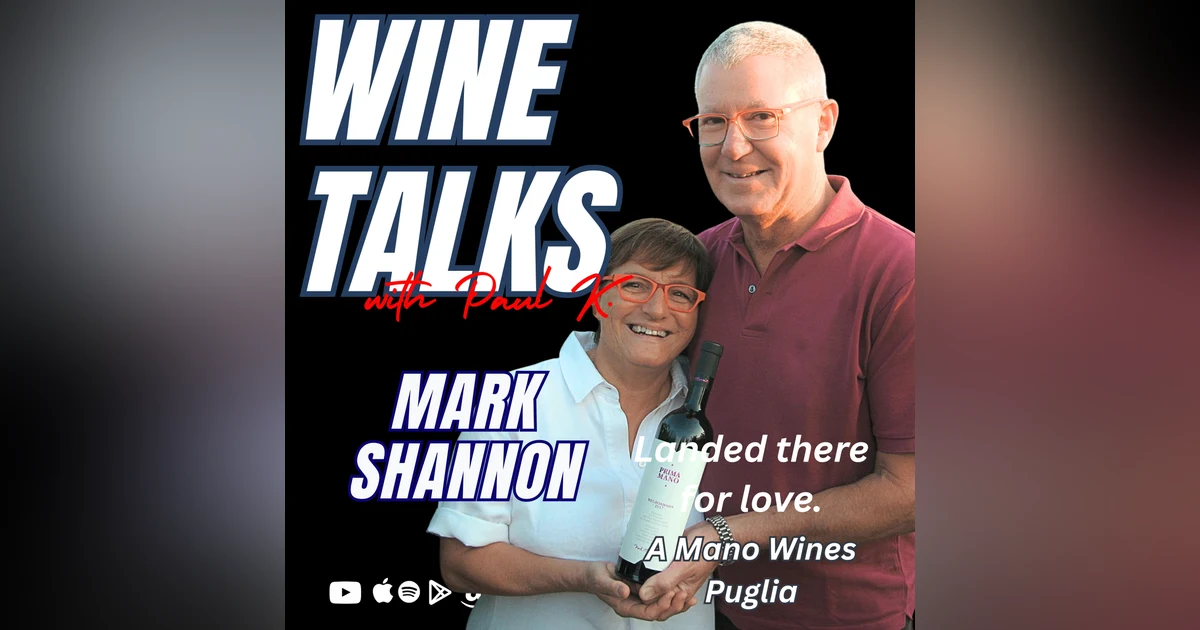
Puglian Wine Evolution: Mark Shannon’s 46-Year Passion for Quality and Authenticity

Wine Talks was invited to meet the Pope....well, at least by the language in the invitation, it sounded like we were going to meet the Pope. It turns out that the word "private audience" meant with 6294 other private invitees. Lol, it was an honor just to be there.
Wine Talks took a detour out of Rome to the now-famed wine region of Puglia. Home of Primitivo, Negroamaro, and Fiano, the area of Puglia has a rich Italian history on its own.
As the trip was put together on short notice, I searched through my database of Puglian wines tasted and found the wines of A MANO as wines I enjoyed. In the meantime, I reached out to Vahe Keushguerian for some advice on who to contact for a podcast; after all, his famed winemaking career started in Puglia. He mentioned Mark Shannon of A Mano wines...how about that for a serendipitous connection? I put out a quick email to Mark, and he graciously accepted...and offered to bring in a "traditional" Puglian lunch for our group.
Mark Shannon may call himself “just a student of winemaking,” but after you hear his journey, you’ll realize he’s more of a wine whisperer—an alchemist who turns curiosity and grit into liquid art. Pour yourself a glass, because in this episode you’ll travel from the bustling streets of Toronto and the sun-drenched vineyards of California, all the way to an ancient town in Puglia, Italy, where Mark Shannon has spent nearly three decades revolutionizing the region’s wines. You’ll discover how he ditched a potential career in medicine for the fermentative fascination of grapes, and how, propelled by his mother’s wisdom to “work at something you really want to do,” he has woven innovation through tradition. Journey me and Mark Shannon as they break down the science, art, and sheer perseverance it takes to make world-class wine in a place once known as Europe’s bulk wine cellar. You’ll learn about the true identity of Primitivo, the surprising origins it shares with California’s Zinfandel, how post-communist Slovakia and Texas played into Mark’s winding path, and why he chooses soil health and vineyard wisdom over trend-chasing packaging fads. They’ll dig into the sociocultural shifts rocking the global wine market, dissect the mythos (and madness) of biodynamics, and debate what makes a wine truly reflect its terroir—even as climate, culture, and commerce threaten to pull it apart. By the end, you won’t just know how great wine is made—you’ll understand why people still obsess over it, why the right bottle at the right table can mean everything, and why Mark Shannon wouldn’t trade his hard-earned slice of Puglia for anything in the world.
-
Amano Wines (also referred to as a Mano or Amano):
https://www.amanowine.com
This is the winery founded by Mark Shannon, and much of the conversation centers around it. -
Bogle Vineyards (mentioned by Mark Shannon as a place he worked):
https://www.boglewinery.com -
Fess Parker Winery (another winery Mark Shannon helped build):
https://www.fessparker.com
#WineTalks #Puglia #ItalyWine #MarkShannon #AdamCarolla #AmanoWines #Primitivo #NegroAmaro #Falanghina #BiodynamicWine #VineyardLife #WineMaking #Terroir #WinePodcast #EuropeanWine #GlobalWine #WineCulture #WineTasting #Sustainability #WineEducation
0:00 If you think about our interest in eating well, people at a certain socioeconomic level want to eat well. They want to celebrate their day. They want to celebrate with their friends. They want to have a reason to sit at the table and break bread, share a smile and a kind word. And that goes with a glass of wine. Sit back and grab a glass. It's Wine Talks with Paul K. Hey. Welcome to Wine Talks with Paul Kay. And we are at an away game, like, way away, in Puglia, Italy. Easy for you to say in a small town called Noce. About to have a conversation with Mark Shannon of Amano Wines. This is really quite a thrill for us to be here. Thank you for having us. Thank you. I appreciate it. You know, I was. When I was looking for things to do in Puglia, and I went through my list of wines I had tasted over the years, and I found many, many a mano wines. And I thought, let me see what this is about. And I question that. And I asked Vahe Kushgarian, and he goes, oh, you have to talk to Mark. He's got such an interesting story. So why would that be? What's so interesting about Mr. Mark Shannon that we were here? I don't think there's anything that interesting about me. I'm a student of winemaking. I absolutely love it. I don't sleep at nights thinking about how to make better wines every year. And I've been doing this now for 46 years. I'm very proud of what we do. I'm very proud of being Pullian. And so interesting. But you were born in Toronto? Yes. Okay. And then you moved to California? California. You raised in California? I was raised in
1:30 California and in Southern California. And I could not wait to escape, really. So as soon as I could, I moved to Davis to study. And it was. I had intended to be a physician. I have an abiding love for medicine. But even at the tender age of 18, I really realized that dealing with people at their worst was not for me. Yes, I want to deal with people. At their best, and they're at their best, and they're behind a glass of wine. That's right. You know, it's a funny story, because my dad was a pharmacist, and he bought a pharmacy that came with a liquor store. And he realized that everybody came. Everybody came in the pharmacy was sick and ailing, and everybody that came to the liquor store is looking for a party. And that was pretty cool. Message received.
2:14 So when you went to Davis, did you go to for medicine or did you? I was accepted and I was pretty miserable. I come from a modest background, Paul. I decided to go home and break the news to my mom and I figured that it was going to be World War three. So I flew home and I told mom that, you know, I've been accepted, but I don't want to go. And I was pretty worried about her response and being my mom. She looked at me, she said, what do you want to do? I said, I want to enroll in a graduate program in winemaking. And she looked at me and she said, you know, Mark, you're going to work for a very long time. Work at something that you really want to do. Wow, that's pretty cool. And so here I am. And so you went to Davis and you just went. Did you switch majors at that point?
3:05 Sort of. Sort of, yes. Fortunately, education in Davis was rather open minded. As long as you met the prerequisites, you were welcome to do what you wanted to do. And I met the prerequisites and I had to convince some professors that I was qualified and they embraced my, my desire to be there. And then it's a. She's right. It's a long career anyway, regardless of what you do. And if you're going to do what you want to do, that's obviously what we all strive to do. So you're pretty fortunate doing that. But when you got into the knowledge, did it satisfy the things that you were looking to do? I mean, was it that interesting? Because it is science. It is part of the, you know, the biology. There's molecular technologies there. It satisfies my every desire. I love to ferment. I love the improvement. I love the fact that there's a seasonality. I like the fact that every year presents a challenge. I like the fact that I can go into a vineyard every year and talk to the grapes and see what has changed for them from this year to last year to.
4:08 To 10 years before. Those are, those are wonderful, wonderful elements. For that passion was developed during your college or was it like. I started making wine with a veterinarian at home. We grew a little vineyard in Malibu. And oh yeah, he said to me, look, when this vineyard, when this vineyard is mature, I don't want to know any more about it. And so I started making wine with them. And I kept my bedroom at a very healthy 58 degrees all year round. This is all the time that I had. This is after you graduated? During school. Oh, during school, during school. So before I even graduated, I was recruited by Bogle And I ran Bogle for 10 years, which is wow, now the largest. I started there in 1981. I say there through 1990. Well, that was its heyday when Bogle was still sort of. Thank you Paul Group. And they made great wines. We featured many, many Bogle wines in that era.
5:06 It was, it was an interesting 10 years life, but became like a huge. A huge enterprise though at some point where they were making all kinds of things. It was time for me to move on. There was no more growth available for me. The family really wanted to be more involved. And I think that when you work in this industry, when you work for somebody else, you have to realize when it's time. And I gave them the 10 years that got them going. I left and I built a winery for Fest Parker in Santa Barbara. Another winery for another small winery in Santa Barbara. I built a winery in West Texas. Wow.
5:48 You know, first of all, Bogle, didn't they have a midnight, a midnight cuvee where they harvested at midnight patissera or something? We always harvested at night in all the years that I was there. We started at 9 or 10 o' clock at night and we worked all, all night long. And so Fess Parker was when 80. I started with, with Parker in 91 and I stayed there for a few years and likewise when it was mature. And consulting is a fun endeavor, but the minute the owners think that the ideas were all theirs because you've given them all to them, it's time for you to move on and do something else. Right. And so I've always done projects that I felt were interesting and satisfying.
6:35 I went for the U.S. state Department. I took a winery through privatization in Slovakia. Everybody does this, which was. I was one of the few people that both had the technical abilities and the marketing background. So that was a blast. That was absolutely Slovakia. The post communist era was so confusing to these poor people because they were used to having the ministers tell them what they could have and what they needed to do. They never developed an entrepreneurial spirit. And the experiences were, were fascinating. Did that change when you were there? We changed it. I mean did that did actually move the needle. We were talking about our media earlier. It was simple. It was simple. You had to show them how to do it. I went into my clients and I said, are we ready for harvest? Yes. Everything's okay?
7:26 Yes. No problems? No problems. You sure? Well, we don't have any grapes. Oh, oh, that's a little problem. Who has the grapes? The social cooperative. Ah. Do you know the president of Course. Would you see if he. If he'll see me go down and say exact same conversation. President, are you ready for harvest? Yes. No problems? No problems. So we're going to start in 10 days. He said, well, there's a little problem. What is it? He said, we don't have diesel for the tractors. That's a problem. That's a little bit of a problem. If my clients give you an advance so that you can buy diesel, will you give them all the grapes that they ask for? They wouldn't do that. Oh yes, they will do that. But that was what post communism was like. And okay, it's simple and don't make more of it than you need to. But if you show them how you work in. In a capitalist system where everybody rubs each other's back, then all of a sudden things happen very quickly. How long were you there? There for two years. So did you really see a change in the mentality? Yes, because we're having, you know, we were just talking about Vayakashkarian and what he's done in Armenia. And we're talking about. Generations have gone already. They still not registering the capitalistic idea.
8:48 The people who were hungry got it very quickly. Yeah, the people who wanted it got it very, very quick. There were a lot of people who didn't want it. How was that worldwide experience? Like the shit. I mean, you went in at Puglia, but after that, where did you go? Did you go back to the States and words, no. I've been here for 28 years and this is home to me. So from Slovakia you came here? I was back in the States. I did a project in Washington state and then I came here. I actually came here. I was asked to do a consultation in Sicily for a brand that I had, that I was. That I had known in California and was fond of. And it had fallen off and the owner reached out and asked me if I would do a quality program for him.
9:31 So I went to Sicily and the only problem with. With it was that being a good Californian, I'd studied Spanish my whole life and I didn't speak any Italian. And we were in Sicily. When was that? Just recently, March. And realized that. That it's not Italian. It's a different language entirely, a different culture. So what did you do there with Narella Mescali or some? I helped them with all their. With. With all their. Their projects, including a joint venture with Australia which Elvie was running. But it was at that point in time where I asked her if she, having been A very successful consultant, and I was pretty happy. Said, if you're good and I'm good, why don't we do a project for ourselves? And she.
10:21 She said, okay. So anyway, were you. I mean, was this, like, relationship growing already or was this still strictly. No, it was. It was growing. We're past business at this point. We were past business at this point. And she called her mom and said, I've met this American. And I had already. I already knew what I wanted to do. I said I wanted to come here. And I said. He called him up and said, I met this American and we're going to go to Puglia and make wine. Her mom broke out in tears and said, no, Alvy, can't you get a normal job? She doesn't say that any longer. So is that. But that's. But that would seem like. I mean, Art's experience with the Sicilians is a pretty proud bunch. I mean, we're going to pick up a move to a different part of Italy and start making wine there. And when I was in graduate school, the origin of Zinfandel was still unknown. And a pathologist had been to Puglia and seen Primitivo and had told us in a graduate seminar about it. He said it looked a lot like Zinfandel to him.
11:24 And so we were escaping the pressure of doing a quality program by going away every weekend. And I said to her, could we go to Puglia this weekend? I want to see this grape called. Primitivo. Said, I can't tell you if it's infidel or not for sure, but I'm either going to know it or not know it. And that was 28 years ago and we haven't moved. So it is. Wasn't a DNA tested to be a descendant of Zinfandel? No, it is exactly the same DNA. Carol, Meredith and company traced it to a almost extinct variety called Kralenic in Croatia, but probably the origin of it is Montenegro. Really?
12:14 The father of viticulture is a geneticist in Italy, and he correctly said the area with the most biodiversity is very likely the origin of. And that would be Montenegro. So it's traveled. I don't think I've ever had a Montenegro based wine, though as an appellation. I've not gone to see it. This is a fairly new experience and I don't travel as much as I used to. It's interesting because Zinfandel is not the most popular grape in America. And of course, probably when you started making wine, it was Considered maybe the only indigenous grape that America ever had for vinifera. But that's not the case. It was. Zinfandel was a beautiful category 30, 40 years ago. And before it has been ruined by.
13:03 By an excess of criticism. Criticism by critics who have pushed the style of it into something that I consider undrinkable. Yeah. And it's a shame because it's really the quintessential table wine. I make wines like I drank with the Italian immigrants when I started in the industry. The wine that you had when you broke bread, and I find those wines still very, very interesting. You know, the. The Puglia, when I started in 88, was really considered bulk wine. It was kind of like the low die of. Of. Of America. And in. That's changed in that time frame, we were producing 1.2 billion liters a year. Wow.
13:45 And it was basically the wine cellar of Europe. If you had a weak vintage in Bordeaux, then you would exchange trailers in the border. If you needed to sell Rioja in supermarkets, you had Malvisianera that you could turn an air compressor on and oxidize, and it became Rioja. The amount of Negro Amaro that has been sold as Chianti would turn your head. Fortunately, in these 28 years, they have managed to clean a lot of that up. No, the reputation has changed radically. But it's interesting because there was even back in the earlier centuries, the idea of putting Tariga nasty now from. From Brazil in a.
14:28 In a Bordeaux wasn't. It wasn't offensive. They did it all the time. And then it became very important to be appellated, driven. And now we're at a point where, you know, that's Puglia has made a name for itself based on the varietals that you guys are growing. I think it's really interesting. Is it a worldwide. Is there a worldwide acceptance to Puglian, Primitivo and Negro Amaro? There is. No. Yeah, there is now, but it's required a lot of work, a lot of. A lot of heavy lifting. A lot of people like Vito, who was willing to travel half the year and show people what these wines are really like, why they are, why they are worthy, why they are terrific values and very, very friendly. Yes.
15:09 Well, like I said, we're talking about Armenia and Otany. And the idea, the concept I'm trying to peel back a little bit is you not only have a region that wasn't necessarily considered, you know, a great region, and you were creating bulk wines. You had grapes that no one probably really knew much about. And there's some grapes here listed on this conversation that I've never heard of but never tasted before. That's a lot of headwinds to producing a brand or a regional acceptance amongst them. Well, we were younger and we had a lot energy. We were full of ideas, didn't have any money, but we had all the ideas. And fortunately for us, all of our friends around the world knew what we were doing and they all wanted to be part of it. So we had a very quick acceptance. Right place, right time, right skill set. And as you know, it's better to be lucky than good. Well, that's true. It's interesting that you pulled out of, you pulled out completely. The States or just California? We pulled to the States. And so where are the other markets in the rest of Europe? We cover all of Europe. We cover parts of Asia, we cover Australia, New Zealand, Brazil, Canada. Still, it's. But I would say that the vast majority of our sales are European because. I've been asked by many Armenian winers, good wines, the wines. You know, the technology in Armenia has radically changed since they became free and now they're making wines. I think there's a few that are world class. Yes. But the idea that we just talked about, which is trying to get a brand and a grape that's no one ever heard
16:43 of to a state like California. And here you are pulling out because the margins suck and the three tier markets pay in the rear end. And I have people calling me saying, will you present my wines? And the distributor is saying, we don't need to taste any more wines here. The distributors don't need anything. They can't sell what they've already got in their book. And if they take something, it's a defensive position. It's not, it's not an opportunity just to make sure nobody else takes it. You know, back in the days of Bogle, they used to build brands like that, right? They, you could give that to a wholesaler and they would say, yeah, we'll take this to the street, see what's going on. I cannot tell you how many red eyes I took to work all day and, and fly all night to present to distributors around the United States in my Bogle days. But that's the way you did it. You went in, you presented your wines, you found the people who were believers, and business was done.
17:32 It worked. Now, how about now? Not the estates, but the rest of the country, the rest of Europe. And there is, there are very little, very few growth opportunities still. We're in a Neo prohibitionist state, which is very, very sad to me, very confusing, very unpleasant. The unfortunate talk about the health issues related to wine are devastating. I don't know how people are going to eat for the next 10 years. I'm certainly not going out to a fine restaurant and having a glass of water. It's affected, it's affecting. I mean, this is the bottom line right here. Yeah. It's that new prohibition is reached Europe, as you obviously you're telling us. But I find that shocking because I can see California. We've already been through prohibition once before. Yes. And the conversations that occurred just before prohibition and much like what you're hearing today, I don't think it's going to result in complete prohibition. No, it's a social issue now more than, more than anything.
18:35 It's going to come and go. I think though. Well, you have to hope so. If you think about our interest in eating well, people at a certain socioeconomic level want to eat well. They want to celebrate their day, they want to celebrate with their friends. They want to have a reason to sit at the table and break bread, share a smile and a kind word. And that goes with a glass of wine. No question about that. It's too part of much of the human DNA. Yes. And when we talk about this winery that's 6,000 years old, that's, you know, could be the. Considered the beginning of wine in this regard. But it's always been part of the human experience. Not a buzz. It could be a buzz, but even. Without a buzz, I think it's such a socially uplifting habit, if you will. Are you part of the what goes together, grows together type mentality? Mine is a very highly evoluted sense of, of growing. I am very, very close to my vines. I believe in some of the very old practices like Silvesta, where you, where you plant the right kinds of, of crops in between the rows in the off season to increase the nutrition of the soil. I believe that healthy soil helps make better quality wines. I'm very much into the true biodynamic, not the Steiner version of biodynamics. What's the difference? Steiner was a
20:06 charlatan and a thief. But the concept, just so you guys know, he's the author of what you would consider modern day biodynamic farming. He's the guy who wrote the book. Everybody's got this book except maybe Mark. I've got it. I've got it. I read it and I couldn't believe it. I've never heard this. The portrayal before, well. There are not sprites under the ground that push the. Push plants up. Nor are there gnomes in the sky. That pull them up. That guy. Nor do you need to bury a horn full of cow manure in order to give nutrients to the soil.
20:46 But biodynamics really means that healthy soil confers health and vigor to the vines and you have a better product. That concept is absolutely sure. For sure. I was watching. Where were We? I was talking about the goat cheese. I was reading a book. I was reading a book on a gentleman that uprooted his family and moved the south of France. And there's their first few days in this village and they're starting to decide maybe this wasn't such a good idea. You know what I'm talking about? Oh, yes. So he. They went to the cheesemonger and they got this cheese and he goes, I could taste what the goat ate. And that. The concept of biodynamic farming is you are what you eat. Eat. Yes. Right. Yes. So were you. Did you start out in biodynamic farming? No, I started out.
21:34 Bogle was a very conventional viticulture. Why me? Here, when we started our own. Our work here is very old. When you go into a vineyard that's been in the family for three or four generations, one of the things you do not do is say what you're doing is wonderful, but the minute you say, but, the conversation is over. You don't push a pullion, you pull. If you make my quality, there's an incentive. There's a lot more money and a lot quicker payment. And that appealed. That appealed. That was how we started the quality revolution of Poole. Well, I suppose. Right. So the.
22:15 The biodynamic part. Well, they probably were not completely congested with chemicals anyway prior to here. Or was it because it was bulk farming? That's what it was. Okay. You've been around here long enough. Do you remember when. When vineyards were actually white with treatment before harvest and harvest was a month or six weeks later than it is today? Yeah. Things have changed a lot. Things have changed. Things have progressed. And don't forget, please, Paul, that the first profit for a grower is a savings. If they don't have to do anything, they don't. Yeah, Right. And that was the native. That sets the native viticulture of Puglia. So your passion here is to best represent what you've got out there. Yes. And make sure people can taste that. Absolutely, absolutely. It's my obligation to Puglia.
23:03 I live very well thanks to Puglia. And I have an obligation to pay back. Yes, very much. Nochi is a fantastic community. Well, it's our first time here and we're fascinated by it already. If you spent a few days here, you would probably be adopted. Yeah. They are so open and welcoming that. So Amano's now looks. We're looking at a bunch of samples here. Yes. It looks like you have four different. Four fans. Yes. We started with a Mono Primitivo. That was the only thing that we made for the first few years. But there were so many interesting things to do here that I couldn't stop. And fortunately, my partner has been very, very kind and permissive. Anything that I wanted to do, I was able to do.
23:53 She's the author of some of this in 2012. Because we live in the countryside, we walk our dogs twice a day. And 2012, before harvest, she asked me to make her a special wine. I said, of course. What would you like? She said, I'd like you to make me a wine. That's the essence of your personality. And I had a very intelligent response. Huh? Yeah. She said, I want a wine that's big and big and bold and smiling, always ready to give you a hug. I said, oh, yeah, I can do that. How interesting. So since we're the mother and father of the modern Primitivo, it had to be a Primitivo. And since I'm a non interventionalist, the only thing that I felt was morally acceptable to change the profile would be to dry the grapes and so imprint. Primitivo was born as, as a, as a dried, as a dried Primitivo. So like a Moroni type. Not that heavy. No, no, I, I still make wines people could drink. Yeah. Oh, let me see. Last night we were at a restaurant in. In what?
25:01 Brindisi Steakhouse. And then I wanted to order them Amaroni, but I knew that, that, that, you know, dried grape raisin, old school funk was gonna destroy the meat. Sweet side. Nothing to do it. But that gentleman gave us a bottle next to us. It was not Primitivo, but it was pulled in. It was, it was in. It was a Burgundy bottle. You were in the heart of Negro Maro. So it's very likely one of the, one of the docs of Negro Maro. And they can be very, very wonderful. Wines, really good wines. So tell me about the Primitivo here. Is it. The ones I've had are the ones. And I was trying to bring up my database here, which is apparently this location can't get. I was going to tell you what vintages of Amano? I had tasted many of them for a long time, but Primitiva doesn't seem to be, at least ones I've tasted lately, that indicative of where they're grown. They're just big, opulent wines. Was that sort of Napa style that's coming up. But are you getting terroir out of these wines? Oh, I absolutely do. The Pulleyans, When. When the bottled wine industry finally caught hold, there were some very bad habits in Scandinavia and other parts of Europe where the sweeter they were, the better they were. Yeah. And so the wines had. The primitives have evolved into a style that I don't care for, and I'm not prepared to.
26:25 I'm not prepared to chase anyone to the bottom. I want my wines to taste like the vineyards where they were grown. And is that. Is that a. Is. Is that a conflict for you? Where. Because of these Neo prohibitionists, because of packaging changes, because of stylistic changes that people are drinking and because Gen Z doesn't know what the hell they're doing, is that a conflict for you to stay that course? No, this. You just. I'm doing it. I don't care. If they don't want the wines the way that I feel they should be made, then they don't have to. They don't have to buy them. There's. There's a world of opportunity out there. If you want a jammy, you kindly call it opulent. We call them piacione, which means they try too hard to please.
27:11 If that's what you want. We go to a restaurant called me Piaget. That means I like it. No, I. I don't have any problem with it. And fortunately, neither Vito nor Alvezia have any problems representing them. They're proud of them. So because this, you know, this whole idea of, like, cans, tetra packs, like, I had a guy on the show from Cornell whose job it was was to create some kind of new lining for a can so the wine would last 24 months. Yes. And. Which is disgusting, sounding as it is, let alone. And you can't shift gears that quickly to even try to adopt, to adapt to this. So it seems to me there's two groups of marketeers. There's the marketeer that's trying to adapt to the marketplace, come to the market as fast as they can with whatever it is, packaging, low alcohol Prosecco with no sugar, whatever they're doing. And then purists like yourself who want to represent the terroir, who want to represent the region, who Want their wines to mean something when you drink them. Why would you get out of bed in the morning? Why would you work this hard? I'm fully retired and I only work six and a half days a week, not less than ten hours a day. Oh, well, that's. Yeah.
28:19 No problem. No problem. No problem to me either. I haven't worked so hard producing this podcast, selling wine. It's like. So you know what I'm talking about. Exactly. You know, I've seen a lot of these fads come and go. I can remember when people thought that the more money they put into advertising, it was Rush Limbaugh giving a promotion or what have you. I never saw them catch on. I never saw them get traction. They're ideas, but they're not really marketing cans. I understand. And I think, in my opinion, it was something that evolved from the commuters on the East Coast. They go get on the train and they have a couple of cans with them and then make that hour and a half train ride more. More palatable.
29:03 There was a woman in that, that was canning wines, and she thought that the Chateau Lafitte would be in the can one day. I'm like, that's probably not going to happen. You know, there are a lot of bad ideas out there, but I don't like to give voice to them. That's one of them. Well, this is. What do we have in our glass right now? You have Fiano Greco. Oh, that's the first white wine that we made. Here we are in a part of the country that produces 80% red and very small amounts of white. I found this vineyard when I welcomed a new Primitivo grower into the family. It's a very strange looking great. Fiano is shaped like an egg and it's got freckles on it. And I didn't know what it was, but winemakers are like little children.
29:45 The first thing you do is put something in your mouth and then you decide if it was a good idea or not. I tried this. I said, wow. Tasted it already. And so it started that to the point where we now have quite a few acres of Fiano under our control. It's got great acid, but it's got a tropical, you know, DNA knows. But this is great, really special. These tend to be older vineyards. Yes. But I don't think that the age of a vine has. Has. You know why everybody thinks older vines produce better fruit? Because they're equilibrated between the. The foliage, the vegetation, and the fruit quantity. But you can manipulate that. You can take a 4 year old vine and make it behave like a 25 year old vine just by doing the strategic defoliation at the right time.
30:39 I didn't know that we have. We vines don't really care about making grapes for wine. They care about reproducing. That's a biological need. So if the grapes are ripe or not, their job is to get them mature enough to release their seeds. That's all we manipulate the system. Is that mono brand. What's the other one? Imprint. Imprint. Would you like to try Falangina? Yeah, let's try that. Oh, Falangina grape. This would be a great grape for them to try. It's a rebirth of, of an intolerance for the. The sales of alcoholic products. I went out, we have a friend in the next village over with a very fine restaurant and, and he's a good friend and I did a delivery to him three weeks ago and said, how's it going?
31:27 He said, you won't believe it. I can have a table of four. And they will leave having spent €90 and had a glass, maybe not even a glass of wine. I can get out of the for appetizer for 19. Actually we've been very impressed with the wine prices on the menu here. Italy is very fair. Unbelievable. Italy and France, you drink well at the right price. Portugal as well, Spain as well. The United States is outrageous. We had a Ornalaya, you know, La Serra Nuevo. It would be 200 on the list. In America it was €38 or something. It was €80. Something really cheap. How about the prices then of the Pullan wines? Are they. Were they in that stratus of, you. Know, really life for pulley and wine is under $15. Really under 15? That's might be 17, depends on the markup on the state, but that's really where life is. And you know what? That's what a good bottle of wine should cost you. You should be able to have a nice one. You might say, okay, it's Wednesday, love. We're going to have, we're going to have a decent bottle of wine because I just made a meatloaf for you. That's normal.
32:43 There's nothing wrong with that. But it doesn't mean that you have to spend 60 or $70 to enjoy that. Don't forget please that in these agriculturally based countries where the work was very, very physical, it was manual, there was a need for an enormous amount of calories to get you through the day because of the work that you did and agriculture is by definition, rather poor. So where did you get those calories from your wine, your oil, your grain, your bread? It wasn't meat. That wasn't on the. That wasn't on the. On the plate. So the enormous consumption of wine in France, in Italy, was because of the nature of the work. It's changed, yes, but the wines have gotten better. The need for all that, all those calories is certainly diminished, but it's still very, very imbued in our culture, which is one of the reasons, Paul, prices are still reasonable. Because the problem is in America, because of the supermarket shelves, and I know they have them here, too. But a 15 wine in.
33:55 On the supermarket shelf at Ralph's has been clobbered with acid, sugar, you know, defoaming agents, all the things that you don't want in a glass of wine. And you can tell. Yes, you can tell as soon as. You open, you can tell what the. Industrial wines holler at you when you open them. Exactly. And this is. This is Valentina Falangina is native to the. To the north of Puglia, and it extends into Campania, into the. Into the Naples area. It was grown there before anybody had the temerity to divide political boundaries. It grows at a very high altitude. It's a fascinating grape. Every grape has its own characteristics, its own personality. And this one has the grace to defoliate itself after about the 15th of August, really. So when the sun starts to finally get a little bit sweeter and the heat, the heavy heat is over, it starts to dry up and drop its leaves off, which lets that warm, lovely sun in and finishes ripening, and it does all on its own. I did notice driving up here that the state of the vineyards was radically different from the lower levels to.
35:08 When we started driving into this area, they were losing their. Now we are going. But there were some that were still green, different vineyards. Yes, we're starting our descent into dormancy now. My vineyards are. My reds are turning red, my whites are obviously turning brown, and the leaves are drying up. And the global warming affected you here? Yes, absolutely. Climate change. The first wine that you tried, the Fiano Greco, was. Because Fiano is very aromatic, but it lacked structure. And Greco is fairly neutral, but it has a beautiful structure. In the past three years, what we've seen is that the Fiano has improved its quality, its structure, its intensity. And the Greco can't stand this warming and this increase in UV radiation. So this will be the. From 25 on, it will be pure Fiano. We won't make Fiano Greco again. Unless the climate reverses, which I don't see that happening in my lifetime. So you're not handling it with, you know, different canopies? Different. If you don't adjust to. To the weather, then you don't get the best out of your vineyards.
36:24 Okay. The last time I tasted your wines was 2010. And that was, let's see, who was the distributor? Wine warehouse. Yes. Yes. And I liked it. How about that? Thank you. It was the. I wrote Zinfandel, which it wasn't Zinfandel, it was Primitivo. How interesting. They were good wine. Mars used to be really good. I don't know what they're doing now, but they were. They were the best bridge. They were. Did you know Don Schliff? Yes, he's a good friend. He's got this big port tasting coming up soon. Charges about three grand to come. The greatest port collection in the world right in Glendale. Don is a fantastic human being. He used to be one of the first visitors at Vinitali. Every year, the minute the door opened, you could count on Don being there one morning. Did you go to. You still go to Vin Italy? We do. And is that still that. I mean, it was second largest, probably now one of the largest wine shows in the world.
37:26 It's enormously large and you have to have a reason for going. We go because, thanks to Vito, Italy has become a huge market for us. And every wine specialist that works for us comes by to say hi. They may not taste wines, but they come by to say hi. Yeah, that's great. And you know, the ability to give your wine specialist a hug maybe. I only see them once a year. And it's been the best part of in Italy is the mortadella. So was there a red in this group? And what's the story behind the imprint? Brand? Imprint was what I'd mentioned earlier was Elvis request for me to make a wine that's personality based.
38:07 Okay, so now would you like to try? Have you ever Tr Susu Manello? I can look it up, but it doesn't sound familiar. V, would you be so kind? So the grape is S U su. S U S U M A N. I E L L. Oh, I. I've tasted six. Okay. You're ahead of the curve. And none of them would have been on mono. And the last. Oh, just say 1. 20. 21. It's. It was from Pietra. Pietra was the winery.
38:49 So, Claudia. So how long did it take to get your Italian? Like where she didn't stop LAUGHING. All my work is in Italian. My guys don't speak English. So if you, if you want to work in the winery, you work in Italian. How long did it take for that? It was. It was gradual, it went in stages. But you. Necessity is a great teacher. That's right. Yeah. You just do it. Right. That's called the immersion method. Exactly. Did they train you at Davis? You know, it's very academic. I know we have a niece who's at the Cornell Enology School. And it makes me grin when I hear the stuff she's learning because she ended up in Bordeaux on an internship that we helped her get in Chateau Bailly. And she came back with the biggest grin on her face was. It was not the classroom, it was the real classroom.
39:44 Let's take a 10,000 foot view on it and realize that the purpose of education, high education in the United States is to teach you to think. It's not to teach you which lever or which button to push. If you're prepared, if you have the basis, the practical aspects of what you do come to you with experience. Well, she told me when she started, she says, uncle Paul, they want to put me in the vineyard. This is before she went to France. I said, well, honey, if you want to be a winemaker, you're going to be in the vineyard. She might as well start there. She came back, she says, I loved the vineyard. That must be just something, a connection that's made. Not for everyone.
40:25 It's connections made by a winemaker. It's not a connection, it's made by an analogous. In Italy, we tend to have very few winemakers. They all put on a white lab coat and they do analysis all day long. Those of us who are winemakers live in the vineyards and we have a bond with our grapes and we understand them and they understand us, and it's the basis for communication. And that's what she'll develop very quickly. Tell us about Susan. 1. Susaniello is still the rarest red grape in Puglia. It was born as a component of Brindisi Dock to give. To give some muscle to those blends of Negro Amaro and Melvisian Nano.
41:11 It's extremely dark, it's extremely tannic. It's very hard to work with. You have to completely abandon the paradigm of red wine making when you approach it. If you want something that's interesting and. And we do has a backbone, that's for sure. Oh, yeah. Oh, yeah. So as a blending grape, though, it probably adds a structure to it's. It's Extremely dark and extremely tannic. So it's a wonderful bl. It's what it was born for. As a blending component. It's a spontaneous cross between a table grape called Uva de Sagra and garganaga. A white grape, Garganica. Wow. Garganiga is very prolific. It's. It's present in a great many varietals. I do not agree.
41:57 So it seems like there's a guy in la. In Kansas, who's propagated what would have been pre prohibition American varietals, even though they're not vinous conifera, they're making wine. Sure. He's having. No, I mean, he's got. He started with 18 varietals, he's down to 14. Because he said, I can't make wine from four of it. Just. You can't drink it. Yes. And I said, but you have the problem of you have no track run, nothing to work from. No one's ever planted these grapes where you plant them, and you have every degree of complexity to try and figure it out. Like variables. The permutations must be off the charts. These indigenous varietals from Puglia, they've pretty much worked with that. We understand them. You just talked about how unique this wine is. You have to throw away all the paradigms of winemaking because you started there. When did that idea sort of develop in you that you're going to have. To treat this differently instantly? You go into the vineyard, you try the grapes, and you go, what grapes talk to you? And they. And they say, if you want me to be what you want me to be, then you need to do something different. Is your wife jealous and you're talking to the grapes? No, I don't talk to her during harvest, and she's used to it.
43:05 This is fabulous. Is it 100, Susan? 100%, yes. Part of this is my vineyard. Part of this is something that was planted for me by a very dear friend, a guy that I've been working with for over 20 years. I asked him to plant it, and he was a little resistant, and now he thanks me. You know, it changed already in the glass. Oh, yeah. My wines are handled so gently that they really like their permanence in a glass. They're really special. This would have been great last night with that ribeye. Okay, so the second group, the third group is the prima mano. Prima mano are our reserve style wines. The wines that are more intense. They are.
43:50 They are what we started to show what the potential is for puglia and they really do hold up the mirror. Which one should we taste? There's a Negro Maro and a Primitivo, and I'm proud of them both. What would you prefer? What do you guys want to taste? They're two different varietals. And so these brands developed, obviously, start with Amano first. Amano. And then you talk to your wife, and she wants. Prima mano was a. Was something that she developed in our second harvest. So early on, and I was dead. Set against it, as I told you, the only thing that we could do was pay cash for these grapes to get them and pay a premium. So our harvest meant that we went to zero in the bank account. I mean, literally at the level of events. Was that stressful? I mean, obviously it is, but I mean, no. You were confident you're coming out of this? I.
44:52 That was the only thing we knew how to do. And wow, we were. We loved what we were doing. And fortunately, other people did as well. You want to try that, Gina? Go down to take it all down to zero. Invest in a couple containers and special flooring or something. They're in the flooring business. We have. We're used to droughts. It's part of the nature of being in. In the south is a lack of water. We are having problems with. With, if you want to call it global warming. To me, it's more an incidence of UV radiation that has increased remarkably. It's just there's an intensity of radiation that these plants have not evolved with, and they suffer for it.
45:39 I see it in my. In my orchard. I see it in my vineyards. And you have to take measures to. To help them. I have my vineyard are small bush vines, the ancient bush vines that were the highest quality when Elvie and I first came here. And normally you would go in and leaf pull them. As I mentioned earlier on this year, I looked at the incidence of the sun. I said, I'm not leaf pulling you guys. You guys get a sun hat. So I left more foliage on, and as a result, I got these incredibly intense wines. Just absolutely gorgeous. But as I said, if that's what nature deals, if that's the hand that you're dealt, it's our job to help them, to help them interpret the environment and give them a little bit of an advantage. Am I confusing you, Paul?
46:35 I've been here for 28 years, and I'm. My LV and I are the mother and father of the modern pian wines. But that doesn't mean that we're necessarily accepted it's much better to keep a low profile. We do what we want, and. No, it's not an industry that shares very well. In certain regions, there is a communal space. Sicily is one. Sicily is very cooperative, but it was forced by their regional marketing. And they have to cooperate. In Puglia, they don't have to. And I wasn't born here, and they're very aware of it.
47:17 It's a bit of a strange situation. If my growers, who I'm very fond of, don't see me for a couple of months, they'll call me and ask me to copy, and we go down and I'll drink a coffee with them, and we start the small talk. And you called me. Did you need something? If they don't see you, if they can't touch you, it's very tactile as a society. If they don't physically see you, they think you've escaped. I don't know why they think you've gone. But there's no pulley in the association of Vintners, or you get together and vote and spend marketing money. Because that's a. That's an idea that brought up at the Armenian vine and Wine foundation, which is you need to come up with a methodology to support the region worldwide. How are you going to tell the world that this wines exist?
48:07 Pulley is different. They're more further along. No, that's a correct approach. That's a mature approach to getting the message delivered. Work together. Everybody rose in the same direction. Yes. Puglia doesn't work that way. That's interesting. This Negro Amaru is probably the most structured, layered one I've ever tasted. Thank you, Paul. That comes from your desire from the vineyard? Very much so. I mean, they're usually thinner, more acidic, and sometimes fruit forward. It's a deliberate technique to. To make a wine that's worthy of being called a reserve wine. And as you say, there's a layer of complexity, a layer of intensity there that is very deliberate.
48:55 Obviously, there's a little bit of oak in here somewhere. No, no. Where is that coming from, that structure? It's coming from the vines and the way that we manipulate them as this, as they ripen. If you really love your vines and they sense it and you do things to help them produce this kind of intensity, they will do it for you. There's a group in Sardinia that plays music. Yes. Have you done that yet? We have a friend who had studied that and was playing music at. What was it? 432 hertz. There's a. It's basically the same kind of music that you, you would listen to when you're getting a massage. Yeah. There was not a control.
49:44 So I can't tell you scientifically the vineyards were very beautiful, very, very good. I can't tell you if that was part of it or if it was just the fact that they, they cared. About what they were doing. It could be a placebo effect. I've heard of it. Well, no, the experiment Sardinia was they played rock and roll to one set of vines, they played classical to the other and the classical grew toward the speaker and the rock and roll grew away me so figure that one just tell. Can you blame them and just tell them what they told me and not tell. I support it. I. I am a traditionalist. Our winery is fairly old and the. The best system for. For storing wines is resin line cement. Underground the wines age better, longer and are much happier.
50:34 Not amphora. No, concrete. Concrete with a resin with a food grade resin lining. And they. That is by far and away the most generous storage. It's. It's a lot of maintenance. But my, my guys are experts at going in and redoing them and so. So interesting when they redo your site. Every year you go in and you inspect them. There are times when you have cracks or, or something that needs to be adjusted. You go in and inspect them every year and every year my guys spend. Spent a month or so going through all the tanks and making sure that they're ready for. For us. So they're not eggs though. They're just concrete. They're concrete. Yeah. But they're angular. Oh yeah. So they're, they're themselves are creating movement. What's in like an egg does where it's.
51:25 I don't think I want to get into that. We'll get that. We'll skip that one. My guys work for me full time and during harvest they're full time in the winery. This time of the year they might be in the vineyard. We might be bottling natural wines at home, we might be doing maintenance. But we are the group. Could you imagine, could you imagine bringing in somebody that doesn't know what they're doing and supervising? It's easier to do it yourself. We've already had 50 minutes, almost an hour. That's longer than usual. We can turn off the formal part of this conversation. It's been amazing to hear your thought process and your passion really thing but we more glean from this conversation is that it just takes passion to do this. I wouldn't know how to do it any other way and have these kinds. Of results, you would have been a good doctor. Thank you.
52:17 That's a compliment. Favorite doctor, Joe. Yeah. Well, thanks again for the time. It's a pleasure, Paul. Cheers.