

 Apple Podcasts

 Spotify

 Youtube Music

 RSS Feed
 YouTube
 Pandora
 iHeartRadio
Orange Wine Is Not a Fad: Digging Up Ancient Flavors in Modern Bottles; Meet Stetson Robbins.
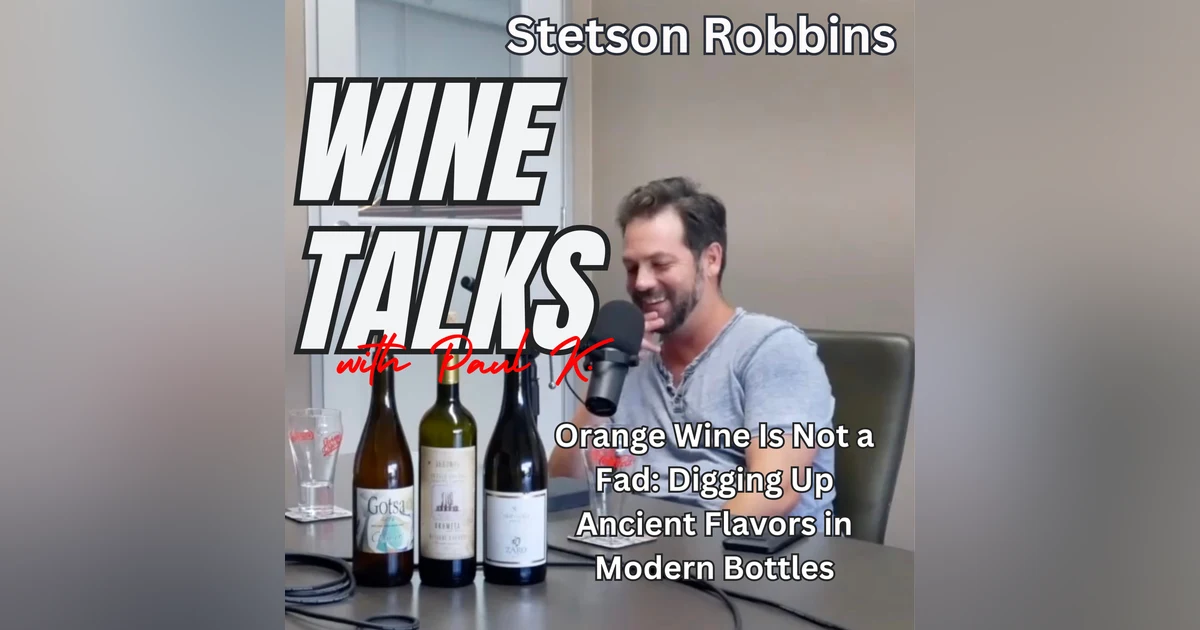

I met Stetson years ago. Orange wine was not a thing. But he was making it a thing. I was intrigued by his commitment to the sector and the develpment of Georgian wine in the US, particularly in Los Angeles.
Bringing Stetson Robbins onto this show is like popping the cork on a bottle you’ve never heard of, from a country you can barely pronounce, and finding it’s the most fascinating taste you didn’t know you craved. Forget everything you thought you knew about wine, because this conversation isn’t about chasing the next California cab or French pinot—this is about tracking the wild, unfiltered edge of the wine world through the forgotten vineyards of Eastern Europe, where tradition, culture, and rebellion ferment side by side. The conversation focused on peeling away the comfort (and sometimes the snobbery) of the usual wine stories and diving deep into what it means for a wine to actually taste like where it’s from—right down to the hands, palates, and histories of the people making it.
One concept discussed was the big secret of “terroir”—not just dirt, weather, or latitude, but the food, the local tradition, and even the pressures of the market itself. These are wines born not just from grapevines, but from migration, resistance, and centuries of culinary survival. You’ll learn how post-Soviet countries like Slovenia, Croatia, and Georgia have turned their backs on cookie-cutter commercial varietals, instead resurrecting their own native grapes and bringing ancient techniques—like wild fermentation in massive underground clay qvevris—right to the glasses of skeptical sommeliers and thirsty Brooklynites alike. A key theme that emerged was that true winemaking is messy, unpredictable, and profoundly human.
The discussion explored not only what orange wine actually is (spoiler: it’s not fruit salad in a glass), but why it’s shaking up wine scenes from coast to coast, frustrating purists and delighting experimenters. Several points were raised, including how even the act of importing these bottles is a full-throttle exercise in grit, luck, and sometimes chaos. This episode will have you questioning everything you thought made a good wine—and craving an adventure, not just a drink.
🍾 How the culture, cuisine, and quirks of a region become liquid in your glass
🍾 Why “orange wine” is the oldest new thing in the wine world—and why it’s taking over
🍾 The radical differences between Eastern European winemaking and Western obsessions
🍾 What really happened when ancient amphoras met modern Brooklyn bars
🍾 How grape genetics, wild fermentation, and centuries-old mistakes are now marketing gold
🍾 Why, after this hour, you might never look at a wine label—or a waiter—the same way
Stetson Robbins is a dynamic force in the world of wine, fusing a theatrical background with a passion for exploring wine’s deepest roots. His journey began in college, majoring in theater and delving into Greek studies, where the Dionysian tradition first sparked his fascination with the cultural significance of wine 03:06. Waiting tables at Walt’s Wharf in Seal Beach introduced him to the nuanced world of wine service, and fueled his desire to learn more. Encouraged by a wine-focused restaurant culture, he pursued sommelier training, including the Court of Master Sommeliers—a path that led him from Walt’s Wharf to Napa Rose at Disneyland, a renowned training ground for aspiring sommeliers 06:10.
Despite this foundation, Stetson Robbins’s real intrigue lay in the stories of winemakers and the diverse cultures shaping wine across the globe. His move into retail at shops specializing in value-driven French wines connected him with import specialist Peter Mann, opening the doors to heritage tastings in Bordeaux and Burgundy 08:07. The true turning point came with Blue Danube Wine, where he championed unique Eastern European wines—particularly from regions overlooked in the U.S. market, including Slovenia, Croatia, Hungary, and Georgia. Over more than a decade, Stetson Robbins was instrumental in building Blue Danube’s portfolio and expanding its footprint to markets like New York and Los Angeles 22:46.
Today, Stetson Robbins is co-founder of Black Lamb, a California-based boutique wine importer run alongside his wife. Black Lamb specializes in sourcing wines from the Slovenian-Italian border and the Republic of Georgia, focusing on traditional, “ancient” winemaking techniques such as skin-fermented whites (“orange wines”) and wines fermented in Georgian qvevris. His mission is equal parts education and adventure: introducing curious American drinkers to the diversity, culture, and terroir that make these wines unforgettable 01:06:30.
0:00 The big element for me that we leave out of when we talk about terroir is culture. And I think that the perspective on taste that the, that the people who are making the wine has, what they eat, what they like, that coupled with the resources that they have access to is, you know, that is also part of terroir. Sure it is. Yeah, that's a great thought. Sit back and grab a glass. It's Wine Talks with Paul Kaye. Your favorite hangout for podcasting. We have a late entry today. We actually very excited to have Stetson Robbins in, and that we were just laughing because of some previous history that I totally had blanked on. And so I'm glad to, to reconnect on this, and we're gonna have some fun. So welcome, Stetson. I appreciate coming in and having some time with us. Good to see you again. This is, uh, this is a no-holds-barred podcast. We're not gonna— we're peeling it all back, man. We're not gonna mess around. Yeah, that's right. Like an orange wine maybe, right? No, we're gonna talk about biodynamic wines, orange wines. We're gonna talk about his career and his new project, which is focused on orange wines.
1:12 And everybody asks me, what's an orange wine? In fact, I asked my daughter this, and I'm glad you brought up your Brooklyn thing. She brought me my first orange wine from Brooklyn. So we'll talk about that. But tell me a little about what you're doing right now with the Black Lamb Project, and we'll go back in your history. So my wife and I started Black Lamb a little over a year ago. California-based wine importer that's focused on two regions: the Slovenian Italian largely, and a little bit of surrounding; the Slovenian Italian border, and the Republic of Georgia. Our the focus of our selection is very much focused on.
1:59 what we could call— you mentioned ancient wine, like Amphitheater. It's like you're going back in time. Going back in time. And I think that this is, this is something that we hope to, you know, push even further and encourage. You know, we went to, uh, I went to New York for a misnomered wine tasting called the Best Wines of the World, or the Best Wines of the World. And there were, oddly, interestingly enough, it was 4 vendors or suppliers that have not come to America before. I spent a lot of time at a Georgian table. I spent a lot of time at a Macedonian table, and Moldavian table and a Slovenian table and fascinating parts of the world for wine. But tell me how you got into this part of the business. So we go back, you had brought a gentleman to taste wines. We'll talk about that in a second. But prior to that, you were, what were you doing that got this bug, which we all have in, in wine? So in college I majored in theater and a large— Oh, so it's a whole act. This whole thing's an act. Totally.
3:00 I mean, it's sales. That's right. I studied the Greek deity Dionysus. I had a teacher that taught a pagan culture class that was very focused on this specific Greek deity. And at the time, it struck me because I couldn't imagine what a culture was like that was so focused where wine is something of such significance. It represented almost like half of their civilization. You had the 2 primary deities, Apollo and Dionysus, and they were the duality that ruled the Greek gods. And so, in studying Greek theater, becoming interested in wine just philosophically, I found myself waiting tables in a restaurant that had an unusually developed wine program because the restaurant also owned a winery.
4:04 Babcock is the— My good friend Brian Babcock. But wait, so you're Greek studies, acting, struggling actor working at a restaurant. Now that's a prophetic thing, right? But you added this wine component, this Greek deity thing. Yeah, because it was— that was part of what— when I started working at Walt's and If I wanted to wait tables, I had to learn something about wine. The— I was already kind of primed because, you know, I was curious to learn a little bit about wine, but also, you know, found it, it wasn't something that I had a lot of, you know, understanding or experience of. And it was quite complicated. And there were all these different varieties, all these different regions. Yeah. You have different glasses. And, and so I was— This is Walt's Warth in Seal Beach. Seal Beach. Still there. Still there. Still there. Yeah. Still a Babcock product. Yeah. You can go drink, you know, Babcock Chardonnay. You know, it's interesting you said that because, you know, we eat out quite a bit now. Kids aren't home, and it amazes me what waiters and waitresses don't know about wines and what they don't understand what they're purviewing, as well as the fact that when you have a really big list, it's even harder to understand.
5:24 Yeah. So we went to New York and I, I forgot the name of the restaurant. You would know it. Fancy place. And I ordered an '86 Bordeaux because I had featured it in the club. I wanted to see how it was doing. And the somm that had never tasted it, so I invited her to sit with us and have a glass 'cause she needed to taste it, right? To understand it. Mm-hmm. So you just took it on your own to decide you should learn about this stuff. Well, they sort of— the restaurant was really— they were really focused on the wine program and the staff being well-educated early on. And so that they were— they, they— and I think they actually like, they paid for my first level. Oh, okay. For Quartermaster Sommelier. So they were, they were really supportive of— That's great. They wanted people on the floor that knew the wines and, and, and I was, you know, eager to learn. And it eventually turned into After Walt's, I wanted to continue with the Quartermaster Sommelier training. I worked at a restaurant in Disneyland called Napa Rose, which was one of the area— one of the Quartermaster Sommeliers were doing their testing at Disneyland. And so if you were part of the Napa Rose, you would just get to do the Quartermaster Sommelier stuff. You got kind of like wrapped up into it. So I just had, just not to interrupt you, but I just had Matt Ellingson, who runs Royal 21 at 21 Royale, which is the level above Club 33. Mm-hmm. Right. So there's this floor now where they had these $15,000 a seating dinners. Oh, at Disneyland. Yeah. Can you imagine that? Yeah. It's considered the most expensive restaurant in, in the country. I didn't realize that. And I, we've been
6:57 to 3-star Michelin restaurants in Monaco that didn't cost nearly as that much. Right. So he was telling me about the Napa Rose program, how important it is to most of cuisine in this Orange County. It's just a very famous place in regards to training, list quality, food quality. I mean, I, I think I, I think they're still doing the course. I haven't been. It was— this was 2000— uh, when was I there? Like 2005. Oh, I see. Okay. I, I don't know if they're still doing as much of the training stuff there, but, um, but no, it was— it— for me, it was a really big opportunity because I wanted to pursue becoming a Master of Wine. Yes. And— or, uh, uh, Master Sommel. Uh, in doing it, I realized it wasn't what I wanted to do. Yeah, I I, uh, uh, I wasn't interested in table service so much as really getting as deep into wine as possible. After that, I ran a little shop after Napa Rose. Uh, I traveled in France a little bit with a, a friend that I had developed who was an importer working for Wine Warehouse, Peter Mann. Yeah, our old friend, man. Heritage of France. Heritage of France. Yeah, yeah.
8:07 So he, he was really— he was one of the first people that really, um, He took me to Bordeaux and Burgundy in 2006. So yeah, I was getting to barrel taste the 2005 vintage, which was quite special in both of those places. And we got to, I wouldn't have had been able to have this experience without him. Well, how did you hook up with Peter Mann? I mean, he was the import specialist at Wine Warehouse, you know, and Cliff, his boss. So I was running, I was running a little wine, or I was working first. I worked at a wine shop. that was pretty focused on inexpensive French wines. It was called Vin de Paix Wines, and it's no longer there, but all of the wines were $15 or under. And almost everything that we, anything that Peter was bringing in that could work price-wise. Well, he had value-oriented wines generally, right? Yeah. Yeah.
8:59 But also some really nice, you know, some things that were, that were not so value-oriented. Yeah. But a lovely guy, and I learned a lot from him. And after retail, I didn't plan to try each area of the wine business, but after restaurants and retail, I ended up curious to see what the wholesale side of things was. And so, to— And many would say, what are you, crazy? Yeah, the dark side. Yeah, that's the dark side. Exactly. But the, the, the experience in France, I, I, I, I, what I figured out is that what I wanted to work, who the, the people that I wanted to work most closely with are the winemakers and the people who got to work most closely with the winemakers are the importers. And so Peter, you know, I was, I, I, I, I hadn't really thought about it until now, but I think I kind of, I kind of wanted to be able to do what Peter was doing. Yeah. Which would be a great job. Yeah. And, and I, and at one point I was actually considering to work at Wine Warehouse.
10:06 Instead, a buddy of mine, Kevin Stewart, convinced me to help him sell some Australian wines that he was working with. And then I picked up this book of strange Eastern European wines that was a company called Blue Danube Wine. And so I had really good New World wines from Australia, and then I had really exotic European wines, and I felt like that would be a good combination to, you know, So that's an interesting concept for that, because I went through the same kind of decision once where I decided to get out of corporate America and go do something on my own. So, but here you are thinking of maybe Wine Warehouse, which would be corporate America in the world of wine. It's very structured, you know, family-owned, but very structured. And Wine Warehouse, just for the listeners, is one of the great wholesale houses in Southern California specializing in wine, particularly, obviously, and didn't Didn't the Meyerson brothers own the Sunkist jelly candy too or something like that, right? Yeah, that was, I think, the start. I think the candy was first. They probably made more money doing that, right? But you decided to go on your own basically. I mean, selling for Kevin, who would want to do that? Sorry, Kevin. And then picking up your own book, which were these Eastern European wines. Yeah. I mean, when I went into the wholesale side of things, I don't think I had necessarily the ambition to have my own import company at that time. I was just trying to explore another area of the industry. And it was
11:38 fun to drag a bag of wine around. And, you know, this was— so with the Eastern European wines, some of the best restaurants and shops in Los Angeles were interested in these things. Mm-hmm. Because they were so, you know, the Basically, when Yugoslavian communism ended and, you know, when the socialist systems of Hungary and Yugoslavia broke apart in the late '80s, early '90s, you know, fast forward 20 years later, they've reprivatized the wine industry and you start to see some real, like, you start to see indications of the potential. Mm-hmm. And they were positive. And a lot of the producers were smart not to rip out their vineyards and plant international varieties, but instead to make their focus their local indigenous grapes. And so sort of is the, over the last 10 years, I think what we've seen is a sort of a diversification of what we see on the shelves and on wine lists, both in terms of regions, styles, grape varieties.
12:55 And that's just such, I can't think of a more exciting— It's an interesting thing 'cause I'm Armenian and we've, I've been to Armenia in 2006, tasted their wines. They were horrible. But I think the Soviet, in the Soviet bloc, you know, the Georgians were the wine manufacturing group and the Armenians were the brandy group. And that's basically the way it was set up. This is what you're gonna do, this is what you're gonna do. And then when it broke down, Armenia now has technologies in making wines, but you brought, The slow, I mean, it's so funny. I mean, you cracked me up when you, when you reminded me that you brought the, the head— this is the very first podcast, not podcast, the first video I ever did. And I don't, I don't know what I'm doing. I still don't really. I've got a camera, I've got this cheap bar, and I decided to do this thing. And you brought in Miha and— Ivan and Miha Batic.
13:43 Ivan Batic. And we, and, and I remember the wines because they're Bordeaux-based. I thought that was fascinating. Mm-hmm. Bordeaux varietals. And they were very good. Mm-hmm. I remember that. And we did this segment and that lighting was bad. And then who knows what the sound was like. But then I got an email from, from Mija, the young man who was probably, what, in his 20s then? Probably something like that. Yeah. Yeah. Uh-huh. He, he emailed me, he says, please take down the video because I don't like my English. And I'm like, you're kidding. I'm like, I'm like, no, I'm not taking it down because this is the first thing I've ever done on a media thing. I'm keeping it up there. He emailed you? Yeah, he emailed me. Isn't that funny though? You have, who knows, was it, when do you think that was? I mean, I think it would've had to have been like 10 years ago, 15 years ago, more, maybe more. Well, 10, a little over 10 years ago. Yeah. So was that with Blue Danube? I was with Blue Danube. Yeah. So Blue Danube was bringing in these Eastern Bloc wines. Yeah. They, they, Blue Danube was founded by a husband and wife. He is German, she Hungarian. They came from the tech industry and they lived in Vienna and Budapest doing like selling computer systems.
14:52 And eventually they came back to the United States. They were both like expatriates originally. And when they came back to the United States, the Austrian and Hungarian wines that they were, uh, that they fell in love with while they were out there were not available in the United States. So, um, they, without having any customers, they organized a container full of wine. They bought most, I think it was all Austrian wine. And that would be death to most, to most companies. That would be, yeah, absolutely. Um, Not only did they, they, they bought a container full of Austrian wine, they bought one pallet of ice wine, which took 10 years. A pallet? A pallet of ice wine.
15:34 Took 10 years to sell that. Uh, no Grüner Veltliner, uh, a lot of Chardonnay. Well, so it was— that container, if anybody knows, is, uh, what, 1,200 to 1,500 cases depending on how you stack them? Yeah. And, uh, you know, in the world of wine, that's a monumentous task. And I think we've had a podcast with Alex Garracci from Chile who did the same thing. He didn't know anything. He came here to play soccer and he brings in a container of Chilean wines into San Francisco, no less, like the worst market to try and sell it. And he goes, oh no, what did I do? So what happened to this container? Well, so they actually did bring in some wines that started getting attention with some of the better pro— like wine programs there in San Francisco as well. And so I was running a small shop and looking for, you know, wines to diversify the weekly tastings that we were organizing. And I became interested in Eastern Europe by virtue of latitude. If you look at the 45th parallel and you follow it east through Europe, there's a lot of territory that we don't talk about. And this is understood as is kind of that ideal position for grape cultivation. And, uh, and lo and behold, all of these places have really long histories. Yeah, their own grapes and their own cultures of productions, their own, uh, methods of like styles of production. Um, and so
17:06 Frank was coming down to LA to sell wine, um, and he was doing this, you know, that's no— what, you can't sell wine in LA driving from San Francisco? No, it's hard to do. Yeah, though it was done for a long time. Yeah. And, and technically that's what I'm doing here right now with that. But when he came down, I was so taken with the wines and how different they were that I asked him if I could, like, can I be the guy who sells these down here? Yeah. And so that was, that's how it started. But you're still at retail then? I was at retail. Yeah. Getting ready to jump to wholesale. Did you bring those wines into the retail shop or? Yeah. Or had already done that? Yeah. And so how was the reception in California? You know, Anything in California that's imported is a little more difficult because we have our own trade.
17:53 But now you're looking at Eastern Bloc wines, places that people probably didn't realize even grew grapes for wine. Was it, was it well received before the Silver Lakes of the world? Yeah, we had— well, Silver Lake was one of the first supporters. Yeah, yeah, that's— they were one of the first ones that were buying. Um, they, uh, our customers, we, we had— it was like a pretty community-oriented shop. So a lot of the people, we would see them on a weekly basis. And so they were coming and it didn't really matter what we, you know, they were open to learning. They were there to be exposed to, you know, these, you know, different wines. Yeah. And so always eager to, you know, they were always like open what sold, you know, what would sell well, you know, what did people actually like?
18:41 You know, then that becomes, you know, which of the wines from those areas then became things that people would buy is, you know, sort of another question. That's a whole different question. So I just bought some wine from a defunct club, uh, and I haven't tasted too much Slovak— Slovenian or Slovakian wine lately. They don't seem as much, but, uh, it was— I got access to these great quantities of great wines. They've done a very good job. It was Slovenian. I can't remember the brand now, but, um, they had sourced some very nice wines and they had prepared the whole club Brought in the wines, they had pallets of it. They had done the newsletters, they researched it, and they had curated nice wines. And then the, the celebrity chef who this was patterned for was Todd English, the guy with, um, Olives and those restaurants. And then he got busted by the MeToo movement. And so the club never started. And they were looking, oh my God, they were looking for a place to move this stuff really quickly. Perfect. And that was the first time that I had tasted wine from that area again. Uh-huh. Until we went to Croatia like 2 years ago, a year and a half ago. And I was fascinated by the region and the variety of grapes, didn't recognize any of them, of course. And in fact, most of the restaurants, and you can probably bear this out, that we ate that were Czech Croatian restaurants did not have French or American wines on them. Is that normal?
20:00 Yeah. You mean in Croatia? Yeah. I mean, when you're, when you're in those areas, you're, anything that you see that would be French or American would probably be pretty, you know, uninspired, something industrial and— Something for the tourists that Don't, yeah. But one of the big successes was Plavac Mali, and this is the red grape of Croatia, and it's the genetic offspring of Zinfandel. And so— Right, that's right. Yes. That's one of the stories that's, you know, there was when, what's her name, Carol Meredith, when like the grape geneticists, when they were just figuring out how like to, like, what is it, like write the genome or— Yeah, right.
20:51 Yeah, sure. When they just figured out how to do the genetic, you know, to test grape varieties genetically, they were looking for something to pursue. And Mike Grgich was convinced that California Zinfandel was a Croatian variety. Really? And that's— I know Mike was Croatian, but I didn't know that was his— Yeah, that's, and so he, He, he, he convinced them, you know, he convinced Davis basically that this would be a good, you know, way for them to, you know, utilize these new, uh, uh, uh, this new ability to test grape varieties genetically to really understand what is it, where did it come from. And, um, he was wrong that, uh, Zinfandel was not identical. It wasn't, um, identical to Plavac Mali from Croatia, which is what he had, uh, which is what he had, uh, uh, contended. have guessed, but they found the identical genetic match growing wild on the side of a vineyard. And Plavac Mali, which is prolific across Dalmatia, Southern Croatia, is the offspring. It's like a few hundred-year-old offspring of Zinfandel. So, the Blue Danube was bringing in these things, you were repping them. Mm-hmm. And then you went to New York. Well, so my, when I started with Blue Daniel, I had no experience in wholesale. I'd never, I hadn't, I'd never worked for an importer. But, but
22:25 Blue Daniel was also, you know, this was a second career for the owners and they didn't have a lot of, none of us had a lot of experience. And so we learned together. My role in the company grew. I was responsible for doing all sorts of label projects. Mija came to my wife and my wedding, you know. Really? Yeah. So we became, you know, this— This is great. This was over 10 years. I was, I was selling in Los Angeles for 5 years. And over that time I became, you know, I was responsible for, I don't know what percentage of the portfolio, but it would have been more than half of it. And so a lot of the We, so I was in Los Angeles.
23:12 People started, you know, we were, we were selling some wine. It was working. We were bringing in more wine. The company was growing. Some more salespeople were kind of like, oh, like, what is this Blue Danube? Kind of taking interest. And then we, we kind of start to grow and then we start feeling confident. So we're like, oh, let's go sell wine in New York. That'll be easy. Yeah, no problem. Right. So we, there was, we hired a woman out there who did a really good job, or as good of a job as she could have considering what resources she had and that she wasn't supported. She was like a one-man band in New York City. And— Excuse me, the deliveries were coming into LA or on the East Coast and being driven here?
23:54 The wines you were selling here, they're coming to LA port, right? Yeah. Oakland and Long Beach. Okay. So she's in New York and she's got access to, I guess, a few cases, but— You asked the right question because yeah, we were feeding New York with small cases just to kind of start start. Which is expensive. Which is expensive. But there were customers that were interested in the wines and they were, you know, committed to taking them. And so it was, you know, justified. And, uh, you know, this idea of growing into something national was, you know, pretty exciting for, you know, for us, even though we were completely naive. Right. And, uh, so you— but you asked the right question. Uh, when we shipped the full container, When we finally decided to ship a container to New York, uh, the person, the woman that was selling the wines decided that she wanted a raise. And it was like, no problem, just sell more wine. Yeah, because we got— it was coming in. And, and it— and she wasn't, you know, it wasn't— she wasn't able to make, uh, she ended up— it ended up not working out. But we had a container of wine in New York. So my wife and I reduced what we own To a pallet, to a single pallet. That's not easy. It wasn't. UPS'd it to Brooklyn and in 3 weeks moved from New York to Brooklyn. Wow. What a wonderful woman. To take— yeah, I don't know what I got her into. I moved 2 blocks and I got in
25:24 trouble. No, she actually joined the company at that time when we moved to handle the admin side of it. That was what allowed us to make this move. And I thought that people were going to be really excited to buy wines from me when I moved to Brooklyn. They had seen everything. Yeah, because it's the East Coast. Yeah, they have way more than we do. Yeah, they were jaded. And so, what was supposed to be a 6-month project turned into an 18-month project turned into 5 years. Oops. And we didn't want to stay there permanently. My wife got pregnant. We have family in Northern California where we wanted to ultimately settle down. And so we moved back to California and, and continued to work on— we were trying to build distribution for Blue Danube nationally, but the owners were getting to a point where they were trying to slow down. I was trying to speed up. And so we ended up separating.
26:21 Mm-hmm. And And a couple of the producers that I had brought to the portfolio, they didn't want to continue working with Blue Danube if I was going to leave. And so they basically said, why don't you sell our wines by yourself? And it— That's a great story. It gave me an opening. And now we're organizing container 5 and 6. Hey. Oh, so that's great. Congratulations. So this is what, what, a year, 2 years now? About a year and a half. Yeah. Okay. So yeah, 5, 6 containers. That's pretty quick. Yeah. Particularly in this marketplace where I suppose though, I mean, we've, we're, we're, we're, we're working on packing our 5th and 6th. Yeah. Okay. So we're, so we've, but we've sold about 4 containers. Yeah. I get it. But yeah, this is a, this is a tough business right now. I mean, there's a ton of different wines. I think you're doing the right thing because If you wanna jump in the fray with, you know, €1 per liter wines that are coming from Europe, you know, you're gonna lose this game. Yeah. Because I can't, I mean, I, I can't play in it. Yeah. The, the logistical side of the business, which is the, the consumer side that you get, you, you know, no one would say, hey, the, the wholesale side's great too, 'cause we know how hard it is. But the consumer side right now is extraordinarily congested. Mm-hmm. And it's full of crap. I mean, just basically €1 per liter junk they're bringing in.
27:43 But the trek is, to New Jersey, up the coast to New York, gets bottled, sent out to wherever it's going, to all these different competitors of mine. So you have a very unique niche. And I think that the public is looking for something experiential about experimenting with wines, trying new things. And it's the marketplace that's gonna prevail in the sense of if you're gonna make money on the wholesale side, if your company wants to be successful, Mm-hmm. it has to be on that side. It has to be on the side where the consumer is learning something. You know, and maybe a tougher hand sell because they're from the Soviet bloc or from the— Unfamiliar. It's, it's right. Yeah, it does. The wines that we're working with, so with Black Lamb, uh, the company that my wife and I have founded, um, we, it gives us the opportunity to kind of go, uh, so I worked with Blue Danube, I covered a lot of geography, you know, if it, it a much larger geography than if you Combined France, Italy, and Spain in terms of just square miles. That's a lot. And no, I mean, East— You're talking about sourcing in Eastern Europe. Yeah. I mean, if you look at from Croatia to Georgia to Slovakia, this is a huge part. I mean, it's a lot of land.
29:02 Georgia wouldn't be considered Europe proper, but Central Americans think of, when they think of Europe, what they're really thinking about is Western Europe. Yes, that's correct. And, and Central Europe is huge. And, you know, I was largely ignorant to it in both, both geographically, culturally, in terms of cuisine. I was just, you know, completely— my introduction to these cultures was through the wine. You know, I got hooked to the wines because the flavors are so unique and different. And if you have these, you know, notions of if terroir is something that you're interested in, this is something that you can, you know, it's quite the, the notions of terroir are quite unique and different from what you're accustomed to from France and Italy. Yeah. So that way, let's pause on that for a second. That is, that is what it's about, right? We, we want to have our customers experience the terroir of something, and that's it's the grape variety is obviously very important, but, uh, I make this comment a lot, and you're gonna explain this with, with your wines, but what other product can you pick up, make in a European country or wherever, and bring it across the world, across the 40th parallel, all the way around the other side of the world, and plop it on the table and say, this is what we represent. And so when it comes to the movement towards terroir, maybe it's, it's not new, but I think to the consumer, it's relatively new. Mm-hmm. To the
30:32 To the oenophile, no big deal. We all get it. We, this is what we study. But to the regular consumer who's trying to break out of these €1 a liter wines, this is what we try to sell them, the idea of the terroir. So tell me about the terroir of these countries. Are they vastly different? And is it compared to like a Burgundy where it's like across the street, you know, the terroir's different? Mm-hmm. Or more like a Bordeaux where it's a little more gradual or Napa? Well, so the big, uh, The big element for me that we leave out of when we talk about terroir is culture. And I think that the perspective on taste that the, that the people who are making the wine has, what they, you know, what they eat, what they like, that coupled with the resources that they have access to is, you know, that is also part of terroir. Sure it is. Yeah, that's a great thought. And, and I think also the market is part of terroir.
31:30 If you don't have a table to compare things on, you don't know that they're different. If you don't take the products out of their native environment and put them in a non-native environment where they can be compared with other examples, then you don't know what the— you can't quantify these steps. You can't quantify it. You're right. That's a really good point. So, the name Black Lamb is— it comes from a book called Black Lamb and Grey Falcon, which is— it was written between the First and Second World War. The full title is A Journey Through Former Yugoslavia, and it's this big travelogue that deals largely with the interpretation of culture. It was written by a British woman who was trying to interpret the Slavic cultures of Yugoslavia in this very critical period in human history. And if you boil down the book to its like it's one of its core tenets, it would be that what we see in another culture says more about us than it does about the other culture. That's interesting. Sure. That's really interesting. Working with these producers is— I had an experience in Slovenia where a winemaker was asking me to— he's like, how should we make it? How should we change the wine?
32:54 What do you want? And I'm like, no, no, no, don't. You make what you make, And I'll buy it if I like it. I don't want you to change. Yeah, I didn't. I felt, I was like, oh my gosh, I don't want to influence. I had this idea that I'm in a vacuum and I'm an anthropologist and I'm trying to find this authentic thing and I might risk damaging it because now he's asking me, what should I do? I'm like, put coconut in it. Let's put some coconut. Well, wait a minute. You're right though, because that just goes to your point about the terroir should include the, the, the palates and the community and where it's grown besides just the soil, because that influences what things taste like as well as the food, right? And it's funny, it's an interesting point you brought up. We went to Italian restaurant that night and I wanted to, I had friends that just got back from Chianti and they're, they're complete Napa Cab fanatics. That's what they have in their cellar. And I said, okay, she wants to go to Italian dinner for their anniversary. I'm gonna, I'm gonna start from the north and bring some Piemonte wines. I'm gonna bring some from Tuscany. I'm gonna go down the south of the heel and get some, you know, Aglianico or something. open. So I want everybody to experience this. And one of their friends who's sort of an oenophile, he goes, I'm going to bring some cabs. I'm saying, okay, bring them. So he brings some stuff and I said, well, let's just first do this experiment with the food just to have fun. And so we tasted this Barbaresco and then we had a Chianti and then we had this Aglianico. Then he opens the cab and I was so proud because He goes, oh,
34:28 now I understand California wines are different. I'm like, yes. Mm-hmm. Because this is what we want. And that, and it goes right to your point that we want those wines to be different. We want them to taste indigenous. We want them to represent where they're from. Yeah. So that we can experience that. That's a very important thing. Totally. So the cuisine in these areas, did they evolve then with the, the indigenous cuisines? Oh yeah. I mean, these are, if you look at, um, So if we start in Georgia, so the 2 areas that Black Lamb's focusing on, Slovenian-Italian border and Georgia, both of these are, in both areas you have close proximity to Alpic mountains.
35:11 So you have the Caucasus Mountains of Georgia, and then you have the Alps north of Slovenia. Mm-hmm. The natural conditions are such where it's forced human migration across these areas. So the Georgians for all of, you know, human history have had to, you know, fight people coming up from the south and trying to take their wine away from them. So what is present-day Georgia is actually probably where humans domesticated the grapevine. So we think of wine as coming, being a Western institution, but in reality it came from Eurasia. I think that, I think that's Becoming pretty common knowledge. Yeah, yeah.
35:53 I mean, the more, the more archaeological evidence that's found, the— and it's also molecular, it's, you know, like genetically testing the grape seeds to identify that they're Vitis vinifera, and then even to identify what variety they are. So there are grape varieties that are still grown in Georgia that predate Christ by, you know, thousands of years. And we have genetic We have genetic proof establishing this. So, a big part of my attraction working through Eastern Europe and working my way for— as you start looking east, if you want to kind of get to the point of origin, you end up in Georgia. Right. And so, in parallel, while we were kind of creating this business, we're creating this business that's focused on these you know, very unique, very different, sometimes unusual wines.
36:47 We're also trying to kind of understand the history of wine and track it back. And that becomes part of like our identity. Georgia, not only was the grapevine domesticated in Georgia, but this was, this was like an Eden for humans. And so all sorts of other plants were also domesticated in this area. So like plums originate in Georgia, hazelnuts, walnuts. Wow. Pistachios. Okay. Not pistachios. I don't think pistachios. I think that I may be— Very Middle Eastern thing, that's why. Turkey. I don't— yeah. But obviously when, you know, we have grape seeds that are 8,000 years old that are Vitis vinifera, Georgia didn't exist at this time, nor did Armenia or any of the countries that we recognize today. These were, you know, definitely, this was like pre-written language. But because Georgia is very resource-rich in terms agriculturally, it's like discovering— if you went to Georgia, which perhaps you will. I was actually invited and I sent Peter Koff, the Master of Wine, because I figured he would get way, at that time, way more out of it than I would've. Yeah. I mean, being that if you're Armenian, this area Is, uh, let me, let me just bounce off of that for a second, 'cause I wanna explain Vitis vinifera because, uh, it's a, you know, it's a Latin classification of the highest level of grapes for wine manufacturing. And number 2 being Vitis lambrusca. And I could have
38:20 sworn having my trip to Armenia that the wines I tasted were not from Vitis vinifera grapes because they were so bad. There is a lot of Isabella, like there are a lot of like non-vinifera, right? Vines growing. I mean, Georgia's covered in grapevines. Like, you go into forests, there are winemakers who literally trek into forests to harvest fruit from one wild plant that never gets pruned, that's just growing. Talk about biodynamic. Yeah, that's— I mean, it's just— yeah, it's just— I mean, it's really, you know, it's like there are, there are some of these abandoned fruit projects where, you know, the wines aren't always the best if you have to carry buckets of grapes. Well, I was accused by a customer of mine that, you know, we have wine grapes in America, which we really don't. But he goes, what about Concord? And I go, yeah, but that's not a wine grape because it's not Vitis vinifera. But we also know that Armenia was the location of the only intact winery that they found, 6,000-year-old, with the sandals and the amphora and all this stuff in there. So it seems to me that the industry, it's new here. It's even new in Western Europe compared to that. I mean, I think I had Chablis Carboneau in here. He's talking about 12th century château, but this predates that. But let me ask you that question.
39:33 Because you said something about the other crops that are coming from Georgia and the cradle of domestication of plants and nuts and things. I've had apricot wines, I've had pomegranate wines, we've had them all. Concord grape, Kentucky, from Kentucky. And it seems to me that the grape itself, and we've domesticated it for wine purposes, that's great. But there seems to be no other fruit, and I don't know the answer to this question, that produces an ethereal beverage as representative of where it's from that creates so much emotion. Like, if you drink apricot wine, it's apricot wine. It doesn't represent the soil and the terroir, right? It's just an apricot wine. Yeah. And I wish I could dig into, and maybe you know, What is it about the grape that has produced a beverage that is so established in our culture and represents where it's from in such great granularity, really? Well, I mean, that, yeah, that's a big question. Well, I'm not— it's just sort of a philosophical thing that's driven me. I mean, I think that, um, something that is very important to, to me is if we, uh, I, so I didn't answer a little bit about food, which is just to go back. Yeah, that's all right, go ahead. But so Georgia's also along the spice trade.
40:55 Georgian cuisine is like, it's like encountering Italian food for the first time. You're like, it's like, it's so many classic dishes that are so specific that you've never tasted anywhere else. It's like, I can't remember the chef from Noma, but he, the René, it's René. René. Yeah. So the chef at Noma described the Caucasian cuisine as being one of the last explored, you know, one of the great cuisines of of the world that hasn't really been explored at a high level. And I think it's due. That's so interesting. No, the Georgians, if you're vegan, if you're a carnivore, you could be happy in Georgia. If you're a vegan, you could be happy in Georgia.
41:41 I describe the food as something a little bit between Middle Eastern, Indian, and Mexican. Wow. Sounds complicated already. Yeah. Oh, it's like lots of green herbs. They bake a They cook with corn, beans, the best, a lot of the best. And this is traditional. This is not nouvelle cuisine, so to speak. No, this is traditional. No, this is very traditional. But something that I came to understand in comparing Georgian food to Mexican food is that Mexican food is also influenced by the spice trade. And so the Moors in Spain, a lot of what, like cumin is not an ingredient. You know, there are things that don't grow in Mexico that are part of Mexican cuisine.
42:23 Tomatoes come from Mexico. You eat better tomatoes in Georgia than you do in the United States. Probably they have older genetics and they're not the, you know, they're not tomatoes that have been grown for their industrial culture. Tomatoes here are terrible. Yeah, no, in Georgia they're like a fruit. Fruit of Armenia. In Georgia, it's like a fruit. Like you eat a tomato, it feels like you're eating a piece of fruit. A cucumber feels like a little melon. But wine was born is a product of preservation. You have this plant that produces a huge abundance very rapidly, and as quickly as it's, as quickly as it's ripe, it goes bad. Right. And so, like cheese, like pickles, wine is a product that's born out of preservation. Mm-hmm. Mm-hmm. Good point. Yeah. And, and I don't like wine that doesn't bear those marks. So, the wines that I'm bringing in, it's like you feel that this is yeast. Yeast and bacteria are— a brewer from Pasadena, Mark Craftsman. Do you know the Craftsman beer? Sure. Yeah, right. He told me, I was drinking in a beer bar having conversations with— Craft 1803, I think it is. Yeah, yeah. And he's like, oh, you wine people talk about terroir all the time. it's not about terroir, it's about fermentation. And he's right in some sense. To a certain extent, yeah. Yeah, to a certain extent,
43:56 he's right. And I think that with the categories of natural wine, biodynamic wine, orange wine isn't automatically natural or biodynamic. It's a style of winemaking. The farming and the vinification will qualify if it's organic or something else. But, um, I had Brandon Sparks Gillis from Dragonette here. He was a baker. My daughter's a baker. He's like, you know, the, the fermentation science for wine pales compared to the fermentation science required to understand bread. Totally. Because it's just so much more complicated. Yeah. But it's a great background to understand.
44:38 And so there's a lot of movement towards Not movement toward, but there's a lot more wineries experimenting and using natural yeasts and getting away from inoculated yeast. Yeah. That influence the character of the direction the wine goes when it's already built into the grape. Yeah. It's already should be part of that process. Yeah. I mean, in, in Georgia you have the combination of dirt, fire, and grapes, and the most magical wines that I've ever encountered, things that are the most like flavors. It's like, how do why don't we have wines that taste like this anymore? And it's so that they're, they're, they're, they make these clay, they're called qvevres. They're, they're not the same as amphoras because amphoras have handles. They're intended for transport and storage. Qvevres were a technology for winemaking that was specific to, you know, the processing of grapes.
45:35 And so— How big are they typically? Big enough to get inside of and clean yourself. 1,500, 2,000 liters, 3,000 liters. There's some that— there's old ones that they've found that are so large, they don't know how— that no one alive knows how to make quebreries that large any longer. And are those— they're fired? They're wood-fired in a kiln that's built, like a very primitive kiln. So low-temperature firing. Is there a versions of this now. No, the, the, the, what you want is the old version. Yeah. If you want to have like, uh, quevries should not be conflated with, uh, tinajas or amphoras. Tinajas are the Spanish, Spanish version of clay, or the, and then you have like Italian amphora, um, because they're using much finer clay and firing at much higher temperatures. So the vessels are much more, they're totally inert. It's like, it's like working in concrete or— Yeah. That's why, that's what I've seen. Yeah. Modern ones that look like they're just— the shape of it is kind of interesting, but they, they're gonna react with the wine like a concrete. No, the Georgian, the Georgian qvevris are, uh, they have to line them with beeswax, uh, because they're, because they're quite porous. Yeah. Um, and, uh, uh, it also serves as like a sand— it's a propolis. It's like a, it has antibacterial qualities as well. Um, But these are much more, the, the microoxygenization that you find in cuverie
47:09 wines is typically much greater than you will in amphora wines. Sure. Because the, the cuveries are buried and there's oxygen in the earth. And so they're, you know, it's, it's, it's a different scenario than a barrel or a stainless steel tank. But one where you, you're gently, you know, exposing the wine to oxygen. So does it take, to go back, like you were talking about, we're going back in, in history and making wines now that they were made of before all the, let's say, modernization of stainless steel and concrete vats and things. To do that, you're basically eliminating any influence that a winemaker might have with direction of its fermentation or possibly where it's being— there's no oak. Do you have oak in your wines? No. Yeah, some of them, like the Cabai wines are all all aged in barrel for the ones I have now are 2 years in wood. But the cuverie is the, is, uh, uh, it's, it limits what the wine, it limits the choices of the winemaker, but it's almost to make really special wines in cuverie. I think you really have to understand it's the cuverie is a tricky vessel to make wine in. It can be, it can, you can, uh, you can't check in on the wine as easily. Mm-hmm. Once you seal them, they, They stay sealed for, you know, typically it depends on the style of production, but they'll be sealed for some amount of time. So you don't know, you know, you, so before you open it, you give a little prayer
48:40 and hope that it's good. But it's, but there's, but it's not, but they do have, they still are able to make critical choices that will arrive at a wine that they intention, that they intended to produce. Yeah. So let's simplify it a little bit. We had this great conversation, it's already been 50 minutes, we haven't discussed orange wine at all. And so my daughter took me to a Brooklyn wine shop and she said, Dad, I want you to taste these wines. I paid $75 for a Nero d'Avola from Sicily, supposedly natural, took it back to the hotel and it was really literally unpalatable for me. And she agreed that it just wasn't that good.
49:23 And that was my first exposure to what somebody might call natural wines. And I've written an article about natural wines being— there's no definition really except that it's basically untouched. But given that, which is a very basic definition, there's so many things that I can just see the wines here and tasted so many different biodynamic and organic wines. And there are a huge array of character. Yeah. I tasted a Sardinian in San Giovese not too long ago, 100% biodynamic, music in the vineyards, and very, very conventional tasting. Mm-hmm. You know, not the rustic style that maybe sometimes these things come with. And then, then you can be very rustic. Mm-hmm.
50:04 Your product line, does it represent both of those or is it mostly rustic wines? That, that Amphora, I mean, this Claverie, Quevrey, Quevrey version. Mm-hmm. Must be a rustic version of the wine. 'Cause you got— They, they can be very like delicate and pro— I, I like the range. You have what you'll refer to, what I refer to in Georgia as old man style, which is going to be skins and stems like 6 months or longer. And these are like the most tannic wines on earth. They're far more tannic. And they're made that way, the same way. And that's the, yeah, I mean, well, that's the intention that is the characteristic of that style. But then in other parts of, this is more typical in the part of Georgia that's warmer. In the cooler areas, you tend to have shorter macerations, less extractive wines, lower alcohol, you know, more delicate. And they can both be made in cuverie. So the cuverie is just, it's an important vessel. It has a long history. It's romantic. It's very difficult to make wine in. The wines that can, that are made in cuverie can be quite unique and sometimes special, but ultimately it's just a container. It's really the first, you know, the first element of of any Georgian wine is gonna be, you know, what is the grape? Where is it planted? When are you harvesting it? Right. Yeah. It's, that's, that's really, it's not the qvevri that makes the wine. Right. It's the, and this isn't, I, this is for me important to point out just because there are, there, there are
51:37 people in that are working with Georgian wine who have this perspective that if it's not made in qvevri, it's not real. And I think that that's absur— it's the same as saying every wine should be oaky. Yeah. Right. We would never want every wine to be oaky. That's right. Right. And so it's, uh, it's interesting. Well, I guess it's— I guess it depends how, how much you want to peel back and be, uh, you know, like a caveman stomping on grapes and making your own wine. And that's— and that should be the authentic way to make wine because that's the way humans started making wine. And that, that's not right either, right? No. We want to— it wants to be a palatable, drinkable, something we can enjoy and become part of our lifestyle. So what with Black Lamb now, what is it you are are trying to do with the public? And where's the marketplace? What are people responding to? Is it restaurants? Is it retail? Are people responding to these wines? Pretty, yeah, I would say both restaurant and retail pretty evenly.
52:32 Um, we were just like looking, we were doing some analysis of which wines are selling well and kind of trying to, you know, 'cause it's the, uh, if you sell French wine, you what people buy. Yes. And you know what sells. And that's right. And, and you can, you can, you know, you have some rough idea of the numbers with this stuff. It's like, you know, you buy 100 cases of this wine and 5 cases of this weird wine, and the 5 cases disappear like nothing. And then the 100 cases sit there. Sit there. Yeah. And so it's just, it's, you know, it's, hey, welcome to the wholesale wine business. Yes. Yeah. Yeah. What a fun, you know, you, you, you, uh, you, you either have too much or not enough. Right. You never, you, you never have just the right amount. It's, of course, you either have too much wine or not enough wine. Yeah. wine. But so this case, the 2 styles that we see really like our customers liking are the skin-fermented white wines, high-extract white wines, and low-extract red wines. So let me ask you this, the orange wine thing.
53:38 No oranges. You know, what's his name? Bob Trinchero, Oh, you know, this is whatever the story is. The fermentation guy was arrested when he's making this dry rosé and he ended up with white Zinfandel. And it's this, you know, hot market thing, you know, makes him famous and Sutter Home goes off the charts. And now he has this fancy wine in Napa because it's paid for by, you know, $2.49 white Zinfandel. So, but that was, that was basically taking a red grape and fermenting it like a white wine and you end up with pink. When, when did orange wine, which is white grapes you know, macerated like a red wine. When did this happen? And is it always been around? We just, it just wasn't part of our regular cuisine or part of our regular routine. Mm-hmm. Or is it something that's just starting that people are, my daughter loves it.
54:26 What's the story behind it? Both. I think both, like the, what we're, what we're experiencing today is a renaissance for these styles, but this style of wine production predates white wine production. White grapes were macerated. Most probably vineyards were mixed with white and red grapes and everything was going in together. But in Georgia, they hold the white grapes in higher regard than the reds in some certain ways. Mm-hmm. with red wine, you can't leave it on the skins. If you leave it on the skins for the length of, it's like a, it's a bit of a paradox. You can leave the white grape with the skins for longer and it becomes deeper in color and more expressive and richer. You leave the red wines on the skins for that for longer, you actually start pulling color out of the wine and the wines become, you know, they, they, they, they lose something. And so the red wines are typically when you're making, when Georgians are making wine in qvevris, the red grapes are in qvevri with the skins for 2 2 to 6 weeks. The white grapes are with the skins for, you know, up to a year.
55:42 Really? Yeah. And so, they actually— so, the white wines will be more tannic than the red wines. Because the acid content in the skin, the white wine is probably just as volatile or just as strong as the red. There's no— there's nothing physiologically different between red and white grapes other than pigment. Other than the color. Yeah. The— what's his— Clark, He wrote Postmodern Winemaking. House Clark? No, Clark Smith. He's like a, he's made, you know, he's like super scientist for making big heavy duty red wines. And it's all about like tannins, you know, suspending, you know, polymerizing the, the, your tannins so that they like stay in solution and you, and you can have like rich, you know, he, he does science. A lot of his work has been, you know, the, the kind of science that would support making like really great, you know, trying to take something like Screaming Eagle and making it better.
56:46 Yeah. So what's, what's the marketplace? But he's really, so he, he, he, he, what he claims is that German technology, stainless steel refrigerant and sterile filtration, that, that is really, that, that really changed That in the cellar, that marks a change. And that's what gave us white wine and rosé. White wine and rosé are the same thing. Red wine and orange wine are the same thing. Yeah, right. That makes sense. So he's saying the Germans have created this idea of filtering and— Mosel during the pre-Industrial Revolution, Mosel, the semi-sweet German wines were like, that was the rage in Europe.
57:31 Europe, and the Germans figured out technology where you didn't have to be in Germany. You could make Mosel-style wines all over the planet because you can, you know, because you can control it. Now we have, now we have the, the, the mechanics to control it. And, and, and then what has basically happened is that the wines just got dry. So the sugar, it's still that, it's still that same, you know, that same reductive, fresh, primary style. And, uh, but we've— the sugar's just no longer present. And, and like a lot of people prefer to drink— like there's a lot of people who just drink red wine. If you just drink red wine, your other wine is orange wine. Yes. Because it's the same thing. Same thing. I mean, at least tactically and phonetically. Yeah.
58:19 Like, not like ripeness is the same and everything's just— you get— I mean, you don't peel a plum, right, or a peach before you eat it, right? I, I consider part of my mission is to reduce the on. Like, every now and then I like a glass of rosé. Yeah. And every now and then I like a glass of white wine. But part of the mission of Black Lamb is to see the proportion of, uh, uh, white grapes processed as, uh, white wine versus orange wine to, you know, I, I think there should be more. This is, this is, yeah, it should be, there should be more of this. A lot of orange wines, you know, Orange wine is a style of production that hasn't had a lot of modern practice. Yeah. So naturally there aren't gonna, you know, people are learning. It's not, it's not gonna be as— That's kind of the question, cuz I've had such a dynamic range of these wines. So let's say, uh, well, I'm gonna have a Napa Chardonnay, so I'm pretty convinced it's gonna be, if it's well made, it's gonna be pretty oaky. It's gonna have some fruit flavors and they'll be heavy on my tongue. It'll be not a lactic fermentation. Oh, that's what we expect. Right. Mm-hmm. But is there, is there a terroir-generated or style-specific generated amongst— forget Georgia in the mid— in that part of the world, but even in America, where I'm gonna get an orange version of Sauvignon Blanc and have some profile that I expect to get because I did that? Or is it too early in the career of this fermentation style to have that?
59:45 Uh, this is still an experiment every time I buy a new bottle. The, uh, yeah, it's, it, you need to, you need to, you have to have, uh, uh, somebody to buy from that you trust who can, you know, who can interpret your taste and guide you to it. Um, the, the orange, obviously oranges are not used. The, the term orange wine is a reference to the color, of course, that the wine becomes. But good. I'm glad you brought that up because, but it's, but all, but there's, there's a, within the industry, we disagree. Do we call it macerated white wine? Do we call it orange wine? Do we call it amber wine? And, uh, I have— I like— you cannot make— a lot of orange wine is the color that it is not because of skin contact, but because of oxidation.
1:00:34 You can't make an orange wine darker than the grape that you harvest. Right. So if you're harvesting a grape like Sauvignon Blanc or, you know, Tokaj Friulano, something that in harvest looks green, it's not going to give you an orange wine wine, even if you macerate it, unless you oxidize it. And so, if, like, we have Sauvignon Blanc and Friulano that's 2 weeks on the skins, you leave Pinot Grigio on the skins for 2 weeks, it looks like it's onion color. Right. Sure. Sauvignon Blanc or Friulano, they don't really change color. And so, the diversity that you'll see in red wine, anywhere from something so light that you'd call it a rosé, all the way to the like heaviest, uh, you know, most tannic, uh, uh, like Sagrantino. One of the Pinot Noir that I got from Chalk Hill that was really kind of dark enough to call it red wine, and that's what I did. And I got in trouble because I said it's rosé, and I got decided— but customers were confused.
1:01:35 I called it red wine, it said rosé on the bottle, but it was really dark. It was really dark. I love that. Yeah, it's really good. Yeah, so So do we have to then, if we're gonna make an orange wine, so to speak, if we're gonna macerate the skins with the juice, do we have to filter it? Do we not filter it? Do we have to leave it this way as just as a social stigma to this type of wine? Does it have to be cloudy? No. So we can do that. And what happens if we filter or fine something like that? Does it change the character? Same as with red. As the same with red wine? Yeah. You don't see, we don't see the hazy red wines. Yeah, we don't. 'Cause they're pigment. Yeah. So, if you hold it up to the light, usually you can see it. Yeah. You can, you can see if a red wine is opaque or shiny. With orange wine, it's more, the wine is more transparent. So, you can see, you can actually see that there's this material. You know, it's, we're not dogmatic about whether or not a wine is filtered or not filtered. The wine should be good. Yeah. And, if the situation demands that the producer filter it and that's what they choose to do, then— How many suppliers? Nobody that we're working with sterile filters. These are, you know, this is just to remove like gross particulate. How many different wineries now are you working with?
1:02:54 About 15, like 15 to 20. Oh, that's a pretty good book already. Yeah. Yeah. In all Georgian or Slovenia, Georgian, Slovakia? No Slovakia, but that will hopefully be coming. Right now, just Slovenia. Armenia, one Hungarian producer, uh, and Georgia. And then Croatia? Uh, yeah, I, I am actually— I'm working a little bit with some. My taste gravitates, uh, I, I like parts— I like some Croatian wines. That's— I thought they're fascinating. Yeah, definitely fascinating. Um, the, uh, a lot of the wines in Croatia are these like big, you know, they're kind of— they're, they're a little bit more along the lines of like classical red wine. They are, yes. And, and we're kind of They're very, uh, they're very Western European-like. Yeah. Some characters. And we're, and I think we're trying to, we wanna work in the fringes. Yeah. We're a small company and there's room in the market to do that. And so you still working with your wife then? Yeah. Oh wow. That's pretty neat. Yeah. She, she does all the real work. 25 years. She's downstairs right now. My wife. Oh yeah. Yeah. Sorry. My wife. My wife and I've been together 20 years. Oh, there you go. So that's great though. We've, we, we figured it out except that, um, you know, my daughter, the way I have the $1 home sale and she just hates it when she, we go to dinner because because we start discussing work, you know. Yeah, we've— we, we have problems to solve or whatever. So she's like, oh my God, I can't believe you're talking about work. Yeah. But I have, I have created, uh, quite a, um,
1:04:27 wine critic out of my wife. So when we got married, it was like Gallo-Chablis, and now, you know, I bring stuff home and she's— I can see by her face, you know, oh, this is something I should feature on the club. Yeah, that, that I have that exact same— the wines land, Kristin, we bring 'em, you know, we, we, we start opening 'em up and tasting 'em. And, uh, you know, typically she'll like a couple of 'em and, and, and the rest of them she's like, no, I'm gonna drink those ones. And I'm like, you find yourself— we have to sell all these. Yeah. But did you find yourself saying, wait, you don't, you're not experiencing the wine I need you to experience. I want you to understand like the source of this and the terroir, including what you're talking about, the cultural, the cultural history behind the wine, because I obviously taste much more than she does, and I appreciate— I think I'm gonna say appreciate more than she does, but I get the esoteric value of them, even though they may not be something she tastes— likes the taste of.
1:05:26 Yeah, right. And I think that's part of the thing we have to teach. And I would guess in your industry, your side of the business, uh, particularly with these kinds of wines, we want to have the consumer or reflect on that and, and maybe broaden their horizons a little bit by, by thinking, gee, if I can really detect this character and I can feel like I'm in Georgia, I can feel like I'm in this region of Georgia or wherever I'm at, that we get them to understand more value behind wine. Like, for instance, when I go home from work today, I tasted probably 60 wines already. She's gonna ask for a glass of wine. I try to contend with her. Your mood, what we're gonna have for dinner, you know, where the kids were pulling our shirttail at the time when they were younger. And I try to bring something to the— in a glass that she's gonna feel more like the whole is greater than the sum of its parts. And I wonder with these kinds of wines, with the consumer, are we getting positive feedback? Are we getting customers saying, wow, I understand this part, I'm seeing what you're talking about? Is that what's happening?
1:06:30 Yeah, I for, um, yeah, orange wine. Consumers are interested in orange wine. This is, you know, the, the category started popping up in the United States maybe 10 years ago. And, uh, the first people that were drinking it were like the, you know, Psalms and, you know, they kind of talked about it and then it was on to the next thing. And, um, you can find plenty of articles talking about the fad. I mean, just recently there was an article in The New Yorker, uh, that like created and upset because the guy completely dismisses orange wine as a category, which I think is— I mean, he doesn't know. Ridiculous. Yeah.
1:07:11 He's not a wine— he comes from a fashion background. And so, the article was well-researched, it was well-written, and I'm glad because I think it gets— if I read it and I knew nothing about orange wine, I'd be really curious. I've got to taste this stuff that this guy's saying. Yeah, right. That's interesting. Yeah. But no, it's just the— as a category, I think it's— wines used to be different. And this is, you know, this is the category right now that really almost any time you encounter it, it can offer you something that, you know, that is an experience. Yes. Maybe you like it, maybe you don't like it. Maybe you don't like it when you start drinking it, but by the time you get to the bottom of the bottle, you do like it. Yeah. Or maybe you don't like it and then you start eating And then you like it. Right. And I think with, um, that's with a lot of wines, right? Georgia, in Georgia, you don't, uh, wines. I mean, for me too, wine's not a cocktail. It's, it's, uh, it's a seasoning and it's, uh, it's part of cuisine. Like, and, and I think everything that you like, you know, how are we feeling? Who are we with? What does the moment, you know, demand? Uh, that will, uh, you know, there, there are orange wines that I'll pull out that are perfectly appropriate to drink like a cocktail. Yeah. You don't need to eat anything.
1:08:25 They're, you know, gentle. And then there's things that you couldn't drink if you don't have, you know, some fatty piece of meat in your mouth. Yeah. Well, it's already been an hour and 10 minutes, which is fascinating. We got to taste some wines. We can probably do this again and again, and I would love to have you back. We'll pick a new subject of what's going on out in that part of the world, and we'll kind of peel that back too. But it's been fascinating to have you here. Great to see you again. Thank you. After all these years. And tell Uh, Miha that, uh, his video's still up. I will. I definitely will let him know. We can check how many plays it's got because back then, who knew? We'll try to pump it up a little bit later. I should, I should, you know, what I've been doing with some of those old videos back in the day, I just, I'm peeling off the audio, but the cameras are so restricted on how much they could record and the audio is so much less quality than it is today that I was using my equipment. But I've been taking some of those audios and peeling them out of videos, pairing them up for about a half hour to 45 minutes worth of— so wait till he gets ahold of that.
1:09:26 He's really going to be upset. Well, we won't tell him. Cheers. Cheers, Tessa. Great to have you here. Thank you, Paul. Thank you.