

 Apple Podcasts

 Spotify

 Youtube Music

 RSS Feed
 YouTube
 Pandora
 iHeartRadio
Navigating Wine Lists and Confidence: A Conversation with Natalie McLean
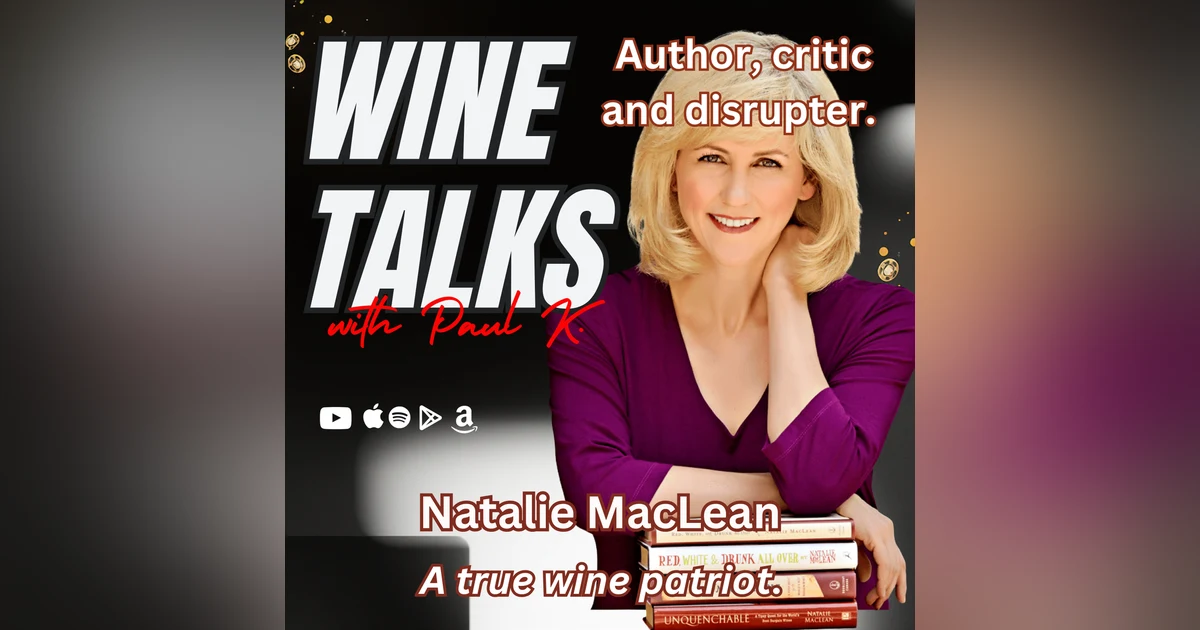

I find her refreshing. I find her intriguing. I find her wise: In wine.
Natalie brings to the proverbial table an unabashed view of wine and she will tell you like it is.
I have to tell you that having Natalie McLean on the show was one of those times where you know you could just keep talking for hours, and still barely scratch the surface. From the moment she cracked her opening line about starting to drink when she met her husband—"and haven't found a reason to stop"—I knew we were in for an episode rich in anecdotes, laughter, and real insight into the world of wine and the people orbiting it. I love a guest who doesn’t take themselves too seriously, especially when that guest has the credentials and accolades to do so if they wanted.
Right off the bat, the story of how Natalie McLean first dipped her toe—well, her glass—into wine was classic. The ex-husband, the MBA couple, and the journey through Spanish classes, golf, and finally onto wine studies left me grinning. You know, everyone’s path to wine is different, but hers, starting with a night course in Toronto after failed golf and Spanish efforts, reminded me that for every over-serious sommelier out there, there’s a person who just wanted to relax after work and stumbled into a passion.
And let me tell you, Natalie McLean didn’t just dip in; she cannonballed. I was genuinely impressed with the way she described her wine education—full sommelier diploma, authoring books like Red, White, and Drunk All Over, and racking up James Beard awards along the way. But what I really admire is her ability to bring it all down to earth. She calls herself the “Chief of Wine Happiness,” which put an instant smile on my face—because at the end of the day, isn’t that what a great bottle is supposed to do?
There’s this refreshing honesty in Natalie McLean about wine’s intimidating side. I shared my own blunders—forgetting wine for family Easter, wandering into the market like any other consumer, grabbing a brand and sometimes striking out. She had her own: sweating bullets in a restaurant interview, staring at a wine list, and famously ordering a Cabernet with Dover sole at a big consulting dinner. Didn’t get the job, but it sparked that classic realization: “I never want to feel that way again.” I could relate—as much as anyone, even after decades in the business, that dusty wine list in a posh restaurant can still get your palms sweaty.
The conversation took a fun turn when she described her divorce tastings—pairing Cabernets with burning love letters. We laughed, but there’s a message in the humor: wine isn’t just labels and numbers; it’s woven into our life’s best and worst moments.
We got onto selecting wine in restaurants, talking to the sommelier, and why confidence is more important than credentials. That tip Natalie McLean gave—to “point at the price” when you don’t want to say it out loud—folks, I’m adopting that one! I appreciated her point: most people just want a glass of pleasure, not an encyclopedia of terroirs. That struck home.
Of course, we got nerdy too—talking about licensing, liquor laws in Canada, and the absurd hoops you still have to jump through to get a good bottle at home if you’re north of the border. Yet, through it all, Natalie McLean kept it relatable and warm, whether it was “free my grapes” in Canada or shelf talkers in American supermarkets.
Put simply, Natalie McLean reminded me and, I hope, everyone listening, that wine is about stories, connection, and yes, a good laugh at yourself every now and then. And that, for me, is what keeps the conversation, and the cellar, alive.
0:00 I say I started drinking when I met my husband and haven't found a reason to stop. He's now my ex husband, by the way. Oh, okay. Well, it's only some credit. Wine helped. Sit back and grab a glass. It's Wine Talks with Paul K. Hey, welcome to Wine Talks with Paul K. And we are in studio today in beautiful Southern California, about 65 degrees here in Los Angeles and I hope you are experiencing the same across the country. We have a wonderful guest Today and Natalie McLean. We'll get to the introductions in a second. Wine Talks is available on Spotify, iHeartRadio, Pandora, you name it, we are there and always sponsored by the original Wine of the Month club, now sporting the Bordeaux and Napa series.
0:44 But let's get to the show because this is a lot of fun. I was fortunate enough to be on her show recently and we wanted to get her on Wine Talks because this is Natalie McLean all the way from Canada. What part of Canada are we in, Natalie? I'm in Ottawa, the capital, the snowy capital. The snow. Is it cold up there today? It's getting warm. Our kind of warm though I should redefine what warm is after hearing your weather report. We're in Celsius, so the conversion always escapes me. But it's about plus 8 degrees Celsius right now, so we're above freezing. 16th is 16. That's like 30. That's like 46. Exactly. So we're wearing shorts and T shirts as a result because we are Canadian, we are winter hardy. See, I set out when I was a kid as a teenager. I was going to come up with my own conversion because it's a linear conversion from Celsius to centigrade, from centigrade to Fahrenheit. You have to have sort of a moving scale. Yes, but I double the centigrade and I add 28. That'll get you within a couple of degrees either way. And if you as it gets warmer then that scale changes a little bit. But I want to read your accolades because this is very important.
1:55 Primarily, you consider yourself the chief of wine happiness. We're going to get to that in a second. We're going to define that. But you're author of the book Red, White and Drunk all over in our kind of book, A Wine Soaked Journey from Grape to Glass. And here's a picture of it and the book A Tipsy Quest for the World's Best Bargain Wines. And she happens to have a copy with her. Now. You also have one James Beard Fisher Distinguished Writing Award Calling the shots. The James Boyd award for the Internet column and feature writing. Easy for me to say. Dining in the wild, wild West. Lady sings the booze. You know, these are clever names. Lady sings the booze. I can't resist a good punt.
2:41 White and drunk all over. And waiter, there's a flaw in my wine. So all interesting subjects. It reminds me of the joke, hey, waiter, what's that fly doing in my soup? And he says the backstroke. So tell us about this journey because it also suggests in some of the Internet articles about you and what you've done that your husband got you into this. Is that true? Are we. Is the husband. Absolutely. Well, I say I started drinking when I met my husband and haven't found a reason to stop. He's now my ex husband, by the way. Oh, okay. Well, it's gotta give some credit. Wine helped. I actually specialize and divorce wine tastings with which, you know, cabernet pairs best with burning wine. Love letter or sorry, love letters. But anyway, that's another topic. And another tasting. No, that's.
3:30 We're gonna have to talk about that for sure. Okay, go ahead. Pair wines with, you know. You know, if you found yourself a good divorce lawyer and it's a great prenup. Or not. Okay, that's after the fact. Anyway, I'm getting carried away. I. But I did get into wine with him. We were two MBAs, A type personalities. And we moved to Toronto together. And as we met in business school, so we started first taking Spanish at night and sort of conjugating Spanish verbs and all that after a long day at work. He was at Citibank, I was at Procter and Gamble. That just was. We couldn't hack it. Then we thought, oh, let's take up golf. And that was a really bad idea because, you know, typical personalities. Yeah. With long iron clubs. Not a good pairing. Then I saw a wine or a wine course at our local college and I thought, we can drink at night.
4:29 That will calm us down and we'll have fun. And so it started with that. We took it together. I continued for the full sommelier diploma program, but he just took the one course and enjoyed it. Well, you said a mouthful there. I have to ask a couple of questions because Ottawa is what part? My North American geography is not very good as far as Canada is concerned. What part of the country is it? That's okay. We're in Ontario. We're about an hour flight from Toronto. We're actually the country's capital, but we're so snowy here. Voltaire described Canada once as a few acres of snow. So no one knows where we are. We just, we're the Great White north, so we live. At least you've got accolades from Voltaire, so that's great. But, but Spanish, I mean, seriously, why would you take up Spanish? You know, because. Why not French at least? Oh my gosh. Yeah. Well, we learned French in school, so, you know, we thought being such obsessive compulsives, let's get another language just for fun.
5:29 And learning languages is beautiful, but not after an eight, you know, 10 hour workday at intense companies. It was like, oh my gosh, please. It's very hard. My listeners have heard this before, but I started about five years ago studying French and I was hell bent to, to learn it. And my, my dad speaks French because in, in Cairo, where he grew up in the 30s, French was the second language of, of the Arabic country until the English, the Protectorate came in and then English became obviously the second language. But if you watch film from the 30s from Cairo, most of the signs, business signs, are in Arabic and in French, so it's hard to do. You have to be really disciplined to do it. And you have. I have to get up early in the morning to speak with the. There's actually services now. There's one called italki.com in case you want to resurrect your Spanish. No, thanks. Pursuit. Good to know. Good to know. And then the golf thing's hilarious because it reminds me of the Raymond episode where they decide as a couple they're going to play golf together and sort of take on the husband's hobby. It doesn't go well in the episode. No. I have this long club and I'm in the sand pit going, I don't need any more tips, darling.
6:44 And that would happen for sure. So. But it did say, like, he suggested that you take wine classes. Was there any wine enthusiasm prior to that besides just, you know, catching a buzz late at night? Yeah, exactly. Well, I cottoned onto wine because I was working for. I also, I went from Procter and Gamble to a high tech company that's now the headquarters of Google in Mountain View. So I started arranging my meetings, quarterly meetings on a Friday or a Thursday so I could drive up to Napa because the one thing when you're working in an intense job, the one thing you can do is take clients out to dinner and start to gain an appreciation for wine, that sort of thing. So there was no time for golf, thank goodness. But I started to learn about wine and so that was always there in the background. And so we both thought, yeah, that sounds good, let's find out what we're drinking so we know what to buy and how to pair it with food and that sort of thing. Was it intimidating back then? Because you know, Procter and Gamble for one, being corporate America, I mean the huge company and I want to get into that marketing, the guerrilla marketing that they do a little bit if we can. But was it intimidating for you to start, you know, you're trying to entertain clients, you're going to dinner, you look at the wine list. That's very confusing. Each wine list is different. How did that go for you? Well, you know, the first experience I actually remember was pre Procter and Gamble when I was at the end of or near the end of the mba. We were all getting interested interviews and I went for one with McKinsey Company, which
8:14 is a consulting company. And the final rounds you went to dinner with a partner and he was shaking down his Rolex watch and his little Burberry cupcakes and all the rest of it. He goes, why don't you choose the wine? And so I had nothing, no experience, except maybe, you know, cold baby duck back of the high school portable. That was it. Like that was the experience. We used to sell that, by the way, just so you know, no dissing, but that was just. That was my experience. Yeah, I thought, well, and I'm scanning the wine list and just sweating bullets because I feel like this is a test. And it was as part of the interview.
8:55 And so I thought, oh, I'll choose something safe and fancy. Mondavi Cabernet from California. So I went with that. And then I sort of look up and he goes, well, that's going to be interesting with my Dover soul. Anyway, learned later that's really incredibly bad match get the job. Don't think it was because of the wine choice, but I never felt so intimidated. And so like I need to know what this wine stuff is all about because I never want to feel that way again. Because it, it's something that gives us pleasure, but it's also wine is something that can make us feel very uptight and very small town girl. In my case it's, you know, that's a the interesting story because here you are, the pressure of an interview, so to speak, and sort of a social. And I just had a friend of my son just was interviewed for a job and the last interview was they took him to a bar and this is a high end real estate Firm that does a lot of big business across America. And they wanted to know how he socialized, you know, in that environment.
9:58 And, you know, he was sort of in that environment. You normally would say, well, I'm not going to order a drink, because that might be a bad thing. But they want him to order a drink and understand how he reacts to that in that situation. I thought it was interesting, but it seems to me, and this is for the listeners and for people that are trying to study wine, I want to learn about wine that that isn't intimidating. It's even intimidating for us if I'm on a list that I don't know. In other words, it's always handed to me. Right? You probably get the list everywhere you go, whether you're with guests or friends or family, they go, oh, give the list to Natalie. She understands wine. And then you look at it and you go, gee, I don't think I've had that Burgundy. I don't think I've had that Bordeaux. And then we go back to the stuff that we've may recognize or we've tasted before. And I highlight by. I was responsible for the wine at an Easter gathering years ago with my in laws down Palm Springs, and I forgot to bring it. Okay? So that's the first mistake. So then I went to the market, and I just, like every other consumer, I went to the market, started looking at the wines, and I'm going, you know, I never tasted that. So I really don't know if it's proper or balanced or whatever, you know, acronyms you're trying to look for, adjectives you're looking for, but. And I made a bad decision. One of them was really good, good value. The other one wasn't so great, and I bought it on the brand. So that it takes confidence to do this, doesn't it? Does. It does. And you're right, Paul, like restaurant wine lists, if they're any good, are trying to get wines that you haven't tried before or that aren't
11:31 often stocked in liquor stores or that sort of thing, because they want to give you a new taste experience. So that puts us, even as experienced tasters, often in the same seat, because I don't know. And, you know, am I going to take a chance on that? Whatever, $75, $50 burgundy or whatever. It would be a lot more expensive. Yeah, well, yeah, I wish. Exactly. And so, you know, I always defer to the sommelier if I'm in a place that cares about wine. Like, what do you think of this? Wine or, you know, we're having the veal and the chicken. What do you, do you think this wine will work? You know, and the thing that people come back at me for is, well, how can I signal how much I want to pay? Especially I don't want to declare out loud how much you're willing to pay for love on a date or business. And I just tip the wine list toward me and just point at the prices only. Clever. Yeah. And I'll say I want something in this range.
12:26 And everyone else thinks I'm thinking, you know, talking style or region, but signaling this is how much I want to pay. That's the other intimidating thing though is that if you're with guests that you're not sure what their budgeting is like or whether they're used to spending $100 on a bottle of wine, you know, you're sort of intimidated. So when we are in Paul Beaucu in Lyon, you know, I was able to say the, you know, type thing to the Somme because my guests didn't know what that meant. And I was telling him I wanted the Bordeaux in the $400 range. And you know, that was easy. But you're right, it's. You're worried like somebody in front of you that your guests are going to go $100, you know, in the back of their mind and they're going, oh, I guess I'm, I guess I'm buying, right? Yes. But that's interest though. The Psalms role in a restaurant, a real restaurant that has a real wine list, not one that's produced by the local wholesaler, is pretty important to help guide clients through and interpret what you're asking them for. You pointed to the dollar amount, but stylistically they have to interpret what we tell them. Well, we like the way I do that. Maybe it's the same is I ask people what they usually drink. I drink, you know, Jordan, I usually drink silver oak or whatever. And then we can at least get a style through that. But how do you, how do you recommend to the, to, to, to people at a restaurant that are trying to decipher a menu,
13:56 a wine list and explain to the Psalm what they're doing. Exactly. That's a great tip. Really great tip. Like just what's. What are we drinking? You know, what are we drinking doing? So what is the chief of wine? Happiness? I mean, that's a self proclaimed thing or is that a degree that you earn? Degree. I would love to go to that school. Oh my goodness. I just have to figure out my minor and my major, but chief of wine Happiness. I mean, you know, I just, I recognize that wine is pleasure for most of us, we are just buying a glass of pleasure. We are not signing up for the encyclopedia of wine, though. That's great if you want to dive head first into wine with all of the different facets and knowledge. But you know, at, at bottom, I think most of us just want to relax with friends, have a good glass. It's not going to disappoint them. And that's my mission. So I, I put that rather than any initials or degrees or diplomas or anything beside my name. Well, I think it's a, that's an important distinction. I want to the listeners understand. I mean, I, I have full respect for MWS and MSS and anybody that's pursuing that.
15:07 And in California, just to sell wine now as a, as an entry level job, if you just want to get in the streets and go to liquor stores and restaurants and sell them wine, you need something, you need a whit said degree or level one SOM certification. Something that says you're attempting to learn a little bit. And so those certifications are important, particularly in jobs where it's important to have knowledge, but they certainly are degrees to the extent that we can't learn the same thing by studying ourselves. Okay, I want to make that really clear. I think maybe the confidence issue comes into play when you have that degree. In other words, I have really good friends that really understand wine, but they still describe it with a question mark at the end. I taste blackberries. You know, do I taste right? And it's like, no, I taste blackberries. That's what I taste. Exclamation mark. Say wet violets in spring and everybody will agree with you. Right? That's right. That's exactly what I gotta start using that. Yeah.
16:08 Yeah. Well, you know, just as long as you say it with power. But that's exactly why, you know, I teach online wine food pairing classes. It's. People don't necessarily want to become masters of wine, most of us, but we want to become the expert on our own palate. And that is that confidence to go into a liquor store and not default to the same bottle every time or to join a wine club, of course, and to experiment and to have the confidence. I know what I, I know when I want to branch out and try something new. I know what pairs with a variety of dishes. That's why, you know, people come to me, at least for the online pairing courses that I offer, because, you know, it's a very small percentage of the population that want to become true experts in the way that master of wine and master sommelier can. Can do for you. Well, it's a. It's a pursuit. It's a pursuit of education like anything else. If you want to learn a language, you pursue it through all the means you can. And there's plenty resources online to read about wine and books. I've got a huge library of books accumulated over the years.
17:16 So you said something important, though. The ethereal value of a glass of wine. I want people, as you put it, to just enjoy the glass of wine they're having. And you. And I can't predict everybody's palate and what they're going to like, though. We find something really interesting. Like, the other day, I tasted a Canary Islands Lisbon Negro. I'm like, never heard of the grape. And I really enjoyed the wine. It may. Not that everybody enjoys it, but your. Your idea that we want to relax with a good glass of wine. And what does that mean, good glass of wine? Well, I think it's perfectly fine. And I do it all the time. And I know it's hard to imagine I dump out a lot of wine, I mean, because I have access to it, but I don't want to suffer through a glass of wine. Why would I want to do that? Yep, Life's too short. And we're trying to drink within moderation limits. So you can only consume so much alcohol, and that's drinking and tasting. So you gotta choose wisely, I think. You know, just like everything else in life. Yes.
18:18 Well, you want to test the limits of, you know, you can only drink so much alcohol. Probably tested the limits too many times on that. But I was tasting the other day, and I'm not sure if we talked about this on your show, but I tasted another day, and I tasted a shiner, a wine with no label. And I tasted. I said, you know, and we're going through a wedding right now. My daughter's getting married in a couple of weeks, actually. Wait a minute. Thank you. It's less than that now. It's scary. And I think to myself, well, I suppose if this wine had a private label on it and it was part of a venue that did a lot of weddings, this would be okay. And I stopped myself. This is my own thought. I wasn't talking to anybody. I was talking to myself. I'm like, no, actually, if I'm going to have a wedding and invite guests, I want to pour nice wines. I want people to feel what you're talking about.
19:04 Relax. Maybe even have a conversation about the wine at the table with their guests, the other guests. Why would I sacrifice one of the most important parts of the meal? Let me cut back on the valet budget, you know, Let me cut back and have a band that's not so good. It's like a fancy car without having the money to pay for gas. I mean, it's like make money for it, you know? Yes, that's what I think. Yeah, There's. I wanted to talk about your book. The. The Red, White, and Drunk All Over. So when you sat out after you set out to. To. To learn about wine with your husband, how long did. By the way, Just for fun, how long did it. Did the. The ensemble lessons last? Oh, he only took the one course.
19:52 Our marriage lasted longer. That was a good 20 years. So. But. But yeah, he was done because then he deferred to me. You know how you do often in a relationship o wine. I'll do finances or whatever that stereotypical. But anyway, yeah, he. He did the one intro course with me, and then I. I took over. Did you learn. Did you learn, like, his palette? Because I have. My wife's palette is totally different than mine, and I. I ensure that I bring home things that she will appreciate. And I sometimes open two bottles because I'm not. I don't feel like it. Exactly. Yeah, no, he. He did. He had a different palette, and so does my current partner, Miles. And at first, Miles was drinking very Australian Shiraz, and I thought, oh, great. Wow. And then. And then. So we.
20:37 I'd start opening wines, and one night he noticed that my red. My red wine was a different color. He said, what's that? And I. I just said, red wine. You have red wine. I have red wine. And as basic as it gets. Exactly. And then he said, no. What? That looks different. And so I had to explain to him that it was a Rhone Valley from Gigal and it was. It was pricey. So he said, I want to taste. This sounds awful of me, but he took a taste and he loved it. And then from there, he's been so much more expensive to. To keep in the market. He got rid of the inexpensive Shiraz and then just switched to that. So. But still, our tastes still differ. I mean, generally I actually enjoy Pinot, but he's still on that pricey Gigal Rhone Valley stuff. You got to keep him from going north. You know, don't get him into the Cote Nuit, or else you're going to have big problems. Exactly, Exactly. There is no North France ends there for one at the Rhone Val.
21:37 That's it. This is a conversation I had yesterday with a woman who's trying to look into the idea of starting a club for a very well known trade magazine, or not trade magazine, but consumer magazine. And she lives in New York. And I said, you can go to any. There's fine wine shops in New York on almost every corner, it seems like. And you can find really, really nice wines in Canada. Is it the same? I mean, how do you buy wine in Canada? What's the availability of different things like gigal your own wines or Cote du Nui Burgundies? What's the general availability given the liquor laws in Canada? Well, we're still more suffering from prohibition hangover than you are in the states in that most of the provinces have government controlled liquor stores. So in Ontario, we have the Liquor Control Board of Ontario, lcbo.
22:33 And although. Exactly. And there are a few wine shops that are grandfathered into existence because wineries opened wine shops and so they're allowed to exist. But we do not have a privatized system here. They do in Alberta and in spots across the country, but it's very regulated. And so the availability depends on the buying power of those, those near monopolies. So the LCBO does have a lot of buying power, does present a lot of wines through its stores, but we just don't. We don't have a store that's, you know, like Tuscany is us kind of thing. If you just want to specialize in Tuscany, you really do have to go with the availability of what's in those liquor stores.
23:22 Actually, yesterday I was, I was looking for pricing on the Bordeaux I really liked, and I just found in Southern California a Bordeaux shop. I'm like, like, wow, that can't be like doing that great. But actually during, during COVID Actually, it's been very good. But I just. When you said the lcbo, which, you know, I think it's like one of the largest retailers in the world, right? I mean, they buy everything. And Pennsylvania, up until recently in the US was the largest US Retailer because they had the same sort of restrictions, but just on the state level instead of a country level. But I just realized, okay, so Canada, suffering from a little bit of post prohibition and then headed south to. We suffer from it. But Joe Kennedy was smart enough to give all his friends regional control over the booze distribution, so at least we have some freedom to. And each state has control over it, and some are more free than others.
24:14 But then you go to Europe and I'm wondering if there's a relationship between the amount of time wine has been part of the culture and the freedom to buy it and express it. So, yes, Europe, there's no problem, right? Right. Most of the rest of the world has no problem. Then you go to the US we suffered through prohibition. It was political football. Still is. We're a little freer than Canada. And now Canada, probably the tail end of alcohol being part of the culture, has the most restrictions. And why has this become a political thing? Why can't we just experience life as the Europeans do? Is there any wind of change coming or no? Oh, yeah, I think change is coming. But wine has always been politicized, whether it's tariff disputes or just the sin taxes put on alcohol like it is on gasoline and other goods that the government feels we don't really need to consume. But I do think change is coming and, you know, consumers demand it. But now, you know, in a Covid, hopefully we're coming out of COVID But in this environment, liquor laws are starting to loosen. For example, restaurants could never deliver alcohol with meals. Now they can. Those laws have been changed, and the word is they're going to stay changed. So you've got all of these restaurants now opening up their own wine delivery business because, you know, it can include a saltine cracker and that's the food. And then just sell, sell your stock of wine. And as we know, Paul, in the restaurant
25:48 business, customers will eat you poor and drink you rich. The margin is in all of the alcohol, but even the tea and the coffee. So I think change is coming. It took a disruptor, an inflection point like Covid that I think is an accelerant that brought the future forward 10 years. But that's a good thing because we're starting to get more options and I think it will continue. Well, you're right. I agree with that. And in America, it changes fluidly. In 1988, when I bought the company from my father, you really nobody really cared. I mean, you just shipped because it wasn't a thing then. My dad invented the idea in the 70s. So even in the early 80s and late 80s, you just did it. If you loaded the UPS truck with 200 boxes, you only manifested 150. Nobody really cared. And it could have gone anywhere.
26:37 And there were there they we reciprocity states in California. So if, if Minnesota or Missouri wrote a law that resembled our law, which said basically, hey, we can ship wine to your state and you can ship wine to our state and we don't care. We're not going to tariff or tax anybody and that those are still around. But they're different than they were. A lot of them went different ways. And so we're still seeing in the U.S. challenges to liquor laws in some states, strapping down more in other states loosing it up. But it's the problem with America is we're getting sued now for shipping stuff.
27:20 There was an article came out the other day where it was determined that one in three bottles shipped to Michigan last year were illegal. You know, whatever that means. And I would suggest it's probably more than that. Not illegal, but probably two and three bottles are illegal. But it's up to us for a lifestyle to decide. In my opinion, if we want to have wine in our meal and we want to be able to buy it openly, I think the consumer has to step up. We have a group here called Free the Grapes and be able to have access to whatever we want. What's interesting about the human race is that we're very creative. So when the governor of California shows up at the French laundry and for $800 a seat, which we were there two weeks before he went, you know, I'm sure you're aware of the story.
28:12 And my wife was like, I want to, I want to go in the room. Because the French Laundry has four or five rooms and normally during regular hours there's four or five tables in each room. But what they decided to do during COVID was that they that you could rent one room privately at that time. And, and then this per seat cost Pre fixed came $800. Wow. Okay. And if you're outside and the regular dining area during the patio was $400. Okay. So it's expensive. What a deal. Yeah. But Newsom was in the $800 section. Just so you know, just for the set the record straight. But after that, Newsom decided that he was going to tell us what was acceptable food. And you said he could deliver saltine.
28:58 Canadian wine delivery can have a saltine and call it food. Right. So we are serving 25 cent top ramen at some of the bars to get around that code. Right, Right. It works. Then they came out. This is a true story. They came out with a list of foods that qualify for brasserie style food. So it was okay to serve a chicken breast on a plate, but not chicken wings. Okay. I mean seriously, time on their hands. Who are making these? Can you imagine this? It was written that way. It was literally written in an article in the code that chicken breast qualifies for real food out of brasserie, but chicken wing does not. It just boggles your mind. And then you have to.
29:42 Who's going to enforce this? I mean, who's going to go around and be chicken wing, Chicken wing police? I'm sorry, it's all cut up now. I can't tell you. But you know, Paul, we have that same thing going on in Canada. Our laws in terms of cross border shipping are nuts. And again, it's largely due, I believe, to the liquor stores who don't want to lose their revenue or who want to keep taking the tax revenue and turning it. Well, they do turn it over to the government, but still it's a way of maintaining control. But we have free my grapes as well. But what surprises me is that wine is the most value added agricultural product we produce in this country and probably yours as well. It's the only product we put in the original packaging on the dinner table. We don't, you know, I think we talked about this. We don't have the stickers on the apples or the strawberries. And yet we're not allowing these small farmers, which is what wineries are, to increase their market and allowing consumers to increase their diversity of taste from something that is truly homegrown. I mean, it just, it boggles my mind that we are not supporting farmers in this way.
30:56 Excuse me. This is interesting because I've been taking some notes as you're talking. Wine is farming. It is fancy farming. Yep. What it started as. I don't think the consumers know that most wine farms are just that they're not wineries. Actually. They sell their grapes to a variety of wineries and they start, a lot of them start out. I can't tell you how much wine I taste here. That started as well. We used to farm grapes. We sell them at Silver Oak, we sell them at Camus or something. And now we make our own wines. And that's, that's probably not a good idea. But it happens all the time. When I go to the wine shop and I went not too long ago to the supermarket, just my wife hates it because when I go to the supermarket, I veer off to the wine section and she's out trying to shop and I'm, you know, screwing around around checking the prices. But in the local vines, in the beach area here, every single wine had a shelf talker, which is for the listeners, one of those tags that hangs down and it's got the point system. And I'm looking at as A trying to pull myself back, being in the industry. And I know much of the wines I've tasted there. But how do I figure this out? I mean, I'm looking at a shelf talker. How do I know?
32:09 Isn't it confusing to. To. To all these ratings and all. Everybody's got a rating now, and they're all over 90. They're all over 90. Yeah, that's right. I mean, I guess you can find anyway, but is that the same in Canada? And how do we as consumers try to sort through all this? It. It is. It's. There's many issues associated with that. It's a great, great question. So every wine has a rating now, and I think it's because wine is unlike so many other products we buy. We can't try it, usually, at least legally, before consuming. And, you know, we're going on the label most of the time. You know, you can try on a dress or a suit, you can read the first chapter of a book, but you can't open that wine. And so then the externals start to matter a whole lot more. The label, the shelf talker. And. And most of us are too intimidated to talk to liquor store staff, even though they could be a great help.
33:05 And I suggest that as much as you would a sommelier in a restaurant. So that's what we're down to. And so the liquor store wants to sell every wine it buys and puts out there on the shelf. So it's going to look for the highest scores it can from whatever source. So it loves every wine, but you necessarily won't. And even if it is a 92 or a 94, you might not like that wine. So what I recommend to my students and podcast listeners and so on is finding. Find someone whose palette lines up with yours so that you know that when that person gives it a 92, it's something you're going to like, because there's a lot of great inflation going on. I mean, just there's crazy scores now where everything's getting a 98 or a 99 from certain sources. But you have to learn, is that a trustworthy source? Or at least do I trust it? Does my palate line up with that person's rating and score?
34:04 And then beyond that, the final tip I always give is make sure you're looking at the words, not just the numbers, because it might be a 94 for Beaujolais, but you don't like light red wines. That's a great point. Yeah. Look at the words. Is it. Do you like Light versus full bodied red. Well, red versus one's pretty obvious. But, you know, do you like lots of mouth watering, juicy acidity, or do you like something that is a bit calmer and not as juicy? You gotta look at the words, too, not just the. I think that's a really important point if we're trying to experiment, trusting the description of this rating system. And I think you're right. I think if you can choose the rating system that you like, if it's a Spectator enthusiast, James Suckling. And now there's some new, new ones out there. And I just started, frankly, with wines that I think are really good. Not. Not everyone, I think the consumers and listeners should know is rated. I mean, it's a conscious decision to get your wine rated it. And there's a lot of political reasons why you would or wouldn't do it. You know, you might be afraid to get a bad score or a low score, and you can't publicize that. But, you know, you have to send those wines to the rating system, you know, to whoever you're rating the wines. And you have to wait for the publication to come out. And so there's. Most wines are not rated. Particularly small boutique wineries just don't bother. So you may not see everybody with a rating, but I think it's important to know that there's some consistency amongst the ratings. And look, if you're talking about James Suckling, he is not tasting all the wines of
35:35 rating themselves. He can't. He's got hundreds, probably thousands of wines to taste, and he has a panel of guys that do it for him, just as he started at the Spectator. But I think finding a consistent source of what you like and what you trust is an important way to do it. The way we've been doing it our office now. Well, it's always been the same premise, but never publicized. And so I started calling it Tuesday's Tastings. So if you see a TT around, you can be fine. It's a very important thing. But I. But. And we do score. Everything I, everything I sell has got a 90 plus rating from me, because I'm not rating it against the universe, I'm rating it against its peer. So other $20 cabernets, this is a 98, because that one's an 88. So you're fetching price. Yeah, factoring the price, looking at that shelf and saying, okay, all those $20 cabs, that's a 98. This is a 75. So it's a slightly different approach because I do get customers asking, why'd you get that wine?
36:37 98? I didn't like it. I'm like, well, amongst other $20 cabernets, it was worth it based on what I taste. But I can't please all the palates all the time. No, you can't. It's impossible. But I think, Paul, that people will follow you and your individual taste, which is a good thing. Now, there's lots of T panels where you get a group of, I don't know, eight to 10 people, and they come up with one score. And to me, that drags wine down to an innocuous middle ground that I don't think serves anybody. Because you're going to get the person on that panel who loves that juicy, acidic Riesling, and then the one who thinks it's too tart or whatever. And I just think that's why in the wine world, we know individuals more than we know panels.
37:20 Like, you know, Robert Parker. He was so famous as a US wine critic. But, you know, who is the tasting panel for Wine Enthusiast magazine? I'm not sure. I mean, there are certain names that even, you know, contribute to these magazines. But I think wine is such an individual experience that for me, at least, you need to find an individual whose palette lines up with your own and trust that rather than a sort of communal consent of that, you know, as I say, beige middle ground of. Everybody sort of liked it, but. But no one in particular. I think I told you this story. There was a Cabernet came by here a few months ago, and I really, really liked it. And it hadn't been rated, never been sent in. So I contacted the broker. And in America, we buy wines through wholesalers. The regular group, Southern Yachts and Spirits, Young's Market, rndc, whoever it is.
38:12 Big, thick books of wines, tons of things to choose from. And then there's brokers that just go, hustle, stuff, stuff. And they bring in some really amazing things. And so she brought in this gorgeous Cabernet. And I said, and I don't meet. I don't want it to have ratings. I don't ask them to make sure there's ratings. I don't care if there's a rating. I just ask if there is one just to understand what they've done with it. She goes, no, but do you want one? I'm like. So I go, what is that? She's gonna shop it around for a rating? Yeah, she's gonna go give it to an MW and say, you know this guy 98 from so. And so. So that kind of defeats the whole, whole. The whole thing, Right. That leads to the next conversation. It's a good segue to these celebrity wines. I just read yesterday that Gordon Ramsay came out with a whole brand of, I think they're Central coast of Monterey based Pinot and Chardonnays. Wow. Pinot and Chardonnay. I would expect him to do something honking big like an Amaroni or whatever and have foul language on the back of the label. But it's interesting, right? Well, they're through Siebold and it's Chris Miller, the famed Master Psalm and he has a winery himself called Siebold now. So there's a Master Psalm who's making wine, which there are a handful of those guys. It's interesting to me because again, we go back to these acronyms. It doesn't mean they're any better winemakers than anybody else because they studied all this. They understand it for sure. But winemaking is science and biology and fermentation science. So. So it doesn't make it that you're a good winemaker just because you have an MW or Ms. But regardless,
39:45 typically over the years celebrity endorsed wines have not worked in America. Have you seen them in Canada? And are they people care? Well, we've seen lots of celebrity wines. I don't know that they have that much staying power because if, if you're paying a premium for that brand or that celebrity cachet, I'm not sure it's worth it. We talked about this, I believe on my podcast, but Snoop Dogg has just launched up here in Canada and we talked about Cali Red and the shelves making its way down in popularity going to the low shelf. So it'll be interesting to see how that goes up here.
40:27 Oh, I do know one of our national newspaper columnists said, said it's so sweet it ruins the finish or whatever. He gave it a really low score, like low for the price. And so I can't imagine that's going to go for well, so, but, but at the same time, I think there are celebrities who actually care about wine and do a good job and often their names aren't on the label. If you think the singer Pink, her brand is Wolf something. And then you've got, well, they divorced, but Brangelina, Brad Pitt and Angelina Jolie with Miraval, made by a very great winery in the Rhone Valley. So you do have exceptions to the rule. But I find on principle there are exceptions. Not usually celebrity wines, their go tos. Well, there's a couple I have a Couple of pins to that one is, yeah, you're paying a premium. There's no way Gordon Ramsay or. Or Snoop Dogg or anybody else is putting their name on the label without a fee. Yes, that's just business. And unfortunately, wine is business. The people that make wine, they grow grapes to make wine. They're in it to make money. We're not going to throw crops away because mildew is coming and we're not going to sulfide it. If we're into that. No sulfite type thing. We're going to do it because it's business. We got to put it in the bottle. And I think that's also the premise of a lot of bad wines. There are bad wines out there. They're from bad grapes.
41:56 There are good grapes that make bad wines, too, from the winemaker's point. So they're bottled and. Or they're sold in bulk and they're blended with other things to soften them. And you mentioned the sugar content of Snoop Dogg's wine. That's the classic way to do two things. One is make it more approachable for the regular wine drinker. And my experience here at the Wine of the Month Club is yes. Why does it have a little bit of residual sugar in the. Them tend to do pretty well, you know, because they're softer and easier to drink. They don't have. They're hard to drink a lot of because eventually this comes cloying and hard to drink. But the initial expression of the sugar is more approachable. And so that's. That is definitely one of the things that they do to cut.
42:40 And also to cut the bitterness. Right. They put a little bit of sugar in there because the grapes are so good in the first place. But. So is he going to call it Cali Red in Canada? What does he call it? Something else. Like it's got his name on it, Snoop Dogg. And they've got this great big metal statue of him in one of the. Oh, do they really? And he's got corks all at his feet. I don't know what's going on, but. But you know, you're right. Sugar and oak, often the ketchup of the wine world, used to sort of hide bad grapes or poor winemaking. If you. If that's all you're tasting or that's the primary sensation, you probably aren't looking at well made wines. Wine. Yeah, because they're gonna. There's a big. There's a big difference between oak that's been infused into the wine through chips or Staves to flavor it versus wines aged in barrel to actually soften it and then give it the nuances. And I think that's important to understand. So this Gordon Ramsay thing, I'm thinking, okay, he's gonna. It's gonna sell some, you know, and I. And I think most of the time that the celebrity approach is that, well, I'm a really special person and so people will buy it because it's mine. Now the other day I had a wine. It was from Terrell Owens, a football NFL player. I'm thinking myself. I mean, seriously. And I know who made it. I know what I could buy the juice for if I just bought it for myself. Considerably less than that bottle of wine that they want to charge because Terrell owns his names on it. Not dissing Terrell Owens. I don't even. Wasn't even sure it was his football career. But
44:14 why would we think that a football player or a basketball player or a golfer's wine has anything to do with anything? Exactly. Yeah. And there was even a study on this Paul at a university here in Canada, Brock. And they did blind panel tastings with different celebrities, except they made the celebrities up. And one was a wrestler and one was a golf pro and one was a football and then a hockey and you know, the wrestler ended up up at the bottom. But just as we might expect, the golfer, that gentil lots of rolling greens association was more brand on brand for wine. So there you go. Really? Yeah. You know, I was, I was actually. I'm going to tell the story because it's really crazy, but I was. I was in an rfp. I was in a proposal mode to be the Professional Golf Association Wine club. And so you would think that there's affinity between golf and wine. You would actually think, and I'm to say this out loud, that there's an affinity between food and wine. Of course there is when we drink and eat. But there really is no marketing affinity. It's very difficult to define that for you. But we have not found over the years of pure marketing business that foodies are necessarily any more better wine buyers as far as quantity and what they like. But regardless, the golf association was looking for a club to start and they felt that there's this huge assimilation between golfers and wine. So I won the bid. I went through a whole presentation and
45:44 we're going to start this club. At that time, there were 16 golfers that had wines. And I was invited to Pinehurst and present all the wines to a group of people that were Interested in knowing. And this one couple came, she says, oh, we just bought a bottle of. I forgot who the golfer was, was from the clubhouse. And they paid like 30 bucks. Okay, for this bottle of wine, right? And I was just offered the same juice with the standard label from that winery for $3 a wholesale cost. Oh, no. Oh my gosh. I felt so bad for them. They're like, what do you think of it? I'm like, you know, I don't know. But none of those golfers are have wine still. Except for Greg Norman, because he actually owns two wineries. So. And Morgan, his daughter, actually manages the wineries and manages the source of the grand grapes and manages what the wine tastes like. But none of the golfers have wines today. And one of them was really good. It was Fred Couples. I forgot who made the wine, but it was a well known winery in Napa. But it was A$60 sangiovese. And if I'm a wine enthusiast, am I going to walk into the wine shop and I know I can at that time spend $60 on a, on a Alexander Valley Silver Oak or Fred couple Senjiovasi. Right. You know, it's a marketing game. Even though if you like Fred Couples still, it might be a gag gift or whatever. But as you know, Paul, you know, what's on the label sells the first time, what's in the bottle sells the second time. And people get to see the quality. That's right. Bucks they're paying. So the irony of the end of the story is we never started the club.
47:18 And that was because the poor soul that was the liaison who used to work for the golf association, who thought this idea was going to work and brought it to the PGA and brought me in on it, was walking from the first green to the second te in a promotional golf tournament with one of the presidents of like Titus or one of these big companies and a tree fell and killed them. Oh, no, that's awful. Isn't that crazy? That is crazy. And it kind of goes to show you one of your time. But they called me immediately because I was one of the last phone calls he had made on his cell phone to discuss this thing. And he had just gotten the contract from the PGA that morning or the morning before. And we were about to discuss the three way relationship between the PGA and why in the month club and him.
48:05 And it never happened. His name was Bruce Florine. It was really sad and it was just kind of a crazy, crazy end of a story, really. I should have brought that up and depressed the whole podcast. Getting back to golf. Of course, the only thing I liked about it was going back to the clubhouse after we had. Had fought our way through the greens and having a nice glass of wine and steak, though they weren't branded. But yeah, that's my only association with wine. Gulf. There you go. Well, he sets. That leads me to the next question. We've talked about this a little bit before, but worst moment in wine, you know, is there such a thing as that? And what might it be for you that you just said, oh, my gosh, this is really not happening?
48:49 Oh, so many where to start. So for my first book, Red, White and Drunk All Over, I decided to do the Day in the life approach. Meaning I worked as a sommelier in a fancy French restaurant. I worked in wine stores, I worked the harvest. So in the restaurant, I thought I'd up the ante. And I'm naturally a nervous, anxious person. And so I thought, why not go for like a four diamond restaurant, a French Four diamond restaurant here to make myself extra nervous. And so, you know, was trying to disappear into the wallpaper, but I finally had to flap my baby wings and get out there on the floor and serve people expensive wines and Bordeaux in particular. And I remember there was this couple, two women actually, and they ordered very expensive wine.
49:38 And I started pouring it and my hand was shaking so much that I dribbled it on the beautiful, beautiful wine tablecloths. And so she didn't even look at me. Her voice in her face just turned really hard and she kept talking to her friend. And then I said, I'm sorry, I'm sorry, I'm sorry. And like I was in this slow motion. I'm sorry. And so she refused to look. And she said, that'll be all. And I felt for the first time what it felt like, wow. Dismissed. Like, not service. Wow. Yeah. And it was just like, oh, my God, I'm never going to do this to anyone who makes a mistake in a restaurant ever again. And so I just sort of slunk off and had to tell the manager and he comped, you know, an extra. I think it was either bottle or glass, but it was just so like, oh, my God, I have a solution for that.
50:31 Okay, the wine pouring disc, that'll stop the drift. That's right. I should have came up with my. I don't know if they would have allowed them in this fancy place, but, yeah, it'd be like pouring with training wheel skills. I got my thing here. What would you think then as a Wine educator? Well, no, no, not the wine educator. The chief of Wine happiness. What would you consider your strongest suit? Like, would it be the education aspect? Your tasting skills? You're just your. Your ability to describe wine, which is different for everybody, or pairing things. Writing skills, obviously, are very high in your list. Thank you. Yeah, well, I think, you know, tasting. I. I don't know. I've been identified as a super taster, which doesn't mean I'm a better taster. It just means I'm a more sensitive one, you know, more taste buds than that. But I think really what my passion is is storytelling. And whether that's through my online courses and trying to connect with people through stories or the writing in the books, I just love stories. Like, we've already. You're a great, great interviewer, Paul. You're bringing the stories out of me, like, you know, sitting down, getting interviewed for McKinsey or whatever. Just the one. We just come. But I think that's how people identify with you. No one identifies with cold, hard perfection. Like, I know all the vintages of all the, you know, raindrops and everything.
51:53 So you're sharing your humanity through a story, but you can also embed the. The wine education through that. And that's. That's really what I love to do. I've said this before, but my mother always put my peas in the mashed potatoes because she was hiding vegetables on me. So I love the creamy potatoes. But that's trying to do with stories is like, keep someone entertained and interested, but at the same time teach you a lot about wine, whether, again, through the books or the online courses. How do you keep that passion going? Because how do you keep yourself educated? What are you doing to keep motivated, to know the next step, to understand what's coming into the thing? Let's just talk about biodynamic and organic wines for a second. Very popular. People are interested and they're asking questions.
52:44 What are you doing to learn, you know, to learn about it yourself? Well, this may be the lazy way out, but I just line up guests on the Wine Talk podcast and ask somebody else. And that's the way I educate myself, because I just ask nosy, impertinent questions that I'd never get to ask if I were just at a dinner party with this person. So we'll dig right into biodynamics or orange wines or whatever the latest trend is. But that's that' way I learned. I've always like being a writer gives you an excuse to nose your way into people's lives and ask them these questions. It gives you access, and that's the way I learned, by keeping curious and staying both neurotic and impertinent. You know, it's funny. Well, I wouldn't say impertinent, but maybe a little. No, just kidding.
53:35 Absolutely. The questions I ask there. We talked about Tilar Mazzio last time, the author of Hotel Place Vendome and Widow Clicquot. But that's exactly right. You know, I read her book because I love the stories of the war and I love Paris and we love the Ritz, we love Barr, Hemingway, and. And so I read this story and I'm enamored and I find out that. That, you know, she has a winery. So she's on the show. We're talking about wineries. Well, I found out from her that she's part of the raw movement out of. Out of London and with Isabel Legeron and I get a chance to talk to. And so we move forward as podcasters and media, like, well, that was an interesting story.
54:16 I wonder where I can get to the root of that part of it. You know, exactly. One thing branches into another, and you just follow your line of curiosity. It teaches us a lot. This kind of goes back to. I keep coming up with more subjects, and we're running out of time here, but we talked about biodynamic wines, and I had a Bordeaux last night that was biodynamic. It was fabulous. And I would have only known it was biodynamic by the taste, because they're a little brighter, they're a little fresher, they have a little bit more approachable character when they're younger, they don't seem to last as long. They don't age well, but they sure are bright. But there are a lot of biodynamic and organic wines that taste like horse manure.
54:57 I'm guessing this. You gotta use a fancy term. Yeah, Barnyard. Right. Well, now they have the poop emoji. I got to make a horse poop emoji. And maybe specific. What type of poop is it exactly? So it's. It gets. And so I. I keep thinking. I don't know if this generation. And my. My daughter, who's the baker of New York, loves orange wines. And she's. She actually taught me about them in the. When they first came out, I had never even heard of them. And I'm thinking this generation, you know, they stomaching these wines because a lot of them just aren't that good. It takes A long time, as you've probably learned with your podcasting and your. Your reading experience for a winery, let's say the three years minimum to become our certified organic or the three years minimum to become certified biodynamic, doesn't mean you make good wine from it. Right. It just means that you're. You're processing the grapes and you're processing in the winery to the standards that that certification allows you. But it takes a long time to understand when you've converted a winery from conventional to organic biodynamic, what those grapes are going to do, what they're going to taste like. How are we going to make the best wine from those new grapes that no longer.
56:12 That are different from the ones that we grew before? Have you tasted some of these things and found them just to be really hard to. To swallow? Yes, Swallow. Better word, swallow. Yeah, exactly. Sure. There have been some real ugly babies in the glass. And, you know, whether it's natural, raw, orange, I mean, there's just some weird stuff out there. But I recognize, you know, there's a whole world of taste and diversity in drinkers as there is in glasses of wine. I just. What I don't agree with is funkiness or weirdness for the sake of. Of it. Like, it's just a wine should still be well made without faults. You know, it should be. Try to be typical of where it's from, but just being, you know, it's. It's like anything in music books and so on. You can be avant garde, but that can't be the only virtue of what you're creating. It's got to deliver some message, some pleasure, some. Something beyond. I'm just different.
57:11 I'm weird things. Put it. Yeah. Okay, good. That was very articulate because, you know, who has not been to the national food market and bought carrots or turnips or something and just kind of. These just don't taste that good, you know, they're just not that good. But they're on trend. They're very trendy. Yes. Just because they're organic doesn't matter. Yeah, we. You were talking about doing a giveaway. Yes. And so I have a. A text number for the listeners. And we'll have to let this run for a little bit as the downloads multiply. And we're going to run a contest. So if you're listening and you want to win Natalie McLean's what my ultimate Guide to Pairing Food and Wine. So it's kind of template driven, so it's meant to be a simple Reference that you can use in the kitchen. And so it's all styles of wine, all styles of food. It looks pretty comprehensive. Squeeze in there. Yes.
58:04 And I just find it gives people guidelines. No hard and fast rules. Just because the first rule, of course, somebody said it, pair the wine to the diner, not the dinner. But if you want a jumping off point, these will give you some areas to look for the wine. If you know the food. Here's what might work, wine wise and vice versa. So that's really fun. We're very generous texting to 626-210-2380. And I'll repeat that in a minute to enter the contest to win Natalie Maclean's food pairing guide. Just put in Natalie in the text and we'll know who it is and we will draw your name from a hat and you can win a set of of pairing guides, which is an important part of what we do because. Go back to a conversation I had with Jonathan Waxman, the famed chef around here, and we'll close with this thought. It's not that long ago that I that my aha moment. And I've been doing this for 30 years, but the aha moment of, of. And I'm going to move the direction of what I do when I get home. Used to be, honey, what are we having? Or what can I make?
59:17 And then I'd open the wine. And now when I get home, it's like, what do I feel like drinking? Do I feel like this Canary Island's red, or do I feel like a fine burgundy and spend $300 on the bottom of wine? Or do I feel like my regular Bordeaux, you know, from the Bordeaux club? What do I feel like drinking? Or in other words, how do I want to feel after I drink this? And then I worry about what's for dinner? And Jonathan Waxman said, yeah, that's what we do. I open the what I want to drink, and then I open the fridge to see what's going on in there to see if anything works. Is that happening at your house? Absolutely. I'm an earrings first kind of gal, and then I choose the outfit. So wine is always first. Not that wine is just an accessory, thank you very much. But I definitely, I lead with wine and then I figure out what can fit with this. The food, the people, the place.
1:00:02 Definitely I'm a wine first kind of person. I think it's a fun approach, and I encourage listeners to start thinking that way and having a variety of wines on their shelf at different price ranges, depending how they feel to experience the character. Natalie, it's been a huge pleasure having on the show. I hope we get to do it again sometime. Absolutely. Paul, I would love to. I've loved the chat we had on Unreserved Wine Talk podcast and this one. I just think we could talk for hours. I know we could. We could. One thing I think should note, though, with your listeners or viewers, everyone can get this. It's not a contest if they go to nataliemclaine.com W as in wine of the month. So it's not just one person who will get it.
1:00:47 It's everybody who wants it can get it at, As I said, NatalieMaclain.com wom nattymclain.com that's Natalie. I e Maclean M A C L E, A N and no H. No Hs Natalie. I have to get. I think I have PaulCanal Karen.com but I don't think there's anything on it. There you go. I know. Like, choose a name. What was my mother thinking? How about Smith? Smith is good. Mom. Cheers, and thanks again. I hope to see you soon. All right. Thanks, Paul. Cheers to you, too. Take care.