

 Apple Podcasts

 Spotify

 Youtube Music

 RSS Feed
 YouTube
 Pandora
 iHeartRadio
Exploring the World of Wine Competitions and Armenian Winemaking with Quentin Havaux
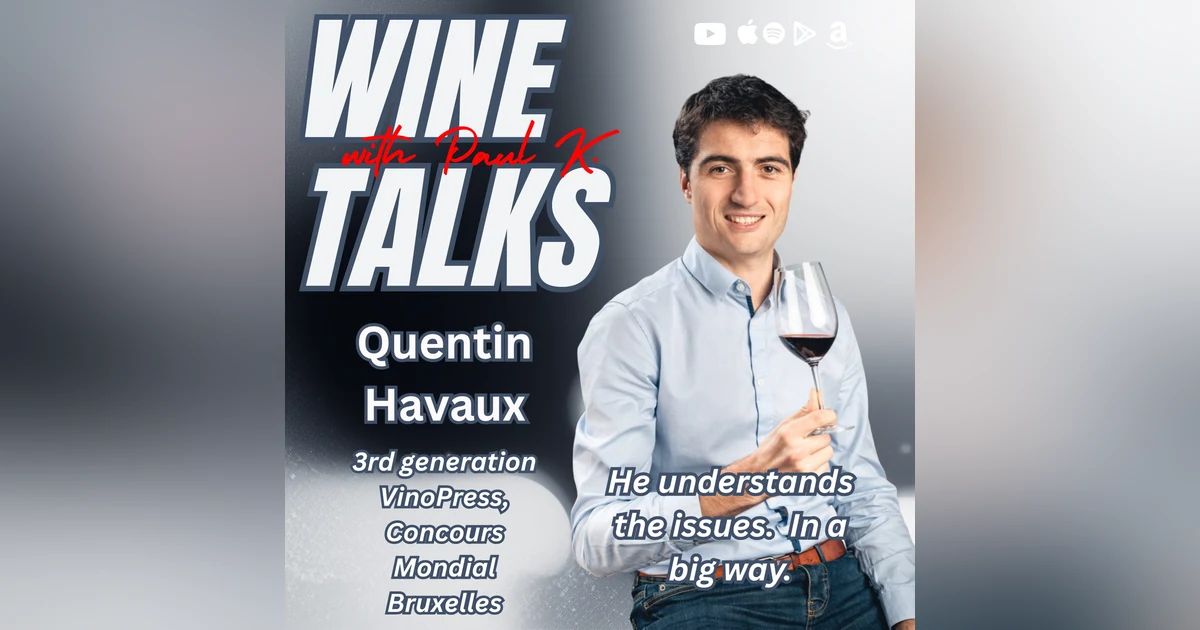

The Concours Mondial de Bruxelles is coming to Yerevan, Armenia. It is a huge feather in the cap of the Armenian wine trade and the story of how and why it landed there is inspiring. Quentin Havaux is the 3rd generation of the fames tasting and judging group and the ascent to international recognition of the CMB is quite organic and humble.
The wine trade is unforgiving and requires tenancity and patience. Quentin describes the history of CMB with pure enthusiasm and passion. And the relentless ambition to tell the stories of wine is inspiring.
Quentin Havaux believes wine isn't about intimidating jargon or arbitrary numbers—it's about the stories, the traditions, and the sheer enjoyment found in every glass. In this sparkling episode, listeners are invited to sip on the wisdom of the CEO of Vinopress, the driving force behind the influential Concours Mondial de Bruxelles. From family roots in the Belgian printing trade to orchestrating one of the world’s most respected wine competitions, Quentin reveals why he’s determined to keep wine approachable and full of wonder, rather than just a sum on a scale. Together with Paul Kalemkiarian, he uncorks how competition medals still shape the global wine trade, what it takes to champion emerging regions like Armenia, and how even the smallest producers can stand out when passion meets innovation.
You’ll hear how Quentin’s commitment to making wine enjoyable for everyone is influencing how we select, taste, and understand what’s in our glass. Get ready to travel from the wine bars of Seoul to the bustling streets of Yerevan, as Quentin brings us behind the scenes—from organizing blind tastings for thousands of wines to creating new ways for both connoisseurs and novices to connect with complex flavors through simple, engaging experiences. The narrative seamlessly blends the old world with the new: ancient Armenian amphorae, fresh-faced entrepreneurs, and an ever-curious new generation seeking more than just another familiar bottle on the shelf.
Here’s a taste of what you’ll walk away with:
-
🍷 How aroma-driven wine lists and fresh consumer experiences are breaking down barriers for everyday drinkers in wine bars around the world.
-
🍷 Why competition medals and international tastings are more than just marketing—they’re vital tools for elevating quality and helping producers from new regions gain global recognition.
-
🍷 Insights into the challenges—and unique opportunities—of introducing unfamiliar grape varieties and wine regions to a marketplace saturated with the “usual suspects.”
By journey’s end, you won’t just know more about how wine is judged or marketed; you’ll see how Quentin Havaux and his team are reshaping the way the world shares, savors, and celebrates wine—one lively conversation, and one unpretentious pour, at a time.
YouTube: https://youtu.be/qxITeNKKmME
0:00 Wine is not like a science. And you cannot just say okay for me. That's why I don't like to give just a score to say, what does it mean? 92 for me, 92 doesn't mean the same as you. For me, 92, it's just a score. It's just number. Sit back and grab a glass. It's Wine Talks with Paul K. Hey, welcome to Wine Talks with Paul K. And we are in studio today, beautiful Southern California, broadcasting all the way out to Bruxelle or Brussels, as we would say in English, with Canton Havo. He's the CEO. And what other title do you have with the Concours Mondial de Bruxe?
0:40 So I'm the director, the CEO of the company Vinopress. And Vinopress is a company organized concretemontial de Roussel, the cmb. I think for you it will be also easier to pronounce. Yeah, Vinopress. That's right. Your grandfather started this idea of WinePress. Let's go. I want to back up just a little before we get into that history. I missed you at Wine Paris. I got to swing by. I think I spoke to your father briefly. Was that a successful event for you guys? For us, it was a big success. So we are there and we are present for. In Wine Paris for the beginning. So like almost four years ago when it started. And for us, it's really a really good to be there because we are there with. Last this year, I think we were there with more than 30 producers only awarded by the competition. And it's really a good window for the.
1:33 For the. On the international stage to be there as a wine competition, but also to promote the producers. You know, it's interesting. And I came away because I was. I did not feel well. Okay, I was, I was. I don't know what happened, but maybe on the plane. And so I was coughing and I was, you know, tired and things were aching. But I was able to podcast with a woman, she's a master of wine. Isabelle Legeron and David Laurent from. From Wine Tech, L.A. wineTech. But what I noticed when I walked around and I saw a lot of old friends, met a lot of new people, and I thought there was no other product in the world like wine, as we already know.
2:17 That's why we do this. But every single One of those 6,000 vendors sells the same thing. And so I thought, wow, how much competition is there in this industry? And that's just a small percentage of the people that make wine, Right? How important is a group like the Concour Mundial to promote a wine, to promote the vendors that make the good wines. In other words, how important is it now to have a group like yours? I think it's really important because this kind of even, I mean, competition, tasting, whatever you can target, you can nominate, it's really important to really elevate the talent of the producer because a lot of you have a lot of good, amazing wine in the market.
3:00 But sometimes you need some people, independent people who will tell me, okay, what kind of wine do you like? But we want to be much more than a competition to only give award for us. We can maybe talk afterwards. We develop a lot of new tools to explain the wine to the consumer as well. And so this is something we want to also to provide more value, not only to reveal the good wine, but also to translate and to facilitate the understanding of the wine to the consumer. Because it seems like, I know you're on social media, I know you're on LinkedIn quite frequently. And you and I read the same things about, you know, the generations behind me anyway, that want innovation, they want pouches, they want cans, whatever they want. And I don't, I don't subscribe to that necessarily. What I subscribe to is what you're doing, which is elevating the appreciation for honest wine, real wine that's made by real people, for real production. Yeah, this is what we do. I think it's, I mean, this is what we try to do because for us it's important. You have, as you mentioned, you have so many wine, different wine also, and it's a consumer point of view. It's, it's really hard to understand.
4:18 It's really. So we need the need help. And also that's why it's really part of this kind of event of competition for us to give the opportunity to the producers, to stand out thanks to the award or to the medals we will provide, but also to the feedback we can translate from the tasting because we have, for all the wine that has been tasted in the cmb, we have a clear profile of the wine. That means we know the aroma, we know the style of the wine, and also for that we can share this information to the consumer. And it's really interesting to provide this kind of information. I think it's valuable. And it's interesting to me too, because the other, the other part that bothers me about some of this press is particularly the younger generations. And you know, you're, you're a third generation. I'm a Second generation wine person and they talk about changing the language. Right. You're.
5:16 You're. Your indigenous language is French. Mine's English. You speak English? I speak some French. But the language of wine is this is. I'm sure the way you talk about wine is slightly different than the way your grandfather did when he started writing vino. Yeah, definitely. I think it's really different. But also the. The way we present the wine. For me, what I have feel when I started in the wine business, it's okay. Why it's so complex. Why it should be complex because wine basically is just fun. I mean, it's. For me, it's like something. But you are on the table. Okay. You can, you can str. But it's really a fun something that you need to like to enjoy. You don't need to feel, let's say, intimidated by the wine. A lot of people and a friend of mine that when they go to the restaurant, they are so afraid to select a bottle of wine in the wine list because they don't know how to select it. And just because they don't know.
6:15 But when the bottle is open, okay, they want to order another one. But it's just like this. I think that's also part of the. Also a lot of people say, okay, there is a deconsumation, but okay, at the end. Also we need to translate it to make it much more access accessible. So it's really important for me. I think that's true. But. And I have this reverse viewpoint because it is true. People are intimidated. They get the list. I can't tell you how many times it probably happens to you frequently. A friend of mine's at a restaurant that maybe they may be out of the country, out of the state, and they sent. They text me a picture of the list and they know that I understand their palate, what they like to drink. But on the flip side, this part fascinates me. Almost invariably, if I'm with new guests or even my old friends, a dinner conversation comes around to the wine.
7:12 And it seems to be less intimidating at that point. Like you just said, once the bottle's open. Yeah. And you start talking, the intimidation factor seems to dissipate a little bit, seems to go away, and it becomes a really lively conversation about what you're drinking. And that intrigues me by forever. And every time it happens, after 35 years of doing this, it still intrigued me. But were you always going to be in the wine business? Your grandfather started vinopress. Was that something you. I know I Hope I will continue in the wine business. But I didn't start. I started to work five years in the bank in industry in the past. And there I learned. I learned a lot.
7:53 It was really interesting. And one day my father knocked on my door, okay, hey son, what do you. Would you want to join the company and say why not? It was not easy choice. It was not. But no, I'm super happy for me to. It's almost eight years that I joined the company. So it's. Yeah, it's fascinating. It's new challenge. It's full of. I mean this industry is full of challenge. This is what I love. Yeah. Well, that's. Aren't the Roth Shields in. In the banking business so, you know, kind of the same thing, Right. Actually that's an interesting parallel. My father came to me in 1988. Wow. And was going to sell the company that, that he had started, which was a direct to consumer wine Club, the first in America. And he said the same thing to me.
8:41 He goes, you know, I'm going to sell it unless you're interested. And I came and visited and worked with. I had worked in his wine shop for years when I was a teenager. But I said, you know, I think I like this. This has a lot of new challenges. And the DTC so. But it wasn't always a. A tasting event. In the beginning your grandfather just wrote about wine. Was he a critic? I will explain you the story. So from the big whole is all. Everything started so before my grandfather, he was a printer. He was a printer in Belgium. And one of these client was the Sommelier association in Belgium. And the Sommelier association they had a magazine that they were. That has been printed in my grandfather printing company. And then at one point they went off a lot of money and they couldn't pay for the printing.
9:36 And how they managed to give the money back, they said, okay, the magazine is for you. The name of the magazine is for you. And so my grandfather started to have the brand of the magazine La Revue des Sommelier in French. And he started to continue to create and to edit and to start article, to start to be interested by wine, to travel and to do editorial for this magazine. And that's the way he entered in the wine business. And then after that he continued to organize a fair. We organized a big fair just before wine Paris, before Dusseldorf, before that we organized a big wine fair in Belgium, in Brussels. It was Mondiale de Bruxelles.
10:24 And the idea was to create a competition to animate the fair. You know, Just like to organize a competition between the wine and the winemaker that participate to this fair. And that's why the company, the name of the competition is Concour Modial de Bruxel, because it was competition for the fair. When was that periodical? When did he start printing? Printing, let's say the printing was in the 80s. And so that was sort of the heyday of wine journalism. You know, Robert Parker and the Spectator was starting and an important part. And that's changed a lot. Have you seen. Yeah, a difference in what people are reading and what they want to read about? I think, I mean, it changed a lot because it changed the way also basically we read the wine Parker invent the score out of 100. In the past it was not like this. When we started the competition, everyone used the gold, silver and bronze medals. And suddenly after Parker, all the, let's say the British or the American critics start to have score of. Out of 100. And from all parts we decided to keep, to have this gold, silver and one gold. Because for us, we don't want to follow these trends of Parker and this, let's
11:58 say new wave. Maybe we are wrong, but we still want to keep this. And we are one of the last big international, let's say critic of wine who still used this ranking of wine and not score out of 100. So yes, definitely, Robert Parker and those kind of critics change the world. I mean, they change everything. It's kind of interesting because it's really not a hundred point scale, right? No, it's really like a 20 point scale. Because you're never going to announce. We think we score out of 100. I mean, because we need to rank and so it's normal. But at the end we don't, like for me, I don't see really a big difference between 92 and a 93. What's the difference? One point. So for me it's just based on the other criteria and no one's going to, no one's going to announce that they got a 79. So it really is just from 80, 80 to 100, which you're, you know, it's a really interesting point you just made and I want to develop that a little bit for the listeners, the point scale. And I think. And I. Let me just back up a little bit. I tasted wine every Tuesday here at the Wine of the Month Club.
13:12 And you know, between 65 and 75 wines for 35 years. And I remember distinctly seeing once a wine would win a gold or silver, a bronze medal from The Concour, they would put that on the label. And I used to see them all the time come through my tasting room where those labels are there, which is something really interesting, because that has a more impactful presentation than a circle with a number on it. Right? That metal looks good and it feels good in its classical doing. But the point I wanted to make was the scoring system's kind of weird. Here's a Wine Spectator right here on my desk. Because if, let's say a wine gets a 95, let's say it's the Canary island, you know, whatever. I forgot the grape they grow there. Let's say it's from the Canary Islands. It's really good. But it's a different grape entirely than what Cabernet might grow in Bordeaux, and that gets 95, too. So there really is no guarantee that if I buy wines by score that I'm going to like it, because those two wines are completely different.
14:19 And. But here you guys have a standardization, not only the metals, but then you're talking about the character of the wine so that we can understand better. And this is, for me, the most important and the biggest advance we have done for the last five years. So now we ask to all the tasters to write comments, so all the tester. We don't ask them just to score it, score it. It's too easy. We know that we want them to really comment the wine. They have to write sentences. And then we have developed a startup in Bordeaux, like an algorithm who can understand this toast, comment, and destroy this comment in data. And then know. That's why we have data on each wine that we taste. And this data, after that, we give it back to the market, to the consumer, to the producer, to the distributors.
15:08 And. And like this, you know, okay, this is a good wine. This is awarded. But you also know the style of the wine, because I am sure that. Because you can find, as you mentioned, like a super good weaseling with a bit of residual sugar. But it's not my style. I know that. I don't. This is not what I like, because I'm not really a big fan of sugar. But for people who like this kind of style, you can be sure that the wine is good because it has been awarded. But you. We provide also information about the style and the aroma of the wine. And this is really important in terms of consumer point of view. That's interesting that you said recently, because I was just reading that the state dinner that Donald Trump is hosting Prince King Charles with, they're pouring Riesling. Okay. I didn't know which one.
15:57 Well, you know what? I was, I was fascinated. I'm fascinated by the idea of wines in the, at not only the White House, but poured throughout the world at the, at that, at that level. Yeah. And you know, I have, I, I. There's a whole book on it called Wines at the White House by, by a friend of mine. And, but it's a, it was a Long island from New York recently, which is a good area for that. But I just thought that was fascinating, actually. Might have been Connecticut. Anyway. And then the Pinot Noir was from Oregon, which is of course a very well known district for Oregon Pinot Noir, but not, not, I don't think, the preeminent district of P Noir. And then there was a Napa Valley Chardonnay. But what's interesting, just as a side note, they didn't pour American wine in the White house until like 1960, 65 or so.
16:50 It was all French. Okay. Through most of the, the growth of America. At that point, all the wines poured at the White House were French. And it wasn't until the 60s that they started pouring American wines. So let me ask you this. One of the, one of the marketing tools I used to use at the Wine of the Month club was we'd go to a fair, state fair, county fair, a food fair, wine fair, and op. Have a booth. And the largest tasting in America at that time, and I'm talking about through the early 2000s, was 2,500 wines tasted and rated. And we use that information to, to show off the wines that we had selected. But I read that somewhere that you're tasting upwards to 7,008, 10,000 wines. Is that accurate in one of your big tastings? Yeah, I mean, for us it's quite. So you know how we organize. Can I explain how we.
17:45 We organize the tasting? So basically this year for. We receive around 7,000 samples entries. So. Wow. Which just for the next tasting that we will organize for the red and white, and basically each wine will be tasted by a commission for at least five to six international tasters. All those tasters, basically what we care when we have to select them. It's about diversity because we are international and we care about the diversity. So around the table you will have different profile of taster. So we have international buyer, but for example, buyer for supermarket, but also buyer for a small retail shop. You will have sommelier and you will have also journalists and people who really come from the market who really work on it.
18:34 And so the different Profile of TSL is really important, but also we will have diversity around the table in terms of nationality. Because I know that you like, as a people from America, you have a, let's say a national preference. But if you go to Asia, if you're in China, they have another national preference. So that's why we care about diversity around the table. So you will have four people or five to six people around the table. From five to six different nationalities with different profile of taster and the taste fully blind. That's really, for us, the most important is to be fully blind. They just know the vintage of the wine and they cannot toll. So that means that they have to score the wine by themselves to write a comment and they score it and then after that they receive the average and they can decide if the wine is awarded or not. But for us, as we are in Belgium, in Europe, we have a regulation about the number of awards we can deliver. It's 30%, we cannot go higher. And that means that if you limit the number of awards that a table can give and also because that means that all the wine receiving on the world at the cmb there is a consensus by a lot of different people from different nationality and different profile that the wine is good.
19:57 That means that all of them went for a super high score to score the wine. And that means we can be sure that the wine reach international consensus and the wine really deserve an award per se. That's really, I mean, the key we do. And after that also we have a partnership with a university in Belgium in the statistic department. And they do a lot of statistics about the result. Because otherwise we, for example, to see if one commission is maybe more generous in terms of score because we have different culture. For me, maybe, you know, in Belgium, if you receive a 16 out of 20, it's really.
20:43 In university is really like, we call it grand distinction. So it means a really nice point. It's really one of the top you can get in the us. Oh, interesting. Normal that you would receive an it an it. It's normal. At the university I did an international exchange in Mexico and I received 95, which is not super nice. It's good. In Belgium if you have like 16 out of 20, it's correct. It's like 80%. It's. It's really good. It's really the top you can achieve. That's interesting. We have different skills. I mean for me, 80 is good. For you it's 90. So that's why we use statistics based on the different profile. Of the taster, because we know that wine is not like a science. And you cannot just say okay for me. That's why I don't like to give just a score to say, what does it mean? 92 for me, 92 doesn't mean the same as you. For me, 92, it's just a score. It's just number. And that's why after that, we do statistics based on the profile of the tester, how we use the scales and everything like this. And so after that, I find that fascinating for a couple of reasons. One, you know, they've gone back and they've done that same sort of statistical analysis with the judgment of Paris. You know, the famed tasting in 1976, which obviously at that time was much looser. You know, the. The standards were much different on how to judge, how to judge. And so they've come up with different
22:14 results of that tasting by applying some of these statistical models to see how it works. And I. And you did that already. You've already decide that. That's really interesting. Why, why Armenia? Why did you guys. I. I know that you do like to choose smaller districts, lesser known places, but how did Armenia become on the map? So basically, yeah, one of the big principle of the Komal de Brucel, it never. It never happen in Brussels, which is good because Brussels, it's nice for once, but after it start to be boring. So basically, so we are itinerant. And the goal is that we can also introduce a new wine region every time we organize the tasting.
23:01 It's also good for emerging regions that need communication, visibility, to promote themselves. So that's why we organize the tasting in different place. Armenia, it was not the first choice. I mean, we started to have like a conversation with them four years ago, remember, visited the country and I was to be on it, honest, amazed. It was really nice. I discovered a full culture of wine, a lot of really interesting wine in terms of great variety of people of culture or story. And that's for me also the reason why we like to be itinerant is to show this new region of the world to the wine world.
23:43 And that's why it was. When I was there, it was obvious we need to organize the competition here to communicate and to promote the region to the world, because it's really, I think, something unique. You don't have so much kind of new place like this who has a so big story, but also so much of treasure, like a great variety. You have like amazing terroir. You have amazing. It's crazy. And so, but you need to go there to understand it. And that's why for us, it was really key to organize an event there to really promote and to show to the people, okay, this is Armenia. This is why you need to care about this country.
24:24 In terms of wine, it's amazing to me, particularly through the whole Soviet bloc era, Georgia, Hungary, Romania, they all went through the same. They all suffered through. And a quick story. I mean, when I started with my father in the 80s, one of the first wines that I was exposed to was a Romanian Sauvignon Blanc, which when I did my research recently, he bought when it was part of the Soviet bloc still. And I thought, I go, wow, that's a pretty amazing deal that he would bring wine in from. From Romania that when it was governed by the government. But it was an excellent value. I mean, the price is right. But Armenia, to me and having. And I'm of Armenian heritage, the progress they've made in the short amount of time since freedom, because they are relegated to making brandy and some fortified wines. And so, you know, there was the. The vineyards were neglected because the quality of the grape wasn't as important. And all the different things that go along with. With communist rule, I just find it stupendous that they've been able to move the needle so fast and get to a level of quality that they have that's, you know, becoming world. You know, a benchmark of world quality. Yeah. But also what I love, it's the technology, but they keep also an identity, which is with the grip. I mean, for me, the biggest advantage they will have for the future is the
25:55 new. The grip, the irony, the vosque, that all those grip are really good. I mean, this is something also that they are. And they are still learning. This is also what I like in this country, because they know how to produce wine, but they are still learning how to improve the yield or to better manage the vineyards. Everything, they are still learning about that. And that make me fascinated about how they will develop for the next 20 years. If you consider what they have done in 20 years, if you look for the future, it can be like it should be a success story. And that's why it's a really good time to be there. Because I think now it's really the renaissance. We are really on the top of the wave.
26:44 And so it's good also for them to be known. But because now, what I think they miss, it's a bit of a. And knowledge of the public, because a lot of people, when you speak about Armenian wine. They don't know that Armenia produce wine. And so that's why they need to promote themselves. Also. That's an interesting quote. One of the shows that's being released by. By Civil Net, the group I was telling you about, we have four episodes. One of them is with James Tufakian, who owns the hotel chain there and started a brand. And he. He's. The opening line in the show is, isn't it cool that we. We come from a country that. That no one's heard of? I mean, it's a. It's a negative that no one's heard of it, but then it's a positive. Isn't it cool that no one's heard that we make wine and that we can explain wine to. To the public through the lens of a glass? I'm going to say it, I'm going to say it now publicly on the air, that I don't think Adeny likes oak.
27:47 I think I put the fresh one on the red fruit, and it's sweet. We agree on that. Sireni, the grape of Artsakh, I think, does really well with oak. But here's. This is fascinating to me. Maybe you see this throughout your career when you visit these new emerging wine districts, these ancient methodologies, like, for instance, at Voskavas Winery, which we just released that show, they use, they. They try to find the oldest katas. The oldest amphora. Yeah. That they can find, and they keep finding them through different little villages. And, man, I think those wines are so complex and so telling of where they're from and that. That it's that ancient method that's doing that. Right. And I think maybe this happens or maybe you see it or you don't, but it seems like emerging countries that are making wine, or at least bring them to the forefront of the wine community, try to rely on some of the current methods, like lots of oak or new oak or new French or new American or whatever they're putting in their wines, only to realize later that we should go back to where it used to be when. When this was burgeoning. You see that. Exactly. No, I fully agree. And also that's also that you can see that in the market, you have no new producer who start. And to have like this, let's say, use a lot of oak. And I think, but. But the best one I have tasted there is really when they keep the
29:20 identity of the grape. And this is for me. No, I think they are learning and they're learning fast. I know that some of them, they still want for themselves like to have a premium. Premium wine and premium for them it's. It's mean oak and they need to have like at least two years in the oak barrel and it's better and. But for me they still learning, but they are learning fast because you can taste no new Irani based on just fresh. No just Karas or use also Antono. It's really nice to see that they can also produce really premium wine in this way. And not only as a lot of country do. When you start to speak about premium expensive wine. A lot of oaks, double oats sometime. And so that's.
30:12 And that's good. And I think you mentioned about the carrots for them. For me it's really interesting because it's really another. It's from. Because I visited Georgia in Armenia and you know, the KV and Caras. And for me it's two type of wine completely different. It's really interesting to see that even if they still using kind of the same aging process. I mean the. The result is not the same. And because it's two type of wine, it's really. It's really interesting. It's really completely different type of wine. If you compare Georgia and Armenia. And that's also something really interesting, really good. What did you think of Yerevan? I loved your city. It's so dynamic. I mean the first time I was there, okay, I. I didn't know what to expect. As you mentioned, you arrived in Yerevan. You are always in the middle of the night. Of course, because the international flight arrived at 3:00 in the morning.
31:14 You arrived, you cross the bridge and then you arrive in the city. It's dark and then you woke up and the day after it was so dynamic. A lot of people. But what amazed me the most it was the number of restaurants and terraces outside. It's full and you can. You have so many really good restaurants, good gastronomy places. It's really amazing to see the dynamic of the city and the people are always outside. For me it's really wow. I was really surprised and on a good way, I think. Well, I kind of liken it too because it is. And I've seen this in Hungary, I've seen in other countries that, you know, the development of the culture is arrested, it's stopped. Know when the Soviet Soviets were there, they weren't allowed to express themselves.
31:59 And so yon is sort of a mixture of. From the architecture to the path they're taking to. Like you said, the restaurants are great. It's. It's sort of a blend of European progression and food recognition. But there's still that element, the old world Soviet bloc mentality. And it. Yeah. And I found Yerevan. Absolutely. What's the word I'm looking for? Just intriguing. Because you can walk till 2, 3 in the morning and you feel very safe. It's true. And I didn't expect that. Me too. Yes, we. Yeah, it's. And it's a mix because. And what I love also, they keep it in Antiti. It's not like.
32:41 Because a lot of big city in the. I mean, in the. In the country, it's like the same. You have like new building, you have like this big tower and you don't have this kind of new tower in Yerevan. It's like still kind of devening entity. This is something unique because in some big. That's what I like. Because in some part of the world, you arrived in the main city and it's like the same as in another big city. But in Yerevan you have this authenticity and this identity that is really interesting in terms of. Yeah, you like or you don't like this. Let's. Big rock building. But it's nice. It's part of the history and the identity of the city. So for me, the personality of it, for sure. And also you mentioned the restaurant. I love the fact that they keep a culture of the restaurant and you have a lot of Armenian cuisine that developed also. You don't have only a pizzeria or Chinese food. No, the majority of the restaurants are Local 1. And this is really good, I think, for the culture and for the country. We were there 2007, I was. I've been there a few times since. But 2007, this is how fast it's changed. You couldn't drink the wines and culturally you're required to say they're really good when you talk to the winemaker, but you couldn't drink them. Okay. And then.
34:08 And the restaurants were all identical. In other words, there was, even though it was all indigenous cuisine, all the same thing. They. It sort of tasted the same. But now you get this fresh take on Armenian food as well as international character. They're bringing in chefs, they're bringing in winemakers that change, you know, blend the cultures a little bit. Which leads me to this thought. You know, you were talking about Georgia wines a little bit. And Armenian wines have the same issue in some cases. There are some very rustic, indigenous Armenian wines still. Yeah. Of the character that, you know, the world's just not going to accept or unless you're just A wine, you know, academic wine person who wants to investigate these things. But the modern take on their wines, the expression of oddity, as you and I discussed, with or without oak, etc. Is starting to create complexity. Yeah. It's starting to create balance.
35:12 It's starting to create, you know, that volcanic expression that Armenia should be known for. When it, when it all said and done. Was that intriguing to you? When you start tasting these, these like. Let me put it another way. In 2007, I would have never poured an Armenian wine at my home. And now I'll open a bottle and not tell anybody that it's Armenian wine. And they'll swirl it and sniff it and go, wow, this is really good. Yeah. And no, but for me, what I love in the. I mean, if you. We can continue to speak about the irony, because for me it's. I'm a big fan of the Iranian and. But also it has this freshness and you have the red food and the freshness of the volcanic. It's really, for me, the quality is there.
36:00 The only issue sometimes you have with Armenian wine is the price. And I know it's price point. Sometimes I don't. I don't understand how they positioning the price. But for me, it's to have all the standard in terms of quality, in terms of. For the world, I mean, for international market. That's why it's really interesting. It's really fascinating to see this profile and it's quite unique because a lot of people ask me, okay, Arini, what is like. A lot of people try to say, no, it's like a Pinot Noir. No, it's not. It's not. But it's unique. It's like something unique. You don't. You cannot compare with other grip. And this is for me, really interesting. It is a fascinating thing.
36:45 And you're right, they'll use Pinot Noir or Pinot Noir Sarah blend as a character. And it's like, no, you can't say that. And you don't want to say that. I was. One of the conversations I had on this show was with Mariam Sagatelli and she owns the first wine bar you probably know. Yeah, yeah, I was there in vino. And she. Fascinating conversation. She's a brilliant young girl, a young woman actually, in the sense of. She has taken it upon herself to introduce yet Aon to the idea of a wine bar. But one comment she made to me, and let me reflect on this. I want you, I want you to go back to some of the other countries that you've hosted the tasting at that all of a sudden now there's a lot of brands and it's, you know, everybody's stepping up to the plate and creating a label and they're creating brands. She goes, I don't know where we're going to sell all of these different brands. In other words, there's not enough consumers here yet to have you see that in other parts of the world where these emerging districts, everybody jumps in the romantic lifestyle of wine and we're going to all be winemakers and, and all of a sudden we realize it's business and there's a lot of hurdles to overcome. Yeah, maybe in Belgium.
38:03 No, it's. What are they drinking in Belgium? No, in Belgium, though, we start to produce wine also decent sparking. And we have new wineries every six months. And it's good to produce wine, but at one point you need to sell it. And we have the same issue. We are exact in UK also uk, they have a lot of wine. They produce more and more every year. But the market, it's. The UK market is not so big and so note if they need to sell it, you need to go abroad and you have to play the game and to compare yourself because it's always easier to sell your own national production in your country. And we have the same in Belgium. We have a lot of new wine every day. But at one point the Belgian market will not be enough and the producer will need to go outside of Belgium to sell it. And it will not be the same because you don't have like this proneness to drink national.
39:04 And it will be, I think, yeah, we have it in uk, in Belgium we have this kind of new. We will face this kind of challenge for the future. You know, I think there is always has been having been through the retail side of wine and the direct to consumer side, and there's a lot of pressure on wine right now, but you see it all the time, how difficult it must be. Let's talk about Armenia for a second. To introduce the world to a new grape. A handful of grapes and Voskahat and Kangun. You mentioned a few of them versus growing Cabernet, Syrah, Merlot, Riesling.
39:46 Not only introducing the world to new varietals, but a new district. And here, here's my business side of this conversation, which is, you know, the, the Bordelaise and the Burgundians and the, and the Tuscans. They're not, they're not going to just roll over necessarily from a business standpoint and say, yeah, sure, you know, let's. We'll put you on the shelf and we're going to give you space in this, we're going to give you space in the arena. And it, it's, it's a real dynamic, it's a real issue that, that you've got big corporations that are commanding all this space at the supermarkets and the restaurants. Yeah. Because of all the different things they can do. And then you've got, you know, little Voskavas and, And you know, Karas. Well, Karas is pretty big. Trying to come in and find a spot, you know, it's just difficult.
40:39 Yes and no. Because as I will tell you, we organize also kind of event to introduce wine in the market in Belgium. So we are communication agency and we did an event last year for Armenian wine in Belgium just to give you an idea. And a lot of people tell me, okay, it's a bit expensive, but whatever, we don't care. It's something that we can use to surprise the client. Because now the client, the consumer, sometimes they are born to drink always the same. They need to have experience. And in the specific, in the restaurant, in type of restaurant and wine bar because we have a lot of wine bar in Belgium. People are there to have an experience. They don't want to drink the same wine at the supermarket. And I think they are to have a place because it's something new, something unique that people will use to surprise their client to bringing them new wine, new type of wine that they never heard and to bring them new experience, a new taste.
41:41 And for that I think the opportunity for million wine is there because they don't have big volume at the date of today. And I don't think so. I don't think that in the next 20 years they will produce huge volume as France and Spain, as you mentioned, or Italy are doing currently. I will, I mean I will not recommend them to start to produce mass volume, but if they keep on quality and something unique and local grape and I think they are like some niche markets, but there are place for this kind of wine in the wine business for the consumer point today, because, you know, that's a really good point. I would prefer to be wine producer in Armenia that a wine producer currently in La Mancha who is producing only volume and you have to sell cheap wine. And for me it's. I would, it's easier to position a wine like this as Armenian wine in the new market. That's one new cheap Chardonnay that's without any Flavor. Don't get me started on that.
42:53 That changed my entire business, you know, when those wines started coming to America, you know, 50 cents a liter type stuff. But that's an interesting point and I think that's really valid. And that is when you use the word experience. And I mean, you and I do this every day and we have our. Like when I do these podcasts, I start to get a craving for something. And like the other day I had a. I had the representative from Cajah Rosa, which is owned by Chateau Gisco, and I was having this craving when I got home to have a Giscore. I don't know why, it's just we do this every day. Maybe. But the idea that you just mentioned in Belgium or anywhere else, that the consumer's looking for a new experience. And I think that's the saving grace of the wine industry and always has been for thousands of years. And that is a new experience. The experiential side of wine is what keeps it interesting and going. Let's just take San for a second. Yeah. And this is something I'm really.
43:54 We are really confident that it works because I don't know if you know, Cocomol, we open already five what we call CMB experience. So CMB experience is like wine, bar, restaurant. Well, you have only a wallet. Wine by Coco Mondial Brucelles for the consumer, we have two in Mexico, one in Milan, one in Seoul, in Korea, one in Benin, in Wow. In Cotonou. And there you have what we provide. For example, I will tell you how it's operated in Korea. In Korea, in the market, the consumer, they love wine, but they don't have any knowledge about the wine. They don't know what is a grape and they don't want to know currently. So basically how we operate the wine list there the consumer can decide I want a silver, a gold or a one gold medal.
44:47 And. And we provide them a wine list based on 3 aroma, I want a gold with tropical fruits, a lot of freshness. And he start to drink. He like, he don't like. If he like, he order the bottles. Okay, fine, he love. And then he will discover what the wine is. He don't go to the wine through the appellation, the AU pay Aussie JP whatever you want. Or the older grape that he, he doesn't understand. And so he go by the aroma, by the profile of the wine. And then they like, okay, they will go and they will understand what type of wine is. And for example, in Mexico as well, we provide, we have A wine list based on the aroma.
45:28 It makes like to the consumer a new experience in terms of wine consumption because they start to play also, you know, in Mexico we have this wine bar and so the consumer take this aroma list and okay. And then when they have the glass in front of them, they start to. Oh, it's true. I smell the pineapple. I got it. And you provide something fun. You provide something interesting to the consumer that he can start to enjoy. And this lot of wine expert, maybe he didn't smell the pineapple, it's just because it was froid and in front of him. But at least he play and he has a fun moment with his friend or with her girlfriend and they can play and the wine is not intimidating anymore. It's something fun. It's something that you can enjoy and you can. You can be relaxed to order. What an interesting perspective to be able to witness between opening.
46:25 What you would think on the surface is the same store, but in different countries with different viewpoints on wine. And you have to adjust how you entertain that client based on their. On their culture. Basically. Yeah. Incredible. Yeah. It's really interesting because I know we are doing this with what we call. We have created like a certification for restaurant who want to use this kind of materials. So we. We support them to create a wine list. We provide them for all the wine that we have in the database from the tasting. We provide them all the aroma that we receive from the command of the taster and we give them in a new way and we implement it in the restaurant. And it's so nice to see the reaction of the consumer because this is something they understand and they like to play with and you provide experience. And also, you know, the consumer, if he has the certification that the wine is good because it's a valid wine and he can select wine based on different criteria that just not country or region or grape. He will try new wine. For example. No, in Milan. In Italy we sell Bulgarian wine. But it was for them to. Otherwise it would be impossible to taste a wine from Bulgaria in Milan. I mean, they are producing massive of Italian wine there.
47:48 Why. But for them it's oh, nice. Tonight we had a Bulgarian wine. It was a really nice experience. You provide them a new experience, new type of wine. And we did an. We did a partnership here in France with one of the biggest retailer to have 250 shop all around France. Normally they sell only French wine. We did something with them during one month. We introduced wine list of 30 international wine that we select by ourselves. Only allotted wine. We provide this information to the client. And the client, even in France, loved it. I mean, we had Armenian wine, we had wine from Moldova, wine from Bulgaria, Romania, Italy, of course, all different kind of region. And the consumer love it because it tried to have new experience, to taste new type of wine that they never heard about the grape, they never heard about the Regent, but they feel confident. Okay, because it's good wine, it has been awarded. But also you give them some information, okay, the style of the wine. Otherwise you will always drink Bordeaux, which is good. I don't want to do a polymaker around the Bordeaux, but you basically, you know what to expect when you order a bottle of Bordeaux. You know, almost the style. But for me, the first time I would go to order a bottle of Mesquet from Bulgaria, if I've never heard about miscat, it's impossible. So I will never order this kind of
49:20 wine. But if someone introduce you in the way that you can understand the wine, I will feel much more confident to order this kind of wine or to buy this kind of wine in the shop. You know, that's, you know, we're out of time. But I don't want to stop quite yet because it's a very interesting thought because when I walked around wine Paris, you know, everybody's singing the blues and about the issues with the wine trade, and there's a lot of reasons for it. We don't have to appeal all back, but you know, parts supply, parts demand, et cetera. But this, this idea, you know, because wine is so experiential and we need to promote that. And that's exactly what you're doing here, that by. By exposing the novice wine drinker. I'm trying to articulate this. The novice wine drinker can recognize that the two glasses of Sauvignon Blanc from two different parts of the world are different, but they don't know how to say it right. And they don't necessarily understand how to appreciate the differences. And here you folks are, you know, creating the notes, creating the documentation, exposing people through your wine bars and through, for instance, your experiment in France to, To try these things. And all of a sudden you're creating wine enthusiasts like, wow, that was so interesting. I never knew these things. And you're right, because they're going to the supermarket
50:50 and they see in America anyway, Josh or Apothec Red or all the standard stuff, yellowtail. And then they just buy it because they're used to buying it. Yeah. And I think this is. It's almost a Hand sell. It's almost like you're doing it like one at a time. Yeah, but I think that's what it takes. And yeah, for me. And, and that's why we. A lot of people start complain that the new generation, they don't drink wine whatever they want. But I think it's just that we have to adapt also the language, the way we present the wine. And that's also because if you speak to the winemaker today, they will always, I mean, it's always lasting. Go to wineries, ask to the winemaker to introduce the wine. He will start to speak about the soil.
51:36 I mean, in front of consumer. Good luck. He will start to speak about the aging process, age on leaves or whatever. If the wine did the malolactic fermentation, if the wine and the type of. And so it's something that it's impossible to understand. I mean, from a consumer point of view, no way. And then they will start to speak about the grape. And for a consumer, okay, but at the end, what is the wine is good and what is the taste of the wine? For me, what is the most important for the consumer? It's all the wine taste. And this is what we are doing now. And if it's good or not. And this is the mission we want to do. It's really to do.
52:16 To facilitate the consumer choice and not to simplify the wine in the wine market. So when is. We're going to finish on this thought? When is CMB coming to America? Ah, when America wants us. That's a good answer now. But one day we, I, we had this conversation several times to organize the Sauvignon selection. So we have one competition only for Sauvignon Blanc to go in California. But it was not. But one day we will come. I want to. We're here, we're here. Got a studio. Love to see you in Los Angeles. Anyway, it's a, it's a, it's a. We're in a bit of an upheaval. There's a lot of problems here in the wine world. There's been a lot of consolidation. Distributors have gone out of business. They've merged together.
53:11 The hospitality, you know, we. I was talking to a restaurant tour last week and. And his bottle sales are off 30%, you know, and that's when you consider that wine and liquor, the part of the, the part of the check, you know, the part of the. Is the margins are in the, the wine and the liquor. And if you're off 30% in that department, you know, You. It's a, it's a tough, it's a tough environment, but I think it's going to settle down, I think. And I had this thought and we'll finish with this. I already said this, but we'll finish again. I think every generation, whether it's Gen Z's, millennials, baby boomers, my parents generation, eventually and some later in their lives than earlier, understand what wine becomes in their life as part of their lifestyle. And it has unique contribution to a lifestyle that it just takes some generations longer to get there. Yeah. And also I think it's part of the, the industry to reinvent himself, to provide new experience. I mean, no, I, I mean I, I saw in so many place, new festival, new place with a lot of young people and they are drinking wine everywhere. And I mean it just also up to us to, to change also and to. But I'm convinced that the young people, the new generation, they love wine. They love wine, they want to drink wine
54:43 and we just need to bring the wine and to speak to them in a good way. And that's why. But it will come for me, I'm not so pessimist. Of course there are big trend about the alcohol consumption which is not, which is not good or not. I think in terms of wine, I'm sure that the consumer, the new generation, they are still there, they still want to drink wine and we just need to also to change and to adapt the way we will offer the wine to them. There's a. I know you're aware of this, but I thought it was really interesting and I had her on the show not too long ago. Pauline, vicar from the think tank out of Chateauneuf du Pape I think is in the Rhone. And this, the name, the name of it is Odd and E. Global. Yeah, right. You know, you know the group. I thought that was fascinating. Anyway, it's such an honor to sit with you and chat about the industry. We ran out of time and I, I was invited to judge by Zara Muradian but I'm going to be on a two week trip to Ireland before, just before like until the 19th or 20th and I just, I couldn't convince Mrs. Callum Carrion to, to hop on a plane to get to Y. But I'm going to continue with, with what I'm doing with the trade and the press and the media to get not only Armenia but other regions of the world into the, you know, the, the phones and the
56:17 videos of the consumer and try and tell a story that's different. Than what you just talked about, the soil and the malolactic fermentation and the grapevine. I mean, who can understand that? But there's passion like you, there's people like you, your father, your grandfather, that are in this industry, that make the industry, and that's what we need to tell the stories about. So congratulations on everything and I'm looking forward to seeing what comes out of Yerevan. Yeah, you follow us on the social media, you will see a lot of picture and video and let's keep in contact for the future to maybe you can take part one event we organize.
57:00 Love to do it. Cheers. Cheers. Thank you very much.