

 Apple Podcasts

 Spotify

 Youtube Music

 RSS Feed
 YouTube
 Pandora
 iHeartRadio
Inside Valentino: Piero Selvaggio on LA’s Italian Food Revolution and Wine Culture
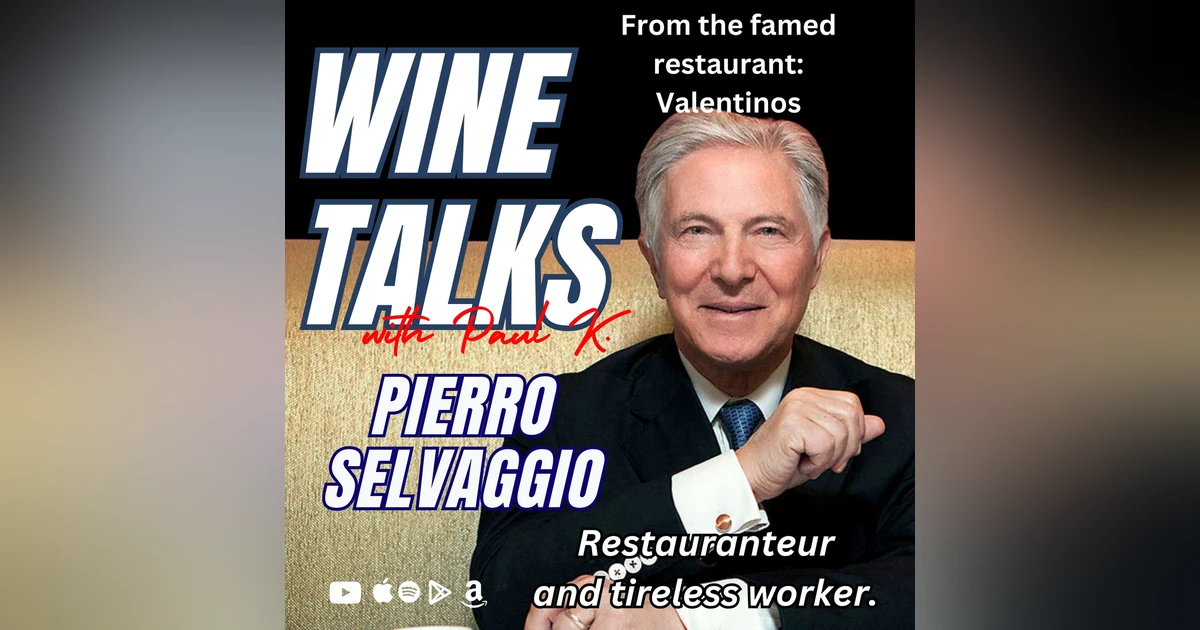
Step into the story of LA’s culinary evolution with Wine Talks, where conversations are poured as generously as the wine. In this episode, I welcomes legendary restaurateur Piero Selvaggio—a man whose career spans the golden age of Los Angeles dining, and whose philosophy on food and wine has inspired chefs, winemakers, and bon vivants the world over.
Wine Talks isn’t just about swirling glasses and describing bouquets—it’s about the unforgettable people behind the bottle, and the moments that shape the table. Imagine LA in the early 1970s, when Italian cuisine meant little more than checkered cloths and spaghetti. Into this world, Piero Selvaggio arrived with little more than $5,000 and a vision—an immigrant’s drive, sharpened by honesty and the hunger for authenticity.
Through his iconic restaurant Valentino, Piero Selvaggio became both a host and a bridge—introducing LA to the wonders of Italian food beyond the basics, and to wines that would soon rewrite world history. The cast is rich with characters: Jim Barrett of Chateau Montelena, the quiet revolutionary behind the Judgment of Paris; Wolfang Puck and Michael McCarty, friends and culinary disruptors; and a procession of winemakers, chefs, and critics who together transformed LA’s dining scene from backwater to beacon.
But at the heart of the story is Piero Selvaggio's enduring message: passion and curiosity are what make the journey worthwhile. He shares how a well-timed piece of honest criticism set him on a path of discovery, how the bonds between food, wine, and people mean more than accolades, and how restaurants aren’t just businesses—they’re places of memory, inspiration, and celebration.
As Paul Kalemkiarian and Piero Selvaggio unfold the tale, you’ll hear about earthquakes that shatter cellars but never friendships, about the pursuit of true ingredients, and about the resilience behind the glamour—especially in times of uncertainty. The conversation is a tribute to tradition, innovation, and the spirit that keeps us gathering, toasting, and tasting no matter what.
Listen to Wine Talks for a seat at the table of LA’s great culinary adventure, and find yourself inspired not just to drink, but to savor the story in every glass.
winepodcast, LArestauranthistory, Italiancuisine, PieroSelvaggio, PaulKalemkiarian, Valentinorestaurant, winecollecting, JudgmentofParis, Californiawines, foodandwinepairing, restaurantbusiness, Michelinguide, chefculture, winedistributors, winelistcuration, pandemicrestaurants, culinaryinnovation, sommelierstories, finedining, wineeducation, neighborhoodrestaurants
0:03 Now, from high atop his desk, get ready to peel it all back and get to the root of the subject, no pun intended. With Paul K. On Wine Talks, where he takes no prisoners and calls it the way he sees it. In 1981, somebody came to me in the early part of 1981. By that time, I was already getting serious about wine. I had stack of Robert Mondav in 1974 that was considered already. You know something, Jewel? I remember the wines, right?
0:50 I was very, very big collector of BB Private Reserve because, of course, you know, Chelycef was unique. But also I start becoming very serious about other California wines. And I was fascinated by California wines, although the strength of me has always been Italian wines. Yeah, of course. So at the beginning of the restaurant in 1974, we started having a very steady customer that was a lawyer in Torrance named Jim Baritz. Yeah, hold on, let me start this. And you just don't. Don't forget that thought. No, I will. Okay. Welcome to Wine Talks with Paul Kay. We're available on Google Play, Spotify, Pandora, you name it. Wherever you hang out for podcasting, you can listen to Wine Talks with Paul K. And you're interrupting a conversation right now that. I'm having a tremendous conversation. An introduction to Piero Salvaggio. Right?
1:42 Salvaggio. He is one of the great LA restaurateurs. And visiting us today in studio, sort of as we're winding out of this COVID 19 thing, we're going to talk about LA in the early days. We're gonna talk about wine, we're gonna talk about what's happening today and what happened in the days. And so he's in the middle of a story about our friend Jim Barrett, who was one of the regulars at my dad's wine shop and a good friend of the family. So he was a customer at Valentino. Right about when Valentino became a little famous. So we talk about 1974, when I was getting a little serious about wine, when I was getting a little serious about what food is all about. I had almost passed that connection that spaghetti and meatballs must be Italian and nothing else.
2:35 So this gentleman became a very good customer. Him and his old law firm, actually. But they were in Torrance, weren't they? That's what they were, torrents. Yeah. You were in Santa Monica. I was in Santa Monica. But obviously, for good food, you travel. You travel, right? And within four or five visits, one day came with a bottle of wine. And he says, you didn't know I make wine too? I say, No, I thought you were a big lawyer. And I knew that Ernie Hahn, that was a major, Major investors and business developed as he developed a Palm Spring and so forth.
3:15 Also gave Jim the idea to rebuild Chateau Montelena that was dormant for 100 years. And. And so he showed me this beautiful label, and he told me that he had a kind of a temperamental winemaker named Mike Gorguch. And that was the beginning of a great friendship. By the way, that bottle of Monteluina, Chateau Montalina was a Chardonnay that let her know within couple of years, became, you know, the big surprise in Paris. So the friendship lasted. I was a big, big supporter of Chateau Montelina until one day after Jim had retired, moved to the Napa Valley, and we kind of kept in talk and so forth.
4:04 Around 1990, he says, send me a picture. And I said, jim, for what is it, an album or something? He says, no, you'll be surprised. So the surprise was a magnum of. Of Chateau Montelino Cabernet with my face on. Wow. Really? A beautiful magnum with my face. That's great. And I was very excited by that. And that became with another wine that was given to me by Franco Biondi, Santi. Like Bion di Santi, Brunello, 1891 Brunello, one of three in the world. Wow. Yeah, those were the two showplays in my wine cellar. So everybody, of course, had to come, had to look around and then says, what are your two favorite wines? So I was pointing at that until a earthquake came in 1993.
4:56 Oh, no. And sure enough, that day actually was January of 1994. My cellar got destroyed and we lost about 27,000 bottles of wine. Yeah, it was one of. It was one of the tragic things of the wine world, really. So as I'm cleaning Petrus and broken Gaia and broken Bordeaux, here is my favorite bottle of wine. The Chateau Montelina 1986, with etched my face and everything. And of course, you know, I almost cried because that had an emotional value. So I called Jim and I said, you know, you won't believe it, and so forth. And I have to say that through the breakage and through the earthquake, the winners couldn't have been more generous, more supportive, really. I had been supporting them. It was vice versa. And so within a month of telling Jim what happened, there was another beautiful magnum of 1986, Chateau Montelina, with my hatching, but with a little difference.
6:03 Earthquake Edition. Oh, that's so funny. Yes. Wow. What a great relationship. Yes. And that is back when was this so that was. Well, that obviously the 1996. 97. And so the first one was. Was in the Earlier. Earlier, yeah. So fast, fast forward. This is just the conclusion of this little story. Irene Birbilia, that was the restaurant critic for the LA Times, was assigned to do the obituary of Jim Barrett. So I didn't know that. So she called me and she says, piero, you know, I know that this guy founded the winery and this and that, but what do you know? So half of the obituary was about my story because Jim was such a quiet, low key person and such a splendid person.
6:52 So this was a little token to his generosity. That is really a great story because I've been doing a Judgment of Paris series. You just added to it with that story because growing up Palace Verdes, I knew the Barretts, I surfed with the Sun. Long story short, I had Bo Barrett on the show already. I've had Steven Spurrier, all that. And so this is a wonderful addition to the story. I just want to touch one thing for the listeners. You know, our paths have probably crossed dozens of times. I've been to the restaurant many times, particularly for trade tastings, which you were very well known for putting on, particularly Italian wines. But the LA food scene, particularly in 72, when you started, that was 72 or 74? 72.
7:40 72, when you started was nothing. I mean, what did we have? Well, and I brought up the word. The names that you just brought up and I brought up, I have them here for a different reason. And I'll get to that in a second. But there was Chasen's and they had chili and there was what, the Brown Derby. And I'll throw another one at you. The Windsor. Behind the Windsor. Ben Dimmesdale was a wonderful, quiet gentleman. And remember that that Middle Wilshire at that time was a much better location. Perino was down the street. Perino's, right? Yeah. What wasn't exciting was downtown. Downtown was a wasteland for restaurant. And the west side wasn't explosive like it became eventually. So I texted my wife this morning because I took her to the Windsor for a Valentine's dinner. Like when we first got married or I don't remember exactly one is.
8:30 And she's like, why are you asking me that? Cause I couldn't remember the name of the restaurant. And then it hit me. It was the Windsor. And I just told her because I was thinking about her and I wanted to remember those days, but I was actually trying to remember what was happening early on in the LA food scene that you decided to open an Italian restaurant. And you brought it up a little bit that Italian restaurants were just red checkerboard cloth pizza and pasta, you know, spaghetti and meatballs. What led you to this idea that it's time for sort of a higher end Italian food restaurant? Well, everything has a purpose. I started with a partner that knew how to cook Neapolitan food. And what I mean, without any sense of negativity. It was more of the immigrant food what was brought here. Just like the Chinese at that time. Everything was Cantonese or the Mexican was Tex Mex or whatever, you know. Italian food at that time was poorly represented because there were no great chefs. And the few great chefs were doing what we call continental cuisine. They were almost embarrassed to use the word Italian as a mainstay, really.
9:39 So Gianni Paoletti, that was the partner with whom I opened Valentino, knew pretty much that kind of cuisine. And that went on until we split. And after we split, I realized that, you know, there were complaints about the food and I wasn't a chef. So finally one day the blow came. A very, very kind of respected person that was president of latter Wine and Food Society. Things were really happening in the world of wine and food. Told me how brilliant I was in my moving around and being a host. But how bad was my food? Honest, isn't it? It was as honest and it was the best blow I've ever gotten.
10:26 Because he made me realize that what he was saying, which was, look how packed you are. And then pretty soon you're going to be fmt. Look how suddenly you're scratching your head and say, what do I do? And it's too late. So I came up with a stupid answer which was, well, I don't have a chef because chefs are white flies. So he was smoking his cigar calmly at that time. You could do that. And he says, well, go and find the white fly. So he put me on my horse and there was a little retro story, which was that a major journalist from Italy that had founded a magazine called Wine and Spirits of Italy, which at the time was Civil Tea del Bere, had come to do a dossier about Italian wine in America. And it was desperate. In New York, it didn't find anything exciting except the usual consortium wines. In San Francisco, it was shocked to see north beach. The great bottles of Brunello and Barolo. At that time, probably the best Barolo was Pio Cesar and the best Brunello was Biondi Santi were lingering in the sun, being roasted almost. This is 70 something.
11:36 78. Okay. In the Later. Okay, good. Yes. And so finally the Italian consulate told them, there is this kid that, you know, is doing nice things with Italian wine, et cetera, et cetera. So he came, we became friends, and as I took him around, he says, you know, I like to reciprocate if ever you come to Italy. When I realized that I needed help, I reached to him and I went to Milan, his guest. And I finally understood what Italian food was. I discovered fresh white truffles. I discovered that there is romit cocarpaccio, that it was divine. I discovered that there were so many wonderful cheeses and olive oil and so forth. So it was a revelation. And coming back for me was, hey, I have to be as good as these people.
12:28 So now I'm still called the Italian Maestro because we brought the first buffalo mozzarella, we brought the first burrata, we brought some of the very first great wines. The winners became my friends. They all became these people that needed what we call the altare. The altar. And Valentino became the altar for them. So suddenly, thanks to Pino, that brought Pinocheil, that brought a lot of this vineyards to me, suddenly I am in speaking terms and good friend with Piero Antinori, with Angelo Gaia, with Antonio Masso Berardino, with anybody who's whom, Italian wine that have become the pioneer and the ambassador of what is Italian wine today. It's phenomenal. You know, there's a. I had an Umbrian. No, Montefalco wine over here.
13:23 Valentino Valentini. Yeah, the mayor of Montefalco, the wonderful guy. We became friends. They make sagrantino. Yeah, we became good friends. That just short paragraph touched on so many subjects about the food and wine business in Los Angeles and what you did for Italian food. Because let's not forget that Catherine de Medici from Florence came to France and taught them how to cook. Right. Don't tell the French this, but. No, but they smile about what they know. You know, that the fork were brought by. Yes, exactly. The fork. So. But what's interesting to me because I was reading about, for instance, Le Pavillon and Henri Soleil in New York and Lou Tess with Andre Sultner, he's going to be on the show. And then there's a book out called Chef's Drugs and Rock and Roll. It's about the transformation of LA food in the 80s. I was part of it. Yes. Right.
14:14 So. So you. Here you are in 1972. This wine really isn't part of the menu anywhere, really. Right. And we. We didn't have much in California anyway. You mentioned the names. That's. That's what I stocked the shelves with in my dad's store. And, and was there really any scene in California, in Los Angeles where wine and food were connected, where you. Where you went to have a glass of wine and to share that with some food or vice versa? Was there any place like that then? No, because we were the first one that in the 80s, we suddenly had the first one page wine list made by Charlotte, which of course included bohemian and bohemian and Western, which of course included Lancers, Matuse, Blunon, Almaden and so forth. Suddenly we woke up to the fact, hey, we bought the first five cases of Sterling Cabernet 1969. Because it was just this new big thing of this gorgeous winery way up in Santa Elena.
15:18 We bought the very first Hal Bronstein, Diamond Creek. This crazy guy that says, my wine is like jewel. It was the first one to have $100 cabernet, if you remember the Lake vineyard. So we were in the path. One page became 10 page became 50 pages. And already at that time, I was so serious about wine, especially after the visit of Pinoch Isle and all of the Italian vineyards. So I gotta have. It became my fever, became the excitement. And I was the first one to explain people how important was the connection of a chef knowing what to cook compared to wine. Because also those first awakening at that time was more wine and food societies and so forth. Now you have a lot of private groups, as you know, that have their own. Their own tasting, et cetera, et cetera, right? And so one day in 1980, late 80s, this gentleman came, nice and chubby and he says, you know, I hear you have a very good wine list. And I figured, you know, okay. So he says, can I see it? Okay. He says, look, I just bought a magazine in San Diego and it was a six page throwaway magazine. He says, but I'm going to turn it into the most famous and most important wine magazine in the world.
16:39 Marvin Schenken, his name was Marvin Schenkin. So when he went back to New York and did this growing and development of the magazine, he says, well, I have a good news for you. We are going to award the best 10 wine list restaurant program in the country. And you're one of them. Wow. So we got the first Grand Award in 1981. And we kept it until we closed the restaurant, which was in 19, in 2018. That's okay, that's. Yeah, you are. This is really fun. An hour is not going to be enough because you just touched on a whole bunch of other things. In fact, I. I was interviewing a woman in Napa. Her name was Joanne Dupuis. She's 93 years old. She's a fascinating woman.
17:27 She had a lot to do with the judgment of Paris because she was the one that toured Steven Spurrier around Napa. But also, since you brought up Marvin Schenkin, she, one of her tour guides, when they went to France on Bordeaux tastings, was the guy that sold the magazine to Marvin Schenken. I can't remember his name. I have the brochure somewhere. So this evolution of what's happening in the world of food and wine is occurring as you're making it happen. This is happening because you're stirring the pot. You went to Milan, you discussed it with the chefs in Italy, and you brought these ideas back because I wrote to you in an email and we were talking about the growth of indigenous foods in indigenous wines. And I have this, I have this theory, usually corroborated by chefs, that yes, there's Tuscan foods that are meant for Tuscan wines, and there's Umbrian foods and there's Burgundy foods. And that's what's happening. But you did something different because you have this abridged list.
18:31 Apparently that's not as big as it used to be. That's huge in front of me. But you have an amazing array of not only California, but Italian and French. For those Spanish wines. And I think that's really interesting because there are vendors that come here that only sell French wines. And they often say, you know, I've been trying to get into an Italian restaurant and they're telling me, we don't sell French wines. We don't sell French wines in this Italian place. So tell me how this evolved. Well, first of all, there are very few Italian restaurants. There are a ton of trattorias, ton of wonderful, comfortable family style restaurant. But the word restaurant in this town that I know beside Valentino was Rex. Rex was downtown and it was another great classic. And I was kind of involved with it.
19:22 And then on the later side, we haven't had really an Italian restaurant of that caliber in Los Angeles. We have had it around the country. As a matter of fact, awards had been given to Felidia, the Bastianich lady that was in partner with Mario Batali. The award was given to a Tuscan fellow in Washington called Galileo. Chicago had a long, long time existing restaurant called the Italian Village that had a good wine program. But we just manufactured and developed the idea that Italian food can go with anything. And wines of the world can be connected to everything. I mean, you know, it's an amazing concept, really. Right. Particularly at that time. Yeah.
20:15 And that has always worked extremely well from us. Valentino was in a very, very unique location. You had to really find it. It was way, way at the beginning of the west side. And he wasn't a great location and so forth. But everybody knew that it was a restaurant where service was very important. And we got a ton of James Beard Award because of it. Wine was extremely important because it was always the catalyst that made the difference between us and other people. You know, people palatal where they are, especially in Los Angeles. You go where it's at, what is trendy and so forth. We were there. If you want to have a great meal with a great bottle of wine, it doesn't matter if it's an old Bordeaux, a great Burgundy or whatever, you can go to Valentino. And a lot of people were calling us just if we had the vintage, you know, a 61 or a 82 or whatever. All of that make us develop the sense that wine is important in any kind of restaurant. And then slowly, as progression has happened with the taste of people and the knowledge of people and the traveling of people, we have now Italian wines in French restaurant, Italian wines all over American restaurant and why not pasta and all of the good Italian things in French restaurant and American restaurant and so forth. Look, everybody has burrat on the menu now. That's right. Yeah.
21:45 Well, my cousin owns me Piache, my wife's cousin. And they have a French cook and they have amazing burrata, which is hilarious because it's a triangle. Right. You said something earlier, and I want to touch on this because I think it's an important of the evolution of what you've done. And I'm going to ask you the question about the confusion, I think, for the consumer today with food and restaurants. And we'll talk about that in a second. But the question is this. There are chef centric restaurants. Or I'm going to say chef and proprietor centric restaurants. Yes. That people go to. They went to because Piero was there or your chef was there and Piero orchestrated this wine list and the foods and traveled to make sure that was. And then there's the corporate restaurants. And I think the consumer is confused with what really good food should be today. There's so many. There's so much messaging. And I want to get your take on, like how do we particularly in today's environment where it's very expensive to run a restaurant. Do we pull off making a restaurant like Valentino that people. Let me get to the point.
22:57 You made wine and food an experience, not what is trained today in most restaurants. Like, hey, you can double the food bill with a bottle of wine or two cocktails or whatever you're trying to do. That's the point of that is I want to double the food bill, I want to double that ticket. But that's not what your objective was. Your objective was to create an experience of food and wine origin notwithstanding. Well, let's say that as the evolution I was telling you in the 80s, 90s, in the 2000s, suddenly, thanks to my good friend Wolf and Pack, it became chef oriented. It became that California food that eventually was even called California cuisine, even if that's not fair, became the idea of what people like, freshness, farmer's market, creativity. And even the wine and the vineyards kind of bended a little bit in that direction. So this is always the great thing about California because of a lot of good qualities, climate and so forth, we have always been in the cutting edge of anything else that happens in America.
24:11 So California wines are made here. A lot of the products are developed here and produced here. So all of that has made us kind of unique and also very receptive and be receptive and all of this because after all, you know, you get tired of the same routine, especially the press needs to write about something new. That's true. I just pitch a small little restaurant in Culver City that serves Sardinian cuisine. And every time I've been talking to somebody, they say, what do they serve in Sardinia? And that tells you how difficult has been to single hand tradition that goes back centuries and centuries. Same thing with Sicily, same thing with the southern Italians. So all of that has though had better reception because there is much more culture, there is a Google, there is the possibility of good people that know how to develop this taste. And so wine has become also more important to all of these things. Because if you want a crispy fresh Sardinian wine, you will be amazed how many there are. Love the whites. The whites, yeah. The Vermentino and Azolia. That's a Sicilian wine. A Sicilian, right?
25:33 Grillo in Zolia, Yes, Catarrato and so forth. And all of those wines are from the Etna, from the volcano, which is really that rich volcanic soil, et cetera. And they go very well with, almost psychologically they go very well with that kind of food. But that doesn't mean that they don't go very well with a simple grilled swordfish or with a simple, you know, saute of shrimps. And then, look, the Italians make Riesling. The Italians make in the north, in the stream north, they make anything that is, let's say, Alsatian style and so forth. So we do have all of these things, and we can match without thinking, this is Italian. This is a good glass of wine. This is an appropriate glass of wine. So chefs learn in turn how important was the wine with their cooking. And so they didn't just cook with it. They started realizing matching with it. And that has become one of the nice satisfaction that we have been having in the last 10 years of young chefs that, as they go to culinary school, take not only food program, but wine program, young chef that have been working under big star, like it could be Daniel Boulou, Wolfenpak, Alice Quarter, et cetera. And in turn, they want to develop their own style and matching it with something that is wine.
27:04 So there is a creativity that is dictated by the fact that we have all grown and the new generation is growing and trying to have an identity on his own. And what's new, what's hot could be also very seriously interpreted. That's an interesting point, because as we talked about indigenous wines and indigenous places, and I brought that up with Jacques Lardier at Gilloux Jadot years ago, and I said, we don't have that in California because we don't have indigenous grapes. You know, even Zinfandel, now proven to be from Croatia. He said, but that's the beauty of America. It's the new world. You get to do new things. And there's no boundaries. We're not. California is the pinnacle of all of that. So let's touch on that a second. In the book, you were talking about chef's drugs and rock and roll and the evolution of the French cuisine, the heavy sauces. I mean, you know, Le Pavian and, you know, one seat per night, and then Lutece after that.
28:00 LA seemed to have been the hotbed of cultural change when it came to food. Yes, I will put two people into the path that's responsible for a lot of the things that have changed in la. If you talk about Italian, Italian wines and Italian everything, then I will take. Yes, you should take. But two of my closest friends, one is Wolf and Pack and one is Michael McCarthy, were instrumental to go into this next development. You mentioned a book that is based and Inspired on Michael McCarty creating Michael's in Santa Monica. That's right. Michael was the complete transcending revolution of a restaurant. There was a house turned into restaurant with a beautiful patio with a brilliant sommelier, Philippe Reich. That was one of the unique, kind of unusual human being that was looking at wine intellectually almost.
29:03 And he was very open about wine programs and what wine to serve with food. Michaels also was the first one to have this feeling about California means bounties. Every plate was beautifully ornate with lots of vegetables, with clean sauces, with a certain elegance. And if you go and back go look at the book, the COVID of Chefs and Rock and Roll is Michael and Mark Peel and Jonathan Waxman and all of Ken Frank, all of the chefs that came from that. Wolf, of course, did the most incredible thing. He opened the kitchen. So the chef became a star. He decided that pizza was more than just a simple pie. But he could shave truffles on top, he could have smoked salmon on top and caviar. So a poor person dish became raised to new heights.
30:03 And with that, of course, all of the quality of the ingredients. Because at that time there was a farm in San Diego called Chino Farms. And they were flying those vegetables that are probably some of the very best at that time to either Alice water the cheapness or at Spago. So this was where everybody just started looking that a restaurant was a theater. It was a theater where there was everything, people watching, elegance, casualness. Because we are very casual in our way of living. But at the same time, food and wine had to be impeccable. And that was also the time where wine kind of raised the bar to liquor and to alcohol and to, you know, to hard liquors. Because at that time, wine seemed to be the natural thing. You could get away in a restaurant and have ingested wine and beer license. And it was good enough and you were well respected. The customer was happy with that. Yes, now the new generation is going back more to the tequila shots and to alcohol and so forth, you know, hard liquid, et cetera. But when you eat, you still have to have that corner. And I think one of the more interesting things that have happened in the last 15 years out of marketing reason is the wine by the glass.
31:31 So now the wine by the glass has allow you to discover, especially if there is a good wine program behind, to discover more than one thing. So you can have a little sauvignon blanche and after that have a little Vermentino and so forth. And after that, et cetera, et cetera, if you want to play that way. But the idea is also Introduce the same people that were introduced to Coca Cola and to Lambrusco and to Blunan. It's coming back. Lambrusco, yes, because he's very good. I mean, as long as you produce a great wine, even Lambrusco could be a good wine. You know, I got to go back. Just a minute. I ran a Wolfgang at a port tasting recently, and I don't know him, and I wanted to talk to him because when he bought the Spago, which was originally Kavkaz, which is an armenian restaurant from Mr. Mercarian. Well, Mr.
32:25 Markarian's grandson is my doctor. And so the book Kavkaz is a fascinating book, Even has some of his wife's recipes. But I sat down with Wolfgang, I said, instead of saying something like, oh, I love your food, or High Chef, I said, can you tell me about what happened with Kafka? And his face changed. Because this is going back to the beginning, right? He says, well, I went back into the kitchen and Marion told me, please get me out of here because my husband's in the front talking to the customers, and I'm back here working. And that's when they made the deal to buy Kavkoz. And there's a whole amazing story about Kafka and Shanghai and Russia and all this stuff, but we won't get there. I want to ask you this question, and I don't know about the Italian chefs, but certainly chefdom in France with the MOF program and the awards, the national awards for chef quality chefs has been around for a long, long time, and it's an esteemed position, and it is now in America as well. But it wasn't then, when you're talking, it wasn't until the McCarties and the Franks and the Joaquim Splichows and those people came and Wolfgang, that made it happen. Why is that? And was that in Italy at the time?
33:38 Was sheftum an important job? Well, the French have always been highly regarded. They invented the Michelin guide. They invented the whole idea of expensive fine dining. They invented the idea that great French wine had to be in the great tables of the world, et cetera, et cetera. But they've always been leaders of all of these things. You know, let's face it, Cabernet Sauvignon, Pinot Noir, Chardonnay. We're talking about French wines. Yeah, they're French varietals. The inspiration to elegance, presentation and quality goes back to French wine, to French cuisine. The fact that they had some of the greatest chef Going way, way back in the previous centuries tells you that they have a history. And so when the Americans had to look and develop something that special, some of the better French chef came to America. And there was Andre Sultner of Lutece. There was here a wonderful chef named Jean Bertranoux that also did the path with l'. Hermitage.
34:53 Joaquin, of course, came much after with the French approach. And there was a great restaurant in Chicago called La Perroquet. There was lots of great restaurant in New York, all French oriented. So the idea was respect and giving credit to whatever was that made fine dining in this country first a reality and then an inspiration to everybody else. Our approach was different because Italian food is lasting much more than French food. Italian wine are lasting much more than Italian wine are lasting much more than French wine. Because there has been a great variety, a great excitement, a great mix of all of the things that we are able to produce. We were lucky because by being invaded by everybody, everybody left something.
35:48 I mean, I come from Sicily, and you have Arab influence, you have Roman influence, you have Greek influence, you have Spanish influence, French influence. And that goes not just in the dialect or in the language, it goes into the food. I mean, when I talk about Aglianico and Taurasi, that is a wine from Campania, you go back to the Greeks and the Romans that planted the first grapes. There is a beautiful history that go with the reality. The French pretty much were kind of cornered into the four great things. Burgundy, Bordeaux, Rhone and probably Epernay and Champagne. But they anything else is Vendepailly.
36:28 It's kind of very ordinary. Instead, the Italians have been working thanks to their terroir, thanks to the evolution of technology into so much more. You know, the south was just south of Italy was a terrible area where you got the grapes and you shipped it, you know, to all of the crooked Negocians that were blending it, and then call it Soavi or call it Pinot Grigio, whatever. And now the new generation, the last 20, 25 years, with people like Angelo Gaia and so forth, says, no, no, no, we are going to make this wine worthy by cutting the hilt, by controlling much more, the whole fermentation process, and more than anything, trying to make wine that tastes good with food. And all of that has happened incredibly. And that's why there is the explosion of the Etna wine. Now Apulia is becoming more raising the bar, for sure, raising the bar. You know, the Amafi coast with the Alanico and so forth. So there has been the excitement of something not only new and pleasant and hard and pleasant to discover, but also easy on the pocketbook because, you know, yeah, if you want a trophy, you buy your chateau, you buy your. Your big Montrachet. But that is for a microscopic quantity of people, a microscopic segment of. Of the world. You know, the rest need good glass of wine. And that is what we have
37:59 been good at. It's one of the things that's interesting. And I missed. I missed Trebekkiari this year. I don't know how. I don't know how I missed it, but it was maybe because of COVID I don't know. But I met Mr. Alois, which is a French name, but he's an Umbrian winemaker, and he's been apparently finding these old DNA vines, these old varietals that are purely Italian in Umbrian. I mean, what is 2000 wine grapes in Italy? And resurrecting some of these vines and producing, to me, amazing wines. And in my side of things, when I have to deal with the congestion of Groupon wines for $3 and all the junk that's out there, and then I taste something as phenomenal as these things, how interesting they are. There's a couple of websites in the wine world, and I want your opinion of this, where they ask you five questions, maybe 10. Do you salt your food? Do you like raw mushrooms? Do you drink black coffee?
38:57 And then supposedly they're creating some kind of palate for you based on their inventory of wines they can sell you. If you answer these questions one way, you're going to get certain wines. And the other day, a salesman came in and brought me one of these Umbrian, really volcanic. I forgot the grape. Well, it's either Sagrantino or Graechetto. If he's white, it might have been a griquetto. And it was amazing, right? And I said to myself, there's no way in the world that an algorithm or a test or a questionnaire can know that this wine exists for it to tell me I like it, right? And so we need somebody like a good psalm that's working the floor. That's that. That. In fact, the other day we were in Napa and we were at the French Laundry, and, you know, I know the list, but I wanted his opinion because he's tasted these things and he's ordered them and he understands them. And I said, this is where you know what the menu is and here's my budget, and I would like to be in the Cote Nuit in this particular meal. What do you have? And he produced an amazing wine. So in your restaurants, did you start out as a psalm? Yes, basically, yes. But at that time, we didn't have the whole process and so forth. But I've been always very involved with the SOMS program, and I've had a ton of sommelier in my life. Were they taste. Were you tasting things that came in the door?
40:22 If. Wine warehouse, they started 72 also, actually. Exactly. If they came into the store, if Don Schliff came in and said, dan. Is a good friend. My salesman was Ray Featherstone. I still remember. I still remember the guy. Yeah. Well, the pork tasting I went to was Don's. Yes. And Don. Yeah, I was going to say Don comes to Drago almost every week. You say hi to him? Yes, yes. He's a good friend. Yeah. Yeah. He lives not too far from here. No, he lives in Glendale. Glendale, yeah. In fact, you know what he did before he became a wine guy? This. He was a sound guy. So I've invited him to come see my studio because this is what he really was, his career. But he. But as you know, he's known for his ports. But I remember. And I was working at the store then. But did Don come in array or the representative from Shallard or Bohemian Warren. Warren. Oh, I can't remember his last name. Did they taste you, or do you just say, well, we're going to put Mondavi Cab on here, and there's only Louis Martini, whatever, and we're going to put some went blanc de Blanc. Is that what. Is that what you did? Let's say that there were very, very few people that had a wine pallet because the salesman used to come with a book. That's it.
41:36 Right. Give it to you and just say, what do you need? And then they had. The wine expert at Charlotte was Georges Chalimo. Ray Featherstone was for me at Winehouse and so forth. But these people, most of them either had the conversation with me because they were a little intimidated and a little respectful, or they gave me the book and he says, you know, teach me. So I had to do that, which I did with great pleasure, because I see now a lot of the people that have become major in the wine world. I'll give you an example. There is a young girl that started as a rookie at Young's Market, and now she's the general manager of Wilson and Daniels and their portfolio, which is spectacular. Her name is Anna Bui. Oh, I know her well. Yeah. And Anna's been. That's amazing. In the wine world for over 30 years and is somebody that has grown into the position and into the knowledge of wine. And, you know, unfortunately, wine have become expensive. The wine critic kind of don't exist, because unless you offer wine, because you are the New York Times or the Wine Spectator, you know, on your own, you cannot do certain things.
42:57 But overall, these were important people because they start understanding that that was the direction. As a matter of fact, Young's market now is so pro wine, Southern wine and spirit steals everything that there is to steal from everybody. Wine warehouse and so forth. You know, there is a sense that wine has become such an important part of the consumption of spirits. The consolidation. And these numbers may not be accurate, but that was told by them, by our mutual acquaintances. But there used to be, I think in America, 4,000 wholesalers, and now there's like, 700, because, like you said, Southern's buying them up. The big fish have been there. Yeah. And I think that's a tragedy, but it's a. It's a reality because particularly during COVID it's very difficult to sell a bottle of wine. There's no on premise being sold anywhere. Almost, right? They're coming here now. People are coming here that would never come here.
43:59 And I won't bring any names up, but they would never call me. And now I can't keep their wines in stock because there's no on premise buying anymore. And that's kind of good for us, I guess, but it's good for the consumer because they're buying online. But I think it's a travesty that these unique suppliers that were bringing in interesting wines, and in fact, the Burgundy I had at the French Laundry, I spun it around, see who brought it in. And then I needed to provide some nice Burgundy for a client, you know, four or five hundred dollars a bottle. And I. I'm not. You know, I taste a lot of wine, but I don't get to taste those very often. And I was. I was so impressed with this selection that I relied on his palate to find things in his inventory for my client, which he did, and it was a big success. But the way I look at wine now, this. The value of a good glass of wine and a good meal, and everybody has their level of where they want to participate, Right? Wine's a study. It never changes. I mean, you never run out of things to learn. You're still learning. Well, and you were talking about the gentleman from Umbria that is studying the vines and come with something else, you know, probably as you were talking about that, I was thinking at the mythical winemaker in Italy called Jesco Gravener. Have you ever heard of him? No. Okay.
45:25 Josko was in the Slovenian part of Italy, which means Friuli, as the two hills. And he was probably the best white winemaker because Friuli, of course, is all Pinot and Chardonnay and so forth, cold weather stuff. And he decided, I want to go countercurrent completely. And he start making what somebody call orange wines. But most than that, he went to Georgia, bought all of those huge, huge amphora things. Amphora. And they start making this completely pure wine that became a big trend. And they are loved by the sommelier, loved by all of the people that want something that is completely natural, completely fresh, et cetera, et cetera. And he just said, I'm not making wine for the money. I'm making wine for the joy of being a trendsetter, of believing in, you know, in experimentation and things like that. You know, that for a while, orange wine was something loved by the sommelier because was a twist on what you do with white grape or what do you do with, you know, keeping the skin on and so forth, the process. Those are all things that are not the main trend, but they are part of why sommelier as to be enriched. And those are most things that happen in few restaurants, because few restaurants can afford the big
46:58 wine list. Few restaurants can afford the sommelier. Few restaurants have the passion, because first of all, you have to have the passion. And that helps a little bit, you know, a little bank book to really have a solid wine program and a wine list. And at Drago Centro, we have an excellent, excellent sommelier right now. And when I started doing the inventory and so forth, I was surprised of all of this, Fraser, that is Piemontese varietals, that is hardly popular. A lot of the wine from Friuli, like Sciopettino, like Refosco.
47:43 And I said, why you buy these things? Because they are something that goes very well with our food. It gave me the right answer. That makes me feel they have to be single ended, sold. But if you trust somebody like you did the guy of the French Laundry, then you will be pleasantly surprised. How you wouldn't have thought about a Sagrantino. You wouldn't have thought about a Sangiovese from Romagna. You wouldn't have thought about a wine from Georgia or South Africa. You know, that's a. You made a couple of good points there. One, what a tough job, right? French Laundry. That was probably the easiest thing for him to do because I told him, I want to cote the nuit and I want something, you know, bold and. Cheeky to stay in the price point that you asked me.
48:34 He knew what it was. But a good song, because there's probably good and bad ones, has to look at this customer and have a conversation with them if they're relying on it. Because you said, like you said, you're going to hand sell a Rafosco, you're going to hand sell a sagrantino. No one's going to look at the list and say, oh, I'd like a sagrantino, you know, which is a great grape. I think it's one of the great grapes of central Italy. But it takes a lot of passion. He's used the word passion on all spectrums of this business, from the food to the chef to the proprietor to the winemaker to the consumer. Has to have the passion, too. And I try to tell my customers, look, wine is a study, and you can take it as far as you want to take it, and you can learn as much as you want to learn. And I highlighted by Emmanuel Kamigi, who is a master psalm who makes wine. You probably know him. He's a good friend of Joe Akeem's, I guess. And he was in. We were talking, and he says, I was up seeing Darryl, you know, Cordy. And Daryl brings out an Armenian wine.
49:35 I'm Armenian descent, and I can tell you, in 2006, when we went, they were bad. I mean, they're just undrinkable indigenously. Oh, we love them. And you have to. The Armenian pride says you have to tell them you really like them, but they're really bad. And now that technology's come and the terroir's been understood, the wines are much, much better. But Emmanuel, Emmanuel tastes his wine. He goes, these are pretty good. And. And then he says to me, now, as a psalm, I have to learn what these things are. I have to learn what Sirani is and Ani and Voskahat and these different grapes. But at the same time, as a winemaker in Purarat, I have to learn how to compete against them, because they're going to be reasonably priced, you know, particularly coming from Armenia. So I thought, okay, that takes that person's few and far between. I think there's a lot of people in this industry that have gotten into it, well, you know, already. Let's just take this example.
50:29 If you want to work for youngs, you have to have a wit set. Whatever 12 or 3 or something. Or you have to have some kind of courtesies level one or two. You have to have something to sell. The competition now is so big that I mean you cannot just bring a portfolio or just bring your little computer, iPad and just say what you want because there is no such a thing. And they have to be educators too. They do. Especially with the tremendous portfolio that these companies that we have been talking, talking about half, you know, but that's the. Sad part because like, and I'm not picking on Southern or youngster, but young's young, I would say does an incredible job. But they've got these books like this thing, you know. And the poor guy who's trying to make a dollar making wine in Napa doesn't get any presents because he, he can't send anybody to Hawaii or anybody to Italy for a free trip if they sell 10 cases. He can't afford that or she can't afford that. So that's why I think the travesty of these small importers and distributors going out of business or consolidating is because they can't get the presentation.
51:34 And I think that's worse now in Covid. Absolutely. Restaurateurs. And it's going to be something that is not going to change anytime soon because there has been obviously a sloth on wine selling. Even if there is a lot of house consumption and there is a lot of wine to be moved. A lot of wine, we call it. In our terms, a lot of deals to be made. That's true. The poor gentleman came in yesterday. Okay. I felt really bad for the guy, but they asked me to be honest. And I taste Tuesdays. I tasted 9:30 to 2:00 clock every Tuesday, 75 to 100 wines. It doesn't matter. I'll taste whatever you bring.
52:16 Okay. Like you probably have done. And he brings his Paso Robles blend. It was a God awful package, terrible package, like his child did it. It was a non vintage blend from Paso. And he wanted, I don't know, $11 a bottle or 10, something I can't remember, somewhere above a hundred dollars. And I said, I'm sorry, but in today's environment, you and I know that there are people who want to move some merchandise. They got to do that depletion because that other vintage is coming out of the tank and it's got to go into the bottle. And that bottle, the stuff on the warehouse floor has got to get out because I got to make room for the stuff in the tank. And that's what's happening right now, particularly since harvest just happened. And I, and I, I said, you want me to be honest, I'll be honest with you. I said, if you want me just tell you, hey, good luck with it. And then he said something that I think is going to annoy you.
53:03 He said, well, it was non vintage. I forgot the grape mix and a really bad package. I said. He goes, well, it's doing very well at a certain restaurant by the glass at 12 or $15. I said, but the difference is with your. They're behind the screen pouring it, so the customer's not looking at the label and he doesn't know it's non vintage. And in today's environment, there's no reason really, in my, my opinion, to have a non vintage wine because there's so many great vintages out there to pour. And he's just, he just did not, didn't like that. But, you know, that's the, that's the reality of Tay's environment. And so it brings me to this question about what you're doing today at Drago.
53:44 It's downtown. Yes. And I've been there many times. I don't remember. What are they doing with the COVID Is there, was there a patio? There's kind of a patio. There is a patio. There's a large patio. Yeah. It's enclosed in glass. And actually we have done very well with it because we are probably the only game in that part of the city that has this facility. And we are a little concerned because now, as you know, it's getting colder, but we have enough to cover. But you know, a good friend like Wolfenpack had to bring Spargo outside. Yeah. On the sidewalk. Beverly Hills. Yes. And they are going to have our time when it rains, when it's becoming really cold. So I don't know. We cannot survive the way they wanted to survive with just to go. To go may be good with certain people because of course, in the affluent community, but they are not gonna order wine because they have plenty of wine at home.
54:45 Food doesn't travel. So the whole idea of great combination of food and wine like we've been talking about, it's right now numb. We hope that two, three months from now when hopefully we go back to a certain normality, we also go back to the normality of doing the things that we do best and propose the things that we know what to propose and to do. Well, my wife was reading today, she's very good about and she works here. She keeps me in Line, actually. And so. But she was reading today about some predictions for, for instance, Instacart, which is the shopping, you know, if you go to Whole Foods today, or Ralph's, particularly Whole Foods, the aisles are clogged with internal shoppers they're filling orders for online. And then I watched the Amazon truck pull up and they loaded all these bags in and that gentleman or woman is going to drive around and drop these foods off. And so now the market's full of virtual shoppers. Right? But she read that they predicting that that's going to drop, fall off the cliff as soon as this thing starts to free up. Because people want to get out, they want to do their own shopping and they're going to want to come to a restaurant. People are starving to go back to normality, do something. And going to a bar or a restaurant that was such an important part of people's life has been negated to them. But not just here, around the world, because as you know, we are stuck everywhere in the world, you know, with curfews and with
56:16 super limitation and so forth. So all of that has to implode or explode because, you know, it can go on. Well, you nailed it on the head in that we know sitting here, the margins in your industry are brutally slim. They aren't any. And I read Soldner's book, Lutece, just finished it actually, and he even talks about and that you're Talking about the 60s and the 70s and the 80s, you know, the razor thin margins. Then too, though, as a chef, he was not concerned. He just, I'm going to buy this lamb and this sweetbreads because that's what I want to make. And it's up to my, the accountant to make sure I make some money. So how much different is this today when you look at the Drago books? It's worst. You know why it's worse? Why? Because everything has gone up like crazy and people are still very reticent to pay, let's say, $25 for certain entrees, $35 for finer things and so forth and so on. And they don't understand you're not paying what is in the dish. You are paying for the moment you walk in. You are paying for the fact that at 6 o' clock in the morning you had people making the bread, butchering and so forth. As we move on, there are so many departments and so forth before the big moment, when five o' clock comes and it's show time, all of that has included a lot of help. And
57:47 employees and, you know, you know, the medical benefits and all of the things. The state of California doesn't help us that much. Right, right, right. Then you have to think about all of the deliveries. Look, they charge us $5 for every delivery that they make. Now, that's new. I mean, EPIC charged me five bucks. For what? And as we talk about deliveries, you know, you always have to single gas. With wine, you gotta be careful what you buy and the extent. But with food, you also have to make sure of spoilage and things like that. So did you do. Did you do food costing back in the 72? No. At that time, I didn't know where anything was. You just made the food and sold it.
58:30 That time, everything was very easy. I mean, a vil scalopino was 5.95. I mean, veal, no less. Right. I remember the. Ruth Rachel says a complete meal was about $30. And, you know, it was so tremendously expensive. Wow, that's. Yeah, that felt like a lot of money. I used to buy a case of wine for, let's say, $100 not too long ago, and now that same case of wine is $1,000. Well, yeah. So that is related to where you were talking about margins. The margin have shrank because people have their idea of what they want to spend. They are very lucky, or we are very lucky to have a big outlet like Trader Joe that can show what wines can cost. Yes. So, of course. Of course your friend from. From Paso Robles should go to Trader Joe and just say, give me $2 a bottle.
59:30 Try and get that sold. But, you know, the idea is there is a control about what people want to spend. And if they see that they can get a. They get a package of tortellini or whatever for $4.95, and then in a restaurant they cost $25. They don't connect to the fact that there are all of these other expenses, service and. Yes, and so that's a good question for the future. Maybe we don't have the answer to that. And it actually leads me to another question I had about that, particularly food and wine. And look at. I'm looking at your list. Wonderful sort of contemporary steakhouse in Hermosa beach or Manhattan beach called Arthur J.
1:00:10 Yes. Great. We love. We love going there. It's a great vibe for us. It's my era, you know, it's my generation. But their list is fascinating because I looked at the list and I was talking to Sahm. I said, it looks like you have 75 vendors here. He Says, no, I have a hundred. And I'm like, wow. You know, is that not. And this is a question of a restaurateur. It's obvious when you walk into certain restaurants that that list was Southern Wines and Spirits. Put it together. Or Young's. Put that one together. Or one of the wholesalers. And we know that some restaurants, Southern will print your menu for you if you. Yes, populate with their wines. Those are not secret. So it's. It's reality. Yeah. So, but isn't it more expensive then to have to cut all these different checks, to.
1:00:55 To receive all these different trucks, to. To see all these invoices go out and to taste these wines and to put them on the list? Isn't that just. Doesn't that make it. And I'm trying to predict the future a little bit. Are we going to see a consolidation in wine lists or we're going to. Hopefully remember in the evolution of the 50 years that I've been telling you about, you know, of the restaurant world and the growth of food and wine and so forth, the restaurants have gone toward the twist. There are no more mom and Papas. I opened my restaurant with $5,000 in 1972. Today, that same restaurant will probably be 3, 4 million dollars. Yeah, right. It'll be like 3, 4 million bucks. Wow. So in the late part of the 2000, more and more it became investors, became people that will put together shares and this and that. So it became just another industry on its own. Is a chef going to see any money? Celebrity chef and so forth. Maybe that little slice because of his presence and this and that. But overall, are the investors going to see money? If you are very lucky, one in a thousand, they may. The rest, they just made the contribution.
1:02:10 Now with wines, they want to make sure that the restaurants are at a certain level. Everybody dreams to have a grand award from the wine spectators. So they tell the investors, we have to invest money in the wine list. And therefore, anything that is highly allocated, they got to have it. Anything. That is the new trend. Used to be Alvaro Palacios. Used to be any of the scheming Cabernet Pinot Noir and so forth. You got a heavy. Yeah. In the Super Tuscan and the Sasikaya and so forth. So little by little, if they have one or two otrisomelia in the premises, they got to have the tools and they got to give them the tools. Then remember, on the other side, you have this company that I think I have five salesmen just for Southern Wine and Spirit. Yeah. One is a wine specialist, one is just fine wine specialist and this and that. And with me, doesn't work because they know better. But if they find the right predator, you know, hey, I want to have it because I want to have a prestigious list. Because, because, because.
1:03:22 And you amass wines that sometimes you're not going to sell, but they look good, they look pompous, they look whatever. Then remember, there is a ton of deals. That's what's happening right now. Exactly. I was going to say, call Southern youngsters and just say, just tell me your deals, don't tell me, and so forth. And you know, what would be the answer? Anything is a deal. What do you want? So they are saying that make a. Difference in a way. Remember, it's like real estate is right now a buyer market. You know, if you have the money, just buy good values, because these values eventually are going to go up. You know, I laugh when I look at Opus One because slowly I've seen Opus One going Now to about 240, 250 a bottle, and for a while was allocated and so forth. And then lately, I'm listening, how much Opus One do you want? And is. You know, that's a problem. Well, that's. But I've talked to a lot of wineries and winemakers and wholesalers and. And I. I asked that question because some of them will tell you 80% on premise or 80% restaurant poor. Right. And that's gone. Right. So now we only had 20% retail. That's why I'm seeing these guys. That's why Mike Salachi at Opus would was on my podcast, is because even though they only make 25,000 cases, it's not as easy to sell today. No. Remember, there were a lot of prestigious wine that were for restaurant only. Now that doesn't exist. Now. You just.
1:04:54 Silver Oak came here. Camus. I can't keep Camus in stock. We're getting on an hour and I don't want to take all your time. And I want to do this again because we have so much to talk about. That's fine. But when we travel, I only use the Michelin guide because there is internal ratings. You know, there's the people that are comparing things, and I can't stand the Yelps and the Four Squares and all these crazy apps because I don't know what that other person thinks of food in general, where they've been, how they've experienced food. And so their experience may be different than mine, but how important is it for a restaurant? A for Michelin, which is just came to LA this year, I think. Yeah, but it won't go anywhere because they need to sell books and LA and nobody cares. And plus in all fairness, we you don't have three star restaurants. You know, restaurants like Providence get close to that.
1:05:51 Meliss used to get close to that. But look here, you got to do volume to survive. You got to do numbers. You got to do what is possible. Because to do a 25 covers at whatever level is it doesn't work. The French Laundry is probably the only exception I know that still is able to get away with 6, 700 a person. We had to go there at 4:30 in the afternoon. And you paid the fortune, right? Yeah, we did it for the experience. Right. But we had the only time. This is once. I mean it was amazing that the 430 slot was even open. But the fact that you can't get in at prime time, forget it. Yeah. So what's good? And we're wrapping this up because it's a Covid thing and I want people to, to understand the economics because the real estate sign, you brought it up. If I own a building like let's say where Celestino's is and let's say Celestino's didn't have any, any courtyard to work with as they do today and they couldn't use the sidewalk. And I find this tragic to a certain extent because it's random.
1:06:53 If you're live in a city that doesn't allow you to use the street like Colorado Boulevard. They allowed Sierra Madre. They allowed. Yeah, but look, downtown you have homeless instead of. Right. And then you can't do that. Right, right. So you have almost no chance to survive all this unless you have a ton of money. Right. Or the investors in your part are willing to continue. And so now what happens to the landlord? The landlord can't put another restaurant in there because it's already equipped and everything. And you've got the clarifying tanks and all that equipment and all that money. The three to four million dollars it takes to start one is kind of worthless. You know, the salvage value restaurant equipment is like that much. So he or she, the owner has to backfill them with something and they're not going to get the rent. They're not going to get the three or five or eight dollars a foot they were getting from the restaurant when it was busy. And so it seems like this trickled up effect that's going to somewhere end up on somebody's plate that we can't afford to have these restaurants go out of business. We have to do something. And so what does a new restaurant look like? What would a new restaurant.
1:07:59 There will be less and less fine dining, that's for sure. Because of the cost. Because of the cost. There will be less and less super talented people that because they want to have two stars, let alone three stars from Michelin, will go out of their way to buy the best of China, the best of this, the best of that and so forth. Because at the most you can do 25 covers a night when you do it. And economically means that you lose your shirt every single day. So right now we know that once Covid is finished, two, three months, four months from now, whenever God finally say that's it, we are going to have a blood bath of restaurant closure and other businesses. I think so 50%. 50%. Because all of these people either don't find a landlord that is flexible and say, you know, pay me what you want, pay me 50% and so forth. A lot of this restaurant cannot do it with just to go because, you know, they still got to open the restaurant, they still got to bring cooks, they still got to bring food, they still got to do everything. And if the phone doesn't ring and. And then you have Jordache or whatever that want 20% or 30%, they all think right now is so up in the air and so confusing. Yeah, that's the problem.
1:09:21 And it's not going to get any better because restaurants, certain restaurants especially that have a certain dimension are looking at Christmas almost like the department store. It's a time to have the Christmas party, to have you can't do it. And people finally will splurge and drink and so forth. None of that is not going to happen. Yeah. So we will get to February, March with scratching our head. Who has been able to survive? Who has been able to say, okay, now let's start again. And let's start again. It will be very interesting because very few restaurants, as I say, can have the high end approach to fine dining.
1:10:02 Look more and more when you read or when you hear it's Mexican restaurants all over. Food costs are low, food costs are low. Or kind of ethnic restaurant where they with tight situation, you know, they do what they got to do with wine is a little bit better because sooner or later these wines have to move. So they are not perishable like it is food. And so that's right. Most of the wine company, as you know, have furlough most of the employees. So when the time comes, they bring them back. So it's a different dynamic. And remember, these are big, big fish that we talk about. That's right. So they can kind of absorb. Well, thousands of reps are out of board. Exactly. Thousands. Yeah. And so there is this whole dynamic that we are all, you know, we don't have a crystal ball about this, just like we didn't have a crystal ball about COVID No, we are victim in this situation of where things are going well. The spirit and the passion it takes to be in this business is going to be what survives and somebody will, will come out of this and do something. My daughter is a French trained boulanger and she was in New York and her, her chef, Jonathan Benno, had just earned a Michelin star at his namesake restaurant called Benno. And Yeah, it was Alando Cast restaurant. Yeah. Before it closed.
1:11:25 Yes. Alan closed quite a few years. It won't open again. No. And so she lost, she lost her job. She was also baking for his trattoria, which was inside the Hotel Evelyn. Then a little bakery. But now she's for much less money. But I was interested to hear this. Young, I think she's Australian woman, opened a little cafe near her neighborhood. She lives near upper Manhattan and it's called Manhattan Village. And she walks to work, she gets there at three in the morning and she does all the baking and the pastries and stuff. She revamped the whole program and I'm really proud that she ate. That's the passion it takes. Right. She took a huge pay cut, but she, she still has the drive to get up three in the morning, walk down the street and turn on the ovens and start to bake. But think about what are the alternative?
1:12:14 What are the other option? Yeah, that's the question. Exactly. So she will be waiting for sunnier days when eventually all of the talent will be paid by a good job, a good offer, et cetera, et cetera. And you know, related to what you just say about neighborhood, more and more people have discovered the neighborhood, you know, just like in Italy, just like in France and so forth. You don't have to go to the west side to go to a big restaurant or a great restaurant and so forth. Beside the fact that there are less and less special occasion restaurants. Yes. You know, you want to, you want to have a good pizza, you know where to go. You want to have good Mexican food. My gosh, everywhere. Same thing with every other thing. And also have to say, the bar of quality has raised a great deal. Products are Better techniques are better. Baking is better than ever. So there are all of these things where.
1:13:12 Yeah. Are they going to make money? Hardly. But at least they will get by until things get better. As you know, these are not businesses where you make a fortune. No. And I think that's misunderstood by the public. Right. They see these restaurants that are packed with people, and at the end of the day, you're making 5% if you're lucky. And also they come on Saturday night at prime time. They don't come on a Monday night when you kind of say, what do I do now? Yeah, what am I doing? Right. So I want your opinion on one last thing, and then I'll let you go. My father started two chapters of Les Amie Devant back in the 70s, when the judgment of Paris and all that stuff was happening and wines were becoming famous, or I guess in Italian, GLI amici divino. Yeah.
1:13:56 Yes. And I want to bring it back. And when I was talking to Mr. Spurrier about this, he said, you must bring it back. Of course, he started Academy Divan, so he's, you know, partial to the idea. But I'm sort of thinking with the. With food and wine, with the barrage and the congestion and the mixed messaging, particularly in the wine business on the street, that it's time to sort of have an informal association you can join. It doesn't cost anything. And I don't know what it looks like yet, because back in the 70s, you had Nathan Cromen come and Robert Bowser and even Robert Mondavi came down a couple times and spoke for my dad's group. But that. That was different. And it's two things on this. I think wineries are ready to do that again. You know, there was a period there for the. In the 90s and the early 2000s, where now we don't have the manpower to put on shows and put on dinners. But I think they're ready to do it again, just from the response I've been getting.
1:14:51 But do you think it's time to do that, to have Piero come in and we'll do a wine and food pairing? I'll open the warehouse out, I'll put a bunch of chairs, we'll pour some wines, we'll have a conversation, we'll do a presentation, or we have to do a zoom call. And my point is, I think it's time to start re educating the consumer on what's going on. All these wonderful wines from these little districts of Italy, all these wonderful wines from Napa that are coming out that need presentation because they're not getting it at the restaurants. You think people would. Think people would respond to that? I think there are restaurants that are already doing it. I went to a champagne event Monday night at the restaurant called Marino. There is Amaroz. And the whole idea was, we'll charge you a very nice meal with truffles and you bring as much champagne as you want.
1:15:48 Really? That's great. You won't believe the Krug and the dp. Everything was there. It was an affluent group. But when you say bring champagne and champagne goes with everything, I couldn't believe that in this tiny restaurant that was a little about the size of this room, there were about 60 people. That's really fun. Yeah. Obviously an inspector would have closed them because of distance. But you know, what I'm saying with your question is. Yes, it's time again now that we have the technology with zoom and so forth. Although I still believe in this, I still believe in the human part because I appreciate, you know, they wanted me to taste some Brunello's via Zoom. And I say, come on, you know.
1:16:38 That'S almost an insult. Exactly. We have to go back to reality. We have to go back to the fact that wine is something that you have to romance, but then it's in the palate. So you have to start kind of understanding what you sip. Yes. You know, I always love to say, you can go like this and drink wine, or you can dissect wine. And there are so many beautiful words that then you use with aromatics, with, you know, swirling and so forth. And it's a poetry, it's. It's exciting. There are so many things. Obviously it's not for everybody, but I'm always amazed, especially with women, how many neophyte you have in the world of wine. And I am very positive that once this period again will be behind us.
1:17:30 It's not going to be business as usual, it'll be ideas, it'll be creativity. It will be how we are going to market and merchandise all of these things. So wine groups are going to become more and more an important part. And restaurants have to be smart enough to attract them. Which is one of the things that I proposed when I went to Drago. I said, we are going to be a wine restaurant. We are going to have every wine group possible. The people that want to spend just so much because this is their budget, or the people that want to have this much because they really want to go all out and let's face it, we have another Thing that we haven't touched on the restaurant side, people now have deep cellar and bring their own wine to restaurants a lot. So I was very, very. Of course, you know, with the wine list like ours, you kind of say this is an insult, et cetera. But more and more, I take wine to restaurant. I understand.
1:18:27 That's interesting. You know, I understand I'd rather pay $30 corkage with fine riddle glasses and so forth than the hundred dollars that a bottle of wine will cost me in a restaurant. I agree with that. There's two schools of thought. And talk about the education part. First, when we went to the French Laundry and we were in Napa, obviously, and my group that was with me were primarily Napa Cab. Their sellers have Napa Cab. And they were fascinated. And my friends laugh at me because I use that word all the time, but they were fascinated by this Burgundy. And so I thought, aha. You know, I got to move the needle a little bit on exploring new things. And this leads me to that conversation. You're just talking about the restaurant on Union. Union. The Italian restaurant on Union. I think they have a wonderful short list. They have a great list. And my thought process when I go to a place like that is okay as long as I know that the psalm and the chef had gotten together and decided what wines they were going to put on the list because of what they're serving. And I respect that. I kind of want to take a wine from their list. I kind of want to see what they were thinking and pay the little extra money. But I'm like you. I find myself where I would have been embarrassed five years ago, 10 years ago, to walk in with a bottle of wine. It just. We just do it now. I feel like drinking this tonight. The only insult is when I see that they went to Trader Joe across the street, got a wine, and bring it. And, you know, sometimes. Because lately I became a
1:19:57 little blatant, you know, because, you know, certain things were annoying. It's like, I'm gonna charge you three times in corkage what you pay for this wine. I know. Now, if you're doing it for the. No, that's a problem. I think you're right. If you're doing it to save the buck, that's different. If you're doing it because you feel like something that you have in your cellar and you're not sure if they have it at the list in Valentino, you know, that's different. But if you're just doing it across the street, look, I don't Want to take any more time? We're on an hour and 20 minutes. Piero, it's been a huge pleasure having you here and to hear the history. And we have more subjects to touch on the next time we get to have you in the studio, but I hope to see a Drago soon. We're big fans. Are you there every night? Almost, yeah. That's my life. My life is the restaurant business. And now that I kind of pretty much, you know, I was in Houston, I was in Vegas, big time. I had three or four restaurants here in town. Just an amazing energy level. Now I am. I'm just the. What do you call it? The twilight of my career. Well, that's.
1:21:01 It's a huge influence. Picked a restaurant that was very serious about food, about wine. Celestino Drago is a fantastic chef. So we have all of the tools. Right now, we are empty, kind of. Yes. But we are ready for the big. We're coming, we're coming. In fact, Joachim owes me dinner, so maybe I'll drag him over there. Joachim is in France or is here. No, he came back. He came back. He's an old, old friend. We had dinner at Hippo the other night. Oh, good. He did my daughter's wedding. My daughter, the friend, the boulanger, she got married in January. And oddly, because she. My wife's like, don't do January because we're just coming out of December here, which is our busiest month. And now you're going to make me put on a wedding for you. And my wife's like, put it in March.
1:21:49 That would have been Covid. Right. So we did. In January, Joaquim brought his whole crew from Patina. And I don't know how you. I really don't know how you boil 200, you know, poach 200 eggs to make, you know, salad, frise. He used to do. Used to do the. The Grammys. Used to do so many different things for thousand, two thousand people. He was there. He's well organized. He's very German that way. And by the way, he's another dear friend, and we didn't talk about him. And he's unfair because as far as French goes, he had nothing but great French chef that came out of his school. And they are all over the. All over South California. Let's just touch on that for a second. When we were talking and I had him on the podcast, he was one of my first shows, actually. Years. Last year, two years ago, he was talking about his experience in Nice and how he bounced around In France a little bit, and then came to America with his crew to what, the thing. Club. Yes, whatever. The club was downtown. But one of the comments that he made, and I asked this question all the time. I didn't ask you.
1:22:56 I'm going to ask you now. And that is, he would go down to the farmer's market at Nice and buy the thing, and he would go to the port and buy the fish and the shellfish. And so this idea of nouvelle cuisine really wasn't that new. It was just the way you did business in that part of the world. And we come to California, and we're coming off of frozen steaks from Salisbury, steak from, you know, Swanson's. And here comes this. This idea to. To cook food from seasonal ingredients. And so I asked him this question. I said, okay, you and I go to Santa Monica Chef's Market on Wednesday, and I buy all organic, and you buy all conventional. And we back to the kitchen and we prepare them. All things, all variables, equal processing temperatures, serving everything. Which one tastes better? It's a question.
1:23:48 I know it's a complex question. Let's say that there is a feeling, first of all, to go through every step, so picking the product, smelling the product, choosing the product, paying a little bit more, because, you know, all of the. At least for me, when I see that a farmer's come from Santa Lucia or from wherever, you kind of expect almost, you know, that he made an extra effort and so forth, then, of course, you are in the hand of somebody that knows what to do with this product. Yes. So, you know, it's always going to be, look, if you go to a restaurant, you don't know where the product comes from. Right. But if you have gone through the passage and you know that there are some of these chefs that are very, very committed to the Wednesday farmers market, to having, you know, connection with then. Then there has to be a difference. I think that's the. I think that's it. I think you're right. I think it's the passion of the farmer paired with the passion of the chef and their relationships. Why. Why will they pay more for a product? Why will they go in Santa Monica from Monrovia, you know what I mean? Instead of getting, yeah, just call. Yeah, just call and say, bring me 10 cases of tomato, whatever. You know, thank you again. Murdoch Club. I was just thinking the Murdoch Club. Yeah, yeah, that's it. That's right. We'll reconvene
1:25:22 and do this again, and we'll. We'll peel back the McCartys and the Waxmans and the the Franks and the and the chefs that worked in your places. I think that'd be a great conversation for the people to hear. And so thank you again for coming and thank you for your time. And we will see you at Drago's. I'll buy off the list, too. Cheers. Thank you for listening to Wine Talks with Paul Calum. Karin. Don't forget to subscribe because there's more great interviews on their way. And of course, all these podcasts are sponsored by the original Wine of the Month Club, 48 years in business. Don't forget to visit our website, wineofthemonthclub.com Folks, have a great time out there in the wine world. Cheers.