

 Apple Podcasts

 Spotify

 Youtube Music

 RSS Feed
 YouTube
 Pandora
 iHeartRadio
I Think You Can Say His Family Invented Provence Rosé. Meet François Ott.
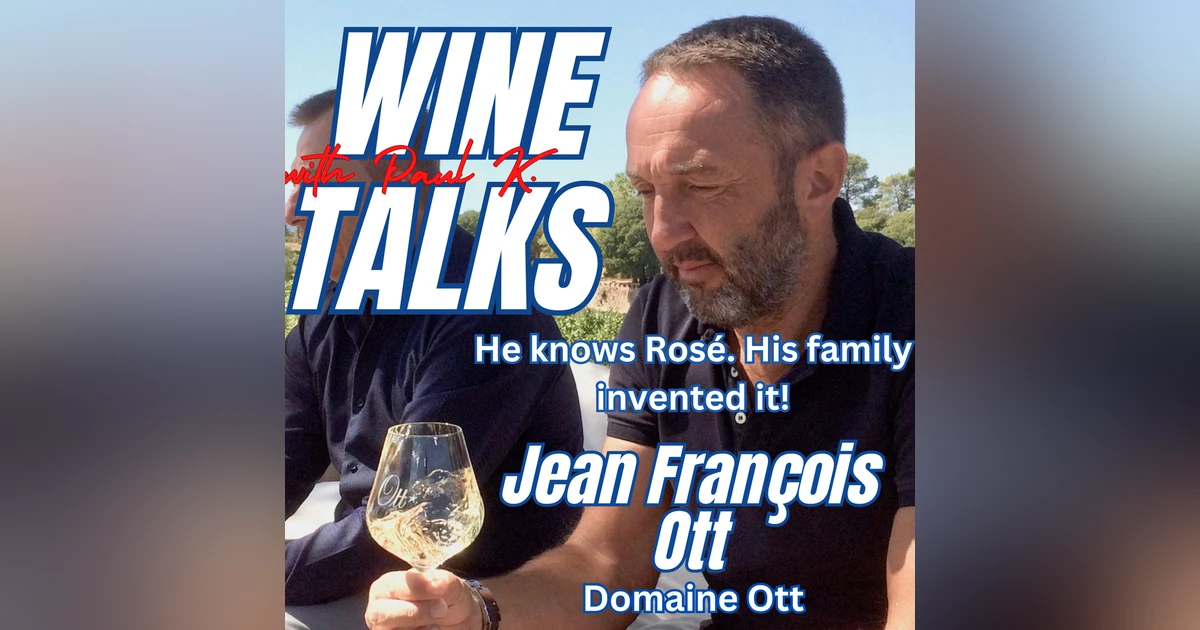

In an engaging moment on the "Wine Talks" podcast, host Paul K shares a fascinating anecdote from his early days as a wine taster. Reflecting on his extensive experience in the industry, Paul recounts how he began tasting wines in 1988. He...
In an engaging moment on the "Wine Talks" podcast, host Paul K shares a fascinating anecdote from his early days as a wine taster. Reflecting on his extensive experience in the industry, Paul recounts how he began tasting wines in 1988. He notes the significant evolution of rosé wine over the decades, particularly in the 1990s when rosé barely made an appearance in his tasting room. Fast forward to the present, and Paul observes a remarkable surge in the popularity of rosé, with every wine-producing region now crafting their own unique versions. From Tuscan to Corsican, Sardinian to Armenian rosé, these wines have carved out a niche in the market, showcasing the diverse expressions of grapes from various terroirs.
In the latest episode of "Wine Talks," host Paul K sits down with François Ott of Domaine Ott to delve into the intricacies of winemaking in Provence. The discussion opens with François elaborating on Domaine Ott’s mission to craft wines that create memorable experiences, particularly highlighting their special cuvée, Etoile. This project, initially a fun experiment, evolved into a sophisticated blend that aims to capture the complexities of three distinct terroirs, producing a rosé that ages with remarkable texture and depth.
François shares insights on adapting vineyard practices to cope with climate change, including the replacement of traditional grape varieties with more resilient ones like Vermentino and Rolle. He discusses the meticulous adjustments in canopy management, pruning, and soil plowing to ensure the vines thrive in hotter, drier conditions.
The conversation transitions to the cultural perceptions of rosé wine, with François emphasizing the importance of elevating rosé to the same esteem as red and white wines. He reflects on the historical impact of the phylloxera crisis and the subsequent evolution of winemaking practices in Provence. Both Paul and François agree on the need to educate consumers about the vineyard and winemaking processes to change perceptions and appreciate the nuanced qualities of rosé.
As they wrap up, François accentuates the joy of opening a good bottle of wine and the intention to provide a taste that reflects the unique terroir of their vines.
Tune in to this sun episode of "Wine Talks" to explore the rich history and innovative future of rosé wines with Paul K and François Ott. Don’t miss the chance to deepen your understanding of the intricate art of winemaking in Provence—subscribe now for more captivating wine stories!
0:00 Carson Leno Fallon. Now it's wine talks with Paul K. Hey, welcome to wine talk with Paul K. And we are at a semi away game, still in Los Angeles, about to have a conversation with Jean Francois. Jean. Jean. Easy for me to say. Jean Francois. Haute of Domain. Haute introductions in just a moment. Hey, have a listen to this. Upcoming shows. I just finished in Bordeaux, France. I had an amazing conversation with Pierre Olivier Clouet of the Cheval Blanc as well as Veronique Sanders van Beeck of Chateau au bail. Incredible conversation about what's going on in the Bordeaux region of France. And also just up a conversation with Monique Elling. She is a d one tennis player who's turned digital wine marketeer. Fascinating, interesting, intelligent conversation about wine. Listen to that. But not while we're here. Here to have a conversation with Jean. Jean. I keep saying Jean. Jean Francois, welcome to the show. Thank you. He's looking at me like, what's wrong with you? You can't even say my name right.
1:08 But we all know of the famed rose house in the provence of Domain Haute. And as we were discussing earlier, the Americans say haute, but it's haute. So welcome to the show. Thank you. It's great. You know, we saw you yesterday in Wally's, had a great lunch, and I've never had a vertical of a rose before. Is that done very often? Not very often. Yeah. Who's, who's, whose idea was this? Was this Maureen's idea? No, I want, I wanted to make it on Rosewine because nobody does it. And it's a way for me to make people understand that good rose can age a little bit. Yeah. Yeah. I want to do the lay of the land, sort of the geography of the provence for people to understand where we're at in France, having just been to Monaco for the Grand Prix, of course, which is incredible. Let's explain to the listeners where in France we're talking about the Provence.
2:12 So we are exactly by the sea in the VA area. We are located between, I would say west from Saint Tropez. Between Saint Tropez and Marseilles. And we have three different estate there, Chateau de Selmierai and Chateau Manceau. So that's the Mediterranean Sea. Absolutely, yeah. And there's a little sea that's off of Monaco and between the island. And now I can't remember the name of it. I saw it on the atlas the other day. But the mediterranean influence is a very important part of these wines. And in fact, yesterday when you discussed that, it hit me, you know, the salinity and that. Wonderful. It's almost the same salinity you get sometimes in the sicilian wines, where you get this little bit.
3:05 It's not salt. I wouldn't even call it salt. Right. It's just an influence. Yep. It's something like, we call it salinity, but actually, in France, it's another word, and it kind of make you feel that, you know, you're a little bit thirsty when you just drink. Yeah, yeah, yeah. It's pretty nice. I get it. Enfranch. There's a phrase a fries for. We call it sapid, maybe sabidity or. I don't know if it works. I think that makes sense. So this is not a new facility. Now I'm going to talk Rose a little bit about the american market, which is particularly in the west coast where you're at today. Rose is kind of new. We don't really discuss Rose until the last, let's say, ten years. The east coast was much more prolific when it came to rose consumption prior. And then, of course, it all started in the Provence pretty much. But your family is not new to this.
4:10 No. My great grandfather started. So he was coming from Alsace because of the name. Right. So he was coming from Alsace. He was just graduated from agronomical school in Paris, and he wanted to make wines, iron wines, and he looked at several regions in France, and he finally ended up in Provence. He wanted to go to Algeria because at this time, Algeria was french. And finally, he didn't move to Algeria, and he stayed in Provence, but he. Wanted to be in the wine trade when he went to school. Yes, this was his idea. What was, was the family in wine before that? No, no, it was like, you know, something like a vocation, I guess. Yeah, right. No, well, I mean, certainly is intriguing to, to be in this industry, particularly as a french, you know, indigenous, native french person, so. Yeah, but, you know, it was, he was graduated from an agronomical school, and at this time in France, they had the phylloxera, so all the vineyard was down.
5:37 And so he had a lot of job replanting the vineyard. And when he first ended up in Provence, he had a lot of. Yeah, it was, it took all his time starting to replant with new type of grapes for other people, and at one point, he decided to buy an estate himself, thinking that he cannot plan for everyone and doesn't make it for himself. So, you know, you said something important because during one of the tours while I was podcasting in, I don't think it was Bordeaux, though. One of the tour guides said when philoxuracrain, which was late, 18 hundreds. Right. That that was the end of fine wine in France, because we had to get american rootstock to fix the problem. And I thought, well, that's an interesting comment to make, you know, since originally the rootstock was french that we got, and then we sent it back. But is that a, is that a real opinion that, that we've ruined of the merry.
6:50 Where did that come from? Is that the question? Nobody can know, actually. I mean, it would, it would be. I don't know what kind of coping can be, but you never know, actually. The thing is, we have rootstock. We don't have any more philoxia. I mean, we still have it, but we don't have any problem with it. Yeah. And the one song, so hit, the. Provence, the phylloxer wiped out pretty much. I know most of the Bordeaux, Burgundy, all the rest of it, but Provence got it, too. Yeah. And so when he went out to buy his first, well, he bought vineyards to make, to grow grapes, originally, and then he decided to make wine. So the first vintage that your great grandfather made, do you know what it is? It must be just after the war. The first. Oh, so, 1819. Yeah. Wow.
7:41 And was it rose? It was. At this time, it was producing the 3d color. Yeah, that's right. Okay. Yeah. Because there's something on your website, you talked about it yesterday about Cabernet Sauvignon, and I thought that was really interesting because you don't hear about that, but you've eliminated that completely from your vineyard. Yeah, no, but I really felt that. I have some example about this. We used to make the white wine in clo Mireille with 50% of uni blanc and 50% of simillon. And at one point, I really felt interesting.
8:21 We didn't really manage to grow the right way. I mean, with the quality. We wanted the uni blanc anymore, so we decided to switch from uni blanc to Virmentino or to roll. And roll, I think, is more adapted to the place. I mean, today, because the weather is changing a little bit, and it's getting warmer, drier. So Vermont chino is. I mean, it's nice at this place, and I really feel that Unil blanc was not nice anymore, and it's exactly the same for Cabernet. And maybe I started in the, at domenot in 2002, and at this time, I had more verd in Chateau de Seul, and I never managed to have the good ripeness on those mower. And so I put them up and today I plan some back, some movie back. Oh, really? In Chateau de Seul. And they go to ripeness without any problem. So that means that we, we need to adapt our. Yeah. The type of grapes and the viticulture to the. To the terroir, to the place and to the climate. So is that, I mean, let's. I have, and this is not a political show, this is about wine. So I try to keep the politics out of it, but there is
9:52 obviously climate change. Many wine districts in the world are wrestling with having to change their policies on how they canopy and trellis. Other parts of the wine world now are producing grapes better than they've ever produced because look at England. You can grow champagne grapes there now and you couldn't. I have notes from my father's trip in 1979 to Sussex, England and the Isle of Wight. You know, it was all german Riesling and german varietals for cold weather. Now, Pinot Noir, Chardonnay. So in your case, do you think that the more vedras come back because that it's more suitable based on today's climate? And then what are you doing to potentially deal with this down the road. On which type of grapes? I mean, on every type of grape. I mean, like, what's the general idea for protecting yourself in the future from problem? I cannot do that. I mean, the only thing I can do is trying to be involved on the everyday process in the vineyard to make sure that what we do works with the climate and the rain or the hot temperature that we have on everyday during the year.
11:18 And so we have small tricks about talking about the canopy, taking the leaves out or not pruning later, plowing the soil at certain times, putting some grass in the vineyard to keep the humidity in the soil. I would say it's the short term story. And on the long term story, I need to know exactly what could be new type of grapes in my terroir. So I make a lot of tries on different type of grapes, grapes that are coming from Greece, Portugal, which you can't pronounce.
12:17 Yeah. And all south of Italy, places that are drier, hotter than what we are in Provence. And it's not going to be for today. It's going to be for, you know, when we talk about viticulture, we always think not from for the five next years, but maybe for the next 20 or 30 years. And I don't know, in about 20 years from now, I don't really know what exactly will be the climate, the weather in south of France. I mean, the only thing I know is we've lost in, I would say 35 years. We've lost a month on the time we harvest. That means that we used to harvest mid September and today we harvest in mid August. So that's so fascinating because Napa was a month late this year in California.
13:31 And, you know, there's been many cycles in the history of agriculture and wine particular. Look at the late 17 hundreds was a cold snap, 15 years of colder temperature. So we don't know what we're up for. But were you always going to be in wine? Your father did this? Yes. You just were going to do it. You had no ambition to do anything else. You wanted to stay in the family business? No, I came back in 2002. I was 29. So I worked in other companies, but not in a wine business for almost seven years. But thinking you were coming back or thinking, yeah, I don't want to be in the family business. I don't have any. I have three daughters. They didn't want my business. Actually, I think I knew that I was going to come back, but I think I was trying to, you know, I didn't feel that being involved with the previous generation, there were six people really strong with 40 years of experience.
14:41 So I was too young for that. So I had to go somewhere else and come back a little bit stronger. No, I agree. I did the same. I went to corporate America, biggest sales company in America at the time. And then I went to a company that had nothing. We had nothing. We had no money, and we had a small computer. This is 19 81 85. But that prepared me for this to be in our industry. And now I would never think of doing anything else because it's so, it's like a, I don't know, it's not a fraternity, but there's so much camaraderie to do this. Tell me about Rose in the world. I discussed it a little bit in the beginning. That rose in California just caught on.
15:29 We had 1974 when Sutter Holm came up with white Zinfandel, which probably was not a good thing for the world of rose. But he's making a face, everybody. But it was a good thing for the world of wine because people that weren't drinking wine, now we're drinking wine. But I think there's still a mindset in Americans that pink wine is sweet wine. Do you still, do you see that in America? I see that only in America, actually. And most of the time people ask us if it is sweet or dry? They just ask the question. Yeah.
16:12 And to tell you the truth, I don't feel, I mean, beside white defender. I mean, I never had a sweet Jose wine. Yeah. Doesn't exist. Well, you know, there's been. I have a story. The listeners have heard this before, but in 74, my father had his wine shop had been about six, seven years. Went to Napa, stopped at seller home. This young man named Bob Trincaro was working the counter back then in the wine trademark. And I'm going to ask you this question about the Provence. But back then, there was not a lot of visitors. There wasn't hospitality like there is today in Napa. And he says, I want you to taste something. It's in the back. He brings out this bottle of white Zinfandel. But he was trying to make what they called eye of the partridge a dry rose. It was Provence style originally. It always had been, but the fermentation stopped and he was stuck with this thing. And then, of course, it became the biggest seller we ever had.
17:11 So I'm wondering if that's just the premonition of american palates. You know, the american palate just got used to this idea. So it was never sweet in Provence, ever. No, but I mean, the cahi desharges of Provence wines, you need to have at least less than 3 grams of sugar. So, wow. At this time, it's dry. Yeah. So besides, besides America, what's the, what is the reception for Rose today, let's say, compared to when you started in 2002?
17:57 I think the, at the beginning, when, when my family started to make Jose, nobody was producing Jose. So it was the beginning of everything on Rose in south France. But I think my great grandfather was smart and he wanted to, he didn't want to compete with high end white or high end red wines. And he decided to create the category of Rose more. But he was producing a lot of Jose. The success was okay, let's say, okay, in south of France, on the Cote d'Azur, on the French Riviera. But it was difficult to sell.
18:46 I mean, enough Jose to sell everything. So decided to multiply the country where he was going to export. But it was also, it was only, we say, niche market, I mean, really small market everywhere. So he managed to sell a good part of his production. But it lasts maybe from the beginning of the nineties until 1990 or after the war, I would say the end of the nineties.
19:32 At this time, the market changed a little bit. And since then, it has been really fast. I mean, the market of rose get developed in about, I would say, 30 years now, really fast. And. I wonder why that is. I don't. I think there are many reasons. I think the first reason is because the quality, the general quality of Jose wines improved a lot the last 20 years. Really. I also think people get, you know, maybe because of Zefindel, but they get used to the color, and. And women started to like this color and this wine, and they started to buy some.
20:26 And I don't know. It's. At the same time, it's a good entrance door to the world of wine, because most of the time, when you're talking about Bordeaux, Burgundy, white or red, I mean, you need to know everything about it. So there's something about the complexity of this world. For Jose, it's way more simple. I mean, it's true. Most of the time, Jose is Provence, and that's it. That's all you need to know. That's an interesting thought, because yesterday's wine, there was plenty of structure. And I'm going to go back to when I started tasting in 1988. So about when you're talking, right, the nineties saw very little. And that was every Tuesday for 35 years. I'd stand in my tasting room, and all of a sudden, I guess if I went back and plotted the graph, you would see this upward graph of tastings, but not only upward graph of more rose. Every appalachian in the world now seems to have its own rose made from its own grapes. I mean, there's tuscan rose, there's corsican rose, there's sardinian rose, and there's armenian rose, my indigenous heritage.
21:54 And I find that interesting, that the market's big enough that they've said, you know what? We should be making rose, too. And they make them from all the grapes that they. Is there any appalachian restrictions in the south of France as to what you can make it from? Oh, yeah. AOC stuff. I mean, the AOC. I mean, in the AOC, you have a list of type of grapes. Oh, you do? And you cannot use anything else. Yeah. And that's interesting because I had a Tuscan. I was like, eh, it was okay. But then I had this corsican. What's the grape? The indigenous grape of Corsica. I was like, wow, this is really special. But the wines we tasted yesterday, which we tasted. The three different estates.
22:34 Yes. And then we tasted Etoile, which is your flagship blend from all the estates. If I remember hearing yesterday, what was interesting about all of them, and particularly tasting a vertical, which, the oldest being 2020, there was great structure in those wines. There was great acidity, there was great fruit. There was a seamless transition from the beginning to the end. Is that the objective here? To produce a wine that reflects terroir and structure? Yeah, definitely. I mean, there are many goals. Obviously. The first one is we need them to like them. Well, that starts it. We can make stuff we like, but that doesn't matter.
23:28 That's exactly the same as the chef, I think. I mean, you obviously produce what you like, but it's also a way to make people understand. I'm not sure that rose can also be a wine with a structure, with a taste and with the characteristic of a rose. I mean, what do you expect in a rose? I feel that we all expect pretty much the same. The freshness, the good balance, the fruit taste. It has to be refreshing. And at the same time, it's wine. So we need.
24:13 We need structure. We need the texture in the mouth. We need it to be good and pleasant. So, you know, that's. I'm glad he said it that way. Last night I had only to celebrate our trip. I had a bottle of obey. But I was looking forward to that during the day. Like, I was looking forward to the idea of going to open this wine. Right. That's good. And you want this to be the same with Rose. And I think what I tasted yesterday, I can anticipate at lunchtime that tonight I'm going to open a bottle of domenot and I'm going to etoile and I'm going to anticipate this acid, this structure and the way it works with my food. And I think that's an important lesson or character that we need the public to learn, not just as an aperitif in the summertime, but as in tasting that 2020.
25:16 You'd almost expect that under the old school to be slightly maturized, oxidized, that the character would be gone. And it wasn't. It was rather bright and ready. Yeah. To tell you the truth, I'm struggling a lot on Rose about the market, because I really feel that people. It's something like Rose. It has to be, you know, how do you say, like, if it's. It's not a serious wine, right? It's not serious. And I'm struggling against that, actually, because I really want rose to be at the same level as white and red. I mean, some whites and some reds are not good. Some rose are not good. That's true. And some, Jose, are really good. And some red.
26:17 You are expecting your dinner and you want to. I mean, you think about it during your day and you want to open it at night. Right. It's pretty much. It can be pretty much the same for Jose. I think so. And it really depends on the way you make it, what you expect, what you put on the production of your. Of your wine. It can be white, red, or rosy. You know, that's interesting, because you said something, and I was. I can't use the word fascinating because my friends laugh at me when I use that word, but I was intrigued by the idea that a one, you said, I don't care about the color because some of it was pretty pale. And I started thinking, wait a minute, for the listeners, if you crush it, if you open a grape up, almost all grapes, there's only a handful of red skin grapes that have red pulp, but most red grapes have clear pulp. And so, really, what's the difference between that and a white wine, except that it started with red skin, and so you should be able to get the same structure, the same appeal, the same anticipation from a rose wine, maybe even more, because you do have that little influence from the skin contact.
27:27 Yes, absolutely. To produce a wine of character. So how do we do that? I have this. It's not an argument, but I have this discussion many times with the academics of the wine world, and that is, wine has always been driven by the consumer. I mean, as much as you and I would love that romantic idea, that wine is this beverage that we can all enjoy, and maybe profitability, if that wasn't a problem, then maybe we would have a different wine. Right. But we don't. We have to appeal to the consumer. So is it trips like these? Here you are in Los Angeles explaining, tasting, talking to the press, talking to clients. Is that the only way that we can do this? Is that a way we need to do it? Yeah. I'm not sure the market can lead the taste of the production. I mean, unless you have 12 million bottles to sell. I mean, the production, our production is small, and the world is big. So hopefully I would find some people that have the same taste. That's a good point. That's a good point. But, yeah, I think we need to. I mean, I really feel that. Well, I like to make it, but I really feel that I need to explain people our job, what we are doing in the vineyard every day, our everyday job, the fact that we spend time in the vineyard, we go into details
28:59 to make it that way and to get consistent from one vintage to the other. All the work that we do in the vineyard in the winery to make it the way it is. And, yeah, we need to explain. Otherwise people would think, I don't know what they can think, but I think it's important to not educated people, but because that's to change the image of Jose in people's mind anyway. Well, the general, if you think about this, well, you're here in Los Angeles. If you get a chance to go to a supermarket and walk down the wine aisle, you're going to find dozens and dozens and dozens of brands of Cabernet, P. O noire and the rest, as well as less. But you'll see a lot of rose. They're going to be pretty much the same. This is the problem I have with the industry in general, is that what people have to reach for off the shelf is going to be tastes like, almost like the one next door to it, because they always have some kind of sugar. The reds, the whites and the rose all have some kind of sugar. And so I think you have to put your wines in a glass in front of somebody to get them to feel. So this, is, this a
30:30 struggle between brand recognition of your domain, which is, for you, would be staying the course, staying that straight line, making those wines that you want to be in the bottle, in your special bottle shape, and never, never deter from that because you don't want to succumb to the consumer part of it. No, again, again, I think I really make, I think that was, you talked about the comments that you had on Bordeaux with the rootstock, and I think we, the wines are changing with our taste. I'm not sure my great grandfather would like the wine I make today. That's interesting. And I'm not sure I would love the wine he was making at this time. That's a good point. But nobody knows.
31:33 And the thing is, that's so interesting. I never thought of it. That's interesting. No, but the thing is, I really feel that little by little, on every vintage, we changed things. And even if there is something like a real consistency from one vintage to the other, I think we adapt not because of the market, but only because of our taste. And I think that's an interesting thought. And I never thought about the, your great grandfather or anybody's predecessor enjoying the wines that you're making today based on what they were up against and their marketing and their palate.
32:24 You know, that conversation goes another way. And I had this conversation yesterday with a master of wine, Vanessa Conlon. And that is, gee, we don't even describe wines the way your grandfather would have described it, right. No, we use different terms and that's going to change again. And I think that's an important part of our industry. And I think it's also why wine is still here. I mean, what is it, 60 00, 10,000, who knows, 12,000 years old. And I think it's beyond the fact that there's alcohol in it only, that's not the only reason in that it does something to our souls. It brings us to some place and sometime. Is that the objective of domain art is to have people feel like a time and place for sure. Yeah. I mean, I think a part of the success of domenot is also because it comes from Provence.
33:16 And, you know, I try to keep half of my production in on the French Riviera because it's a really good, you know, a window on the, on the, the market and foreign markets because people are coming in south France. They are not coming for most of the time. They are coming on holidays. It's always good memories and good memories, good holidays, good wine. When you come back to your country, I mean, feeling that you come with a part of your holidays, it's always a good point.
33:58 We also, and we really try to adapt our viticulture to have the good grapes, the good sepage at the right place. And our vinification is trying to respect distaste. We want to have the same taste from the grapes to the bottle. And that's also very, I think that's also a good point on that. That means that, yeah, we want people to have a part of the terroir of the place by the taste of our wine. You said volumes that you said a lot there. And I'm going to touch on one point, but we are to talk about Etoile. I want to get to that. Now when you said we want to have good times, we want people to equate or recognize that when they're on the French Riviera, Saint Tropez, Marseilles, nice, Cannes, all those places that when they open a bottle of domain haute, they feel something and they're going to remember this feeling. And so when they come back to the states or they go back to Italy or they go back to Germany where they're coming from and they see that bottle shape, they have that memory of that moment. And that's what wine is. No other beverage does that. In fact, if you're drinking Jack Daniels, you forget.
35:26 Right. But let's talk about domain atois because I think an important thing, and tasting that vertically essay, what was the first vintage of domain etoile. And what is the objective of domain Etoile? Etoile. Domain Etoile Etoile Etoile etoile is a special cuve that we use to make, you know, only for fun and not for sale. I mean, it was always at the end of a blending session with the clumierais, Chateau de sel and Chateau Masson. Yeah, it was like a joke at the beginning because so no one ever says that. But we never wanted to market it to blend two or three terroirs. We wanted to have a really special wine on each terroir. But you know, at one point trying to blend two or three terroir at the same time would be. I mean, it was, it was fun for us and it was interesting.
36:26 There is a difference. I mean, I'll stop here. I don't want to interrupt you, but for the listeners, there's a huge amount of distance between the three chateau all the way down to x. X, I always say wrong x. Yeah, I mean you've got quite. Yeah, it's almost 100 km between, uh, between the, the three of them. And um. Yeah, so the terroir are really different. Glomere is really by the sea. Chateau de sail is 300 meters high, totally different soil, and uh. Chateau massage Bandol. So yeah, they are really different. Boom. And uh, I really wanted to make a flagship for dome.
37:08 And we've started. The first vintage was 19. It's a really tiny production, but the ambition on this, Jose, is really to have in the same bottle the complexity of three different terroir. And also, I would say, the haute couture style. You know, when you put all your efforts in only a really tiny production to make it as perfect, I mean, as perfect as you can. I mean, as perfect as you think it can be, or it should be. And yeah, we go into details on everything to make this really tiny production. And at the end we have a rose.
38:10 I mean, you should tell that, but my ambition is to have a rose that can age, that have the complexity, that have the texture, that everything that you can expect from a grand vin. Yeah, nice wine. And maybe a wine that you think of during your day because you are going to open it. That's right. I want to think about that as well. You know, that's. I just, it just hit me as you're explaining that if we're in Bordeaux and we were growing Merlot, Cabernet, Petite Verdot franc or whatever. Petite Verdot and Cabernet Franc, whatever, we're growing.
38:52 The winemaker is blending the character of these grapes. They're from different terroir, probably. But more importantly, we're blending the character of that vinification of that grape. Okay. If we go to Burgundy and we're only growing Pinot noir, and we, I mean, you would be probably shot and hung if you took, you know, Romani Conti or a Bosny Romani district and blended it with a bone, you know, and you, you call it Burgon, you're going to be shot. You know, you couldn't do that. And it seems challenging to me that you are now not blending grapes. Cause of course, you're using different grapes, but you really are trying to structure three different terroir, not three different grapes from the same place or the same grape from two different places. You're talking about three distinctly different wines because of where they're grown. And balance that into etoile. What a challenge.
39:50 Because you're picky. I mean, your palate is gonna be very refined to understand these three terroir. Yeah, but you've tasted yesterday, side by side, the three states, and we make them exactly the same way. Our Vichy culture is pretty much the same. But for me, the terroir and the type of grapes are really, as, they have to be really close. I mean, that means that there are places where we can grow easily, and I think it's the right type of grape, maybe Grenache and some other places we cannot. So we need to adapt the type of grapes, the terroir. Oh, from the terroir. And I think it's. I mean, they are so different. The way we make them is exactly the same again. And the tasting at the end is so different that I really feel the characteristic of each state. So then when it's about making the blend for Etoile, I know exactly what we are going to tip. Yeah. Which character we are going to keep from. From one cuvette to the other, and to make the, at the end, the final blend of it. And so how has it toile been received in general by the rose public?
41:19 I think it's, again, the world is large and the production is small also. How much are you making? 5000 bottles. Oh, wow. Yeah. So it's 400 cases. Yeah, yeah. So it's. That's very small. Yeah. I mean, for the whole world. Yeah. And if you want to leave some of it in Saint Tropez instead of Marseille and some of Monaco, you've got. Yeah, exactly. And, uh, no, but the. Yeah, the market, I mean, people who love our wines, they are really. I mean, they are really happy, and, I mean, no complaint at all about Etoile. Obviously, it's a tiny production, but I really feel that it's pretty good for the image of domeno, but the image of Jose in general.
42:08 And that was also the goal, if you can imagine. We're almost out of time. I mean, it's already been 45 minutes. It always ceases to amaze me or never ceases to amaze me. That's the case. But the future plans, you're testing grapes, they've got things like Turriga Nationale and syrah in Bordeaux. Now, the AOC of the provence provide for experimentation. And what are we trying to do? We trying to find grapes that are acclimated or create wines of completely different character. What's going on out there for that in the future? What have you planted, lisse?
42:54 Nah, actually, the AOC is working on it because everybody is conscious that. We. Might have to adapt our viticulture and our sepage. I think we don't want to wait. I mean, I don't want to wait for people to make tries on everything. As I told you, in some places, you cannot grow Grenache or you cannot grow Cabernet Sauvignon. So we need to find the good type of grapes that fits with our terroir. And when I talk about terroir, I also talk about, obviously, the soil, but also the weather, the climate in general.
43:52 And so, yeah, we. We need to know. And. But again, it's a long process. I mean, it's not for today. It's gonna be for 20 years from now or 30 years from now. And first, to tell you the truth, first, I have tasted a lot of wines from new type of grapes. I mean, not new, but the type of grape that they are using in hot and dry regions. And when I like one, I try to plant some in our terroir and see the result if it does work. So here's an interesting thought I did. I had a podcast with a gentleman in the middle of America in St. Louis, Missouri, and he decided that he would repropagate, replant american indigenous wine grapes. Okay, we have no Vidis vinifera here. It's Vidis Lambrusco.
45:02 So he planted, I'm gonna say, 20 different ancient american varieties. And he's in the hills of the Missouri. And I told him, I said, you know, you have nothing to work from. You have no history. You don't even know what these wines are supposed to taste like. You don't know what they tasted like back then, and you don't know what they'll do. You don't know what altitude they do better, and you don't know what soil they do better, and you don't know anything. And I thought, wow, all the combinations of terroir that could go into this, this winemaking, this guy has to create. In your case, if you're planning to reganacinate, say you're sort of got some, you've got some footing because you understand the terroir, but you don't understand how that grape is going to do. So it's going to take 20 years to have some understanding of it. Yeah. You know, between planting and having the first harvest, it lasts at least four years.
45:56 Four years. And then when they are only four years, they are young, so maybe they are going to be better in ten years. So, you know, it's all, it's. Everything is about time in the wine industry, I would say. But there is also a thing, and that what I think what I learned in working in farming, you never know. I mean, there are so many things going up at the same time from one vintage to the other. You need to change everything. You need to adapt. Every day is different.
46:40 Sometimes it rains in May, sometimes it's June. Sometimes it doesn't rain. Sometimes it's hot, sometimes it's cold. So everything is different. So, yeah, when you need to change something, like the type of grape, I mean, it's a big job. So it's a big job. We just need to start now to be able to adapt our vitriculture, adapt to our blending if we need, and if we don't, it's okay. I mean, we've. We would have learned a lot. Thank you for spending the time this morning. I know you have a full day ahead of you. You're going to be back in this facility tonight for another dinner. How long is this trip for you? Is it just LA? Are you going to be. No, actually, I was in New York. New York already? Yeah, last week. And I'm going to move to San Francisco and back to France. Wow. I mean, it's springtime. I think I need to.
47:39 Yeah, that's right. The season started, right? I mean, yeah. The beaches of Saint Tropez are full. Yeah. And, you know, at this time of the year, I mean, in the vineyard, we have really a big job to do, and we are preparing, obviously, the harvest. But, you know, when we work well, between May and end of June, we are almost done for the harvest. I mean, we made. If the job is well done at this time, we made 85% of the job. It's Bud break right now. Exactly. Well, thank you for being here this morning. Thank you. Cheers. Thank you.
48:27 Thank you for listening to wine talks with Paul Callum, Cary. And don't forget to subscribe because there's more great interviews on their way. Folks, have a great time out there in the wine world. Cheers.