

 Apple Podcasts

 Spotify

 Youtube Music

 RSS Feed
 YouTube
 Pandora
 iHeartRadio
How CellarTracker and AI Are Changing Wine Collecting
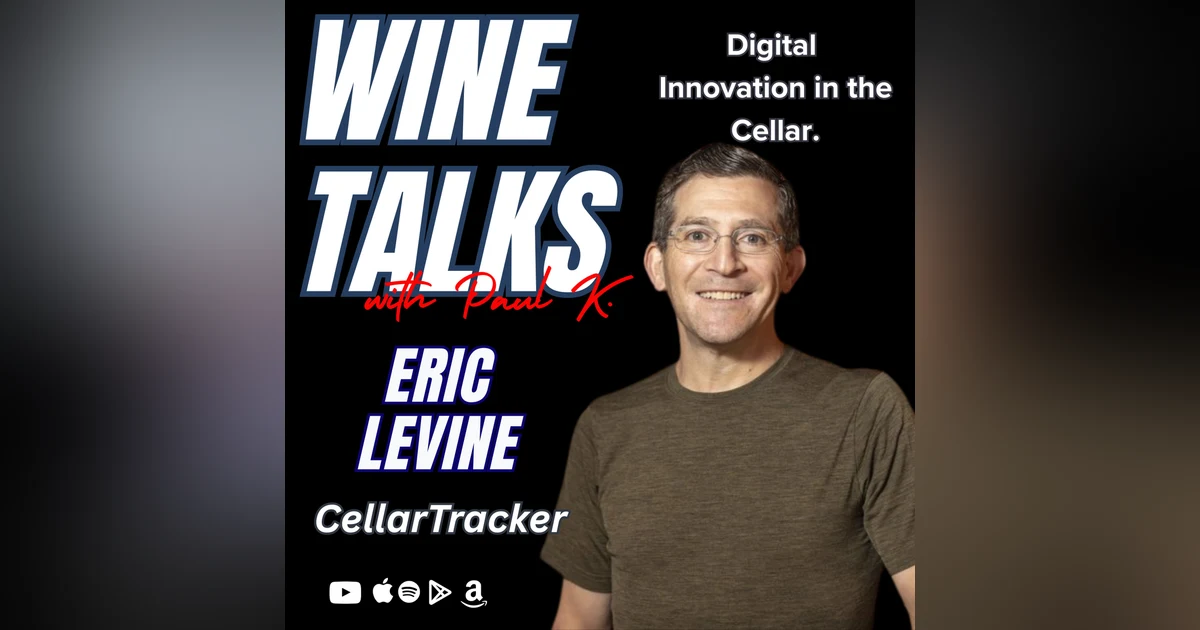

I have had a dozen cellar apps. In fact, many were brought to me as the President of the Original Wine of the Month Club to be tested. The current database that houses all my internal tastings over the past 35 years was never produced as a commercial product. And as you can imagine, it is so 1993.
Thanks to the energy and self proported "tech geek" Eric LeVine, keeping track of your cellar and much more is at your fingertips.
Not only has he created an incredibly robust app in the wine trade, but he has also created a community of collectors and novices alike.
When your name rhymes with “wine,” it seems only natural you’d play a key role in reshaping the world of wine collecting. Eric LeVine—yes, “LeVine” with a capital V, as in “wine”—joins Wine Talks to uncork a conversation that’s as much about technology as it is about terroir. In this fascinating episode, you'll discover how a meticulous software engineer transformed from a tech geek into a bona fide wine enthusiast after a life-changing cycling trip through Tuscany. You’ll hear first-hand how Eric’s frustration with clunky, outdated wine cataloguing tools led him to build CellarTracker—a platform that's now indispensable for collectors and curious drinkers alike. Listen in to understand how CellarTracker blossomed from a personal spreadsheet to a global community, amassing over 12 million tasting notes, helping both green beginners and seasoned oenophiles keep track of their treasured bottles (and avoid that collector’s nightmare of opening a vintage past its prime). You’ll also learn how CellarTracker leverages cutting-edge AI to make wine research and cellar management nearly effortless, whether you’re uploading receipts or hunting for that perfect Loire red hidden on your top cellar shelf. Eric goes beyond geekery, showing how technology—and even a little bit of chat-based wizardry—makes wine less intimidating, more approachable, and, most importantly, more social. If you’ve ever wondered how technology can add confidence and curiosity to your wine journey, or how the experience of each bottle is about more than just what’s in your glass, this episode will leave you swirling with inspiration.
-
CellarTracker (Eric Levine is the founder and CEO)
-
Website: https://www.cellartracker.com
-
#wine #podcast #technology #CellarTracker #winecollecting #winesoftware #AIinwine #wineinventory #winereviews #EricLeVine #winetech #winedatabase #wineenthusiasts #PaulK #winetalks #wineeducation #wineexploration #winetasting #winecommunity #winejourney
0:00 I think the most exciting thing about wine is the utter diversity of wine. I view my journey over what has now been 40% of my life doing this as using technology to help make wine more approachable, to not dumb it down, but to meet people wherever they are, no matter how geeky they are. Sit back and grab a glass. It's Wine Talks with Paul K. Hey, welcome to Wine Talks with Paul K. And we are in studio today in beautiful Southern California, about to have a conversation with Eric Levine, way up in Seattle with Cella Tracker introduction in just a moment. Hey. Just released a couple incredible podcasts. One of them was just really fun because it was an enology student from Cornell who just returned from her six week stint at Chateau Aubailly in Bordeaux, France. And of course, Wine of the Month club was an integral part of getting that internship. And the way she is so eloquent in telling her experience in Bordeaux, in another country as a wine student. So take a listen to that. But not why we're here. We're here to have conversation with Eric Levine. He's the founder and CEO of Cellar Tracker.
1:05 Welcome to the show. Hey, thank you so much. Sorry for the screw up, but we're here. Yeah. And actually, believe it or not, it's Levine. It rhymes with wine. My. Oh, Levine. Yeah. My great grandfather screwed up and most people would expect Levine, but it's. I got a capital v. It's. Anyway, 1910 was the original sin and it's convenient later in life that now it rhymes with wine. Yeah, I mean, that's incredible. You know, it would seem natural that you got into the trade somehow as a. With a name like Levine. Right. I had a conversation with Max Riedel. Everybody says Riedel, but he says no, this Riedel, as it rhymes in needle. So. So let's talk a little bit about. I've. I've been in this trade for. Since 1993. I wrote, I bought a piece of software in DOS off the shelf to run the catalog side of this business.
1:52 And we actually wrote what I think is probably one of the most robust and still the most most robust direct to consumer part of any piece of software that's out there today. And there weren't. There weren't any really. There's just little databases of where you could keep your wine information at that time, of course, in DOS and some. Maybe it was FoxPro or some database like that. What gave you the idea in 2003 to start seller Tracker? So the original moment was actually 1999. And two things happened one, I started working on a team at Microsoft. Do you remember when software would crash and it would pop up and say, send error report, don't send.
2:33 Yes. So that was me and two guys in the Office team who decided crashes suck and we're going to let the world tell us about them and we're going to use that to fix stuff. Wow. The other thing that happened is my wife and I went on a bicycling trip in Tuscany. And I always liked wine, but didn't know that much about it and came back a changeman, had just fell in love with wine. And so then over the next few, two bottles became 20, became 200, became 700. And so fast forward to 2003. I'm keeping track of my wine in a spreadsheet. I was looking at a bunch of different wine specific software to catalog the cellar, didn't really like anything and decided to just build something for myself and sell. Our tracker happened at that point. And then the final part is I showed it to two friends who immediately said, oh, I want to use that. Which is like, oh, I hadn't thought of that. And I got the two friends on there and then I realized, oh, wow, three people could be 300 or 3,000 or whatever. Like this is a thing that's so interesting. So let's go back to Tuscany for a second. And I don't really talk about aha moments all the time because I think everybody sort of beats that. A dead horse. But an aha moment that leads you into not only studying wine and understanding wine and appreciating collecting it, which is a bad disease which I have now.
3:47 You know, I didn't know really until I sold my company what that disease was, because I. I was Scarface. I just sold everything I had my hands on. And during COVID so much came in the door that we could sell. And all of a sudden I had this collection of Bordeaux and Burgundy. And now I realize what it is about collecting that is if I drink that bottle, I won't have it anymore. And that sucks. So I. There's always another going, you know this. There's always another vintage. There's always another. Yeah, that's true. So anyway, what was it about that. Because it led you down a path of, you know, create a career for you that you had this moment. Was it the Tuscan wine? Was. It was. I can tell you exactly what it was. I'm a very meticulous guy. I remember way too much stuff. So it's 1999, it's harvest time, we're in Castalina in Chianti. This was a bike trip. So we had done a nice big ride that day, and they had a little local merchant up from Siena and he put four wines in front of us. And again, at this point, I enjoyed wine. I didn't really know anything about it. And so the four wines were. And I was not wine aware, so I don't remember the exact vintages, but I remember the appellations. So there was a Chianti, a Chianti Classico Reserva, a Vino Noble di Montepulciano, and a Brunello di Montalcino. And then he was. He did a song and a dance talking about IAGT versus DOC versus docg.
5:05 But basically what I remembered was four wines all made predominantly from Sangiovese. And over the next few days we biked to Montepulciano and de Montalcino. And so I got to visit the towns. And so, you know, and he pointed like, okay, one hilltop over there, one over there down in the valley. So I just assumed these four things were going to taste exactly the same. And as we tasted through the four, they were completely distinct. And my mind was blown. I didn't understand how four wines all made within, you know, 30, 50 kilometers could be so different, made from the same grape. And then you spend a week biking around Tuscany having, I think, you know, if there's a region in the world where the traditional food, foods and the traditional wines are just magic with each other, Tuscany's high on the list. And so, you know, so we kept tasting wines over the course of the week with meals. And so I just came home and, you know, in technology you'd say it was the bit flip moment, right, Where I just, I had to learn more. I was compelled. I wonder if this doesn't just also sort of corroborate one of my thoughts. I do on the show all the time, which is the experiential part of wine, is such an important part of wine, and that it's actually coming back now. How long ago was this? 1993, you said 99. 99. So just coming up on 26 years. Ago, when my dad, in fact, this patch here was from the 70s, it was all about that. You got together, you talked, you experienced, you
6:36 visited. And all of a sudden there's a connection between that wine bottle and that visit and that time you had together. That place, that winemaker, whatever it might be. The. I mean, I sort of call that context, right? And it's. It's I'm glad I'm not a wine critic because they have to separate context, you know, as they taste something and evaluate it. And you know, Parker always said, you know, he would just remove it and, and it was almost clinical. Right. And pretended you could be so precise. I'm glad I don't have to do that. Like, if I know a winemaker, generally I appreciate their wines more. If I like the person, I can feel them in the bottle. And you know, anytime I taste something from Tuscany, I think to that trip and those wines and you know, my collecting has gone to a lot of other places, although I still always love Tuscan wines and Italian, you know, obviously Italy has so many regions and so much diversity of wine. Yeah, it's.
7:27 It's complicated for a lot of people. Maybe not as complicated as Burgundy, but it's complicated. Yeah. So you came back and wrote this thing. What, what was the prevalent language in code back then? So I was so at that point was working on the Office team and it's actually some of this original code still exists, but basically it's Microsoft SQL Server on the back end and the front end was classic ASP with VBScript and JavaScript down in your browser on the client. To this day we're still very much a Microsoft shop. And on Azure and in the cloud and SQL is big, but all the other stuff has evolved dramatically. There's so many frameworks and rich tools now for building amazing stuff.
8:11 And how many, let's call it not versions but major reiterations, has the product gone through? I would say four. So there was the original site that I created which basically makes Craigslist look sexy. Craigslist, I think famously was like one of the least good looking websites on the. Plenty of sign. Yeah. And so if you go to sellertracker.com classic the original is still out there and it is black and white and blue and it is just as retro a website as you're ever going to find. And there's still people who, some people who cling to that. I did a major renovation of the desktop site, sort of a slow rolling one between 2010 and 12. We launched a mobile site and app based that in 2014. And then over the last three, four years we completely re platformed and built a very modern, beautiful mobile application. That's where the vast bulk of the effort is going into is subscription.
9:08 Subscription based. Now it is subscription. So it's always been. I used to call it voluntary payment or if you think back to the ancient days of software Sort of as you referred to, shareware was a thing then where, you know, if you use it, like it and pay, but it. What it's been for two decades is if you pay, then we flip on some extra functionality. But about a year and a half ago, we did make a pretty significant switch in mainly how we talk about it, calling it a subscription. We did take some things that used to be free. And this is, you know, you get to do this once. We basically just sort of said, look, what do the people who are paying get versus what do the people get who are using it for free? We want to make sure the free proposition is powerful and wonderful and also honors the. The fact that Seller Tracker really is of, by and for the community. The value of Seller Tracker is what everyone creates. And so all the 12 million reviews people have created are free to anyone who wants to come. And whether you register or not, although generally experience is better if you register and log in. You don't see ads or stuff like that. But anyway, a year and a half ago, we did sort of formally create a more formal subscription model, set prices. You don't get to sort of make up your own price or something like that. Although to this day the throwback is we do, even if, you know. So we suggest what you should pay based on the size of your collection. But if you disagree, you can basically say, well, you know, I don't want to pay that. You can pick one of the lower levels and you still get everything. So here's an interesting question. How much? And I'm going through this now my own seller, because I told you that we sold the company and they didn't buy or want any of my collectible wine. So I've got, I don't know, like
10:41 2,500 bottles of wine here. And I'm a. I'm not an organized guy. You know, I'm neat to the extent that I make sure things are in their place. But I, you know, the tediousness of, of keeping track of it, it drives me crazy in the seller. And how do you, how do you, how do you address a guy like me? So, I mean, you know, first and foremost, I'll step back and say that probably the biggest misconception about Seller Tracker, and, you know, some of it comes from the name is. And it was originally designed for me as a tool to catalog and track my own seller. The big surprise was as more and more people started to sign on and use it, we get the better part of 10 million people a year visiting the site Downloading the apps, et cetera. For most people out there, they actually just use it as a research tool. They're looking at all the information that's amassed, the reviews and tasting notes and drinking windows and things along of that nature.
11:37 So the biggest misconception is that you have to actually use it to catalog and track your seller. Now, that said, if you choose to do that, that was definitely the original core use case. You know, we have definitely come up with like one of the features we're really excited about that we created in the last couple years. And we don't talk about it as an AI feature, but it's actually using AI behind the scenes is you buy wine from a retailer or winery and they generate a receipt that comes to you, an email or even a paper receipt. You can take a picture of it and literally just forward it to us. Add addselartracker.com if the email matches your account. We're using AI to pull out the vintage, the wine name, the price, the size, the quantity, the purchase date, the invoice number, and then putting that all into a tool. We match about 90% of the wine names automatically to our database of 5 million wines and you just confirm them and say, boom. So that's all about how do you lower the friction on the way. Yeah, that's amazing.
12:34 Yeah, I'm kind of amazed by it. Sometimes it works just flawlessly and it's technology, so it's fallible. So the goal is look, for someone like you, the trade off of time has to make sense. And I think there are definitely people who are like, look, it's going to ruin the romance or it's too much work we find for people who want to track and know, then it's going to be useful. Now, in the age of all the AI features we're starting to build now, which get more to recommendations and helping people learn and explore and discover, think about, you know, food pairings, whatever it might be. Really any kind of question you could ever think to ask. Frankly, we only need to know what are a few wines you like, what are things you don't like to start to dial in and have those tools really personalize themselves to you. So part of what we're thinking about is how do we make Seller Tracker a much more broadly available tool for anyone who's just passionate, curious, wants to learn, explore, discover, and wherever they are in their journey, no matter how expert order or they have to decide they want to learn, they have to be interested beyond I want a glass of Chardonnay. Or a glass of Merlot with no curiosity beyond that. But if they care, they want to have the journey, then.
13:48 You just put your finger on the pulse of, you know, almost all the conversations on LinkedIn and where, you know, they're trying to force the public or not force the public, or tell the public what's up, what's not up. And the aristocracy want all that, which hasn't changed in the millennial. It's just a different generation that thinks they've got a better idea of it because it's interesting. You know, one of the things. Nothing's worse than being a collector and then something going over the hill because it wasn't managed properly or you lost it. I can remember when I moved the company, I lost all my best stuff. I didn't know what happened to it. And finally I remembered I'd locked it in a closet in the old building, and thank goodness I still own the old building, and went there and unlocked the closet, and there it was, you know, stuff from my Dad's store in 1975, you know, so it has great value.
14:35 But if. If I'm one of these people that wants to use it to its complete efficiency, you're talking about not only inventorying your wine where it probably is in the cellar, you can love its features. Barcodes for every specific bottle. I mean, you can go. You can go crazy in terms of how much precision you. How much data you enter, or just keeping a simple list, you know, and it. It varies if I grab. Well, here's a. Here's a bigger problem. Yeah. We're here in Southern California, and the Altadena fires displaced my daughter and her husband and the three kids. They didn't lose their house, thank God, but they. They live with us. Well, my depletion is much faster now than it had been prior to their arrival. And so, you know, if I was able to just take that bottle and scan on the way out on my phone, or even an iPad that's hanging inside the cellar and know that that was depleted, that can happen. You can do that already today. And we think we can make those tools a lot better. And, you know, really, you know, almost totally hands free today. You can basically, you know, scan the front label or scan the upc. UPC is funny because the industry doesn't tie it to specific vintages, so you still need the user. Again, click and pick the specific wine and the specific bottle. But our goal is how low can we.
15:54 How much can we lower the friction around both? Populating your seller, you Know, every time you buy, having it automatically populate and likewise on the, on the way out, just helping you keep that up to. Date, et cetera, you know, and that's, that's how I use AI here, because I, I don't believe AI is taking jobs. I think it's just going to add so much more information to, on the plate that it's going to require just, you know, just different places for, for labor and for trained personnel to work. But I always look at what I'm doing to see where I can apply it and I. You don't even know the answer to that question all the time because you're, you just are assumed and kind of embedded in what you do. And then all of a sudden you go, wait a minute, I could, I could apply AI to this. Is it the way you look at this kind of thing? Because certainly the idea of scanning a receipt is brilliant and putting it in my inventory right away, and then the values there, at least the retail value at that point.
16:49 So, you know, I, we're, you know, we have a pretty significant team of engineers right now really leaning into this. I mean, I will say, number one, it's early days and things are moving so quickly. It is. That's a question. It is shocking. And I am an optimist, you know, writ large for society. I think that's a whole separate question in terms of what we can do to help one, collectors who are putting some amount of information in seller tracker to make that more useful and to help again with exploration, discovery, seller management. I am unbelievably optimistic. It's super fun for me. We just launched a chat feature in beta about a month ago.
17:30 And so it's fun. Sometimes I have my standard ways of how I'm going to go. Either rummage the seller physically or sometimes I'll start on the computer and I've got a notion of, oh, I want a Loire red tonight. And then I just asked the chat like, hey, find me all the Loire reds in my cellar within their drinking window. Read all the reviews from this year and based on the reviews, tell me which ones seem to be most ready and summarize the review for me. And it came back with a list of three. And I sort of, I mean, this is just in a chat, but you can imagine soon it would be more like Siri, where I can dictate to it. And it picked a different wine than I had. I'd been fumbling around for five minutes on the computer the old fashioned way, and just in two Little back and forths. I was. It steered me to wine. It was great. And I'm sure any of the wines I could have picked probably would have been good, but it was just such a new way for me to even think about interacting with this technology.
18:22 And, you know, for food pairings or imagine the scenario of saying, hey, I want to build. I want to do an Italian wine dinner. Help me build three flights, you know, based on the wines in my cellar. And I've got about 3,000 bottles. And the chat has access to that privately. It knows what I have. So I can ask it to basically propose flights. I can ask it to propose a. Look, I couldn't even imagine a year ago that this was like Star Trek kind of stuff. Like, okay, we could build that in 10 years. It's just about here. And our implementation is far from perfect, but it is moving so quickly. I am such an optimist on what we'll be able to do to make this more useful. Well, it is moving very quickly and things will be obsoleted very quickly and very fast. And there's even a talk about this bubble, sort of like the dot com bubble occurring with all these applications.
19:14 I sat down at Starbucks for a month or two and just went through a training session. So I understood what was out there to do it. And some of those packages, they're already behind. And this is not that long ago, but it is pretty amazing that as long as you are keeping up with what its capabilities are that you can do something like that. You couldn't write that code. Right? I mean, it's just like the early days of websites. And I never bought off of this. I never thought it was possible. I never thought it was real. When they would say, hey, tell us if you like to eat mushrooms and salt your food and whether or not, you know, put ketchup on your hamburger, that we're going to pick wines for you. And if anybody tested those, those algorithms that were on those websites would know that it would give you the same wine suggestions. Anyway, there's a bunch of horse hockey, however, now with the ability of AI to go to the web and find all these reviews and to find all the character that has been described as and maybe summarize that better and then bring it back to you with the recommendation, it's phenomenal.
20:15 It's very good at summarization in particular. I mean, you think about large language models. That's what it's all about. So we're flexing it, we're using it, we're experimenting and so we started with the first problem we tried to solve beyond us using AI as a tool for parsing receipts, which again, to the end user, that's not an AI feature. It's just a way for us to have some technology extract the information we want from a receipt, either a picture or a textual one. But the first actual AI application was literally you go to a page for wine and there's a button to say, will I like this wine? And it loads up into the AI a bunch of information about me, what I've tasted recently, if I've posted tasting notes, what I'm purchasing. And then it's sort of cross referencing that against the actual wine. And it's a make, trying to make a determination of, of how likely or unlikely it is I'm going to like it. But then it's got like a three sentence summary. And so even if it's guessed wrong, when it describes the wine in two or three sentences by summarizing the notes and summarizing sort of the metadata, and it's actually able to go look up the alcohol percentage, even though we don't have that in our database. I almost always can tell right away, like, is this a very parkerized kind of thing that I'm a little less like, you know, all due respect, I'm, I'd probably lean a little more old world and a little more on the acid end of the spectrum. But like, is, it describes the wine, like I know right away. We have also now summarized this wine, which is a longer form. You know, think like a one pager, where it's going to go through and talk about the,
21:45 the variety, the region, the vintage, the specific wine and winery. And I'm, I'm a nice textual learner. So I love that because that's a, you know, go to any of 5 million wines in the database and it's sort of, it's asking it, you know, tell me in a, in a nutshell what you know about it. And anyway, there's a bazillion things that we could do. We're just trying to figure out what, what works and what we can do with the technology as it exists today. And if it doesn't work today, it's probably going to work in a year or in six months or whatever it might be. You've said a lot that I wanted to play with and we only have 45 minutes or so and I don't think I can cover all of these little pieces. I'll try to be more teres. No, no, no, it's so fascinating because you. One of the things you did say, and it's a very human thing, is I, because I'm in the trade, been doing for so long, you as well, and you said it yourself, I feel like drinking tonight, right? I feel like having. Not only drinking in general, I feel like drinking a bottle of Loire red or, you know, a Bordeaux or a Burgundy, whatever. And I had this conversation with Jonathan Waxman, the famed chef, and he goes, you know, I don't. I come home from work, and it's not what I'm making for dinner, it's what I feel like in my glass.
22:55 And then I'll cook around it. And. And that's a fascinating comp set which you brought up. I felt like this. And then we. What. What goes with this? And then you. You make some. You make all these options. Another thing you said, too, that's really important, the summarization idea. And because AI for the listeners, has a bias, and sometimes you can ask it to explain the bias when it makes a decision. Right. So if you. The. The Master of Wine test really isn't necessarily about whether you can identify, you know, cinnamon or cardamom or something in a glass of wine is if you did sense that, why did you sense that that, and what reason do you think it exists? And so that's kind of an interesting approach to having AI do that for you. But here's something that happened to me getting when I started collecting more than just selling, and that is my knowledge base and my. My, let's say, my world geography. You know, I didn't study that in high school. Who paid attention to geography? And now it's like, you know, I know everything. It seems like because there's a wine district everywhere in the world, practically has your. Your wine knowledge base exponentially grown since you started writing code around it to.
24:04 To accommodate somebody's cellar and accommodate, you know, food pairings or whatever you're doing. Did you just. All of a sudden, you open up the whole volume of information? Yeah. I mean, the funny thing is I started actually when I was trying to figure out what's the right schema to create a wine database. As part of my early learning, when I was really getting passionate about wine and geeking out, I. Oz Clark's Encyclopedia of Wine, Like, I sort of read that thing cover to cover and looked back at it. I mean, it's a little dry. Who reads an encyclopedia? But it, you know, it was a nice sort of structure. But literally, when I came back from the trip in Tuscany. One thing I didn't mention was I went to the guy who I worked with at Microsoft, who I knew knew more about wine than anyone else. And I was like, Antoine, help me. Help me crack the code. Like, how do I do this? And his advice was two words. It was pay attention. And he basically was. He sort of said, look, if you're going to open an Oregon Pinot from a particular vineyard, what the heck, Open two. Two different producers, same vineyard, or same wine, two different vintages. And then his idea was always be comparing and then writing it down. And then his idea was to write it down in a paper book, at which point I was like, well, that's unsatisfying. So that's where a few years later, Cellar Tracker came out of that. But really what I realized was for me to learn about wine, writing notes about wines as I tasted them. I got into a tasting group. E Robert Parker bulletin board was very vibrant at the time. And that's sort of where I cut my teeth. And people had this notion of going to offlines and people would come back and they'd post tasting notes.
25:32 And so I was doing that and I wanted a tool to store that. And so Cellar Tracker again, sort of popped out of my head during this period of time. But for me, the learning was knowing when I was having something, you know, a condrew like, oh, that's Vonnet. I've had a Washington Vonnet. And just understanding the differ between varieties in different regions and even how a wine name is assembled from the underlying data. Like when I first launched Cellar Tracker in the earliest, earliest days, you know, it would put for every wine in the world, it would put the name of the variety in there. And so you don't say, you know, Jean Paul Versay, Vionnet, Condru. You know, you don't say Vionnet. Right. It's part of the description, but it's not in the wine name. It's not composed. So. So I learned really early on because wine geeks were like, you don't do it that way.
26:19 So I learned like, oh, how do you compose wine names? In very regional ways around the world. That makes sense. And even I made mistakes in the initial database schema for how to catalog stuff. But it was part of my learning journey. And then the accident was just that it was useful for other people. There was never a goal to build a company. I was just building a piece of technology for myself. And then other people wanted to use it. And I've sort of been running to catch up for the last 22 years. So do you consider yourself a wine geek or a tech geek? I'm a tech geek turned wine geek. I'm a geek. Anyone? Trust me, all my friends will be like, yep, he's about the geekiest person you'll ever meet. But I wear it as a badge of Arnor. And I would say, you know, as far as wine goes, look for anyone in the industry. I think the most exciting thing about wine is the utter diversity of wine. The fact that there's no right or wrong. There is so much, as you said, every region of the world, there can be something interesting and so many new, exciting regions beyond the traditional ones. But I think people underestimate and forget when you're not into wine yet how unbelievably intimidating it makes the category. So whether so, you know, I view my journey over what has now been 40% of my life, doing this as using technology to help make wine more approachable to not dumb it down, but to meet people wherever they are, no matter how geeky they are or how beginner they are, along just no matter where they are. And to appreciate the full nuance of wine. Again, not dumbing it down,
27:52 but also to try to remove a little bit of the mystery that just makes it, I think, scary and intimidating for people young and old. It's a hard category to get into. And once you get a little base of knowledge and confidence and know what you're dealing with, then I think wine starts to get fun. You know, that's the most important word of all of this, is confidence. I've known psalms in people in the trade forever that know a ton but have such little confidence to express it that you would never know it. And I, and I agree with you completely. You. You really can't dumb it down, because really dumbing down only means I'm gonna. I'm gonna enter as a person, I'm gonna enter into the trade to an extent that I want to. You know, I have friends that are huge proponents of the stuff that we taste together, but they would never bother going onto a map and to see where it's from or bother visiting the neighborhood. They just won't. And that's okay. I have no problem with this. But. And I wouldn't say that's dumbing it down. It's just everybody's going to have their level of intellectually intellectual curiosity as to what this stuff is, and there's something very special about it. There's something. I suppose there's something aristocratic about it. If you wanted to look at that. When I think the industry itself, and I think your software actually fights this, I think the industry itself propagates the aristocracy of it. I think swirling and sniffing is one of those things that people just what are you doing? You know, they're confused as to what you're smelling and maybe they don't smell it. My whole premise in this
29:23 industry, and I want to ask you some questions specifically about the software, but my whole premise is there are amazing stories and experiences to have with it. And when those people have that, whether they're novices or not, that will realize there's something very special about it. And even to this day, I have a wine that I've never had and just go, wow, this is amazing. Happened last night with my son in law. Like I said, my depletion is twice as fast as it used to be. What was the wine? It was a Super Tuscan. I forgot the brand. It was rather. I bet I can find it for you. Coli. It's been on my shelf forever. And it had, it was so terroir driven. It had so much interesting terroir and soil and minerals to it that I had not tasted it. My wife doesn't like that style and so she said, do you have something else? So that's again, my depletion is twice as fast as I expected it. But my son in law is like, no, I want to finish this. This is really, really fun to taste.
30:18 I can't remember the brand name anyway. So if I'm a beginner, if I've never done it, I've got my first cellar, I got my 48 bottle wine chiller. Where does seller tracker step into my career with this and how do I use it? And then I'll ask you the same question. For an experienced, fully stuffed seller, I. Think the starting premise is that especially if you're just getting going, going back to what I said, paying attention, knowing what you have, paying attention to when there's never, you know, drinking windows, people expect a greater degree of precision around what that means. But recognizing that wines evolve and you may like them more or less at different points of their evolution and they can get, definitely get, I think everyone will agree at some point wines are past.
31:06 So just having some notion of that and knowing what you're having and starting to pay attention to, you know, oh, I like this style of Chardonnay. I don't like that style of Chardonnay. Also recognizing your taste may shift. So if you have the 48 bottles, literally just take Pictures of the labels, pick the wines, stick them in there, maybe record the shelf number if that'll save you a minute when it comes time to go find the bottle. You know, people tend to be overly pre price. Like people with thousand bottle sellers want to have an individual XY coordinate for every single bottle. But you know, that means then if you do that, then anytime you want to move a bottle or sort something in the cellar, you got to go update the software. Like it's always a trade off of how quickly can I find the thing and how much energy do I have to spend maintaining the information in the database. And again, people are often overly precise and don't make that trade off. Well, but just, even, just having the list. And then now again, this was even before the AI tools and the ability to sort of get into food pairings and have it suggest which wine you might want to open. Or just say, hey, surprise me, pick one. Like it's, you know, it's, it's just fun sometimes to just do it differently. But then, then people start to know what they have also then maybe they don't over buy and go really super long on one particular thing. And some of the best advice I got as a collector early on was like the rule of three bottles, right? Like one for now, one in a bit and one to age kind of a thing. And you know, occasionally you get that third one and you wish you'd bought a case. But you know, again, there's
32:37 always another vintage. And if you hone in on a region and a producer having a tool like seller tracker and just tracking it as you go, I think is going to help you be sort of a little smarter as you start to build up on the front end of the equation. You sound like a retailer if you're gonna say buy three, buy five, buy six. Because I mean one can be sad. Because if it was, yeah, that's really good. You're just like, no, you know, But. I'm doing a tasting here in la. It's one of the famous port collections in the world. And it's right here in Glendale, California. Guy named Don Schliff and he said in the next tasting, which is October, you're going to be opening probably the last bottle of the some of these vintages that ever existed. And that, that's sort of sad and it's kind of cool, right? It's like, yeah, no one's ever gonna taste this after this. Well, this collection behind me here, I, I have to figure out if the guy had seller tracker or Not, I guess based on the fact that he left him in his cellar is. No, but we were walking on the street in our neighborhood right here in Arcadia, California. Went into an open house, went in the basement, and down there was all these wines and much more than what you see. And I, I, one of them was in a bucket in a staged tasting.
33:48 And it was the wine I got married on, which is this obscure Riesling that my dad bought 1983. And I told my wife, I said this is impossible that this guy has this. It turns out all the wines in the rack were my, from my dad's selections back in the 70s and 80s. And so I, I did a one for one bottle switch with the guy. So he got a full 100 some bottles of fresh wine and I got all my old selections that had my dad's sticker on it. And, and I'm guessing if he had cellar track, he would have known. We opened a lot of them and none of them were over the hill. They were all, you know, some were tired, but none of them were, had changed so badly you couldn't drink them. I thought that was interesting. Now let's say I have my 3000 bottles here, 2500 bottles. And I said I'm going to try seller tracker. You know, what's, what's the first thing I should do with this so that. You know that look, you know, physically you just think about, forget the technology for a second. 2,000, 3,000 bottles of wine. It's a lot of stuff that's, I mean, it's literally, you know, three pounds a bottle. You're talking, you know, tons, literally tons of wine and glass. So a, there's two approaches people can take. And this happens all the time. You know, there are professionals out there who will just come and, and, and storage companies who will just come in and just do it for you. So if, wow.
35:02 Yeah. And you know, they charge you per bottle and whatever. But for some people, if time is precious, it's just easier to get it done, get it in and they'll, you know, they'll do the optional thing of like going and barcoding all the bottles and they'll even work with you to keep it up to date, that kind of stuff. So that's the, the white glove end of the spectrum. We don't do that ourselves, but we have a list of people who do that and travel around the country. And you know, for some people that's the way to go. Otherwise, like what I always advise people is get a friend or Two who know how to read a wine label. Get a couple laptops and you do like a call and response. One is physically pulling up bottles. He's reading it off. Another is typing. It's going to autocomplete really quickly. And that's usually the most efficient way, like people using a laptop, understanding what data matters from the label. You know, the other approach is you can take pictures of the. You can scan the upc, you can scan the label on the front. I personally, maybe it's because I built the site in 2003. I'm very comfortable with a textual search in a laptop, but I'm kind of an old dinosaur. But the key thing is having someone there helping you and doing it. Call and response. I see people get through a thousand bottles in a couple of hours. Yeah.
36:10 Harder, the more cramped it is. And if stuff's really piled up in fridges, then you're moving stuff and inventorying and putting it back. You can see, you can take it in pieces. Some people will do a shorthand. If you're very knowledgeable on wine, what the pros do is they'll do a shorthand inventory into a spreadsheet. You can email us the spreadsheet. We can basically then stick it into your account, match 90% of it. And that's the fastest way to go if you have any existing data dump or can do a shorthand inventory. But generally speaking, once you get past the project, then, boom, you've got the data. And it's actually not a lot of work to keep it up to date. Unless you're, I don't know, opening thousands of bottles a year. I mean, I open one most days. Of the week, so you have a gateway to the database from Excel or any CSV file or any.
37:00 I'm coming from one package to another. Yeah. Any form of data, you get us a text file or a spreadsheet. I've got a set of folks on my team. They'll work with you to sort of figure out, okay, what columns are what. What information matters. We'll get it in our template. We'll get it in there. The technology can match 90% of the wine names, and then you just basically just have to match the wine names, and then we can suck in all the data from your spreadsheet. That's phenomenal. Yeah. Different ways to go. Yeah. After you zapier or anything for that. No. So here, by the way, here, the biggest complaint I ever hear, and I hear this a lot, it's kind of almost like a running joke. If I'm friends with someone and they inventory a seller, a big, bigger, more mature seller for the first time, usually I get an earful from the spouse because one of the first things they go and do is they bring up this report we have called Ready to Drink, which is sort of superimposing your wines. So let's say you have 12 bottles of wine and you have a 12 year drinking window, you know, 2020 to 2032. So here we are in 2025 and you haven't opened a single one yet. The basic idea, the algorithm is going to say, hey, you're five behind, you should be drinking those or heaven forbid you're past the window. So they bring up this report and usually it's like a crime scene showing them all the wines in their cellar that they really probably need to check in on because they, you know, they might be, they just have too much or they're potentially past the window. So the spouse complaint is I don't just get to go and pick what I want to drink.
38:26 I got to pull it from this report and it's always going to be at the top of the report. And I'm like, hey, sorry, that's between you and your spouse. And you know, but yeah, I can't help it. That's actually very funny because yesterday when I sold the company, I didn't, I didn't collect wine at home because I had a warehouse full of it and so just leave it here. But when I sold the company, I had to bring it home, some of it anyway. And I built the cellar in the kitchen. It's really nice, holds about 900 bottles, but I couldn't get to the top shelf. Once I stocked it with a ladder. It's a 14 foot ceiling and I got that vintage view thing where you put the box. So I finally worked with an iron monger and we put together this beautiful ladder and yesterday for the first time I got up there and that's where I found this Super Tuscan.
39:08 Oh nice. And so I'm like. And I, and if I had cellar track, I would have known it existed. It was, wasn't tired, but it certainly was peaking and it was in a good spot where it was maybe, maybe. Maybe losing it was good in this case. Yeah. And I would have never gotten to it. I couldn't get this ladder but I would have known if I had it had. Sellout tracker. What, what, what do you tell then People that come. If, if I come to the site for the first time and I've Never been to your site many times. But am I trying to solve a problem typically as a consumer or am I just sort of pounding around, looking around, see what's going on and you know, what's the intent of the people that come to your site generally? I mean. Well, by the way most of the people coming to us these days by far are coming through our app app.
39:50 20 years ago it was all Google and Websites. Now it's all the Apple App Store is driving thousands of people to us a day. It's mind blowing. And. Again I mentioned earlier, the biggest misconception is that Seller Tracker is just for if you want to catalog and track your seller. So we're going to try to figure out okay, how do we make the tools more approachable and make it more understandable that this is just a research, exploration and discovery tool and you can track your seller and you can use it to guide shopping if you want to do that. We've stayed very, very far from commerce by design. You know my joke is I'm the only person in or around the wine industry who doesn't try to sell you wine every five minutes. It's just not our role. We really try to just be very much for the consumer.
40:36 So I think as long as someone is curious about what it is they're drinking and buying and sellering, etc. Then there's value. Seller tracker can deliver them either in the free version or even more with a subscription. So that's what we're trying to get across to people is it's a great tool for cataloging and or learning, researching. I think it's wise the DTC market and the Internet. Our first website is 1997 so we've been doing it for a long time or we had and I was writing a website before we sold that I think was probably the most robust, best DTC engine in the industry. Only because what we wrote in 1993 was still more capable in the back end than anything was available on the market, which always befuddled me. But we went through it so many times and fixed it so many times and realized all the features that we needed to make it work with the, with the granularity that customers expected these days. I just thought it was fascinating that nobody had produced that yet. It's probably better now and AI's probably changed that. But do you even then is the feature set of a piece of software like this just open ended for. I mean because it, it becoming so much more, so much easier to modify and to drag data in and to go look for data. Do you even consider feature stats? Like yeah, well, I mean the feature, it's almost like Microsoft Office. There's a lot there what we're trying to do. So I actually have like, you know, I've grown the company. So when the, the pandemic started, the team was just four people. We're about 25 now. So we're really actually leaning
42:07 in. And I'm excited because it means more innovation, more features, more stuff for consumers. But I actually have a marketing person and so there we've just tried to boil down to basic value propositions like this is a tool to help you find, you know, help you learn about new wines, find a fair, you know, if you're looking at a wine, figuring out is this a fair price to pay? Figuring out when to drink wines, just answering the most basic questions of will I like this wine increasingly with AI and sort of again recommendations and preference based stuff. So honestly I feel like we're actually just trying to answer really, really simple questions in a very consumer centric way to just make wine a bit more approachable. And if you have a big seller and are willing to do the work work and where our goal is to lower that work, there's a lot to be gained from that. But I also recognize it's either for, you know, not everyone wants to do that and that's okay as well. Well, you, you built it because you had a neat, you found a need in your own thing. I have to tell you this.
43:11 The database I used forever to take every Tuesday I tasted wine came to me as a five and a quarter inch disk. And it was a test. They got a beta of the software and they never produced it. But I've been using that software ever since. And I wrote it into Windows finally. But I was in DOS forever and I just found it fascinating. Now it's just obviously very archaic. I don't use it anymore. But you solved the problem, your own problem with this piece of software. And now you have to sort of keep your ear to the ground as to what other issues are coming up. And you know, the dynamic of the wine collectors changed, the consumers changed, the technology. The technology's changed, right? Like I built a very simple website. I never imagined, you know, a smartphone and that this would be the dominant way that people would experience technology. I never imagined a camera. We don't do location based things yet, but I think increasingly it's not inconceivable that we want, we do want to do more to help people Just record their wine journey. So if you visit a winery or just when you're out at a restaurant, or imagine you walk into a restaurant and based on your location, it knows the wines that are there in the restaurant not.
44:21 And it also knows because you know if you're using it what you like and it's bringing up for you, hey, here are the top 10 most interesting wines on the list that are a good deal and match well against what we know you like. Like, you know, like. It sounds. That's phenomenal. It sounds. We're not delivering that yet, but sort of rest scenarios like that's in reach. You're. Yeah, you're discussing it and imagine the database of, of videos of people. You'll the. We talk about the experiential part of wine and here you are sort of virtually creating that experiential part by, by showing up virtually in a restaurant that somebody else had been to in your database. And do you use. Do you do that? Where the user's experiences are being conveyed to each other as to what. What might happen? Like, you know, like the problem I have with Vivino, for instance, is I don't know what if that guy. What is it that rating? What does he know or she know about wine? But that, you know, that I would listen to them.
45:17 Because seller tracker has grown very methodically over 22 years. And because the original use case was really targeting collectors and wine geeks who were going to tastings and really meticulously writing about those, it for better or for worse, created a filter where it's more wine geeky. It's people who are really paying attention. You know, Vivino, I think they have 70 million app downloads. We have a million, you know, so. And again, about 10 million visitors a year to the website, et cetera, which is substantial. Yeah, it's. It's big numbers relative to the industry, but it's still small. But it's. Ours is more skewed to a more authoritative audience to a more geeky, more collectory audience.
45:57 And not, not in a snobbish way, but it's a set of people who are really paying attention. And you know, look, there's people on there whose reviews I disagree with a great deal. There's people whose reviews on there I think are unbelievably insightful. And so the more that the tools and the technology can help me figure that out and present voices to me that are interesting based on my preferences and what I like and the similarities between the things that other people like and that I mean we're not at that level of suggestion yet. But the tasting notes in Solitrekr are public. People know they're public. There's about 12 million of them now. And so for the public facing information, absolutely. Using that to help filter and find voices and then therefore discover wines and producers that would match to what I care about is great. And then for the different kinds of AI and recommendation tools, you know, people, privacy is super important. It happens in a past life when I was at Microsoft building this error reporting stuff. Later on I was running security and privacy for Microsoft Office at the point where it was about a $20 billion business.
47:02 So I'm a real stickler about that kind of stuff. So people can make their sellers on Seller tracker completely private, completely locked down, or they can open them up and let their friends see them or just have it open to the community. So you can go on Seller Tracker. And if you figure out who I am, user number one, Eric, you can see my collection. It's all there anyway, all the recommendation stuff. It has access to my data. The community as a whole doesn't necessarily. We have to make sure boundaries matter a lot lot. You can build that yourself. You can build into your own account what. Yes, Visibility. Very, very simple switches there. I had to. This is fascinating and amazing only not because I came from that industry and understand the headwinds to doing that in a much more simple way back then, but when you consider the idea. If you ask the Wine Institute of America how many people drink wine, they would probably say something like, they used to say something like 25,000 people would raise their hand of a hundred. So if you take 75000 people out of the equation, and I used to use this number for the subscription model because yeah, 25000 people raised their hand, they drink wine. But that includes the guy that goes to the, the woman or man that goes to Olive Garden orders the house Chianti. They, they drink wine. But they certainly want to. They certainly weren't a, a suspect or a prospect for the wine of the month club since they were going to be a subscription. And that would kind of apply here that there, there's what you've done to get 10 million visitors a year from an industry that, where most people raise their handy. I drink wine. But none of them,
48:32 another 95% of those people would not consider software to run anything in their lives when it came to wine. And Here you have 10 million visitors a year at least raising their hand to see what, what this thing is that's pretty phenomenal. Really? Yeah. I mean, for a lot of people, they may not even know they're on Solar Tracker because they're just typing into Google and we're what comes up because we're a big source of information for us. The key differentiator for someone who can potentially benefit again is what I would call curiosity. They're open, they want to learn. They recognize that wine can be a journey. It's an exploration, and there's always something new to learn. And so I think for anyone in that frame of mind, Cellar Tracker can be just a godsend to help make wine sort of more exciting, more approachable.
49:17 Well, I know I'm excited about going home and checking it out because, you know, just when I put the ladder up yesterday, I had to move a bunch of stuff away from this vintage view so I wouldn't crush it in case the ladder fell or leaned against it. And so now they're. Now the whole thing's screwed up. There's, you know, there's Barolo's next to Bordeaux. Who do I. You know, this is a mess. That's true. I'll start with the B. This has been fascinating conversation. We're already out of time, but I think we could easily run another 45 minutes without even thinking about it because of the intersection of technology and wine. It's a huge subject now anyway, with trying to help. Help the industry be more efficient. There's software out there where, you know, you can start a case of wine on a website and tell your friend that, you know, go fill it out, and he goes on, or she goes on and adds six bottles to that case, and all of a sudden you get the benefit of, you know, the volume and you split a case and it gets shipped differently. All kinds of interesting pieces of technology are happening, and I always wonder if they're just trying to. In your case, it's not. I'm not directing this comment at that because you're. You have a different approach, but I'm always wondering when it comes to the industry, how they're going after. I suppose it's trying to make it more efficient so people are involved with the industry. I don't think it's going to make them drink more. And I don't think it's going to raise the level of. Of interest in wine if you produce a better logistics system and get the wine shipped better. This product gives you more curiosity. And as you dig deeper into the things you're
50:50 doing and into your cellar and all of a Sudden you learn, you know, where, you know, Canube Hill is in Barolo. You know, you obviously figured that out because you were playing around with Cellar track, and that's. That part's really cool. I think it's really cool. Yeah. Thank you for the time today, and I hope we can do it again. Absolutely. Yeah. As I said, things are moving and changing quickly, so there will always be more to talk about. And I think hopefully I lived up to sort of the way I sold myself of being a geek. But I, you know, I love wine, I love technology. It's. It's very fun to bring them together, and it's fun accidentally having, you know, vine in my name. So that. Which is very clever on your own, but I'm not going to call it geeks anymore. It's passionate. Yeah. I'm. I'm tech passionate and I'm wine passionate. As a little kid, I got labeled geek early on, and I wear it as a badge of honor. But, yes, I am passionate. And. And again, wine is.
51:46 I just. Just again, I can remember that first trip, but wine is. The world is complicated, and I think there is nothing better than sitting down with friends and family, nice meal, nice bottle of wine from a producer, you know, winemaker you've met. You know, like, it's, like, it's just about being social and maybe making the world a little less complicated. So solar Chair helps people along the way, then. Awesome. I've done my part. Therein lies the rub of a good glass of wine. I'm going to call it an honest glass of wine indeed. Cheers. All right, cheers.