

 Apple Podcasts

 Spotify

 Youtube Music

 RSS Feed
 YouTube
 Pandora
 iHeartRadio
From the LA Lakers Locker Room to Napa Valley vines: Kelly E. Carter on Diversity, Story, and Wine Exploration
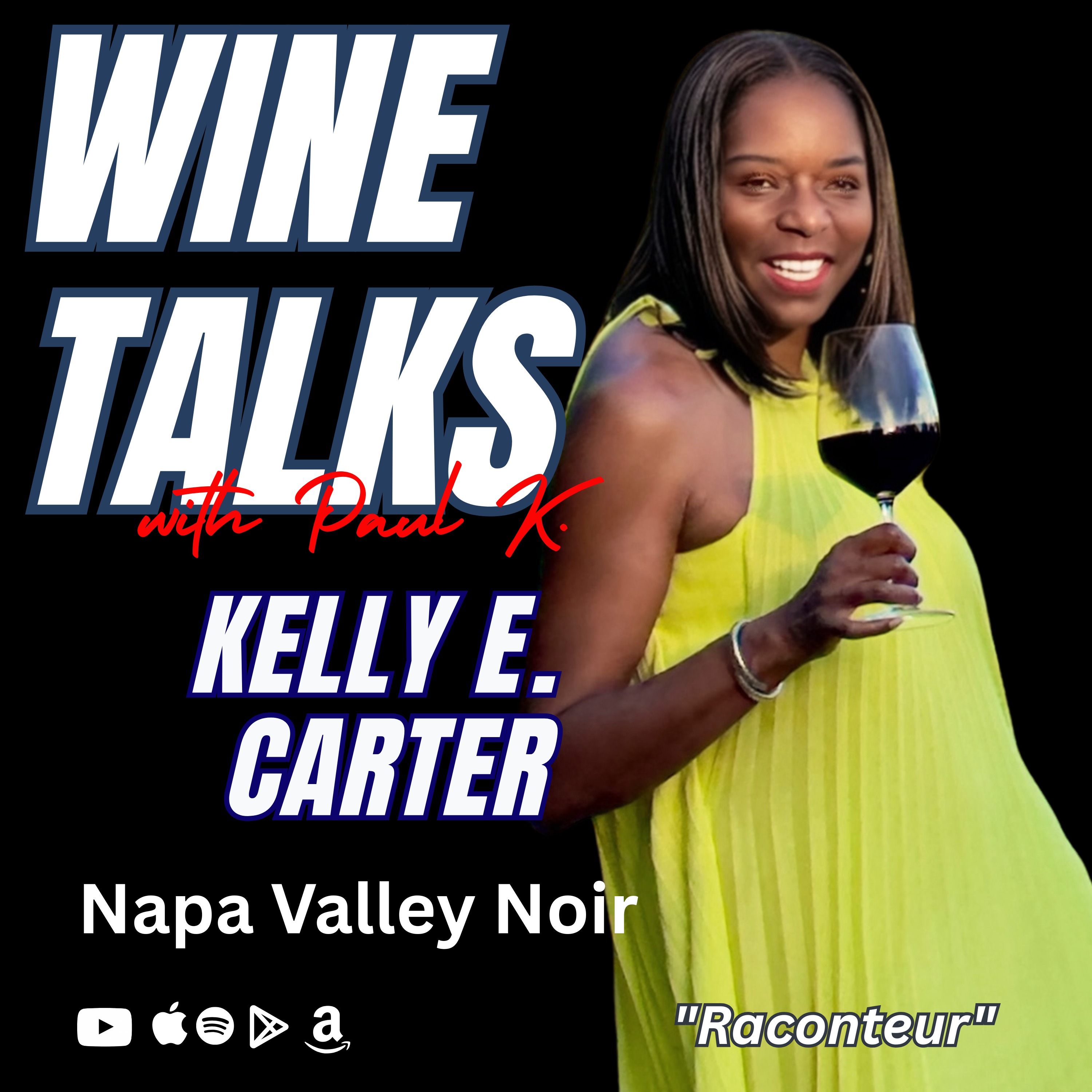
I can tell you it was like sitting with a long, lost neighbor when sitting with Kelly E. Carter. And in fact, we were neighbors of sorts back in the day.
It wasn't until I was searching for images to create the icons for this podcast did I realize I was in the presence of true maverick royalty. Besides being a New York Times best selling author, she has reported from the greatest sporting events of the world: the NBA FInals, Super Bowls, Grand Slams, Stanley Cup Finals and much more. And more intriguing, she was the woman reporter in the locker room!
I was so intrigued and we could have spoken for hours because she is the Founder of the wine tourism group, Napa Valley Noir.
sitting down with Kelly E. Carter in the studio for this episode of Wine Talks was like taking a stroll down memory lane while simultaneously hitching a ride on a train heading straight for the future of wine tourism. There’s something about Kelly—her energy, her wit, and just her knack for storytelling—that gets you thinking about the wine industry in ways that feel both nostalgic and freshly invigorating.
We kicked things off with some good old home turf banter—Kelly’s Windsor Hills childhood (Ray Charles and Ike & Tina Turner for neighbors, no less) and my own roots in Inglewood. Instantly, there was this shared sense that, before wine stole our hearts, Southern California had given us some pretty unique perspectives on culture and community. And as Kelly pointed out, “you’ll never know everything” about winemaking, which is honestly the very reason some of us keep swirling, sipping, and studying. I know I do.
What genuinely impressed me was Kelly’s trajectory. She was the first female to cover the Lakers—how many people do you meet who set out in fourth grade to be a sports journalist and actually make it happen? She wasn’t just content to report on sports. She made her mark, switched lanes into entertainment, and then into luxury travel writing, which eventually led her to Florence and Positano. It’s the kind of layered journey you don’t hear about every day. You talk to some folks, they’ve been in wine their whole lives. With Kelly, it’s travel, sports, culture—all converging in the glass.
We got into the nitty-gritty of wine and travel writing and how AI could never replace the boots-on-the-ground experience. I had to laugh—when Kelly plugged Napa into chatbots, she got recommendations for wineries that are closed for renovations. "You have to know the latest," she said, reminding me that the best wine stories are always written with real shoe leather, not just code.
Her insights into Napa Valley tourism were equally compelling. As the founder of Napa Valley Noir, Kelly’s passion lies in creating experiences rich in narrative, not just pouring cabs for folks who made it big in tech and want a taste of the valley lifestyle. She’s all about partnerships with wineries that have soul, stories, and a genuine connection to their craft—whether it’s a historic vineyard run by women or an impromptu meeting with Thomas Keller that leaves guests starstruck. Frankly, I couldn’t agree more. The stories make the bottle—and the memories. That’s what keeps this business alive, even as the market shifts.
Kelly also talked about the recent surge in African American visitors to Napa, thanks in part to celebrity influence (LeBron, Kobe, you name it), and her drive to ensure these visitors experience the full magic Napa has to offer, not just what's on the surface. She’s honest—her intake forms ask straight-up about comfort level on bottle prices. She knows how to match guests with the right wineries, sometimes calling in a favor for an extra pour or a charcuterie board, because that’s how relationships form and deepen in this business.
There’s a lesson in Kelly’s methods: whether it’s a group of corporate execs, first-timers, or veteran collectors, she makes sure the experience is tailored and memorable. Maybe it’s the aftermath of her own battles—her candor about beating a rare cancer got me thinking about perspective, gratitude, and the importance of living fully, whether it’s raising a glass or hiking through a vineyard.
Talking with Kelly reminded me why I started this podcast in the first place. It’s the human stories behind the wines, the journeys of the people who bring them to life—and the shared desire to know just a little bit more, one sip, one story at a time. Cheers to Kelly and to all of us still curious.
YouTube: https://youtu.be/AXGYAhnctSE
-
Napa Valley Noir
-
Alpha Omega Winery
-
Brown Estate Vineyards
-
French Laundry
-
Bouchon Bistro
-
Ad Hoc
-
Visit Napa Valley (tourism board)
-
AAAV - Association of African American Vintners
-
1010 Wine Bar
-
Vera Wang
-
Tod’s
-
Mohawk Industries
#WineTalksPodcast #KellyECarter #PaulKalemkiarian #NapaValleyNoir #NapaValleyTourism #AfricanAmericanWineCulture #WineIndustryStories #WinemakingEducation #WineTastings #TravelWriting #ItalyToNapa #LuxuryTravel #AAAV #WellnessInNapa #WinePricing #BordeauxBlends #WineExperiences #WineBusinessChallenges #CelebrityWineCulture #PersonalMemoir #HeadAndNeckCancer
0:00 You'll never know everything. And that's what's so intriguing about winemaking, is I don't care how much you learn. Yeah, right. There's always something more. And if you're a curious person that keeps you coming back, sit back and grab a glass. It's Wine Talks with Paul K. Hey, welcome to Wine Talks with Paul Kay. And we are in studio today in beautiful Southern California. But to have a conversation with Kelly E. Carter, introductions in just a second. Hey, have a listen to a show that I just released with Zara Muradian, and she is head of a foundation in Armenia bringing Armenian wines to the world. And it's a government foundation that is trying to get exposure for this incredibly old industry in Armenia. But not while we're here. We're here to talk to Kelly E.
0:48 Carter. She's the founder of the Napa Valley Noir, as well as the New York Times bestselling author. And she claims herself to be the unofficial mayor of the Yontville. Welcome to the show. Thank you so much, Paul. It's such a pleasure to be sitting here with you. It's amazing timing that we got this work out. I know, right? And I'm so happy you're back in LA in your old stomping ground. Yes. I don't get home often. It's my second time here this year. My friends are like, you should come home more often. You should come up to Napa more often. Did you grow up in LA then? I did. I grew up in Windsor Hills, which is like the black Beverly Hills. And my neighbors were Ike and Tina Turner and Ray Charles. Dating myself right now. I mean, I was born in Inglewood. So you go. Yeah. So right there. Yeah. So it's right there. Yeah. Just north of Englewood. My dad was president of the Lions Club, president of the Chamber. He had a pharmacy on Van Ness in Manchester. Manchester, yeah. Because you had all of those doctors as clients.
1:42 I mean, you're doing tastings for them. Right. That's how he started the company was after we moved to the South Bay. On Tuesdays, he in that picture right there. He was holding tastings, and the doctors would support him. But back In Inglewood, in 19, you know, 59 or 60, there weren't, you know, we didn't taste a whole lot of wine down there. But, I mean, I came along right after that, and I was drinking Manischewitz. Yeah. Beautiful. You know, as a kid, because my grandmother. I mean, my grandmother's sister, my great. Aunt, it's pretty amazing what's happened There. Because I learned how to ride a bike at Hollywood park before the form was there. Yeah. My first lemonade stand was on Manchester Near Prairie, that kind of thing. And. And then it got a little dilapidated. A little. A little. And now it's come back. Oh, my gosh. With Sofi and Intuit and even last night, I was at ten ten Wine Bar, which is on the. By Inglewood. I mean, right at La Brea and Centinella. And two black women, two sisters, owning. I've been trying to get them on the show.
2:40 Really? Yes. Okay. Well, I'm. Yes, I reached out to them a little bit, and it was a little while ago with the aav. Aaav. Yeah. Association of African American. Did you know the chairman grew up at West 82nd Street? And I grew up in West 84th Street. No way. And he was born one year behind me. Oh, my gosh. Is that crazy? Who's that? Which one? Yeah, I knew you're gonna challenge me. I know, I know. Sorry. It's like. But who's it. Because they have. Okay, so they have the founders. They. So they've got Mac mc. But Max from Check. Max just retired. Yes. He did Vision Sellers, which is amazing. It's like. And then the number two guy. Oh, well, you have Phil Long Phil. That's it. Okay. How embarrassing. I'm going have to cut that out. So in case Phil is Phil and I. Case Phil is listening. We were neighbors. You should be listening.
3:35 Yeah, we were neighbors. That part of our lives. And we were only one year apart. He went to Daniel Freeman elementary, like I did. Not crazy. Yeah. My dad would take me to. I'd go to work with my father. We. I'd stamp brochures at Manchester and Van Ness. And. And then he'd take me, the driver, the prescription driver would drive me to school at Daniel Raymond. So anyway. So we're like kindred spirits here. Yes. So tell me, then, how'd you end up in Northern California in the wine trade? Oh, my gosh, it was a long route. Had I known I could just move from LA up to Napa, I would have done so. But I went the long way, and I went through Italy. And so my background. You talk about the form. Yeah. And so I was the first female to cover the Lakers. I started off as a sports writer and decided fourth grade to become a sports writer. Fourth. Fourth grade to become a journalist. Sixth grade to become a sports writer. In college at usc, I set my goal to be. To cover the Lakers. And at the age of 28, it was my fourth job.
4:35 By then, I got the job to cover the Lakers. Wow. How incredible. And so I've always kind of been this. I set my eyes on something, that's what I'm going to do. I always said I would only cover sports until I turned 35, because I didn't want to be this old woman in the locker room trying to, you know, kind of flirt with you. Locker room? In the locker room? Yes, of course, if you're gonna be a sports writer, you have to go in for me. But. That'S funny. I was always professional. I would tell the guys, hey, if I see something I've never seen before, that's what I'm going to write about. Forget the game. And so that would, you know, put them at ease. Because there weren't a lot of women in the locker room then. No, that was probably cutting edge almost. Yes, because that was 91 when I started covering the Lakers. How did they receive that? Were they like, yeah, yo, go, girl?
5:22 Well, I remember when I was a student at USC and we could cover whatever we wanted to in one sports writing class, and I picked the Lakers, and they treated me like a regular member of the media. But I remember they were playing the spurs one night and George Gervin, the Iceman. And so he's. I could hear him in the shower. There's a woman in the locker room. Bring her back in the shower. No, really, Seriously. But because I'm so tall, six foot one, so the guys didn't really mess with me. And that's really interesting. And so that really helped a lot. And there were some, you know, I covered Major League Baseball. Reggie Jackson was not always very nice. And so. But I would tease him about it later as I got to know him. Once I started covering the NFL for USA Today and after the game to go to Carmen Policy's box for. He had a little post something. And so Reggie would be in there. He was retired by then, but I. How interesting. Yeah, but not a lot of stories. You.
6:16 But you were destined to be in journalism. Is that why you went to usc? Yes, because it was in best journalism school. And where did that sort of, you know, affinity come from as growing up. In just growing up. I love to read and write, and I just started writing when I was in the fourth grade. I still have what I wrote in about someone's house. My neighbors across the street, they used to decorate their house. It was hideous. Absolutely. About this hideous thing. But I wrote something very nice, and I still have that because I'm Working on my memoir. And so I have a lot of material that's so interesting. So, yeah. So I covered sports, and then I changed to entertainment and then changed to travel writing. And when I changed to travel writing, so then I moved to Italy and plan to stay in Italy the rest of my life. I moved at the age of 40. What part of Florence for first? And I always knew that would be my starter city. And then I wanted to find a small place on the sea where nobody spoke English. Ended up going to Positano where everybody speaks English. And so. But I stayed in Positano for 15 months. I was after a year in Florence. Did you learn Italian? See? See Italiano. No, Moto benett.
7:37 That's very cool. So. And after that, people said, why didn't you stay in Italy? I'm like, well, I thought I'd get married. I couldn't find accounts I could count on, you know, without cheating. Italian men. Count I could count on. I can count on. Not even on Sesame Street. So I ended up going to New York, and that was really to get my travel writing career going because I needed to meet those travel editors. And so once I met them in person and then I said, okay, because I wanted to do luxury travel, I can do budget travel all on my own. Right, that. Right. Right. So that's interesting, though, because I just think I was just gonna ask this question because it's off script. The I. You know this. I know we have the script. We haven't even started. I never even use these things. But this whole movement of AI and we were just talking with Josh in the engineers booth about how AI has been changing media and changing all kinds of things. Wow.
8:31 Yeah. There's obviously has a bias and it doesn't have common sense. It would seem like travel would be one of the least available opportunities for AI to invade. Because you really have to have the experience of doing that. You have to have these intimate experiences when you're traveling to write about. Well, also. And you have to know the latest because sometimes I'll type something in in chat and ask it just to see what it tells me about Napa. It's giving me places that have closed, places that are under construction even. Oh, and visit Robert Mondavi. Well, Mondavi's construction. It'll be open again next year. I mean, there are just some little things they just don't know.
9:12 Yeah. And there's no way to keep up on everything. But you couldn't get that feeling that comes from your right perspective through. All through AI and it just seems like one of those areas is not going to probably ever intrude on. Well, I've seen a lot of travel stories written by AI and even when I was working at Alpha Omega, and obviously I had a Google search on set up. And so every time Alpha Omega was mentioned, and one day, this was, I don't know, three years ago, and this travel story came through, and I'm like, God, this is the most poorly written article I've ever read. And it's all incorrect. Oops. And then I, you know, we realized it's like, oh, bot wrote this. This was not done with by a real person. We were just that the.
10:01 The Villagio version of the youn Phil est. The gentleman bought them. Jabara bought Gary. Yes. And they were pouring Alpha. It was a tasting night. Thursday was tasting nights. And there Alpha Omega girl came. Oh, really? Yeah, she was, you know, she's a tasting room gal and she. I love the wines. I thought never had them before. Oh, really? Oh, my gosh. After all these years, doing this wine's really good. So how did you go from travel to wine? I mean, there's obviously travel is part of wine. I mean, that is part of it. And even when I covered entertainment, I was working at People magazine. And then I went back to USA Today, where I'd covered sports and started doing entertainment there.
10:42 And part of that is covering Hollywood. You're always at fancy dinners, and I was always invited to a lot of places and, you know, so drinking a lot of champagne, drinking a lot of wine. But it was really even going back to when I covered the Lakers and the Lakers trainer at the time, Gary Beatty, and he's of Italian descent, and he would say, kelly, I see you drinking white wine. Because I traveled with the team for four years. Wow. And he says, you should drink red wine. It's healthier for you. And so Gary got me into red wine. When do you think that was? Why? When? Oh, this was in. In the 90s. Wow. So just after like the morally safer 19. Yeah, it was like 91 through 95. I covered the team. So he already bought off on this idea that. Yes. And so that got me into red wine more. So. And then when I cover the NFL and I cover the six most western teams for USA Today, so I would come up to Napa because the Raiders had training camp in Napa.
11:37 And so then I go to the French Laundry. It wasn't quite then the French Laundry that it is now, but I would go and do my wine tastings. And I still remember, like, the first great bottle for me at that time. My first bottle that I purchased was, like, a 1994 Caymus that I thought was just excellent. And I didn't understand about vintages or so. And I went back to purchase it later, and they're like, oh, we're all out of that vintage. I'm like, what do you mean you don't have any? I don't understand. But that's a little. I didn't know. It's like, once it's gone, it's gone. I should have bought more than one bottle. And then. But that gets you into everything. And just. So that just built well. So when I lived in Italy and just going. Going around to Tuscany and various wine. Regions, the intellectual curiosity to wine.
12:26 No more. The taste. The taste. It seriously was. It kind of set you up for something. I know I had some great experience even going to Bordeaux and some of the. Oh, my gosh, some of the chateaus that I went to, and I'm just like, oh, I mean, you know, older than me and. And I should be, like, so impressed and. But I would. I wasn't paying attention to the production. I really didn't care about that. It wasn't until I moved to Napa that I really gained an appreciation for wine making. So interesting. And then once I started working at Alpha Omega, I was director of communications, but I'm like, okay, I'm going to work harvest. So I'm on the sorting table. I'm out in the vineyards. I'm picking grapes.
13:07 I'm, you know, like this with the vineyard manager because I want to learn. And then I really got into it. Then I did my w set studies and just knocked out 1, 2, 3. People said, why are you starting at 1? You've now been in the wine industry. Four years, which is like, red wine. Is red wine. Exactly. But I wouldn't build a house starting on the second floor. So I wasn't going to build my wine education either. Starting at 2. I didn't mind starting at 1 because it even gets my mind just thinking a certain way. So. So when you do, we're going to talk about the tours here. What will Napi Napa Valley Noir is. But you struck. You hit a very important part of what we talk about and what consumers hear, and that is how much education do you recommend or how much.
13:58 How much excitement do you expect to get out of your clients? And do you promote that idea or. As I am mostly, hey, you get out of what you want to put into it, and you're never going to learn it all. It's impossible. But there is an intellectual stimulation and an emotional and romantic stimulation to the subject. So how do you deal with that with your clients? I mean, you just show them a good time and let them walk their own path. No, I really want to partner with wineries that have a great story. I don't want the story to be such and such. Made so much money in wine, I mean, in tech, that they just came to Napa and opened a winery. It's like. Or surgeon or restaurant. I mean, anybody can do that. I love stories. I love. I went to Lark Mead for the first time recently in Calistoga. Beautiful story and with females. And I was just like, so this is enchanting. Yeah. And that's what I love. I love stories. Because at the heart, that's what wine should be centered around, stories. I think that's what we have to get back to and really help the industry get back to what it was before. Completely agree. And that picture is 1975, and that's what we sold.
15:11 That's all there was, was stories. Because the idea of corporate wine and the idea of bringing in 50 cent a liter junk from Spain and putting in the bottle with a fancy label didn't exist. Right. It was. This is all earnest storytelling from immigrants coming to Napa or wherever they're coming from. Yeah. I think you have to go out in the vineyard. I like taking clients to places where they can go in the vineyard and they can taste the grapes if it's harvest time, or even going into the cellar and just having some kind of backstory to it. Even though when I started drinking wine, yes. That didn't always interest me, but I think that that's the way you keep people. You think that's a natural progression. It is. It is. And that's the first glass. Yeah. I love about wine as. And you mentioned. And you touched on it, is you'll never know everything. And that's what's so intriguing about winemaking is I don't care how much you learn. Yeah. Right. There's always something more. And if you're a curious person that keeps you coming back. Is that part of, you know, part of this part of my career in my life?
16:14 This podcast has stimulated that thought process and that interest in that academic and intellectual and romantic part of wine. I'm totally with you on the storytelling. Is that something that motivates you every day? Like, you get up and you go, oh, wow, this. What am I Going to learn today at what. What am I going to see today? Or if you have a client group coming in, what am I going to show them? And what's the. What's the point of all this? Yes. And even when I go out, I'm invited to a lot of places. Obviously, everybody is looking for business right now in. In Napa and Sonoma. And so I'm invited to a lot of places to come and taste, but I have to decide where am I going to go. Otherwise, all I'm doing is, you know, trying to get to your number of over 100,000 tastings, which isn't going to happen. But I really. I don't want someone.
17:04 Oh, and we make these single vineyard cabs from so and so. Like, really? Yeah. Yeah. So. So I want more than we make these cabs or so. And I noticed, you know, Napa's problem is Napa has not had to market itself, and now it has to market itself. Well, we were just talking about the expense of coming to nap, and I didn't finish my thought, and I'll finish it off camera. So we don't embarrass anybody. But yes, we know. And it's. That's a challenge. Napa, you know, I get a lot of inquiries from first timers. People are very intrigued by Napa right now, especially African Americans, which are. There's the tourism, you know, visit Napa Valley release statistics last year, and the growth with African American visitors to Napa Valley, it's tripled. Wow, that's great. And so. But it's a whole thing of bringing people in. Everyone's not going to come in and buy $500 bottles of wine. That takes a while. And you may never get to that point. No, you know, it's. It's a lot. So wineries have to figure out, okay, we have to be okay with people paying a little less. They're going to level up as people learn more, you find your comfort level. That's one thing I always ask when I start off talking to a new client, and it's on my intake form. What is your bottle price? Comfort level.
18:36 And it's 50 to 100. They're telling you the truth. Like, they want to say a 50. I know one wants to say, but you'd be surprised how many people pick that 50 to 100. And then the other category is 100 to 150. 150 to 250. 250 plus. But you have to be very honest with me with what your budget is. Otherwise I'm going to go crazy because I'm going to show you the best time. I mean, my specialty at the club was 10 to $18. I mean, that's what I lived in. Right. Which is that marketplace has changed. Let me ask you the question. Something happened. I forgot what social upheaval we had. Maybe it was the early 2000s, and I reached out to the AAAV, the Association of African American Vendors, to see. I forgot what my inquiry was. But there were only five members at that time. Oh, my gosh, there are so many. It was like maybe two or three after it was formed. And then. Yes. And then now there's like 200 plus. Right. Went to the tasting. The tasting of that.
19:33 The Oxbow. I missed the one I had. The next Oxbow actually had to come. Oh, I'll be at the next one in. Yeah, I'll be at the one in April. I tasted every single wine there. You did? I had to miss. I was down here in la, actually. But let me. Let's talk about the. Culturally. You came from Inglewood, around Inglewood. I was born there. You just went to 1010, the Boing Bar there. Which. Which I've. I've known it to be in existence for. For many years already. Well, they've had that. What is they. What did they just have? It's been open, what, three years, four years, I can't remember. Functional business now. Oh, my gosh, it was packed. It was like last night. And I had to, you know, run by. And Leslie, the owner, was in. She's. Oh, you're in town, you know. So is that. Is wine culturally new to the African American base or is it pretty much. So people are. Yes, I think it is.
20:19 I mean, obviously there are people who. Most of us didn't grow up with wine cellars. Like I said, I grew up. My mother. My parents drank spirits. My great aunt who lived with us drank Manischewitz. And so. Well, that was fermented grape juice. Anyway, so I drank that. But generally it's new and it's aided by the hip hop community, the athletes in particular, NBA players. People like LeBron, you know, made it very sexy. Even Kobe Bryant, you know, Kobe came up to Napa. I blended wine with him at the Napa Valley Reserve. How cool. Oh, my gosh. And they. It was. He was doing a promotion. Oh, Hublot. The watch company had come out with a new watch for him, the Mamba. And so they did the unveiling at the Napa Valley Reserve and did a wine blending session. And I told Colby I said, oh, you should move up here after you retire. And I was trying to get him up here. Well, you know, there's. I was talking to the Somme at Boa Steakhouse, which is. Yes. Culver Studio in that area.
21:25 And he said that it's almost nightly on a home game if, depending when it ends, they get a phone call from LeBron or somebody, they say, hey, pull out the Lafitte or whatever they're gonna drink, get a couple of rib eyes going, and we're gonna be there in 10 minutes. You see what these guys are drinking. I mean, Jimmy Butler with the warriors, you know his sellers. Oh, Sasakaya, he like loves it. And there are a lot of hip hop guys in music and they are. They have podcasts and they're really talking about some of these ultra premium wines. That's really interesting. And so that has really helped. And that all stems back from Greg Popovich, who was the San Antonio spurs coach. Big wine guy. And so he would talk to, you know, Tim. Duncan. Duncan, different players about wine. Tony Parker didn't mean the same Tim. I don't know if Tim's right, but.
22:12 Tony Parker, Cote Duron, I think, or something. Tony. Tony does. Yes. Right. Yeah. So is that what spawned Napa Valley Noir? In a sense. It spawned it in a sense, but also what I saw. I saw a lot of people. I saw the black tourism growing in Napa, but no one really reaching out to them to let them know what actually is possible. We come up and we go to Brown, and I love Brown. They have their downtown tasting room, which is limited in size. They did used to see visitors at their estate and. But it wasn't. And that was. I was like, okay, you. You've got to do more. You've got to get out. And there are wine dinners you can have in a cave and lunch in a vineyard. And you can have access to winer, winery owners and winemakers. And.
23:12 And we have the money for that. You know, when you're talking about access, that generally comes with a purchase expectation. You know, someone's not going to show up. And you're buying a 50$1 bottle of wine for six people. You're not going to get a winery owner to come out and, you know, sit down with you. You set that stage before you do these things. Yes, you have to. It's managing expectations on both ends. You don't want to put the client in an uncomfortable position. And you certainly don't want to ask something of a winery owner or winemaker. If you have to make it worth their time. Yeah, it's time. Yeah, it is time. And time is money. Yes. And sometimes. And people don't mind popping by to say hello because they know it's all about that interaction and that's what's going to keep people coming back. Oh, my gosh.
24:01 I had the best experience with so and so or I had a chance to meet, you know, so they may not sit down and have a tasting, but those certainly come by and say hello. Well, you don't think your friends in that video that saw Thomas Keller. Yeah, I mean, Thomas Keller magically appear. Yeah. So they're gonna go to Bouchon and they're gonna go to French Laundry or ad hoc or whatever they're doing. But I would see that when I worked at Alpha Omega and the owners, Robin and Michelle Baggett, as Robin would love to, you know, they just live down the street from the winery. Robin loved to just walk around on the terrace. Hi, I'm Robin. I own Alpha Mate. You know, sit down, have a glass of Chardonnay with them or something. And those are the kind of things that stick with people. And it also shows that it's not a corporation that owns a business and it's not Constellation and Treasury and everything. And so when you know that Snoop Dogs, Cali Red. Yeah, but those are things you have to. But that's an interesting thought. I just. You triggered a thought because in the 80s, when Pat Ture brought Wolfgang Puck out of the back of the kitchen Maison and brought him to the front and that became hospitality. Yeah. And I love this idea, what you're doing, because I believe in, like you do, in that, you know, tourism, experiential tourism is where the wine trade has to go back to this little patch here. And I've told this story through a thousand times to the listeners, so maybe they can turn it off for a second. But this,
25:32 this is Les Ami Devan. It was 150 chapters in America. And you would go and Mandavi would speak and Lawrence Bowser, Robert Bowser and Harry Waugh and people in Palos Verdes, where my dad's store was, would go to dinner and then they would taste Mondavi's wine. And then that was indelible. That conversation was indelible. And those tastings, I think you're on the right track in that regard that we need to bring that experiential part back, right? Yes, you have to, because that's what people are going to remember and that's what they're going to post. We're in social media world. That's new, right? That's. People are paying attention. You know, they plan their whole trips around Tik Tok. Yeah.
26:13 It's true though. It's really interesting. Yeah. And so they'll, they'll go with you. You're going to take them around to what, what's, what can I expect? I'm going to call you tomorrow and come to town. What are you going to do for me? Me? I am going. So I just had a client fly. She left yesterday. Now this was a lady who had never been to Napa before, traveling solo from North Carolina. Wow. Which I thought was very interesting. Even when her inquiry came in and it was a Hotmail email address. I'm like, oh, this is a fake. She just wants to know what my prices are. Nobody uses hotel. Yeah. Hotmail, aol. Yeah. These are red flags for me. But that taught me to take everybody seriously because she committed immediately.
26:58 Some people, they see my rates and like, yeah, okay, yeah. You never hear from them again. Sign me up. Business. Yeah, it's business. You're not going to get everybody and that's, that's fine. And but what I did for her and she didn't need all four days curated. She wanted one day. It maybe did one and a half days. When was hot air balloon that didn't go up because we've had some kind of bad weather. But even a place where she didn't. I didn't curate for her. She just happened to mention she was going because she was staying downtown the day she got in. So she said I'm going to go to Brown and I'm going to go to Celadon for dinner. And I said okay. And so I sent a note to send an email to my contact at Brown. I said I have a client coming and she's coming in on her own. I didn't book her but she'll be there. He said, oh yeah, I see her name. She's coming at 4:30. And I said okay.
27:54 I said just give her an extra pour or something like that. Right? Yeah. And then I get an email from her two hours later she's oh, thank you so much. They gave me a complimentary experience and a charcuterie black. Oh wow, that's great. Thank you. So those are things and I can't always do that. But I, I appreciate that. Brown did that for me and I have eight clients going to them in, in two weeks or so. Well, they appreciate the business is business, right? I mean, yeah. At some point. Yes, exactly. And it's just keeping them fresh. But it could be. If I'm going to call you, it's. Everything's custom. I tell you what I want and you. It depends. I'd like to know what someone's palette is. I was referred to. Someone referred me to a colleague. The guy was coming to Napa to speak at a convention, a guy from Texas, wine drinker. And I get on the phone with him.
28:52 I said, so you love Napa's big red cabs? He said, no, I hate them. I'm like, oh, really? Okay, let me see. Okay, what do you like? And he said, bordeaux blends. He said, left bank Bordeaux. So I said, okay, let me figure out. What am I going to do? And he was coming. It was a very short amount of time, so a couple of places, and he only had Sunday to taste. A couple of places I would have sent him were closed on Sundays. Others were booked. And then I said, oh, you. Some connections got him into assome on Atlas P, you know. Yeah, right. Yeah. That Heidi Barrett has an interest in. They pour so many different types of wines. And I told them what his palate was and his traveling partner's palate.
29:40 They bought a lot of wine. Wow, great. Contacted Alpha Omega, where I used to work. And even though they're known for their single vineyards and everything, but I know that they do a left bank and I know all the wine. I know their skus. So I asked Eric, the tasting room manager, I said, hey, can you put together a tasting, Put together a flight just with these wine? He said, sure. And so those are the connections that I have where I can contact a winery and say, okay, don't pour this, but pour this. And this is what they like. And so I mentioned to know and I want to talk about the book. Actually, I did stop and bring one of my books. People say, think that's me? So what. So what is. This is. Oh, this was Venus Williams. This is the New York Times bestseller. Yeah. And when did that come up?
30:27 This came out in 2010. And it's a book about really what sports teaches you. We had some really heavy hitters interviewed for this book. Everybody had their own chapter. So you have Sir Richard Branson, Ken Chenault, who's the CEO of American Express at the time. Bill Clinton, Phil Knight, you know, started Nike. Marcus Samuelson, Meg Whitman, Jack Vera Wang. So what inspired you to make this book, write this book? Well, the publisher came to me. Oh, well, that would be one inspiration. But I was trying to. I'D met the publisher at a seminar for secrets of book publishing or something. I'm pitching my.
31:08 I just moved from Italy to New York, and so I'm trying to write my memoir about my two years living in. Living in Italy. And so she was kind of interested, but then she had me in, you know. Anyway, months later, she came back to me and she said, hey, I think I have a first great book project for you. Because writing a memoir, and I've been a magazine writer and a journalist, a newspaper writer, it's hard to write a memoir, I would think. So that's actually one of the questions. Is, like, how do you balance. Very hard. So this book is great because it's 46 people who were interviewed. They all have their own chapter.
31:49 And the first part of the book is Venus. I would write the stories, send them to Venus. She would read, write about what resonated with her, and write how come she wanted to become a businesswoman when. While she was still playing. Things that her parents taught her. Wow. So the book is really about the lessons that you learn from playing sports that help make you a success in life in Compton. Yeah, exactly. Exactly. Growing up in COMPTON, Venus was 10 years old when I first found out about her, and I was covering tennis. Is there something on the horizon that you're writing now that's not related to editorials and a couple of things. So I'm working on my memoir, Bellini for one. And so that it's based around my time living in Italy. Bellini for one. Bellini for one. Because I'm a solo person. I'm always at a bar by myself, eating by myself. Bellini for one. Table.
32:44 Interesting perspective. Yeah. And it's. But it's my life, but it's more. I thought it was enough to just write these great stories, kind of like A Year in Provence, which. I love that book. And people said no. To write a memoir, you have to develop the character, and you have to. There has to be an arc, and they have to go through something. I said really didn't change when I lived in Italy. I think living in Italy taught me things about myself. But it wasn't until I moved to Napa that I really changed, I think, and became the person who I am today. So now I'm bringing the memoir all the way to Napa. So it's a lot of cutting down. No one wants to read. It's not an autobiography. I don't want to bore people. Do you think you need. I always ask this question of winemakers because I think it's an important question if you're making wine in Italy or making wine in Australia and then you come to Napa and you've now made wine in many parts of the world before you settle at your final career spot. But I want it from a life's perspective standpoint. Do you don't think. You said you weren't sure that you learned more about yourself a little bit in Italy, but there wasn't till Napa that you landed there. But it would seem to me what a great perspective change. It would have to live in a foreign country and then to learn about yourself and then have a chance to expand the boundaries a little bit where. It does teach you about yourself. Because you can see how much you want to grow. Learning a new language at the age of
34:15 40. People thought it was crazy. It's not easy. No, it's not easy. And our brains are pretty fixed, right? Exactly. But it's part of that. It's part of that growth. And you know, I thought I loved, you know, the Renaissance period. Then I, after a while I got bored with looking at. I love Botticelli and it's like the art, you know, Venus butterfly and everything. It's like. But after a while I said everything looks the same. I don't see any people of color. And I know there are people of color. We've been whitewashed out of everything. I got tired of looking at in Florence Renaissance. Yeah. And I lived across the street from the Feetsi. I lived on Via de Bardi is my incredible apartment without. With fresco ceilings and right on the river. And I could see her. I can see her intensity of just talking about. Oh my gosh, it was incredible experience. And I would move back there. Yeah, yeah. We're going to Rome in two weeks. We got invited to meet the Pope.
35:15 Really? Yeah. They're canonizing an Armenian bishop. And. And somehow, I don't know, my friend said, hey, you want to go? You got two weeks to make it. You know, we're going in two weeks. Okay. Yes, I'm available. You're ready to go. You know, my daughter is a French trained. And my friends are going to give me crap about saying this again, but she's a French trained boulanger. And I'm saying this for the perspective of living in a foreign country and then learning the culture because I think that's the most important part is like, how do we talk about the wine and culture now? But she had an apartment on the sixth floor which used to be for the housekeepers. Of those old buildings, the room was smaller than this stage, the set here.
35:59 And as far as she was concerned, she had an apartment in Paris. I couldn't even go in the room. It was so. I was so claustrophobic, I couldn't even stand there, you know. But her perspective was, I have an apartment in Paris. And so she got to live that life for a few months and walk the streets, and she would bake bread, and then she. That whole thing. And I think that's so culturally rounding. Oh, my goodness. It's amazing experience. You know, when I lived in Italy, and it takes you a while, especially in Florence, before they work up, they think you're a tourist for a while. I remember when they really accepted me, and it was a place I buy my produce, and so they're used, and they would see me come in, I get my head of lettuce. And one day the owner reached down and he pulled out a beautiful selection for me. Wow. Like, I've made it. Wow. Yeah. You really arrived.
36:47 I know that. Yes. I am a real local here. And so. How exciting. Yeah. Because I, I. I sat down. My father spoke French. He spoke five languages, actually. And before he passed away, I thought, you know, I'm gonna learn French for him, to just talk with him. And so I did. And what that does, as you with your Italian, it expands your horizons culturally because you can't learn a language without learning the culture along the way. You have to study Napoleon a little bit to understand the French culture. You have to understand the revolution, the Renaissance. You have to understand the revolution. You don't understand all this stuff in order to sort of get a perspective on the language. Yeah. And you. And here you are getting a special tray of vegetables. It's like, totally arriving.
37:31 I know. It's like. Yeah. Because otherwise, it's, you know, who knows what they're going to. You just get to pick whatever you think. You think Americans, you'll be in the Napa wine trade, and you hit it on the head. There's, you know, the. The famed surgeons and the restaurateurs and the, you know, the government contractors that made their money and they went up, you know, and opened the big chateau and realized, I'm a farmer now. Yeah. And this is really hard. And I can't make a dollar. Right. I mean, do you think there's a lot of that? There is a lot of that. But it teaches you, you know, you see where you rank and you're not in charge. Mother Nature is in charge of everything. And you have to accept that it's a tough life being a farmer. I gained so much, and I don't garden or anything like that. I tell people, it's like, I don't make any. I don't cook. I make reservations, you know. But what a respect I have for the farming community. Yeah. Our farm workers.
38:28 Well, the true passion. I sent a young girl that used to be an intern here to Bordeaux this last summer. She's a Cornelli knowledge student, and she. We got her an internship in Bordeaux on the Left Bank Chateau Bail. And she goes, uncle Paul, I don't want to. I don't want to work in the vineyard. And that's what they're asking. They're going to ask me to do. I said, look, girl, I go, if you're going to be in the wine business, you're going to be in the vineyard. Right. This is where it happens. You know, you're going to be a farmer, and then all the rest of it's going to be. You know, the part you think is going to be fun is really sex for the box office at this point. You're just. You're going to have to learn how to tend. And she started in the vineyard at the internship, and she texted me. She goes, this is unbelievable how. And I haven't had a chance to completely wrap up with her, but she came away with this incredible insight into what wine is. Right. You really gain an appreciation for every glass. Yeah. Every sip.
39:25 It's a lot that goes into it. So your daily routine in Napa is organizing trips. Organizing trips. Reaching out to people. Because as much as I, you know, I purposely name my company, I wanted the name Noir in the company to reflect, let my people know that there is a face looking out for them. But I always tell people it's not a limitation. No. Right. Well, that's interesting thought. Yeah. Because I've had some of my corporate clients. Todd's, the Italian fashion house, which goes back to a relationship that I developed when I lived in Italy. You know Mohawk, which is a global flooring leader. Yeah, that's right. The clients of yours. Yes. Wow.
40:10 Yeah. My friends in flooring. That's why I know this. Okay, so nobody knows Mohawk. You really have to be like, they did $10 billion in sales last year. Yeah. And I curated experiences for them. They were blown away. Wow, that's. That's exciting. Yeah. There was a woman, maybe you've met her, Joanne Dupuis. Heard of her. Well, she's like 95, maybe 97 now. Okay. You should listen to her podcast. One of the first California, you know, tourism people. Oh, really? She was responsible for taking Stephen Spurrier around to Freemark Abbey and Chateau Montalain and all those places to find the wines for the Judgment of Paris. Yeah. And she was the first woman to ever speak in front of the Napa Valley Vintage Association.
40:50 Okay. Like Brother Timothy. Yeah. And Louis Martini and all those guys. Amazing. Yeah. It's really a cool story. So she has a podcast now? No, she's been on the show. Okay. I was gonna say, if she's, like, 95 and has that energy to do. What you're doing, I'm gonna get you the book. She wrote a book called the Rest of the Story, and it was written after Bottle Shock came out to prove that. That most of Bottle Shock was kind of pocus. Right. And she was there. Yeah. This is what really happened. So is there. I know there's lots of competition for, you know, tourism, and I think, yes. There'S a lot of it, but there's. Everybody has their own connections and everything. And, you know, one of the people who's been so instrumental in me getting to where I am, getting off the ground successfully would be viewed as my competitor. Yeah. Right. But she gave me my first client, and she called me two weeks before I was ready to launch. She's like, kelly, I've got too much business. Can you take a client? Wow. And she's like, are you ready? Sure. Coach put me in. I can do it. You know, book of Private Chef. And, you know, and it was like. Oh, there's a lot of camaraderie amongst the, you know, tourists in terms of. For the most part, yeah. There's only been one person who I reached out to and said, oh, I'd love to get together with you. It's like.
42:09 But it's. And it's not to. You know, we're sending people to a lot of the same places, but it's what you do for that purse, what else you do. It's going that extra step, and that's when you have to find out everything you can about a client and go that extra step to make them feel like a vip. We're almost out of time, if you can believe it, because there's so much more to talk about. We have to do it twice. So I'll do it when I come to Napa. And. Yeah. John. Phil. But have you. There's a whole issue right now in the trade. Of course. Wine sales are down. You've got the gen zers, and, I mean, There's a million reasons social marketing is imploding. There's just all kinds of problems with the trade. I'm a romanticist. I think that that will. The ebbs and flows and it's going to happen. Things will change again.
42:56 But do you see that in, you know, tourism in Napa Valley right now that there's a less interest by generations or just by the cost? What is it? I don't think there's less interest. The interest is there. It's a cost that is really prohibitive for a lot of people. Now. Some of the people don't know if they're going to wake up and have a job the next day. That's true. And so they're booking very last minute, even with I know one proper manager. And so she said she'll get a last minute booking for a house for 10 people. Because people just don't know if they can. It's true. They don't know if they're going to have. People are drinking less. I had an inquiry from one client. It was going to be five. Five couples flying private, just coming up for two days. They don't drink wine. They want to go to the French Laundry. And when all wellness and they wanted to go. So I curated this whole wow, everybody. Not everybody's drinking wine these days. But what Napa Valley offers is tremendous wellness. And you can go bike riding in the vineyards, you can do olive oil tastings, you can go to Calistoga and do mud baths. And there are all these different things that you can do and they didn't even want to do because I was going to set up a tasting to do something with the alcoholized wines, which I drink. So I know you cringe. Are you kidding me? There are some good ones. There are.
44:22 They have some good ones from Germany, from Spain. I'm still trying to find a good one from Napa. Well, you know the process, right? It's kind of a disgusting process. But they apparently there's been some new molecular difference processes that have changed. Don't tell me how the hot dog is made. I'm just going to my hot dog. But when they pull the alcohol out, it pulls out all kinds of stuff and they got to put it back in. Blah, blah. Yeah, yeah. Some of it tastes like grape juice. And so you do. I haven't found a good. I have found decent reds, but they're out of Spain. You know, it's interesting. I used to feature in when I had the gift basket business here. We. I didn't have there Wasn't d alc was around. Ariel was the first one that I remember from the 80s. It's still around, but, you know, I wouldn't sell it. So castor sellers in Paso would bottle white zinfandel before it fermented. Okay. But the problem was it wanted to ferment, right? Yes. Right. Because it naturally wants to do that. And so he was. My biggest problem is it was corked cork, finish, glass, bottle 750, the whole thing. And it was kind of fun because you can uncork it and you poured this wonderful sort of sweet. I just don't understand why that's not the alcohol. Why did it not just drink that than wine that's been removed? But that's not the point. Let me ask you this other question, and we'll wrap it up. We. We spend a lot of time at the beach in the south Bay here. And it's a. It's a.
45:42 It's a very healthy lifestyle. You just. I live in Arcadia. We live in the valley. Maybe it's because it's our daily routine. It doesn't feel like the health lifestyle is healthy. Napa feels like it could be that lifestyle. If you lived in Napa, lived in yon. Feel that you're playing pickleball, you're going on walks. I know they've expanded bike trails throughout the valley. Yes. And is it it starting to feel like that, or has it always been that way? The sort of. The spa life? No, it is going more toward that. There are. There's yoga in the vineyards that you can do really sound baths. I mean. And you're gonna start hearing more about it. Visit. Napa Valley just brought someone on to be like a wellness ambassador. Yeah. And so they realize that's really where things are going. Yeah, I can see that. You have to have more than wine. I mean, not. I personally don't need anything. You need any more. Yeah.
46:33 Neither do you. Wine's fine. No, but you do have to have more. You know what happens to me when I have these wonderful inspiration conversations? I start thinking about wanting to drink tonight. Yeah. I started, like, when I go home, I have a Napa Valley cab, or am I going to have, like a Bordeaux or whatever? What are you going to have tonight? I don't know. I'm a Burgundy guy. Yeah. But, you know, that's a very expensive habit. Yes, it is. It is. And it's so amazing. I mean, it's like, how come wine is so expensive anyway? Well, here's a. Here's a. I didn't bring this up. We were talking about it briefly, but we visited a good friend of mine. His name was Chris Phelps. He made wine at Petrus. He was the Dominus winemaker when they first opened for 12 years. Makes wonderful Cabernets from Yountville Sleeping Lady Vineyard. But they have that Bordeaux structure because of his experience. Right. And we're talking about it. I mean, the bottom line is, if you want decent grapes without getting into the boring metrics of the wine business, if you're paying $15,000 a ton, I mean, the. The rough sketches, you got to charge $150 a bottle. Yeah, you do, in a sense. And then. But some people get away with less. Yeah. I mean, there's a guy who does Custom Crush at Alpha Omega. His wine is $65 a bottle. Oh, that's great. He doesn't do it to make money. No. Does it to donate to all. Nobody does this to make money. No. Well, yeah, that exactly. You know the joke about that, but, you know, it sounds good and everything. And you have these, you know, these trophy wines in your cellar that you never plan to open. I know. I go to people Sellers and I'm like,
48:06 when are you going to open that? Oh, no, I don't want to open it. I said, just refill the bottle with coffee or something like that. Drink the wine. No, it's a. It's a disease. It is in that regard. And I never had it until I sold my company. Yeah. And they did. They wanted none of what was in the cellar here, which I had collected during COVID and all these other things. And I may end up being like, 2500 bottles of wine is a lot. And there's some classified growth and Grand Cruise and all that stuff are in there. And I get them. I get the mentality now, because if I open it, I don't have it anymore. If I don't open it, I never get to experience this. And if you die before or you. Let it go too long. Yes, that is the thing. It's like, oh, my God. Gosh, that's the worst. You uncork a bottle, you're all ready, and then it's like, ah, should have opened it last year. I will tell you. We were at. At a restaurant in the Yonville. I won't tell you what it is because I'm sure it's just a fluke. I ordered a bottle of Rosa de Mono and it had bubbles in it. And the. And the waitress agreed. She goes, yeah, this got bubbles. So that came back to me from the gm, saying, that's the way those wines are. No. And I'm like, that's. That's.
49:18 Possible, you know? Yes. See, I think you said, that's impossible. Yes. And I thought, you know, I have to say something. On the way out. They fixed it. They brought something else. But I said, you know, I've been doing this for a long time, and I've tasted a lot of wines and roasted. The Montaccino is not bubbly. No. It's just not the way it is. And that clearly is a huge. Usually a heat problem. Right. Stored properly. Yeah. So this has been such an honor and pleasure. Oh, no, it's my pleasure. We want to talk about. But we can do it again. And we are in Napa quite a bit. In Yountville, particularly. Yeah, I'm right in Yountville. You'll see me. You'll see Thomas Keller pop out from behind me and welcome. Yeah. That's standard operating procedure. Right. We all know this.
50:02 And actually the. The Village, the vintage estate, are now the state of Yonville has a little upstairs office. Yes. They let me use podcasting, so. Good. We could do that. Because so much to talk about. Not only on camera, but off the camera. Yeah, for sure. No, it's like, I think back to my, you know, my basketball writing days, and you talk about Armenia, and I'm like, Tark the shark. I look at you and I'm thinking of Jerry Tarkanian and all the fun I would have. Well, his brother lives. He just passed away, but he lived two doors down from me. Yeah. Oh, yeah. Yeah. Right here in Arcadia. Oh, my goodness. Myron Tarkanian was his name. Thank you.
50:43 Thank you. What's. What's next? Are you going the weekend off? You're going to see friends, I think you said. Tonight I'm going down to Newport beach and for my best friend, who's high powered sales exec, anyway, she has to host some people in a suite. So she's like, come on down. We're. Oh, nice. So I'm gonna go down there and then I'm at a symposium tomorrow for head and neck cancer. That's interesting. Yeah. I actually had. You had. You had that. I had a rare cancer. I beat it. Wow. I'm here before you went to library. When you got back two years ago. Oh, incredible. Congratulations. Thank you.
51:24 Yeah. Amazing. Yeah. So and so are you speaking or just going to listen? I'm listening. I did speak at ucsf. Did a head and neck cancer patient symposium in August, and I was on the patient panel. I'm like there, you know, I try to get poster child. Yes. I try to give people hope. You can have cancer and you can look like this afterwards and get on with your life. You go. And so I really try to be a support to others. Yeah, that's excellent. It's a very traumatic. It is. It can be very traumatic. And that's another book that I'm writing too, is on my first year of diagnosis. I was diagnosed in 2023 with a rare oral cancer that only 4 in 1 million people a year affected with. That's really rare.
52:11 It is. I always thought I was one in a million. Yeah, well, four in a million. Well, sorry you can't have everything. No, but it's all about attitude, getting on and, you know, soldiering on. We'll continue that conversation. Yes. Cheers. Okay. Cheers to you.