

 Apple Podcasts

 Spotify

 Youtube Music

 RSS Feed
 YouTube
 Pandora
 iHeartRadio
From IT To Wine. Garry And Joanne Brooks Could Not Shake The Dream Of A Winery
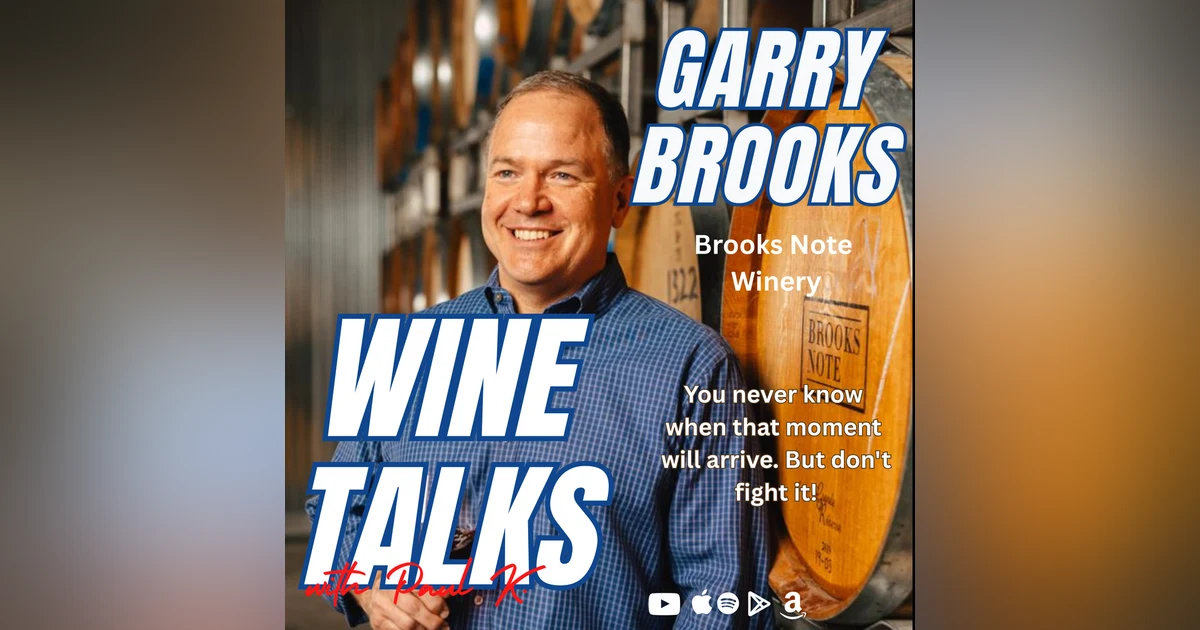

Gary Brooks doesn’t just make wine—he turns the whole idea of winemaking on its head and brings it back down to earth, reminding us that, after all, it’s just “rotting fruit.” But don’t be fooled by the humility. In this episode of Wine Talks, you’ll discover how a man raised in Annapolis, guided by a career that veered from the Navy to IT management, ended up chasing Pinot Noir dreams in California’s Petaluma Gap. As Paul Kalemkiarian digs in, you’ll learn how Gary navigated the split between wine academia and hands-on “cellar rat” labor, why starting Brooks Note Winery took more grit and capital than sanity, and what it’s like to pour your soul—and your bottles—out of the back of your truck just to make ends meet. Gary shares candid stories about the hard business realities behind artisan winemaking, how texture and mouthfeel outshine flavor notes in the true art of blending, and why he thinks the grandest moments in wine come down to honest connections, not pedigreed grapes. You’ll come away with a new appreciation for the world of small-batch winemakers—their struggles to sell every bottle DTC, the tactical parties in living rooms far from California, and the ever-present quest to avoid pretentiousness in a trade often accused of it. Above all, you’ll grasp why a genuinely great wine experience is often about memory, friendship, and the joy of pure discovery, not just what’s in the glass.
✅ Wine: Just rotting fruit… or the ultimate art form? ✅ Hear Garry Brooks and host Paul Kalemkiarian tear down wine’s pretensions while sharing the REAL journey from the cellar to your glass. ✅ On this episode of Wine Talks, dive into stories of risk, resilience, and why Pinot Noir is the grape that changed everything for Brooks Note Winery. ✅ You’ll never look at a bottle the same way again—tune in and discover why wine’s magic goes way beyond what’s in your glass.
#WineTalksPodcast
#BrooksNoteWinery
#PetalumaGap
#WinemakingJourney
#PinotNoirLove
#WineLessPretentious
#DTCSuccess
#WineAndStory
0:00 I think wine is the least pretentious thing. It's like we're just rotting fruit. Right. It's sort of ideally we do it well, sometimes we don't. That's what I'm saying. It's the same beverage as it was. It is, right? It's the same beverage that it was. And I think that when you make it too pretentious, it makes it hard for people to be really interested in it. Sit back and grab a glass. It's Wine Talks with Paul K. Hey, welcome to Wine Talks with Paul K. And we are in studio today in beautiful Southern California, about to have a conversation with Gary Brooks, the chief bottle washer at Brooks Note Winery. Introductions in just a second. Hey, listen to my new podcast called Song of America. The first release is coming up soon. And Song of America is the name of a book written by George Mardickian, the famed restaurateur who was President Eisenhower's culinary expert who traveled the world fixing the army's food. And he wrote a book called the Song of America.
0:56 And it's a great story of coming to America and being successful at his trade. So I got permission from the family to use the name and that. Hence Song of America coming out. First show is the Agojanian family, one of the great racing families in America, as well as Armenian heritage as well as LA history. So have a listen to that. But now while we're here, here to talk to Gary Brooks. I'm glad you stopped by, Gary. We've had a lot of fun having this conversation, but welcome to the show. Thanks so much for having me. Pretty cool. It's your first adventure out of Petaluma. In a minute since COVID Yeah, it's sort of. Yeah. I mean, we've done a couple little private parties around, but this is really my first time getting out and meeting a bunch of folks in la. It's been fantastic. We're all right, huh? Yeah.
1:45 Yeah. Turns out so. But did you. Were you. Did I say something? Were you raised in Petaluma? You know, I grew up in Annapolis, Maryland. So, you know, and I was in the Navy. My naval. Isn't the naval school in Annapolis. Yeah, when you grow up in Annapolis, you realize you don't want to go to the Naval Academy. Those poor guys are out there and ladies, they're marching around in 103 degree weather and 100% humidity and it looks horrible. So I did ROTC and I went to Duke, but my first ship was in San Diego. And if you had told me when I was 17 that I would be living in California. I would have told you you were crazy. Really? San Diego's really cool, though.
2:29 It's really cool. And then, I mean, so don't cry. For my service. I was in San Diego for a couple years and then we moved home ports to Pearl Harbor. So another tough duty station. And I did that. And then the segue into wine is that as I was flying back from Pearl harbor to get my MBA at the University of San Diego, I sat next to a young woman who was starting her viticulture and enology degree at UC Davis. And I kind of did this mental head slap. Like growing up in Annapolis, I didn't know any winemakers, and I didn't even know that was a job. And then I learned that you could go to wine school. I'm like, what?
3:17 You could do what? Yeah, that was pretty. So that's interesting because that is. That is one of the paths. In fact, I just sent one of my interns here at the Wine of the Month Club to Cornell. She was so interested in wine that she also. Also another great school. Like another. It's. Who knew? I guess there's, there's. I mean, when I, When I kind of started down this path 20 years ago, there weren't as many wine programs, but now I think there's maybe one in all 50 states or at least one big wine. You know, that's a lot different than investing in creating. And it looks like you have. We have six varietals here on how many wines you're making now, but too many. We're making too many. They're delicious. But, you know, it's probably more skews. Than again, going to school.
4:03 And we could probably take the path of conversation now. Going to school versus being a seller rat and working your way up. And that's. I'll challenge you with a question later. But you get out of school and you like, okay, I need probably capital and I need a place. And I have to decide if I'm going to go to Europe and try to, you know, know, cut my teeth. Out there first or you know what I think? So for me, I was lucky. I had some fantastic advice. When I jumped off the cliff, I quit my day job. It took me a minute, thanks, to get to the wine business. So I was in consulting for a little bit. I met my wife Joanne at Accenture. Back in the day, when you got. Married, what were you doing? I was in lower middle management working in a cube. I was an IT project manager at Gap in downtown San Francisco. And your wife said, this is okay, but we should completely chase a wild hare. I know, right? Like, I got lucky.
5:05 No, she encouraged me. I was not fulfilled going to my cube every day. And we had planted a Little Vineyard in 2002 at my sister in law's house. And going up to prune 300 vines, it was a little bit like Christmas Eve. It'd be Friday night, and I'll be all excited. And I was never that way about going into the office. And my wife encouraged me to jump off the cliff and head in a totally different direction and so give up some actual income and go to work in the wine business. So I got lucky. But one of her friends was the family that owned Old World Wines up in Windsor. So Derek Trowbridge, and he gave me some great advice. He was like, listen, there's a couple different ways to get into the wine business. And one way to do it is to try to go to school and start at the top. And the other way is to go and be a seller rat and start at the bottom. And I did both of those while I was going back to school. Turns out that my C's in chemistry from college were not good enough for UC Davis. So I went and I had to take a bunch of other classes.
6:30 But while I was doing that, I went to work at Ravenswood in the lab, in the cellar. And so I was. You know, they hired me for a harvest, and then they were generous enough to let me come in and work in the lab on weekends or work in the cellar when I could. And I did that for the couple years that I was taking the classes I needed to get into Davis. And then once I was in, I finished up the whole winemaking program in Davis. And I was like, 13 months. Are they still around Ravenswood? No, they're not. Something happened to them. Yeah, I don't really know. I think that the brand got sold, probably bought up. Yeah. Pretty prolific wine at the time, though. It was pretty prolific wine, but I met. So I worked for Joel Peters, and Morgan probably doesn't remember me, but I was at Ravenswood when he was doing one of his first harvests in the wine business. So kind of when Bedrock.
7:32 Morgan Peterson. Yeah, yeah, he's been on the show, actually. Well, and now Morgan is a. He's a rock star. I am still slogging away. Well, this is interesting because I have the woman, the young girl I sent to. I didn't send her, but who got into Cornell, whose interest was partially inspired by the Club. Their parents planted a Little Vineyard, about 150 vines, and that was part of her sort of indoctrination and inspiration. But the difference is, her father is a good friend of mine, is a developer by trade, says, this is the stupidest business I've ever been in. Oh, it's terrible. It's like, as a. So that's a big difference, you know, and you sort of. You sort of start off in this, and you're like, oh, man, one day I'm gonna have my own wines and have my own brand and that kind of stuff.
8:21 So I worked for the man for a little bit and made wine along the way. And then my wife and I started BrooksNote in 2012 with 35,000 bucks. Wow. But 12 years or 13 years, now, that's pretty good run. Tilting at windmills for a while. And we were selling. I always say we were selling wine off the back of my truck, but it's like going to little tastings and meeting people and kind of growing the business and. Yeah, it's terrible. Like, it takes a lot of capital. Like, you don't see any return on your investment for three years. And if you do. If you do. But. But it's a. It. You know, I. It helps that you. If you love what you do, then you don't really. There's a whole bunch of metrics out there. Talk about. Well, one of them is, like, probably 4000 or 5000 winemakers in California alone. And you know that not every one of them is this passionate person that could do what you're doing. Right. Some just go to corporate. Corporate winemaking, and they. They love it, but they're not prepared to jump in. I think they have to go to corporate winemaking, but, you know, at some. Point, but get out and do your own. You know, I'm lucky. It's sort of, you know, we're in a position where, you know, my.
9:32 My folks actually kind of moved with us up to Northern California. And so when I was going back to school, I had somebody who could help us take care of the kids. We didn't have to pay for childcare. You got all the breaks, didn't we? We got a lot of breaks. Like a village to make a winemaker, you know, and if. If you'd taken all of the money that, you know, we. That. That we saved and invested in this, I. You'd think I'd be in a more lucrative, lucrative job, but. Well, look, chasing dollars, you certainly did not and would not know whatever tell you unless you're chasing the wine business for the dollar. In other words, I've had people sit in that chair, that their whole ambition clearly was to do something in the wine trade, that they would get bought up and gobbled up by some big, big thing and make their, you know, hundreds of millions of dollars because they have market share on the shelf at the supermarket. And yeah, I mean, like, doubt. That's definitely, yeah, I think that's the, I, you know, that's the, that's certainly one path. I mean, we, you know, I, I, I really love what I do and I, you know, I fell in love with Pinot Noir along the way, which, which has been fantastic. And, you know, I, I guess you could say that what we do, what I do is art. And, and I have a, I have a really specific perspective on, on what we do.
10:59 So here's the, here's the thought of the word of art in wine because you went to school, you did all the metrics, you did the science and the chemistry and the biology. And you, you know, and as, you know, as people in the show have heard that it starts in the vineyard and you have to take with, you know, what, what you get and make a wine. And I had this conversation yesterday with this French winemaker and he goes, I'm going to use that. And that comment was, you know, there's no such thing as a bad vintage. If you're making an honest wine, you're doing it the right way and you're, you're representing what Petaluma is giving you in the different vineyards in the different areas, and you do that, then the wine is successful, regardless of the fact that it may not be as tasteful as the one you had before. But if you create an honest wine that represents the vintage and the place, then there's no bad vintages. But that's not the point. In order to get there, the art seems to be not in the phenolic ripeness, not in the ph, not in the acid content, not in the brix, not in the things that you do to help guide your harvest, but in your ability to understand going into that harvest, what you think is happening and what that wine will be like. You know, I think you're right. So you start off with a perspective on, well, you start off with some fruit, right? You've got a vineyard that you're working with. In a perfect world, you've made wine from there for before long time. So you have an idea of
12:31 what you're going to get from the vineyard. And then Mother Nature Just throws a bunch of curves your way. And sometimes it's rain, sometimes it's cold, foggy weather, sometimes it's a late bud break, and sometimes it's smoke and fire. You have a perspective, and then you have tools. So the chemistry that you learn at Davis or working in a lab or wherever you kind of picked it up, and the biology and the craft that you learned working in a cellar, you put all of those tools together and you try to create the wine that you had sort of in your mind's eye when you started the whole process.
13:19 And then you have to adjust along the way. It's sort of. It's the. Maybe you get the heat spike and the fruit is riper than you want it to be. And so you were thinking you were going to do something that had a little restraint, but. But the grapes arrive and they're 27 bricks, and you're like, okay, well, so now what do we do? So how do you take what you've been given? And maybe you've got these tools that you've developed over a couple years of working on your own or working for the man, or however you get there, and you try to put together the best wine you can from the circumstances. You were at corporate.
14:02 I would say Ravens would be corporate at that time. Especially in the. The that era, they were pretty popular wines. What did you learn there? Or maybe you didn't learn anything in this regard as to what headwinds you might encounter building a brand. Because the wine business really is two businesses. Making wine and putting in the bottle. Which is great, but it's the easy part. What are you going to do with it? Yeah, I can tell you that the club, the. That's my father in that picture there, that he started in 1972, really was based on the premise that there's always something really good to buy that people just didn't know what to do with. There is. And so. So I would say it really wasn't until I went out on my own and I started BrooksNote that I figured out how hard it was to actually be in business.
14:49 I mean, so at Ravenswood, you know, you think about it. My first day at Ravenswood, I sampled. I'm sure that this is OSHA approved, but there were six high stacks of barrels as far as you could see in the barrel room. And I sampled a lot. That was 1,000 barrels of wine. So at Ravenswood, the scale was enormous. But the thing that was really cool about that job was that, you know, we would have 200 tanks fermenting at a time. And my job was to come in at 4:30 in the morning and measure the sugar level and write down the temperature. This was before networking and taste every single tank. So throughout the course of harvest, I got a chance to taste hundreds of wines. And some of them were great. You don't really always learn the stuff learned very much from, like, if that tank tastes great the whole time, then you don't really learn anything. But when it tastes terrible, and then you see the winemakers and the things that they do to sort of fix those problems or adjust the fermentation so that it goes in the right direction, I get a chance to see that over and over. And I think that was the value there. And then I worked a harvest at Acacia, which was super fun. I was
16:20 the grape sampler there. No, Acacia was still sort of a private group, smaller group. You know, they had just got bought when I was there. They were still functioning probably they were. Still kind of in transition at that point. And Paul Hobbs had just kind of come on as their consulting winemaker. But my job was mostly in the vineyard. So I was the grape sampler. I would. I strapped two buckets to the side of my mountain bike and I went for a six hour ride in the vineyards every day. Wow. It was in good shape. I was in great shape. Holy cow. And then I got hired after that at Costa Brown. I was enologist there for a couple years.
17:03 I mean, and really that's. I think I learned how to make pinot from Michael and Shane Finley and Ryan o' Donnell. And that was, you know, what I do today isn't that different from what I did there. So Petaluma, it's a relatively new appellation. I think I had the Trombettas on the show and she was sort of part of that group that created Petaluma for the listeners. Petaluma runs east, west, kind of dumps itself into Sonoma Valley. Was that in the middle of the Sonoma Valley? Well, you know, it's kind of at the. So the way I explain it is that. So there's a break in the coastal range right around the town of Bodega Bay. And as the air heats up in Sacramento, it pulls wind and fog in from the coast. And it's the wind that makes the Petaluma Gap such an amazing place to grow grapes.
18:00 It's sort of. If you, I don't know, think back to your grade school geometry, the Petaluma Gap sort of looks like a rhombus. I got an A in geometry. Yeah. Good. That's. That's the. This will. This will. That. That'll help with the analogy, then. So it's like. It looks like a rhombus, with one side of the rhombus is the. Is the coast, and the other side, the west side, is the coast. The east side is the ridgeline of Sonoma Mountain and the Katati Grade, sort of the northern end of the Petaluma Gap. The southern end, there's actually a little triangle that dips down into Marin County. But that area in there is the Petaluma Gap, and it's defined by wind.
18:41 So it's. The average wind speed during the growing season is 7 mph above. And if it's lower than that, you're not allowed to be in the Petaluma Gap. Way up in the. My favorite California district for Pinot was Way up by Seafarer and Wayfarer and way up. Oh, yeah. But the complexity and the finesse and the genteel nature of the Petaluma wines is fast becoming one of the. One of the great districts of California, in particular, Pinot Noir. Well, and when I was at. When I was at Costa Brown, I think, you know, I was no, in no way involved in decision making in the. You know, in making that. That 2009 Sonoma Coast Pinot was the Wine Spectator wine of the year. But about 85% of that was from the Petaluma Gap, from Terra do Permisio and Gap's crown. But how did you end up there?
19:37 How did I end up at. Yeah, I mean, that's. Well, you know how. It's like, all roads lead to kind of converge Burgundy. You know what? When I finished my harvest dedication, I actually went back to Ravenswood for a minute. I started looking for a gig, and I saw this crazy article in the Spectator about Costa Brown and these cool guys that were making this amazing Pinot. I was like, damn, I want to do that. And I sent my resume in because I'd been working in the lab at Ravenswood for, I don't know, two, three years at that point. And I'd been working in the cellar there a bit, too. And it turns out that Shane Finley was the associate winemaker there. He went to.
20:23 I don't remember. It was vmi, something like that. But he really liked to hire military guys. And so my Navy background and my degree from Davis and my experience at Ravenswood somehow got me a job at Costa Brown. And that was when Costa Brown was. They were the new cult Pinot on The block. And so it was, I'm gonna have. To drink a bottle tonight just because I was telling the story. It was so really lucky on my part. And then I work ass off. I worked hard. And there are some things that they were doing there that really fit into my background, too. So I'd come out of consulting.
21:05 I'd worked at Accenture for a couple of years. And so I had this real process orientation. And Costa Brown was growing like crazy at that point, and they were looking for ways to. To help keep the quality of the wines as they grew. And I think Ryan o' Donnell and Shane both recognized that one of the things that was going to be successful in that was documenting processes and kind of the boring stuff that corporate America does all the time that I had been doing for a minute.
21:45 And it was great, because then I was using these skills that I had picked up, you know, in the. In my previous life while I was working in kind of a dream job. It's kind of funny how in this case, you're reading the News Spectator. It could. It doesn't have to be even in wine. It could be, I think, for me, for podcasting, after selling, you know, 17 million bottles of wine, and I saw it happening, I went to go visit. It's very interesting story. Real quickly, I was asked to come consult with somebody to start a wine club, and it was a very famous comedian. Adam Carolla. Yeah. And I thought, why would I go? Why would I want to tell them how to do a wine club? They'd be competing against me. But I went because I get to see his car collection. Sure. Well, that sounds good. And then he walks in and he's gonna go in the studio and look in the street. I want to do that. I mean, it's. All of a sudden the light bulb goes off, and you're saying, you know, hey, this looks pretty interesting.
22:43 Yeah, I kind of want to do this. And it shapes, like, your decision making, and it creates a goal. You know, I think that, you know, when you step into the wine business, it's, you know, it's bright lights and, you know, and twinkly stars, and there's. You're in a candy store. Like, there's. It's the coolest thing ever. And so for me, I was a little overwhelmed just learning from a fire hose or drinking from a fire hose. I think that's the analogy we're looking for. Yeah.
23:25 And then you go and you work at some place like Costa Brown where you. So you learn these skills about how to Make Pinot Noir. So I remember watching Tough Michael Brown, and, you know, he just. Incredible. There would be 250 barrels down on the floor, and he'd be putting together the Russian river blend. And he would, you know, out of 200 barrels, you know, you'd get a chance to sort of taste through those barrels. And every once in a while, you get invited to taste the wines as they were going through it. And. And he would change out three barrels and it would be a totally different wine. Yeah.
24:09 And. And. And so you got it. You wanted that skill. Oh, God, yeah. I mean, that's. That. That was so cool. Taste wine now. What. What do you think? You're like, my skill set is like, I know the value, like, instantly. You know, what it should sell for. That's what I did. That was my. My bent. I. You know, I pick out flavors, and structure is huge for me. I can. That's very important. But if you were to say, you know, Gary, I'm really good at when it comes to tasting, blind tasting, picking out the, you know, mushroom, foraged mushrooms. What I am not good at is, like, if you put seven Y's in front of me and say, which one of these is the cabernet from, you know, Argentina? And tell me the vintage, I'll be like, I have no idea.
24:53 But I'm pretty good blender. And I think I learned that from Michael and not just watching him do it and going back behind him and sort of figuring out what he did. So what do you do? Do you think it's important to be able to do that? I mean, do you think, well, no, not that part. I'm talking about the person that goes, well, I can taste six cabernets from the same vintage, and I can tell you which part of the world. I mean, is that important to anybody? I think it is fair, for there are some people in the wine business who. I think that's essential. I think if you're a psalm and you're at a really fancy restaurant and you're trying to find the right wines for your customers, I think that's really important. But I don't have that skill. I mean, I have a very different set of skills. I can tweak. You know, we'll. So the Weir vineyard Pinot is on the table in front of us. And so our Weir vineyard, there are three different clones there. There's the two. A clone, which is a Swiss clone.
26:04 It's kind of brought in by the state of Washington, named by scientists because they have the best names 2A. And then there was a Pomar clone that Joe Roccioli brought back. And then there's a. A clone that Paul Masson brought back, purported to be kind of from Romanee Conti. And sometimes whenever somebody says the word Romanee Conti, you might have skepticism. Yeah, right. I do. But each one of those does a really different thing in the wine. And so figuring it. For me, my skill set, I think, is in figuring out how much of each one of those we want to. Use. What the oak treatment's gonna be, and then pulling a little bit more of one thing and pulling a couple little levers to make the best wine we can.
26:55 And it's what I learned at Costa Brown, which I had always thought about flavors and forest floor and raspberries and mushrooms and whatever. And at Casa Brown, I learned about texture and mouth feel, because that's. That's what those wines are all about. And, like, beautiful floral aromatics. So let me just stop for a second. This is a very important part of our trade now. Yeah. And there's this whole movement, and with the younger generations, and I, you know, with wine being around for 12,000 years and 6,000. We know of it in Armenia, at least. You know what, it's the same stuff it's always been. Now you've, you know, it's been refined, and you're able to, you know, blend from different vineyards and, you know, basically create the sum is greater than the whole of its parts. Well, we have to stop the pretentious of wine. We don't need to talk about Pomar clones. We don't care about, you know, DRC forging from, you know, palm of. We don't care about that. We just want good stuff, and we want to be able to have a drink. And I. I don't think wine is ever that. Ever that it has attraction. That's why the market's full of wines that you and I probably would never. Drink and dumbasses like me that are. Making it, but it's full of wines, and people go there and they buy their Josh, they buy their Apothec red, and that brings them to the table. But one day, I think everybody that has a glass of a wine, like a Brooks Note, realizes
28:28 that there's something very special about this. I think everybody. Not everybody goes through that. Right? But to start off, I'll say wine is a zero or a one, right? It's like, if it's a zero, set it aside. If it's a one, dig in, right? It's like A binary code. It's a binary code, right. It's either you like it or you don't like it. And in a perfect world, you get to try some wines that you really enjoy, and that could be like, maybe that's your level of enjoyment, and that's cool. But maybe you'll have a dinner sometime and there will be a wine that really brings out something different in the food and you get kind of excited about that. Or you go on a trip and you visit a vineyard and it's beautiful and you have some wines that maybe you've never had before. And I just think it's a really different experience for everyone. And I guess for the new generation, I think wine is the least pretentious thing. It's like we're just rotting fruit. Right. It's sort of ideally, we do it well, sometimes we don't. That's what I'm saying. It's the same beverage as it was. It is, right? It's the same beverage that it was. And I think that when you. When you make it too pretentious, it makes it hard for people to be really interested in it.
29:51 Okay, so stop right there. Yeah. If we're talking about clonal selection and the things that turn us on to understanding what a wine is, that's clearly very small percentage of the wine drinking public cares nor wants to know. Right. But, you know, I think of that as, like. So if you were to ask me to. I'm sorry, I'm a Luddite, but if you were asking me to put together a really good impactful TikTok video, I would have no idea. And you would start talking to me about tools that you use. Like, maybe it's the lighting, maybe it's the music, maybe it's your knowledge of what your friends like. I don't know. But it's. There's some set of tools that you're going to bring to the table that you know about that I have no idea. That's true. And so when I talk about that stuff, I'm not trying to be like, I know it all. And I'm just trying, like, those are the tools that I know a little bit about that help me craft this thing, that in a perfect world, you have maybe a little transformative moment when you're like, oh, man, that's really good. I'd like another sip of that. I think when I say that, all people come to it. Everybody that has an honest wine could almost invariably agree that it's good. May not have something that appeals to them, like the binary code. I'm not sure I agree with you on the binary code thing, where at that moment, at that wine, that time, I don't like it. But it doesn't explain the people that go on vacation and have this Chianti, and they're sitting in front of the Parthenon, and then they come back and ask me to buy it, and I buy it for them. They
31:22 tell me it doesn't taste the same. Right. Because the emotional connection. Right. It was the experience. And so what's interesting about this is you can go to dinner, and I'm sure almost every dinner you have, because you're in the manufacturing side, but certainly in my side as a retailer, if I'm at dinner, people know I was in the trade or in the trade, the conversation always comes around to what's in that glass. And it's not an intimidating conversation. It's just a conversation. Right. Which you don't do with other beverages. You do it with wine. And I think that's the ethereal value of it. In your case, the more complexity you can bring to the table and the more interest that when you taste that wine, I think people detect that. They just don't know how to explain it. 1. I mean, I'm okay with that. Like, heck, when I taste our wines, I taste with my assistant winemaker, Reid, and my hospitality manager, Savannah. And I do that because I can't pick out all those flavors that we all have certain sensitivities, and I get some of them and other people get some, and together we're better.
32:30 I think that when you're. It's just that moment of transformation where you're like, oh, man, that sip was really cool. And whether it's over dinner, whether it's because you're at a certain place or you're at a certain time with your friends, with your fiance, whatever. And then I think by the argument, you mean, yeah, well. And then I think that there's gonna be some times where you can't pick up that, you know, you're like, oh, this isn't as good. But there's also gonna be times you're like, man, that flavor takes me back to that time and that place and those people, and it's pretty magical. And, you know, all of the coronas that I drank in my life, I enjoyed them at the moment, but they don't always take me back to a moment in time. You know, it's interesting we said that flavors. I'm going to ask you this question later. I used to wrap this up. Usually I do with French winemakers because the book was written in French originally. But it's about wine is the best medicine. But it is probably one of the most memorable senses, if not the most memorable sense you have is smell and taste.
33:48 Yeah. And that you can be 50 years later. You sense something. You'll recall that. And you're like, oh, my mom used to make that, or whatever. Right. And it can take you to that place, the time. I think that's super cool about wine. And I think I hear an awful lot out there about the people ringing the death knell of the wine business because it doesn't come in a can and it's. It's not a ready to drink beverage. But I also think about something that's been around for 6,000 years. There's a reason why it's been around. Yeah. Nothing like is one of those few things that's so complex and can be transformative. You can enjoy it, and while you're sipping it, you can get in and get as nerdy as you want about that wine. You can dig deep into the corners and, you know, and figure out all of the flavors and the. And, you know, and it lends itself to both of those things. And two people who bring something very different to that same glass of wine will experience it differently, but they can both enjoy the hell out of it. And that's.
35:04 I think that's really cool about wine. When my kids started and I have three girls. You have two when they started in Little League and we played our very first game. And it's my sport. I love baseball. I loved coaching it. Still coaching my grandson now. But I'll never forget this quote from a guy. And it applied. Just hit me when you said that, which is, we played this game. They're seven years old. There was nothing remotely close to what baseball is, you know, in this game. And I was at third base. Coach. And he was for. But he. After the game, he goes, I could talk about that game for a month. Right, Right. In its most elementary form. There was so much going on in that hour and a half or whatever it was that it inspired the human psyche to want to talk about it. And wine does do that. And do you crave, like, I drank beer growing up. I drink that down. My dad owned liquor store, for God's sakes.
35:55 And I never craved, you know, having a beer. Well, beer maybe on a hot day, but you never craved having a Jack Daniels. But, man, there are days when I'm going to Come home and I'm waiting to grab a Petaluma Pinot or I'm waiting to grab a Bordeaux. Yeah, I mean, I think you're right. And for me, a lot of it is food. Like, I took a brief detour in my journey to take a couple classes in culinary school and I thought about being a chef. That's great. And, and so you got it before. In the morning anyway, so you might as well. I know, right? You're like, hey, why wouldn't that work? It turns out that the stuff I loved about cooking you don't get to do when you're a chef. Yeah, right. It turns out it's more of a job. And. But so for me, the wine and food thing is like, that's where, you know, I think about what set of flavors I want to have in that glass with dinner. And that makes a big difference. We're not even in the marketing yet and I want to talk about it. But at this tasting yesterday at this podcast I did at Chateau Potel, and it'll lead into this conversation about marketing, he had.
37:11 This never happened to me on a podcast or really at a regular tasting. And so he had put out his six wines he wanted to taste and he had the local Michelin star restaurant Latok by Ken Frank, make the pairings. And so I sat there and of course, it was just before dinner and there's six, you know, artichoke velote and a rondelina pork. And it was just, everything was paired together and it was fabulous to do it that way. But let's talk about that for a second. The marketing side for him, he's also 100% DTC. Pretty much 100% DTC. Now, I gotta tell you something. When I sat with Inglewack yesterday as well, my brain went to the day that my dad and I negotiated the purchase of the Wine of the Month Club. And he had listed the five competitors that we knew of in 1988 and one of them was Zinglenook. Oh, there you go. Because the only DTC companies that occurred, that we were the only first third party company but that were winery based and it. And I don't think that caught on for a long time. And now he seems to be essential. I mean, so we're lucky. So, you know, all of that selling wine off the back of my truck, you know, as I, as, as my wife and I grew from 2 tons to 20 tons of production. Wow. That was, you know, and we're, we've, we're a little Bigger now. But
38:42 all of that was learning how to sell wine. And it's a. So we were. Because I'm not big enough to have distribution. And I realized really early that the margins in wholesale are terrible. That if I wanted to support my grape habit, I had to go out and learn how to sell wine. And so we built a DTC winery. And so we're about probably 90% direct to consumer. And I remember my friends telling me, like, kind of, right, going into Covid, you know how crazy I was, how they had grown a lot faster and were a lot bigger by going wholesale. By going wholesale. And then their lives just, you know, their wineries just stopped during COVID because there was no such thing as there was no more restaurant, there was no more on premises stuff. It all went away. And as a deliverer of wine, I was an essential worker, at least that's what I told myself.
39:49 So we kept delivering wine and made it through Covid because of that dtc. And we're pretty lucky that that's where we are now. I think you were saying that how many. There's a lot of winemakers in California. So a lot of what I do now is Tupperware with wine, basically. So a little guerrilla marketing. One of our fans or family or somebody who I can kind of cajole off the street invites us to a party at their house. And I bring the wine, they bring their friends, we hang out and we introduce 12 more people to. To BrooksNote. And we do it outside of.
40:39 When you go to places where there aren't a million winemakers, you swing a cat in California, hit like three winemakers. A stuffed cat, Not a real cat. Don't swing real cats. Cat juggling. Yeah, that's bad. No, cat juggling. But you go to someplace where maybe there's not as many of us out there, then it's kind of neat because. Because like my experience growing up, I never met a winemaker and I didn't even know it was a thing. And then all of a sudden, there's somebody in your living room and they can talk to you about why wine is so cool, or at least their perspective on why wine is cool. And so, you know, God, I love if you get the chance to meet an artist and talk to them and talk to them about their work, or you talk to a chef and you talk to them about their cooking. It's kind of magical to listen to someone who has some passion about what they do. And I think that that comes through in that sort of face to face Interaction in a living room with 12 people. Let me just stop there and say. And Inglenook's bigger than that, by the way. I don't know that they ever had living rooms with 12 people like that. Maybe when they started 100 years ago. Share a couple things you struggle with. One, the COVID thing, which you know why in the month club was 30 up and it was like do no wrong. But Silver Oak came as came. They would have never paid attention to a company like mine at this day and age.
42:09 Maybe back in the earlier days. But they said, you know, we're. We're not selling anything. Right, Right. All the restaurants, because they. They went after on premise. Right. And I said, I'll buy, but don't forget me afterwards. And they did. So I'll give them that much credit. We still have access to it if we want it. But also after Covid came all the wholesalers that decided, well, we better get into dtc. And so they were looking for people to help them understand that. And I think what most of them landed on was it's a different business like we were talking about. Podcasting is a different business. So if you. There's no relationship between making wine and. And selling it a dtc, those are two different animals. Right, Right. But. But you said something really important and interesting and we used to do this and there are some very famous companies that came out of the home wine making, home wine tasting scenario and maybe, maybe up in your heads a little, you know, because you said it's remote, more remote, it's more interesting. But I used to send crews out and they put on tastings and I had rules like, you know, we're gonna do the tasting. But, you know, this is where you get paid by how much you're going to sell and how many members you sign up. And our goal was to sign up members. I didn't really care if we sold any bottles that night. Right.
43:25 Because the margins are really in the next shipment, as we all understand. So that's a. And I think that what you're doing is right on. Because wine is experiential anyway, and the experience is important to. For that memory. And here you are in their living room with these gorgeous wines saying, yeah, this is the story. And you know, and then you try to multiply that too. It's like, so you meet people, you try to offer them that great first experience, and then maybe they come and visit in the tasting room and you try to have, you know, you try to continually make that connection and sharing what you love, like, I don't know, like it's.
44:14 It's an easy process that you end up repeating. And ideally it supports the grape habit. Like, that's kind of the. And you meet these really cool people that you kind of connect with along the way. I had people before, even when we sold the company, there were people in the database that had been getting wine since the 80s. And my dad used to work the state fairs and that's learned how to work a booth like that. And he even had a cot in the back of the booth so he could sleep while my mom was selling. And that experience. I remember your dad. People are like, I remember your dad, you know, sold me my first chance of tasting wines. And I go, wow, that is pretty impactful. But there's another story by Bruce Neers, who's one of the old timers now at Napa. And he would tell you, and this is fascinating to me, let me see if I can articulate it. Load up the station wagon, come to Los Angeles. He was the sales manager, Joseph Phelps, and he would stop at five stores, you know, the Green Jug, Wallies, Pal Streties, Wines and Spares, my dad's shop and a couple others, and go back and hopefully the van was empty. Right. And here you are literally doing the same thing. Now, wait a minute, let me get to this thought. It could be that that is what it is. And it's always going to be at some point to do what you did. And the supermarket wines are always going to be the supermarket wines. And maybe the Internet wines have taken over, you know, the digital buyer of the supermarket style wines.
45:43 But your brand is still an experiential. Brand that requires connection 100%, I think, because how else are you going to know about me? Like, how else? Like I make 2,500 cases, which is. I think we used to spill that much on the floor at Ravens when we were racking barrels. Like it's the. How else will you get to meet me? Yeah. And how else are we going to catch fire? I mean, I'm a technological Luddite, so like, you know, I'm not. You're not going to see me on TikTok, but so I have to try and I have to find a way to meet you. And you ever have leftover inventory? Not yet, but that's the crazy. We sell everything we make. I mean, and we're lucky. You know, where I. The wine's on the table in front of you. So there's a couple 23 pinots, there's a couple 22 pinots in there. We have a 21 cab. But we're a little ahead of the market. Right. So I've got some friends that they're selling these really beautiful 21 pinots, and we're kind of out ahead a little bit. It's like, we're lucky. We work hard at it. I work hard to get out and try to meet people and. And pitch the wines. But, you know, so far, we've sold everything we made. That's great. Congratulations. It's a.
47:06 Like I said, it's. It's all just supporting my grape habit. Like, that's the. There was a story about Palmeyer, you know, going to Burgundy and trying to buy some land, and it was an escrow to buy it. And then they pulled some 12th century rule on him, and they wouldn't allow him to buy it. And now he ended up in north. North Sonoma county with Clo. Cleo. Cleo Palmier. Is that the fascination of Pinot? I mean, is it because it's such a conduit to the soul, or. I mean, to the soul, but to the ground, That's a challenging grape on the outset, anyway. Many winemakers never get as successful with it. So for me, it was. I remember the minute that I fell in love with Pinot Noir. We were doing a Burgundy tasting with some friends. So I. I was working at Ravenswood, and we get, like, 10 friends together, and we'd get 12 bottles of wine, and we would focus on a specific region for these tastings. And all my friends, they would do. They'd bring a cab. They'd organize a cab tasting or a Zinn tasting. And I kept doing these Pinot tastings, and I did one from Burgundy, and it was only six bottles because Burgundy's expensive. And I just remember we tasted around once, and the wines were good, but they were kind of tight, and they hadn't opened up yet. And then we kind of went back around again.
48:33 And the second time I tasted this wine, it was like fireworks. It was like there's a symphony playing in my head, and it's like. And I saw all of these things that I hadn't seen the first time around, and this nuance, and I just wanted more of that. And so. And then I've been chasing that ever since. So I think that was my. That's my. My step into the world. We were going to dinner to some friends tonight. I was going to take them a Bordeaux that they. That they've liked in the past. But you know what? And now I've been spent so much. Time talking about Premier Cruz Burgundies and the Master of the.
49:16 I mean, well, it's the. I know my wife likes it. There you go. That's a. That's always a good choice. Yeah, right. But, you know, I just think Pinot is such an amazing food grape. It goes great with steak. It goes great with kind of anything that you're going to put in front of it. Not blue cheese. Like, I would stay away from Pinot. That is a Cabernet function. Right. But almost everything else, it's going to be such a great wine for. And you know, the thing that I really love about Pinot Noir is that if you pick it at the right spot, so not too ripe, you don't use too much oak, you don't use too much whole cluster, you can tell where it's from. So you can fall in love with terroir in a way that, you know, and you can get as fancy about this conversation as you like. But I think what I love about it is that an Anderson Valley Pinot tastes different than a Russian River Pinot, and it tastes different than a Petaluma Gap Pinot. And I just think that is super cool. And my job as a winemaker, in addition to making good wine, ideally, I can help you find that journey too, which I think is really cool. It's very cool.
50:39 And we're out of town, actually, we're long. But I have to do this. This is called Wine is the best medicine. Dr. E.A. murray is written in the 70s. He was a French MD as well as a French homeopathic doctor. And he's got a lot. You can find them online. And this book is available in French as well. So he takes human maladies and assigns grape wines to them too, and has a reason. So this is much like the Master of Wine test. And by the way, just to understand it's always 30, I'm gonna give you three choices. And right now, the accuracy of the question, the answers is 33. Right. No one really has a, you know, a statistical edge on doing this. So, yeah, like in the Master wine test, you know, you may get it wrong. Like this is a Cabernet from Chile. But you have to justify the answer, right? Why you think it right. Just like the CP test, you gotta do your work right? So that's why I'm more interested. So there's.
51:38 If you want to lose weight, this one of three wines that will help you do that. Oh, my goodness. It'll be a Santa Millen a cote de bonne or dry champagne. And then, like, why did you give me the answer? Regardless if it's right or wrong, I'm. Gonna go with dry champagne. Why? Lower alcohol, little less sugar, so lower calories. That's a good one. And if it's because the coat de bone, I'm going to want four glasses of that. And the champagne, I can still have two, and it's relatively guilt free. Well, the answer was the cote de bone. Really? All right, well, see, clearly I did not do my homework.
52:26 Sometimes I set people up on purpose, give them a chance by picking the grape that they're used to. But the funny thing is, I don't see the answer in the longer version of the question. There's no w. The last thing is urinary stones. Yeah. Well, there you go. Not for no weight loss in there. No, it's not in here. So it doesn't tell me why they think coat to bone is good for weight loss. You know, I think obesity. Let's try that. There we go. That might be it. No, because the answer for obesity is rose from the Provence or dry whites from Sancerre. So that's not even the right thing. Yeah, well, here's another one. All right. Okay. Old age. What am I. Do I get three choices? Yes. So it's going to be dry white wines, Champagne or l' Occoutane.
53:15 I'll tell you what I'm going to drink tonight, though. I can tell you that. Yeah. Yeah. I mean, I. You know what I don't have. I don't have a. I'm not sure. I know. I think a l' Occretin. Really? All right. The Burgundy wines, for their part, are rich in mineral elements, which an old person often lacks. I don't know. My kids might say I get too salty as I get older. Yeah, that could be the problem. Well, I have a couple of glasses of bone of lox Cortana. That sounds lovely. Let's see. Yeah, it's so funny, it doesn't say weight loss. It's here in the back. That's the. Anyway, such an honor to have you here. I'm so excited to hear your story, and I'm glad you're able to be here in our beautiful town of Monrovia before.
53:57 What's your next stop today? I think we're headed out to. To the Saltner. Oh, yeah. Oh, yeah. Taste a little wine. And. And. Are you guys doing a dinner that night, Nick? No, just a little visit. Yeah, she. They do a lot of dinners and stuff one day. Yeah, she'll have me. They're great. I proud of them. Because that's not an easy, easy run. Tough gig. Yeah. Cheers. Thank you so much. This was really fun. I really enjoyed it. Thank you.