

 Apple Podcasts

 Spotify

 Youtube Music

 RSS Feed
 YouTube
 Pandora
 iHeartRadio
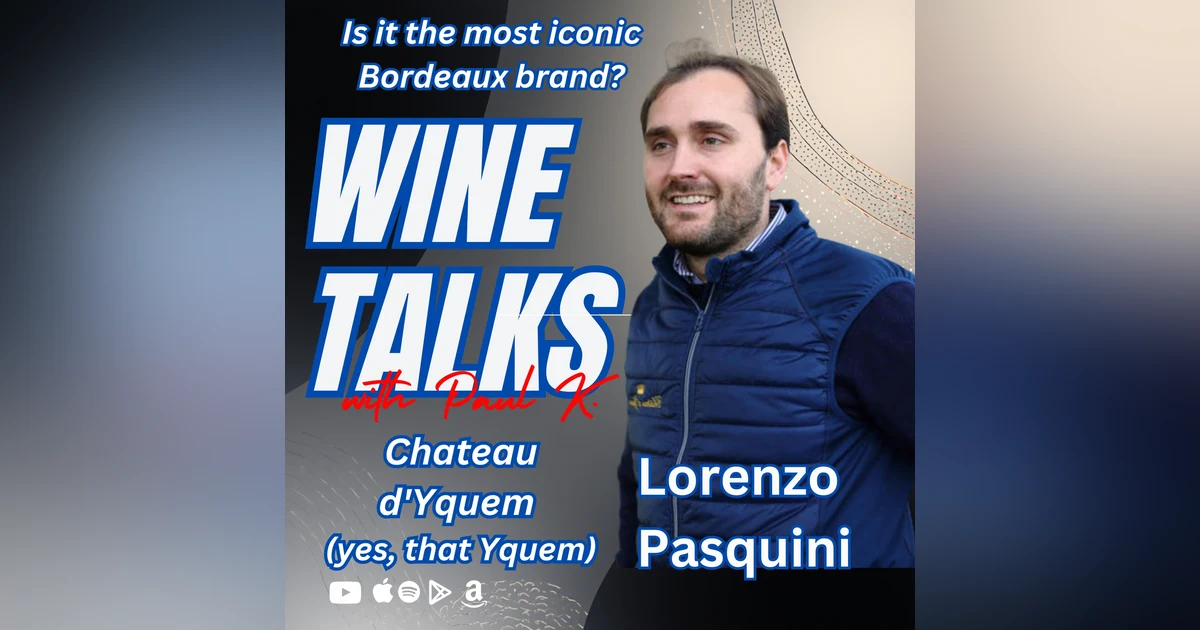
Château d’Yquem: Exploring Wine, Noble Rot, and Human Emotion with Lorenzo Pasquini

Wine is experiential. It is what the industry has to hang its hat on. Each glass needs to conjure up emotion. memories and a sense of being.
My father bought his wine shop in 1969 and a started his academic journey to understand and promote wine. He took master slasses before they were masterclasses: German Wine Academy, the Italian Wine Consortium and many more. He was a learner.
So when he was telling me a story about one of the most emotional wines he had ever tasted, and how he had waited in a long line to get a thimblefull of a taste, it was required listening. That day at a Hueblien auction, they were auctioning the iconic 1921 Chateau d'Yquem and I believe the auctioneer was the famed Michael Broadbent.
When I heard that Lorenzo Pasquini, the Director of Chateau d"Yquem was going to be in LA, I created a stir of inquiries to get him on the podcast. We ended up at Wallys famed wine bar and restaurant for a sit down episode of the show.
I have to tell you that sitting down with Lorenzo Pasquini at Wally’s in Beverly Hills was a breath of fresh air. It’s not every day you get to share a table (and a glass) with the director of Château d'Yquem, one of the most storied estates in Bordeaux. Right from the start, Lorenzo hit me with a line that stuck: “Wine is by definition very human.” As someone who’s been fascinated by the soul and story of wine for decades, I couldn't help but smile. This wasn’t going to be your average technical chat about barrels and Brix.
Now, I like anecdotes—my dad was the king of them—and I come from a world where every wine has a memory attached. Lorenzo gets that. He talked about how Yquem isn’t just a brand, or even a name, but something almost universal, capable of creating emotion in savvy collectors and absolute newcomers alike. It reminded me of my dad waiting in line for a thimble of '21 Yquem at the Hublin auction—the anticipation, the respect, the pure joy of tasting something almost mythical.
We dug into the mystery of botrytis—the “noble rot”—and why it’s at the heart of what makes Yquem so special. Lorenzo’s insight was that it’s not about control. There’s an element of surrender and humility. You can prepare, observe, react, but ultimately you wait for nature to do her thing. That’s the contrast, really, between technology-driven wines and those that are still, in essence, artisanal. There's a sense of patience and a sense of trust in the process that I find inspiring—and grounding.
He made me think differently about the grapes themselves. I had always pictured noble rot as something pretty unappetizing. But Lorenzo described how, seen under a microscope, it's actually beautiful—almost poetic. Sometimes you just need to change your perspective to find the beauty, even when it comes to the fungus that transforms a grape.
We compared vintages—the pure botrytis expression of 2013 versus the fruit-forward 2017 and the youthful vibrancy of 2023. Lorenzo talked about the pickers, some well into their seventies, able to discern the subtle aromas and select only the best bunches. There’s a community behind Yquem, not just a technical team, and their wisdom and experience shape every harvest. It feels honest, real—less about chasing perfection, more about honoring the place and the moment.
Of course, I had to bring up my penchant for pairing Sauternes with pot-au-feu—cordial glasses be damned. Lorenzo set me straight on the right glassware. More importantly, he reminded me (and our listeners) that sweet doesn’t mean dessert. Yquem can go with just about anything, as long as the story and emotion are there.
We talked about time travel—the unique thrill of opening a bottle from 1811, discovering a wine that’s still alive, still evolving. It’s about respecting history, but it’s also about a relentless drive to improve, to find that extra tenth of a percent of quality.
Lorenzo’s journey—from Tuscany to Bordeaux, from Rome to Argentina—is a testament to the interconnectedness of the wine world. He sees France and Italy as two faces of the same medal. That resonated with me. In the end, whether you talk luxury branding or climate-driven sustainability, Yquem’s story is about people, patience, the land, and the endless effort to express something honest and beautiful in every bottle.
This was a conversation that didn’t just inform—it inspired. That’s the kind of insight I’m always looking for on Wine Talks.
YouTube: https://youtu.be/hY9oZkhiwyI
#ChateaudYquem #noblerot #Sauternes #Bordeauxwine #LorenzoPasquini #PaulK #wineemotion #terroir #vintagewines #winetasting #artisanalwinemaking #sustainability #LVMH #wineindustry #aromaticcomplexity #luxurybrand #Frenchwinehistory #grapeharvesting #organicviticulture #timetravelwine
0:00 Wine is by definition very human. It's how human beings have been capable of stopping the process of transformation of wine into vinegar and create this beverage that creates emotion into human beings' bodies and souls. Sit back and grab a glass. It's Wine Talks with Paul Kaye. Welcome to Wine Talks with Paul Kaye, and we are at an away game today out in Beverly Hills at Wally's, about to have a conversation with Lorenzo Pasquini of Château d'Yquem. And I'm just going to go right into it because it was such an interesting tasting. You are the chief, you are the director, chief, what do they call you exactly? We say CEO, but indeed it's the director of the estate. The CEO seems like an American term. It is.
0:53 In French we say directeur. Yeah, the director. But it will be the director. And yes, in English it will be CEO. Do you think, you know, as I was listening and watching your presentation at lunch and then also here at Wally's— we're at Wally's in Beverly Hills, by the way, everybody. It's an incredible restaurant and bar and wine bar if you're interested in coming out, or if you are in Beverly Hills, for sure you swing by Wally's. Do you think the Château de Quim, is potentially the most iconic brand of wine from France, from Bordeaux? I don't know. It's certainly a name that resonates very high. Then I don't know if it is a brand or a name and where it sits in the ranking. Definitely, we believe it's one of the most beautiful wines in the world. And definitely it's a wine that creates emotion and that resonates in a lot of people's mind. Glad you said it that way.
2:00 And for the listeners, you'll hear why Château d'Yquem is so special and so emotional. And we're going to get into that in a minute. But my father was a very academic wine person. He bought a wine shop right here in Southern California, made it one of the top 5 in the '70s and '80s. And his most momentous moment that he would tell, and there's lots of stories, was he stood in line at the Hublin auction and they were auctioning off, I don't know how many bottles of the 21 Dikembe. And he couldn't wait to taste it. He stood in line for like an hour and then they gave him this little thimble full of this wine. And it was one of the highlights of his career in the trade. And he did a lot. And I think it's because of that emotion. Why? And I was going to ask you this during our tasting. What is it about a wine that's been hung on— hangs on the vine, gets literally rotten, can create so much emotion? It's a combination of things.
3:05 First of all, the name Yquem itself already creates something. Then the wine for us has the capacity, we like to say, to be universal. Meaning that it's a wine in our mind that is capable of creating emotions into savvy wine people, but also into people that are new in wine. And the reason of that is also multifactorial, meaning that it's definitely, first of all, the relationship that this time has with time. This is a wine that can travel through decades, centuries, but also wine that you can enjoy in its most vibrant youth. That's, I think, very touching, very emotional.
3:56 And two, it's aromatic complexity. We like to call it the aromatic brightness of the wine. The wine is very bright, very, you know, involving in a way. Since the first moment you put the nose on top, it's a bouquet that is very intense and very complex. And then in terms of palate, of course, the sugar. The wine is sweet. The sugar, it's a big ally to, you know, involve people, to bring people in. But then together with the sugar, there are plenty of other dimensions. There is this bright acidity, this long bitter and salinity, the taste that comes with the sugar and the dynamism, we like to call it the dynamism of the sugar. And so all this is, you know, a combination of sensations that usually moves you and that stays with you for a long time. We like to think that drinking again. It's an experience that stays with you.
4:57 Probably the most emotional wine I've ever tasted. Unfortunately, I have Château d'Yquem at home. I don't open it every day. I have some Barsac Château Coutet. Very good. But it doesn't matter because even today, you have to take a pause when you put that wine to your nose. And you have to stop and it almost stirs up thoughts. It almost brings back something. Something happens. And I suppose that is the ethereal connection of wine to the earth, to the soul of the human being. Right? We talked about that. Wine is by definition very human. It's how human being has been capable of stopping the process of transformation of wine into vinegar. And create this beverage that creates emotion into human beings' bodies and souls.
5:56 I think that Yquem, and more generally the wines that are based on this natural phenomenon called noble rot, have probably a supplement of emotion thanks to this thing of the noble rot, which itself is incredible. It's a transformation of the worst disease in viticulture into something that brings the grapes to a second life. But the result, it's even more incredible because the result is a wine that is more concentrated, more aromatic, that has this relationship with time that it's unique. So it's a wonderful transformation. And what's beautiful behind all this is that this is only based on nature. It's not something we can replicate or fake. Whether you have the microclimate for it or you don't, and that's it. That was one of the questions today, and I wanted to bring it up again because we could probably do this for 3 hours, and so we don't have that much time. But there's late harvest Rieslings, they're gorgeous. There's California late harvest wines, and that's just a wine that has dried on the vine, hasn't gotten rotten. And if it does get rotten, it's not going to be what you're calling noble rot, try this, which creates this character. But the thing that I thought was fascinating you said was that that's completely out of your control, and that dynamic that it creates is nothing the winemaker can do about it. You have to wait. It positions you
7:26 in a position of humbleness. Humility. Humility. Sorry. Humility. And meaning that indeed you are a little bit less in control. Of course, there are things that we can do in order to put the grapes in the best conditions to receive the noble rot and to express it. But if the microclimatic conditions of the year are either too dry or too humid, there is not much we can do. We just have to accept. And observe, and be ready to react. At each time, there is a window to capture the grapes at the best spot.
8:09 That's phenomenal. And I think what's nice behind this, apart from the humility or humbleness, if I can use this word, humility, it's the fact that it's very artisanal. And I think the world needs stories that are natural, that are artisanal, especially as of today where a lot of things are very much under the control of technology. I think it's nice to say that there are still things that are just under the control of nature and the sky and what the sky wants to do with it. It is a sense of humility that would force you into just waiting and understanding and hoping that the thing— it was fascinating to me about the region of this part of France, which is south Bordeaux, basically in the south left bank, is that it only happens there. And so it's part of the terroir. So whatever it is that the climate creates, the humidity you talked about and the humility that has created that, that it landed in Bordeaux. And why? How did it come to humanity? You talked about it before we had to get the whole story, but how did it come to humanity that this was something so special that we had to see what was going to happen if we made wine from these literally rotten grapes. I think if any consumer or listener of the show saw the grapes, they'd go, "Eh," right? Like they'd throw them away. You know what's fun is that if you look at the bunch of grape that is rotten, it's very ugly.
9:42 But when we brought these grapes to our laboratory and we looked with the laboratory inside the grape. We saw, I can show you the picture, we saw the blooming of the fungus that is wonderful, that looks like a flower. So that teaches you that sometimes beauty is about perspective. So you have to look from very close to see it beautiful. And this picture that you can find on internet that I can show you, it's really fantastic. It shows you all the poetry also behind this winemaking. I would love to frame a picture like that. 'Cause it's probably really cool looking. It is. They do like an X-ray photo kind of thing? No, it's just a, you know, you zoom it a lot, 400 times. Yeah. Until you see the actual if of the fungus and it looks like a flower. I will show it to you. How interesting. So we were talking a little bit about the marketing of wine and the way the generations approach wine. And I was telling you about the collector friends I have that, seek all the great vintages from the Bordeaux and Burgundy region. And I think that element of time travel, which you were talking about earlier, is really the key to the sustenance and the longevity of wine. It's been around thousands of years. We know this. We already know there's a 6,000-year-old winery in Armenia. It's not going anywhere. And I think you really said it right. You articulated the fact that it's a time
11:16 travel. You are experiencing a place of time, a sense of time and a sense of place. And every time you open a different vintage, you're taken to a different time. We like to say that tasting an old vintage of Yquem is the most elegant way to travel through time. Yeah, that's so cool. And it's true. Wine is itself a travel in time and space because when in Los Angeles, you taste a wine that is made in Sauternes decades before. You're traveling together with the wine. I think that that travel is even more intense with Icap. It's— you said something too when you're tasting, and I had not experienced that.
12:00 I don't want to get into the wine geeky stuff, but the salted caramel idea, this salinity concept. Boy, when you said that, I've never thought of it before in a wine like that because for the listeners, the wine is— there's a fair amount of sugar in it, right? If you were to calculate the amount of sugar, it's a fair amount. But that extra salinity, that extra complexity changes this. So let me ask you this question. You didn't make it since 1900, you said, 10 times. And that's because the rot was the wrong rot or it never happened? Exactly. Because the weather was either too dry or too humid. But that's pretty good record, right? I mean, that's not bad. 10 times.
12:42 No, that's not bad. I prefer it to stay like this and not to increase because I prefer to make the wine anyway rather than don't make. Because my thought is this, if you're particularly here in this case where botrytis sets in and you have to wait and be patient for the botrytis to develop, and that could happen at any time and it could develop further. I was going to ask you during our meeting what that metric was. We know phenolic ripeness, we know Brix, we know pH, we know all those things, but what is the metric with mold? There is not metric. Of course, we have an idea of the level of sugar we want when the juice is in the press, but the truth is that it's based on observation.
13:34 Actually, the quality of a grape of noble rot is defined by its purity, meaning that it's only noble rot and not other microorganisms there that developed on the bunch. And that assessment has to be done either visually or by smelling the grapes. We ask to our pickers to put put their nose on the grapes to make sure it's only the best rot that they are harvesting. But as I said, there is no metrics. It's more experience and observation. What are they smelling for? Like my wife would say, that's disgusting. They just have to make sure that there are not other microorganisms that can taste, can smell something specific.
14:21 And is that, are they trained for that? Of course, yeah. We have the chance to have this incredible group of pickers. Their average age is 60 years old. Wow. A third of them is above 70. Am I qualified? Some of them are retired from ICANN that keep coming for the harvest. And it's a real community that makes ICANN. And for us, it's super important also that since our wine is so artisanal, it relies not only on the technical team, it relies on the community of people that is proud to be behind this. It seems like then, if given that circumstance, pickers know what to smell for, you are basically waiting for nature to come around and develop this grape in a way that represents Château d'Yquem, that there really are no bad vintages. There are different vintages. But if you make an honest wine from the grapes you're given, then that's a good vintage because it expresses that sense of time and that sense of place. And also because if the vintage is bad, we just don't make the wine. Yeah, as well. So when it carries the label, it means that it has at the level of quality that is required to carry the label. And then inside that, of course, there are different vintages. There is a small hierarchy between the different vintages, but if it's no good, it just doesn't exist. No good, you know, if you do put it in the bottle, then it is going to be a representation
15:53 of that time. And it's different. Standard. Yes. Because there's a huge difference. And I'm not sure that I would've detected that without tasting them side by side between the vintages we tasted today, which is '17, '13, and '05, and the '23, which was fascinating to taste. And a huge difference all the way down. In one of them, I forgot which one it was, you were talking about you get the expression of the rot, the noble rot over the expression of the grape. 13, because 13 is a vintage where the weather was pretty cold, let's say, and cloudy. And so we don't have a big concentration of fruit compared to other vintages like, let's say, 17 that we're tasting today, or 23 that we're launching at the moment.
16:37 And so 13, a little bit like 2007, are pure expression of Dorothée itself. That's crazy. And it's very interesting to see that because people don't really know what this fungus can bring to the grapes. By tasting these wines, you can have an idea. When I open a bottle at home now, I'll admit we don't have roasted chicken on Sunday as the French. I do make pot-au-feu quite frequently. I love it. Pronounced well, actually. Yes. And I'm sure that goes with this, but But every time I do open a bottle of Barsac or Sauternes at the house, the first impression that people give— and I learned something today. I do use cordial glasses for that, and that's wrong. So we're going to go back to white wine glasses. It's okay. I get that. But a lot of times somebody says, no, I don't drink dessert wine. It's like, no, you just got to taste this. And especially it's not because it's a sweet wine that it's necessarily a dessert wine. Yes. It's a sweet wine that can go with dessert, but it can go with plenty of other things.
17:39 And it was— and everybody will rave and say, what is this? And they'll ask that question and they'll want to know the stories. And then all of a sudden it becomes an experience for them. And all of a sudden the bottle is empty. Yes, exactly. And then we get another one. We go to the cellar. You were talking about— and when I studied French, the language, in order to learn a language, you kind of got to study the culture in order to make things happen. And, you know, Josephine Baker, for instance, was a huge subject of mine. I loved Napoleon and Josephine, Josephine, his girlfriend. You know, that's a fascinating subject for me. And Eugénie, there's a book out on Eugénie. And you were talking about Britney today and she built that— I mean, Biarritz, the famous château down there.
18:24 But you had— you brought up Josephine Ikem, you call her. But what's her— what was her real name? What was her— functioned at the château. Her name was Françoise Joséphine de Sauvage, married with de Lurselus. Very long name. Yes. So we call her Joséphine d'Ikem, very simply. Joséphine was the one who held the estate from 1785 until 1851. Very long. Wow. She had a very long life. And she also was positioned at the top of the estate very young because she lost her parents when she was only 17. And so during this long life, totally dedicated to ICAM, she has done plenty of things that were somehow of a revolution or at least a before and after. I think that Probably she is the one that positioned Yquem where we know it today. And actually, the proof of that is that 4 years after she passed away, Yquem was classified Superior First Growth. So it's clear that it was thanks to her that we had this unique positioning, because we were the only one in Bordeaux to be positioned as Superior First Growth.
19:44 And what she has done was polished the technical approach of harvesting by successive passes, set the fact of aging the wine in new barrels, built the barrel cellar that we still use today. And actually today will reach the 200 years of existence. Wow, congratulations! She started to position before with her husband, and then alone when her husband passed away. He came on the best tables and the best the courts around Europe. She did the label as we know it with the letters and the crown. So she was a manager of a luxury brand way before these words would exist. And the impressive thing is that she has done that during the course of the French Revolution, which was a— Let's see. Well, so she was around with Madame Clicquot then? More or less. About that time? Yeah, more or less. During the French Revolution? I know that was an issue for her. Yeah, it was the same period.
20:59 Interesting, because I do think it's interesting, and I try to articulate this, a lot of French women here in the wine business in America— I sat with one today, Clarisse— But it's a very patriarchal society, at least it was for a long time. It was very much. And there's here these strong women that are making this. Actually, she was an only child, so that was probably the reason why she was raised as someone who would take the estate, even though at the time it was not very common to have a woman taking over the estate. But it was great because there is also a big feminine touch to these wines, and so probably Thanks to her and her feminine touch, we set a style, a vision that we continue to respect almost 200 years later.
21:48 So what's the oldest vintage you've tasted? Myself? In 1811. Wow. Yeah, and I had the chance to taste some vintages of the 19th century. I have in mind very precisely an 1865 that I tasted 3 years ago. And it's incredible when you taste these very old vintages of Yquem. And what's the most incredible thing is that you still can imagine the future of these wines. It's not like you're tasting a wine at the end of its run, right? You taste the wine that you feel it's still running and it will continue to run. And that is the most incredible. That's so interesting. So it's a— so obviously the colors are changed and the balance of acid, fruit, sugar, and sugar being a preservative in itself.
22:37 You said something earlier today and I wanted to kind of peel it back. We were talking about the export of Bordeaux to England, and of course that was the huge market for not only Bordeaux, but as a négociants, but for Champagne as well. And their cuvée was different than the Russian cuvée. And you talked about the technical changes that have occurred, but here's a wine from 1811, from 1865, that you are fascinated with the taste. And so how much difference does the technical play in this? There are, I cannot say exactly which are the difference since 1865, but IKEM has always kept a will of improving.
23:21 And I think that is the most important thing that we have to bear in mind as a team who today has the chance and the privilege to be at the Helmut Newton, which is that we have this incredible past that we have to respect. We have this incredible wine that is based on some things that define the style of the wine that we need to transmit and enhance. But at the same time, our mind doesn't have to be only the one of respecting and transmitting, because it's not by doing the same things that you will necessarily have always the same result. Actually, I think that we need to keep alive this flame of trying to struggle for that 0.1% of improvement, because it's that that will keep you having the same result, I think.
24:14 So always striving to try to do better and better and better. And if we look at the history of, again, this And this is what happened. And so this is what we have to continue to do, balance that vision of transmission and protection together with the vision of challenging some aspects in order to try to do even better if possible. And so over these last 200 years, of course, there have been improvements, which doesn't mean that the style changed. It just means that it's not because a brand is so established that it's steady and it's actually the other way. As I said, it's trying to keep the best and improve the rest. Is that a tough balance? And we're going to get into your career here in a second where you've learned all this, but it always seems to me a tough balance to— now you've added this whole element and complexity of noble rot, but to express a wine Use technology, do all the things you need to do to improve it a little bit, whatever, how slow it is in our business. You only get one chance a year to do it, but also maintain what is Château d'Yquem, like making sure that that customer knows when they put it in the glass, this is who we are, but it's progressed from where we were. I think it's based on two things. One is not rush, meaning that it's true that you make wine only once a year. But Ecam is a very long story, and if it's not this year,
25:45 it could be next year. And I think we have to view the evolutions on a long-term vision and change things that could be repeated and that could stay for the next decades or so. So first of all is position ourselves on a vision of long-term, long-term on how we do things. And the, the time frame where those things that we will do will continue. And the second is also know what things— no, so well, Hicham, that you're able to, to make the difference between those things that are vital to keep and those things that are important to evolve. And the only way to be able to judge is by knowing the estate so precisely that you can understand which is which. So that's an interesting thought. When I was in Wine Paris, I went to the Armenian booth. I spoke to an old friend. Her name was Juliana.
26:51 She was consulted by— there's a bug in here— by Michel Rolland when they were growing grapes in the the valley. And she said, he said to me, yes, you can grow grapes here and they're probably going to be good grapes, but we have to wait 100 years to find out what's going to happen. You've been there 6 years. So how does that feel like? It feels like you're just a youngin, right? It's sure that in an estate like Yquem, the time feels different. You could stay there 30 years, and it's still small compared to the history of the estate. So what you rely on is also what the people before you passed. And so we have things written, we have records, we have things that have been transmitted by word of mouth. And so the first thing that you do when you enter in a world like Yquem is to study, to try to learn, to read and to listen.
27:51 To the people that have been there before. And also, of course, ECAP is not only myself. We are 80 in the estate, 50 in the technical team, 3 as the managers within the very technical core, myself, the cellar master, and the vineyard manager. We have some consultants also that have been there for a very long time. Our president, Mr. Wauton, has been there for 20 years. My predecessor has been there for 40 years, and he's still a consultant for us. So you see, it's a group of people that are all focused on the same way and that also are aligned on the same way of doing things. Sounds like there's like 100 years of experience there. Just add it all up, right? It's a community and a culture that allows us to go beyond the timeframe of ourselves. Yeah.
28:53 You were not— you weren't born in France and you are at the helm right now of one of the most prestigious brands and not only brand of wine that's so recognizable, but in the luxury segment, which is, you know, a huge segment for obviously LVMH is all about that. But you were born in Tuscany. What's up with that? I mean, you're a Sangiovese guy. Yeah, I was raised in Italy. I was actually born in Rome and raised between Rome and Tuscany, where my family has a small vineyard estate. But very quickly I wanted to come to Bordeaux to finish my education. And actually the opportunities made me stay in Bordeaux or related to Bordeaux. So I'm very much A son of Bordeaux also, I've very much been trained in Bordeaux and learned in Bordeaux. But definitely, I was very lucky and very privileged to have the chance to be part of this story and now even more to be appointed CEO. And this definitely went above what I could dare to expect for me. Well, it's a huge difference in cultures. I mean, I was fascinated. We've been to Monaco a couple of times for the Grand Prix, which is just one of my favorite things to do. And you just drive 45 minutes, you're in San Remo, and it's a different culture altogether.
30:13 And I suppose because of Catherine de' Medici coming from Florence to marry the king and that there's a blending of cultures, but it just seems like they're so different. Not much. France and Italy are very, very close. I like to say that they are two faces of the same medal. Oh, there are plenty of things that put us close. The Mediterranean culture, the love for cuisine, the love for wine, the historical heritage, the love for artisanal and agricultural products. So there are plenty of things that make France and Italy close. French people love to go to Italy, and Italian people love to go to France. There are plenty of Italian people working in France and French people working in Italy. Also in wine, there are these exchanges.
31:03 I'm not the only Italian guy making wine in France, and there are plenty of French guys making wine in Italy. So I think there are two countries that are extremely close and welcoming one with the other. I'm glad to hear that. It's true. I'm sure it is. Have you ever made wine in the New World, like North America, South America? Yes, I had the chance to live 4 years in Argentina making white wine. And that was just between my first period in Bordeaux and my second period in Bordeaux. You know, it seems that even Argentina, Chile, even though it's New World because it's a younger appellation and there's less tradition to worry about, it still has a very traditional feel about it. Argentina? Yes. Yeah, I always like to say I was working for Cheval des Andes, which is the extension of Château Cheval Blanc in Argentina. And also part of the VNH group. And I always, when I was there, I always like to say that Argentina is an old viticulture in the new world. There are centuries, more than a century of history of viticulture in Argentina. That's a good way to put it. Malbec arrived there in 1861, and I had the chance at Cheval de Zon, they still have vineyards from the '20s, of last century. Wow. So I mean, that positions Argentina not necessarily in the new world per se as we consider it. Of course, the story of the Argentine wine is
32:33 different from the French or Italian, and there are things that are new, but there is a real wine and vine culture in Argentina that dates back. So Cheval des Andes is in Mendoza? It is. And is it high altitude Malbec type thing? Yes, it's around 1,000 meters above sea level. You know, I had Monsieur Arnaud, part of the French royalty family that you— I could have called him chevalier. No, I could have called him count. I forgot the first name, but he was making wine there. And there seems to have been a movement in Argentina about really testing the height up the Andes as to what's going to do. Yeah. And it seems— and I'm just wondering about the wine world, like the consumer, are they understanding that? I think so. What that means? I think so. Of course, there are different types of consumer. There are those who just like the taste of wine and don't want to get deep. And then there are others that like the story, like to understand. But definitely it's the same as talking about noble rot. There are people that understand that the world of complexity that it is, and other people that just want to taste a wine that creates an emotion.
33:52 And so, yes, I think it's something that is very interesting for the— I mean, I find it fascinating, but I'm a wine guy all the time. So here's the analogy I was trying to talk to you about lunch, and maybe I'll make it as short as I can, which is if you're in— and I came to this conclusion the other day watching a baseball game, and I realized that I understood everything that was going on on the field. I love the game. I study it. I've coached it. I read books on it. It's— I told my wife today, I said, I just love this game. As I study wine, I love the study of wine. But not everybody does that. So you go to the stadium, you go to your football stadium, there's 50,000 people that obviously like football, but they're not interested in reading about it, They're studying it. They know when a good play happens, they cheer, and then they go home and they go back to their regular lives. And I think that's most of the wine-drinking public.
34:47 They enjoy it. They want to know about it. They don't want to know too much about it because then it spoils the fun for them. So how do we get to those people to grasp onto the idea that we can serve Château Canon with chicken dinner on Sunday, or that it's not just dessert, or those kinds of things? How do we get that experience to them? First of all, I think that there is not the consumer of wine. There are plenty of different consumers. There are those that want to go very deep, those that want to go deep in technical things or in historical things, those that like the pairing with food, those that don't like to pair it with food, that just like to pair it with the moment and the view. And then there are young people, older people, people that are very savvy, people that are not. And so I think that we need to consider this because, as you said, it's like for a sport event, there are those who really are into the sport or those who are just into the event or the moment. And our job needs to be the one to be able to bring this story, the same story, to all of these different people, of course, in a different way.
35:57 Without betraying who you are, but maybe adapting the speech to these different people. And definitely what you do is part of this. Oh, thank you. Bringing the story with a megaphone that is different than the megaphone that you use for other types of consumers. I think the most important thing is to educate in general, is to explain what makes your wine unique and why it has a story that is different from another wine. And I think the real base of everything, it's the education. And I really believe that our exercise, rather than commercial, is educational. Well, and I think that this is what's not saves the industries. I don't think it's in that much peril, but it's what it's what establishes this industry. And I had this conversation the other day. We were in Paris, we were at the local tourist bistro in front of the Eiffel Tower, Tour Eiffel.
36:58 And they brought me a quiche that I ordered and I had to stop for a second because it was like my mother's quiche. My mother's a great cook and she always made quiche and I hadn't smelled it like this since then. And my wife's like, what's wrong with you? I said, you can't believe the memory that just brought back. And I think that we've developed those experiences and I don't think the experience, for instance, and I used to say this all the time, is buying a wine on the internet for $5. That's not the experience that you want to have. It's not having a pouch. I think we were discussing, I was discussing with Rafael that somebody came out with a pouch like a child's applesauce pouch and you squeeze the wine. That's not the experience. And as part of the movement right now, Everybody's trying to find this either billion-dollar idea, which is around packaging or no alcohol or low alcohol or whatever they're trying to do, instead of developing the story, instead of telling the story, like, this is what it's about.
38:00 I think so. I agree that the industry does have to be saved because it's not at that level. But what will keep the industry dynamic is definitely, I believe, much more educating and get the story out rather than find a solution with the pouch, as you said. I mean, with all due respect, of course, yes, of course, to all strategies. I'm not here to judge, just giving my vision. That's actually the reason why the packaging of ICAM is still the same, because we believe that what we have to do is to bring the story. How many cases or bottles? You make 750s, 375s. I saw we were pouring Magnums today. What, um, how many bottles are you making? Uh, it depends. The average is between 60,000 and 80,000 bottles per year. But to give you an idea, we prefer to speak about the average per plant, which is one glass per plant. While Okay. Per vine, while in Bordeaux usually is one bottle. One bottle per vine. Yeah. I used that analogy the other day. And so I go, what are you talking about?
39:11 I go, yeah, you get one bottle of still wine per vine. And one of the questions I was going to ask today, which I didn't, was, what do you lose because the wines, the grapes are dried? And now you're telling me you get one glass, which is a fifth of a bottle. Yes. We lose a lot. We lose the old crop. Sometimes we have to renounce to the old production because the climate was not— and the quality was not the quality of ICAM. And so I think it's by being ready to lose a lot that you preserve also the promise of excellence of ICAM. And that's the price to pay to keep The excellence of what we can. So in the world of— I had Yves Delaunay here, nice guy.
40:02 And, you know, he's been a luxury brand representative. I think he was with not Covassier, but with Louis XIII. Is that Covassier? Yeah. Is that a different world? The luxury brand, the LVMH world of marketing, the LVMH world of hotels, the LVMH world of wine. Is that a separate standard or it's just across the board? You guys are just doing the best you can to make the best you can? I think that the core of the approach is really the same, which is make as best as we can and have a long-term vision rather than just a short-term performance vision. And that's, I think, it's really what Mr. Arnaud has in mind for all his maisons. Then, of course, the way this is applied to each brand is very different because brands are very different. But the core values are the same, definitely across the board, and they are held by the family itself. So my daughter was— my friends are going to laugh at me because I bring this up quite frequently, but she went to Alain Ducasse pastry school outside of Lyon, and she baked in Paris. And in fact, I was watching Midnight in Paris, the movie, and her bakery is in the background of one of the shots.
41:23 So I took a picture, sent it to her. But Alain Ducasse came into the, came into the bakery. It was just a corner bakery and tasted her wares. And she was, you know, liked them, all that. And I thought, how interesting is that? This guy is so involved with the brands that he would show up in a little corner bakery. And another friend of mine who was a sommelier at Louis XV in Monaco, I said I worked there a year, never saw him. But is there that kind of hands-on representation from corporate of LBMH to come see you, make sure you're doing the right thing? Yeah, of course. We have a certain degree of autonomy, but of course we belong to a group, to a family. And so we have a board of administration that looks after us.
42:09 Plus we have plenty of interactions with the administrators, but also with other people of the group. And it's very, very valuable for us to have access to this incredible knowledge that is very cross-thinking in terms of skills that goes very, very, very far, especially because they all have also the respect for each maison. And so it's a strong mutual respect between those who have the very broad skills and those who know very well the place where they are. And I think that's the best of both worlds. What's next for you in the context of Château d'Yquem? I mean, tomorrow I'm out to Texas to continue to present the vintage. And in general, what's next? I think it's to continue to make the best wines as possible, one of the best wines in the world.
43:05 I hope so. And to make it as environmentally friendly as possible and as socially valuable as possible. And then make this story of the noble rot shine around the world as much as possible. Actually, there's one last— one of the things I want to bring up, but I didn't bring it up and we'll wrap this up. But I think in the world of business, industry, doesn't matter, that sustainability, probably the wine industry is probably most susceptible, most inclined, and most obvious to be in the sustainable world. So Yquem has moved that direction. Yquem has always been animated by this idea of sustainability.
43:56 Which for us means an environmental sustainability and a social sustainability. And environmentally-wise, we have never seen any herbicide. We have always fertilized our vineyards with manure produced on-site. And now since 2022, we are organic. We also stopped to plow our soils. We work with COVID crops. We are very much engaged in a, in a plan that will divide by 2 the total carbon footprint by 2030. So there are plenty of things that we do on that side, plus we are doing a lot of things to enhance the biodiversity of the estate in general. And on top of that, we believe that we have We need to preserve, sorry, our positive social impact. And so we have a team that it's made of almost 90 people, plus there is a community around ICAM, especially those speakers that come during harvest. There are 100 more people, plus there is all of our country, rural community. Around Château d'Yquem, plus we are in the French viticulture context, and we want to have a positive social impact on all of those circles. That's excellent.
45:25 Somebody told me once, look at the glass is recycled sand and a cork is a recycled piece of bark, right? That's true, in a way. That's kind of part of the deal. Well, since you're headed to Texas tomorrow, My daughter just moved to Paris, Texas. Nice. They don't speak French there. No, they have an Eiffel Tower, though. It's a little tiny Eiffel Tower. And it's a very good community. It's about 2 hours north of Dallas. Where are you going to be? You're going to be in Austin? Austin, Houston. And you're going to be doing similar thing. You're going to be tasting buyers and restaurant tours. Presenting the new vintage and spreading the word. Excellent. Such a pleasure to meet you and have you on the show. And I hope when we get out to Bordeaux next, which I will be there for sure, I was able to— when we were there for the Moët Perris, I would tell the Uber drivers, you know, I could live here. Je pourrais habiter là. And they're like, no, you don't want to. I'm like, no, for me, it's like, you know, it's a vacation. The grass is greener always on the other side. Exactly. Paris is wonderful. There's a little bit of traffic. And so when you're in, you complain about the traffic, but The city is fantastic, but it's not bad to live in Los Angeles neither. No, right.
46:42 Thank you again. Cheers. Thank you.