

 Apple Podcasts

 Spotify

 Youtube Music

 RSS Feed
 YouTube
 Pandora
 iHeartRadio
Breaking Wine Barriers: Rita Rosa’s Journey from Nigeria to Bordeaux
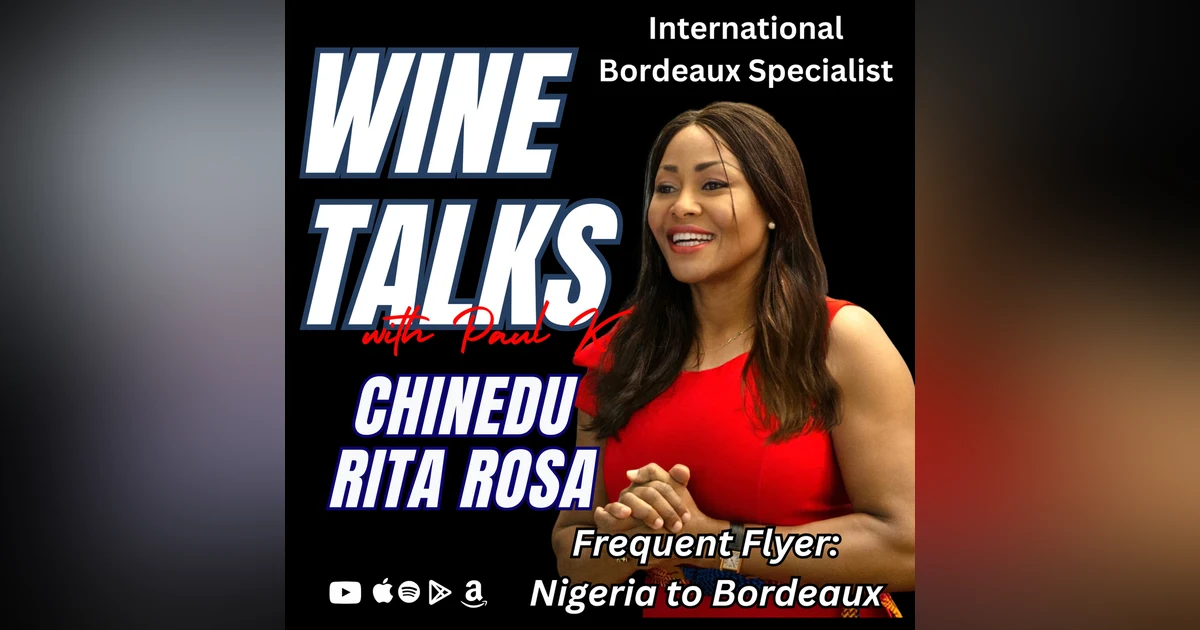

Wine Talks has been watching this woman. She is making waves in a part of the wine world that one might not consider in daily converstaion: Nigeria.
How does one become a Bordeaux specialist in Nigeria? Where does that inspiration come from?
I have to tell you, having Rita Rosa on Wine Talks was like catching a warm breeze off the Mediterranean—unexpected, lively, and full of stories you want to tuck away for a rainy day with a glass of red. I started our conversation, as I often do, thinking I’d heard most things about the global wine world, but Rita took me right to the heart of Nigeria, weaving its vibrancy into the fabric of Bordeaux’s storied cellars.
Let’s be honest: when you hear “African wine market,” most folks in the business still think it’s in its infancy, maybe a curiosity for big European houses sniffing after emerging markets. But Rita set me straight right from the jump—Nigerians have been drinking wine for quite a while, thank you very much. She explained that Lagos, with its 30 million people and a nightlife that rivals New York, is a place where wine shops mingle with the energy of a city that never sleeps.
What struck me most was Rita’s insistence that wine, at its core, is about what makes your heart beat and your mouth feel alive—forget the technical jargon for a moment, and just savor the connection it brings between people. I’ve always found wine to be the great equalizer at the table, but Rita has this beautiful ritual, telling her guests—ministers, commissioners, presidents—to leave their titles at the door and just be human, united by the “elixir which brings all of us joy.”
And talk about insight—she moved from banking into wine through a happy twist of fate, marrying into a family that started an actual wine store in Nigeria. She didn’t just open the doors; she redefined what a wine shop was in Lagos by bringing Bordeaux’s best right to West Africa. Rita didn’t mince words about what it felt like to be a black woman in the predominantly male, white-dominated world of wine—walking into tasting rooms in Bordeaux and feeling the eyes on her, questioning her authority and knowledge. And yet, her sense of pride in being Nigerian, in holding space for herself and others like her, was palpable. That same energy she poured into her business, her studies, and later into programs like Bordeaux Mentor Week, aiming to open doors for young hopefuls from emerging wine countries.
One of my favorite moments was when she shared her disdain for wine pairing rules. Rita throws caution (and orthodoxy) to the wind—she’s out there pairing Bordeaux with Nigerian meats and letting guests explore, taste, and challenge all the old conventions. As someone who’s never shied from having strong opinions about pairing, I found her approach utterly refreshing. It reminded me of my own tendency to resist being put in a box, especially by tradition-bound French winemakers.
Throughout our conversation, Rita kept tying things back to connection, humanity, and the healing power of wine—how her own store in Lagos became not just a business, but a sanctuary during grief. I resonated with that, having seen the same in my own shop over the years. In a world where the market is consolidating, distributors are cautious, and cell phones threaten genuine interaction, Rita’s approach stands as a glowing reminder that the heart of wine is, and always should be, its power to bring people together.
So here’s to Rita—her infectious energy, her resilience, and her vision for a new, more inclusive wine world. I count myself lucky to have had a front-row seat to her story, and if you ever get a chance to pair Amarone with plantains or taste Bordeaux alongside cassava ravioli, take it. That’s the kind of experience that makes Wine Talks more than just a podcast—it’s a journey.
Or watch on YouTube: https://youtu.be/CVimDZmf_4g
#WineIndustry
#AfricanWine
#WomenInWine
#WineCulture
0:00 I think I say this to people in the wine industry every time. You don't know anything, and you know everything when it comes to wine. You know what you love, you know what makes your heart beat, you know what makes your. Mouth feel alive. When it comes to technical. Aspects, we get it wrong a lot. You know, sit back and grab a glass. It's Wine Talks with Paul. Kate. Hey, welcome to Wine Talks with Paul K. And we are in Southern California today about to have a conversation with Chenu. You know I'm going to say it wrong. Yeah, we just talk.
0:45 So you can call me Rita, Danny. Yes, that's it. Thank you. Out in. She's in Nigeria right now, but she lives in Bordeaux and she's a. Wine export consultant as well as founder of many organizations in the wine trade. Welcome to the show. Thank you so much, Paul. I'm actually in Angola. I just came to Nigeria. I mean. What do I know? You know, that's. That's a part of the world I visited very often. You know, that's kind of interesting. Let's start with that. Yeah. You're from Nigeria, though. That's where you were born and raised. Yes, yes, yes, yes. And the native language of Nigeria is English, right? It's not French?
1:29 Not. Not the native. Like, the common language is English. But Nigeria is a country of 350 languages, and we have three major languages, which is Yoruba, Igbo and Hausa. The west, most of the west speaks Yoruba. The east speaks Igbo and then not speaks ausa. So we have three major languages. Are they dialect? Are they dialect? Oh, no, these are languages. These are languages. They have no similarities at all. And it's a huge country. It's a country of 250 million people, counting.
2:11 It has a land. It's huge. Like I tell people when they look at the African map, they should forget the map they see on paper because that's not a reflection of what Africa is. Nigeria alone is 2.5 the size of France. Wow. I thought, you know, aren't there some African nations that. That French is commonly spoke? Yes, our neighbors are actually francophone, like we call them. There is beneath Togo, Cote d'. Ivoire. They speak French, but we are. Colony, former colony of England.
2:54 Ah, you can say I'm not used to the airports. Well, my bro, my father is from Cairo and so. Oh, he spoke French, but that was because. Was a second language Arabic. Do you speak Arabic there too, or no? Yes. No, we don't speak Arabic. I speak Arabic because I have A connection with Lebanon. But no, normally in Nigeria, maybe up in the north, they don't speak Arabic, but because they are Muslims, they do learn Arabic. So interesting. I have to get out there and see what's going on in that part of the world. Oh, you really do. It's amazing. Everybody that has been here. So that's where. That's what I love to do, and that's what I'm doing. Currently I have four of my wine producers.
3:49 The tour of Nigeria twice, three times a year with my wine producers from, From. From France and mostly from Italy and France because they have been really. Really working at being in the market and being present in the market. So we have a week, sometimes two. That's me being crazy. I have one full week of food, wine pairing, tastings, masterclasses. B2B meetings, you know, and then market visits. Because Nigeria is such a huge country and it's divided. So we have the lot. And the south, like I said, the south is a lot of Christians and the lifestyle and nightlife, there is something to behold. It can. It can definitely, you know, compete with New York and it never sleeps. Lagos is absolutely bonkers. We have 30 million people in Lagos.
4:55 And yeah, it's a hump. It's a fabulous home. So tell me then, this is interesting, and this is why I thought Your resume on LinkedIn was interesting to hear about this idea of wine in Nigeria. And you're talking about pairings. Your list of accomplishments and the things you've been doing in this trade is extensive. Probably talk for hours. But. Are you importing Bordeaux or Tuscan wines into Nigeria or what's the primary function? Oh, God. Okay. So what I do. That's why I call my expert. I call myself an expert consultant. Because when it comes to wine, I have done importing in the past.
5:39 Right. I had the first wine store with my late husband's family. The first wine store that you could actually call a proper wine store where you could go for tastings, you could come and we will have discussions about wine. And we had the best wines from Bordeaux. So it was strictly a wine store that. Had border wines. Champagne, cognac, Pinot, you know, a lot of things. It was in Ikoi, in Lagos. Okay. It was. This was. This is revolutionary for that area. I mean, I obviously. Oh, yeah. Wine consumption would not be associated with Africa in general. I mean, there's many other indigenous drinks, I'm sure. So this was kind of cutting edge for you to do this.
6:28 Yeah. But, you know, it's. It's. You Know when people say that, I, I kind of say no, actually Nigerians have been drinking wine for quite a while. The thing is, because we're such a huge population and a huge beer drinking company country. After Dublin, we have the second second largest Guinness distillery in the world. We drink a lot of Guinness. We drink a lot of beer. So the, the. But imagine this is a population of 250 million people, right, if. Say 60 million drink beer or 80 million drink beer.
7:15 The other 80 million. Exactly. The other 80 million do not even drink. Then there's 90 million who drink. Right? Yeah. So it's, it's. Yeah, I think I got my Math Maths right. 160. 160. Yeah. So. It'S. It's a matter of the numbers, right? The numbers is what makes Nigeria so amazing. Because another thing is that we are not into tourism. Every product we bring into the country is consumed by Nigerians. Really? Right. Yes. It's. We're not like Kenya, we're not like Botswana. We're not like. A lot of Cote d' Ivoire is a good wine drinking country. The people drink wine, but they still have a lot of tourism. Nigeria hardly has any external tourism. We are our own tourists. As I speak to you, it's going to be dirty D E T T Y December in Nigeria where most of our fellow Nigerians will live in the US and the uk. Wherever in the world they are, they come back for Christmas and this is like. Yeah, it's.
8:38 There's one thing you have to know. Christmas in Nigeria growing up is the time you see all your family. So we have re. That idea has been rebranded by, by the government and they are welcoming back. All our Nigerians make. I think every 10 person you see of black African descent, there is. At least three that are Nigerians. Like you can't go into a black community. Yeah, yeah, yeah. We are so much. How did you end up in Bordeaux then? How did you end up in Bordeaux and then. Was it wine first? Was it wine first and then Bordeaux or wine first?
9:25 Before love, it was wine first. I went to Bordeaux actually. So we are really going up and down with our stories. But the fact is. I was in banking and I was married to a very lovely man who. They started importing wines and I. I was a banker. Okay. And if you know anything about black women. We love business, we love doing business, we love side gigs. And I was like getting married to you. So everything you sell, I'm going to be selling.
10:06 Wow. So I started. Yeah, yeah. So I started doing that in the, in the bank. And of course, my, my colleagues were happy. Oh my God, we can get wine directly. But I tasted the wines and I didn't like it. Remember, we like bargains. Okay. And I said, okay, I'm gonna, I have to try whether, you know, you gotta try your own products, you know, before you sell. And I didn't like it. I. I was, I was lucky enough to have been introduced to wise by my uncle, who is an archbishop. He still, he told me not to say this anymore, but you know, I tasted wine the first time through him and it was a Tuscany like he was in Rome. So I tasted some really good. I tasted some really good wines and I loved it, you know, and I was telling my late husband there that, babe, these wines, they are not putting it. And he was saying, yeah, but you know, the price, we need to keep the price. I'm like, yeah, but I'm sure for the same price we can get something equally good.
11:20 You know, that's interesting. So that started my. Yeah, that started my forage into the wine world. Well, let me ask you a question real fast. Yes. Your uncle was an archbishop. Was a Catholic archbishop. Yes, I am a Catholic. I don't know if you know this trivia question or not, but it's my favorite trivia question. I ask it all the time when I'm giving a speech. And that is the number one per capita consumption country of consumption of wine. Per capita. So the number one. Which is like nine times the per capita consumption of wine than the number two country. What do you think the number one wine drinking country in the world is? It should be Italy. No, it's the Vatican.
12:06 So. So you can tell your uncle it's okay. If he's still around, you can tell him. We understand. You were. We were just in Rome and we were watching the canonization of an Armenian archbishop from 1915 who was martyred. Wow. During World War I. And so we had to. We got to sit right up there with the Pope and he walked right in front of us. Yeah, it was kind of interesting. Wow. Quite an honor. I'm not. Are you Catholic? We're not. We're evangelicals. Why were you there? We had friends that are an Armenian Catholic church in California and they asked us. Okay. Anyway, so I thought that was a fun anecdotal side note about that. So you're in Bordeaux and you are. I mean the way you listen, your bio here that you are a consultant, export consultant.
13:00 And the first Nigerian owned and female owned business of its type is that an important. Is that an important distinction in Nigeria to be female owned? I mean, I know in America. Oh, yeah, Particularly the wine trader. Very important subject. I mean, seriously, Paul, you know, the wine business is mostly male dominated. And can you imagine me with my melanin, walking into a room of. 60 white men. And telling them, I know what I'm talking about when it comes to wines. I wish I'd been there. Tastes. Oh, God, it was fun, like taking a glass of wine and actually like, you know, going through the whole process and saying, oh, I don't like this. I like this. You could see the eyes practically tearing into me, like, who the hell is this? What is she doing here? Well, you know, I. I've had some interesting women on this show and black women as well. I grew up. I was born in a black neighborhood in Los Angeles and grew nice elementary school there. But I had.
14:09 I've also had the first woman who ever spoke with the Napa Valley Vin Association. Her name was Joanne dupuis. She's like 98 now, but she was the first 60s to speak. But I've also been to the association of African American. Did you say Theodora Lee? Excuse me? Did you say Theodore Ali? No, her name was Joanne Dupuis. You can get away with it. But then I also, you know, visited and went to the association of African American Vintners and tasted, I don't know, probably 100 wines that they're tasting. And they're. They're excellent. So a lot of movement has happened in both female and African American participation in the wine trade. Yes. I think it's fascinating that you're able to do that, this, in that part of the world.
15:09 It just seems. Exactly. I think that was. I think that was a shock for them because I would not claim to be anything else than Nigerian. And I'm very proud of my lineage. I'm very proud of being a Nigerian woman. And. I keep telling people, no matter how many passports I hold, I'm a Nigerian. That's the first thing you hear about me. That's the first note you hear from me when I speak. I'm very intentional about being proud of who I am. I'm very intentional about. Visibility and also people acknowledging that I'm not going to change. For who? For anybody.
15:53 And so moving to a place like Bordeaux, I did my wine studies in Bordeaux, did my WSET exams there. I did a Col d'. Ovar. And during those times, I remember the first time I went into the room, I told this to my friend Jane and she was like. My. My former professor, he's a friend now. It was so funny. I walked into the room, and he looked at me like. She lost, you know, I'm like, hi, guys. And I have to tell, I am this boisterous person. I don't change in the class. I jump. I make noise. I am. I think I might have a bit of adhd, but it's fun one.
16:38 And I'm like, hey, guys, listen, let's have fun. And I was like, guy, come on, bring the wines. Let's taste. When you walk in the room, don't they? Oh, yeah, sure do. Yeah. Everybody. Everybody knows you're here. So it's very intentional, though, because I keep telling people, I say to friends of mine, listen, if I'm a bit too much, I'm sorry. I can't help it. It's just who I am. And I would try. No apologies. I cannot tone down. No, no, no, this is what I'm saying. I said, you just have to deal with me. That's it. If you want to be with me, you have to deal with me. And, you know, walking into a room like that, and. And he looks at me, and I'm sure he was like. Because I was already in the wine trade, and I learned wine by tasting. Like, I didn't go to any school at this moment. I was reading Jancy's book.
17:35 That was the first wine book I had. My husband, now he bought it for me as a gift. It was me drinking wine every day, having people come to the wine store. This is in 2008. Fast forward. I moved back to Nigeria after my husband, my first husband died. And I just reinvented myself because I really loved wine. And I had this opportunity to be in a space where I had wine everywhere. Like, I could taste anything I wanted. And I was so happy. It gave me courage. I have two beautiful daughters. And at that point, it was. It was really difficult.
18:26 But the wine store gave me something else to look at, you know, to look up to, like there was something else to do. And I'm a. A social butterfly. I need people around me. I feed on people's energy like they feed on mine. So having that kind of environment every evening, you can't imagine. I was. I. I dealt with my grief through the wine store. Why do you. Why do you think that is? I mean, you're a banker. It's numbers. It's rather rote. It's meetings. I'm sure corporate Nigeria was full of males as well, but why do you think Wine does that. Why does wine connect people like that?
19:11 What is your theory on that? Why does it soothe your pain? So it's. I think I say this to people in the wine industry every time you don't blow anything. And you know everything when it comes to wine. You know what you love, you know what makes your heartbeat, you know what makes your. Your. Your. Your mouth feel alive. You know, then when it comes to technical. Aspects, we get it wrong a lot. You know, so wine, everybody becomes equal.
19:52 So one of the things I tell my guests when they're coming, I have guests who are commissioners, ministers, whatever. I tell them, once you get to the door, you drop your. Whatever you think you. Your. Your reputation, your. Your wonderful ministership, your presidency, I don't care. Drop it outside the door, drop it out. And it really made so much difference because we were all connecting as humans, as individuals who had. Some people had such strong opinions about Zinfandel, which I wasn't selling, and they were telling me, you have to sell Zinfandel. While some people were mellow people, some people were carbonate Soviet people, some people anti. At that moment, we all just become human beings. We don't care your status, we don't care where you come from. We just have a conversation as human beings over this elixir which brings all of us joy, you know, And I think. I don't want to interrupt you, but I think that is the indefinable part of this. And you said something interesting I want to use. Makes your mouth feel. Feel alive.
21:11 And that's. That. It's. And that's that complexity that, that inter. That intellectual curiosity that occurs when you taste a proper wine, an honest wine, that. That expresses a time and a place exactly as. As Florence Catillard said in an interview, welcome to humanity. You know, I thought that. Wow. I think. I think that's. That's it. Florence. I was. I saw her in. In Naper, and she was like, when are you coming to the chateau? I was like, I'll see you in. You saw her and you saw her at the. The winery, in the. No. At the cwi. The recently concluded. No. GWI Global Wine. Markets. Yeah.
22:03 By the guys from the California Wine Institute. And she came for Jansen's, I think, the first day talk or the last day, the second day. So I think. It really brings out the humanity in us just having a glass of wine. And I think that's why wine drinking, for me, education is so important, because if you're drinking wine. And you say, I want to get high. I feel sorry for you because that's absolutely the opposite of what wine does. Wine gives you a sense of peace, a sense of belonging, especially when you're drinking with friends. And I love to have a discussion, and wine always brings out discussion. Have you noticed people always talk more? People are more engaging. They are more.
23:05 You know, there's more eyes like this. There's eye to eye contact. This is one of the things I love about being in France. Like when we give a toast, like, as you look at my eyes, you know, it's so much fun when people do that. And I tell people, this is what wine does. It sees into your heart. You can see the person. I mean, it's, it's. It really is indefinable. And you, I always say this. You're talking about Guinness and beard drinkers in Nigeria. Yeah, it doesn't do the same thing. Jack Daniels doesn't do the same thing. Wine does it. Oh, how did you become friends with Jane Anson?
23:47 I'm trying to get her on the show. She said she'd come on, but I haven't had her on the show yet. Well, as soon as she's free, I'm sure she'll be able to. She'll make it because she is. Okay, so. And this is what I say to people, why it's important to have. People in your corner. Some people you don't even know in your corner are in your corner. Right, Jane? Jane was still with Decanter when we met. And she had called me like, we have common friends. We've met each other in social events. But at that moment, I wasn't really talking much about my business or anything because I was trying to build it. Because I have to let you know, when I went to Bordeaux, I got remarried and I went to Bordeaux with so much confidence and my capabilities and what I've done in Nigeria, because top nigger and I had told them, hey, guys, I am moving to Bordeaux. And they were like, yay.
24:56 Go. Come, come, come. We're happy to see you. We want to. I told them, but, you know, when I come, I would need a job. I want to. I want to go into the wine trade properly. I want to. And there was a lot of positive, yeah, yeah, yeah. But when I got to Bordeaux. Radio silence. Really? Why do you think that was? Why do you think that was like that? Just because you're a black woman from Nigeria? Well, no, it's just simple. You. You cease to become useful. Like in Nigeria, I was the one choosing the wise for the wine for the, for the wine store. I was the one, I was the manager on the floor.
25:41 Right. I was the one suggesting wines to people. And I think my. I outlived my head. I was no longer so useful. Do you feel. Did you feel alone at that point? Because such. Well, there's a couple things. I wasn't just alone. I was depressed. I have never been. I am this person in the morning till night. I am always smiling, I'm always laughing. The first time in my life I ever felt depressed was in Bordeaux. Wow. In my life, in my whole life, even when I lost my dad, I lost my husband, I had never felt depression. And I did. And because why you felt useless or. Because Bordeaux, such a giant swath of land and there's so many important moving parts, it's hard to understand at all. What. So, so like I said, I like to be in my pond. I felt, I thought Bordeaux was my pond.
26:44 I thought. I told my husband I wanted to move to Bordeaux. Right. He, he. He was happy with us staying in Paris. He's French. And he was like, oh, we have a home close to the Lua in the Loire. And I was like, now the only way you can get me to move from Nigeria was Bo. And he knew it and he did it and we moved. And with confidence, I said, okay, man, you can go now. I'm in my place, I'll take care of everything. And for. For three to six months, I was proven wrong. And that really shook me. I'm a very. I'm a.
27:26 No know. Let me just stop you there for a second. There's a. I just had a podcast yesterday with this gentleman. Yeah. And he wrote this book, it's called A Season for that. And he, he's American, he's a. He's a tax accountant. And he picked up his family and moved them to Oak, a little tiny village in. Outside the Provence, in the Roan. And he experienced the same thing. You know, he arrived and of course he's a French speaking American, which is unusual. And it took. It took months to adjust and not feel like an outsider. How long did it take you to feel like you were part of the program in Bordeaux? No, you would never feel like part of the program. I just created my own village.
28:15 I just created my own village. I don't want to. I don't want to be like I am known in Bordeaux. I have very, very good friends, very good support system in Bordeaux. But I will never be. That. I will. Right now, I don't even want to. Be you bring you. Then your job in Nigeria is to bring Bordeaux and Tuscan wines to as an exporter or just to consult with those winers. American wines, Tuscany wines from whole of Italy is not just Tuscan wines from Sicily, from Puga, from piedm, wines from Portugal, wines from South Africa. What I do is connect them to the right importance. Like now in Angola, in Rwanda.
29:06 I have some contacts in the past. And what I do is go mix them, find out what they need and see where we can work together. And then I get my wineries, we put a portfolio together with prices and what they need, and then we propose to them. And once we do that, and when we get orders from them, my job now is to make sure that the communication continues. I propose budgets, plans, masterclasses, visits to the market. Because one of the things that was lacking when we were importing wine in Nigeria was this. I was selling Cheval Blanc, I was selling Chateau Margot, I was selling Chateau au Brion, Cabo and the rest, but they never came to. They usually stop. Those usually stop, but they never came to Nigeria.
30:13 They never did. Like it wasn't an important enough market for them. Now I can tell you that we have events. From Cheval Blanc. All the big, the great names, all of them now want to come to Nigeria. And because now there's traceability, you know, with the Negro, sometimes they don't even know where the wine is going to. We have most of the wines going. To the francophone countries. They were actually coming to Nigeria. But the wine producers do not know where their wines are. You know, that's interesting. I can tell them where their wines are. Let me stop you there for a second. Because worldwide, there's a, you know, consumption issue. There's neo prohibitions, there's. There's, you know, packaging things going on and there's.
31:04 But in America, you know, this. This job that you're doing now, bridging wineries with distributors and suppliers would be very difficult. Particularly in California, it's gotten very difficult. There's been a consolidation of distributors. I have two or three Armenian wineries, since I. My heritage is Armenian, Trying to get into the California market. And even with all my connections, nobody's taking on new brands. But is that because Nigeria sort of an emerging market for wine brands to come to, or is it pretty established and we're just bringing the best we can? It's because we're more adventurous. We are not stuck in our ways. We have very young people coming up. We have very like.
31:50 They are interested. You should See the wine pairing and tastings? I do, yeah. People, we are one of the youngest population in the world, really. And they are well traveled, well educated and they want to know, they want to try things. And when you have people who are not, I don't want to, you know, not going to throw shades at anybody. We're talking about people who say, oh, if it's not Emilio, I will not drink it. If it's not, blah, blah, blah. We don't do that. We're ready to try anything. And that is why the market is growing the way it is.
32:32 Because there are people of different. Age brackets, pockets size, you know, and they're trying everything. And once they see something they like, like they're not stuck. We don't get me wrong, okay, we love brownies. Nigerians, if you know about Nigerians, we love the big brand. But I'm now talking of, in general, they must have the big brand. But we're talking about everyday drinking. They are open and if they taste something they like, they're going to buy it. They're going to buy it. From a, from a growth standpoint, from a revenue growth for the industry, from a case number of case growth, things are on the upswing in Nigeria. Nigeria is already a 450 million dollar business.
33:23 Wow. In Nigeria, the growth is going to continue because we are not. Stuck up with the young people in Nigeria. They still enjoy their lives. We're not, you know, we're not pulling back. And even the ones who do not drink, they have friends who drink. They enjoy hanging out with their friends. So it's not. We're very social. We do keep our phone. We love our phones. Don't get me wrong, because I think that's one of the biggest problems that the wine industry has to deal with is the phones. You know, although you see them, they're. Like, I hate them. I know. So when do you have the time to interact and have a glass of wine? Well, that's one reason.
34:15 That's one reason. I mean, I wake up every morning, my wife's, you know, two in the morning, she's on her phone. But the other reason I don't like them is that people use them to. Look at pricing and look at what other people said about wines. And they use Vivino. Yeah. Oh my God. But let me. I'm gonna. It's the worst. They come into my, they came into my wine shop and they'd bring the thing out or we go to dinner and somebody, I bring a, I bring a Grand Cru Burgundy. To dinner, and they. They take a picture of it and they'll look on their phones like, what are you doing? Just enjoy the wine. So let me. I. I want to switch gears on you a little bit. Yes, I've had. I've had Tim Hanai, who's this crazy.
34:56 I mean, you said you're adhd. My wife would swear I'm adhd. This guy got on my podcast. He says I'm adhd. I'm bipolar, and I'm a recovering alcoholic. And I'm a master of wine. And he's a master of wine. His name was Tim. Yeah, Tim Hanai. Nice. And he would argue with you about the functionality and. Or the legitimacy of food pairing and wine. And you do a food pairing event in Paris. It looks like I do food pairing in Vaux Paris. Sweetly. Nigeria, like I do. Tell me about that process. What do you. What do you do? So let me tell you truthfully, I am not one. I'm not a stickler for rules. I don't care what you taste with your wine. I just try to find something that we. You would enjoy with that wine.
35:54 I'm not trying to tell you, oh, if it's not red meat with this, I don't believe in that. That's why I did the food and wine pairing, African food. Because believe me, when. When I started with the wine. This is 2000 in Nigeria. They will tell you it has to be steak with red wine. It has to be fish. I didn't believe in that. That was why I started doing my kind of food and wine pairing. And if you ever have the opportunity to come to one of my events, I am herb. I wreck all the meats. I don't care what I'm coming. I hope so. I'm gonna have one in vin Expo, hopefully in February. So I don't care.
36:40 Yeah, I just. I just give me something that tastes good with the wine. I don't care about the color. I want something that really tastes good to you. And sometimes it might taste good to me, but it doesn't taste good to you. And I am not telling you. I am correct. I'm not telling you. Oh, if you don't do it my way, that. That's the highway. It doesn't work that way. It's one of the first things I say during my tasting. I tell people, listen, this is always trial. You have your right to your own opinion. You, whatever you think, if I give you maybe chicken wings today and you didn't like it, try gytoki wings tomorrow. That's what I have. I'll try with. Yeah, just do you. And I just want people to engage in not being stuck in a box, because that's one of the things that is very detrimental in the French wine industry.
37:42 You know, they put you in a box and they want you to stay there. You and I can't be put in a box. Like, I would explode. So I tell people when we do the tasting, just enjoy it. Go take burgers, fish fingers, whatever makes you happy. Try it with as many wines as you like, and then choose what you want. It's an interesting thought because, you know, a lot of people talk about, well, you know, it goes together, grows together and all that kind of stuff. And then. But then you have. You have places like Africa. I'm sure indigenous African food has got a variety of spice character and is probably exotic that way. And Armenian food is not Armenian food. Like, up until recently when yet Ivan has become a little more cultural. Was the same stuff always.
38:33 I know Armenian food because I grew up, like I told you. My latest one was Lebanese, and I did not live far from the Armenian quarters and all that area. We used to go there for dinners. And it's the same thing. Like, this is the food. Well, the thing about African cuisine and Nigerian cuisine especially is that we have these young chefs. I have one. She's amazing. She's from Togo, Albene. Her name is Kafui. She does most of my dinners, and she wakes up in the middle of the night and sends me a message, oh, my God, I just found something crazy to do with plantains.
39:14 Wow. And I'm like, hit me with it. Let me ask you that question, because it's an important question, particularly with indigenous cuisine. I mean, Armenian wines, which is Adani grape and Voskahat and Kangun, and these crazy varietals do seem to be, you know, compatible with the Armenian indigenous cuisine. But not every country has indigenous wines. But let me ask this. Is it possible with your friend, your chef friend and I have very, very limited. Exposure to modernization of these cuisines like Armenian wine. Mediterranean food, like Armenian food or Lebanese is very hard to modernize. Can you modernize African food?
39:59 You can modernize everything, even Lebanese food. I have a chef. He is first carrying from. He's Lebanese. And what we're trying to do is actually to. When we say modernize, we're not trying to remove the essence of the food. We're just trying to add something to it or remove something from it that we feel is overpowering and maybe Making the food less easy for other people of. Who are not from that origin. Right. And for African cuisine, we have done a lot of modernization. We make.
40:43 Ravioli from cassava, the manioc. Yes, that's good. We make. Yeah, yeah. We make pasta from yam flour. So it's indigenous products. But instead of us just cutting it the way we used to, we're using it to make something else. And because of the texture, it does work differently with the wine. Yes. Like people. I remember there's something called a wedding. It is a vegetable. Very slippery. And snails. Nigerian snails. Yeah, yeah. It's kind of like. It's a beautiful. Oh, we. We have it in Lebanon too.
41:32 Oh, what's the. What's the name? It's like the bagel. It's a beautiful vegetable. We eat it in Lebanon too, but they don't blend it while in Africa. It's blended so that it has a slippery essence. And we used it in Italy. No, no, no. It's a leaf. Is a pure leaf. What's a leaf? I'll send you the name. It's really lovely. I can't remember the name right now because I have beautiful music playing in my background, which I love music a lot. So I'm in between the two. But I'm going to say to you. And this, when cooked the Lebanese way is with chicken and the broth.
42:15 Chicken broth, right. What. In African way, it's cooked and blended and then mixed with tomato sauce, with stock, meat, whatever, and eaten with pounded yam. That is. I don't know if you know the. Do you know the yam? Yeah, of course. As a tuber. Okay. So we blend it and this is like one of the most interesting traditional food in Nigeria. And nobody believed they were eating it at the dinner because it looked so different. It tasted so different. We either reduce or reduce the spice. And it was just one. We had a reversal.
43:03 It's not Malahea, is it? No. Or piperine. Jeveladier. Now I. I wish I had my. This is where Google works. Very good. So let me ask you that if you're going to be in Paris and you're going to be pairing food. And of course, I've done a lot of chefs on this show. My daughter is actually a French trained boulanger. She. She. Oh, wow. She went to school outside of Isanjo in Is. But you know, there's something very fascinating about the evolution of food, particularly in Europe. Americans have just kind of caught up to this idea of. So she comes to. She comes and you do these food pairings in Paris say Vin Expo, and. Yeah. Are they French influenced at this point, or are they just modern cuisine she's trying to produce?
44:01 No, no, not at all. Because they're actually. The food and the wines are not French wines. No, French wines. Not only French wines. We have. So when I do this dinner, I have like 10 of my wine producers. I select them with the wines according to their wines and the food. We want to pair, and we have 10 of them, people tasting their whole range of wines, and then we choose from those wines we. What we use for the dinner, you see. So it's actually more African. That's the word. Yeah. It's more African.
44:44 Centered because the importers, the people that I invite are actually African importers. To the dinner and then the wine producers, of course, and the. General reception is probably incredible. Are there any African. Are there any African indigenous grapes at all? Well. I will be honest with you. I have a friend right now, her name is. This is actually the wine producer for Springfontaine. Her name is Jeanne. She grew up in Burgundy and she is growing some grapes in Togo. I have another friend growing grapes in Cote d'. Ivoire. But for African indigenous grapes, I do not know that we have any. I mean, America, Africa was. No, no, no. I do not think we have any. Most of what we have are. We're brought in. In South Africa, like, you know, and then even in Uganda.
45:53 No, we don't. We don't. I think Africa has more staunch grapes and I mean, fruits. Very, very. Coffee has. Africa. We have amazing coffee, amazing tea, chocolate, cocoa, of course, which is one of the things we were talking about while we were here, because. Africans have decided, I think, I'm very proud to say a lot of African countries have now understood that the things we were giving away, making millions to European countries, are things we could make here. So we have chocolate factories now. We have roasteries, we have coffee.
46:40 Farms and tea farms that are perfect in our countries. We were making them and sending them out has. We're. We're out of time, actually, if you can believe this. But. I did want to ask you because. Because the African marketplace is so unique and different than the rest of the world. And it seems to be, you know, in its infancy. You know, if you look at the Chinese and the Japanese market, the Japanese were well ahead of the Chinese in there. Consumption of wine and their understanding of luxury items and luxury goods. Yeah. The Chinese now, you know, are starting to understand wine.
47:22 Have. Has there been any effect then that you've noticed between, as you abridge Bordeaux and other parts of the world, wine wise to the African market. A decline because everybody's crying the blues. 20% off. I had a wine, a restaurant recently that told me their bottle sales were off 30%. Is it affected? Has this marketplace affected the Nigerian marketplace? Paul, I don't want to give that information because it's causing me too much trauma. A lot of people are. Now, I certainly don't want to raise any trauma in your life, you know. No, no, no. Honestly.
48:04 I had this conversation. And somebody said to me, oh, chichi, you are the one. You're the reason why they are hounding us now. And I'm like, I'm so sorry, because I am really proud of Africa. I'm really proud of the steps and the moves we've made in the past right now and what I see is going to happen in the future. The kind of. So what I have with Jane was a birth to that. You know, you asked me about how I got to know Jay was Because she came to interview me, right? Yes. About my story and how I wasn't gonna call it a success story then, but how I managed with all the difficulties, with all the roadblocks and, you know, space that Bordeaux wine is. How did I manage to lift my head above it all and create something which I can tell you truthfully, was not reported the way she wrote it. Right. And she got upset about that, and she called me and said, babe, I'm so sorry. I don't know.
49:21 This is not what I section. And I'm like, it's okay. The fact is that you even mentioned my name. Do you know what I mean? You even mentioned my name. Any pressure? Exactly. I said, you even mentioned my name. So let them run with the story the way they want. I'm okay. I'm fine. And that was an opening to a lot of things. So she's one of my dearest friends. Not because. Like, ask anybody. I don't know people's names. I don't care about your name. I don't even want to know which winery you represent. I like to know people, who they are. First of all. I've drank every wine you can imagine. I just want to know you, and if I connect with you, we would do great together. So that was why we came up together at the Porto Mentor Week, because she was like, oh, this cannot just continue. We, you know, we need to do something. I'm like, yeah, I want to do something, but I don't have the name. I Don't.
50:29 There's something about this industry like, that. There's a certain amount of camaraderie. You don't need to tell. You don't need to tell somebody. You. You know, you're at Chateau Margaux or Chateau Cheval Blanc. You know, I interviewed Veronique Sanders from Chateau Bailly. Yeah. She's lovely. I love her. And she was in America last week, and. And, you know, when she saw me, it was this huge hug and smile and it. And so there's a certain camaraderie, and I think you're taking. Not taking advantage of that. I think you're. You understand that. And it. I don't. I don't know sure why that is. I. I've done a lot of things in my career. I sold a lot of things in a lot of businesses, and I. Nothing is like this one. And I thank my dad every day for. For getting me involved with it. Nice.
51:17 You know. Now your friends call you chichi. Yes. See, I picked up on that. Well done. So everywhere I go and somebody just called me chichi, I'm like, excuse me. Yeah. Are we friends? I do it intentionally because, like, get to know my name first. Yes. Before you think you can call me chichi. Right. And Jane always laughs about this. She's like, don't call her Gigi. You're not her friends. Careful. That's funny. And I will. I will. I will. You are. I have people call me my. My nickname that I've never met, you know, And I'm like, I'm okay with it. No, I'm not. I'm not.
52:00 I'm not your friend. Don't call me. Don't call me by my nickname. Nicknames are for people. I really feel, you know, when they call me, I feel the warmth. And they are calling me. You know, some people, they call you not because they want to call you Gigi. It's because they are lazy to call your full names. I don't like that, because I will call your full name. I am happy to call. I will practice your name. Oh, you're gonna say Callum Carrion. 12 letters. Yes. Callum Karian. I was. I looked at your name. It's very. For me, it's very important. Uh, but one of the things I would like to say before we leave is with everything I've done in my life about having been a mom and having a wonderful family, the Bordeaux mentor week. It's my passion. It is what makes me happy, being able to help young people who are dreaming of Bordeaux Bordeaux is like a dreamland. You think oh it's candy store. Yeah. But when you get there the shock hits you because you will not be let in. And if you don't have somebody like Jay and me.
53:13 We found that out the hardware and if you don't have them. It'S going to be tough. It's going to be tough. So that's why for Ross Border Mental week is it's now become like our baby and we have lots of babies all around the world and we're so proud of that and we're just grateful that we were able to you know, take that, take that step and try and integrate the bottle wine industry and the future. Because these guys, a lot of them are from India, Kenya, Nigeria, South Africa, China, Brazil. These are the up and coming countries. These are the people who will keep the wine world alive.
54:02 A lot of the old gods are going to go, so where's the next step? Who are we catering to? You're right. So we have to think about that. We have to think about that. I think that's very noble and I think you're, I think introduction, introducing the younger generations to what wine really is and what it means to humanity is so important because you know they've already there was the Gen Z years. Now I, I'll say I've done my part because my, my son in law drinks all my champagne because I've taught him about champagne so that's not good. But oh my 17 year old, he's 17 and she can like he doesn't drink but she is such a good taster. That's great. I am so I feel like yes, one out of one. My oldest doesn't like alcohol but my youngest is like pro when it comes to how to taste it and I am so proud of her because I look at her sometimes and I'm like at her age I didn't even think about what the taste is. So I have done a good job. So tap mommy. Keep up the good work and such an honor to hear your story today and I hope that we get to do this again and I hope we run into each other either in Napa with the Franciard or we're in Paris at having.
55:26 Are you coming to Paris? Paris is my preferred. I'll go to Paris any day for any time. If I can stay two nights in the Paris on the way to somewhere else I do it, I love it and my wife does too. So I didn't, I didn't think about Vine Expo but that'd be great. We went and we went to Vinexpo when I was in Bordeaux, but I guess. Yeah, I know. I will keep you posted on that. I'm gonna be there. Let me know. I would love, love to see you. I'm judging in Armenia in May because they have landed the Concour Mondial de Bruxe. And so I think what I'm gonna do is swing through Paris. I think I'll swing through Paris then. Really? Yeah.
56:18 In. In. In Armenia. Yeah. Pretty interesting. Wow. So that is amazing. Well done. Gorgeous. You know, downtown Yerevan is pretty. Pretty cool. And I. And I went out to the vineyards. I'm going to send you a link to a show I made as a fundraiser for the TV station there. I went and interviewed five winemakers in there. Nice. Wow. Really good. The footage is really good. But we were down. I mean, one of the interviews I did, the woman says, you know, we're in sniper distance from where we're standing here. I'm like, oh, great. Oh, my God. Yeah, I was a little. No way.