

 Apple Podcasts

 Spotify

 Youtube Music

 RSS Feed
 YouTube
 Pandora
 iHeartRadio
Beyond the Vines: Tony Biagi’s Journey Through Napa, To Kalon, and Winemaking Wisdom
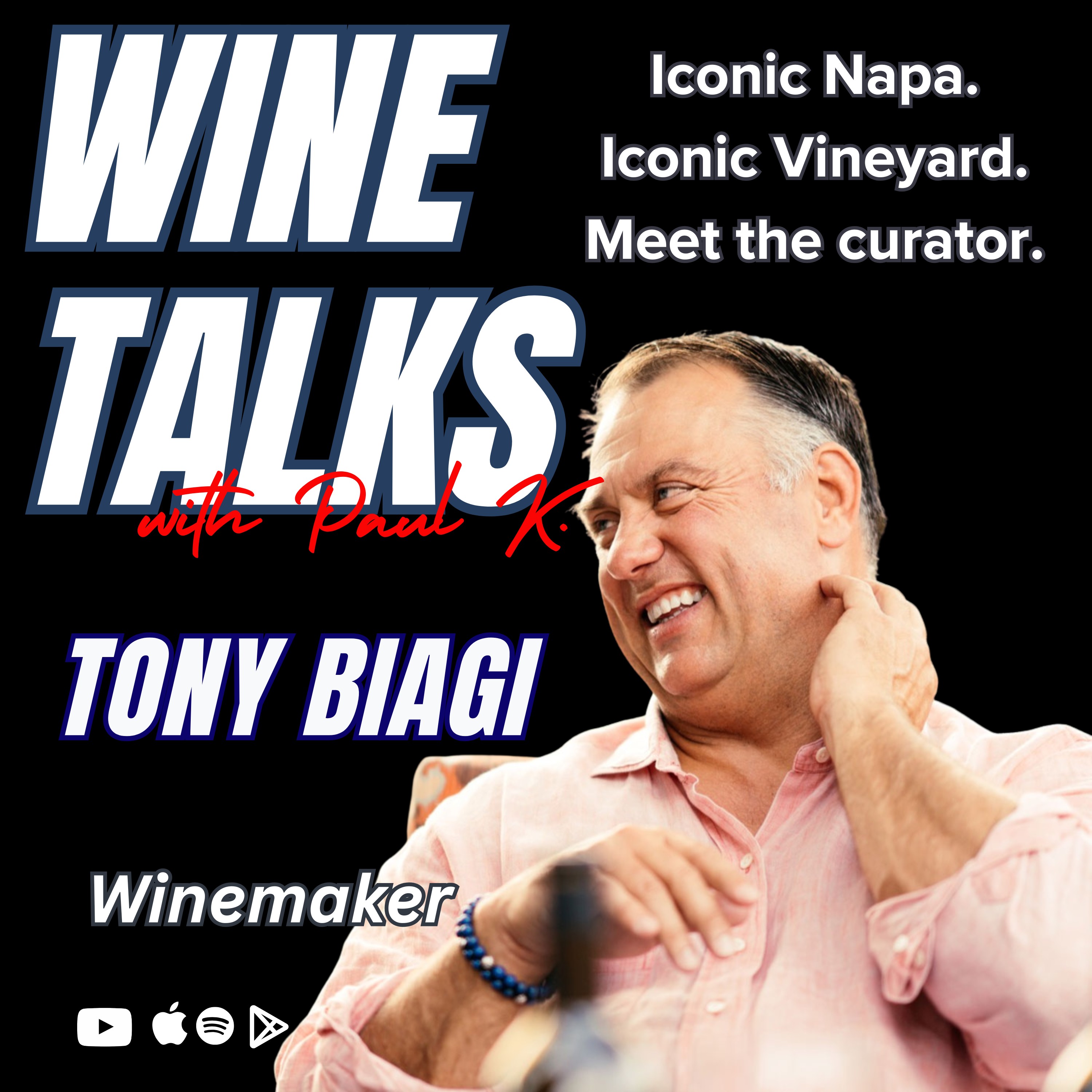
One of the on-going themes with Wine Talks, with virtually all guests, is the idea that you never stop learning in the wine trade. I supposed you could say that about many industries, but wine carries with it the idea of the harvest; the surrounding conditions that otherwise would be called "terroir" when discussing the differences from one year to the next. And there in lies the "never stop learning" aspect of wine. Each year is different and each your your knowledge and curiosity is compounded.
Tony Biagi relishes in this concept. He finds the will and the drive directly from the annual but perrenial unkowns when the next harvest arrives. We had an inspiring conversation at the Robert Mondavi tasting room in downtown Napa (a must stop when visiting).
ony Biagi might claim his parents thought he was crazy for joining the wine world, but on this episode, it’s clear that his unique path—from wrestling recruit to celebrated Napa winemaker—brings bold insight to every bottle he touches. You’ll walk away with a fresh perspective on what really makes a wine legendary—not just the soil or variety, but the relentless curiosity and humility of those who tend the vines. Listen as Tony wrestles with the legacy of To Kalon, Napa’s most storied vineyard, unraveling its mysteries alongside Paul Kalemkiarian. You’ll learn how American and French traditions collide in the heart of California, why the freedom to experiment drives vintners across the Atlantic to our shores, and how the “Burgundianization” of Napa reflects a deeper search for identity and place. Tony lays bare the tension between making wine for the critics versus crafting honest, vintage-driven wines—the kind that can never quite be replicated and, like a great song or timeless meal, stir something primal in us all. Hear the unvarnished truth about organic farming, weathering adversity like wildfires, and how a single harvest offers but one shot each year to get it right. Find out why the energy in a morning vineyard or the quiet wisdom of mentors shapes every glass, and discover how genuine hospitality—not snobbery—keeps the wine world alive. By the end, you’ll possess an insider’s grasp of not only To Kalon’s rarefied terroir and innovative spirit, but the soulful alchemy that endlessly draws winemakers and drinkers back to the table.
-
Robert Mondavi Winery (owners of part of To Kalon Vineyard)
Website: https://www.robertmondaviwinery.com -
Ridge Vineyards
Website: https://www.ridgewine.com -
Ravenswood Winery
Website: https://www.ravenswoodwinery.com -
PlumpJack Winery
Website: https://www.plumpjackwinery.com -
Duckhorn Vineyards
Website: https://www.duckhorn.com -
Hourglass Wine Company
Website: https://www.hourglasswines.com -
Cade Estate Winery
Website: https://www.cadewinery.com -
Chateau Cheval Blanc
Website: https://www.chateau-cheval-blanc.com/en/ -
Harlan Estate
Website: https://www.harlanestate.com -
Staglin Family Vineyard
Website: https://www.staglinfamily.com -
Domaine Leflaive
Website: https://www.domainedeflaive.com/en/ -
Dalla Valle Vineyards
Website: https://www.dallavallevineyards.com -
Turley Wine Cellars
Website: https://www.turleywinecellars.com -
Terravox (Missouri)
Website: https://www.terravox.wine -
Wine Spectator (wine magazine frequently cited)
Website: https://www.winespectator.com
#NapaValley #TonyBiagi #PaulKalemkiarian #winemaking #TokalonVineyard #terroir #CabernetSauvignon #CabernetFranc #organicfarming #vineyardhistory #winebusiness #wineratings #hospitality #winetourism #innovation #tradition #vintage #wineindustry #RobertMondavi #winetastingrooms
0:00 We're allowed to craft what we feel the best wine is from the terroir on the property. And so I really think that as a, as a winemaker, you have to do that. I think if you start chasing this or chasing that, you can get caught with your tail, you know, and so you have to craft what you feel is the best. Sit back and grab a glass. It's Wine Talks with Paul Kay. Hey, welcome to Wine Talks with Paul Kay. And we are at an away game up in the Napa Valley about to have a conversation with Tony Biaggi. You know, I don't even. I don't. Every time I say it, somebody corrects me. To Colon. Tokelon. Yeah, to Colon. Again, I've heard it a million different ways. Of course, Tone or Tokalon. I think most of. Most of the Napa Valley people I've heard say tone, but I have a feeling back in the day it was supposed to be pronounced Tokalone. So, you know, have a listen to a show I just released. It was really fun because I had an intern from Cornell University. We got a stint in Au Chateau Bailly in Bordeaux, France.
0:57 And she was on the podcast and she told of a 19 year old's perspective of going to France and explaining how she was indoctrinated to the vineyards and into the winery, into the French culture. And I was. It's a fascinating perspective on something like that. Really, really fun, but not why we're here. Okay. We're going to talk about Tom Biaggi and, you know, so much to talk about. We're up here in the Napa Valley and I'm reading a little bit about the history of this vineyard and it seems to be. Could be considered one of the most famous vineyards in the country. Yeah, I would say that, you know, Tocquellon and Martha's Vineyard would probably be the two, but Tocquelon's of course, taking the mantle as probably.
1:39 I hate when we go back to France, but I think we have to. Here is the Grand Cru side of Napoleon. Why do you hate to go back to France? Well, no, I love France. No, no, I just think sometimes we get caught up in trying to compare and compare, compare rather than be our own thing. However, I do believe the Grand Cru system of ranking vineyards is there for a reason. I think to definitely would take that mantle. I wonder why they don't do that here. Is it. Is it a vintage association kind of issue or. I don't think so. I think it's very much that Our country is based on a capitalistic society where everybody can know if you want to plant Pinot Noir in Calistoga and make world class wine, go for it. No one's going to tell you what to do or the opportunity. I think it's also a way for France to protect wealth. Back in the day with, you know, the feudal lord, not the feudal lords, but the dukes and duchesses owned a lot of the stuff. And so, you know, our property is better than yours, so it's worth more money. I think that's an interesting perspective. So. But I've always had this romantic thing about the fact that they protect themselves, but the French love the factory. Any European loves the fact that America is this wide open book and you can do whatever you want in that industry. But then at the same time we lose some of our, I don't know, like they protect their butter and they protect their cheese and then their wines.
2:47 And their wine business. They protect their wine business, subsidize it. I wonder if that's, in this day and age, a negative. If it's, if it's, you know, because there's such an issue with the industry right now and there's declining sales and all these different things going on with Gen Z and packaging, but I wonder if that, that control is actually stifling a little bit of creativity. I would think so at times. I think this is why a lot of them come here. I mean, there's a, there's a, there's a wealth of French knowledge here now in Napa Valley and Sonoma, you know, Philippe Malka, Benuet to name two or even, you know, yeah, cathiards over there and you know, the old four springs. So I think they love the opportunity to be an open book, to be able to craft whatever you'd like and do whatever you want. You might think you're crazy, but hey, do what you want, you know, So. I think we're all a little crazy. To get in this business at times. I think my parents thought I was, so I know that. So how did, how did that happen? Did you. Born and raised in San Mateo, California by Belmont, San Mateo. My parents were divorced, so I go back and forth and they were. My parents were super supportive growing up.
3:46 Loved unconditionally. My mom said all you need to do is find a job with healthcare. So any moms out there will get that comment. So healthcare is very important. And I just knew I can never be behind a desk. I knew I can. I had to be outside. I went to Davis. Strangely Enough. I was recruited to wrestle and I want to be a marine biologist. I took a winemaking class with Ann Noble and I fell in love. Said, oh, I could do this. And my parents were collectors. By no means the collector in the way you would think. My stepfather collected Ridge. He loved Ridge Zinfandels and those wines and Ravenswood. My father made home wine and Lodi. It was ghastly stuff and awful stuff, but he enjoyed doing it and he enjoyed drinking wine. So it was always around the table and so it was always part of the lifestyle there. But it was by no means with my dad cracking 82 Latour for dinner, that was not the case. But he knew what the finer things were, especially my stepdad. So he was really excited for me to go into the business. That's an interesting thought though. The Finer Things. And I'm looking at that book over there, the Greatest wines to Collect. And I also watched a movie recently, somebody sent me of the greatest collection in the world. Simple Guy just got the bugs early on. And now considered the greatest collection of the world. The value of the collection. And I wonder what the. And I just got inspired looking at this book. Is that just because us or do you think that everybody has the opportunity to get that inspiration when they have the proper glass of wine that you just go whoa? I think it exists in any medium, whether it be food. People, you know, have a bite of
5:17 three star Michelin food and then they have to see every three star Michelin restaurant in the world. Yes. Music, you know, I mean. Exactly. Or music. Music or sound systems. I mean, I just like the car on my car radio. But people have Macintosh systems that are just to start a 50, $70,000 systems. I think wine plays into that. And I don't know if it's the finer things in life, but just tasting what is the best of the best, understanding that and understanding what goes into it. And I think it touches back with Tokelon and the fact that when you have wine from a site, a place, you can say this bottle's from that place. I think Burgundy does that the best, of course. And I think California has sort of become the Burgundianization of such of valley. Everybody makes a single vineyard or something. And I feel that the place. I think people really love the place now more than ever. I think with social media sort of dominating everything, people really want to touch and feel place. Well, to Cologne has so much history and maybe when it comes to representing a sense of time and place, it that just takes time to Understand it here. You are rather newcomer to the vineyard. How did you. Yeah. Go about trying to understand what this vineyard does? I think I'm still learning. I don't think. I don't think you ever know. I mean, for other places, you know, before I came there, I was at Plumpjack for 10 years. And that's an old famous vineyard called the McWilliams Vineyard. And I felt not into four or five vintages in did I even understand how the property kind of worked. And even with some client, other clients I have now, I just made a decision this year to do something completely different. Talking to my assistant, going, you know, and he agreed.
6:50 He goes, I've always looked at it this way. Maybe I should look at it that way. And I think at the people that have come before me at Toquelan, you know, the people from the Robert Mondavi winery, You know, there would be Robert himself or Tim Mondavi, Jean Viev Johansson, who's still there, by the way. I mean, she still comes by and I get to ask her questions. We butt heads all the time, very lovingly, but, you know, philosophical. Philosophically, yeah. No, but she knows the property. I'll ask her a question, goes, oh, yeah, I remember walking that in 89. And that vineyard was very much like this, you know, like, wow, okay, That's. That's a wealth of knowledge you can only accumulate over time. I think you'll understand this. I mean, if you have children, you'll get it. If you don't, I think people out there with children will get it. You know, it's like, I'm not smarter than you. I'm just older than you. I've seen more things. So I really think that's the case. I mean, and not. But also to understand who's walked the property before you is really, really pretty impressive. So how true is that? Right? I mean, that's a really interesting point. Experience in life, whether you're a parent telling your kids or a winemaker, it takes time. And I. I do a lot with the Armenian vineyards, Armenian wine trade, trying to establish a position.
7:56 And I've told people, man, what they've done in the short amount of time since they were free because the wine industry was stifled by the Soviets is amazing. But they have a long way to go to understand what a vineyard is going to be able to do. Yeah, absolutely. I think what we have here, you can reflect on that experience from these people that were there already. Absolutely. I can definitely Genevieve, who's there, and I can even, you know, Luckily, I'm friends with Tim Mondavi outside. Or I can ask him questions. Hey, when. You know, when your dad or you are looking at this and you're setting it up, because the vineyard now was originally set up by the Mondavi for Tim Mondavi and that last company. Why were you thinking this? Why were you thinking that? And Jean, Vivienne, what were you thinking? Just to get the perspective. Now, I'm dealing with their thought process. I'm dealing with the results of that thought process.
8:42 So I really feel that being able to talk with them and ask them questions, sometimes they're like, you know, I thought this, and I was way off base. Or sometimes you hit it out of the park with your idea. That is what it is. We're still learning over here, you know, And I. And I think, you know, you look at Burgundy or you look at Bordeaux and their systems, you know, it makes sense why the first growths were the first growth, the uplifted rock and pebbles here. We're still trying to figure it out. I mean, I was blessed to work with Dan Duckhorn right out of college, and he always pointed to the alluvial fans of Napa Valley, of where the best vineyard should lie. And Toquen's in an alluvial fan. So Dan was right, you know, so. So do you think that your perspective. Because this is important, particularly now in today's marketplace with the Gen Z's drinking particularly, they don't want to drink what their parents drank. They don't collect all the different issues. We don't. We go on forever on that conversation. We want to, but we won't. But the.
9:30 The idea that the perspective has to be contemporized. Now, I've heard two schools of thought when I do this podcast. I was with Monsieur Clouet of Cheval Blanc, and he's like, we don't look at the consumer. We just produced what this vineyard's gonna produce. And given that thought, and I had this. I floated this to him, and he agreed with me, which was, there's never a bad vintage, because if vintage is true to its environment, then it's a good vintage. It may not taste the same as the one previous or the one after, but if it's true to the weather conditions, the soil, and everything that was presented in the vineyard that year, it's a. It's a proper vintage. Yeah, but we have a dynamic here. We have consumers. We have to decide, you know, so is your perspective different than your predecessors? And is that based on. Do you think the contemporization of wine in the industry we have to deal with because we have to sell stuff. That's our job. I think what I've been blessed with here at Tokalon is that the ownership group, which of course is a publicly traded company, but the management group, I should speak one step down, allows us to craft the best wines from the property in our beliefs of what that should be.
10:43 I don't think they've ever come to us and said, you need to do this, you need to do that. I've never been told once to do any of that. So interesting. Been very good most all, you know, whether it took long or any of my clients are really about working together, you know, now I talk to the ownership, I talk to the, my bosses, well and then other companies, the owners quite a bit. And we have a lot of connection with that way. But in the end it's a lot. We're allowed to craft the best wines. What we feel the best wine is from the terroir on the property. And so I really think that as a winemaker you have to do that. I think if you start chasing this or chasing that, you can get, you can get caught with your tail, you know, and so you have to craft what you feel is the best. So. So that aligns itself with that traditional thinking, which is we're going to produce the best expression of what it is. Yeah, absolutely.
11:30 And I think with Tokalon Vineyard company, they've allowed me to say, you know, there's no case. They've never make me, they don't need cases, they want to make the best wine possible. So some years it's going to be small. I mean, in a tough year, you know, we would probably make less wine. And in a world class vintage, if we can craft, we will. It's about the quality and the wine in the moment. It's not about, hey, we need X cases every year. So they very good to me about that. What does. I love this conversation because it's, it's what I believe. It's the Roman. It's not the romantic part, but it's the honest part. And wine. I remember reading an article years ago from a guy saying the problem with wine is they don't listen to the consumer. And they don't. And I'm like, but I don't think that's what wine is. We need those consumer versions, the Josh's and the Apothec reds on the shelf for the people that come and taste. And then all of a sudden Realize there's something like to cologne on the shelf also. Right. But the contemporary thinking is, what is innovation? We need to innovate. Does that mean anything to you? Innovation in the wine world, is that sort of a vineyard innovation, packaging innovation, marketing? Well, I think the funniest thing about innovation, it's a great question, but I think innovation is the innovation that allows us to go back to tradition. You know, what. What are the tool. What are the tools you're giving me so I can make wines traditionally? Yes.
12:48 You know, like, that's how I want to look at. Look at innovation, you know, and so forth. That's clever. I like it. You know, and because there are so many more tools out there. And I, you know, Bob Levy was a mentor of mine from Harlan, and he said the best winemaker has the most. Most. The best winemaker has the biggest quiver with the most arrows. Right. And that's experience. And it's what tools you have and how can you use this tool to fix these issues? You might come up. No vintage is perfect. I mean, you know, the best vintages, of course, are other vintage. The head pops up here, you know, oh, what's that? Sometimes bigger game of whack a mole. Sometimes it's a lesser game of whack a mole. And it is a natural beverage. I mean, if you're making natural beverages, I mean, when I say natural, we're growing the grapes organically out of Tokalon and we're fermenting them. You know, we're not using it. We may use a little nutrient. We do use commercial yeast. And I can go into a deeper issue, why I would do that at low volumes, but other than that, Malolactic is native. And then we're going to try to rack them three times and bottle them. We're not doing anything out of the ordinary. So. So those. Those lessons, having been a duckhorn Cade, Plump Jack. Yeah.
13:50 Hourglass. Which one of my favorites. I'm still there. Yeah, I'm still there. Are you really? Absolutely. Yeah. So we had a bottle at Rheinfeld the other day. Yeah, thank you. Yeah. You know, Jeff Smith had been really good to me and he allowed me to do this because I was working at PlumpJack and I was looking for my next. Next opportunity. And Jeff was very kind to say, hey, why don't you come work for me? And I was replacing Bob Foley and you can take. You can work with some other people and start your little brand yourself. And so that's, of course, now, many years later, has allowed me to Work with Ton vineyard company, which is very exciting for me. So that's really cool. Yeah. So those lessons, like, you're in a different part of the Napa Valley when you work at these different places, you're under the tutelage of a different organization.
14:35 Yeah. Both management and philosophical. Does that bring a certain amount of roundness to the next project that you're working on? I think the ability to see more, have. Have it open, you know, your lens is so much wider. I think you see a lot of things. You go, oh, that might work here. Maybe it won't work here this vintage, but maybe next vintage. I've learned something that might help me. And again, it's about adding arrows to your quiver. You know, like, let's try this. I saw this over here because I do, you know, I do some. Do some work in. I did some work in Paso Robles. I did some work. I still work in Santa Barbara a little bit with some consulting with a client down there, and I do some work in Sonoma. So, you know, different fruit sometimes brings up different ideas. And so. But then how. How can I implement those ideas? You know, maybe waiting to pick maybe the maceration techniques, maybe, you know, the oak choices all sort of open your mind a little bit more. I mean, I think this business, it's like the chef, you know, the more wine you can taste, the more ideas you can see. And I always tell young winemakers, interns, hey, work with me for this year. Take what you like, that I've done, and what you hate, throw it away. But there's going to be three or four things that you're going to learn from this, and then, you know, taking the next step. I interviewed with Tony Soder once, and, I mean, Tony's a legend here in Napa Valley. I mean, he's, to me, you know, as cool as it gets. And he said, work like nine and go work nine harvests in a row. And of course, my dad, my stepdad's like, absolutely not. You need a job. You know, So I couldn't do it. I wish I could. But his idea was. I now understand what he was saying is, go see as much as you can see, especially when you're young in this business, because you don't have children, you don't know, you don't have a mortgage payment. You can
16:08 do that, you can travel. And this is what's great. You know, I know we were talking about my girlfriend, Katie Linda. Her son is doing that right now, and he's traveling all over the world. He's been in New Zealand, South Africa. You know, he's working with Staglin right now and these great companies and he's seeing so much. And I'm jealous, you know, 50 years. Old, I'm super jealous. Like, I just came to work in Napa and don't get me wrong, I enjoyed my time there. Of course, to see the world because of a job is pretty cool. Well, that's a, that's another. I bring that up quite frequently because there are many people that go do two vintages a year. They go to South America, they go southern hemisphere, they do a vintage there, they come back and do one up in the northern hemisphere. And I think you'd agree with this. Obviously you, if, if you work that same vineyard for 20 years, if you work at to a cologne for 20 years, you have a certain perspective on that vineyard, almost every vine, practically. You're going to know and you're going to create a different wine than somebody that's doing what, what Katie's son's doing, traveling the world, working in different vineyards, getting a different perspective with a worldwide perspective. They're going to come back with a different opinion of what this vineyard is. And one's not better than the other. It's just perhaps it might be better, it might be worse, who knows? And I think, but I think what he's gaining is knowledge that in 20 years working with his family's vineyards, he'll have all this knowledge from the beginning to look at his vineyards maybe a little differently than the winemaker does right now. So I just, I'm, I'm, I'm kind of looking back on my, you know, there's no regrets. But I say I wish I would have done that. You know, do I agree with. Yeah, So I really wish I would have seen something. This is when, when I was
17:39 talking at the beginning about this young girl that went to Chateau Bailly, my first conversation with her as a 19 year old, she says, I don't want to work in the vintage, you know, in the vineyard. Uncle Paul. And she's at Cornell eonology school. I'm like, well, if you don't want to work at the vintage girl, you're going to, you might as well get out now because you're going to be in the vineyard. Well, what was the first thing they did? They put her in the vineyard. Yeah. And now she's like, I love the vineyard. So there must be something very cerebral about that. Well, yeah, it's funny, you know, walking Tokelon and walking Anyway, but really, Token, because of the history and the energy of that property, the vineyards do have an energy to them, and you can feel it at times, sometimes more than others. I definite think, you know, Toklan in the morning when it's foggy, is pretty beautiful. I don't think there's many other places in the world that's like it. Just the vista that you're looking out east from the vineyards all the way back against the Himayacamas. Yes. It's just a stunning piece of dirt. You can feel the energy there. And so there's a reason. I mean, it means. I think token means beautiful place. I mean, it is so. But vineyards in general, maybe it's the water underneath them, maybe just the roots. They're very magical places to be in wine. So very calm at times, too. Maybe that's the difference. Maybe that's the reason.
18:47 Wine, because I never get a definition as impossible to define. Why? What's so special about this product and what's so interesting about it? And why does it connect us to the soul? And that energy you're talking about coming from the vineyard might be the answer. That wherever that energy is coming from and whatever you believe that energy is coming from is what differentiates the beverage and how it affects the human soul. It's a connection. It creates all kinds of energy. When you share. I would agree. I think also what people forget at times is it's vintage dated. And so when you're having that bottle of wine at your favorite restaurant and you read that vintage and remember, wine's usually sold Sauvignon Blanc. Of course, white wines come to market much quicker, but great white red wines are often aged. And so you're seeing something that's five or six years old, and I feel it brings you back to that moment at time. It does. To me especially, I could tell you every vintage and what it was like, what was going on in my life. You know, the best of the best and the worst of the worst are all sort of marked by a vintage and that number.
19:48 And I think, anybody, you know, oh, 2007, oh, yeah, this was happening. 2004, oh, my daughter was born. And then you start thinking about it, and I think that metaphysicalness of it, like opening the mind to that date and then having that liquid do that, and then maybe drinking a little bit, imbibing too much and maybe getting a little more emotional about that. But I really think very few things in our heart, our. In. In our world, our vintage data that we consume, you know, I Mean, yeah, that's true. Nothing else. They use up use updates, you know, best buy. But you don't ever, you know, they don't say drink buy on our wines. It's basically all right, that 1975 is a really enjoyable bottle of wine, you know, So I think that. And then that it comes from nature, It's a natural product. Yeah. And it comes from a vintage date, I think are the two most powerful things. I think that's it. I didn't even think about that thought process because I, when I was in the retail side of things all these years, people would say, and they would do it too late. And that would be, I need a bottle of 2004 for my daughter's when she was born. And I want to find. That's my daughter's birth year. And I have, I've been collecting them. So it's so funny. So they wait till it's 20, 25 and go, I need a bottle, you know, 21 year old bottle. I'm like, well, I don't know, you know, it's a little hard to find, but if you thought about it up front. But why? The question is, why do we do that? Why? Like, what is it that we try to preserve when we buy a bottle of wine of a birth year or a wedding year? Like, I used, I bought 86, I got married in 86. I bought the Charles Krug 86 Winston Cuvee or something. And it meant something. It's all gone now.
21:20 But I bought six bottles and it meant something every time I opened it. And you don't, like you said, you don't do that with a Best Buy date, you know. Yeah, Jack Daniels, Heineken. None of that occurs like that. So do you fight then? Do you fight this Napa, you know, it has settled on a style that people appreciate it and we need the people to understand those styles. And I won't name any brands, but there's that opulent, fruit forward little high RS type wine that represents currently, unfortunately, sort of a default style of the Napa Valley. Do you fight that or you just. We, we appreciate the fact that they exist because it brings people to the table. I think you have to look at this. Your second idea is how you have to look at it that brings people to the table. I focus on what I can do and make the best wines possible, you know, using the tools that you were saying, the, you know, the moving forward of mechanization or just having better ideas of how to do things, but trying to go back to the naturalist wines possible. Yeah, you know, very.
22:28 Additions, just sulfur, other than sulfur, and then bottling without filtration. That's the goal. There's no nevers. I think the. I think generally I would like to be. Yeah. I mean, but so never and always. I mean, I also don't want to sell something to the consumer that might be spoiling the bottle. So we're looking at that, and we have to be careful of that, I think. Oh, is it. It's where philosophy meets incompetence, you know. Yes. Philosophically, I want to do this, but I don't know what's going to happen if I do it, so I'm going to do it anyway. And that, that gets pretty dangerous pretty quickly. You know, I've had, over the years. There's one biodynamic, actually, it's very funny because we're talking about the vineyard a little bit, but it's a biodynamic from Sardinia, I think. And these guys play music in the vineyard, you know, and they had done this experiment where they put rock and roll in a vineyard and they put, you know, all this stuff. I suppose there's. You talk about the energy in the vineyard. I suppose there's possible, yeah. I mean, if you look at Le Flev. I mean, La Flev is biodynamic in the vineyard, and they make their wines more traditionally in the cellar. But I think it really does start in the VI and how you handle things, which is really exciting about Tokalon. I mean, you know, they're trying to. Taking all the, all the acreage from Mandavi's Tokalon organic, you know, certified organic. Well, weren't we always organic? I mean, I mean, I mean, up until a certain point when pesticides and sexicides and herbicides became a thing. Yeah, I think, I think they always did what was. You know, I think if they could do it, they would. We're. Now we're asking the questions. Why would you. I think that's more than ever. Look, I started in the, in the 90s, and it was already a push to organics. But I did hear the older stories of no bugs in the vineyard. Never saw a bug in the vineyard. You know, smudge pots
24:00 burning. Winter, you couldn't see up valley because it was so, so, so smoky and all these different things. And I think that's changed quite a bit here. And so I'm really proud that we're, that they're, that we're doing that here. No, I, I. Look, I think in general, particularly with Sort of the movement, the political movement towards healthier eating. This is sort of healthier drinking. I think it makes a ton of sense that the vineyard's not, you know, doused and stuff. And I. There's a lot of books about how we've destroyed our wheat farms and through all kinds of reasons, and now we're going back. I just think it's interesting that we've created this problem of insecticides, herbicides and pesticides and the diseases and the things that come from it. And now we're allowing ourselves and patting ourselves on the back for going back to what it was before. Well, again, I think we have to pat ourselves in the backs. We are trying to make change, and change is hard, you know, and so, I mean, a pat on the back might be maybe a little too crazy to take the victory lap, but in the same instance, I'm really, I really feel proud that, hey, you know, at least maybe we're the first generation to do that. I think it's great. And the generation above us to start moving back to camp, we. We can. We coexist, you know, and with regenerative farming and so forth. Well, they, you know, they talk about that. You know, in the earlier days of organic farming, I may say 20 years ago, the yields were lower. You were. It wasn't guaranteeing you're getting a better product. You were just getting organic. You weren't. And that was the problem. That's what I think soured a lot of people. There was a couple wineries, and I won't name names because they don't probably want to be known, but they were organic in the vineyard, but they didn't want to be known for those organics because it was. Was who.
25:26 You know, there was other wineries that had the, the stigma of organic and bad. Yeah, organic meant bad. And I don't, you know, that's why I think someone like Le Flev, who does biodynamically in the vineyard, farms biodynamically, but then crafts wonderful wines. And I know Dalavala is doing a lot of biodynamic things and they make world class Cabernet now. So you can do both. Whereas I think in the 70s and 80s, I think it was, you can't do both. Right. So that was, that was kind of bad. So. Well, we did, you know, there's a lot of movement for food too, and, and there's an energy when it comes to wines and food, like we talked about earlier in the vineyard, that come from seasonal food. I just thought of this, the other day, I was thinking, like, oh, my gosh. Because we. We. My daughter just came from a town called Potsdam, New York, which is. You don't want to go there.
26:12 But the coolest thing about it is you go to the farm and you buy your vegetables, you go to the dairy and you get your milk and you buy your meat from the. The. From the butcher, from the cattle ranch. Well, that's as seasonal as it gets, 100%. And there's a. There's a. There is a certain value, huge value to that nutritionally and I think to the human cycle. You're also getting out, you know, where you can. Your daughter can just stay at home and order all of her groceries, you know, online and deliver it. But you're getting out, you're talking to people, you're talking to the vendors. You're. Hey, what's going on? How's it looking out there? Oh, whoa. The cow's not happy right now, you know, Right. Or the butcher. Hey, I don't really like this. Maybe go to this cut of meat or, Or. Or the vegetable. Yeah, I'm sorry. We had a bad run on strawberry this year. You know, in the springtime was really weird. We'd have a lot of good strawberries, and the garlic was weird. I mean, just funny. You see things. So the more you're out there, the more you see. Oh, sorry. It was super late.
27:02 We had heat during the flowering of these certain peppers, and so we had on peppers for another three weeks. And it's just funny to be able to talk to people, to understand how the weather and the climate affects us every day. But I think when you sit in your home in front of a computer and just hit buttons, you know, you're. You're not even around that. And I think it's funny, right? I didn't even think of that. It's a really good point, but isn't wine the ultimate seasonal product, a vintage wine? It is. And I, you know, I often tell people the hardest, you know, we. We compare our business to the restaurant business. You know, we are. We are overly reliant in a great way on Hispanic culture, which is a restaurant business in California as well. So, you know, you have that and you have how hard it is to do. The difference is they can cook that pork chop every night, 15 times a night. We get one chance with grapes to do it. Well. Yeah. You know, and then next you have to wait to next thing. Oh, God, I should have done this. Yeah. But then next year is completely different. Then you know, it's kind of like, you know, like I want to, I want to play dice, I want to play craps. But then next year you're playing blackjack because the weather's completely different.
28:04 So it's just, you know, I tell people I get 30 or 40 chances in my life to do it right and do it well. You know, luckily I do work with some other clients, so I get to touch more stuff. But for the most part part, you just spent a year. You know, when you lose a year, like 20, 20, the fires where, you know, almost all my clients for the most part did not make wine. You almost lost a whole event. Just kind of like, you know, in that way, being a professional athlete, when you go down with an injury, you lost a year, it's just gone. And you're not guaranteed many more of them. So that's interesting. You know, there's, I brought this up before and I think you just mentioned it and you, you, you live the reality of it that, yeah, 30 to 40 vintages is probably a career year period. It is 100%. Yeah. And that doesn't seem like a whole lot, you know, for a lifetime, because it is only once a year. It is. And you, you know, there's a lot of pressure there not to make any mistakes. You know, there is. And I think, you know, especially working with Toquelon, I mean, you know, you have these world class grapes coming at you almost every year. You know, you're getting the best, you're getting the best ingredients. Like working at a three star Michelin restaurant. Everything you buy there is going to be world class, the best suppliers, the best everything. I think that's kind of what Tokalon is, is that this is best fruit coming at you and you better make the best wines. Now what's the, the what's best that's in the eye of the beholder. But in my mind, did I craft the best wine possible from what I saw and from what the vintage is? And I feel great about that.
29:22 That's kind of all you can, because like I said, what you could, I can guarantee if we were went out for a wine list right now, you'd probably pick something completely different than me. We would both agree on whatever we picked that we enjoyed, but we would have probably gone somewhere completely different. That's the love of wine. Right? So, so let's go to the business side of this, the Tokellon hierarchy of management. Do you meet like this is going to move into the distribution side of things. And the way DTC works and all the problems we have in America with selling alcohol. But when it comes to Tokelan, what is the conversation like in the boardroom? What do we talk about?
30:02 I think they. I mean, I don't really know because I've never been in the boardroom, so I can't. No, no, no, no. That says a lot right there. Allow us. They empower, you know, Sam Glazer, who's the, who oversees the wine program in San Martin, to really let us do our thing and let us be. You know, they said a lot. They've been very hands off. I mean, there are some. There are some small family wineries where the owner sits next to you every day and make sure you do everything right. So being. The fact that they've empowered us to make the best wines possible is super. That's. I mean, that's the best form of leadership you can have. That's amazing, empowering. So, so. But I think if you were. And I'm not going to put words into their mouth, but I think they know that they own the best, arguably, if not the best piece of property in California wine business. If not the Americans, you know, that's amazing.
30:49 They know what they have. Yeah. But that takes a lot of discipline for the. Particularly in today's world of marketing and all the issues that are coming down the pike here and this drop in consumption. I mean, I was talking to Violet Gergis. She, I think she said the taste room traffic goes down 30%. You know, that's a substantial amount of traffic to ignore. Right. And here they are at your place saying, we're still. We're going to hold the line. We're going to. We're going to let the team do what they need to do. Well, not only that, there's. If you go to Mandavi, right now, they're reinvesting in the tasting room. They're leaving the arch in the tower. Of course, they redid it all, but then adding new tasting rooms, they really believe in the long term viability and success. I noticed the construction fence on the highway. Yeah, yeah. No, it's going to be beautiful. And hopefully you can come back to the launch of it. It's going to be really exciting. So they're investing long term in it. They believe in it long term. So, you know, that's interesting because Robert Madhavi, I saw the pictures out in front here when we were at the arch here down in Napa Valley downtown. I did not know this building existed. Been by here a thousand times. I never noticed it, but there's pictures of Robert Mondavi out there, and he was considered the. The. The flag waiver, the, you know, the inspiration behind and putting Napa Valley on the map besides the judgment of Paris and all these other things that occurred. But the guy that went out and waved the flag, who got on the plane, who went down to Southern California, spoke at my dad's Les Amie Divan meetings to make this happen because he believed in what was going on here.
32:16 Yeah, absolutely. No, I mean, it's an honor to work with these grapes and the grapes that, you know, in 66 his family had and working with them and, you know, I got a chance to meet him three times and oh, yeah, he. He was super inclusive. I mean, super nice. He sat next to us from Mustards, of all places and started asking us questions. And when he found out that we were in the wine business, started giving us a hard time about stuff. And I mean, what can you say it hasn't been written already about him? He's just a legend. Without him, we're probably 30 years behind the curve. I mean, his dreaming and his tenacity and his focus, his vision. I was talking to George Tabor, the guy that showed up at the Judgment of Paris. He was on the show a couple years ago and he said, yeah, maybe California would have become. It wasn't for my article and that whole Judgment of Paris, maybe it took. It would take 10 more years. And I don't know how you make that prediction because it took a worldwide. Maybe Robert's job would have been a little tougher to get on the planes and fly to SoCal and fly to the east coast and wave the flag in the Napa Valley. But certainly now the world, the wines are world class and they compete all. Over the world, 100%. I mean, sometimes win. It's. You know, I don't think he ever wanted to be the best. I wanted to compete. I think if you. I think if you're in this business, you learn that everybody's taste is personal.
33:40 I always used to jokingly say, you know, I don't want to come in first in any blind taste. I want to come in last. I want to compete. Yeah. And I want to, you know, I feel that's pretty good place to be because some person's going to rank it first. Some person's going to rank it. That's just the way taste is. You guys seek that, the. The ratings and all that. I don't know if you guys are submit them. I Don't know. We do. I mean, I work with all the critics, you know, and. And I still think you have to focus on making wines possible that make yourself happy again. It goes back to chasing this and chasing that. I mean, the marketplace for critics has changed. I mean, when I came through, there was two. There were a lot of critics. There were two powerhouses. That was the Spectator with James Lobby affecting California Wine, and of course, Robert Parker. There was Stephen Tanzer on a lesser extent in the Connoisseur's Guide and Underground Wine Journal. I think underground was Steven, but for the most part the wine enthusiast, of course.
34:26 And then the wine news. I don't know if you remember the wine news, but it was really the Spectator and it was Parker. Those are the 100 pound gorilla. So you, I think, has changed considerably. Here's one of the reasons. Just visually, when you go to anywhere, particularly a supermarket, almost every wine is a shelf talker on it. Oh, yeah. So now the consumers look at going things. So it seems like there's a little dilution in the ratings. Yeah, I mean, there's a lot of people doing it. But I do think that's a great thing because of the fact that when two people have such a power, more full grab on it, and they both like the same style of wines, and that's not a bad thing. Look, every style is about.
35:06 Every style's allowed in any wine business. You know, it's like anything else. But when two critics like the same thing, it could be very, you know, okay, well, gosh, you know, we need to focus on trying to drive this. Well, now there's so many different great critics out there. I'm just gonna make the best wines I can make and hope and find your tribe and find your critic that enjoys what you're doing and what you're trying to craft. I think that's the best thing for them. That's the best thing for the consumer. It's the best thing for brands. Brands and just to go out and craft, you know, do what you believe in and find your tribe. And they'll find you if you're doing it well. Look, not everybody does it well too. That's the hardest part. You know, there's been a movement for Eno tourism lately all over the world. And I.
35:48 When I was selling wine, when I was selling the Wine of the Month subscriptions in the early days, there was this huge value to me standing somewhere like at a Taste of LA or a Taste of Pasadena or Taste of the Oregon event and shaking a hand and having that conversation with somebody. And certainly that kind of relationship is built for a wine dinner. All the different methodologies that we have to share a glass of wine with somebody. But it seems to me, particularly in today's marketplace, that the experiential side of wine is becoming more important to earn the trust of a consumer needs that kind of conversation. Yeah. You know, it's funny, we were talking about critics just now. Wine Spectator has sort of taken this view now of re educating the young consumers again. And I thought they did a wonderful job in this article recently. And where I'm not here to show, you know, to talk about any critics, but I think what they did was let me tell you how wine's made. And I had people in the business who've been in the business 20 years ago. This is a great article. They're trying to identify the younger generation. This is how white wine is made. This is how red wine is made. I think it was the white wine article that was written. It was fantastic.
36:57 They're doing a really good job of trying to re. Educate the consumer. Especially we're talking about the younger consumer coming up because wine can be terribly. And you know this more than anybody, wine can be terribly overwhelming and scary. And then for years, especially before critics became, and the Internet became so powerful, the gatekeepers can be very hard with the information. I mean, I can remember being a young person going into wine stores and they had no idea I was at UC Davis getting my degree and working retail in the winter weekends, they'd almost shoo me off. Like, why are you here? Go away. Why don't tell you anything. And I could just imagine someone who's just a young financial person getting out of the business and going to a wine store and being told that way. No wonder people. So I think what Spectator did in this article is a great thing for wine in general to show you, here's how it's done. This is actually a natural beverage going from getting to end. They're also doing a great job. And most of them and the bigger issues are talking about, you know, the, the articles they write about Italy, the articles they write about Spain, the articles they write about France. They do a wonderful job and a deep research on where to eat, where to drink and where to visit. Now, granted, that's their bend on some of the wineries, but getting people here is everything. I mean, as you know, you travel the world for wine, and I've been lucky enough to do the same. Wine grows in beautiful places. Yeah, we all know that and there's great food, you know, So I. There isn't a day I don't think my dad. Dad. Yeah. For telling me, hey, son, I think I'm gonna sell the Wine of the Month club. You may want to just come check it out then I would work for him for three months and packed wine and charge the credit card.
38:24 I go, yeah, I think I can do this. Yeah. And that's like. And he passed away a couple years ago. But I'm like every day I'm like, wow, thanks for letting me do this. Yeah. Then you got to take a trip. Then they winds a Spain go, hey, why don't you come over for a couple weeks, check out Spain, whatever. Absolutely. You know, that's the interesting problem though, because wine is you can learn as much and you're still learning. You're going to Learn through your 40 vintages that you get to manage. This book that's on the table here about the greatest collection in the world. You can continue to study at the infinitum. So I've always believed that the individual persons could be their resistance to learning. It could be their excitement to learn. Whatever it is, you can learn as much or as little as you want. But I've always believed, believe that that honest glass of wine eventually finds its way to the generation. Some generations are later. Gen Z's are a little later, but they're going to get tired of White Claw and they're going to get tired of these flavored beverages that have all this crap in it. And they're going to have this glass of wine one day and go, you know, this is really interesting stuff. And some of those people will say where it's from, let's go visit it. Some wong. Some are going to say, I'm going to continue to buy this wine because it's just really good. And I'm wondering like all the word. I should be careful the adjectives I use for what I read on LinkedIn and places like that of these people that are talking about how the industry doesn't react and it doesn't understand the consumers. And I'm like, well, part of it's a. It's one time a year and two, there is a certain aristocracy that
39:54 surrounds wine. Right. And I have to be frank in that I'll go to a tasting room here. I mean, I tasted 100,000 wines in my career. Documented. Right. So I get it. I'm better at some. I'm better at sort of structurally understanding wine rather than the flavors. And what I Taste. But when you walk into a tasting room, sometimes you're just treated like you're paying a hundred bucks, you know, whatever this charges these days. And I think that adds to this aristocracy a little bit, that I'm a little intimidated because they want. Want to. They want to share that they know more than you. And I don't think that's a good thing. Absolutely not. And I think the best workers in the. In the tasting room let you sort of let go along with you for the ride, you know, invite you, listen to you, you know, and that's what I've seen. At least now I still go to tasting rooms. I go. I like to go over, because I don't make a lot of Pinot Noir. One client, I do. So I like to go to Russian river and taste wines. Yeah. And just sort of. And then, you know, Katie and I, you know, my girlfriend will go. We'll go taste wines together and just observe how they're hosting things. And it works for her because she go back to her winery and say, hey, I saw this. And this. This might be a really interesting thing to. To. To talk about. Right. And I. I get to see how people are handling themselves. And some people, like you said, want to talk over you, want to tell you. And then they find out that you're a winemaker in Napa Valley, and they're like, oh, okay, that was an interesting hour. I just, you know. Yeah. So. But most people just, I think the best salespeople, I mean, and that's why I think we need to invest a lot more time and energy into the people that work in our tastings, because they're the front line. They're the ones. Ones talking about our brand and. And. And
41:25 expounding on what we're trying to achieve, and not only about the brand, but the wonders of Napa Valley or Sonoma. You know, a rising tide floats all boats. We want people to come to California. We want people to go to, you know, if they're going to Paso, we want them here. But, hey, they're coming to California. They're. They're going to eventually find us. And that's interesting. You know, unfortunately, it has. You know, we are working on some things to get. Trying to get things more affordable here. Things are expensive, and we're not. We're not ignorant to the. To that. So, yeah, that is a huge issue. And here's what was told to me recently in a tasting room in his. The woman's husband is a winemaker in the Valley as well. And she said, and I kind of experienced this because we typically stay in Yountville. We have a couple of hotels we really like, and we noticed that the attendance is down. There's not many people here, but the prices are still really high. And the comment that was made to me was, yes, the. The hotels have business to run as well, and so they're able to use a skeleton crew with a 30% occupancy charge, the same amount, and. And. And their expenses are lower, but they still get the revenue. But that's not good for the tasting rooms because the people aren't here. Driving up down the highway and going, thing seems to be busier this week, and of course, it's harvest, so that's. Yeah, it's a great time to be here. You know, we have seen, you know, as busy as it was a couple years ago. No, but I think that's just. If you look at, you know, I think Covid really sort of accelerated things. It got really busy again. So the Roaring twenties feel.
42:54 Whereas if you look at the long term, I think this was posted, I want to say, in the New York Times or the Wall Street Journal, if you take off those years, we're still on a path up. It's just not as great as it was in those time frames. It's still growing. It's just not growing as fast as we. As we experienced during COVID which I think any business would say was pretty booming for a couple of years, too, so. But we need to do more. I mean, I think I don't get to make a lot of those decision reasons because I'm not at, you know, I don't own hotels here. Well, that's not by design. Yeah, yeah. I make wine. But I would say that I hope that they're, you know, I know that visit Napa Valley is working on that. I know hotels are working on that. I know the leadership of the vendor solution are all working on opportunities to get more people here, to get it more affordable to do all those different things. It's kind of interesting. No, I would want to finish it. We're almost done, but I want to finish on the philosophy of Tokalon on the way up. But there's 13 that I know of wineries for sale in Temecula and Temecula.
43:49 And I, I told somebody, they asked me, like, what would you think? I said, you're not in Temecula. You're not buying a winery. You're buying strictly a hospitality business because the busloads come in. It's A. It's. It's experiencing wine country in a much more affordable environment. And you don't have to travel six to eight hours in a car to get there. You can travel two hours anywhere in la, you get the Temecula, two hours. And so they're like, what do you mean? I said, it's not about winemaking there. It's about hospitality. And maybe there's some lessons there because you said it already. It's really salesmanship. Hospitality is really salesmanship. And maybe that's one of the aspects that tasting room managers and tasting personnel should be indoctrinated to, which is. My career, was a sales guy all my life, is understanding the customer. Customer. Yeah. Understand the person's walking the door, where they're at in their career of wine tasting, in this case. And, you know, if I'm selling copiers, where they're at in the copier world, whatever they're doing, to understand with that and then respond to that.
44:53 Respond to that position and take it to that level, wherever that is. You know, Danny Meyer wrote a great book on service, and everybody who's in the service industry should read that book. Yes. Because, I mean, his restaurants in New York are just juggernauts for service. And I think even I've read the book on the winemaking side, how to talk to People. How to. How to. You know, because I am still selling, you know, whether I'm selling right now to your company or. Or whatever I'm selling. I'm all. You're always selling, whether you like it or not. And, you know, you have to be. And so I think everybody should read that book at least once, especially if. In sales, because I will. Yeah, it's a great book. And he's a Cornell grad, so. Right. Yeah, I think so. So. So tell me about, as we wrap this up, the. The. The. The ongoing philosophy and then what we think the future holds for. To cologne.
45:39 Yes. So, you know, agree it took long. You know, so we craft three wines. We craft highest beauty, we craft Eliza's Cuvee, and we craft hwc. And the highest beauty is as a collection of the best blocks that I get, the best barrels of Cabernet Sauvignon from Toquelon. I work with 10 different blocks. I hand select them myself. And the second wine, I'm going to talk. I'm going to talk about what my favorite wine is right now, because it's special. The HWC is basically. When Robert Mondavi got the property in 66, they discovered a clone of Cabernet. It's very small, very small, clustered berries, very dark, very black. And it's called the Mondavi selection.
46:21 That wine is just that clone. It's only planted sporadically throughout the Tocquellon vineyard. And I craft anywhere between 300 to 600 cases of that a year off the property. And that's a Special, special caber. 100% cabernet. Highest beauty. Andy Erickson, of course, founded the brand I took over. I intend to blend a little more Cabernet Francop Petit Vo in there. He was 100% cabernet there. The last wine, I think, you know, I was asked, you know, to chat with you today. You know, they said, well, just if he asks you what you. What is your favorite wine you're crafting right now? I think the most unique, one of a kind wine we craft off that is Eliza's, which is a Cabernet Franc. Cabernet blend. Wow. Cabernet Franc at Toquelon is really special. It's one of a kind. Not very many people make it. Even, you know, over at the other side of Tocquelon, you know, they have, I think, two acres of it. And so we're very blessed to get Cabernet Franco there. I've talked to Tim Mondavi about it, and he's like, yeah, Tony Cabernet Franc. Special.
47:13 And it really, truly is. So that's the wine that I'm probably the excited, most excited for people to try, critics and consumers alike, because not many people get a bottle of Cabernet Franc and put it out to them to somewhat masses. So those are the three wines we're crafting, and we're always trying to work to get better. We have some new blocks coming online on Toquelon. They had to replant some stuff, and we had some older vines. I mean, there are blocks out there that are two years old now that the Mandavi family planted that we're working with that. It's just beautiful, beautiful Cabernet Sauvignon. So super excited to work with that. And then, as I said earlier, I'm now going into my. I worked with the 21s and 22s of Andy Erickson, and Andy was kind enough to recommend me for this job when he moved on. And Thomas Brown, who also crashed Schrader, was also kind enough to recommend me. So they both coincided. So I was able to get the job. And just building on what he built and just really getting to know the blocks, because then there, you know, there's some blocks that I think are just now coming online that are going to be amazing. So, you know, Cabernet Frog is getting a little renaissance. I think it's the sirens call. It's everybody loves Cabernet Frank. Then for some reason, no one ever buys it, you know. Yeah, but they, you know, they've. They've been. Some of them are thin, some a little acidic. They don't care a lot of depth, but they've come around. And I remember I had a conversation with August Sebastiani last time we were up here. And I, When I was talking to him, I go, wait a minute. I go, I bought like in the early 2000s, maybe even late 1990s, the
48:45 cabernet franc from Sebastiani. I go, it was. And the label was like one of the little girls in the family drew it on the wall. He goes, yeah, that was my sister, sister. And she taken crayon and they took a picture that made it a label and it was 100% cabernet franc. That was back then. Yeah. But now you see it, you know, Santa Milion is, you know, very prevalent always. But to see. I would love to see how this Cabernet franc and this vineyard is so. Probably so expressive. It really is. And I think that's why Tim and Davi said it's so special. Cab Franca is so special there because I know that now, tasting the Cabernet Francs, I can taste in the older Mondavi reserve wines, you know, and when it's funny, because even three or four, I know it's funny, you'll do a wine tasting and someone go, how much franc is in this? And. And 2%, like, ah, I totally get that. I'm like, well, I don't. That's funny, you know, 2%. I don't know how you taste that, but it's funny at 4 or 5%. I do see a little bit of that sort of the etherealness to it, the sort of the herbal, the really beautiful herbalness to it. Sort of like the violets that I always take. Darjeeling tea, you know, a gunpowder tea.
49:49 So just, you know, it's like a dried herb, Herb. Herb de Provence kind of thing that I love in that wine. So it's super exciting to work with. And so we're doing some co fermentations with Cabernet there to make a more. More complete wine super fun. I super love it. And, you know, kind of a. It's kind of an ode to Cheval Blanc in A way. But even though there's no Merlot, you know, this Cabernet gets to take that place. But you know, there's a lot more. Actually our last visit to Saint Emilion opened my eyes to the fact there's a lot more Cabernet Franc than you think there. Oh yeah, absolutely. To counter the, the, the, you know, the viscosity and the weight of Merlot. So it's kind of interesting. Yeah, they're not planning Merlot out there too because the climate change are saying or Cabernet. They're planning Cabernet more and more over on the plateau, not down in the flats. So it's been interesting to see how it goes. So can you imagine they're. They're testing like Tariga national and stuff in Bordeaux. Yeah, we're doing it here as well. We're doing it here now. I've often said, you know, you get to get the whole. Are you worried about cabernet? 10 years from now I go, Cabernet will be here long after I'm gone. There's so many smart people here. They'll figure out ways to grow it.
50:49 You know, people are going back to head trained again to get more shade, you know, more, you know, back to camp California sprawl to shade the fruit more. There'll be new clone material, new rootstocks, as you were saying earlier. And it's a great way to almost, you know, we're going to wrap this up. But what's old is new again. You know, we're going back to St. George. We're going back to 110R. We're going back to the old heritage clones that had been here for 50, 60 years. And so I think, you know, it's funny, all these old farmers we made fun of now are geniuses. So you know how that works, right? Well, there's a guy, it's called Terravox. It's in Kansas, right outside of Kansas City. He's up in the hills. He found a book, Eisterhold, his name was Eiserhold. He found a book of American wine grapes from the 1800s, pre prohibition from that part of the country, which is, you know, really where most of the wineries were. And they always, they started in Kentucky, I think. Yeah.
51:42 And so, and I told the guy and I read about him in the Smithsonian magazine and he's trying to repropagate these things. He found 14 of these grapes in different nurseries around the country and he's starting to grow them. And I'm like, dude, you have the tallest job in the world. You have no history. You have no idea what the soil is going to bring you. You have no idea this grape's going to do. He goes, I know. He goes, I've already thrown four of the grapes off the vineyard because I can't make a palatable wine out of them. I said, wow, what an amazing task to not have any history to work from. And it's not vinifera. It's like, oh, no. It's like. It's a little brass guy. Yeah, well, because you got to remember, I mean, that's such a humid area. Humidity is just not good for grapevine, you know, for. And then also you have Pierce's disease, which I'm sure they would have pressure as well. That's what killed. You know, they called it Anaheim's disease. That's what killed most of the vineyards in Anaheim. So, you know. You know, it's so funny.
52:35 You land over in Ontario and there's all these old head train vineyards all around. It's crazy. So, yeah, so I'm excited to see. That'd be interesting to see. I mean, that's interesting. That's an interesting piece of history brought up as we end. This is. You know, most of LA was planted like that. Anaheim was devastated by Pierce's. Yeah, they used to call it Anaheim's disease. It wasn't Pierces, it was Anaheim's disease. Yeah, no, that's what they call now. It's, of course, Pierce's disease. But, yeah, I know. And you know, you know, Tegan Pasalako over at Turley, I mean, he's pretty knowledgeable in all this older stuff, so he loves collecting these old books. So he's always posting stuff and pretty fun. I mean. But yeah, I mean, California has a great history in the so. But we're learning, like I always say, what I know could fill volumes. What we don't know could fill libraries. Well, we appreciate the fact you're here at the helm to propagate that history and contribute to it, because as most, most, at least European and now American vineyards would say, or winemakers, I'm just. Passing through this 100%.
53:29 I hope they'll leave it better for the next person that's after me that's. It still goes. I mean, the vineyard's amazing and I know that my time will be up and then the next person will be coming on in. And, you know, it's always interesting, you know, to love French wine and to see that. I wish there was more. I think the family winery in Napa Valley is making a comeback now because of that, too. That you'll see that the generational pull. I mean, it's like anything else. It's called the wine business, their side of it. That's going to be very hard. It's the business that's not the pretty side, it's the hard side, but it's a business. So great having you on the show and good luck with the harvest this year. Thank you. Yeah. Running through it right now. I'm going to go head back to the vineyards as soon as we get done, so. All right. Cheers. Cheers.