

 Apple Podcasts

 Spotify

 Youtube Music

 RSS Feed
 YouTube
 Pandora
 iHeartRadio
Behind the Scenes at Paris’ Barbecue Championship: Judges, Prizes, and Local Impact
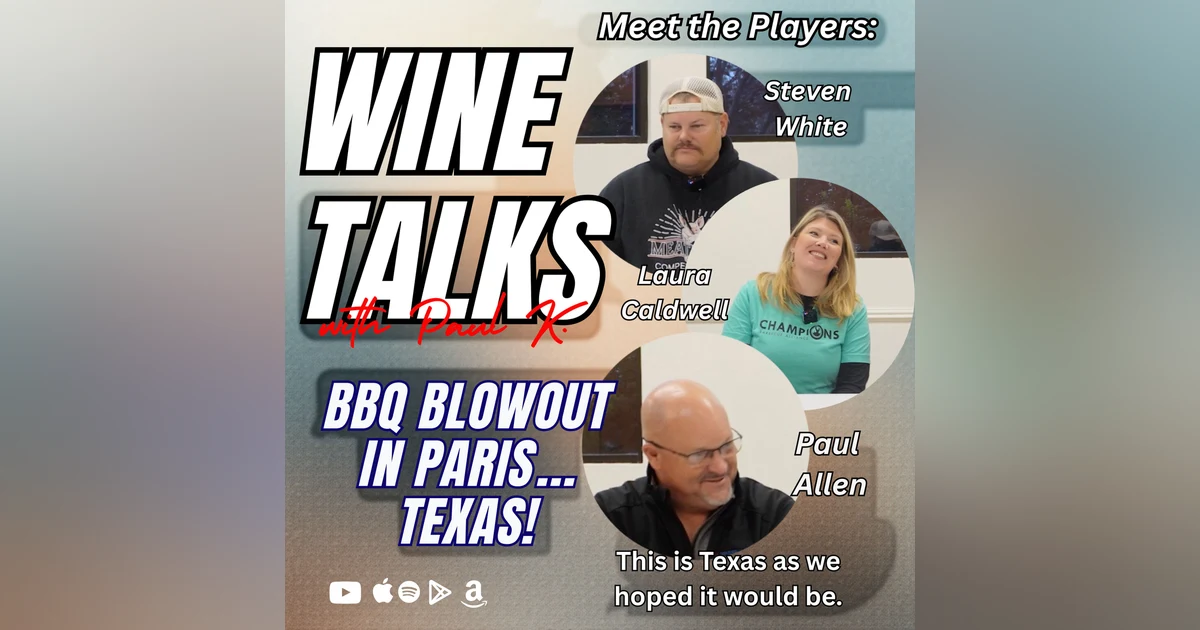

Paris.....Texas. The subject to two movies over the years, the most recent a romantic comedy. Listen, folks, this ain't no joke. I can personally attest that BBQ is alive in well in Texas and this day was a Championship Blowout.
Wine Talks was so intrgiued about the whole culture of BBQ, that we set up a podcast with Steven White, last years Grand Champion, Laura Caldwell, the representative from the Championship Barbecue Alliance, and Paul Allen, the 8 year President of the Paris, Texas Chamber of Commerce. We had a hoot.
This episode is all about barbecue in Paris, Texas, but it’s also a celebration of community, camaraderie, and a bit of competition. The host, Paul Kalemkiarian, kicks things off with heartfelt family anecdotes and dives straight into the welcoming spirit of Paris. Our guests — Steven White, Laura Caldwell, and Paul Allen — are true barbecue champions, and their love for bringing people together through food is practically contagious.
A few tasty tidbits:
-
Barbecue isn’t just about grilling meat — it’s about balance. As
Steven White
explains, the trick is not being “too sweet, not too spicy, not too anything.”
-
The competitions are run by alliances like the Champions Barbecue Alliance, who keep judging modern with QR codes and cell phones — no greasy, handwritten scorecards here!
-
Newbies are ALWAYS welcome. Veteran pit-masters love sharing tips, but the real trick is in the execution (and maybe wrangling an occasional bacon stretcher just for laughs).
-
The event supports local scholarships for kids, blending culinary skills with giving back.
Most importantly, it’s all about the joy of gathering around good food. Whether you’re debating the merits of beer, whiskey, or a surprising glass of wine with your brisket, you’re guaranteed to find laughter and friendship.
If you want more nitty-gritty details, heartwarming stories, or just an excuse to fire up your grill this weekend, this episode’s transcript is packed with flavor. Just ask if you want to zoom in on a specific part!
Let me know if you want more fun facts, tips from the pit, or favorite wine pairings to go with those ribs. I’m here to serve — lighthearted and informative, just like this Paris, Texas shindig!
#BarbecueCompetition
#WineTalksPodcast
#TexasBBQ
#FoodCommunity
0:00 I love food. I love cooking. Food brings everybody together. Food makes everybody happy, no matter what. If you have good food and you invite a bunch of people over, everybody's happy, right? Nobody's dropping in anybody if there's good food on the table. So food makes everybody happy and brings everybody together. Sit back and grab a glass. It's Wine Talks with Paul K. Hey, welcome to Wine Talks with Paul Kay. And we are away game today, way away in Paris, Texas. So see that pause there? So, yeah, comedic pause we call that. We're gonna have conversation with Laura Caldwell at the Alliance Barbecue. What's it called? Champions Barbecue. Alliance Champions Barbecue Alliance. Stephen White, last year's grand champion, and Paul Allen, president of the Chamber of Commerce. Such a pleasure to be here.
0:47 Thank you. Now, I'm here because my, my daughter had her fourth child. Congratulations. Thank you. Congratulations. Yeah. Three days ago. And so now it's a household full, right? Grandma, Grandpa got to come out. But I will tell you, they lived in New York, way north. And so it took us five hours to fly there, two hours to drive there. We're so happy to come to Paris, Texas, I can tell you. So we're glad you're here. Thank you. It's an incredible thing, but it's an interesting town. And as I drove around and we've been here now twice, and I'll come back at the end of the month is. There's such great camaraderie here, Paul. It's just amazing. The spirit, just this building alone here, the civic center, is amazing.
1:29 Where does that come from? Well, I'll tell you what, that's kind of what makes Parish special. I've lived here all my life and that's kind of how we do things. We treat our out of town guests like they should be. And like you said, there's a lot of camaraderie within the community itself, through the businesses, through our schools. And so we're. I'm fortunate to be able to live here, I'll tell you that. And you've taken eight years as a. The president. Yes, I'm. I'm coming up on eight years being the president of the Chamber. Yeah, it is. That's quite amazing. My father was president, his local chamber, we've been involved in the social clubs, Rotary, Kiwanis, Lions, all those things. And it takes. That's a lot of effort and a lot of work. It does.
2:10 But you got to have a good team. And I've got a. I've got an amazing staff and we work so well together. I'VE got great boards that support what we do. So I couldn't ask for a better. Position to be in Paris is 25,000. A little over 25,000 in the city limits, and then 55,000 in the county, Lamar County. That's substantial. My town was 25,000. I grew up and, you know, it was a hometown. It felt good. My mother was the first city councilwoman ever in my home. Oh, really? Oh, yeah. That was very controversial thing. But we're here this weekend for the. The barbecue blowout, which is a. Which is a sanctioned event from the Alliance. Yes, the Chimpanzee Barbecue Alliance. Yeah.
2:56 Tell me about that alliance. Why. How did it start? Why does it exist? Our president, Fred and our Roddy used to be our best president, but Fred and Roddy kind of, I guess, headed it up. Fred and Roddy, yes. They kind of had it in all of. They're. They're two good friends and love barbecue. And then they had some, you know, they're. They wanted to, like, give more creativity to the cookers and stuff like that. So they created this alliance. It's all electronic in the judging room, so it's all done on devices. So there is no hand entering, you know, scores and stuff like that. So it's all done. So. But you sanction events throughout the state? United States, all of the states. We have even a handful up in North, Northeast. You'll go to California, where the rookie barbecue people are. We will, but they probably like a barbecue. Our guys. Barbec. Anyway, it's totally different, my hometown. And it's really bad. Oh, is it? It's really bad. We won't go there. There's definitely different flavors, profiles throughout the United States, but we have, I think five or six now up in the Northeast, so. And that's growing. We have a really good connection up there. And he's been spreading that. That's a really interesting point. I have. Was it Paul Rain or who? The famous barbecue book guy? You heard of this guy? And I've tried some of the recipes, tried to make them work, and certainly regionality is a huge part of barbecue. North Carolina. South Carolina.
4:22 Yeah. You know, Memphis is that you guys deal with all those different regions and trying to. So the way it usually works. I mean, some of our guys from Texas do travel to those, you know, up in that area, but a lot of them are going to be locals and stuff like that. So they have their own flavor profile, and we bring the public in to judge. So typically, if we're, like, in Tennessee and Did one. Those Tennessee people would have a different flavor profile than we do in Texas. So we would use the public to come in and do it. So they're. Our goal is that the flavor profile for the public would match the cookers, kind of. It doesn't always work that way because if our guys come up there, they give them some Texas. That's interesting. What happen. With competition barbecue? What we're trying to do is build something balanced.
5:07 We're not trying to be spicy sweet, nothing. We're trying to just have a balance so that any person can come in and go, man, that's good. No matter what. That's good. No matter where you live, California, New York, doesn't matter when you eat it. That's good, that's good. It's just balanced food. It's not. You stay out of. We say it in the cooking world, we say you stay out of the twos. Not too sweet, not too spicy, not too anything. You just try to be balanced so that you can go anywhere in anybody. So even the judges. We don't know where these judges are from that's going to come in. They could be. They could be you traveling in from New York and have some friend that, hey, let's go judge this barbecue. We don't know. So it's supposed to be all about balance. What do New Yorkers know about barbecue?
5:49 And we do have some judges coming from a long way off. They're coming to spend the night, and they're going to be judging tomorrow. How do we find these judges? You just. You just seek them out, really. So you just look for. It doesn't matter if they have experience, they're on the Cooking channel or they're one of the, you know, they need. To be 16 years or older and like barbecue. Well, that's a strict. That's a strict. But that's fascinating, though, because I want to peel that back just a little bit more because there are regional differences that we just spoke about. And you're going to show up and you're going to make Texas barbecue. And you might be in Memphis or you might be in North Dakota or South Carolina, which. Let's just take mustards, for example. The mustards are entirely different from state to state. Right.
6:33 And so that balance you're talking about comes from bringing that to the table, hoping people. Not hoping, but showing people that we can make barbecue throughout the country that everybody's gonna like. That's correct. At some point. It's pretty fascinating. Some of the cookers say, like, they don't want to be. They don't want to offend anybody. They would. If you like sweet, they don't want it to. If you like sweet, they don't want it to be too spicy. Kind of like he was saying, meat in the middle. Not too sweet, not too spicy. But they don't want to offend anyone in the judging room, because if you offend somebody, they're going to dock you on your card. You're going to get it. You know, in Europe, they protect this stuff. For instance, the French protect their cheeses by region. They protect their wines, of course, is what I do.
7:16 And one of the things about America is we've sort of blurred those lines, right. You can get Texas barbecue in North Carolina or in. In New England, and you can get New England clam chowder in Los Angeles. But there's some. There's some authenticity from having it from where it's from. Right. You still have that author I see going on. So how many events do you guys put on a year now? I think we're right at the 30. Wow, that's a lot. No, we have, like, we probably have three to four a weekend, to be honest. I don't know the exact number, but we. I think we are either us at IBCA or Neck and Neck on being the biggest sanctioning body. And. And the alliance then organizes that reaches out to the Paul Allens of the world throughout the different parts of the city.
8:01 It's opposite. He goes to us. He pays us to come in and sanction it so that the cookers come in and get their points. And then it goes into a. Overall. They. They gather points throughout the event to organize the event. Let's say he's the organizer. I just kind. He just. He just pays me to run that room and make sure everybody follows the rules. Good work, if you can get it, huh? Sometimes those cookers can be a little extra, but, yes, I love it. So it's really. This is, for me, it's quite fascinating to do. So from your standpoint, you come in. You come in the night before. Yes. You jump. Yes. And this is. This is in the. Each. Well, this one's a little bit different because this one's closer to home for me. So usually we drive in on a Friday, we cook Saturday, we'll say the night Saturday and drive home Sunday. So it's every weekend. So we cooked last year. I cooked 22 events last year. So, I mean, that's one every other weekend. Yeah, one every other weekend, basically. Well, of course, Christmas Yeah. And so I. In the parking lot here, there's smokers already set up. There's big Winnebagos. Oh, yeah, Trailers. These guys are coming from all over. The country going, we have somebody coming from what, Missouri? Missouri. I'm coming from Missouri.
9:11 Arkansas. Yeah. Arkansas. Yep. Why do you do it? Let's wake. When you wake up in the morning, why do you say, I'm going to barbecue today, man, I'm gonna kick their butts right now. For me, actually, for me, it's. I love cooking barbecue, don't get me wrong, but we have a barbecue family. So this is our friends. We all cook in the parking lot together, and we all hang out together. This is our friends. So that's what we do on our weekends. I mean, we call each other during the weekend. Hey, where are you going? Where are you going? I mean, so, I mean, as ball. It's so hard because, like, for me, I'm kind of the central guy here, and everybody wanted to be clear, close to me. So it's. I just get in the middle and start stacking up from there because it's all our friends, you know, we all know each other. So it's a whole fraternity camaraderie the country.
9:57 Yeah. And that wasn't hard to figure out. You know, this is our fourth year, and, you know, I've become friends with these folks that have been here before, and I talk to them throughout the year, too. Just, hey, how things going? Congratulations on your win. And so I keep up with these guys. And so it's a. It's a special. It's a special thing. And that's why everybody comes back to Paris, because he checks on them throughout the year. He cares matter. You know, we all matter in the parking lot. So. And they take extra good care of me in here, so I get spoiled. But. But yeah, that's why everybody comes back to Paris. What about this health food movement? And I'm a huge proponent of beef. You know, protein. I a protein person. Like, I don't care about the other stuff.
10:48 Last night, all I had was protein. But is there any pushback on that? Is there any cognizance of that? Is there any sort of issue with the. People talk about this, like, wow, I'm got too much cholesterol here. And isn't that right? Isn't that the right way? Like, this is the way it should be. Like, aren't we programmed for this in the first place? They did it in old days. We ate protein, survived. So what's. What has. How Many years has alliance been around now for. We'll be pushing 4 in February. Have you seen an evolution in what. What's being cooked, the style that's being cooked? This balance you're talking about, is it changed at all? Is it. You're still sort of on the upward ramp trying to find that sweet spot. I think they're always searching. No pun intended. We're always searching, and that's the problem. I mean, that's what you get when you get off the street. Judges.
11:37 Right, so we cook the same food. Pretty much everybody out here is going to cook the same thing they cook every weekend. The judges, Are you going to like it or they're not? Right. You're either going to win or you're not. And it's really in the judge's hands more than it even is in our hands, because all the cooks are cooking the same thing consistently every weekend. We're cooking the same flavor profile, the same thing. I mean, meat. Meat is different every time. Right. So the cow doesn't walk the same or the pig didn't do the same thing every single time. Right. So there's differences in there, so you got to know how to overcome that. But for the most part, we're all going to cook our same flavor profile and hope that we turn it in, and hopefully the judges like it. I mean, that's pretty much. That's pretty much what it is. That's where it is. It's all up to the judges. It's not really even in our hands. It's up to the judges. So. No, but that's an important part of that does kind of jive with today's movement, which is you are what you eat eats.
12:25 Right. Like, I made some burgers the other night. They came out great. I grind my own meat. I blend my own blend. All that stuff happens at home, and people come over, they go, wow, this is really good meat. Yeah. Because you take a little extra care, and then you find the right beef and the fine pork, the right turkeys or chickens. So how do you do that? How do you sort of make sure you're getting from the beginning an animal that properly raised, eat the right. Eat the right thing. I mean, like, for most of these. Like, for me, I. I cook the same briskets every time. I cook the same ribs every time. The same. Same manufacturer. So I cook per. Naturals every single time. Ribs. I cook a Snake River. Write that down, pray. Fresh, fresh, naturals. I cook a Snake. A Snake River Farm Wagu brisket every weekend. I Cook the same thing every weekend. So I, I can pretty much tell you what the timeline is, when that's going to be done and what it should be at this point in time. And if it's not there, we can, I can make adjustments on the fly to get it back to where it is. So increase the temperature, slow the temperature down, whatever that is that I need to do to make that happen. So when you go to. Let's say you go to North Carolina, you're going to take Prairie Fresh Farms in the same. We would take them from here to go there because we know what we're getting here. Yeah. And the one thing I noticed too, when you're watching the TV shows, let's, let's talk about this pit master show. Is that real?
13:47 I mean, is that. No. Is that, is that just phony? I mean, it feels phony. There's some realness to it, but it's scripting. Scripting too. So. Yeah, I mean, we cook against all those guys that are been on barbecue Pitmasters. We cook against them here. There's non reality tv. Yeah. So. So the competition itself is. Is real. They really had a competition. They really turned in stuff and the judges really did pick and they really did. There was a winner and they did make money. So I mean, there was. That part of. It's true. Some of the other things behind the scenes were scripted by far. Yeah, yeah. Like if you've ever watched it, Myron Mixon is actually really a super nice guy. And if you watch it, you think he's not a nice. Oh, yeah, he's the nicest guy in barbecue. But you watch the show, you would not think that about him. But he's a super nice guy. Well, there you have it. That's scripted already. But you think of these home barbecue, home smoking systems with the little briquettes. I mean, one of my managers back in the day at One of the Month club was he. He learned how to take his Weber and snake the. The charcoal and then have the smoke every five minutes, whatever that, know, whatever. He's chuckle wood in there somewhere. Yeah, right. An overnight deal. And then they come up with these. What is it, the Brickman or something.
14:54 And they come this little disc and I mean, does that take the fun out of the reality out? I feel like this, man, you got to start somewhere no matter what. So, you know, if you don't want to stand out in the cold and, and monitor fire all day long, that's, that's, that's on YouTube. I mean, you got to start somewhere. Barbecue. So food in general, I love food. I love cooking. Food brings everybody together. Food makes everybody happy, no matter what. If you have good food and you invite a bunch of people over, everybody's happy, right? There's nobody's, nobody's dropping in anybody if there's good food on the table. So food makes everybody happy and brings everybody together. So any barbecue guy, I mean, you do whatever you got to do, make good food. People all love it. That's what it's about. It's about having friends and, you know, people that get together and things like that. So that's what you're. That's the whole thing with food.
15:40 I think that we're in the same business because wine has that same impact. And I always talk about like, if you have Jack Daniels, which is great, that's one of my favorite spirits, bourbon. American bourbon is my favorite. But that there's a different type of camaraderie when you start drinking bourbon. You know, at the dinner table, you have a glass of wine and the proper food and it changes the whole dynamic. Last night I was up till late with my, my son in law. We were just talking. We had a bottle of French wine and we just, just went at it. And we had barbecue by the chef. We were talking about, there's some local barbecue houses that, that aren't here today. But man, I thought it was really good. We were at Shoals last night and I thought the, I thought the barbecue was great. We enjoyed it very much.
16:26 So was this started like as a hobby for you or just for fun or. This whole camaraderie just started. It's definitely a hobby. It's a losing business by far. Yeah, we spend a lot of money every weekend. We travel a lot of distance, put a lot of mil on to go burn meat in a, in a parking lot. And for a judge to tell us that it's crap, that's the reality of it. This is definitely a hobby and it's. Definitely so attracting new hobbyists. How does this happen with the alliance? What do we do? Honestly, it comes with the promoters. You'll notice the cookoffs that are, I don't want to say dying, but have a lower team count are like, Paul is their, you know, they're promoters and they're giving away money. So they're there for that, but they're not there for the socializing or the promoter or the event, if that makes sense. Yeah, sure. They're just there for the money. Right? Typically with the smaller events, I would say now, the sm, the new smaller events, they're there to help grow that event. Typically, we have some back in Houston that are small, but the promoter is great. So those, you know, we're slowly growing and she's just so far away. So from everybody. But what is Today's prize money, Mr. Allen? Ten thousand dollars for barbecue and fifteen hundred dollars for turkeys, specifically because we have the National Turkey Federation as a sponsor for this. The National. There's such a thing as the National Turkey Federation? Yes, sir. Not heard about that in Los Angeles. So it
17:56 is the same organization that takes the turkeys to the White House. Really? Yes. Well, they're just pardoned recently. Yes, yes. So the 50 is for Turkey, the 10,000, it's a one lump sum deal. No, it's spread out. You know, we want. We want as many people to walk away with something as they can, and everybody understands that. But it's important to give away money. Yeah, no, I'd show up. I show up for ten grand. A slight, you know, maybe cover the cost of the meat or not. Sometimes you went out and I did it. Sometimes spread out the payout. Usually it's the top five or five or 10 today. Or top 10. Top 10. So that 10,000 spread between four places or four, 40 places, I guess you could say 10 for chicken, ribs, pork, and then brisket. So.
18:46 And does that menu change? It's always the same menu. Well, okay, so CB does have an option, I guess, for some promoters, if they don't want to do points pork, I push the pork. Because Michael Kors, they love it. And they go to the Royal in Kansas City so they get to practice their pork. So. So you walk around with like a badge. It's like you're the official and you're calling people out on. Yeah, she does rule infractions and stuff like that. They love it. They. When they see me coming on that. Clipboard, they, you know what, we're just working here, all right? I don't even have to be in a CVA shirt and they see me coming, they think they did something wrong. I'm usually just checking songs. It's really not that strict, but we do have a few roles that are very strict. So, you know, I was playing with Chap GPT before I came over here and looking for ideas to talk about it. It's so funny because it's got all this emotional strain to this whole work. And like, how do you recover from a loss? I'm like, I don't think that's really an issue here. No, no, we drink it away if they lose. If I can't win, I want one of my friends to win. That's a liar. Y. We have. I got what, we have like eight in our group right now. And I mean, I want one of my. One of my buddies to win, right? I mean, yeah, if I can't win, I want one of my buddies. When obviously I want to kick all my buddies butts by far, but if I can't win, I want one of my buddies to win. So I mean, that's kind of how we go. And we have a great. I mean, all of our. We're all tight knit, so we love it. We cheer for each other when they get calls. It is your day. It's your day. I mean, like I said, it's all in the judges, so it's. If it's your day, it's your day.
20:17 Well, I ask it for. I also was playing around because just wanted to see what it would say. I said, give me some puns to use. You really smoked the competition this time. Oh, really? How corny is that? You know, when, when in the wine world, my dad used to use this when we chose wines for our business. At the time, it was a Davis UC Davis scale of, you know, aroma, color, viscosity, all the stuff that you would try to determine why when the judges are given their. Their sheets, what's on that presentation and. Then taste and texture. So the way it works is we show them the boxes. They never get to touch them for the presentation because we don't want them to mess them up or, you know, do anything with them before the next judge gets to see them. So, like, there will be six people at a table. We'll show the box and then we'll put it back on our table.
21:07 Then the second I guess step is we would put them out on the table and they'll rotate your devices, will tell you what box you're on. And so you'll hear me in the judgin. If you're in there, like making sure the box numbers match your device numbers and stuff like that so that they're getting the right score and that's where they do the taste and texture. So that's the digital part you're talking about. It's all on the. All on little cell phones. That's incredible. Y. Is there a UPC code or QR codes on the boxes? QR codes? QR codes. That was a joke. There's QR codes on the boxes and there's QR codes, like the devices I have to set them up so it goes to that category. So when you bring your box in, you have a little team QR code and. And I'll scan that and then your box. So everything's blind on my end. That's phenomenal. Okay, so here's. Here's the. One of the things when I'm watching the Pit Masters that I conjured up, this is years ago. I don't think I've watched it in the last few years. Was I like everything hot.
22:03 Like when I go to a restaurant and I tell the chef, like some hot soup, I mean, I want the chef to go, you must be a nut. That's how hot I want it. So by the time you package up the food and you put it in the container and you rotates around, does it lose some of its temperature? And some of it. I mean, it does, but they put it in there. We have foil in the bottom for that reason, so that if it is too hot, it doesn't melt the foam boxes. There's been many times that I almost need hot minutes to show a box because they're so hot. So they're all still at least warm. We have a 10 minute before the hour window, but if I get all the trays in before that window's open, we just go ahead and roll it. So when the last box comes in, we go straight to the tables. Let me tell you what such a good husband I am. I have to do this for the rest of the world to know. My wife loves Starbucks. I mean, twice a day I miss Starbucks. And there's one here in Paris, as you know. And she wanted the little egg bites last night, yesterday morning, so I went to Walmart next door. I mean, Walgreens next door, bought foil, went to Starbucks, got the little egg things and wrapped them in foil. So by the time I got back to the house, they were still hot. Oh, nice. We do. That's sweet. That's something else. That's a great guy. Exactly.
23:16 So that's the other question I had. If. If Stephen is putting his thing in the thing and there's a bell that goes off or a timer, they. They know their time. Yeah. You got to get it in. And if. What's the. What is the leeway there? There's 10 minutes before the window. So at noon, when the clock strikes noon, you're done. The door's lock, nothing can happen. Nope. You're out. Yeah. You drove all this way, smoked all. This meat, you should have been on time. I guess. And that's happened, has it happened? It happens. People get, I mean you, you lose track of time, you're not paying attention and, and you look up and go oh I got to go. And you don't have time. I mean so here's not as bad cuz it's all closed. But I mean sometimes you go. I mean it's an eight minute walk to get to the turn in period. So you have to go, okay, I have to be ready be walking by now to get out to make that walk. You should make your plan. And a lot of cookers will walk, walk the from trailer to turn in like today so that they know they'll do it. It takes me two minutes to get to the door. Nobody runs flanker like try to get in their way. A little football move there. People run.
24:26 People, people run many times and usually we have a young lady at the door with the microphone. Like you have 30 seconds or 45 seconds or whatever. And what's the preferred beverage with barbecue? Beer. I know, beer. Okay. Or whiskey. Trying to move me into wine I guess. Wine. Oh, I don't know many. That's probably. Why would I call Paul? He goes, wine talks. Really? What are you doing out here? So tell me about the Paris community and their reception of, of what you've done with this with the show. Well, the whole purpose behind getting this started was raising money for scholarships for our local kids. And so we've really had a lot of buy in with that because it's, it's going to a great cause. I want as many teams here, I want them to have a great time. But the bottom line is I want to raise money for these kids. And, and so we've been very dose of scholarships for all of our local schools plus Paris Junior College.
25:33 And we've been very successful with that. And so we want it to continue to grow for that reason. And we'll have all of our local schools here competing against each other in their own little category starting tomorrow. And that's a lot of fun. So the schools. High schools. High schools, yes. PJC is right here. Yes, I said it right. Pjc. I thought I was going to transpose that. Yep. Who else? Paris High School, North Lamar High School, Prairie Land High School, Chisholm High School and Paris Junior College. And this is, and this is kids that are interested in the subject that want to learn from the pros actually. Just they're just getting together and cooking barbecue and the public comes out and they get to vote on who their Favorite team is. But the thing that we do is whatever money we raise, we divide it equally among all schools.
26:27 What a great community event. Yes. In camaraderie to do for the kids. My wife and I do a lot of that at our home for other causes for kids. But it's about the kids. When you're helping kids. Yeah. They must be very, very special. Yeah. Must feel very special that you do that for them, that you provide as a scholarship money to go to college or scholarship money for classrooms. Right. Where you. For college student. Wow, that's great. And so the rest of the community, they just. How many. How many am I going to see here tomorrow? You know, it varies. I think we're going to have pretty good weather. Yeah. And so I. I'm. I'm hoping that we have a great turnout, but it's been a great.
27:07 It's. It's a great event already. Yeah. Just with the number of sponsors that we have and the number of teams that I think we're going to have. So we're really looking forward to it. That was. I was. I told my wife, I said, this is a state championship. We're not messing around here. We need to show up to Paris, Texas. You know, go look at the Eiffel Tower. Right. We're here for love. We're here for. We're in for a good time. What is your involvement when you started doing this? Why did you care? Laura, I've been in barbecue for probably six, seven years, and then I just. I'm not very much of a sitter, so, like, sit down and relax and enjoy. I want to help. And just got into the judging room and started helping, and then it just kind of went from there. Were you barbecuing at home at the time? I mean, we do barbecue at home and just do the typical, you know, tenderloins and stuff like that, like. But nothing crazy. It's just being around people, to be honest. The socialing. Social skills. Social socializing is what I'm trying to say. Yeah. Just being around people and just hanging out and enjoying it and having fun. So one Valentine's, when I have three daughters, and I thought, I'm gonna make a brisket, and I went out to the barbecue and I sliced off a piece. It was unedible. Couldn't eat it. Did you use hickory? I don't remember. I don't know why.
28:32 It was really bad, and I didn't. There's no way to recover from that. Right. What do you do? I mean, what was bad? It was Too smoky. It was tough. Tough. And the flavor, maybe the. I don't know if I rubbed it, I remember, but it just maybe was the cut. So what I did was I went around the back of the yard, went to the market, got some New York steaks, came back to the backyard, put them on the barbecue, and came in as if I had just gone outside. So. But how does that happen? Like, you know, does it ever happen to you where it's just. It didn't work? I mean, it has before, yes. I mean, and it still does every now and then. It just. One of those things that, you know, it just won't get soft or whatever. Most of the time we're cooking, we cook to take a brisket almost to where it's falling apart, and. And we want to slowly just. We're riding that ragged edge of overcooked and. And. And cooked. Right.
29:26 I mean, that overcookedness is right there. I mean, so it's going to be super tender. It's going to almost fall apart a little bit on the overcooked side. But then, like you said, as we turn in and it cools down, it all tightens back up again, and you have that window of. I mean, we're walking a fine line of getting it cooked enough that when it gets to the judges, it's tightened up enough that it's still together and it's not overcooked. So it's. It's a. And what is that? Same issue with turkey. Where is it that, like, you're worried about dryness with a turkey? Oh, yeah. 100%. You don't want that. That's. That's strictly time. Time and temperature. Yeah, And. And don't overcook it. And don't overcook it. It's temperature, really. Time doesn't really. I mean, it's temperature. I mean, time. You just have to manage your time no matter what. But you. You put a probe in it, click it to, you know, where it's done and wherever you want it, and then get it out of this smoker as fast as possible. I mean, you want it to rest. And so you use digital thermometers, type things to check the dungeons. I mean, wait a minute. You know, pit masters, the guy takes his thumb, and it's just like, if. What is that? You know, whatever it feels like here is what it's.
30:29 Whether it's done or not, they don't do that. So, like, for me, I've run. I've run digital thermometers in mind, and they're just a monitor. Right. I'm just going. I'm looking for a number, like for brisket. I'm looking for 210. 210. I'm going to start now. I'm going to start feeling of it and. Okay, where's it at now? And it should be close to being done by then. There is, there is in the wine world, when you pick a grape. When. When is it. Right. What's the question? When is the food done? And there's two ways. One is the mechanical way, the technical way. What's the ph, what's the sugar content? You know, where are we at in the sunshine as far as that day of picking? But there's also what they call phenolic ripeness, which is how it feels when I touch it and when I bite it and how that. Whether it snaps or not. Do you have that sort of balance when it comes to brisket in Turkey, where you sort of. Yeah, I got my thermometer in there. But there's also this sort of natural gut feeling when I'm, When I'm cooking. You're feeling of it. I mean, no matter what you're. You're feeling of it.
31:26 And I mean that those probes are just there as a. Just a guideline. I mean, we're literally, from there, we're feeling of it, we're making sure. Okay, is it. Is it done or is it not? I mean, all the way around. I mean, and that's ever meat. I mean, chicken, you've got a probe in there. Then once it hits the temperature we're looking for, you're going to probe around in there and go, okay, everything is done. Get out of the. Get it out of the fire. So that's, you know, that takes skill. I mean, how long do you think. Yeah, how long do you think somebody has to stand over that smoker to get a reasonable understanding of where they're at? You know, the next time they do it, there's. Okay, but there's guys that hit the scene and they stay hit immediately. There's guys that hit the scene and they don't hit. They don't hit immediately.
32:10 So you either have that ability or you don't. And I don't. I mean, that's interesting. You're not going to gain that ability if you, if you don't know already, like when you've touched something. And I mean, so now there's all kinds of barbecue classes, too. So everybody takes classes. And you take a class and, you know, you go eat someone's food and then go, okay, that's really good. Now, how do y' all recreate that? And that's what you kind of do. I mean, that's really what your. The whole goal is. It's different now than what, you know, I've been in this three years. Three years cooking heavily now, and the barbecue scene has changed a lot because there's every weekend somewhere, there's a class, just about every. All your big guys have a class somewhere out there. So you can go take a class, and they'll give you all their recipes, they'll give you all their injections, they'll give you everything that they do, and they'll show you all hands on what they. What they do. And so you leave there and then go, okay, now I gotta go recreate that. But they have all that knowledge in the very beginning that, you know, back in the day, they didn't have that. Everybody had to go learn their own. Right? You have a guy that hit something, and he just, okay, he's hit a seasoning, and now it keeps hitting. Nowadays, it's not the case because everybody cooks almost so much the same food because there's so many classes and so many. Everything out there, they all learn from each other.
33:21 They're all kind of the same thing. So we're all cooking maybe a little different method here or there, but for the most part, all the guys are going to be cooking the same way. So. You know, my mom used to say, most recipes suck. Yeah, right. Like, you get a recipe from the LA Times or New York Times or the Paris Weekly. What's the name of the paper? Paris News. Paris News. And then you try it and it doesn't work. And I think that mostly because my interpretation of it, like, if I go to this barbecue class and I think I've got it under control because I have the paperwork and I bring it home, but then I try it. And you. I think you have to have the touch. You do. It takes time. Touch. You do. You do. You can give anybody your recipe, but if you can't cook brisket and you're. Not going to, I will give anybody any pointers ever. I'll tell you exactly what I do. At any point in time, you can come in my trailer and watch me all day long. It doesn't matter to me. You got to go execute it in the long run, and that's what the difference is. And. And you got to be able to overcome at times, like, you know, not all the briskets cook the same. Right? So if that brisket's not done or you're. You're following a pattern of time, and I'm looking at temperature and time going, okay, I'm not going to make it here. I'm going to have to do something, right? I got to kick my fire up. I got to make some changes so that I make turn in, right? Or. Or I had a hot fire today and burned some stuff up, and now what. How am I going to recover that? Right? And so there's some of that stuff like that. I mean, like, you get carried away sometimes, and you got probes and stuff, and you're trying to hit temperatures, and next thing, you look at that probe, and it's, you know, like pork. You're looking for, you know, 208 or 210, and you look at it, and it's 200. You look back at
34:53 20 minutes later, and it's 220. You're like, what am I going to do? You got to be able to recover that stuff. And that's where that must make the good guys good. And the other guys, they just can't do that. They just don't have that ability. And so that's where you win and lose. Barbecue competitions on the cutting board in the very end, everybody cooks the same meat. For the most part, they're going to cook the same flavor. That's not a big deal. But you win and lose on a cutting board when knowing what to do with that meat, knowing that it's too soft or it's whatever else, or knowing what to put in a box, that is your best stuff, you win and lose on a cutting board most of the time, generally. So that's interesting thought, because during the show, of course, they. They decide which steak. There must be 35 stakes on this thing. In this case, it's New York or something. And how they choose which one is which that they're going to take to the judges, and the rest are just sitting there, whatever they do with them. But, you know, it's funny, we were talking about this yesterday, Paul. There is that tonight, there's the FFA chili cook off, and I'm going to walk the grandkids down there right across the street. But one of the rules, when I read the rules, was if somebody asks you what meat it is, you must tell them, like, in other words, everything else. You're not required to talk about the spices and how you're gonna. How you prepare it, but you have to tell them if it's chuck or tenderloin or whatever. And I thought, well, that's interesting. Well, here we're talking about, you're willing to share everything with, with whoever wants to know. Yeah, it doesn't matter to me. I told anybody I love new cooks. I want new
36:24 cooks. I want to help new cooks. I have a passion for helping new cooks and get in here in the scene. Because if we don't grow our, this, this whole hobby thing that we do, it's going to lose. The older people are going to fall out. If we're not bringing new people in, it's going to die at some point in time. And you already see, I mean, we already see you go to the American Oil every year. The American Oil is the largest barbecue cook off there is and the numbers are going down instead of going up. So we are losing tread in the industry. Oh, I see. In the world. So we have to find a way to get new cooks in. But new cooks are intimidated by better cooks. Right, but you can only get better if you go cook against them. That's right. And you go learn what you're doing. You gotta go, you got to do it. You just got to go do it. So everybody always asks, you know, how do I get in there, man?
37:07 Go do it. Just go do it. Go find a barbecue, cook and go cook it. Or go find someone that, hey, can I go sit with you for a day or can I come watch you or whatever, you know, whatever you have to do, whatever you feel like is your best way to get in, do it and jump in two feet in and go for it. Because that's the only way you're going to learn. I mean, it seems like scholarships for kids at schools, bringing them in here to cook against each other. Some one of these kids or 2 or 10 or 20 are going to say, this is really fun. Yes, I had a really good time doing this. I think it was last one of the competitions. We've had a high school team come in and they competed against the big kids and they, they didn't know a lot about it. And like I know a lot of these guys and I'm like, okay, well you do brisket, so you're probably gonna wanna go, you know, over here and they'll help you with whatever. Like all we have a good. They love it when I've Ellen told em to do something in the cook's meeting. Like if I have a whole bunch of new cookers, I'm like, okay, we'll go find this trailer. This trailer, this trailer. And you know, you know, go ask them Questions, you know, if you wanna know what to put in the box or if it's sauced or not sauced. You know, all the cook questions and stuff. Cause I do the judging stuff, but I don't cook typically. So I send them out to certain people that I know aren't going to be like, no. And we've got some folks that this will be their very first sanctioned event they're excited about. I want to meet these people. Yeah, they are excited about coming. Okay, so now let's just get to the fun part of some of this.
38:35 Like, you've got all these guys out here. You get some smokers people coming in. Now, I was a boy Scout, and I'd go on a camporee and we'd hike into the Vietcong village of the Marine base or something, and then we'd all be stuck. And then you'd send out the tenderfoots to go do something that's impossible to do as a joke. They wouldn't know they're tenderfoots. They're new to this. Is there a little bit of camaraderie, sort of joking around with the newer. The newbies that come in here and they're giving something, like, I'll give you an example. One of the things you tell a kid, go get a bacon stretcher. And so they go around all the troops saying, well, do you have a bacon stretcher? And, you know, there's no such thing. I don't think I've ever. I don't think I've ever heard that. There's no, like. I think the reason why I don't do that is because the new guys are so intimidated, and they see state championship and 10 grand. Like, some of them don't come, but, like, in the cooks meeting, I'll ask them, like, who has never cooked a CBA before? And I'm like, hey, guys, if you want to come talk to me afterwards. Because some of those guys just don't want to ask questions in the cooks meeting in front of everybody. Yeah, right. So.
39:33 But I can also grab a few of the cooks and be like, okay, well, why don't you go see Stephen or why don't you go see Aaron or, you know, whoever supports Amazing. But I also know the cookers that are going to help them, if that makes sense. I know the ones that are going to turn them down and ones that are actually going to bring them into the trailer and show them how to trim a pork butt or whatever. I used to collect sports autographs. I realized there's really no reason for it, but I had a painting of Arnold Palmer and I actually went to a golf tournament. Arnold Palmer was there. He happened to be standing right in front of me and I had this painting and he signed it me for me. And the artist told me, he goes, if that was Jack Nicholas, he would have sliced it with a knife. Yeah, he would have not supported an autograph like that. So tomorrow night you're gonna.
40:15 Tonight, you're gonna meet here tonight. It's tonight. We're gonna be in here. Yes. So what's going to happen in the, in the, the grand ballroom here when all the chefs come? What, what are the. What's going to be laid out for them? Well, at 5:30, we have a rip cook off cooks meeting in the judging room. Just, it's a, it's a fun cook. A fun little rib shootout on tonight. But after that, Paul and his amazing team, they feed us burgers and hot dogs and stuff like that. And then in the main ballroom and then we do the cooks meeting. I thought maybe like quiche Lorraine or. Some kind of food. He's brought in some pretty cool people though, on Thursday nights before. So. So you lay out the rules. What do you, what do you do? Yeah, that's not. And it's just like a meeting people.
40:59 Yes. Questions. They ask questions. Some of them will get their boxes. Paul tells them thank you for coming and tells them what we're here for. Like, we're raising money for the kiddos and stuff like that, so. But they all love Paul. Everybody knows who Paul is. We have guys that'll come up and just pop ups and drums. Like not even have somewhere to stay. They'll sleep in their trucks. Because he's, he's just. Because we don't have room in here. We'll take care of them. We do take care of them. We usually. I think last year, one of the years, it was raining really bad and we found like the walls for their canopy, because they didn't have any walls. We found some from other cookers and helped them have a little bit of a shelter while they're cooking, you know, so. Wow, this is this really quite warming, you know, the camaraderie and the sense of family. I feel like that's the whole point of it really, to be honest. Raise money for the kids and have fun and do all that.
41:48 So. Well, this has been fascinating for me. We're already at 45 minutes, if you can believe that. It goes quick sometimes. And so I wish you all the luck. Tomorrow we're looking forward to being here and bringing the grandkids. Kitties. Kitties are free. As Paul put it on a text, they need that much barbecue. My wife and I and my son in law will be here. We're looking forward to just chewing the fat, so to speak. That is not one of the puns that was on here. Cheers. Thanks for coming. We're glad you're here. Thank you for having 100%.