

 Apple Podcasts

 Spotify

 Youtube Music

 RSS Feed
 YouTube
 Pandora
 iHeartRadio
Behind the Bottle: Wine, Humility, and Inspiring Stories from Rome to Texas
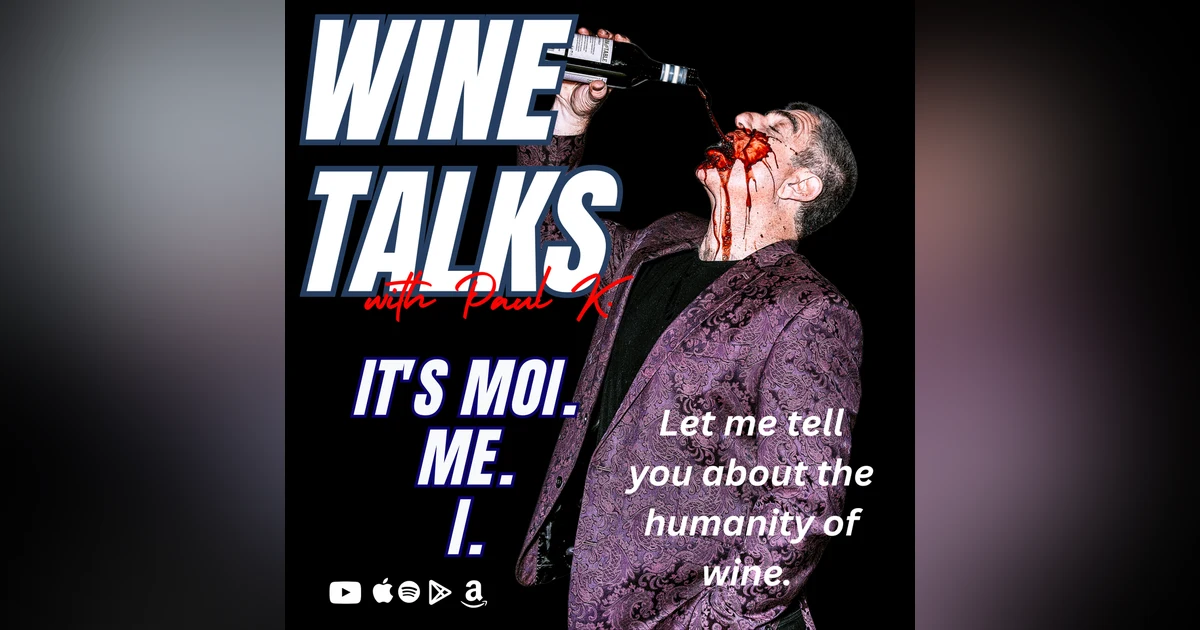

Wine is about the humanity. This concept hit me on a flight home from Rome. I was watching a movie and started to weep. I realized the human soul needs passion, passion forsomething; maybe another person, maybe a lifestyle, maybe a career, but passion drives our will. And wine is full of passion. To do it right, it takes nothing less than passion.
Hey there, it’s Paul Kalemkiarian on Wine Talks, and in this episode, I really wanted to get personal and share how deeply humanity and humility run through every thread of the wine world at its highest levels. I open the show reflecting on a profound sense of gratitude after tasting with some top producers—it reminded me why I’m passionate about this podcast. Wine isn’t just a commodity to me; it’s an expression of earth, spirit, and story, and the purpose of Wine Talks is to spread that message.
I also let listeners into my own little world, sharing that I’ve tasted 100,000 wines over the years and even built a comprehensive database (and now an AI-driven app) to catalog all these bottles. It’s quirky, but it keeps me grounded in what I love.
Then, I shared a special moment from a recent trip to Rome, where I had the honor of attending the Vatican for the canonization of an Armenian archbishop. It was a powerful experience—full of history, pageantry, and meaning. Of course, the promised “private audience with the Pope” wasn’t exactly one-on-one selfies, but still, being there among so many was remarkable.
The journey continued to Puglia in southern Italy, where I managed, despite short notice, to meet with Mark Shannon of Amano wines. Mark’s story resonated deeply—an American winemaker settling in an up-and-coming wine region, driven by pure passion. We recorded a heartfelt conversation, shared great food, and I came away reminded how wine connects people at the most human level.
On my flight home, I got unexpectedly emotional watching Top Gun: Maverick. It hit home how we all seek passion and escape—sometimes in movies, sometimes in travel, sometimes in wine. No matter our circumstances, that longing for meaningful off-ramps never goes away.
The show then explores not only the artistry and soulfulness in winemaking, but also the nuts-and-bolts of the business—from manipulated supermarket bottles that miss the mark to innovative new packaging concepts, marketing strategies, and the challenges faced by artisans like Mark Shannon trying to access the U.S. market.
I shared anecdotes about recent guests—a geophysicist connecting volcanic soils to wine character, a business-savvy marketing pro, and other passionate personalities in the wine world. I reflected on the fascinating diversity of experiences, from NBA stars getting into wine to trailblazers supporting Armenian wine in the global conversation.
In the end, I emphasized why I do this: it’s for the humanity, the stories, and the connections that wine brings. My hope is always to bring listeners closer to the heart of wine—whether it’s a legendary Bordeaux tasting or a birthday party at my own home. It’s all about sharing, learning, and feeling something real.
Cheers to the humanity of wine—and thanks for joining me on this episode of Wine Talks.
#winepodcast #WineTalks #PaulKalemkiarian #winetrade #winebusiness #winetasting #humanityinwine #PugliaItaly #Armenianwine #Bordeaux #NapaValley #passionforwine #storytelling #volcanicsoil #winemarketing #appellation #Primitivo #Zinfandel #winemakers #wineculture
0:00 The unifying thread of all the people at this level of wine production was the humanity of it, the humility of it, the, the fact that you don't control it, the fact that it, you are given from God, from the soil, what you put in the bottle. And I left this tasting with this really warm sensation in my heart that I was in the right place at the right time and the right trade and the right expression of humanity to share with the world. And this is why I do this podcast, this is why Wine Talks exist, is to share this humanity. Hey, welcome to Wine Talks. This is Paul K.
0:45 Yes, I am the guy. I am the guy, you know what I'm saying? Tasted a hundred thousand wines in my career. And I'm going to show you guys one of these days in one of these episodes how I created a website and now an app on my phone to keep track of wines I've tasted on and off site. There's about 60,000 wines in the database that I use since 1993. And then there's about 40,000 wines that I tasted off site at trade tasting is the one I'm going to talk about here in a little bit. And then now when I go to dinner or go to Europe, I was just back in Rome. We then I have an app on my phone that I created an AI that allows me to keep track of the things I've tasted on the road. And it's quite voluminous already, which is pretty interesting.
1:36 But on the way home from Rome, yeah, we went to Rome and we were invited to meet the Pope. At least the agenda said private audience with the Pope. Well, let me decode that for you. We did get VIP passes to the canonization of an Armenian archbishop from the 1900s, early 1900s, who was martyred during the Armenian genocide. And when the Turks took over, they insisted that the Armenians change their religion to Christianity, I mean, to Muslim Islam. And this bishop archbishop refused and so they martyred him. And so the Pope decided to, at this stage, canonize him, which makes him a saint. And so we had the opportunity to sit very close to the Pope as he came out of the Vatican. This incredible amount of pomp and circumstances and the entourage of cardinals and archbishops and bishops, it's quite fascinating and quite honorable to watch.
2:43 And so then the next day, our agenda said private audience with the Pope. Now that sounds like to me, we know we're doing selfies and high fiving. However, I decoded this and what it means is when on Wednesdays, every Wednesday, you can have Quote, unquote, an audience with the Pope. You can Google that term audience with the Pope, and it'll tell you that that means on Wednesday he comes out, I think it's the whole balcony scene that he does and greets what would be 100,000 people or more. Now, when we were there for the canonization on Sunday, we were in this VIP section which were probably a few hundred people, but below us in the square were a hundred thousand plus people. And let me tell you, it takes a long time to disperse that many people by foot because there's no Uber coming in to get these people out. And so that in itself was a great and interesting experience. However, the private audience with the Pope means. And this was for the people that attended the canonization of these five or seven martyrs. There were different countries. There were two Venezuelan martyrs, there was one from Spain, I think there were a couple others. And so everybody that was invited to that VIP type reception was told this is a private audience with the Pope. Audience, meaning he'll greet you, but as he does Wednesdays private meeting,
4:17 6,294 other guests that he was having a private audience with. So that part was kind of interesting. There's this beautiful hall called the Paul vi, I think, and that's adjacent to the Vatican. And we all muscled in there and then he came out and gave a, gave some prayers and things for about an hour and then he left. Oh, but all in all, an incredible experience to, to witness Rome is really cool. You know, of course, all the ancient Roman ruins as well as the, the shopping and the food is excellent. Then we went off to Puglia, Italy. And this is part of the conversation here last minute. You know, in Europe, typically when you want to schedule a meeting with a winery or a. Do a podcast like I was willing to do, you know, they like a little bit of notice, you know, three to six weeks, particularly of the big houses. You got to coordinate with the local representative that handles the wines here in Los Angeles. So it takes a little bit of time. But in this case I didn't have the time because our, our invitation to see the Pope was last minute and we able to organize a trip out there.
5:31 And so what I did was I looked at my database, the one I was talking about, of all the Puglian wines I had tasted, which were hundreds. And Puglia being the part of Italy that's above the boot, you know, the heel of the boot. And it used to be sort of a jug wine area, not unlike, I don't know if Lodi would be the white analogy. Early days of Lodi, you know, a lot of good juice coming out of there, but none of it was sort of earmarked for the Pulian appellation. But that's changed and now there's some very, very fine wines coming from the area. The grapes are Primitivo, which is Zinfandel style, if not DNA wise, Zinfandel Negro Amano, which is a great grape that makes a wonderful fruit. Forward wine, but dry. This Fiano is a white grape. Wonderful wines. So I looked at the database and I found some wines from a winery called a mono a space M A N O meaning by hand in Italian. And I didn't know, I didn't know the winemaker at that point. I just saw them in the database and I liked the wines and I remember, I remember tasting them, but I emailed people that a gentleman, you may remember, his name is Vahe Kashkarian. He is a winemaker in Armenia. He makes sparkling wine there, called a few other brands. But his first job before he ended up in Armenia was at Puglia.
6:54 Tim. Hey, Vahi. Do you have anybody invite Mark Shannon on a wines? All of them moved to Italy 30 or 40 years ago, fell in love with a Sicilian woman and. And they moved to Puglia, a little town called Noche, and they started Amano wines. And so there's a lot of pieces to this that make it really interesting. But the podcast is out now. It's really interesting. He's a brilliant guy. It's pure passion and that's what this conversation is about. So I, on the way home, really happy with the, with the podcast. He brought in lunch for my group with six people with us all, all together, and we had a nice conversation on the podcast. And a poolian, typical poolian lunch. And on the way home from Rome, I watched Maverick, you know, the, the Top Gun, Maverick with Tom Cruise. And I was crying. Now, maybe because of my old age, I'm more emotional about stuff like this, but it wasn't about that. It was.
7:56 I was sort of watching the acting and I was, you know, and Val Kilmer, who was really sick at the time, and they got him to get some screen time to move the story along. But I realized that everybody wants a departure from their life. Like, we want an escape route. We want an off ramp sometimes. And for us, my wife and I, traveling is part of that off ramp. Because the minute you get back, as you all know, you are like overwhelmed with things you didn't get done. When you were gone. And things that you got and pick up where you left off as well as catch up where you left from, what you didn't do. And so this off ramp sometimes is in the form of a movie or music, but it's passion. We all want to feel some passion. You know, the, the part of one of the sub stories of Maverick is his reconnecting with an old girlfriend and she now runs the bar and she's very hardcore in the beginning and of course they fall back in love and, and he realizes at the end that his life needed to be around a woman. And this part of the passion of the show is really intriguing to me and made me think about this concept of it doesn't matter what economic stratus we are.
9:15 Doesn't matter, you know, if we barely get along and we're living paycheck to paycheck, we still want that off ramp. We still want passion in our lives. We still want to feel human in our lives. And if we have lots of money and we can spend on anything we want to, that doesn't substitute for the need for passion. It won't. It can't. And I don't mean passion romantically necessarily. I'm just talking about something that is diverting from our regular daily lives. And, and I take that concept and I apply it to this tasting. I went to on, on, On Saturday or Thursday? On Thursday it was called the, it was called the Du Rive, which is the Two Rivers. And so it was all Bordeaux, but it wasn't just Bordeaux, man. I'm talking about Mouton Rasheed, we're talking about Chateau Bailly, we're talking about the Pichon Longueville, I mean, the great houses of, of Bordeaux, both right and Left bank. And at this crazy place called Mr.
10:17 Brainwash Museum on Beverly Drive in Beverly Hills. I don't know what the, I really don't understand what it is because there's these giant basketball that's taller than me. There's a Mac computer that's taller than me. There's a matchbox car that's a full size car, you know, in the matchbox box. And I'm not sure what it is, but it's a really fun venue for wine tasting. And when you sit and you talk to people this level, and one of them was Christian Moex. I'm gonna put a picture up on LinkedIn pretty soon, or social. And I, I, I mustered up my best French and I was actually really proud. And I was hoping my dad, you know, I wish My dad could have heard, or I could tell him the story about being able to speak French to what would be considered one of the top five wine people in the world. I mean, this guy owns Chateau Petrus and all these other vineyards and he's just well respected. But that's not the point. The humility that this gentleman had in Veronique Sanders Van Beek of Chateau Bailly and, and the woman at Mouton Rocha, the director, Mouton Rothschild. I determined that at that level of wine, it's purely about the humanity of it. Yes, we have to sell wine and Bordeaux in a different difficult position.
11:38 The wine industry is that way. And I'm not a doom and gloomer, so I'm not going to get to that point. But, but clearly the unifying thread of all the people at this level of wine production was the humanity of it, the humility of it, the, the fact that you don't control it, the fact that it, you are given from God, from the soil, what you put in the bottle. And I, and I left this tasting with this really warm sensation in my heart that I was in the right place at the right time and the right trade and the right expression of humanity to share with the world. And this is why I do this podcast, this is why wine talks exist, is to share this humanity. Now I also try on the podcast to show you different perspectives and I'm going to go through a list of people have been on the show recently to understand, like, it's not just about that, right? There are, there is the business side of wine, which is a very important side of business, very important part of the business. Wine is consumer driven. We, we, we want to produce what people want. And that's the interesting part. Like, you can go to, like you, when light beer first came out 100 years ago, you know, basically they took that old marketing cross and they put like heavy, light, you know, low alcohol, high alcohol, whatever the parameters were, and they just, oh, Bud Light fits.
13:08 I mean, Budweiser fits here and Corona fits here and Guinness fits over here. And they go, oh, yeah, we should make a light beer. That's basically how it came about. And that was consumer driven. So you made what the consumer was looking for. You don't, you can do that with wine. And that's what you see at the market. Which leads me to another story. But wine really is the opposite of that. Wine is you. If you're expressing wine properly, then you are delivering to the bottle of what was given to you by the land. You don't get to play with it. You shouldn't play with it, at least at that level. And so the consumer then has to learn and understand what that vintage was about, what that soil was about, what that weather was about, what that those grapes were about when they were. When they were harvested.
13:56 I'm going to touch on that story really quickly before I get into this list of guests. Right after Rome, we landed, waited three days, and we went off to Paris, Texas. Now, have you probably heard of Paris, Texas? It has an Eiffel Tower, actually, with a little cowboy hat on it. To me, it was the expression of rural Texas lifestyle. First of all, coffee's like a dollar 85 and gas is two bucks. Okay. Just so you understand, I almost filled up the rental car just for the fun of filling it up, because I wanted to see the number go be so low. But I had paid the gas. I had paid Hertz for the gas already anyway, so I didn't do it. Paris, Texas, got a cute town. It's been through some major devastations. Had a big fire in 1916. They've been. Is it part of Tornado Alley? And my daughter lives there now with her husband. He's running a church, an Anglican church there. I had this. It's a dry county. We haven't figured it out yet. I got to figure this out. But it's dry and there's no liquor stores, but you can go to a bar and have a drink. And so we stopped at Whole Foods on the way in outside of Dallas to pick up some wines. Okay. And Whole Foods or Trader Joe's, doesn't matter. Supermarket doesn't matter.
15:09 And so I'm an educated buyer. Right? Seriously, I did taste a hundred thousand wines and have continued to taste all the things you see on the shelf. So I understand if I look at a label, what it's telling me. And I did the best I could to satisfy the palate of my wife, who loves Bordeaux and California cabs. And I wanted a couple Pinot Noirs. And I have my districts in Sonoma and Napa that I like in Pinot Noir. Russian river being one of them. Petaluma Gap, which they didn't have. And they all sucked. I had to muscle them down. And that is not the way you should drink wine. But. And I don't mean they sucked and that they were bad. I mean they sucked in, that they were manipulated. There was one Bordeaux at the end that was still. That was dry and had some character and complexity. It was not high in residual sugar. What they Call rs. And so I, and, and I'm looking at my son in law who loves tannat and Beaujolais and, and interesting varietals from around the world, prayer at Spain, you know, things like, things wines like that. And he looked at me like, like, what is wrong with you? Like we sent you to the market to buy some wine. And he came back with this. And I was so distraught over that, this idea that I couldn't find a wine I liked. And so that sort of leads to the expression of wine as it should be from the vineyard vs expression of wine that the consumer is
16:41 expecting. And so what I bought was what the consumer's expecting, which is a perfectly legitimate fine part of the wine business. And what I didn't get was what the deli, the vineyard would deliver otherwise to a fine wine that is made to what is given, not to what the consumer is expecting. But so what I'm trying to tell you is that in the Wine Talks I like to show you all points of it. So I'm not going to just show you the people that are passionate about wine and bring the humanity to wine in the soil. I'm going to also bring you the periphery people, the people that are doing things in the wine business to sell more bottles and to attract a consumer. Just saw a post today on LinkedIn where, you know, imitation is the best form of flattery. Somebody posted that they had created this 1.5 liter bag in the box wine and then one of the big suppliers in California just copied it. Almost looked identical. It was the same idea. And so this was a complaint, I guess, by the person who posted. But you know, it's, it is what it is. This is what consumerism is. That's what marketing is. One thing about social networking, it's instant, right? So if, if I'm a marketeer and I'm trying to sell wine or I'm trying to sell widgets and I see my competitor selling a widget and he does something, he or she does something on the Internet, on social, and it works. I can do the same thing the next day. Used to take, you know, weeks, if not months to copy advertising and make it work. Now you can do it literally at a moment's notice. So the idea behind Wine Talks is not only
18:14 to express wine as a passion and a sense of humanity, it's to also show the business sides. I mentioned Mark Shannon, an expat from, from America, had gone to UC Davis, fell in love with a Sicilian woman and creates Amano wines. Now what's interesting about him besides the fact he did not go to Milan, I mean not Milan, but to Tuscany or to Piemont to make Barolo or to make Tuscan wines like Chianti. He went to Puglia and this was an unknown district, particularly 30 years ago when he started Amano. And I thought the wines were gorgeous and structured and expressive of where they at. And he was very passionate about what he's doing. But he pulled all his Wines from the U.S. how about that deal? So I can't even get them. And last time I tasted them was 2020 and so that was five years ago. They're gone now. And what? Why?
19:11 Why? Well, it's hard to do business in the US and it costs money and it's congested and our distribution network's a mess and we have three tiers. You got to go from supplier to distributor to retailer to consumer. It's a. It's a freaking nightmare. And so he decided to live without it because he wanted people to buy his wines that like his wines and not worry about the business side as much. And it's harder because sales are off in general for wine wineries. But you know, he just backed out thanks to our gooberment. Gooberment. I just had Barbara Gorder on the show. Now you want business side of wine. This woman was brilliant, educated and brought to the wine trade marketing skills from Leo Burnett, which was a very well known firm in the marketing world. And she had brought non wine programs and experience to the wine trade.
20:10 And she and I saw most things the same way, but not everything. And I like that. Let them challenge me. I've seen a lot, sold a lot, drank a lot, you know, the whole thing. So I think you find her interesting. Barbara Gorditch it will be released Tuesday. I had Diana Kandylian on the show. She's an Armenian who is a PhD in geophysics. Now here's an idea that I thought was interesting and I brought on the show because I saw something she wrote about volcanic soil. And now, you know, one of the great aspects of wine that's being touted is not only volcanic soil which creates this amazing complexity in wine, but altitude.
20:54 You know, Napa is like at 6 or 700ft above sea level, right? Not very much. I grew up on a cliff in Palos verdes. We were 300ft above sea level. I mean the like I can hit golf balls into the ocean. So that's really low. And there's some of the hills and mountain of. In the mountainsides of Napa are Different. But you know, Armenia has, you know, you start at like 1200 meters or like 3000ft or a thousand feet. I mean it's very high, 2000 to 3000ft. And so that creates a different character of grape. So Diana Kandelian, who is by trade a geophysicist, has fallen in love with the asp with wine and because of its of her industry's influence on wine. So really interesting take on that part of the wine business.
21:43 I also had Abby Boy Bogle on. She was fascinating because she has come up with a methodology and here's the business of wine where a 750 milliliter bottle, which is the standard size for a wine bottle is being not say replaced re examined as a size. And so she created a company called Small Lot Bottles which gives wineries the ability to not only put it in half bottles or some other vessel, but like a test tube test, 100ml test tube. So what's 100ml? You know, we have to deal with the ounces versus versus metric all the time. But if you think a 750 milliliter bottle is about 25 ounces, then 100 milliliters is going to be, you know, what's that?
22:39 I can't calculate my head, but it's going to be less than a glass worth of wine. If the average glass is 5 ounces, the Hamilton is probably going to be 2/3 of that. But it's working. And you know, there's all kinds of labeling requirements when you do this and all kinds of headaches. But she's figured out a way to do short runs for wineries that want to expand their packaging offers to their clients. Which means, you know, there's a company out there that sells, you know, test tubes of wine so you can taste it. If you want to buy more of it, then you can buy it. You can buy it. So it's really interesting stuff. That's Abby Boyle Bogle. I had Tony Biaggi on the phone on, on a podcast live in his tasting room in Napa Valley downtown. Beautiful structure. If you go to Napa proper, the, the town of Napa, there's a wonderful building that's a Robert Mondavi tasting room and that he makes wine for Tokalon to Cologne. I didn't even, I didn't even realize till I spoke with him how important a vineyard Tokelon is and his refreshing outlook on wine.
23:43 And the, I'm gonna say pressure, but the honor it is to create wines from this vineyard that's such an iconic vineyard in California and of course the Napa Valley. That's Tony Biaggi in studio here. Right here on this thing, I had Kelly E. Carter. Wow. Wow, what a fascinating story. And she is the president of Noir Napa Noir and she does touring, high end touring in the Napa Valley for, for anybody. And she, but she was the lady in the locker room for the Lakers and an award winning journalist who wrote a book with Venus Williams called Come to Win. I just got my copy. I'm going to start reading it soon. But what a fascinating story and how she came to wine. So she had nothing to do with wine. She was a journalist. She was, you know, you know, particularly in basketball, the NBA is big on wine. There are great stories about many basketball players that are actually like, Dwyane Wade has his own brand.
24:51 You know, these guys, they're, they're in, they're in the mix of making wine. And it's a very important part of the subculture of the NBA actually at this point. And so she, she came in to talk about that. It was really great. Kelly E. Carter. I had Zara Muradian on the show and you might sense this Armenian link, right? Handelian, Muradian, Kushkarian, Kalamkarian. Zara's a pioneer in wine trade. I had her husband on the show then I had her on the show and she's up now on the, on, on the podcast. But why, why, why?
25:32 She was able to induce Concour Mundial de Boxe, very famous wine tasting from France, Brux, Brussels, Belgium actually, but all French. I don't know if you know this, but the Belgium, Belgium native language is France is French. And so in May next year there's going to be a convergence of like three or four hundred judges, including Moi, to taste through five to seven thousand wines all over the world. Wines, not just the Armenian wines. But she was the instrumental being with the vine and Wine foundation of Armenia, which is the government arm of wine trade, to organize the, the tasting to be in downtown Yerevan, Armenia.
26:21 That's huge. I mean that is huge because the Armenian wine industry is trying to get itself a foothold in the world. Wine trade is very hard to do. You've got unusual districts, you've got unusual grapes in a place that no one knows about. And so she was instrumental in making the world know about the Armenian wine trade. So that happens in May. I'm going to be there, going to be judging. I'm hoping to put together many, many podcasts and or a TV show or two on various characters that make this happen in the wine business out there. So a lot going on now, the least of which is my grandson's 8 year old birthday party tomorrow night at my home and we have about 100 people coming and I've got to figure out what cocktails I'm going to make.
27:12 I've got a really cool bar there that I built. Looks like the Jetsons would live there and we're going to be pouring some pretty interesting cocktails and wines. So that's, that's today's conversation and needless to say, this is all about the humanity of it all. That's why I'm here. I would love to produce, you know, a fancy wine or a fancy brand or a fancy character that the gen Zers would love and everybody would, you know, fluff fawn over my marketing prowess and all those things but it's not why I do this. I do it for the humanity. I do it for the storytelling because it is about the story. Cheers.