

 Apple Podcasts
 Spotify
 Youtube Music
 RSS Feed
  YouTube
  Pandora
  iHeartRadio
 Champagne Rebel: Marvina Robinson Pops the Industry’s Bubble
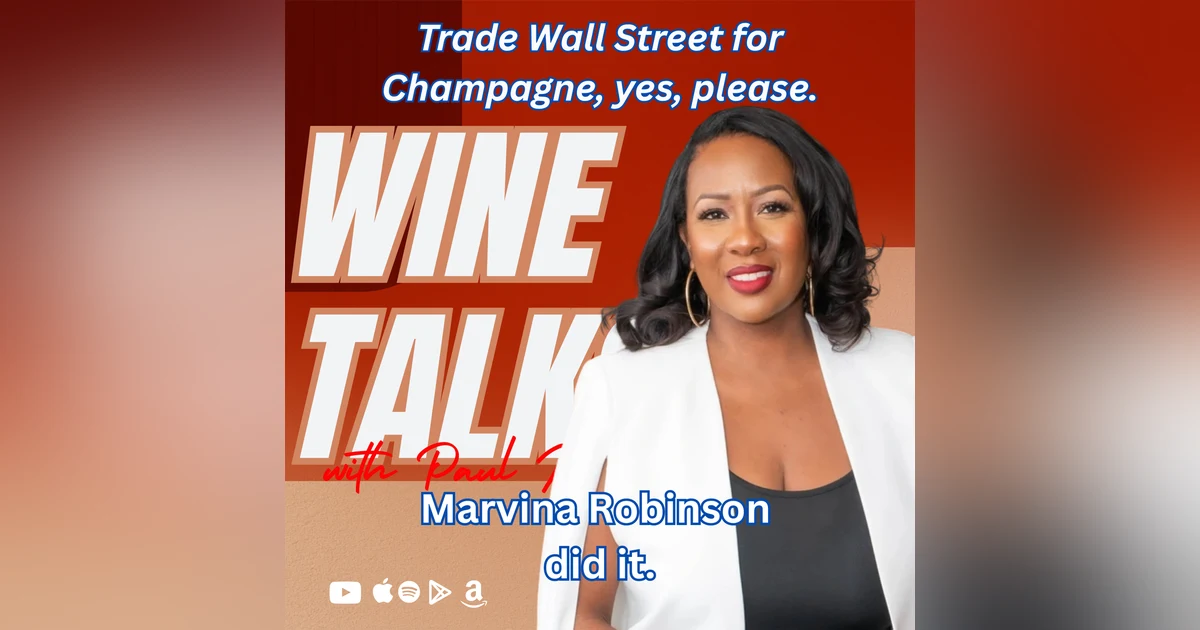

0:00 How can you not love champagne, you know? And it's just, it's a story itself. And I feel like anytime I enjoy it, whether I'm happy, sad, whether it's business, non-business, it's just something there for me. Like I keep a journal of all the bottles that I drink. I go back and I make marks so I can see which ones I've been drinking the most. I have some favorites and I just love the whole process. It's like nostalgia to me. Sit back and grab a glass. It's Wine Talks with Paul Kaye. Hey, welcome to Wine Talks with Paul Kaye, and we are in studio today in beautiful Southern California. Actually a little rainy today in Monrovia. About to have a conversation with Marvina Robinson of Stuyvesant B. Stuyvesant Champagne. Introductions in just a moment. Hey, have a listen to Stephanie Franklins— that's plural. They're both members of the Association of African American Vendors, and they both have a different plight in this industry.
0:55 One of them is producing wine, or going to produce wine, in a little town called Shankleville, Texas. No one's ever done this before. An amazing story. She's calling back to her roots to go do this for her great-grandfather. As well, another Stephanie Franklin who just started a brand called Fly Wines while she's sitting around at a bar with a friend, decided that corporate America was no longer for her and bit off, uh, starting her own company. Not unlike Miss Marvina Robinson, who we'll talk to today. Hey, give me some good reviews and subscribe. That's how it's egotistical podcast to stay in business. We appreciate you listening today. Today we have Marvina Robinson from B. Stuyvesant.
1:37 I want to say it like the French would say it. That's the problem. Right? B. Stuyvesant is how I pronounce it. Okay. B. Stuyvesant. It's named after my neighborhood, so I go off of that pronunciation. And this is, this is a champagne brand, which is an amazing story. We'll get into that in just a second. But you call yourself the CEO, CEO, chief bottle washer, whatever you call it, right? You're running the show. Yes, I am the founder and CEO of B. Styris and Champagne. And how long— Go ahead. I mean, we all know, you know, as entrepreneurs, we take on all these roles. But you were not always doing this, getting into this trade. You were in Wall Street, I think, right? Yes, I worked on Wall Street for 20 years.
2:19 It was a great career for me. You know, I just began to change loves probably in the last 5 years. Champagne was my hobby and I would go back and forth to France to kind of like explore Champagne. I really wanted to know more about Champagne. I always believed you have to immerse yourself in the culture. So I just started doing that. And you can read as many things you want on Google, whatever classes you want to take, but it's nothing like being hands-on and in the culture to really learn and understand. And that's basically what I did. And long story short, we can get into the long later. I just decided to take a risk for myself and start Beast Iverson. And what people, some people may not realize is that this was not originally meant to be for retail. I was really opening up a small champagne bar to introduce a lot of grower champagne, which I find such, so beautiful. And that's when I was going back and forth to France. I would've searched these brands. And I still do.
3:18 And I was going to import them over, which I still do. I import over small batches. I help people build, help clients build out their champagne portfolios. People are looking for something different. It's like still my hobby. And B. Styrocent was going to be the house brand of this small champagne bar. COVID came, had inventory, and it went into one store. From there, it just grew on its own and that is the business, became the business. And what I decided to do is, because I only launched with 2 cuvées, I decided that I actually now then wanted to actually build a full portfolio for the business. And that's basically what I've been doing over the past couple of years. Did you have any wine experience prior to this? I mean, like, you just used the word cuvée, which is certainly a wine term. But when you ventured into this, did you just start from scratch or you just had an appreciation for bubble tea? And so I would, I basically started, when I started going back and forth to France, I just started picking up the language and understanding it a little bit better. I call myself Dora the Explorer. When I want to learn something, I like go in my rabbit hole. So I just learn and I adapt it. Like I think, prior to launching the establishment, my wine knowledge wasn't, I wasn't like up to, I wasn't a big wine head. I always liked sparkling. So original story is how I really came to
4:51 Champagne. My girlfriends and I, we would come, you know, in Brooklyn, hang on a stoop, and we went to different colleges. And what we would do was to catch up, we would get a bottle of Champagne, we'll share it. Couldn't really afford it, but we'll share a bottle. We had plastic cups and we'll just sit on the stoop talking, catch up. And then one time I remember one of my friends, we were in a store together, we were like, oh, we could get 3 bottles of these instead of versus 1 bottle. And unfortunately, that's exactly, that's how I started like, what is the difference between the two? And I'm like, okay, this brand versus this brand versus this brand. And lo and behold, I said, oh, this started sparking my interest, and slowly but surely, I actually decided to do the research. It's kind of interesting you said that because the story you just told is very similar to Tilar Mazio, who's the woman that wrote Widow Kliko, who's now— now it's a movie. I'm sure you're familiar with all of it. Yeah, I haven't seen it yet, but I've heard of it. Well, I did notice that at least so far, the picture they use of the woman they use as the actress is much better looking than the actual Widow Kliko.
6:00 I know nothing about that. It says she's passed away. I guess I can say that. But no, the story's interesting 'cause there, it was friends getting together, sharing a glass of champagne, and then peeling back the story a little more, a little more, trying to figure out what this is all about. And then landed in, in her part, she actually started making wine, sparkling wine in Vancouver Island in Washington. But you know, it's kind of interesting that wine does that to you. that you're with your friends, that you're having a glass and all of a sudden— Yeah, it's just something amazing. I get this feeling like, first of all, I only drink champagne, right? I don't drink liquor. I only drink champagne. You go, girl. I don't drink the other sparkling stuff. I mean, unless I absolutely have to, if I'm like at an event or that's all they have, most of the time I'll forego it.
6:47 Sometimes I'll just hold it and take a sip if I really feel like I need— I want to take a sip of something. So I have an expensive habit, as people say. But it's just, it's something so celebratory. I hope I said that right. Celebratory. That's my tongue twister. You got me stuttering. That's my tongue twister. What's the word? It's something such an amazing feeling to like open up a bottle of champagne, you know, grabbing a bottle, unwrapping the foil, twisting the wire cage. You know, we got 6 tourniquets. 6 twists to it. Having your thumb securing the cork, turning from the bottle, hearing that little psst sound, and then knowing that one bottle of champagne takes over a year to make, and some take significantly longer. So it's not produced where you can just go, like how soda can just go be pumped into a bottle. It's such a labor-intensive wine, and to appreciate it, you know, as it's poured, and why not?
7:46 You know, that's a really interesting thought I just— that you just brought up because it's really important, particularly for listeners and people that are, you know, that are dabbling in wine, that want to learn about wine. You're— yes, I taught my son-in-laws the concept of Champagne and the value of that glass. And now you're right, it's costing me plenty to keep stocked in what I serve at the house. Mm-hmm. And it's an interesting thought because just the the mere— boy, we're both having trouble with the words today. The sheer aspect of making honest champagne, real champagne from the Champagne district with the proper riddling and the proper aging and the proper cuvée automatically qualifies the wine for what I call honest glass of wine, which is not played with, not doctored up, not the stuff you see on the shelf at the market that's got sugar and acid and all the things they add to it so that has a profile that's similar to the previous year's profile. Champagne is really by trade an honest glass of wine that reflects something, some time and someplace. Is that— was that the intriguing part of that for you? It is, because you think about like you have these— it starts with harvest season with, you know, handpicking the grapes, right? Then you go to your first press, then you go into your Second, your fermentation where you're going to get where the bubbles are organically made, not organically as far as like the process, but
9:16 it's not— yes, I'm losing words all the time today. Yeah, it's kind of bizarre. It's just the whole process that I love about it. And you think about it, you have these primary 3 grapes, you know, Pinot Noir, Meunier, Chardonnay. And there's so many different brands of Champagne that can have these beautiful tasting profiles. And like, how can you not love Champagne? You know? And it's just, it's a story itself. And I feel like anytime I enjoy it, whether I'm happy, sad, or whether it's business, non-business, it's just something that for me, like I keep a journal of all the bottles that I drink. Wow, that's great. And I go back and I make marks so I can see which ones I've been drinking the most. I have some favorites and I just love the whole process. It's like nostalgia to me. My wife doesn't like champagne. Can you imagine that? She only— I can only get— and I try to stump her though. I did the other day. I stumped her with a Grenache from Spain because she won't drink Rhône varietals typically. She usually catches me trying to stump her. But she does not appreciate champagne. It's not grounds for divorce or anything. It's just, it's just a thing. What's your bottle of choice? Myself? Yes.
10:40 You know, I try everything like you do. Right now in stock, I have a lot of Roederer 242, 243. I've got some, I've got some Limoux, Musodet Limoux. I've got some Taittinger, and mainly because when I have a guest as yourself, I make sure I bring the wines in. And so it's kind of interesting thought when I brought— when you made me think about Clovis Taittinger, he was on the show twice. And I suppose you're in the same thought process that Champagne is not generally accepted, as most people, for celebrations only. Yes, people, that's a myth, right? Because I guess it has like the sparkling bubbles. Like champagne could be for anything. Just like you can pair champagne for an entire 8-course, 10-course meal. And that's something that we're— that B.
11:34 Styerson is moving forward to in 2025, where we're going to begin hosting champagne dinners where we show guests that you can pair A full dinner with all, nothing but Champagne. I think that's— I just went to one actually at the Getty Museum here, and it was incredible. And then the next week I went to a pairing of late harvest wines from the Niagara Falls area. So I mean, you could, if you do it right, you know, you can pair most wines with food, but Champagne is very versatile that way. Right. It is. And I wonder if the general public— how do you sense what the general public is thinking in the variety of styles that you can get? And then even among, let's say, Brut Rosés, there's so many different styles and character based on the maker.
12:27 Do people recognize that? Your clients, are they coming to the table and say, wow, I'm starting to notice and I'm starting to understand the differences? No, I think a lot of— I think a lot of people come and they have these theories, and they're interesting theories. And I feel my role is to not shoot down their theories, but to open their eyes how to further evolve it or look at champagne. And it's just not about these stylists, it's about the overall champagne industry itself, the overall wine itself. And that's what I, you know, it depends on what they come with. If they say, I only drink this, and I'd just be like, well, you know, there's thousands of Champagne.
13:12 You know, you shouldn't punish your palate just by only drinking this. Like, though I own a Champagne company, I drink a variety of Champagnes. Now, there's some that I will not drink 'cause I don't— my palate is not a friend of it. But there's so many that I love to explore. And that's my thing. Like, for myself, I go to different wine shops or when I'm traveling, I try to find rare bottles so that I can have them into my wine fridge, and I share them with my friends sometimes. Sometimes I just don't— I don't need to share with anybody. Yeah. I mean, how do you— it's a really interesting question, just sort of on the social side. You know, people come to the house and there's certain things that you don't open because you're not sure that the appreciation of the story or the history of that particular bottle is gonna be, you know, it's gonna register with anybody. So you bring out nice wines that you want people to enjoy, but you kind of wanna bring out that really special bottle. Yeah. And you're sort of like— I do that sometimes. I'm a hoster, so I host a lot at my house and I invite my friends over and we just, we just have a good time together. We're eating, we're drinking.
14:24 I'm normally the champagne provider. And I bring out what I choose to bring out. And when I bring out a special bottle, I kind of tell them why that bottle is special. I try to, you know, I don't want to say educate my friends, but I try. I give them some guidance on champagne if they want it. You know, I don't force it down their throat. And sometimes when I'm hanging out, I'm like, I don't want to talk champagne. You know, I just want to hang out with my friends and just have a good time. Naturally, it comes out here and there, but it's more about like sitting amongst my friends and enjoying a good glass of wine. You know, it's an interesting thought. I was just at dinner last night with my brother-in-laws, and since you're in the industry, you know, the conversation tends to move that way. And what I've found over all these years is that, you know, I run with it. Again, try not to intimidate anybody with information and dole it out as people are interested, but It always comes back to a non-threatening conversation about wine in general, right?
15:26 And so people want to talk about it and they want to hear the stories. And if you're not arrogant and spouting off soil types and things like that that they can't understand, but they have legitimate questions on what is so special or what it is. And there's a movie, maybe you've seen it, it's a French movie. It was on the plane the other day coming back from Montreal, and it was— Set in the 1800s, you know, just after Madame Clicquot was popular. And the concept was between a gentleman and a woman chef. But he says in the movie that wine is the intellectual part of a meal.
16:06 And I thought that was so poignant because it really does stimulate the conversation. That's a really good conversation. And it's entertaining even more. Right. Right? It does. So when people— when you talk about champagne with your friends or even guests that have never dined with you before, do you feel like, A, the conversation goes that direction and B, you have to sort of throttle out what you're gonna say? It always goes that way. So when I'm out with my friends, I'm a very laid back, I'm an undercut person. So let's just say you and I were at dinner. I didn't know you. We're all at the same table, in the same room. I would not say, oh, I own, you know, what company I own, right? I'm just here having a good time or trying to have a good time. It would be my friends that would be like, oh, she owns this, you know, let's ask her this.
16:54 And I'm like, sometimes I don't want that responsibility because sometimes I just want to have fun, right? You think about it as an entrepreneur, you work all day. Yeah. Your mind is always going. Bowling, going. You just, I just don't wear the hat as the CEO, right? Sometimes I'm shipping, you know, I'm packing, I'm, you know, tasting room, we do tastings. So it's a little bit of everything that you have to do. And sometimes you want to have that release. But going back to your original question, yes, like as the person who is a champagne enthusiast, that does lead a lot in conversations. And I agree, sometimes it can be a positive or negative conversation depending on who's on the other side of the conversation. And then you just— and for me now, sometimes if I'm really adamant or I know, if I feel like I want to take the conversation there, then I'll push the conversation more. But also, it's also about also reading the room. You might have other people in this space that might not be interested in this topic. So I always tell people, don't hog Don't hog the room. You know, other people are here. You know, this is a conversation that doesn't need to happen right now, or X, Y, and Z.
18:10 For instance, I've told my friends, do not tell the somm if they're— if we call one over to give me the wine list and then tell them he's an expert, whatever that means. What do you mean? That's the word they use, because that's when the somm rolls their eyes. Right. Right. They're like, oh my God, one of those guys. Which I'm not. You know, I don't choose not to talk about it. But certainly if it's time to talk about it, let's— I'm happy to do it. Like I said, it does provide conversation points. And if you're humble about it, it's a great conversation. People really want to know. I mean, they really want to learn if they're interested to hear the different stories that go with a different bottle.
18:55 So when you started this idea, you just, you came up with it, you flew to France, you probably quickly indoctrinated the romantic side of wine, and particularly in France in the Champagne district. What were some of the things that you didn't expect when you took on importing and/or, you know, branding? I didn't expect all the paperwork, right? I just wanted the fun part. The paperwork was a lot for me. It was very heavy. And you think about it, it's designing a bottle. Like, you think about, you have a cork, you have the wire cage, you have the foil, you have the cap, you have the label, you have all the contents in the label, and you have to go through COLA to get all your labels approved. The packaging, which is your box going to look like?
19:50 When it gets here, like, how am I packing this? Like, what is it going in? What am I storing this in? Where's the warehouse? Is it temperature controlled? Those little tidbits I was not prepared for. Yeah. Right? And they always come up. And I look at it where I'm a problem solver for myself. I don't solve other people's problems, but I'll solve them for myself. Where as an entrepreneur starting this business, I own my business myself 100%. I don't have any investors or loans or anything. I try to work on make sure I can keep my money in-house to grow the brand. So all the labels on our bottles I design myself in PowerPoint. I hire somebody from Upwork to do my CMYK files and then I send it to my print head, right? Wow. Same thing with our foils. You know, I'm also about clean lines. I don't need a whole bunch of scribbles, no fanciness. I want you to see the name and the brand.
20:43 And that's it. I also didn't know how I really wanted to grow the brand. I just knew what I wanted. I knew the end product. I didn't know how it was going to grow. And I'm thankful that the brand grew itself on its own organically. I don't have a big PR team. I don't even have a PR team. I don't have a communications team. People organically find B. Styvesant and they organically grew to love B. Styvesant. Yeah. And the brand grew, right? So I'm thankful for all our followers on our Instagram page because those are the consumers, all of our customers hold the brand. So every time you buy a bottle, you give it as a gift, or you share it at a dinner, you're exposing somebody else to D. Silvestre, you know? So that's what I love about our brand. Like a lot of people ask me, oh, who do you pay? Who do you do this? Not in my budget.
21:36 And it's important to me because You know, people believe in B. Thyrosin, right? Believe in the brand. We have an amazing product, and that's how we continue to grow. You know, you said a mouthful there. I mean, you touched on so many points of entrepreneurship, and I want to just peel some of them back. I mean, it's not for everybody. You got that right. It's not. Definitely not for the weak. And let me tell you, I don't know— And where did it come from for you? Oh yeah, I mean, I'm a hustler, you know, I'm a Brooklyn girl. So I have always had just go, just be like Mechie and just do it. I'll find a way to get it done. This is not my first business. This is my first business I'm really vested in. Wow. I used to own a cafe. I used to own an indoor cycling studio. And those were like open quote hobbies 'cause I was still working full-time, not putting my all into it.
22:33 I'm just a go-getter, you know, and I like to, like, if I have a vision of things, I like to see it out to the final end product. And it's just part of my personality. I do have a dominant personality. I try not to, but it does come out here and there. And I always believe if you have a dream or something, like, don't just sit on it. Like, explore it. Explore it till it can't be explored anymore. That's a great philosophy. But it's, again, it's not only did you do that and you've already been in hospitality, it sounds like a couple more times, which is itself a brutal and difficult business to do. So you are not afraid. And I think that's an entrepreneurial spirit, is not to be afraid and not look at the headwinds first, but to challenge them when you, when you see them. Right. But then you picked alcohol, which carries a whole nother layer of bureaucracy and a whole layer of of headwinds to it as well. But it does take, I think, in the alcohol, the extra level of complication is where the passion drives you through to the endgame.
23:40 If you don't have the passion to do this, I mean— Right. And being in the alcohol industry, wine industry, it's a lot, right? You have distribution, which is still a problem for me, but I figure it out very slowly. And when one doesn't work, you just got to be able to shift gears to get to the next. I've learned that you can't harbor or sit on something or cry about something too long because what's going to happen? Nothing. Nothing. You just got to get up and keep moving. I have up and down days and there's days that I have down and I'll take a day where I'll say, you know what, today's my pity day or today's my sad day, today's my cry day. Pull the covers over my head. Listen, I'm not great. I cry. But guess what? The next day I get up and I'd be like, let's go. You know, and I think about what's my next move. I don't live too far from my office and I drive, right? I hate driving. And then some days I like to get on the train. And while I'm on the train, I'm just thinking, I'm manifesting my day. Like, if I have a blocker the day before, I'm thinking about it like, okay, how am I going to take this off my to-do list? What am I going to do to get around it? And this is it. And 9 out of 10 times for me, like, I'll figure it out and it might have to be in steps, but I feel like I have a good close net of people where I will bounce ideas off and they give me good feedback, which is important. I think also as an entrepreneur, you should also have a good set of circle of people who's gonna give you the good, the bad, and ugly. Don't always praise you. Don't have yes people around you.
25:11 And that works for me. But I would say like, You have to be able to move back and forth as an entrepreneur, as a business owner, or a leader in any industry you want to be, because there's always going to be a challenge, a roadblock, or some new law might go into effect that's going to mess up your entire business. So you have to be able to shift quickly so that you're not standing on the outside looking in like, oh man, what happened? You know, it's kind of like recognizing even subtle opportunities to fix a problem or to grow. And I, in my career, I did this for 35 years. I just sold the company last year. It was all 100% DTC. In fact, we invented the idea in the '70s, my father did. So I always had a conservative sort of friend or confidant, and I had a liberal one, not politically, but business-wise. Mm-hmm. And I would always use those 2 to sort of come up with the framework of a decision. Right. And wherever I've done, for instance, when I was in school, when I was in the fraternity, I was the president. I had a very conservative treasurer, and I used to go to him for that right side, you know, no-risk decision. And I would go to the other guy for that, you know, pie-in-the-sky dreamer decision. And then I would massage that information. But you need to do that in this business, particularly with the wine trade, because sometimes you, on your train ride, you The problem that was bothering you 2 days ago becomes much clearer.
26:40 Right. And also the solution shows up. And sometimes it's a pretty good solution. You know, it's like, wow, why didn't I think of this earlier? Exactly. That's happened to me numerous times. And I'm like, I hate to say it sometimes, but like, they'll all work out. It's a cliché statement, but it happens. No, it always will. The other thing you said while you were talking about it was, the brand building part and no PR team. And I find this a lot. I just got back from a tasting last week and I was talking to all the small boutique— there was mostly Napa vintners. And, you know, they're all crying the blues, really. Our industry's sort of in a tough spot. Champagne was taking a hit not too long ago. Mm-hmm. But Bordeaux's in a tough spot right now. And I think in general, consumption's down.
27:24 There's this whole non-alcoholic movement, blah, blah, blah. Yes. But for you to grow a brand organically is pretty— that's a pretty tall order to— and I think it goes back to doing the right thing. And this is what I mean, again, having trouble with my words today, but there's a whole movement amongst sort of Gen Xers and millennials, and we have to innovate in our industry and we have to create this stuff. And it almost sounds like we're trying to dupe people into trying our wines or trying to do something by a package, by using a pouch or a can or a Tetra Pak or something, when the reality of it is what you're doing is exactly what's needed, which is this organic— it's slower, it's word of mouth, it's having that discussion, it's pouring the bottle, it's pouring that bottle, having them taste, telling the story with an earnest Objective to help people understand what a good glass of wine is? You feel that's the direction that it needs to be? Yes. That sounds perfect the way you said it. It is like organic and it's a slow but steady process, right? We spread out, we, you know, and for me, would I change it to be faster? Maybe, right? It's been a better space. But I will say this, I do not regret the way my business was formed and how every step that we've taken to get to where we are today. It has been a learning lesson. It has been a
28:57 blessing. I have met so many wonderful people that have come from different countries to come visit me. I had people that came from Amsterdam. I had people that came from Japan, people that have come from Canada. Wow. Different states that come to visit us. Oh, I read about you in the paper and they, take the time to come and visit. So I'll tell you a quick story. So we just moved into a new space and we weren't taking any tastings because we're literally moving. We're still in the Brooklyn Navy Yard, but we moved to different buildings. And I had a couple come in from Tennessee and they didn't make a reservation or whatever. I'm like, we're in the middle of moving and like we had moving gear, like literally. They're like, oh, we're just here for one more day from Tennessee. And I said, you know what, I'm gonna do the tasting. I said, just gimme like, let me find a setup where I can properly host you. 'Cause we have a large tasting table that seats 10 people, but we already took the table apart. So we took a desk, we moved it to the back, we put a nice white tablecloth on it. We already had bottles chilled and we just, I made an ambiance for them. And we literally just sat and we just talked about champagne, the tastings and everything. That was the best 1.5 hours of my time because that day, you know, it made me appreciate my brand. And this is what I realized I love to do. Like, I want to sit and I want to talk about tastings. I want to talk about champagne.
30:24 Of course, Naptier, I want to start with B Stylist and then step out of different champagnes and be like a little mini teacher of champagne. One of my goals is to be a teacher or a professor of champagne. So all I want to do is just teach about it. Isn't that the reward of what we do? When you have that commitment from a client who trusts you so much that when they go back to Tennessee and they're talking about their trip and who knows where they went on the entire trip, but you know that they're going to have the conversation with their friends about this woman who took their time. and opened champagne for us, even though she was in the middle of a move. And it ties right into this concept of experiential innovation. And this is my new word, you know. I like it. Because I'm tired of listening to these pundits, these kids that don't— haven't done this, haven't risked a penny, haven't sat in front of customers and heard what they had to say to develop your next strategy and to understand the value of this glass of wine. And we need to be innovative. And I think experiential innovation is really where it's at. And meaning that was innovative. I mean, it may not seem like it to you because you were moving, but you made an attempt. You set up a little booth, a little tasting table, and you got it
31:54 done. And those people went back and told the story. And I was just in Bordeaux at Château Haut-Bailly, and they built this incredible new winery facility, which is entertaining amongst the concrete and wood barrels. And it's this beautiful facility, and it's for clients who want to experience Château Haut-Bailly. You show up and you're in this immersive environment that teaches people about Bordeaux. And so I think that's the course that this industry needs to take. And this patch, you can't see it here, this is called Les Amis du Vin. It was a group of wine enthusiasts in the '70s. There were 150 chapters in America.
32:36 My dad had a chapter in his store, and that's what it was. They would show up at the store, they'd show up at a dinner. The women wore their minks, the guys wore their tuxes. Robert Mondavi would speak. And that's what wine was founded as in America, as this experience and this idea. And, you know, you can learn as much as you want to learn. You don't have to be an aficionado. Mm-hmm. But you have to be able to experience it. Right. I think, I think you're doing exactly the right thing at the right time to do this. Thank you. It is about experience. Like, I have a friend who we always say everything should be an experience, right? So when people come into my tasting room, I want them to have an experience. positive, but I want them to have an experience. I want them to leave like, wow, that was amazing.
33:22 Or, wow, I learned something. Or, I just enjoyed myself today. Exactly. And that's the vibe that I want to create here in Brooklyn. You know, we get a lot of questions that come, oh, is this real champagne? Because it has to come from the Champagne region. I'm like, yes, this is real champagne. I'm aware of all of the— what's needed to be called champagne. I have some type of intellect and I tell people, you know, like, have a seat and just sit back and learn, you know? That's great. Or just enjoy your vibe and what's coming here at the tasting room or wherever I'm at speaking. There's a— I was up in Napa, I guess it was July when the Association of African American Vintners had their tasting.
34:04 I promised Angela McCray I would come and I tasted every single wine that was there. And I enjoyed myself, had a great time, and had this amazing conversation with Phil Long, I think his name is. Yeah. And we, we grew up literally— he's one year younger than I am— 2 blocks from each other in Inglewood. Okay. So he, he grew up on 82nd Street and I grew up on 84th Street. Okay. I mean, we were literally like a bike ride away from each other. So, so the conversation turned from wine to this, like, you know, Inglewood in the day. But I'm going to say it was early 2000s, probably some social issue was going on in America. And I contacted the AAAV to see if I could get some samples to put in the club.
34:52 And there were 5 members at the time. And now there's 200 plus. And you just earned some accolades from the group. Tell me about that. Right. So I just won a grant from Association, and I'm very thankful for it. When I first entered the industry, when we launched in 2020, they were one of the groups that I actually reached out to, right? I was interested in knowing more about it. I was trying to find my peers in the wine industry, right? You think about it like some people and some wine professionals are very stuffy, very boxed in, or don't want to be, you know, assessed. And I was just trying to find my way to fit in because it's always good to have people to know in the industry. And I reached out to them and they did some amazing events. I know Wine Enthusiasts did some partnerships with them. And then I got to know some of the people within the actual association and it was cool.
35:48 So I had, you know, I joined and then I filled out the paperwork, you know, went through the whole process and I won a grant. It's actually the first grant that I ever won. That's great. Because grants are hard. You know, you gotta sit down and fill out all that paperwork. And a lot of times videos are required. And as an entrepreneur, sometimes I don't have time to do it all. So I won't— I'll just be like, oh, I can't do this right now. I gotta wait to have a little bit more time, which is something that I have to work on for myself or have my staff begin to work on, start it so that I can, you know, finish and submit. But yeah, so it's a great association to be a part of. You meet a lot of the vintners, you meet a lot of people that's in the industry and people who just all want to learn. Unfortunately, I did miss the event that they did have that was back in France, but I look forward to the next major event to be there to see some people that I haven't met in person, which would be great.
36:48 It was a really— it was very professional. It was at Next to Oxbow, Julia Child's old school. I forgot the name of it now. The cooking school took it over, but it was really well done. It was really interesting. And I'll tell you a funny story. There's a young girl, she's in Oakland, and I'm desperately seeking her name in my head, but she was making wine from flowers. You may know her. She is cute, bubbly girl. And I had her on the show and she's making wine from flowers. And I said, well, what do you, I mean, Seriously, what are you— what are your headwinds? She said, well, um, racism, sexism, and grape supremacy. I go, what does that mean? She said, well, I go into the liquor stores and the wine shops and I say I have wine from flowers, and they tell me they don't sell wine unless it's made from grapes. Okay. I thought, that's really— that's really funny. And not only am I impressed with her for producing wine like that, but she was able to get the ABC and the TTB to license a 20-foot storage container as a winery. Now that took some entrepreneurship, right? It is. It is. It's a lot of things. I feel like for me as a small, smaller brand, I have freeway in how I grow my business and the things that we do.
38:08 We're definitely, we have some good things coming in 2025. I have one big major thing. I'll probably announce it a little bit closer. I have to get all the pieces together. I'm waiting for some more approvals. All right. And one thing we're doing is definitely kicking off the champagne dinners in March. And every month we're going to have them in a different state and then reopen our tasting room and just continue to share my bubbly knowledge. Well, the reason I brought it up was because There's, you know, there's— I've had a lot of women on the show. You know, there's something like 25% of the population of women coming out of enology school. I just sent off a young girl who was an intern here at Wine of the Month Club too. She got accepted to Cornell Enology School. Oh, that's great. She probably is going to earn an internship this summer at Château Cheval Blanc. And And there's— but there's still a small percentage of women in the executive ranks of the wine and distilled spirits industry, as well as people of color. And here you are, a woman of color who's started a brand in a very, you know, very specific brand in a very specific part of the world. Have you— did you feel like you have experienced any sexism or racism along the way? Oh, absolutely. Yeah. Really? In what part?
39:34 In what part? The comments. When I was first starting, this will never go anywhere. It's dumb. You're not French. You're Black. You're a woman. Even sometimes you have people that send me interesting emails, you know, and it's okay, you know, because at the end of the day, I'm doing what I love. And if it bothers you that much, then that's your problem. And it's a lot to take it because sometimes on the wrong day, you know, like on the wrong day, it can really sting, right? Yeah. Some days you got to have your armor on and it just like, it's like pellets, it just pop off of you. But some days you're vulnerable, you know, like as a woman, you know, women are emotional and I'm emotional at some days and it'll just sting sometimes. And then sometimes, you know, you might want to respond or sometimes I have responded.
40:24 Professionally. So I had this one guy and he said, this was when I first launched and we were in some virtual room and he accidentally sent me the message to me, you know, in the Zoom rooms. Yeah. And he said, this is the dumbest thing I've ever heard. She'll never go nowhere with this brand. It's just a hoax. for the peers that we were in. This is a Me Too— she even said this is a Me Too clinker or something like that. Wow. And I took that statement and when we got back to the rooms, you know how people say questions or whatever you could upload? So I screenshotted it, not uploading it. And I said, you know, I just want to reply to this publicly. I'm like, one, if you ever have something to say to me, We're all in the room.
41:17 Don't send it to your friend. You can send it to me. And I said, too, you know, I'm pretty serious about what I'm doing. You know, like, I know what I'm doing. I'm not, you know, uneducated. I'm not stupid or anything. And I addressed him professionally, right? And the moderator of the group ended up apologizing to me, though he never apologized to me. Guess where I saw him at? I saw him at a couple years ago, at this British wine show. And he was one of the journalists there and who came to my table. And I had like a lot of people was at my table and he came to my table and I said, oh, I remember you. You remember me, right? I said, remember you said that this will never go anywhere? I said, well, let me taste you some of my portfolio of 6. Come, you stand right here. And he was like, oh, you know, I think you just read it the wrong way. I said, no, I didn't. Well, I said, no, I didn't. It's pretty obvious.
42:14 But he didn't want to do the tasting or anything, I guess, because he was more embarrassed. And more importantly, that I addressed it. Right. Wow. And if I have to do it again, I will address it again. Because, you know, when you say things like that, it's actually like wine. Like, is wine sexist? Does wine have a color? You know, it's like, why, you know, why wouldn't you just say, yeah, I'm sorry. Yeah, it was a mistake. And I'd love to taste the wines and see what you've done. Exactly. So, but— Well, that's, you know, you don't need the extra headwinds, but I'm sure it's real. You know, we know it's real, but sometimes that inspires. It does inspire because— Put your head down more. Right. And I still have that screenshot. I have it on my computer. So some days, on my lowest days, I'll look at it.
43:04 But I say that the drive needs to come from within, right? because you don't have to prove anything to anybody else but yourself. That's it. And for me, I took a risk on myself leaving a very great career in finance, financially comfortable, to come to the side of entrepreneurship, not knowing anything as far as like, is revenue up, down, like what's gonna hit us? And I feel like I'm making my strides, right? The first 2 years of business, we had COVID pandemic, so Those business metrics are not the easiest. Then you have the 3rd year of business where you're still in a gray area. Consumers are now going out. So the marketing, the buying trends are changing and we're now in year 4.
43:46 So I would say— Wow. Congratulations. Thank you. I'm weathering the storm. We're coming up into year 5 on February 12th. And I'm excited to see where B. Styerson grows in the next 3 years. And when we are, and I'll be more excited when we hit our 10-year mark to be in the industry. And I am proud of myself to bring this brand to life, you know, and surviving it. You know, it's not easy. It's a roller coaster, but it's my roller coaster to ride the ride up and down because I believe in myself and I believe in my brand. And I now have consumers who are regular buyers of B.
44:28 Styerson that look for our products for Whether it's everyday, not everyday consumption, we don't invite any alcoholics, but for having that household every day, for the holiday season, for gifting. Those things, you know, mean a lot to me. And then we are their go-to for those items. So I'm excited about that. You know, you've done something amazing and your 4 years is great. Did you have— was your e-commerce functioning during COVID yet or you just started? No, we were functioning. I made sure that was functioning. Because I mean, COVID was incredible for my company. Yeah, so I think that really helped us. I didn't have distribution for the first 2 years of business. I only did direct-to-consumer. So I only started distribution last year.
45:11 Well, you know, it digs into the margins when you do that. So DTC is the way to go if you can do it. It's a lot of work though. You know, you think about like packaging, you think having staff, And you think about like peak time orders, it's a lot to manage. But I mean— Well, it's at least a 2-legged stool, if not a 3-legged stool, particularly on your side. Here at the Wine of the Month Club, it was memberships, gifts, and bottle sales that, you know, floated the boat. In your case, you know, you're gonna need distribution because it's, you know, there's less work to it, but the margins are less. People want it right away, right? And then the DTC, which gets you all the margins in the world, but takes more effort to get it. It does.
45:58 So this organic marketing is— we were talking about a little bit before we started, but you don't have a PR firm. You don't have— you have a little team there, and then you guys are doing your own social, your own Instagram, your own Facebook, blogging. What are the things you— what prongs do you have facing the public to tell people about your brand? Social media. We have a really good— people that subscribe to our website. We're not scammers. I hate spam. So I send stuff out maybe 1 or 2 times a month. We make sure that it's enriching. We do tasting profiles in our newsletters. Around the holiday times, we might send out more because we like to do pairings.
46:40 We have collaborations coming out. And then it also becomes word of mouth. You know, one person spreads to the other. Yeah. We have a presence here in the Brooklyn Navy Yard. People come in to do tastings. Supposed to have a reservation. We prefer if you have a reservation, but some people might pop in and if we're here and can accommodate, then I will accommodate. It's just word of mouth basically. And people find us doing research. You know, I'm fortunate that we've been landed in a lot of great articles. So we do have an online presence coming to, you know, when people want to Google us. A lot of articles pop up sort of shows that we've been around or what we can do. And that's it, you know? And then we're carried in a nice amount of stores where people are learning the brand and some stores that do tastings at or come in, meet the maker. And we have our own, like we do pop-ups in different states. Like I was just in LA 2 weeks ago. So we did pop-up in LA.
47:39 We have a pop-up in Washington, DC coming up December 14th. Where in LA were you? LA? Yeah, what part? Downtown. Well, we could have, would have come and joined you. Oh yeah, I was there for 3 days. And who's the supplier here, the distributor in LA? We self-distribute in LA until January 1st, and we have a new distributor that's picked us up. Who's that? We're not announcing until January 1st. Oh, okay. I probably know them. Yes, you do know them. So they'll take over distribution there. And my goal for 2025 is to get out to different states and do some of these tastings and dinners. So we have Houston up in March, and then we're planning to do a different state every month. for the whole 2025, excluding January, February. March, we have our big grand reopening of our tasting room, though we're open, but putting all the elements together, but it'll be in March.
48:49 Our limited edition that's been out of stock for 2 years will finally be back in stock. So we wanna have that. That's gonna be our kick-off for, and then also introducing our newest cuvée, Eminence, which is being released in March. You know, they say that women are better at multitasking than men, and my wife would certainly agree with that. Because I mean, all those irons in the fire in our industry, each one of them requires a certain amount of commitment to get, you know, to the finish line because they all rot with headwinds. And you're doing it. We're out of time already, which is incredible. We have so much more to talk about. Yes. And so we're gonna do it again. And I hope if you come to LA, we're gonna have a chance to taste together. But I'm gonna ask you a question. This is a book. It's— since you're a Francophile now, as I am, this is a book called Wine Is the Best Medicine. Uh-huh. It's written by Dr. Murray. Uh-huh. This is from the '70s. And it's basically a whole bunch of human maladies and the curative wine And they're all French varietals. So this is a French guy. There's no Spanish or American wines that solve the problems of the human race.
50:01 So I'm going to give you an ailment, and I'm going to give you 3 choices to solve this problem. Now, just no pressure because no one ever gets it right. Nice. I mean, the number of people get it right is 33%, which is exactly the odds you would expect, except that much like a Master of Wine test or a Master Sommelier test, there should be an underlying reason why you chose this selection. So I'm going to give you the fever. Like if you have a fever, which I didn't have on my cold this time around, but let's say I had a fever. I could drink a Saint-Émilion Rouge, a young Beaujolais, or a dry brut Champagne.
50:50 Which one should I take and why? And there's a dosage to this, by the way. Oh, which one should you take? Yeah. Which one should I take to solve my fever? I say— Saint-Émilion, Beaujolais, or dry champagne? I said you're going to take the dry brut champagne. You're going to take it because champagne is the answer for everything. It's a what? Champagne is the answer for everything. Yeah, okay. See, that's a good answer. Now I set you up, you know, I gave— that was a softball thing. Yeah, you're right, it is champagne. And the reason that Dr. Murray says is because these wines contain, among other things, 2 important elements for a feverish person: phosphorus, which is eminently stimulating, and sulfur in its sulfate of potassium form, Whose detoxifying action on the body has been established. So what dosage would you recommend now that you are in the know of this problem?
51:51 What dosage? In what format do you mean in dosage? Do you mean like milliliters, glasses, what? Oh yeah, glasses, I suppose. Let's say a 5-ounce glass. I would say take a 5-ounce glass. For the first, then wait 21 minutes, take another 5-ounce glass, then wait an hour and then take another glass. All right, so that's almost 2/3 of a bottle, 3/4 of a bottle. Well, here's the picture. See that big bottle there? Yeah, I said the whole bottle. See, I was getting there. You cut me off. I was getting there. You saw it. I was getting there. Yeah, you were there. You were very close. If you wore glasses, then we would've been done. I was there. You cut me off. Yeah, you didn't have it. Take the rest of the bottle. All right, we'll give you credit for that. That was fun. It's been a pleasure to, to hear your, your, your, your story and your path to this great industry. And, uh, looking forward to tasting the wines. I will find them and bring them into my riddle rack at home.
52:50 Okay. And, uh, share them with my friends and tell the story as well. But it's been a pleasure to have you on. And, uh, thank you. I look forward to, to meeting you one day in person. Maybe we'll be in Shankville, Texas when she opens her winery there. I have to check that place out, but I'll actually back on the West Coast sooner. We're around. Yes. Thank you so much. My pleasure.