

 Apple Podcasts

 Spotify

 Youtube Music

 RSS Feed
 YouTube
 Pandora
 iHeartRadio
Building Michael Franzese Wines: Samvel Hakobyan’s Immigrant Success Story and Michael Franzese’s Transformation
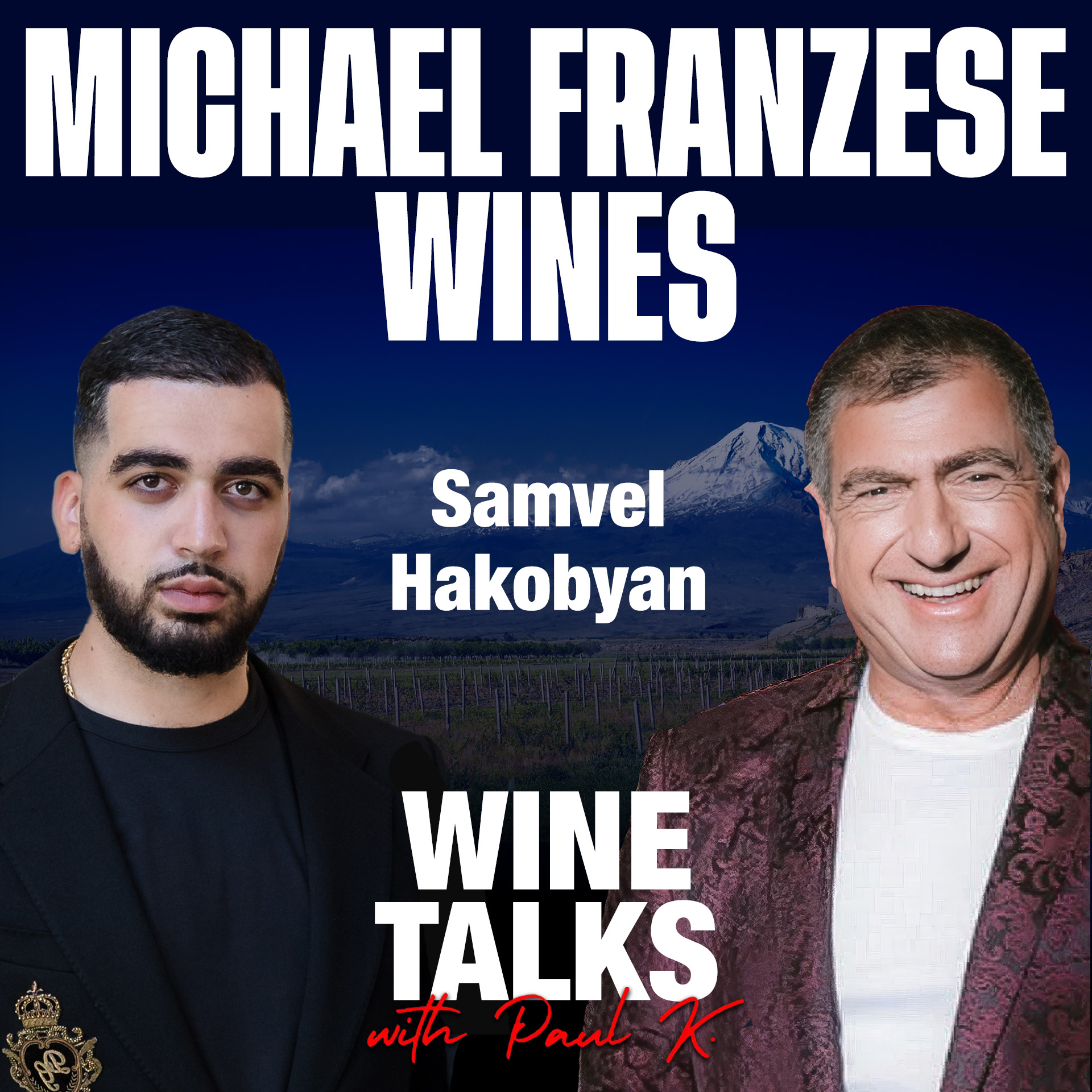
Wine branding is slow. It is different than other products; more rules, a limited set of consumers, and big brands standing in your way. These are the typical headwinds; unless your Samvel Hakobyan.
I am convinced, despite the current tone of nah sayers and industry pundits looking for some kind of magic bullet to ease the woes of the trade, that proper and tested principles of business are more important now than ever—Persistance, perseverance, and passion; if you do not have these principles in your quiver, you are done. Where do these principals come from? are you born with them? Can you learn them? Can you read them in a book?
The answer to these questions lies in this podcast with Samvel Hakobyan.
I have to tell you, hosting Samvel Hakobyan on Wine Talks was one of those moments that reminded me why I’m addicted to these stories—especially when they connect so many worlds you wouldn’t expect. But today, I want to linger on the Michael Franzese thread, because that’s where grit, fate, and transformation collided like a flash in the cellar.
Let’s set the scene: Samvel, a young Armenian immigrant whose family had just clawed its way out of a bankrupt pizza shop in Sacramento, grows up idolizing one of the mob’s most notorious figures—Michael Franzese. Not for the notoriety, mind you, but because Franzese’s story is one of transformation. Here’s a man who was the biggest earner in the mob after Capone, who finds God in a prison cell, and emerges not just clean, but on fire with a completely different purpose.
So, how does a nineteen-year-old kid in California, hustling in door-to-door roofing, go from being a fan to actually sitting across the table from Michael Franzese? It’s pure Armenian inspiration. Samvel told this story with the kind of detail that gives you goosebumps: Challenges at every step, flights canceled, Uber rides missed, and yet, by sheer persistence, Samvel finds himself pulled up to a hotel in Texas at the exact moment Franzese steps out to get into the very Uber they just exited. I mean, come on—if you wrote it, nobody would believe it!
What kind of young man sidles up to a former mob boss and asks for his phone number? Only one who expects more out of himself and the world around him. And Michael, ever the seasoned reader of people, tells him, “If you have the guts to ask, I’ll give it to you.” There’s a lesson in that right there: Opportunity doesn’t knock; you do.
Fast-forward through a winding road—Samvel helping his family, digging out of debt, building a marketing agency, and yet never dropping that thread with Michael. When the time came to link Michael’s story with Armenian wine, Samvel saw it instantly: Combine a narrative of personal transformation with the oldest wine culture in the world. Who better to front a wine about rebirth, legacy, and endurance than a man who lived the mob life and now stands in the pulpit? Michael wasn’t just a celebrity face. He became a real partner—a man who insisted the wines were as good as his redemption story, who put his thumbprint on the bottle and packed the aisles at Costco in person, shaking hands and turning heads on social media.
When Samvel talked about getting Michael to speak at his events, launching wine, and explaining to skeptical Armenians why an Italian-American’s name is on the label, I saw something much deeper: the courage to look outside your own comfort zone, to make new friends, and to tell a bigger, bolder story. Samvel’s partnership with Michael Franzese is not just branding—it’s building a bridge, and showing that the best of Armenia’s wine tradition is strong enough to carry a narrative of transformation all the way to American shelves.
What I took away from Samvel, and from Michael’s improbable turn from mobster to mentor, is that you can’t underestimate the power of reinvention—or of simply reaching out in the moment the universe opens the door. These are the stories that get passed along a hundred tables, over a hundred bottles, making us all believe just a bit more in second chances—and in the boldness it takes to ask for them.
Cheers to that.
YouTube: https://youtu.be/QaLEcGd-gC8
#WineTalks #ArmenianWine #MichaelFranzese #Entrepreneurship #ImmigrantStories #WineMarketing #Resilience #ChristianFaith #ArmenianHeritage #Transformation #BusinessStorytelling #PapaJohns #Salesmanship #SocialMediaMarketing #WineIndustry #Kroger #OvercomingAdversity #BrandBuilding #AncientVineyards #FamilyLegacy
0:00 The most inspiring, amazing conversation I've had in a long time just occurred with Samvel Hakopian. The story of his immigration to America and how he connected with Michael Franzese, the famed mob boss turned Christian in jail. And now bring in a huge brand of wine. Incredible conversation. You will be stumped, stupefied and amazed. Cheers. Sit back and grab a glass. It's Wine talks with Paul K. Hey, welcome to Wine talks with Paul K. And I am in studio today. But to have a conversation with Samvel Jacalpiano from Michael Franzes wines introductions in just a minute. Hey, have a, have a watch or listen to a great podcast I did completely off subject in Paris, Texas, because I got the interview the grand champion of one of the major barbecue, barbecue blowouts they call them in Paris, Texas. And we had a great conversation with him, the president of the chamber of commerce and the woman who organizes countrywide these barbecues. And by the way, there is such thing as a beef hangover, but not while we're here. Here to have a conversation with Samvel Jacopian.
1:14 Welcome to the show. Thank you. We've been working hard at doing, trying to do this. Yes, you've been amazing, but you know, that's the way it is in Hollywood, right? So you gotta persistent. In fact, I had a conversation last week with David Zucker, the guy that wrote Naked Gun and all those famous slapstick comedies, and he's, he's trying to sell a movie now that back to the same kind of humor that he wrote back in the 70s. And he said, look, you just can't give up, you know, you just can't give up on life, on anything really. And in particular in Hollywood when it comes to media. But tell me about, tell me about Michael and I, and I always say it wrong. Franzess. Franzes. Michael Francis. Francis. See, there you go. Tell me about, tell me about his relationship with you and how the whole idea of Michael Francis Wines came about.
2:06 Well, there's, it's. It's a very long story, but I'll try to keep it as brief as possible. So I was a very big fan of Mr. Michael growing up and I always had a dream of one day meeting him. So my family, quick backstory. When we first migrated from Armenia, my dad was a delivery driver at Papa John's and mom was a cashier at Walmart. So we had modest upbringings and the store went bankrupt. And my dad decided to say, hey, you know what? We're going to take over the store. Well, they're not Qualified. We don't have the finances. And they don't even speak English. Right. They just came in and went straight into work where speaking wasn't necessarily required. And they get tickets and fly out to Kentucky. And in Kentucky, they run into Papa John's. They go to the corporate office thinking, this is how you go through. And in there, Jon Schnatter sees them and says, hey, you guys have to fill out a franchise application. You gotta have a million dollars in that word, et cetera, et cetera. Wow. They didn't meet any of the standards. But he looks at them and he says, you know what? I have a feeling you guys are gonna do a good job. I just wanna know who's gonna run the store. Cause you don't speak English, and that's gonna be needed. And with the translator, my dad says, our son. And John says, okay, no problem. We'll give you guys a shot. Because the store went bankrupt and it closed down. And they end up giving them the shot. And we end up taking over the store. And within a couple years, it becomes the number one store in Northern California. I dropped out of high school at the time to come in and help run it and fell in love with the world of business. And I had a dream of one day meeting Mr. Michael. And all of this comes back into his circles. That's why I'm sharing it. So. So
3:38 fast forward my family. My dad brings friends and family to help support get life started in America. They backstabbed, take money away from us, and now we're half a million dollars in debt. And we went from running a very successful store to opening more businesses to now a collapse. And I decided, you know what? I'm going to help my family out of this situation. So I went and got a door to door sales job at a new open construction company by my friend Bozkin. And so April, I started. I'm 19 years old. I have no experience in sales, no experience in construction. I just ran a successful store, knew how to manage people. And I said, vas, Michael Francis is going to be a guest speaker at this event in Texas.
4:18 What do I need to do for you to buy tickets? So I could go and I could just hear him speak. And he says, well, Sam, it's your first month. I don't know, that's probably a little too ambitious. I said, no, I want to meet this man. He said, okay, if you could do $100,000 in sales. This is, mind you, this is door to door, knocking on doors, trying to sell people roofs and I'm 19, right? I didn't have this much gray hair at the time, so they didn't take me seriously. But we end up with it. And he says, okay, if you do 100,000, I'll buy it. Well, praise God. April 14, I did 138,000 in sales. And he said, I'm going to buy two tickets, one for you, one for me. We'll go together. So we go to the airport and the flight out of Sacramento gets canceled. Then there's another flight and that gets canceled. And I'm like, vaz, I've been excited waiting for this. Let me drive and let's fly out of San Francisco.
5:03 He said, okay. So we drive to San Francisco, we miss the flight, and then on the next flight, it's a red eye flight, we end up taking it. So we end up taking a midnight flight from San Francisco to Texas. So Mr. Paul, as we're pulling in, as our Uber's dropping this off, Mr. Michael stepping out of the hotel to get into that same Uber. So that split second, and I immediately go up to him and I say, hey, could I have your phone number? You're Michael Francis. Oh, my God, it's been a dream to meet you since I was a kid. I love your story of transformation, how you found God. You were in the mop. Could I get your phone number? He looks at me, he's like, how old are you? I'm like 19. And you're asking for my phone number? I said, yes. He's like, well, if you're bold enough to ask it, I'll give it to you. At the time, I didn't understand what it means, and he gave it. Fast forward a year later. I do well in sales. I get recruit marketing, I start a marketing agency. Because other roofing companies reached out to me. And I decided to. When Covid happens and then the war in Armenia happens, I decided to reach out to Michael Francis. I had done well with the marketing agency, built it successfully, and I reached out to him And I said, Mr. Michael, I would love to meet with you. And he responded back. He gave me 30 minute lunch. It ended off being three and a half hours together. And during that time, he was getting into the pizza business.
6:21 So I said, look, I have great relationships with the president of Papa John's. I would love to introduce you to him and he could help you guys expand your operation. And he said, sam, if you make that happen, it would be great. So I made the introduction, I flew in again. I was there in person when they Met. I helped organize the whole thing. And he looked at me and he said, sam, just know that today you made a new friend. I'm no longer just Mr. Michael, too, but now we're friends because you did something that's helping us grow. And I like you. All that stuff. So when the war in Armenia happened, I said, hey, I gotta help Armenia. And we can no longer, as a group of people, we can't just be victims of what happened in 1915 with April 24th. We gotta look at the genocide. What have we created? If we're just out there with posters yelling for help all day and not showing people why they should help us, we're not gonna get any help. And the example I bring up is if you have a homeless man asking for 100 bucks, nobody's going to give it. You have Bruce Wayne, I mean, from Christian Bale, or you have Donald Trump or whoever it is calls an ask, you're immediately going to give it. Why? The ask is the same. It's one's doing something and the other is not. So we have to show the world what we've done as people. And since we invented winemaking, I decided to bring Armenian wine to the United States on a national scale and let people know what this group of people are, how we are inventors, how we are creators, and how we've been able to last through time. And I realized it would be hard to bring an Armenian product to the US Unless I had a leverage
7:52 point. And that's where I called Mr. Michael, and I said, Mr. Michael, you have a story of transformation. You're a man that went from becoming, you know, the biggest moneymaker in the mob after Al Capone, to finding God and changing your life. Let's put the two together. A store of transformation with wine from the world's first vineyards and bring something new to the market in a way that could be innovative and disruptive. And that's where we started. Man. There are so many lessons that you just explained it. And I could just say the podcast is over now because there were so many interesting tangents in there that we know that. I think we just had a mouthful. Wow, that is an amazing story. And, you know, one of the lessons that just came out of that, and there's many. And this is not enough for one podcast, frankly, is the. The Armenian entrepreneurial spirit and the ability to. To recognize opportunity. And, you know, you came from a part of Armenia which is, you know, just post Soviet. You know, there's a lot of fraud and a lot of Problems, you know, particularly in Armenia right after freedom. But that's not your family story. Your family story is like my, like the story of my grandparents coming to America and starting the carpet store in Hollywood and becoming president of Rotary and these, this recognition of, of the freedom and the opportunities in front of you. It's an amazing thing. When you came here, how old were you? I was 6 years old when we came to the US and you had. Learned English there,
9:24 or at least studied it there? No, I learned here. I learned here. Yeah. I didn't know English when I went to school. First grade. And your parents left, what year was that? 2006. Oh, so. Well, you know, and I visited in 2007, the first time. So you. About that time was, you know, it's been a few years since freedom, but there's still a lot of corruption. The government was still bad. I mean, it's not necessarily all that great right now, but it's better. There's. People aren't having heart attacks because they started businesses in Yerevan that are. That are being taken advantage of. But what was that impetus? Why did they do this? They. They did it so because they were afraid that I would get drafted into the army. And we're very. We're a very Christian family and very spiritual, and they just had the feeling that there's going to be war when Sam's 18, 19, 20, he's going to be drafted in and we're going to lose our son. And I was the reason. My dad had a store. He had a nice convenience store in Armenia. He was an entrepreneur always. But they left everything and moved here just to make sure that doesn't happen to me. And little do you know, that's exactly what happens with the war in 2020 and a lot of classmates.
10:37 I had a lot of people that I knew when and didn't come back. And that's a. That could be. It's not a political show. We could easily make it one really quickly when it comes to that story, but we won't at this moment. But yes, you know, let's delve into the first Christian nation for a second, because I think this is important and I. Some of the Armenians use that as sort of the feature. One of the features of the Armenian race is that we are the first Nation and what, 400 AD to adopt Christianity and as the nation. But most of it seems to be we're not Muslim, not that we are strong Christians, but we're not Muslims, so that makes us Christians. And. But I get from you a Very strong sense of the belief. A believer as well.
11:24 My, my son in law, we just got back from Texas. He's an Anglican priest in Texas. My other son in law graduated from seminary with a master's in divinity. Congratulations. Very strong as well. And I, and I sense that from you. Anyway, how did that, how did that become that in your family household in a country like Armenia? You know, my grandma was the one that brought it. She, she was running a furniture store and one of the people that Brother Pavel, who's very well known in Armenia in the Christian community, brought the faith over a preach to her and she accepted. And so I had the fortune of growing up in a Christian family. And I also, as I got older, I accepted it fully upon myself as well. Because if you look at what the biblical teachings are, and we won't make this into, you know, religious episode, but if you, if, when I look at the teachings, it's all teachings that if you live by you live love others, do unto others that you wish done upon to you. And I've just only seen the benefit of it and have felt it and wanted to continue that.
12:24 But it's been our family story and it's something that we actually take a lot of pride in. Armenia being the first Christian nation because we've seen how much influence Christianity's had. And at the time when Armenia accepted it, it was a very powerful country. I mean, this is 300 A.D. where a lot, I mean, we're a lot larger than what we were today. And it's had a big influence in the spread of it. And, you know, it's definitely something to look at. We were pioneers in. Do you think that. See if I can articulate this the way I want to say it in that as Armenians, we like to talk about the things that we brought to the world, but we say it as a matter of fact, instead of showing it.
13:05 And I think what you're doing is showing it through this, this project and we'll talk about in a second. But your parents come here without, without any understanding of what they're going to do, how they're going to get there. I don't know. You know, there's lots of many stories of immigrants coming to America with $25 sewn in their shoe and that kind of thing, but don't speak the language. Land in Fresno or Sacramento. Sacramento. And is there some kind of. And my father was the same. My father, if he came from Cairo, he didn't have much money. He came here, got his master's in Pharmacology and just started opening pharmacies. You know, this is, this is what we're born into. And I'm trying to figure out if there's a national trait or an indigenous trait. This, this ability to absorb risk, to take on risk without hesitation and to understand, try. Actually maybe not understand the ramifications.
13:58 Just do it, Paul. You know what's interesting? So I have. There's a theory that I have and I. Sometimes I get in trouble for it, but I'll share it, is there's very few real Armenians left because of what we witnessed in the genocide. And there was three types of Armenians that survived in the genocide. Those that saw what was coming and fled. Those that stayed and fought and survived. And those that betrayed, they betrayed Christianity. They betrayed their people. So in our land, there's only two types that are left. The ones that fled came out and created the diaspora. And we've seen amazing success from the diaspora of Armenians. There's a lot of real Armenians there. But the ones that left were those that stayed and fought who were traumatized, right, because of everything they saw. I mean, you can't be the same person after witnessing that and fighting for your life against those with guns, with shovels and sticks, and those that betrayed. And so those are the breeds. And those that stayed and fought every generation are the same ones that go out and fight and get less and less and less. But those that betray that betrayal, blood and those that were mixed in with the, with the Turks has also expanded. So there's very few real Armenians left.
15:10 But when we look at our history, whether it was during Alexander the Great's time, he never conquered Armenia, he conquered the known world. But when he came and it was Afghanistan and Armenia, he liked the people of Afghanistan because they were beautiful looking. I didn't want to mess with them. And he respected the Armenians. Depending on which historical context you take is because we were creators. And he realized that, hey, I could use these people to build amazing things. I don't need to destroy them. Then we look at Genghis Khan. When he came, Armenians had made a deal with his father and he respected. And when his father asked Armenians because they did a favor for him, there's a whole history. All they said is like, look, we see what you guys are doing. When you decide to take over, just don't hurt us. And the father signed and gave them a letter. So when Genghis Khan kain, he appreciated that, collected money from Armenians and left. So there's a reason why we have been able to survive. We really haven't had enemies. We've been able to get along well with others. And so the real Armenians that still have those traits that haven't been messed up by all the events that have happened are just some of the most unique people out there that's. That's left because we know how to negotiate. We have the survival. We're willing to take risk. And we also love helping people. I mean, anyone that speaks about Armenia speaks about. Man, you guys are so welcoming. You always put great food. We feel like family with you. And that's just who we are as people. I think that's DNA for sure. It's.
16:31 I grew up in Southern California in Armenian household. You know, my dad spoke five languages. They spoke mostly Turkish in the house because my mom spoke Turkish. But it's always funny when you. Particularly in the American world, which I respect the American culture greatly because of what they've done. Absolutely. But when you meet somebody that does it, oh, you're Ian, you're Armenian, and they go and they talk about all the great friends they've had in their life that, yes, when you talk about a new year coming in, old anxiety and old acquaintance be forgot. It brings back these people that were in their lives, that were their neighbor or their across the street or the guy that owned the market down the street was an Armenian guy. And they always have fond memories of those relationships. And I think that's a lot to do with the DNA.
17:16 And I think you're right. I'm interested to know why you get in trouble for saying those things, but we'll talk about that later. We do have this survivor's instinct, and I asked this question of Vahe Kashkeri in an interview, and I said, do you have no fear? I mean, I was earnestly like, don't you have any fear? He goes, let's just say I was bad at evaluating risk because. Because we are an emotional group and we are, you know, we have a. We have vision and we. We have vision of the future. Like, we know that if we pay the dues now and we work hard, we can reap those benefits. But we're always looking out. And.
18:01 But one thing that you said that was really interesting, salesmanship is. Can be learned. You can learn the mechanics of salesmanship. I went to Xerox sales school for two weeks, twice or three times, and eight hours a day of sales training. But not everybody comes out with the same skill sets or the same determination or the same hard work ethic. And that's what salesmanship is. And I try to explain this to a young Armenian woman who's now in Napa selling for. For a major winery there. I said, it's the metrics are going to prove themselves out as you needed to make $138,000 or $100,000 to go to Savannah. But that's not that come part. Most of that comes from your. Once you learn the metrics and the. In the. And the mechanics of salesmanship, the perseverance and the personality and the DNA takes over, does it not? Yes. And you were out shaking the tree because you had an objective, because you wanted to go Michael Francis, which is amazing. How did you hear about him and what was it about his story that was so intriguing?
19:06 I was 10 years old when my grandfather, my mom's father, brought in a dvd, which was a translation in Armenian of his testimony he was giving at a church in San Diego. And at the time there was. You've probably heard of it. Vodogite had come out, which was an Armenian TV series about, you know, it was like a mob style. So I fell in love with the genre of mob. But I was also a strong Christian, so I got a chance to have both best of both worlds and just a transformation as someone who achieved wealth and power at a very young age. And it was a goal that I had of, you know, achieving, getting to a certain point by a certain age at a. Seeing my family go through the struggles they did. So it was an inspiring story for me. Well, but I guess as a young child, the mob, you know, that whole thing is kind of cool. Even though you're a strong Christian, there's still a certain amount of humanity to. To what he did do and now what he's doing. And how long do you spend in jail? So he spent. He served a total of eight years where three years was in solitary confinement. Really? Yes. Is that where he found God? That's where he found God. And the crazy story is.
20:18 And one day when we get him on, he could share it, too. But a guard dropped off the Bible in his cell, and there was a day where he just wanted to take, you know, just for a moment, he had the thought of it's. It's worth ending it all. And a guard drops off the Bible that day in his cell. And he had fell in love with a woman and. And the mother of that woman, who's now his wife for 40 years before he was taken away, said, michael, I'm going to be praying for you. And one day I see you speaking to thousands of people about God. And at the time, I mean, he's making 500 million a year cash in his account. He's like, yeah, yeah, whatever. But he really says it. He's like, it was that woman's prayers that made that guard drop off the Bible that day. And he never saw that guard again.
21:03 Really? And he never saw that guard again. Like an angel. Yes. And that moment changed his life. Wow, that's phenomenal. He got out. Did he start preaching? Did he start Bible study? Did he start a church? So he was actually recruited by NFL, NBA, MLB to go. And at the time when he was sentenced, FBI came to him and said, look, you're not. You're not getting into a deal with this. You're not putting anybody out there. Because he never cooperated. He never put anybody in prison, and he never cooperated with the government. They said, there's something else we want to offer you. There's gambling problem. And if you could go and speak to all of these professional sports teams and colleges about the dangers of gambling and how the mob uses gambling, too, because athletes are very competitive, so they're a great target for people that want to, you know, bookmaking and all that stuff. So they made a deal with him to go out and speak to colleges, and he's spoken with every professional team, NBA, NFL, mlb. And that's where his career started.
22:06 Speaking. And then one of the pastors reached out and said, hey, you have an amazing testimony. We heard you. One of the athletes heard you shared it with us. And. And that's where I took off. He became a public speaker across. Across the country. He's done over 3,000 speaking engagements. And in the United States, no 3,000 churches, not including all the professional teams. I mean, when we launched Francis Wine, one of the first customers we had was Bill Belichick from Patriots. Wow. And he was a. He was a fan of him. And I'm like, is that. Is that really him? And I look at the domain@patriots.com. Yeah. And so, yeah, there's girlfriend, right? His. Lot of news about him and his girlfriend. Oh, yeah, that's. And then interesting about him getting speaking jobs once he got out of jail would be. You know, that's a huge issue right now. They just exposed that major gambling ring. And not only that, it was a fraudulent gambling ring amongst professional athletes. So that's the timing of that, is when that. When. When that came out.
23:04 Mr. Paul, we had about every news media reached out to us. Like, when that news break broke out, we Did a video on YouTube. It got I think close to 1.5 million views. Like Fox, CNN, all of them reached out to us to cover it. And, and he became, you know, it helped grow the brand even further because it brought more publicity. That's phenomenal. So you, you become friends, you told the story about how you met him. Talk about it. Angel of, you know, coming down and plucking you in front of an Uber driver to the, to your, your idol growing up and then of course producing what it's produced. But I like this idea that, and I'm on the market side of wine. I've been doing it all my life. You know, it seems to be all my life now. And I spent all this time in my dad's shop in the 70s. So this is ingrained in my DNA is the wine business. It's very tough.
24:00 And I'm helping a lot of wineries in Armenia right now try to understand what to do here. And it's tough. I mean, it's a really tough racket. And your idea to have some kind of leverage, some kind of hook that would, would bring Armenian wine to the forefront of the wine public, which is very difficult to do in any business, let alone wine, but because alcohol, but salad dressing and toothpaste, all the rest of it just same thing. Was there a winery in Armenia already? Was this your family's winery? How did we stumble across bringing a brand to America from Armenia? Well, my, the fortune I had is I was, I came from a marketing background. That's what I, I was self taught in marketing and ran a marketing agency with a great partner. So when the war happened and I wanted to bring something from Armenia to the United States and I, in my research, I found that winemaking originated from Armenia. I'm like, holy smokes. Like, that's a, that's a huge competitive advantage. Something to really speak on. And then when I told my dad, I said, dad, look, you know, and personally, you know, I, I wasn't big into wine or I wasn't a wine connoisseur myself going into it. It was more of a vision of bringing the world's first wine, bringing ancient world wine to the new world. And I shared that with my dad and he said, hey, your uncle actually owns a winery? His cousin. Wow. My father's cousin. And they grew up together. My grandpa raised them and I said, great, let's get on a call with him. And he's been in the business for 25 and now it's 30 years. But at the time it was 25 years.
25:29 And he said, if we see sent out some samples, Mr. Michael sampled it, we picked the ones that he really, really liked and that's what we went forward with. So. But the winery at that time, let's just go back to 2006 when you left and I was there in 2007. This stuff generally was undrinkable. Okay. We fast forward a lot of years and, and what's been amazing about the Armenian wine industry is how fast they've been able to bring the wines to a competitive nature in the wine world, at least from a character standpoint. What's in the bottle. But, you know, in oddity, you're down. I mean, we were down there. I stopped at one of the roadside kiosks and I tasted the wine the woman made. It's actually, it's actually pretty decent. I mean, you could actually drink this stuff. I thought it was gonna be off the charts. 2006, 2007, undrinkable stuff. So the wines that were being made by your uncle at that moment, and this is 2000, approximately what, 15. When one of this, when we started. This, it was 2000. So we launched the brand 2022. We got incorporated. 2023 was our first year of business. So they've. They had a chance and they obviously have updated the winery, come to modern techniques, creating wines of character. Tell me what you think about Odiny as a grape and the. On the worldwide as a marketeer. Tell me about Odiny as a grape. What you see.
26:57 Audeny is a. Is a fantastic. It's very approachable and it's a great wine to introduce people who just want to get started in the wine. And Mr. Paul, as you know, what makes Armenian winemaking special is, you know, a lot of the wineries don't add sulfites to the wine. We have. We have rich oxygen in our soil. With the black soil, we have nine months of sun, high elevation. So Armenian wines are very, very approachable. And one of the comments we always get, because we do a lot of samples, a lot of demos, one of the comments we get is, man, this is dangerous. It's dangerously good, it's easy to drink, it goes down. And to your point about increasing the wine quality in Armenia, one of the things we had is Russia has spoiled us. Right? Because I mean, and not to make any national claims, but a lot of the Russians would drink whatever alcohol it's there. They just love alcohol and there nobody could out drink the Russians. I mean, they won World War II and that's documented because of alcohol. So our producers were used to just making wine, whatever it was, and exporting it out to Russia. And Russians will buy it. And as long as it was chip cheap and it. And it gave them the effect of alcohol, then they would buy it. What happened is as Russia's market started to slow down, they had to realize that, hey, we can't just depend on Russia buying our wine. And that's sort of the time where we came in and Europe had a higher standard. And what I'm proud of our people is they actually really innovated and they started meeting those standards so they could start exporting to Europe. They could start exporting to. To the United States. So I think opening up other markets forced them to
28:28 also increase the quality, not just focus on quantity. Where else they wouldn't be able to make it in other markets? Well, I. That part I know. You know, it's interesting. I had a conversation with a. With an Italian house and another Russian oligarch that decided to go to Tuscany and build this winery. Then there's. There's Voskavas. I mean, everybody knows the. They're. I think the Oeans have, you know, Russian distribution ties, and they took their money, brought it to Armenia outside of Yvonne to build a winery. So I think the, you know, the Russians have relegated Armenia to brandy during this time. But in today's economy in America, with the congestion of wine, with the consumption dropping a bit, with the shelves being, you know, a shelf talker on every shelf in every market that, you know, you walk in there as a consumer, you're barraged by yellow tags. Bringing a grape that no one's heard of, oddity from a district that no one's ever heard of. You know, viad store, wherever you're coming from, and putting on the shelf as a marketeer, how has that been? And I'm so impressed with what you guys have done so far. But how.
29:41 What kind of headwinds have you encountered and how did you overcome them? So I'll. I'll share a trade secret here. And it's. Hey, hold on a second. You know, we got. It's. Everything is about positioning. So when I met with Josh Schnatter, Papa Johns, he. He recommended I read a book, positioning. And everything is positioning. And if I went to market and I said, hey, and wine is also known for stories, right? People want to hear a great story with it. And when we came to market, I didn't even talk about Armenian wines. I mean, when we went to the presentations, when we Met with Kroger. That was the first chain we landed. All I spoke about was, this is wine from the world's first vineyards. So if I was to put up shelf talkers that say, hey, try aud any, and you have hints of cherry and pepper and blah, blah, blah, I'm not standing out from anyone else when I make a claim of saying, hey, after 6,200 years, taste what we have learned. It piques people's curiosity. So it's a matter of understanding psychology. And when we first came out, Mr. Paul, a lot of Armenians made fun of me and the Armenian market didn't accept us. I went to LA myself and I tried to ask help from others. Nobody brought us on. Like, we have not even tapped into the Armenian market yet. When we first launched, they said, why would you put an Italian's name on an Armenian wine? Well, if that Italian has 2 million followers and has an amazing story, and we should be proud that an Italian is putting their name on an Armenian
31:12 bottle of wine. When I went to a room full of Italians in New Jersey that showed up for one of the events we were doing, I had to get up and explain to them why an Italian put their name on an Armenian bottle. Yeah, that's the opposite. It's supposed to be the opposite. So a lot of branding and marketing and just removing. And the thing is, wine industry is filled with a lot of passionate people about their product, and therefore there's a lot of bias that hinders them from growing and marketing. They all think inside out, right? They're like, hey, here's what I know and let me communicate that out. Where we should think is outside in what are the people thinking, what are the people desiring? And how do we bring that inside and leverage what's already existing to communicate. Communicate the desire that's in the exterior from the opportunities we have in the interior. So that's what we did. It's like, hey, the industry is dropping, but it's not dropping because people stopped consuming. It's because the industry just is used to the old way of doing things. They're used to just doing tastings, samplings, restaurants. We took the whole social media approach of this is where people spend a lot of their time. This is where they have to discover us. And that's what's going to lead them to go and make a purchase. You know, okay, they're going to stop you there, because that's really important stuff. And this is, you know, I spent, you know, the last years of my company, you know, I'VE said this before, but I sent 33 million emails in 2022 alone. Wow. And posted daily and wrote 300 pieces of content, took 300 images and you know,
32:44 the whole thing. And we did that prolifically because if you think about it, and maybe you're too young for the TV show Bewitched, but in Bewitched, you know, the Larry Tate owned this PR agenc, they did a, you know, an easel presentation of the next pitch and then of course, the, the client approves that. And it takes weeks, if not months to get that message into a newspaper, magazine or on tv. Right. But today you and I could start that in a few minutes. We could start a campaign on something. Barrier sanctuary has lowered. We can see if it works and change directions in two hours if we wanted to. But that's. And so that's really important part. That's where people are hanging out. But do you think the Armenian. This is gonna be tongue in cheek question, you know, because both dying hard, Armenian DNA. But do you think the Armenian pride is part of what gets in the way of this idea of letting an Italian on my label as well as not growing Chardonnay, Cabernet, Merlot and the rest?
33:44 Yes, I agree with you. And if you look at the problem amongst everything about our culture and our people and all like the one big flaw in our DNA is that pride. And it's. And we don't understand how to use it properly. And it creates, and we're, and it creates a very closed loop where we're not open to taking in. But I think, Mr. Paul, with what you're doing and why I'm a big fan of yours and I applaud you is I also think a lot of it is a lack of education. They don't know the benefits. They don't understand. If you were to go and tell any Armenian winemaker, hey, we could 10x your sales by doing this and actually show them evidence and give them a guarantee they will do whatever you tell them.
34:26 But because they, they only know what they know and they don't know what they don't know. And that's what creates a big thing. And because of the success of Francis Wine, we have a lot of wineries we're working with in Armenia now and everyone wants to work with us. I get reached out every single day by new wineries giving me the best deal. I mean, we, we've imported over this this year. We've done over 20 containers of just auditing in the U.S. wow. Not, not including the other one. So. And we're growing that and I think we're going to drive this revolution. And what, what my goal is is eventually is to become that bridge that could help Armenian made products get into United States and leverage our network of retail relationships. Walmart, Costco, Albertsons, Kroger, all of these relationships to bring in really good quality products in a way that the product is going to move off the shelf. So the packaging, the branding, all of that. So God willing, that's the goal of the. For the next five years after we have, you know, after we establish Francis, we have a couple more years to really reach the level of scale we have an opportunity to reaching. Let's talk about that for a second. Now we're into the marketing.
35:32 There's this whole movement now. I'm old school to a certain extent. I mean tonight at New Year's Eve I'm opening very fancy, probably a couple of bottles of first growth. Bordeaux is a celebration of, of a lot of things in our lives and just being alive and being able to do what we get to do and tell these stories. And so I'm so old school that way. But I don't think. And there's this whole movement of rethinking the wine trade and what you've done is rethought things, right? You look, like you said you're looking at the outside in trying to figure out what people are doing, where they're hanging out, what the messaging should be. And I think it's, I think that's just good marketing, whether it's wine or, or widgets. But what's in the bottle's got to be solid, right? You can't, you can't bamboozle the wine world. Here's what happened.
36:21 One of the reasons I sold the company in 2023 was because I was not getting the quality merchandise I used to get when I was in a different model. And the model was always to look in the corners of warehouses and wineries for the stuff that they forgot about, didn't know about as well as which was Trader Joe's model when they first started selling wine. But that's, that evolved into 50 cent a liter crap coming from Europe and being bottled on different brands, sold on, on YouTube and Groupon. You know, 12 bottles for 50 bucks free shipping and they're even making a few bucks on top of that. And I think the gov, I think the public just said, you know, this stuff isn't any good. And so they get one sale and they're done. There was no Loyalty. And so we can rethink the messaging all we want, which you've done, but you got to make sure that stuff in the bottle is representative. What you're telling them it represents. Well, if it doesn't, then you're a fraudster.
37:21 Right. If you, if you're, if the product itself isn't good and you're marketing it as good, that's fraud. It's not. Not business. Yeah. So we're, we're, we're taking into assumption that you're bringing in a great product and you're looking at, okay, now how do we make people. And to your point, Mr. Paul, it's across every industry we have this issue. I mean, we saw it happen in 2008 in the United States. Greed always gets in. And that's why you have recessions and why recessions are very healthy, because they filter it out. It. It becomes a reset system. And so that's what the industry is going through right now. And it's going to be a matter of, hey, are we going to be able to adapt? Are we going to be able to meet the customer where the customer is the consumer? Are we going to continue doing things the old way? And that's why, I mean, look, the industry's down, but you look at what Josh is doing, right? Billions of dollars in sales is why. Because they understand the customer.
38:13 They understand the consumer psychology and the consumer behavior. They're meeting the customer where the customer is. They're not expecting the customer to come and meet them where they are. That has changed. That world has evolved. It's the category shift that's happening across all industries. And now it's come to the white space. And those that are able to adapt are going to be able to thrive and ride the next wave. And those that don't, aren't. But the product has to be good. If it's not and you're promoting it, that it's good, it's just simply fraud. That's a really good point. What it came down to me, for me, during all this and selling a lot of wine with, you know, the metrics were very important. You follow the metrics and you can manipulate the metrics as best you can. Roas and all the rest of the things that you follow when you're trying to sell a bottle of wine, particularly on the web, but you, and you use those metrics to refine what your messaging is and what you're missing. But it had to be that somebody opened that bottle of wine and went, wow, you know, or they served the dinner with their friends and they said, wow, where did you get this? And that's how that message. You know, it's funny because social networking, I, I had to tell this marketeer that came into my office because the idea of social networking was the same as it always has been when they started doing. And that is one tells 10, tells 10, tells 10, tell 10. It has a hundred thousand people know the message, right? That's what it's all about. But that, that also happens in conversation at dinner time with friends over bottles. They shake a picture of the bottle,
39:44 they take a picture of the back label. What they do and they tell their friends. That's the same story, right? But they're not going to do that unless what's in the bottle is quality. In fact, there was an auction here in LA for an Armenian importer. Won't throw anybody under the bus, but they were selling brandy in collectible bottles, swords, animal figures, trucks, all kinds of stuff. And my son in law, who's a nodar, was excited because he was able to buy these things for a dollar. And I said, look, if it's Armenian branding, it's VSOP in this five years and they're going bankrupt.
40:28 It's not because the stuff was too good, right. And, and I haven't had a chance to taste it. I'm convinced that it's going to be what you're talking about. It's going to be that sort of fraudulent. Not fraudulent. I won't, I won't accuse the person of fraud, but putting in lousy distilled spirits into a creative container and trying to pawn it off as something interesting though he's done very well with it on Facebook, Marketplace. After he bought it, he paid a dollar for these things anyway, so let me, let's have some fun. I have people sending me youtubes of Michael in Costco. You know, stopping people in the aisles and grabbing a bottle and telling the story.
41:15 Was that your idea? And two, the response seems like it's incredible. Yeah, we did it. We were actually together, we did it at Costco. I mean we've, we've done all of them together in Costco. When we did it in Irvine, the store sold out. The video got a hundred thousand organic views. Wow. People were sharing it. And it's again, it's like the messaging. How sticky is it? What's the positioning of. And he's, he's done an incredible job with Mr. Michael. I mean the amount of work he's put in and the amount of support has Been incredible. It's become a full time job for both of us at this point. And for him, he was really big on the quality first. At first we brought in some SKUs that are no longer there with us. So when we spoke about quality, I want to give him credit on that too. He says, sam, if my name and my thumbprint is on, on this bottle, it better be dang good. And you know, yeah, so he's, he's played a big role. But yeah, social media, we manage the YouTube and everything. So our team is behind all the production. Every video you see, we touch it.
42:12 Let's talk about your copy for a little second. We're almost out of time, oddly. And again, why I said with this, probably not enough for one podcast. But you did you start the marketing firm prior to the wine thing because you had been so successful selling door to door roofing and then realized, you know, whatever inclination to marketing and salesmanship you gained on the street, you turned into an organization. Yes. And tell me about that process. I mean, like risk. So when I was, when I was 19 and doing well in sales, the suppliers, I was rewarded with salesman of the year, all that stuff. Praise God, for I was never really a good salesman. I just looked at how do I help people solve their problems. I was really good in math. My grandfather, my grandpa was, it's funny, when he was on his deathbed and I said, grandpa, is there a wish that you have that you never achieved? Because we did a lot of stuff for my grandpa. We loved him. He said, I wanted to be a math professor. That was the only dream that was left that wasn't achieved. I'm like, okay, no problem. That's not, I'm glad, I'm glad you're finishing off with that.
43:20 So I love Nat's personal problem solving. So I always looked at sales of how do I help the person solve a problem? And so when I was doing well in sales, other roofing companies reached out and said, sam, can you come and do sales consulting for us? And I made sure they weren't competitors to my friend's company. And as I went out and did it, I'm like, you guys don't have a sales problem. You have a marketing problem. You're calling people and telling them, hey, you'll get a free roof and a free solar. And you're going in there trying to grab 60, $80,000 off of someone living off Social Security security. You can't do that. So they said, well, how do we fix it? I said, you got to get better leads. Can you help us? And I said, sure. So I went, I googled, learned how to do marketing within three days, signed my first client that week. They paid 2, 500 bucks to start. And that's where the marketing started. Wow, that's great. Yeah. Talk about. That's Armenian. No fear of risk. I mean, just, you know what, we'll figure it out along the way. And I feel proud that I have some of that.
44:17 I got it from my father who came to America. The same story. This has been a really fun conversation, and I did. I was actually having trouble deciding which direction I wanted to take it because there's so many different tangents and so many interesting pieces of this. And we could have the conversation about Armenian religion, we could have the conversation about entrepreneurship, we have the conversation about wine and the conversation about social networking and marketing and social. We could have all these conversations at separate times. But I won't take any more time today. We've already gone 45 minutes plus. And I think it's been an opportunity for us to grow a little bit more on some of these subjects together. I think there's a lot of fun things in storytelling to communicate to the. To the world. That's.
45:02 That's what sets. That's what's going to set it all apart. Yes. And I see you have Mount Arad behind you, and I think I took that same picture when I was in Ottomany. That's headed down the highway right there, isn't it? Yes. Somebody. Somebody. I had to take it from the moving car and it still came out. Really cool. Yeah. Oughta add something special for all of us. Are you do. Are you due there in any recent. Any future time? I'm trying to set up an interview with. Right now with Patrick, but David and the Prime Minister. So if we do set that up, then it'll be my first visit. I haven't been to Armenia. I haven't been back since we left, so. Wow. Interesting. Okay.
45:47 So thank you so much for taking the time. I know it's been hard to get a hold of everybody and make it work, but this worked great and I really appreciate the time and I hope we can do it again. I really appreciate you, Mr. Paul. Thank you for what you're doing and for putting this together. Thank you.